Introduction
Discourses take place in many political, judicial and societal arenas within and beyond nation-states. They are alternatives to bargaining, voting or authoritative decision making and can foster consensus in pre- or post-agreement interactions.Footnote 1 Compared to pre- agreement interactions, post-agreement interactions are rarely in the center of attention, although discourses matter in these settings, too. Judicial discourses take frequently place in international courts, such as the European Court of Justice (ECJ), the Court of the Andean Community, the Court of the European Free Trade Association. International judicial discourses are good laboratories to analyse dynamics of arguing. The density of exchanged arguments is very high and judicial discourses are, in this sense, most likely settings for successful arguing. At the same time, effective arguing is very difficult before courts, since the parties have eminently strong interests, because they maintained non-compliance despite being detected and did not negotiate pre-judicial settlements. In this sense, non-complying states are not open to persuasion. Drawing on the example of the ECJ with its mixed record of effective judicial discourses, this article analyses the conditions under which judicial discourses promote compliance. This requires tackling the more general question: Under which conditions can discourses foster consensus and when do they fail? The key to the answer is that the quality of arguments matters. If actors share a common standard for the assessment of the goodness of exchanged arguments, they can filter unconvincing and bad from convincing and good points and thereby incrementally develop a consensus. If they don't have a common yardstick to evaluate the quality of claims, intersubjective validity cannot be achieved. Consequently, actors talk at cross-purposes although they exchange arguments and discourses end in dissent.
The argument proceeds in five steps. The next section introduces the EU infringement procedure, demonstrates that judicial discourses take place for all cases that reach the ECJ, and illustrates that not all judicial discourses succeed in quickly fostering compliance (II). Why is it that arguing takes place in all cases but is not always effective? The subsequent section develops a theoretical explanation (III). Unlike Habermasian arguing or social psychology approaches on persuasion,Footnote 2 this article inquires into the quality of arguments in order to explain the varying success of discourses. Not every argument is per se good and suited to convince others. Arguing is only effective if actors exchange arguments and share a yardstick based on which they can commonly evaluate the quality of claims. Under these restrictive scope conditions, participants of a discourse can equally sort good from unconvincing arguments and thereby incrementally develop a consensus. If the parties lack a common standard with which they can intersubjectively assess the goodness of exchanged ideas, they talk at cross-purposes and discourses end in dissent – even though we might observe pure arguing. As a consequence, persuasion fails and non-compliance prevails. The German drinking water case illustrates this theoretical claim (IV). Germany violated the European drinking water directive (DWD) though a legal transposition that restricted the applicatory scope of the DWD and granted de facto many exceptions. While this saved compliance costs, it hampered the effectiveness of EU law. The European Commission opened an infringement procedure and referred the case to ECJ. A judicial discourse started, but failed in the first stage, since the parties lacked a common standard on which the quality of exchanged arguments could be equally evaluated and talked at cross-purposes. Later on, the advocates used arguments to which they could mutually relate in a meaningful manner and the judicial discourse became effective. Non-compliance could no longer be defended with good arguments and the argumentatively entrapped government quickly adapted the German drinking water policy in line with a demanding water quality approach. Alternative constructivist arguing and persuasion approaches as well rationalist enforcement, bargaining and principle-agent theories cannot sufficiently account for these compliance dynamics (V). The article concludes with the finding that intersubjective validity of arguments is the key to successful discourses. This requires that arguments are exchanged, that actors share quality yardsticks, and that the type of arguments fits shared evaluative standards. Only than, participants can commonly sort unconvincing and bad from good and convincing claims and incrementally arrive at a consensus. For example, truth-claims require a shared scientific paradigm; normative arguments a shared idea on righteousness. If either common evaluative standards are lacking or do not fit the type of arguments, discourses fail because the actors cannot meaningfully relate to each other but argue at cross-purposes. Common lifeworlds are important for effective arguing,Footnote 3 since they inhibit shared reference standards for the evaluation of the quality of ideas. The presence of a European lifeworld is helpful, but not sufficient for effective arguing. Even in the EU, every discourse risks dissent, because a European lifeworld competes with domestic or party-political ones. Hence, if the meaning of a particular norm is contested, such as in the German drinking water case, a shared European lifeworld is too broad to decide which competing interpretation is superior. In such hard cases for effective arguing, judicial discourses offer an expedient: Judicial methods of interpretation serve as additional yardsticks to evaluate the quality of arguments. Yet, they only foster consensus, if actors exchange arguments and share methods of legal reasoning whose interpretational scope fit the interpretational scope of the problem at stake.
II. The puzzle
International cooperation generated a wide range of international law. Yet, violations occur and delimit its effectiveness.Footnote 4 In response, international institutions developed various compliance restoring systems that often encompass judicial adjudication.Footnote 5 Unlike domestic courts, international courts lack a legitimate monopoly of force as a last resource and are bound to talk states out of non-compliance. This holds also true for the EU, where member states are responsible for the legal and practical implementation of European law, but occasionally fail to do so.Footnote 6 If the European Commission detects non-compliance, it opens infringement proceedings (based on Art. 226 ECT).Footnote 7 In a first stage, the Commission seeks to solve the case in bilateral interactions.Footnote 8 If that fails, the Commission will refer it to the ECJ.
Judicial discourses start, once cases reach the Court, and end with either a withdrawal of the case or an ECJ judgment. Before the ECJ, the parties do not debate political aspects,Footnote 9 but European and national advocates engage in two-stage judicial discourses. The written stage deals with matters of fact and legal issues of how to understand the norms in question. A Judge-Rapporteur summarises the arguments in a confidential report to the ECJ. Than, the oral procedure starts, in which the advocates solely concentrate on how to interpret content and scope of disputed norms. After all judicial arguments are exchanged, the European Advocate General prepares a written opinion for the ECJ, who than decides the case by consensus.
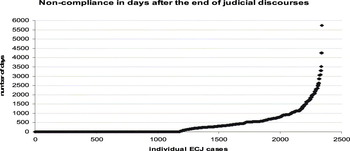
Delay of compliance after judicial discourses.Footnote 10

Judicial discourses induce the use of arguments and of judicial methods of interpretation, while bargaining is not deemed as appropriate.Footnote 11 Although judicial discourses take place in all ECJ cases, they only sometimes facilitate domestic adaptations and compliance ahead of ECJ judgments. If judicial discourses fail, states are not persuaded to give up their initial norm interpretations, do not initiate and possibly even complete policy changes before ECJ judgments, but tend to delay compliance for at least another and up to 15 years afterwards.Footnote 12 By contrast, if judicial discourses are effective, states rapidly comply either before ECJ rulings or quickly complete already ongoing legal changes within less than a year after judgments.
Figure one shows that approximately half of the cases are promptly solved once judicial discourses ended. Even if some quick settlements were instances of successful compliance bargaining between a state and the Commission in the shadow of the Court, the figure indicates that judicial discourses are neither always successful in facilitating compliance nor is it likely that they always fail. Why is judicial arguing sometimes successful?
III. Theoretical argument
How can we explain variation in the success of judicial discourses? Constructivist approaches content that states can be talked out of non-compliance interests in the course of judicial discourses, if arguing is effective. In order to conceptualise endogenous interests, scholars recurred to the Habermasian theory of communicative action.Footnote 13 Not the least because this approach generates either personally or institutionally fix hypotheses on persuasion and cannot explain much variation in the success of discourses, the research focus shifted from whether arguing takes place to the conditions under which arguing is successful. ‘Second generation’ arguing approaches draw on the Habermasian discourse theory to identify conditions under which arguments make a difference.Footnote 14 Public settings with broad access and transparency, high norm density and high institutionalisation foster effective arguing, because these variables approximate ideal discourse conditions, with a common life world or public opinion as a substitute thereof.Footnote 15 ECJ procedures are highly institutionalised and have hardly changed over time.Footnote 16 Hence, judicial discourses should foster effective arguing. By contrast, access and transparency are constantly low and do not further effective arguing: only the advocates of the parties participate, oral exchanges are not generally public and the Court deliberates in closed settings (ECJ rules of procedure Art. 56, 27). Not only do expectations deviate, the variables are also constant across ECJ cases and cannot sufficiently explain why only some judicial discourses are effective.
Another approach draws on social psychology.Footnote 17 In this perspective arguing fosters ideational change, if actors are cognitively open to become persuaded. This is more likely to be the case if they have few prior believes and attribute moral authority to other speakers, as well as if issues are new, environments are changing, the uncertainty is high due to policy failures, or if interactions are de-politicised and take place in an in camera setting.Footnote 18 Again, institutional and contextual variables that induce effective arguing in judicial discourses, such as the level of transparency or the moral authority of judges, are constant and cannot explain variation in the success of judicial discourses. By contrast, other variables indicate that judicial discourses should hardly succeed in talking states into compliance: States’ non-compliance interests are eminently strong since they did not opt for pre-judicial settlements, issues are not new and environments are unlikely to change rapidly during the discourse.
Under what conditions can consensual norm interpretations emerge from judicial discourses and when they are likely to end in dissent? State of the art approaches seem to have difficulties to explain why states are only sometimes talked into compliance. This section departs from these approaches regarding one essential element. The latter do not theorise that not every communicated argument is good, but can as well fail to be persuasive. The approach introduced here, by contrast, analyses the quality of arguments and claims that this is crucial for the varying effectiveness of discourses.
Judicial discourses accelerate argumentative speech acts. Yet, exchanging arguments is not sufficient to induce ideational changes, since not every argument is persuasive per se. Only good arguments can be convincing and possibly end norm violations. What characterises a good argument? Which ideas might change actors’ compliance interests? Simply put, the answer is that good arguments have to be intersubjectively valid. This requires that arguments are exchanged and that actors share a yardstick which allows them to equally assess the quality of arguments in a discourse. Truth, righteousness and appropriateness are three standards to intersubjectively evaluate the goodness of communicated ideas.Footnote 19 If actors share a common conception of how to assess the quality of truth, normative and value-based claims, they can commonly factor out good from less compelling factual, normative or value-based arguments, substitute old by better ideas, and incrementally arrive at a consensus. A truth paradigm encompasses ontological, epistemological and methodological elements. Exchanged causal or factual arguments are conducive to ideational change and consensus, if the actors adhere to the same scientific paradigm and share expertise on the subject matter.Footnote 20 Similarly, norm generating discourses can end in consensus, if actors share a standard of righteousness on which they measure how certain aims, procedures or scopes of norms express or hamper the fulfillment of their common interest. However, sharing a standard of righteousness does not help to solve questions of truth or vice versa. Common evaluative standards have to fit the type of arguments made. Unlike these discourses, judicial discourses deal with contested norms rather than truth claims or common interests.Footnote 21 Once norms are contested, a dilemma emerges: in order to argumentatively solve norm interpretation conflicts, it would be necessary that actors consent on which common interest is expressed by a norm’s aim, procedure or scope, while the very fact that a case has been carried to Court indicates that there is dissent. Nevertheless, the parties of norm interpretation disputes are not trapped in talking at cross-purposes. Judicial discourses offer an expedient: different judicial methods of interpretation allow specifying what norms are about and to which situations they should be applied. In this sense, judicial methods of reasoning serve as additional yardsticks to commonly measure the quality of arguments. They differ in their interpretational scope. The broadest scope has the historical method of judicial interpretation, which specifies scope and content of legal norms through references to the initial will of the norm-creators.Footnote 22 The teleological method is only slightly more specific, since it specifies the purpose and content of a norm though analysing the general aim of the broader legal context: What is the purpose of the treaties and how does it relate to the norm in question?Footnote 23 The directive-immanent teleological interpretational device is more specific than the general teleological means, since it specifies content and scope of a disputed issue (for example, is exception X acceptable?) by analysing the general aim of the norm at hand. The general systematic method is a bit more specific than the general teleological one. It inquires into the broader legal context in order to solve interpretational questions of a norm embedded in the context: Is there another legal norm that delimits or specifies the meaning of the norm in question? The directive-immanent systematic method of legal interpretation is suited to solve more detailed interpretational issues by analysing the paragraph or article in question in the context of the whole legal norm: Are new concepts introduced in other paragraphs that define or delimit the issue in question? Are there exceptions in other parts of the norm that impact scope and content of the interpretational issue at hand? The wording method aims at solving interpretational differences of great detail by analysing the exact phrasing of the paragraph in question: Are new concepts introduced? How are they defined? Are exceptions specified?
A shared standard of truth is not helpful in effectively solving conflicts over values or vice versa.Footnote 24 Similarly, not every judicial method of interpretation is suited to solve every interpretational problem. The interpretational scope of problems and judicial methods has to match; otherwise actors simply talk at cross-purposes. Some disputed issues are complex and characterised by imprecise, ill-defined concepts concerning aims, procedures and applicatory scopes, many cross-references, several relevant paragraphs or articles, and complex exceptional clauses. Other interpretational problems have narrow interpretational scopes: Contested issues are highly specific and characterised by relatively precise concepts, few and accurate cross-references and clear-cut exceptional rules. Judicial interpretational techniques also vary in their scope. Some are broad, capture norms comprehensively and are suited to solve complex issues (for example, historical or teleological methods), others are narrow, focus on detailed interpretational difficulties and are suited to solve issues of detail (systematic method) or of great detail (wording method). Successful judicial discourses that produce intersubjectively valid consensual outcomes require firstly that the parties exchange arguments, secondly that they share a judicial method and thirdly that the latter matches the interpretational scope of problem at stake.Footnote 25 If these conditions are met, the parties do not talk at cross-purposes but can relate to their arguments in a meaningful manner, can commonly sort good judicial arguments from less convincing ones, and can incrementally develop consensual norm definitions.
National advocates are in close contacts with the responsible ministries and disseminate judicial arguments.Footnote 26 If European and national advocates establish consensual norm definitions in the course of the one to two years of a written and oral judicial discourse, national advocates diffuse them together with the supporting arguments back into the ministries.Footnote 27 This fosters domestic persuasion processes. If ministries at a minimum accept the legal expertise of their own advocate, they learn that judicial experts consider a particular interpretation as superior and that their initial norm interpretation cannot be justified any longer by valid good arguments. Actors who accept that non-compliance cannot be argumentatively justified lack means to coherently and plausibly excuse norm violations vis-à-vis European enforcement authorities.Footnote 28 Argumentative entrapment changes the parameters for action: Continued non-compliance would either be irrational (violating new believes on which interpretations enforcement authorities might accept) or inappropriate (violating integrity, consistency or credibility norms) for affected states. Hence, successful judicial discourses facilitate swift policy changes that end norm violations. The hypothesis states:
Consensual norm interpretations leading to quick shifts into compliance are likely to be achieved in judicial discourses, if the parties do not argue at cross-purposes but share a judicial method fitting to the interpretational scope of the contested issue.
IV. Case study
This section analyses the incorrect transposition of the European Drinking Water Directive (DWD, 80/778) in Germany, which had been referred to the ECJ in 1990 (case 237/90). This single case study has in-case variation on the independent variable and, therefore, reflects a most similar systems design. At the same time, it keeps country-specific variables (for example, political or legal culture, political and administrative capacities) and policy-field characteristics (for example, domestic structure of interest organisation) constant.
The case
Drinking water is one of the most highly regulated aliments. Hence it comes at no surprise that the DWD defines more than 60 quality standards for drinking water. The European directive was mostly in line with the German public-health oriented water approach, but required additional and tougher environmental standards and allowed for fewer quality exceptions. This brought about severe domestic resistance of the German Federal Health Authority (Bundesgesundheitsamt, short: BGA) and drinking water providers who feared high expenditures and opposed the bureaucratic workload.Footnote 29 In this context, the Kohl-government did seek to minimise implementation costs and was reluctant to comply with the DWD.Footnote 30 Hence, the German transposition, the Drinking Water Regulation of 1986 (DWR), de facto allowed for departures from environmental quality standards and limited the applicatory scope of the DWD. The European Commission opened an infringement proceeding in 1987 (1987/0440) in response to this minimalist, cost-saving transposition. Non-compliance interests were very strong, in particular since it became clear after the German unification that the European drinking water quality standards cannot be easily met in the new Länder and would require immense investments.Footnote 31 Consequently, Germany insisted on its undemanding interpretation of the DWD and the European Commission referred the case to the ECJ in 1990.
In Court, the parties disputed, firstly, under which conditions states can grant exceptions from the DWD quality standards to water providers (for example, what are ‘states of emergencies’?).Footnote 32 Secondly, the parties discussed whether all quality departures have to be reported to the Commission (as a precondition for detecting implementation deficits). At the very beginning of the judicial discourse, Germany argued that deviations from the quality approach of the DWD can be justified as long as public-health standards are not juxtaposed and that there is no need to inform the European Commission from every single granted exception. The European advocate defended a broad scope of the DWD and argued for the opposite.Footnote 33 Even before the judicial discourse ended in 1992 with an ECJ judgment, Germany altered its legal acts for the first issue at stake according to a demanding norm interpretation. For the second issue, legal change was already underway but had not been completed two years after the ECJ referral. Hence, the case was not withdrawn although it was practically solved, and the ECJ issued a ruling. One month later, Germany quickly abolished non-compliance with the 1992 Drinking Water Provision (DWP).Footnote 34
Explaining compliance dynamics: the judicial discourse hypothesis
How can we explain that Germany shifted into compliance during the judicial discourse? The judicial discourse hypothesis expects effective arguing, if the parties share a judicial method of interpretation that matches the complexity of the interpretational problem. The following discussion focuses exclusively on the communicational requirements for quality derogations, because this issue took longer to be solved. It analyses the arguments exchanged in the written and oral stages of the judicial discourse and inquires whether rhetorical and policy changes were absent or took place.Footnote 35
The German Drinking Water Regulation (DWR) of 1986 was the initial transposition of the European DWD and did not prescribe the exchange of information between the central state and federal states. Consequently, the availability of comprehensive information on the drinking water quality and derogations thereof was not legally ensured. This constituted a window of opportunity for distributing low quality water behind the back of the European Commission. Hence, the latter repeatedly stressed that drinking water quality must be comprehensively documented. In order to ensure that water providers systematically and comprehensively collect water quality and quality derogation information and pass it on to the European Commission, the Commission urged Germany to legally regulate its domestic water quality monitoring system. By contrast, Germany regarded its decentralised quality reporting system as sufficient, although it did not systematically and comprehensively require reports on implementation data and de facto excluded permanent deviations from quality requirements. The advocates of both parties talked cross-purposes at the beginning of the judicial discourse, but shared a judicial method of interpretation matching the interpretational scope of the problem at stake later on.
Early in the judicial discourse Germany defended its transposition by using the highly specific wording method of interpretation.Footnote 36 The wording of the DWD demands a ‘wholesome communication’ of failed parameters (Article 9 I, Article 10 III DWD). However, this concept was not further specified in the remainder of the European directive. The DWD was also silent on whether the procedures ensuring wholesome communication had to be spelled out in a legal rule.Footnote 37 Based on the wording method of judicial interpretation, Germany argued that the DWD did not explicitly prescribe a national legal act on the collection of relevant information and the communication of derogations.Footnote 38 The central concept ‘wholesome communication procedures’ is vague and not defined in the DWD so that the interpretational scope of the issue at stake was very broad. The narrow wording instrument was ill-suited to tackle the high complexity of the contested element. In the turn of the early discourse, Germany also used the broader systematic technique and referred to a German legal institution. In putting the DWD into the context of ‘states’ loyalty towards the federation’, the German advocate argued that the Länder are practically obliged to report derogations to the central state, which renders a secondary law on communicational requirements irrelevant.Footnote 39
Based on the wording method, the European advocate could not dismiss the German argument that the text of the directive was silent on whether procedures for the collection of water quality information and water quality derogations should be legalised.Footnote 40 Yet, the wording of the DWD did not explicitly prescribe the German option and the European advocate did not conclude that the German transposition was in line with the directive. The European advocate did also not interpret the European directive and the German DWR in reference to the ‘loyalty towards the federation’-principle,Footnote 41 but regarded the latter as irrelevant to the caseFootnote 42 and as functionally inadequate.Footnote 43 Instead, the European advocate applied the broad directive-immanent teleological method.Footnote 44 According to this line of reasoning, communicational requirements had to be legally prescribed in order to ensure the effectiveness of the European drinking water approach, since the Commission could not fulfill its monitoring function otherwise.Footnote 45
In this stage of the judicial discourse, arguing was not effective and the advocates talked at cross-purposes. The text of the DWD lacked an explicit paragraph concerning whether or not states have to make legal rules to ensure complete reports on bad water quality. Since central concepts were vague, the interpretational scope of the problem was very high. Consequently, although both parties used the narrow wording method, they could not produce an intersubjectively valid interpretation. Instead of facilitating a single reading, the wording instrument of judicial interpretation allowed for two conclusions. Firstly, that the DWD did not require certain legally binding communicational mechanisms, so that the choice of how to achieve ‘wholesome communication’ was entirely up to the member states (German position). Secondly, that various monitoring and information mechanism can be used, but each of them has to ensure ‘wholesome communication’ which implicitly presumes a legal framework in order to ensure effective implementation and compliance (European Commission). The wording method did not allow deciding which of the competing interpretations is superior. While the broader directive-immanent teleological method and also the broader systematic one had much better fits with the complex problem and, in turn, might have provided a single interpretation, none of them was shared by both parties. Hence, in the first stage of the judicial discourse the parties argued at cross-purposes and dissent prevailed.
The hypothesis predicts that the early judicial discourse failed to produce an intersubjectively valid norm interpretation so that Germany became not argumentatively entrapped and did not shift into compliance. In line with this, the government continued saving compliance costs and prevented major investments in 1990 and 1991.Footnote 46 They opposed a demanding reporting system that comprehensively gathered all deviations form the drinking water quality – especially if derogations were long-lasting and, thus, severe problems.Footnote 47 Due to the aversion to increase transparency, in particular for environmental aspects, the government and the lead ministry (the health ministry) opposed a demanding proposal of the Social-Democratic opposition on the institutionalisation of communicational channels.Footnote 48 The draft included a reporting system to comprehensively collect and disseminate information on drinking water quality to the public, the central state and the European Commission.Footnote 49 The government neither highlighted the merits of the European DWD nor consented with the SPD that the German DWR only incompletely dealt with the communicational requirements.Footnote 50 Instead, they shifted the responsibility to local authorities, claiming that the latter were solely responsible for monitoring the water quality and derogations.Footnote 51 Hence, the health ministry had not been persuaded by legal arguments exchanged before the ECJ and did not believe that the German position can no longer be argumentatively defended. In line with the absence of ideational changes, the Germany did not shift into compliance. The government did not introduce a comprehensive quality monitoring system, although a legal change concerning the other issue at stake in Court (necessary conditions for granting exceptions and the role of ‘states of emergencies’)Footnote 52 would have provided a window of opportunity to do so without much additional work. The Drinking Water Regulations of 1990 (DWR) transposed the other contested issue and also specified reporting procedures on derogations in this context (Article 4 III). However, the government did not introduce a comprehensive quality reporting system. Communicational obligations for granted quality deviations were restricted to meteorological reasons associated with ‘states of emergencies’. The 1990 DWR did not require the collection and dissemination of information on derogations caused by permanent conditions, such as the texture of the soil (geogen reasons).Footnote 53 Excluding this sub-type was important, since geogen quality deviations were more durable than short-term meteorological ones and consequently brought about more severe and costly drinking water quality problems. A comprehensive reporting system would have uncovered all instances of poor drinking water quality. This would have increased pressures on water suppliers and the government to invest additional resources and would have multiplied compliance costs.Footnote 54 Thus, in line with the failed early judicial discourse on the quality reporting system, the 1990 DWR only entailed an incomplete quality monitoring system and required no reports for long-term derogations that were caused by the texture of the soil.
The 1990 DWR did not solve the issue on the proper communication procedure and the judicial discourse continued.Footnote 55 Yet, due to the legal changes with the 1990 DWR (that had been introduced to transpose the other issue at stake in Court), the discourse shifted substantially. It moved from the abstract and complex question of whether reporting requirements should be legally prescribed in general, to the more concrete and far less complex issue of what to do with derogations caused by the texture of the soil.Footnote 56 Since this issue was explicitly referred to in Article 9 I DWD and this Article did not introduce new and ambiguous concepts, complex exceptional clauses or linkages to other parts of the DWD, the interpretational scope of this problem was narrow. The parties debated whether geogen derogations must also be reported to the European Commission (position of the Commission), or whether the communicational obligations refer only to quality derogations that were caused by meteorological ‘emergencies’ (German position). Again, the implications were important, since the number of reported derogations and potential costs for water providers were much higher for the former than for the latter option.Footnote 57 The wording of the crucial Article 9 I DWD states:
Member States may make provision for derogations from this Directive in order to take account of: (a) situations arising from the nature and structure of the ground in the area from which the supply in question emanates. Where a Member State decides to make such a derogation, it shall inform the Commission accordingly within two months of its decision stating the reasons for such derogation; (b) situations arising from exceptional meteorological conditions. Where a Member State decides to make such a derogation, it shall inform the Commission accordingly within 15 days of its decision stating the reasons for this derogation and its duration.
The European advocate applied the wording method to the German DWR and the European DWD.Footnote 58 Based on this, the European advocate argued that Article 9 DWD grants specific, but not general geogen exceptions and that only specific exceptions from drinking water quality standards, which are caused by soil-related problems, can be approved.Footnote 59 Consequently the wording of the DWD demands that information on all quality deviations has to be collected and communicated to the Commission.Footnote 60
Initially, the German advocate did seek to justify the exemption of soil-related quality deviations from strict communicational requirements and referred to the wording of Art.9I DWD.Footnote 61 Yet, Article 9 DWD precisely addressed the issue of what to do with derogations and was not compatible with the 1990 DWR and the initial German position.Footnote 62 The wording method of judicial interpretation only allowed for one conclusion of how to understand the communicational obligations of the DWD: all instances of poor quality have to be reported.Footnote 63 By contrast, the non-communication of soil-related exceptions could not be justified with the wording instrument. Part a) and b) of Art. 9 I DWD unmistakably specify the reasons for possible derogations as geogen or exceptional meteorological conditions.Footnote 64 Consequently, the wording method of judicial interpretation demands that information on both types of quality deviations must be reported.Footnote 65
The German advocate had used the wording technique at the beginning of the discourse and could, consequently, not to simply this disregard this method and the argument of his European colleague later on as the narrow interpretational technique matched the narrow scope of the interpretational problem. Thus, in the late oral stage of the judicial discourse, the German advocate did not challenge the wording-based interpretation of his European colleague with arguments based on alternative methods of legal reasoningFootnote 66 and no longer denied the necessity of comprehensive quality reporting requirements independent of the sources for quality problems.Footnote 67 Also, the German advocate no longer claimed that general exceptions are possible if they are caused by the texture of the soil, so that they must not be reported to the Commission on a case-by-case basis.Footnote 68
Both parties shared the narrow wording method that matched the limited interpretational scope of the problem at stake. Thus, the hypothesis expects that an intersubjectively valid norm interpretation emerged among the legal experts to which Germany became argumentatively entrapped and ended non-compliance. Once it became clear in the late judicial discourse that legal experts do not see any room to justify deviations from the consensual norm interpretation with good arguments,Footnote 69 the health ministry and members of the government became entrapped. They changed their rhetoric on drinking water policies, initiated legal changes five months ahead of the judgment, and enforced complete implementation of the new demanding drinking water policy afterwards.
Firstly, rather than focusing on costs associated with the European DWD and defending a minimalist drinking water quality approach, the government highlighted the merits of the DWD for preventing environmental and health damages.Footnote 70 They even stated that environmental concerns were important for the maintenance of Germany’s high water quality standards.Footnote 71 While drinking water issues were debated in terms of public health fitting to an undemanding reading of the DWD in the Bundestag before the judicial discourse, drinking water quality was also regarded as a matter of environmental protection afterwards, which matched a more demanding water quality policy.Footnote 72 The distinction between rightful health-related quality parameter and ‘unnecessary’ environmental quality parameters was no longer maintained and the conviction that compliance expenditures for the latter should be reduced stopped being in vogue in the health ministry.Footnote 73 This was in stark contrast to the arguments prominent in 1989, in which the scientific and technological basis of the DWD and in particular of some of its environmental parameters had been attacked from all sides in order to justify a minimalist, cost-saving transposition of the DWD.Footnote 74
Secondly, the government and the health ministry not only changed the rhetoric, but also adapted legal acts in line with a comprehensive monitoring and information system. The health ministry drafted the Drinking Water Provision (DWP) already during the late stage of the ongoing judicial discourse in July 1992.Footnote 75 The DWP was passed in December 1992 and entailed communicational requirements for all water quality derogations.Footnote 76 As expected by the judicial discourse hypotheses, the 1992 DWR constituted compliance, since it was based on a demanding and comprehensive interpretation of the DWD.Footnote 77 Most remarkably, Germany changed its drinking water policies, despite the strong non-compliance constituency of water providersFootnote 78 and despite compliance costs, in particular for the drinking water systems in the new Länder, were still immense.Footnote 79
Thirdly, in line with this policy change, the health ministry also strengthened domestic compliance monitoring and enforcement measures. The German Federal Health Authority (BGA) had extensive contacts to water providers in the Länder, opposed the 1990 DWR and the 1992 DWP, and campaigned for ignoring some of the drinking water quality parameters.Footnote 80 The BGA was concerned that comprehensive quality reporting systems would reveal all instances of poor drinking water quality, in particular in the new Länder. They thought that this would increase pressures on the BGA, local authorities, and water suppliers or even lead to additional EU infringement proceedings for failures of practical implementation of the DWD.Footnote 81 Neither the government nor the health ministry used the scepticism of the BGA as a window of opportunity to pursue a less demanding drinking water quality approach in the implementation stage. Instead, they reacted promptly with threats of dismissals, in order to bring the BGA in line with compliance and eradicate domestic norm violations.Footnote 82 All these indicators point towards the effectiveness of the judicial discourse. After a decade of violating the DWD, Germany finally abandoned its non-compliance rhetoric, adapted legal acts and achieved compliance very quickly after the ECJ judgment.Footnote 83
V. Review of alternative explanations
This section analyses in how far alternative constructivist and rationalist approaches can account for the observed policy change.
IV.1 Constructivist approaches
In the German drinking water case, the government introduced policy changes accompanied by changes in its rhetoric towards the end of the judicial discourse. This policy change was stable over time and the government did not shift back into a less demanding drinking water approach after the Commission had closed the case. Hence, is very likely that the government had become persuaded to abandon its former non-compliance interests. But was this ideational change induced through other channels than the effective arguing in the judicial discourse? Did societal compliance proponents push the government into compliance from below? Did high norm density or moral authority foster effective arguing?
Societal compliance proponents might have triggered persuasion processes bottom-up, if interest groups were present and had sufficient resources to engage in compliance strategies.Footnote 84 In the German drinking water case, water providers and the BGA were strong domestic compliance opponents and preferred a less demanding water quality approach.Footnote 85 Environmental groups, such as the Deutsche Naturschutzring, Greenpeace or the BUND Naturschutz, were aware of drinking water quality problems and formed the compliance constituency.Footnote 86 Although they were well staffed, possessed resources and had networks, they only halfheartedly supported a demanding water approach. This was not the least to the suspicion of some environmental groups and even the Green Party that high drinking water quality standards would prevent citizens from using water that falls short of these standards for non-consumption purposes in order to save scarce resources.Footnote 87 Thus, the compliance constituency was rather inactive prior to the 1992 policy change. They did not publicly criticise the government or argue in favor of a demanding DWD interpretation and did not push the government into compliance from below, but later on collaborated with the government on the implementation of the refined drinking water policy.Footnote 88
The explanatory power of the norm density hypothesis is also limited. The norm density between the parties in the ongoing judicial discourse was relatively high, since Germany as a pro-European founding state has had time to become socialised into EU norms. Also, the validity of the DWD was not at stake in Court, but only questions of detail.Footnote 89 Yet, this thick common lifeworld did not help to foster persuasion and ideational change, since both parties talked cross-purposes in the early stage of the judicial discourse and effective arguing took not place. The European advocate referred to the common European lifeworld in referring to the purpose of the DWD.Footnote 90 The German advocate, by contrast, focused on its domestic lifeworld and referred to a national legal institution, the of ‘states’ loyalty towards the federation’ principle.Footnote 91 Unlike the early stage, the late judicial discourse quickly facilitated compliance. Yet, the European norm density did not increase but was constant across the ECJ case. Hence, the norm density hypothesis cannot explain the variation in the compliance dynamics.
According to approaches drawing on social psychology, arguing should be effective if a speaker enjoys moral authority.Footnote 92 However, European and German advocates represented particular interests, which limited their moral authority. In contrast to the parties, ECJ judges should not be biased towards a particular political position, but should base their independent judgment solely on legal reasoning.Footnote 93 In this sense, it more likely that governments attribute moral authority to the ECJ judges than to the advocate of the other party. This might foster compliance with judgments, in particular if states are pro-European and regard compliance with ECJ rulings as demanded by a logic of appropriateness. However, in the German drinking water case, the moral authority of ECJ judges cannot explain compliance dynamics, because the legal adaptation was successfully completed prior to the judgment concerning the first issue at stake and already on its way concerning the second one.
V.2 Rationalist explanations
The rationalist literature offers a broad array of explanations why states opt for and abandon non-compliance. Enforcement, compliance bargaining, and principal-agent approaches basically content that states as strategic rational actors opt for non-compliance in order to save implementation costs. Consequently, norm violations can be remedied if external or domestic compliance costs or benefits change and render compliance cheaper or non-compliance more expensive.
Enforcement approaches expect that states invest resources into compliance, if external norm violation costs exceed domestic benefits or if domestic compliance expenditures decline considerably.Footnote 94 In the drinking water case, benefits from violating EU law were high during and after the judicial discourse. Due to the immense anticipated implementation expenses, water suppliers and the Länder opposed all the parameters beyond the already present German approach and preferred a flexible transposition with broad exceptions.Footnote 95 In addition, the agricultural lobby feared a shift towards a polluters-pay-approach, according to which they would pay for causing low drinking water quality through nitrates emissions.Footnote 96 Compliance costs remained constantly high for the government as well. They had to invest billions of DM in the years after 1991, in order to raise the drinking water quality in the new Länder and to enable laboratory facilities to sufficiently control its quality.Footnote 97 Nevertheless, the Kohl-government quickly complied with a demanding reading of the DWD. Accordingly, the health ministry designed and passed a new DWR in 1992 that did not entail unspecified or ambiguous new concepts, created no overlaps with other bodies of law, did not allow for many exceptions and required rigorous reports of the water quality. The 1992 DWR did not entail windows of opportunity for lax norm applications in the future implementation stage although this would have reduced future expenditures. Moreover, the government strictly enforced compliance with the 1992 DWR against the BGA, although a less thorough application of the quality standards and the reporting requirements would have opened a backdoor for saving compliance expenditures.Footnote 98 Thus, decreasing domestic compliance costs cannot explain the observed policy change.
Did external non-compliance costs increase after the ECJ judgment in November 1992 and, thus, foster compliance? Since 1993, the ECJ can issue second judgments and financial sanctions (Art. 228 ECT), if a state continues non-compliance for more than a year after the first judgment. In the drinking water case, the sanction-threat was remote during the judicial discourse and also directly after the ECJ judgment. Germany did not shy away from looming financial penalties. Instead of saving compliance costs as long as possible, the health ministry started and almost completed legal changes more than two years before sanctions would have eventually become imposed. Also, the health ministry opted for a demanding form of compliance with no in-built opportunities for flexible implementation and did not tolerate lax practical applications, as proposed by the BGA although this would have saved compliance costs while possibly avoiding sanction measures by the ECJ.Footnote 99 Moreover, the government did not instrumentally adapt to rising costs. Instead of applying a cost-benefit rhetoric, they recurred to a language of righteousness and appropriateness and emphasised the importance of high water quality for both, public health and the environment, which fitted well to their new demanding drinking water quality approach.Footnote 100 In line with that, the government did not publicly emphasise that the ECJ has ultimately been responsible for changes in the German drinking water policy and that Germany had no choice other than obeying, although such blame-shifting would have avoided potential losses in domestic reputation vis-à-vis the strong domestic non-compliance constituency. In sum, there is no evidence that Germany yielded from the threat of future enforcement measures of the ECJ and therefore changed its drinking water policies in 1992.
Another alternative rationalist explanation is compliance bargaining.Footnote 101 In Court, bargaining acts are inappropriate and empirically not used.Footnote 102 However, Germany might have approached the European Commission outside the Court, successfully negotiated a compromise in the shadow of the ECJ, and quickly changed its legal acts accordingly.Footnote 103 Since ECJ cases are politically sensitive, it is not possible to get information on whether such interactions took place. Therefore, this section applies counterfactual reasoning. If compliance bargaining would have taken place in the drinking water case, Germany did either not successfully manage to construct a compromise according to its minimalist compliance preferences, since none of its initial positions shaped the outcome: The 1990 DWR and the 1992 DWP closely resembled the positions of the European Commission. Alternatively, bargaining failed completely, since the Commission did not close the case prior to the ECJ judgment. Hence, informal compliance bargaining cannot explain why Germany fully adapted legal acts in line with the demanding ECJ ruling within one month.
A principal-agent approachFootnote 104 assumes that states know that judicial discourses could end with demanding norm definitions. If governments as principals anticipate which judicial arguments defend their policy interests, they might instruct their advocates to stick to judicial methods that will not produce a deviating norm interpretation. In this perspective, quick compliance with outcomes of judicial discourses could be due to the fact that either national argument won over European ones or that the government changed policy interests independent of judicial discourses and instructed their advocates according to their new interests. In the drinking water case, European and not German advocates’ arguments had been stronger in shaping the outcome of the judicial discourse.Footnote 105 Also, there was no alternative source for governmental position changes. The domestic context remained stable since there was no governmental change during the judicial discourse and the period of legal adaptation. Between 1990 and 1992, domestic compliance costs did not decline but even increased as it became clear that the water sector required major investments in the new Länder.Footnote 106 At the same time, the public was not strongly mobilised and environmental organisations did not push the government into compliance, but remained rather inactive.Footnote 107 Hence, there is no evidence for the claim of the principal-agent approach that the German government changed its policy ideas independent of the judicial discourse, shifted into compliance and afterwards slackened the leash for the German advocate.Footnote 108
Summing up, none of the alternative constructivist or rationalist approaches sufficiently explains the observed compliance dynamics. Since judicial discourses increase the use of arguments and are in this sense most likely cases for effective arguing, the limited explanatory power of constructivist approaches is particularly surprising. Contrary to these approaches, the theoretical argument advanced in this article places emphasis on the quality instead of the quantity of arguments. Arguments are exchanged all the time. Yet, only if they are intersubjectively valid, consensual outcomes are likely. This requires that actors can commonly assess the quality of arguments, which, in turn requires shared evaluative standards that fit the problem at hand, for example a shared scientific paradigm for truth issues, a shared standard of righteousness for normative arguments, a complex judicial method of reasoning (for example, teleological) for problems with broad interpretational scope, a narrow one (for example, wording) for precise issues of great detail. Only if these conditions are present, actors can factor out less compelling ideas and incrementally develop a consensus. Otherwise, they argue at cross-purposes and dissent prevails.
VI. Conclusion – the power of judicial discourses
As an alternative to bargaining, discourses are important in international pre- and post-agreement interactions.Footnote 109 Empirical studies have demonstrated that arguing can be more than just cheap talk.Footnote 110 Yet, discourses on the local, national, regional and international level inevitably face the risk of dissent, as a glance on the EU infringement proceeding revealed. In order to solve the puzzle of the varying success of discourses, this article inquired into the contextual preconditions for effective arguing. It started from the claim that the exchange of arguments alone is not sufficient to foster consensus and that the quality of arguments is often neglected but very important to explain the varying effectiveness of discourses. Hence, it analysed under which conditions arguments can be intersubjectively valid and are, thus, suited to persuade others. Most importantly, participants of a discourse need a common yardstick for the evaluation of the quality of speech acts. Yet, sharing an evaluative standard is not sufficient for sorting bad or irrelevant arguments from good and persuasive ones, so that a consensus can be incrementally achieved. It is crucial that the common yardstick fits the type of arguments made. Truth-related arguments require a common scientific paradigm; normative arguments require a shared standard of appropriateness, and so on and so forth. If a common reference system matching the type of arguments made is absent, intersubjective validity cannot be achieved. Consequently, actors will talk at cross-purposes instead of incrementally developing a consensus. Applied to judicial discourses, effective arguing requires that arguments are exchanged and both parties share a judicial method of interpretation fitting to the interpretational scope of the contested issue. A broad method, such as the teleological one, suits issues with broad interpretational scope, while methods with narrow interpretational scope, such as the wording one, fit well to very precise issues. Effective judicial arguing fosters consensus on the interpretation of a formerly disputed norm and entraps governments. If they at a minimum accept the legal expertise of their own advocate, lead ministries learn from successful judicial discourses that their initial norm interpretations cannot be justified any longer with good arguments. Since non-compliance becomes irrational (violating believes on which interpretations enforcement authorities might accept) or inappropriate (violating integrity, consistency or credibility norms) or both, the actors quickly shift into compliance.
The German drinking water case illustrated that rationalist bargaining, principal-agent and enforcement theories as well as prominent constructivist arguing and persuasion approaches cannot sufficiently account for compliance dynamics. In the early stage of the discourse on the possible derogations of the DWD and reporting requirements, both sides were talking at cross-purposes. As expected non-compliance prevailed because the parties did not share a method of legal reasoning that fitted the broad interpretational scope of the problem at stake. Within the EU, arguing at cross-purposes happens frequently, since compliance is delayed in approximately one-third of all judicial discourses (see figure 1). In the German drinking water case, however, the emphasis of the judicial discourse shifted over time, which was a side-effect of the discourse on a related interpretational issue of the DWD between the same actors. As a result, the problem at stake in the late judicial discourse had a narrower interpretational scope. Concerning the refined disputed issue, the advocates used the narrow wording method that matched the limited interpretational scope of the problem. This fostered one norm interpretation of the communicational requirements for quality deviations in the DWD, which was intersubjectively valid among the legal experts. Arguing was effective and, as expected, the argumentatively entrapped German government quickly abolished non-compliance.
The German drinking water case illustrated that institutionalised discourses can succeed and foster compliance, but nevertheless face the risk of dissent and continued non-compliance. In how far can the insights from the German case be generalised to other states? Compliance research teaches us that the willingness of governments is crucial to adopt policy changes, but its actual compliance ability might be limited through political, administrative or financial capacity shortcomings.Footnote 111 Hence, discourses can more readily change state behavior where norm violations are caused by the lack of willingness to comply. By contrast, discourses will be less effective in quickly changing state behavior, if affected states simply lack the capacity to comply, while capacity building is time-consuming.
Apart from capacity requirements, three conditions have to be fulfilled therewith discourses are effective and, depending whether it is a pre- or post-agreement interaction discourse, create a new norm or generate compliance. For arguing to be effective, the actors need to exchange arguments, must share a standard for the evaluation of the quality of ideas, and the common yardstick has to match the type of arguments. If one of these conditions is violated, actors will talk at cross-purposes and dissent prevails.
Are these insights good news for the effectiveness of discourses in general? Yes and no. This article contributes to the state of the art research in highlighting that intersubjective validity of arguments is crucial for the success of discourses. This requires that actors share evaluative standards fitting to the type of arguments made. Hence, the threshold for successful discourses is high: Even if states exchange arguments and share a common international lifeworld within a particular international organisation, they face the risk of dissent for all issues that touch areas, in which domestic and international lifewords overlap, so that reference systems compete. Moreover, even shared reference systems for particular truth-related or normative issues in pre-agreement interactions do not guarantee successful post agreement discourses. Common yardsticks for truth or for other non-controversial norms cannot help to rank the quality of competing normative claims. Cause-effect propositions on how a particular action hampers or reinforces a norm are meaningless, if the aim or the scope of the norm is contested. Similarly, consensual norms cannot serve as yardsticks for the interpretation of dissented ones in post agreement interactions or for the identification of a common interest in norm negotiations. A consensual norm is not a good means to intersubjectively rank the quality of competing interpretations of a second norm. Firstly, common interests and norms can change over time so that a new norm might willingly express misfit. Secondly, if specific issues rather than the validity of norm as such are contested (for example, what is the applicatory scope of a norm? which exceptions are possible? which procedures are described?), they cannot simply be solved by referring to another norm. In the post-agreement stage, legal discourses offer an expedient for such argumentative dilemma: Commonly applied techniques of legal reasoning can be functional equivalents for a lacking yardstick on righteousness. Similar to other discourses, judicial discourses only foster consensus if three conditions are fulfilled: It is necessary that arguments are exchanged, that actors share judicial methods for the evaluation of their quality and that the interpretational scope of the method of interpretation matches the complexity of the problem at hand. Thus, judicial discourses can increase the effectiveness of policies in legalised regimes and international organisations in helping to remedy non-compliance, even if the common lifeworld among the constitutive states is limited and the norm density accordingly low.