Introduction
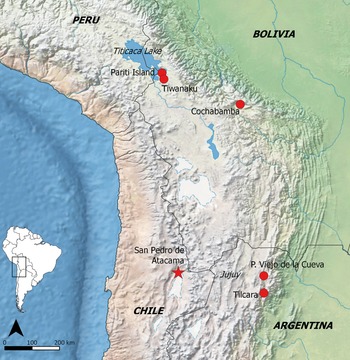
The Middle Period (MP, ad 400–900) represents a dynamic moment when people, goods and ideas continuously moved between distant places within the south central Andes (SCA; Fig. 1). In this area comprising south Peru, eastern Bolivia, northwest Argentina (NWA) and northern Chile, the MP is characterized by the appearance of a variety of artefacts bearing an art style associated with Tiwanaku, thought to represent a shared religious iconography that developed in the Circumtiticaca area (Berenguer Reference Berenguer1998; Korpisaari Reference Korpisaari2006). Although Tiwanaku colonies were set in some regions (e.g. Moquegua Valley), distant localities such as San Pedro de Atacama (SPA) in northern Chile (Fig. 1) stand out for the increment in quantity and variety of foreign artefacts, raw materials and status items related to the Tiwanaku phenomenon. Based on the presence of gold artefacts, pottery, snuffing trays and textiles with Tiwanaku iconography, for many years SPA was interpreted as a Tiwanaku colony (Barón Reference Barón, Rivera and Kolata2004; Benavente et al. Reference Benavente, Massone and Thomas1986; Tamblay Reference Tamblay, Rivera and Kolata2004; Thomas et al. Reference Thomas, Benavente and Massone1985). Today, the evidence indicates that the relationship with Tiwanaku was indirect, i.e. SPA was independent and autonomous, and its contact with Tiwanaku and other neighbouring regions such as NWA was articulated by dynamic trade routes mediated by communities from the southern Altiplano or other Tiwanaku centres such as Cochabamba (Berenguer et al. Reference Berenguer, Castro and Silva1980; Castro et al. Reference Castro, Berenguer, Gallardo, Llagostera, Salazar, Falabella G, Uribe, Sanhueza, Aldunate and Hidalgo2016; Dillehay & Núñez Reference Dillehay, Núñez, Saunders and Montmollin1988; Llagostera Reference Llagostera2004; Reference Llagostera and Lechtman2006; Salazar et al. Reference Salazar, Niemeyer, Horta, Figueroa-Larre and Manríquez2014; Torres-Rouff et al. Reference Torres-Rouff, Knudson, Pestle and Stovel2015; Uribe & Agüero Reference Uribe and Agüero2001; and more).
Map of the south central Andes showing the location of the sites mentioned in this paper. Casa Parroquial is located in San Pedro de Atacama.

Among the foreign goods reported in SPA, gold and silver offerings stand out in their relatively high concentration at this single locality. Gold and silver offerings in SPA include nearly 200 objects weighing approximately 2.5 kg in total. They are mainly small pendants, headbands, bracelets and pectorals, followed by some rings, headdresses, beads, bells and ritual goblets (keros and portrait-vessels), all items distributed in seven cemeteries.
Gold was the first metal to be used in the Andes. The earliest finds, dated around 2155–1936 bc, are nine tubular beads in Jiskairumoko, Peru (Aldenderfer et al. Reference Aldenderfer, Craig, Speakman and Popelka-Filcoff2008); still, it was with the expansion of Chavin religious imagery during the Early Horizon (900 bc–0) that goldwork spread in the central and south central Andes (Lechtman Reference Lechtman, Roberts and Thornton2014). According to Lechtman (Reference Lechtman, Roberts and Thornton2014), Chavin set the trend of using gold, and metals in general, deliberately to communicate and express religious, ideological and political power (González Reference González, Perea, Montero and García-Vuelta2004a; González & Vargas Reference González and Vargas1999; Lechtman Reference Lechtman1991; Reference Lechtman, Henderson and Netherly1993; Shimada et al. Reference Shimada, Griffin, Gordus and McEwan2000).
However, and despite their wide publicity in the present, gold ornaments are actually rare during the Middle Period; even at the site of Tiwanaku gold artefacts are uncommon (Korpisaari et al. Reference Korpisaari, Sagárnaga and Väisänen2011). At Tiwanaku itself, the greatest amount of gold ornaments is 15 offerings associated with three individuals in the Kalasasaya temple (Korpisaari Reference Korpisaari2006). Other important assemblages of the period include 23 gold objects found in a grave in Pariti island (Bennett Reference Bennett1936); the San Sebastian treasure with nearly 60 gold objects and almost 600 small pendants, also associated with one individual in Cochabamba (Money Reference Money1991); Burial 11 with 35 gold ornaments in La Isla de Tilcara, and Pueblo Viejo de la Cueva with nine objects, both in Jujuy, Argentina (Tarragó et al. Reference Tarragó, González, Ávalos and Lamamí2010).
In general, gold finds are rare in the Altiplano and Jujuy, and they usually concentrate a significant number of artefacts in individual burials or offerings. In SPA, however, there are multiple individuals bearing gold (and silver) buried in different cemeteries at this single locality, which appears different from other contemporary contexts. Until now, it has been assumed that all the gold found in SPA was imported from Tiwanaku, resulting from attempts by local leaders at showing affiliation to the Tiwanaku sphere (Salazar et al. Reference Salazar, Niemeyer, Horta, Figueroa-Larre and Manríquez2014; Tamblay Reference Tamblay, Rivera and Kolata2004). However, the number of items and strategic location of SPA within the trade network suggest that the circulation of these items was more complex than expected, probably combining gold artefacts arriving from different areas (Stovel Reference Stovel2001; Reference Stovel, Silverman and Isbell2008).
So far, metallurgical studies in SPA have mainly focused on copper metallurgy (Cifuentes et al. Reference Cifuentes, Figueroa-Larre, Salazar and Mille2018; Lechtman Reference Lechtman1996; Lechtman & Macfarlane Reference Lechtman and Macfarlane2005; Reference Lechtman, Macfarlane and Lechtman2006; Macfarlane & Lechtman Reference Macfarlane and Lechtman2016; Maldonado et al. Reference Maldonado, Rehren, Pernicka, Núñez, Leibbrandt, Hahn, Hauptmann, Modarressi-Tehrani and Prange2010; Reference Maldonado, Rehren, Pernicka, Núñez and Leibbrandt2013; Salazar et al. Reference Salazar, Figueroa-Larre, Morata, Mille, Manríquez and Cifuentes2011; Reference Salazar, Niemeyer, Horta, Figueroa-Larre and Manríquez2014) and technological approaches to gold and silver have been absent. This paper presents the first results of a project focused on the gold and silver technology in SPA during the MP. We aim to contribute to both regional and local archaeologies by answering questions such as: a) how gold circulated within the SCA, and how precious metals connected SPA, Tiwanaku and other polities of the period; b) which artisanal practices are associated to this technology, described as a basic ‘sheet technology’ (González Reference González, Perea, Montero and García-Vuelta2004a); and c) how gold grave goods can reveal intra-community connections and allow us to explore their local meanings. Here, we study Casa Parroquial (CP), the cemetery with the second largest assemblage of gold offerings in SPA, using the elemental composition and manufacturing technology of gold and silver grave goods as a starting point to discuss social practices associated with the procurement, reshaping and offering of noble metals. Our discussion engages concepts that may be of relevance elsewhere, including the identification of individual artisans through reverse engineering of artefacts, the life-histories of objects, the value of gold, and multi-craft activities in heterarchical societies.
Casa Parroquial
Excavated in 1994 by Téllez and Murphy (Reference Téllez, Murphy and Lleras2007), the site is located in the centre of the modern town of San Pedro de Atacama and was found during construction works made in the Parish House. The rescue excavation involved a very small area of 2×3 m, which revealed a section of a probably larger cemetery where 22 individuals were identified. Calibrated radiocarbon dates (2σ ranges) from burial 6 (ad 899–1150) and burial 18 (ad 885–1101) place the site at the Middle Period, during the late Coyo Phase (ad 700–1000) (Stovel Reference Stovel2013, 378).
The stratigraphy of the site is complex, mainly due to a loose matrix composed of sand, coarse sediments and pebbles which made it very difficult to produce a clear record of the burials. The matrix was humid, which resulted in poor conservation of the organic material, and some areas were disturbed. Téllez and Murphy (Reference Téllez, Murphy and Lleras2007), however, were able to identify burials of inverted cone shape, dug directly into the soil to a depth of 1.40–1.75 m with no markers such as posts or large rocks. The presence of a white layer of decomposed material surrounding some of the bodies and their undisturbed positions suggests to these authors that at least some individuals were wrapped in textiles before burial. Some of the features appear to be multiple burials, but the association between individuals was not always clear, except in the case of individuals 16a–16b and 12–17. The offerings were ascribed to specific individuals only when they were in direct association. A summary of the individuals and grave goods is given in Supplemental Table 1.
A total of 97 grave goods of different materials was recorded during the excavation, but some of them were in such poor condition that they did not survive thereafter. In particular, 15 sheets and discs of corroded silver were recorded (Téllez & Murphy Reference Téllez, Murphy and Lleras2007), but only one fragment was found in the museum storage in 2016. Other findings comprise 36 gold objects, two copper artefacts, about 17 necklaces made of hundreds of copper mineral beads, fragments of nearly 16 pottery vessels, four bone tubes, six lithic objects, fragments of copper minerals, and a wooden tube.
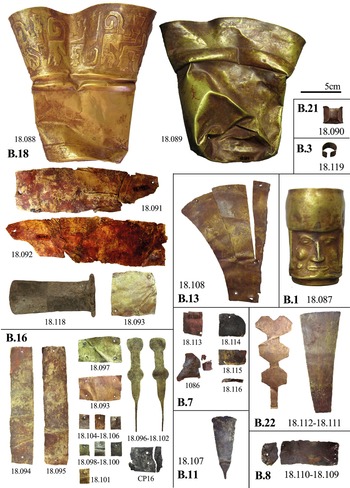
Fourteen burials (64 per cent) contained metallic objects (Fig. 2). Of these 14, 10 burials (71 per cent) had gold offerings. Two burials contain only gold offerings (14 per cent), in six burials gold was combined with silver (43 per cent), and in two burials gold was combined with copper objects (14 per cent). The remaining four burials (29 per cent) contained only silver grave goods. Within the metallic assemblage of the site, the types of objects represented in gold are an axe (n = 1), a wooden tube wrapped with a gold sheet (n = 1), a portrait cup (n = 1), keros (n = 2), rings (n = 2), headdresses (n = 6), pendants (n = 7), sheets with perforations of varied shapes and forms (n = 9), and fragments of sheets (n = 6). In silver, the records identified discs (n = 5), conical bells (n = 2), chisels (n = 1) and many fragments. Finally, two copper axes were recovered.
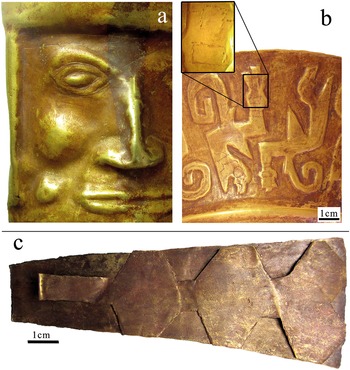
Gold grave goods from Casa Parroquial (collection of the Instituto de Investigaciones Arqueológicas y Museo R.P. Gustavo Le Paige s.j.). The variety in colours in objects from (a) B.16 (except CP16), 18.093 and 18.107; (b) B.22; and (c) 18.091/18.092 is due to different light conditions when photographs were taken, rather than reflecting actual differences (Photographs: M.T. Plaza.)

Methods
Of 35 noble metal objects preserved, we analysed the 32 gold artefacts and a silver sheet recovered from the excavations and stored in the Museo Arqueológico R.P. Gustavo Le Paige from San Pedro de Atacama (935 g in total, excluding the gold axe, which weighs 203 g (A. Cifuentes, pers. comm. 2021)). Bulk chemical analyses of major elements (Au-Ag-Cu) were undertaken using Olympus Innov-X Delta Premium portable X-ray fluorescence spectrometers (pXRF) on unprepared surfaces. These pXRF instruments are equipped with a Si drift detector (SDD) and achieve a typical resolution of 145–150 eV FWHM for x-rays of 5.9 keV (on a steel standard). Analyses were performed in the Alloy Plus mode using the so-called Beam1 at 40 kV with a 2mil Al filter in the X-ray path, for 20 s live time, and quantified using fundamental parameters adjusted with empirical calibrations. The values given are averages of three readings per object, in percentage by weight. Although the manufacturer and set up are the same, two different instruments were used in this research (pXRF-2015 and pXRF-2016, after the year of analysis). Precision, accuracy and comparability within and between instruments were monitored using a series of certified reference materials. Results show a very good degree of correspondence between both instruments, allowing us to pool both datasets together (Supplemental Table 2).
To test further for minor (<1 per cent) and trace elements (<0.1 per cent), samples of 11 objects were analysed at the AGLAE in Paris using particle-induced X-ray emission (PIXE). The setup used a 3 MeV external proton beam of 30–50 μm, 3-6nA current and four Peltier-cooled SDD detectors to collect the X-rays emitted by the sample. Surface patinas were mechanically cleaned and the objects analysed once, using beam scanning areas of 500×500 μm. Data normalization from different detectors was carried out using silver values, with the GUPIX program combined with the software TRAUPIXE.
Samples of 10 objects were mounted as polished metallographic sections and analysed using a Hitachi s-3400N scanning electron microscope with energy dispersive microscopy (SEM-EDS) at the UCL Institute of Archaeology. The instrument was operated at 20 kV with counting times of 100 s, a working distance of 10 mm and a process time of 5. The same instrument was used to observe, under secondary and backscattered electron detectors, whole artefacts and unprepared samples placed directly in the SEM chamber under high vacuum. The SEM was set to 15–20 keV and variable working distances were used. Finally, all objects were studied under naked eye and using a digital microscope (Dino-lite Edge), to register manufacturing traits. Our results also include the ICP-AES analysis of axe 18.118 by Salazar and colleagues (Reference Salazar, Figueroa-Larre, Morata, Mille, Manríquez and Cifuentes2011).
Chemistry: results and discussion
a. Bulk chemical composition
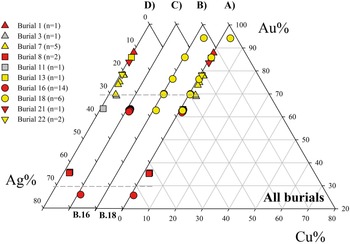
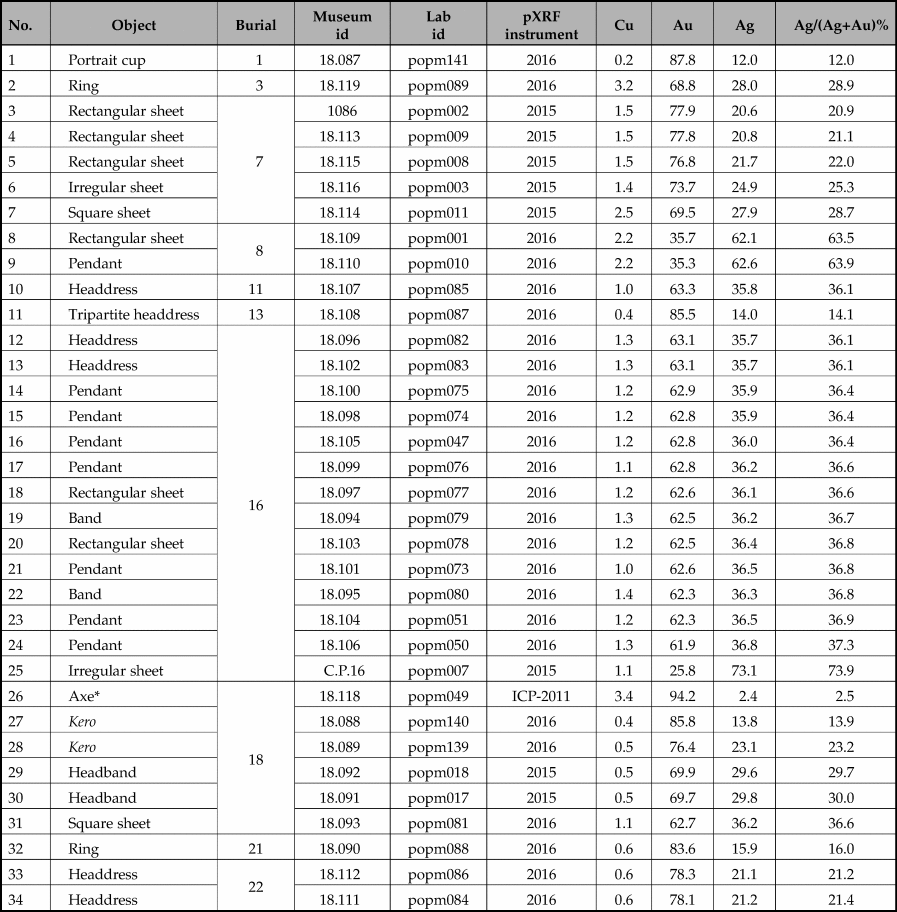
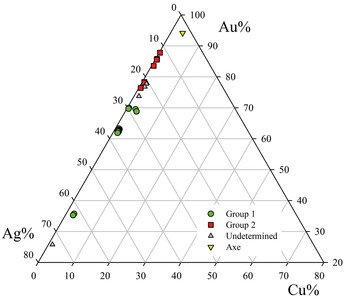
The bulk chemical composition of the 34 objects analysed shows a scattered distribution, where two broad groups are recognizable (Fig. 3): 91 per cent of the assemblage contains 61.9– 94.2 per cent gold and 2.4–36.8 per cent silver; while 9 per cent of the assemblage has higher silver contents between 62.1 and 73.1 per cent, with 25.8–35.7 per cent gold (Table 1). The copper is low in all cases, ranging between 0.2 and 3.5 per cent. The high-silver group includes the so-called silver sheet (CP16), which turned out to be a gold-silver alloy instead of pure silver (26 per cent Au, 73 per cent Ag and 1 per cent Cu). To this picture one should add those fragments recorded as ‘silver’ during excavation but not preserved: it is not possible to ascertain whether these would have fallen in the silver-rich group or formed a separate group with higher silver levels.
Gold-silver-copper ternary diagram presenting the bulk chemical composition of the 34 gold grave goods from Casa Parroquial, by pXRF, and one by ICP-AES (Salazar et al. Reference Salazar, Figueroa-Larre, Morata, Mille, Manríquez and Cifuentes2011). (A) Diagram showing all burials; (B) only burial 18; (C) only burial 16; (D) all burials except 16 and 18.

Chemical composition of 34 offerings from Casa Parroquial, by pXRF and ICP-AES.

Notes. Values are an average of three readings, and are normalized to a 100 weight per cent. Results are organized by burials and gold content. *Axe analysed by ICP-AES by Salazar et al. 2011.
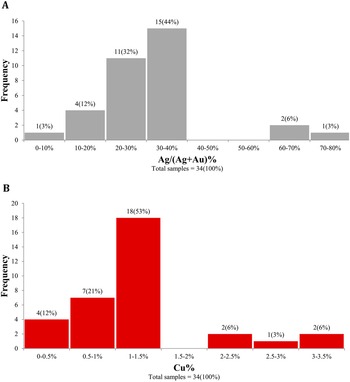
We calculated the Ag/(Ag+Au) percentage ratio to facilitate comparisons. This ratio has been used in archaeometallurgical studies of Au-Ag-Cu alloys to estimate the hypothetical amount of silver naturally present in naturally argentiferous gold before it was alloyed with copper, based on the facts that alluvial gold generally has negligible amounts of copper (<1 per cent), and assuming that all the silver in the gold was present as a natural impurity (Guerra & Calligaro Reference Guerra and Calligaro2004; Hough et al. Reference Hough, Butt and Fischer-Bühner2009; Martinón-Torres et al. Reference Martinón-Torres, Rojas, Cooper and Rehren2007; Reference Martinón-Torres, Valcárcel Rojas, Sáenz Samper and Guerra2012; Uribe & Martinón-Torres Reference Uribe and Martinón-Torres2012). Bearing in mind that a) copper values in SPA assemblage are typically very low (up to 3.5 per cent) and b) the presence of silver objects at the site (Téllez & Murphy Reference Téllez, Murphy and Lleras2007) suggests that silver could have been available for artificial alloys (and not only as a natural impurity in the gold), we use this ratio for a different purpose here: as a descriptive parameter to search for compositions that might denote either individual gold sources or possible alloying practices (see following section). The results in Figure 4a show that the resulting value is lower than 30 per cent for 47 per cent of the objects; 44 per cent display levels between 30 and 40 per cent; and 9 per cent of the assemblage has a higher value of over 60 per cent. Copper contents are very low, with 86 per cent of the objects containing levels up to 1.5 per cent, and only 15 per cent with 2.0–3.5 per cent copper levels (Fig. 4b).
(A) Frequency distribution histogram of Ag/(Ag+Au) percentage values of 34 objects from Casa Parroquial; (B) frequency distribution histogram of Cu per cent of 34 objects from Casa Parroquial.

PIXE results show that all the objects analysed contain zinc as a trace element, while titanium, gallium and nickel are scarce (2–3 cases, Supplemental Table 3). Meanwhile, under the SEM we identified minute iron-rich inclusions in the matrix of five objects (18.091, 18.092, 18.113, 18.115 and 18.116), and copper-rich inclusions in samples 18.109 and 18.110. Inclusions of complex composition containing copper, iron, tin, zinc or arsenic were identified in samples 18.092 and 18.110 as well.
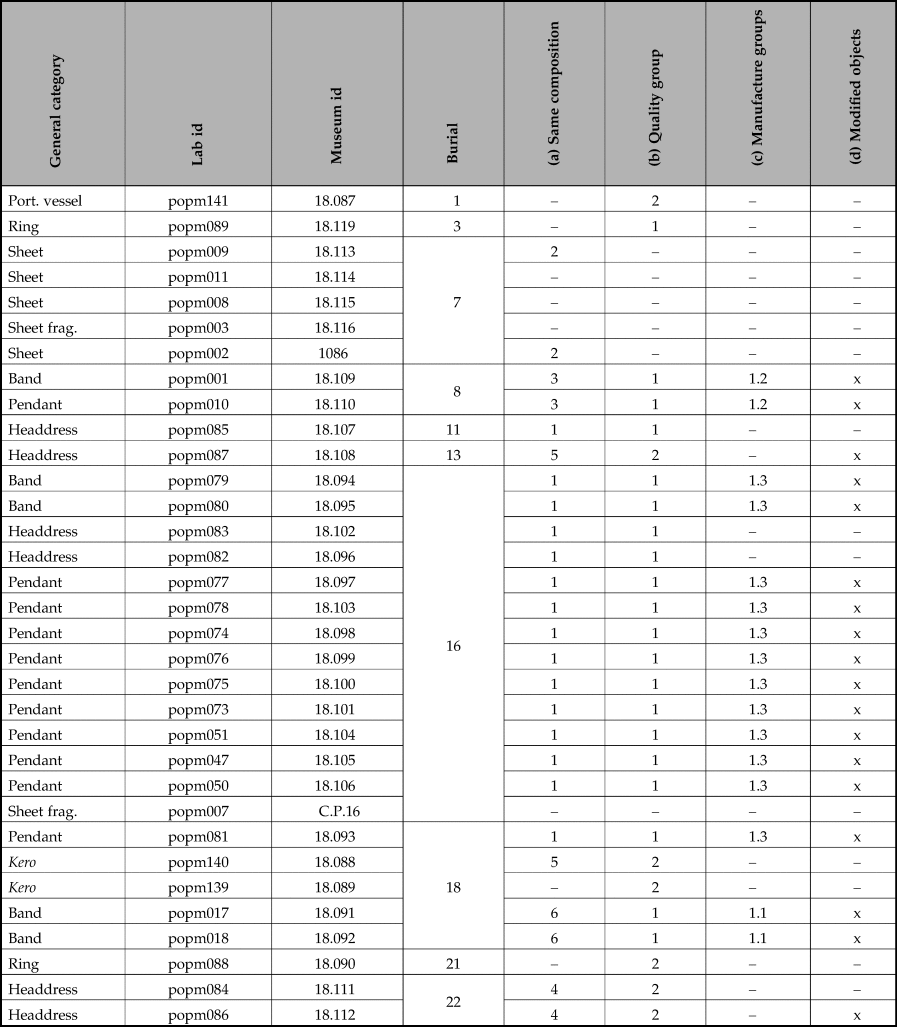
Interestingly, some objects share very similar bulk compositions (Table 1). This is the case of 15 pendants and headdresses from burials 11, 18 and 16, which form a very tight compositional group with 1.0–1.4 per cent copper and 35.7–36.8 per cent silver. Other examples showing almost the exact same composition are sheets 1086 and 18.113 from burial 7 (1.5 per cent Cu, 21 per cent Ag), pendants 18.109 and 18.110 from burial 8 (2 per cent Cu, 62 per cent Ag), headdresses 18.111 and 18.112 from burial 22 (1 per cent Cu, 21 per cent Ag); and the kero 18.088 from burial 18 with the headdress 18.108 from burial 13 (0.4 per cent Cu, 14 per cent Ag). Headbands 18.091 and 18.092 from burial 18 share both bulk composition (0.5 per cent Cu, 30 per cent Ag) and trace elements (Fe, Zn, Ti: Table 2a).
Summary of artefacts sharing the same composition (a), manufacture traits (b–c) and modified objects (d) from Casa Parroquial.

When we look at the distribution of compositions within burials, we see different patterns (Fig. 3). For example, in burials 7 and 18, object compositions appear scattered; while in burials 8, 22 and 16 all the offerings plot together (except the high-silver object CP16 from burial 16). From burials 1, 3, 11, 13 and 21 we analysed only one metal object each.
b. Native gold and alloys
Silver levels up to 30 per cent are consistent with silver content naturally present in alluvial gold deposits. Higher values are possible but very rare, hence pointing to artificial gold-silver alloys (Chapman et al. Reference Chapman, Leake and Styles2002; Guerra et al. Reference Guerra, Fernández, Delaveris, Encuentra and Villanueva2019; Hough et al. Reference Hough, Butt and Fischer-Bühner2009; Samusikov Reference Samusikov2002; Spiridonov & Yanakieva Reference Spiridonov and Yanakieva2009). Near SPA there are gold and silver deposits, but they have not been chemically characterized. The records found to date are from other gold deposits from the central and south central Andes, which contain different amounts of silver. For example, very pure gold with silver up to 5–7 per cent is found in south Peru (Sandia and Carabaya region), in Bolivia (south Lipez, the Eastern Cordillera and Yani region) and in Jujuy, Argentina (Mina Eureka). Meanwhile, silver contents up to 10–14 per cent are recorded in San Pedro de Cachiyuyo (Atacama region, Chile), Vilander placer (south Lipez, Bolivia), Vetasmayo placer (south Peru), Ancash (north coast of Peru) and Rinconada (Jujuy). Finally, high silver levels are registered in Cerro Casale with up to 21 per cent Ag (Atacama region, Chile); in La Joya district in Bolivia with 30 per cent Ag; and in the alluvial deposits of the Tumbes River at the boundary between Peru and Ecuador with 26 per cent Ag (Alarcón & Fornari Reference Alarcón, Fornari and Boliviana1994; Angiorama Reference Angiorama, Perea, Montero and García-Vuelta2004; Hérail et al. Reference Hérail, Fornari, Viscarra and Miranda1990; Reference Hérail, Lagos and Vivallo1999; Palacios et al. Reference Palacios, Hérail and Townley2001; Petersen Reference Petersen1970; Ramos & Fornari Reference Ramos, Fornari and Boliviana1994).
Considering the above, it is plausible that the objects from CP with silver levels up to 30 per cent may have been made of unalloyed native gold. Based on the variable Ag/(Ag+Au) percentage ratios recorded, it is likely that different gold deposits are represented in the assemblage. Likewise, iron-rich inclusions were found in five objects with silver levels below 30 per cent. The presence of iron-rich minerals in gold is not unusual (Angiorama Reference Angiorama, Perea, Montero and García-Vuelta2004; Guerra & Calligaro Reference Guerra and Calligaro2004; McEwan & Haeberli Reference McEwan, Haeberli and McEwan2000). They are typically found in alluvial gold grains as remnants of the original primary deposits in which gold is usually associated with quartz, limonite, hematite and pyrite as host minerals (Boric et al. Reference Boric, Díaz and Maksaev1990, 68, 82, 94). However, upon melting of native gold, these mineral impurities tend to be separated by their lower density and immiscibility, forming slag or dross. Consequently, their presence in sheets 18.113, 18.115 and 18.116, and in headbands 18.091 and 18.092, all with silver levels up to 30 per cent, would suggest that the metal was not necessarily melted; possibly these sheets were shaped from gold grains applying cycles of cold-work and annealing.
For artefacts with over 30 per cent Ag, however, it is much more likely that we are dealing with artificial alloys (Angiorama Reference Angiorama, Perea, Montero and García-Vuelta2004; Guerra et al. Reference Guerra, Fernández, Delaveris, Encuentra and Villanueva2019; Lechtman Reference Lechtman and Ravines1978; Root Reference Root1949; Rovira Reference Rovira, Scott and Meyers1994; Schlosser et al. Reference Schlosser, Robert, Ernst, Detlef, Tellenbach, Reindel and Wagner2009). Therefore, the presence of artefacts with both low and high silver suggests the possible presence of both naturally argentiferous gold and gold artificially alloyed with additional silver. We cannot rule out, however, that different types of native gold were melted or mixed together.
Regarding the copper content, it is widely accepted that native gold usually contains levels of copper below 1 per cent, commonly ranging between 0.1 and 0.8 per cent (Guerra & Calligaro Reference Guerra and Calligaro2004; Hough et al. Reference Hough, Butt and Fischer-Bühner2009; Schlosser et al. Reference Schlosser, Robert, Ernst, Detlef, Tellenbach, Reindel and Wagner2009; Spiridonov & Yanakieva Reference Spiridonov and Yanakieva2009; Townley et al. Reference Townley, Hérail and Maksaev2003). However, other authors report copper levels up to 2 per cent or even extraordinary cases of 6–8 per cent Cu in alluvial gold (Ogden Reference Ogden, Nicholson and Shaw2000; Petersen Reference Petersen1970). Chemical analyses of samples from gold deposits in the central and south central Andes usually show copper levels as traces, i.e. <0.1 per cent (Alarcón & Fornari Reference Alarcón, Fornari and Boliviana1994; Ramos & Fornari Reference Ramos, Fornari and Boliviana1994). Exceptions are primary deposits in Chile and placer deposits in Zaruma (boundary between Peru and Ecuador), which contain copper up to 0.7 per cent (Hérail et al. Reference Hérail, Fornari, Viscarra and Miranda1990; Palacios et al. Reference Palacios, Hérail and Townley2001; Petersen Reference Petersen1970), or placers in the north coast of Peru (Pallasca and Ninamahua) containing copper levels up to 6–8 per cent, a very unusual composition for native gold (Petersen Reference Petersen1970).
Against this background, the copper levels for most of the artefacts analysed would seem consistent with natural impurities (cf. Guerra et al. Reference Guerra, Fernández, Delaveris, Encuentra and Villanueva2019). Importantly, copper contents up to 5 per cent in gold alloys will not affect the colour or melting temperatures significantly (Schlosser et al. Reference Schlosser, Robert, Ernst, Detlef, Tellenbach, Reindel and Wagner2009, 416), and would thus not necessarily be noticeable for the user or producer of the object. Most probably, therefore, even the copper levels above 1 per cent in the assemblage are unintentional, indicating either the use of alluvial gold deposits with exceptionally high copper levels, or contamination with copper minerals during collection or while melting in crucibles previously used for copper (González Reference González2003; Guerra & Rehren Reference Guerra and Rehren2009; Hauptmann & Klein Reference Hauptmann and Klein2009).
PIXE results show zinc as the main impurity in the analysed objects. This element is also found in gold and silver objects from Salta and Jujuy (Argentina), together with iron and nickel (Angiorama Reference Angiorama2001; González Reference González, Perea, Montero and García-Vuelta2004a, 333). Unfortunately, published data of trace elements in gold or silver objects from the south central Andes for comparative use are extremely limited, with notable absences in Chile and Bolivia, making it premature to pinpoint specific geological sources.
Technology: results and discussion
a. Manufacturing techniques
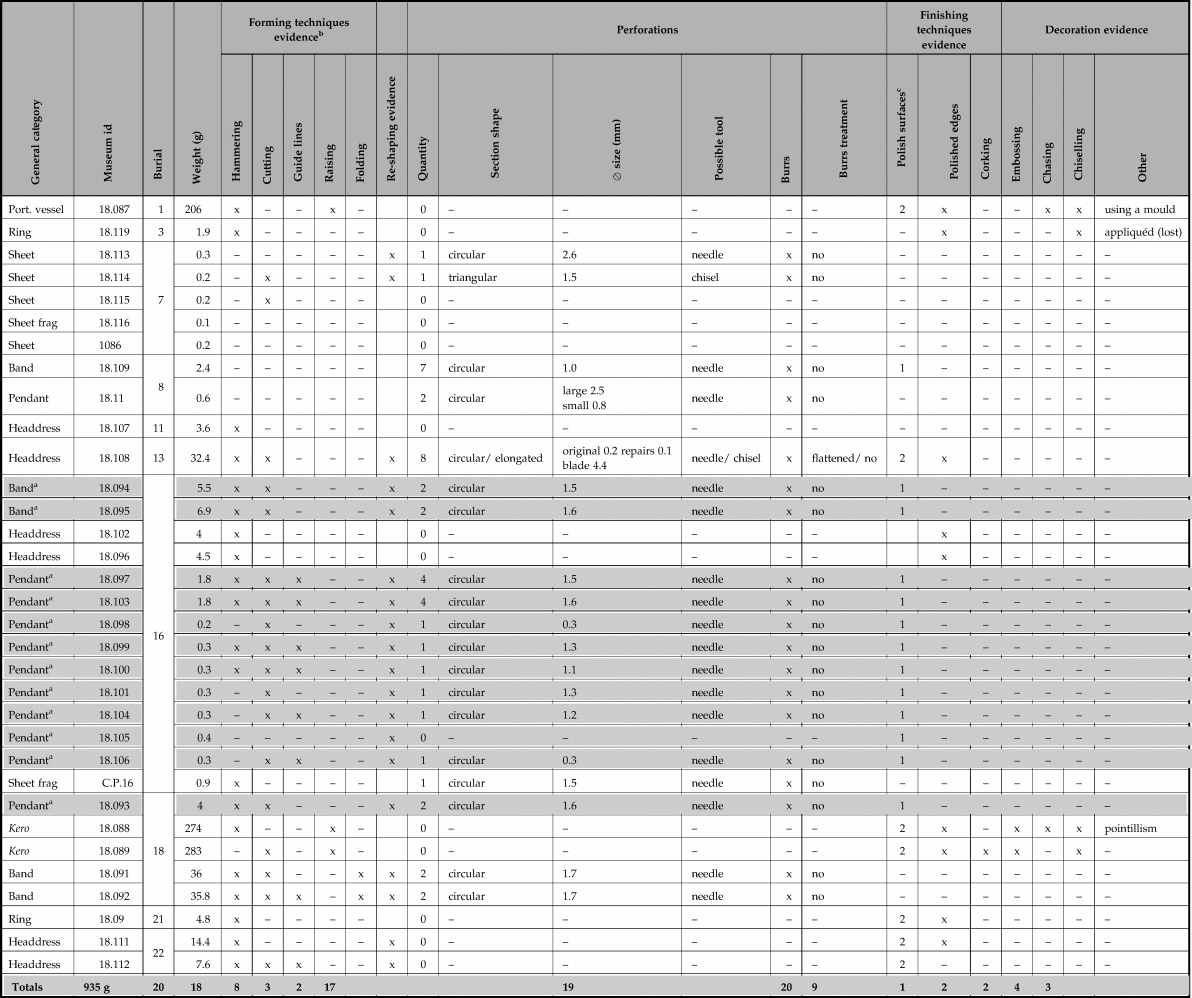
All the objects in CP (89 per cent), except the three goblets and, probably, the axe (likely cast, although we could not examine it) were made of hammered sheets that were cut to shape. Hammering and cutting marks are visible on the surface of nearly 20 objects (57 per cent; Table 3); in two headbands (6 per cent) we also identified folding as a main forming technique. In eight cases (23 per cent) the presence of lines adjacent to cut edges suggests the use of guide lines drawn prior to the cut. Alternatively, the portrait-vessel and two keros (9 per cent) were modelled by ‘raising’, a technique whereby a metal sheet is hammered against a matrix, compressing the metal and raising the walls at the same time, achieving a 3D shape (see Carcedo et al. Reference Carcedo, Vetter and Canseco2004, 164). As to finishing techniques, we registered 20 objects (57 per cent) with polished surfaces (one or two sides); and polished edges were identified in nine cases (26 per cent). Only four objects analysed were decorated: the three goblets and a ring. Embossing, chasing, chiselling and pointillism were used to decorate the goblets, while the ring was decorated with an attached appliqué that is missing. While conscious of the risks of value judgements, we can state that the vast majority of the objects are cursory and quite rudimentary in their manufacture and appearance, in the sense that they did not engage particularly complex techniques. Therefore, we find it useful to discriminate objects showing evidence of more sophisticated skills and/or careful manufacture from those displaying a more limited range and/or a more cursory approach to manufacture (Kuijpers Reference Kuijpers, Ball and Arnoldussen2015; Reference Kuijpers2017; Reference Kuijpers2018).
Summary of the manufacture techniques observe in the assemblage of Casa Parroquial (n = 33). The forming, finishing and decoration techniques identified here are based on the presence/absence of marks present on the surfaces. The dimensions of the objects are given in Supplemental Table 4.

Notes. (a) Largest cluster of objects sharing the same manufacture techniques. (b) We register the presence/absence of visible forming techniques, finishing treatment and decoration technique marks. (c) 1 = objects with only one polished surface. 2 = objects with all their surfaces polish (both sides in two–dimensional sheets and the exterior in the case of the keros).
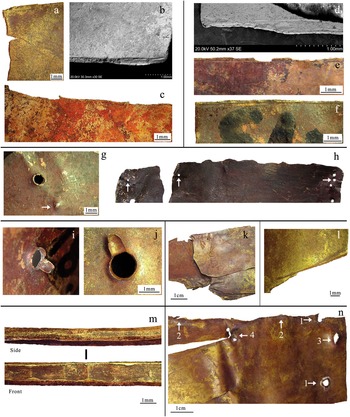
Based on manufacturing traits, we can cluster some objects together. The largest cluster comprises 12 objects that share many features (Table 3). These are seven rectangular pendants (18.098–18.101, 18.104–18.106), two rectangular sheets (18.097, 18.103), and two bands (18.094, 18.095) from burial 16; and a square sheet 18.093 from burial 18. The surface of the 12 objects is the same: rough on one side and smooth on the other, although there are not visible polishing marks. The edges were roughly cut and not polished, leaving the same fresh cutmarks on many objects (Fig. 5 a–c); only a few of them have one or two worn edges, which may represent the original edges of the object or larger sheet from which these were cut. In six sheets we found possible guide lines, suggesting that the artisan drew the design before cutting them (Fig. 5 d–f). All perforations are circular in section, with burrs left untreated, and in all cases there is a long burr with the imprint of a point, suggesting the use of a pointy tool such as a needle (Fig. 5 i–j). Furthermore, they are similar in shape; e.g. sheets 18.097 and 18.103 could have been made by cutting a sheet like 18.093 in half; and the seven rectangular pendants appear to be part of a large and thin band cut into pieces (Fig. 2 B16, B18).
Details of manufacture traits. Fresh and unpolished edges in pendants (a)18.097; (b) 18.105; (c) 18.094; guide lines in pendants (d) 18.105; (e) 18.106; (f) 18.100; (g) attempts at perforation in pendant 18.109; (h) repair in 18.109–18.110; needle-type marks in (i) 18.105 and (j) 18.103; (k) folding evidence in headdress 18.091; (l) unpolished marks in 18.112; (m) hammering and polishing marks in headdress 18.102; (n) headdress 18.108 showing 1: flattened original perforations; 2: rough cuts; 3: untreated perforations; 4: repair. (Photographs: M.T. Plaza.)

Similar to the previous group, but without visible cutting marks, are sheets 18.107, 18.109 and 18.110, characterized by uneven and worn edges. Sheets 18.109 and 18.110 appear to be parts of the same pendant that broke before it was buried. The presence of three similar aligned perforations linking both sheets suggests they may have been part of a repair to hold both parts together (Fig. 5 h). We also found imprints on the surfaces, probably failed perforation attempts (Fig. 5 g). The circular perforations, the imprints and their similarity with other perforations of the assemblage suggest the use of a pointed tool, possibly a needle. The headbands 18.091and 18.092 show characteristic peculiarities: they were shaped by folding, hammering and cutting a larger gold sheet, leaving pronounced folds all over the surface (Fig. 5 k). Once the main shape was obtained, the ends were perforated with a needle. Burrs were not treated and in two cases the same perforation was punched twice. The technique in general is still unsophisticated.
Headdresses 18.096 and 18.102 show a somewhat more careful manufacture, while both are identical in design and manufacturing techniques. They comprise an elongated sheet with a disc-shaped decoration at the centre and top end (Fig. 2 B16), and a thick and pointy appendix of rectangular section. Their edges are smooth and polished; long facets are visible on the pointy end, suggesting the use of a smooth tool (perhaps a stone) to round and polish the sides and edges (Fig. 5 m). Surfaces, in contrast, were not polished.
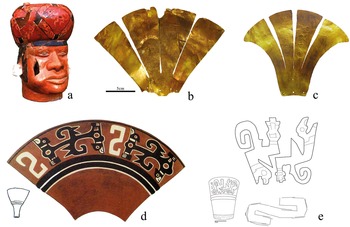
An interesting case of artefacts clearly altered and reshaped are headdresses 18.108, 18.111 and 18.112. The headdress 18.108 is a well-made tripartite sheet, with polished surfaces and edges, comparable to others found in Copiapo (Chile) and northwest Argentina (see Fig. 8 b–c), although these have four rather than three appendices (González Reference González and Goretti2006, 252). The perforations at the base are circular and the burrs were flattened (Fig. 5 n1). However, at some point in its life, this ornament was crudely cut, losing some of its appendices. The cuts are short, perpendicular, chiselling marks (Fig. 5 n2). The same blade was used to perforate the base and the top of the appendices; these perforations were not treated (Fig. 5 n3). Two small circular perforations were added as part of a repair to avoid losing the thinnest appendix (Fig. 5 n4). Headdresses 18.111 and 18.112 present similar cases, albeit with more subtle modification. Both headdresses have polished surfaces. Now, 18.111 has a trapezoidal shape and its edges are even and polished, erasing all cutting marks. In turn, 18.112 has a complex shape: two hexagons at the centre and a heart shape at the top (Fig. 2 B22). The edges of this headdress are roughly cut and unpolished, leaving visible cutmarks at the borders (Fig. 5 l). The bottom edge of both ornaments seems straight but under the microscope it appears irregular and slightly bent, suggesting that the sheets were detached from a larger one by bending the metal until it broke (possibly another four-appendix headdress). When both headdresses are stacked together, they fit perfectly (Fig. 6 c). This, combined with the same elemental composition and texture of the surfaces, clearly shows that sheet 18.112 was once a trapezoidal sheet (like 18.111) that was subsequently reshaped, cutting out some sections of the metal to obtain a new design. We therefore have objects that were intentionally reshaped. Interestingly, the quality is very different between the original work and the modification: the former is careful and tidy, whereas the latter is relatively rough and, to our modern Western eye, careless,Footnote 1 with no finishing treatments to match the quality of the original work. This is a strong indication that the modifications would have taken place at different times of the objects’ life-histories, revealing rather complex biographies where the final appearance of the object was the result of its production and alterations during use (see Sáenz Samper & Martinón-Torres Reference Sáenz Samper and Martinón-Torres2017 for other examples in Pre-Columbian goldwork).
Details of manufacture and decoration techniques: (a) chiselling in portrait vessel 18.087; (b) chasing, embossing and pointillism in kero 18.088; (c) headdresses 18.111 and 18.112. (Photographs: M.T. Plaza.)

In the three goblets, vertical or horizontal joint marks were not found anywhere. This absence of joint lines suggests the use of raising as the main forming technique, as described by Carcedo and colleagues (Reference Carcedo, Vetter and Canseco2004, fig. 10). Surfaces were polished in all cases, but there are different manufacturing traits in each case. For example, portrait-vessel 18.087 has a flat base, whereas kero 18.089 has a circle drawn on the base, imitating a concave base; and kero 18.088 has a low concave base. Rims are different as well: in 18.087 the rim is inturned, whereas in 18.089 and 18.088 the rim is everted. Further, the rim of 18.089 has a pronounced external thickening that is absent in 18.088. Dimensions are variable as well, with estimated volumes of 0.3 l (18.087), 2.5 l (18.088) and 3.0 l (18.089). Keros 18.088 and 18.089 were carefully flattened, showing no visible blows, pointing to a ritual killing of the goblets.
Despite the fact that the same techniques were used to decorate the three cups, i.e. embossing, chasing and chiselling, these were combined differently. In the case of the portrait vessel 18.087, the face was made by chasing, probably using a wooden mould from the inside (Carcedo et al. Reference Carcedo, Vetter and Canseco2004, figs 10–11). Chiselling was applied afterwards to retouch the features of the face (Fig. 6 a). In 18.088, embossing, chasing, chiselling and pointillism were used to create low-relief creatures, double torus and horizontal S volutes (Figs 6 b, 8 e). The rounded torus of vessel 18.089 was made by embossing from the interior and chiselling from the front. The differences between these goblets suggest that they were made independently; the three of them, however, display skill and knowledge in a range of techniques that are conspicuously absent in the rest of the assemblage (Kuijpers Reference Kuijpers, Ball and Arnoldussen2015; Reference Kuijpers2017; Reference Kuijpers2018).
Finally, there are six very thin sheet fragments; some of them are cut and others are just broken fragments (CP16, 1086, 18.113–18.116). Their manufacture traits show no particular characteristics, thus they were not included in any of the groups (Fig. 2 B7, B16).
b. Technology and reuse
In broad terms, we can identify two groups of objects based on the quality of the manufacturing techniques (Table 2 b). The largest group comprises 20 objects (57 per cent) showing rather crude, arguably ‘poor’ craftsmanship (Craft Group 1); the second group is made of seven objects (20 per cent) showing more careful manufacture and ‘better’ finished work (Craft Group 2). The six sheet fragments (17 per cent) of undetermined manufacture traits are not considered in these groups. We propose that both groups include imported objects, probably from different areas and certainly made by a range of artisans with diverse skills and different levels of expertise (Kuijpers Reference Kuijpers, Ball and Arnoldussen2015; Reference Kuijpers2017; Reference Kuijpers2018). There is not enough evidence to suggest the possible origins of the objects in Group 1; as for Group 2, the quality, design and decoration of some of these objects clearly point to Tiwanaku style. Furthermore, we propose the existence of a local tradition that involved the reshaping and modification of gold (and possibly silver) sheets and finished ornaments, which were cut, hammered and perforated when adapted to local taste or need. In this sense, it is possible that some of the objects in the first group may originally have been part of larger artefacts of better craftmanship (i.e. Group 2), which had the evidence for skilled and careful work obliterated by the subsequent reshaping.
Group 1 includes three headdresses (18.096, 18.102, 18.107), two headbands (18.091, 18.092), a ring (18.119) and series of sheets and pendants (18.093–18.095, 18.097–18.101, 18.103–18.106, 18.109–18.110). In general, none or only one surface is polished; edges are uneven, unpolished and worn; perforations are circular, made with a pointy tool (e.g. a needle) and leaving untreated burrs. Compositions are variable, but always with silver levels equal to or higher than 30 per cent (Fig. 7).
Gold-silver-copper ternary diagram presenting the bulk chemical composition of the 33 gold grave goods from Casa Parroquial, by pXRF. The axe was analysed by ICP-AES (Salazar et al. Reference Salazar, Figueroa-Larre, Morata, Mille, Manríquez and Cifuentes2011). Artefacts are organized by technological groups.

Within Group 1 there are three subgroups, each internally consistent in composition and manufacture and thus suggesting that they were made together by the same artisan (Table 2 c). For example, headbands 18.091 and 18.092 are the only artefacts shaped by folding and cutting a larger gold sheet (Subgroup 1.1), whereas the two-part pendant 18.109 and 18.110 was repaired, perforating both sheets to keep them together (Subgroup 1.2). Subgroup 1.3 comprises 12 sheets that look alike (18.093–18.095, 18.097–18.101, 18.103–18.106). They all bear rough cuts, unpolished edges (with only a few being worn), visible guide lines and untreated needle perforations. This third subgroup shares the same chemical composition as headdresses 18.096, 18.102 and 18.107, but their manufacture traits are slightly different. Headdress 18.107 has worn edges instead of fresh cuts, whereas 18.096 and 18.102 show polished edges and complex designs, compared to the other sheets. Considering the presence of a few worn edges (old edges?), and many fresh cuts in the sheets of Subgroup 1.3, together with the evidence for different manufacture features and old edges in the three headdresses, it is possible to suggest the previous existence of (an) additional ornament(s) made of the same metal, probably as part of a set, which was cut into 12 smaller pieces. Interestingly, the modification marks of these 12 pendants are identical—like headbands 18.091–18.092 and repairs in 18.109–18.110—indicating that were made at the same time by a single artisan following the same working techniques and gestures. Technical gestures and compositional groups that reveal the work of specific artisans have been also identified in Muisca metallurgy from Colombia (Martinón-Torres & Uribe Reference Martinón-Torres and Uribe2015).
In contrast with the expediently made pieces of Group 1, in Group 2 we found objects showing a more careful manufacture and better finished work, probably produced by more experienced artisans (Kuijpers Reference Kuijpers2018). Due to space constraints, we have described only some of them: three goblets (18.087–18.089) and three headdresses (18.108, 18.111, 18.112), but the group also includes ring 18.090. In general, all these artefacts have their surfaces finely polished, as well as the edges; perforations are retouched (flattened), some artefacts are decorated and designs can be more complex. Regarding compositions, these seven artefacts have low silver (12–23 per cent) and copper (~0.5 per cent) levels. Interestingly, two of these objects were clearly reshaped using the same untidy techniques found in Group 1Footnote 2 (headdresses 18.108 and 18.112).
Considering design and decoration, some of the objects in Group 2 can be tracked to other traditions, such as Tiwanaku. For example, the portrait vessel 18.087 represents a man with a hat chewing coca, a common design during the Tiwanaku IV phase, ad 500–800 (Bennett Reference Bennett1934; Flores et al. Reference Flores, Kuon and Samanez1998; Janusek Reference Janusek and Kolata2003). Ceramic goblets with the same figure are found in Pariti Island (Fig. 8 a) (Sagárnaga Reference Sagárnaga2007, fig. 1), while a stone specimen is held at the Ethnologisches Museum zu Berlin (ref. V A 64570). Also common in Tiwanaku iconography is the combination of bird, feline and human attributes to create specific motifs (Flores et al. Reference Flores, Kuon and Samanez1998; Janusek Reference Janusek and Kolata2003), as is the case of the avian design in kero 18.088. Here, the design combines a bird with a wing and a curly tail (Fig. 8 e). A very similar avian design is described by Posnansky (Reference Posnansky1957, pl. LI) in a kero from Cochabamba (Fig. 8 d); as well as in pottery and lapidary work from Tiwanaku (Bennett Reference Bennett1934, figs 15, 17, 21; Posnansky Reference Posnansky1957, pls 28a, 35c, 37a–b). In SPA both connections are possible, given the evidence of pottery, textiles and snuffing implements with styles from the Titicaca basin, as well as textiles and pottery with Tiwanaku variants from Cochabamba valley (Oakland Reference Oakland1992; Stovel Reference Stovel, Silverman and Isbell2008; Uribe & Agüero Reference Uribe and Agüero2001). Finally, headdresses such as 18.108 are more difficult to trace, but similar ornaments are reported in northwest Argentina (Fig. 8 c) and Copiapo, Chile (Fig. 8 b). Specialists, however, believe these ornaments are more likely to originate in northwest Argentina (H. Horta, pers. comm. 2016).
(a) Portrait-vessel from Pariti Island (modified from Sagárnaga Reference Sagárnaga2007, fig. 1); (b) headdress no. 2611 found in Copiapo, Chile, Collection of the Museo Chileno de Arte Precolombino (photograph: M.T. Plaza); (c) headdress from northwest Argentina (modified from González Reference González and Goretti2006, 252); (d) avian motif in a kero from Cochabamba (after Posnansky Reference Posnansky1957, pl. LI); (e) detail of kero 18.088 (drawing: M.T. Plaza).

The three subgroups in Group 1, as well as the headdresses 18.108 and 18.112 in Group 2, are basically objects that were modified or reshaped using relatively simple mechanical means: punching, cutting and folding (Table 2 d). Noteworthy is the shortage of solutions involving melting metal, which suggests a lack of knowledge of (or interest in) those metallurgical processes. Assuming that this reshaping took place locally in SPA, the absence of local high-temperature technology would also mean that SPA artisans did not necessarily melt gold to produce their ornaments, but they obtained finished artefacts that they modified according their taste or needs. In this case, cutting and punching were the main working techniques, requiring tools such as chisels, needles and burins, already available in San Pedro and extensively used in other industries such as bone and wooden sculpture (Horta Reference Horta2014; Salazar et al. Reference Salazar, Niemeyer, Horta, Figueroa-Larre and Manríquez2014). The modification of gold objects would support the multi-crafting background of San Pedro society, where non-specialists worked different materials and participated in a range of different activities and tasks, in either an opportunistic or a communally regulated way (Castro et al. Reference Castro, Berenguer, Gallardo, Llagostera, Salazar, Falabella G, Uribe, Sanhueza, Aldunate and Hidalgo2016; Crumley Reference Crumley, Ehrenreich, Crumley and Levy1995; Reference Crumley, Kohring and Wynne-Jones2007; DeMarrais Reference DeMarrais2013; Nielsen Reference Nielsen, Gnecco and Langebaek2006; Reference Nielsen, Nielsen, Rivolta, Seldes, Vázquez and Hercolli2007). Having said this, we should note that the chemical overlap between craft groups 1 and 2 is limited, contrary to what we would expect if finer objects were routinely being cut and reshaped. Furthermore, objects in Group 1 are typically the ones richer in silver, which would necessarily require high-temperature alloying or recycling (Fig. 7). In particular, above 30 per cent Ag there are three compositional modes with ~36 per cent Ag, 62 per cent Ag and 73 per cent Ag, representing at least three melting episodes. Unfortunately, we do not have enough evidence to propose that the melting process took place in San Pedro; analyses of the few crucibles and moulds found in SPA would be necessary to explore this possibility (Cifuentes et al. Reference Cifuentes, Figueroa-Larre, Salazar and Mille2018). Alternatively, it is perhaps more likely that both the gold-rich and the silver-rich alloys arrived at SPA readily alloyed and, once there, the basic work of reshaping them—as seen in CP—became a local activity, produced by non-metallurgist multi-craft artisans. If this was consistently the case, however, we would expect more compositional overlap between both groups.
Final considerations
Distribution and meaning of the offerings: the local perspective
Some patterns are observed in the distribution of the gold offerings in CP. In terms of quantity and types of objects, there are two burials with over six items (18 and 16), whereas the other burials have only one or two ornaments. It is interesting that in burials with two items, these have the same composition, forming a set. This suggests that, in general, most people in CP would have had access to only one gold object; when they had two, those were acquired at the same time. A different example is burial 7, where a child was buried with five thin sheets of different compositions. The group appears to be made of fragments of larger sheets that were collected and deposited with the child. The quality of these offerings is low compared to those of other burials.
Individual 18 is an adult male with six gold items, among them an axe, two keros and a wooden tube wrapped in a gold sheet. All of them are significant elements used as power emblems and ritual elements in SPA (Horta Reference Horta2014; Llagostera et al. Reference Llagostera, Torres and Costa-Junqueira1988; Salazar et al. Reference Salazar, Niemeyer, Horta, Figueroa-Larre and Manríquez2014), suggesting that the individual played an important role within his community, maybe a chief or a shaman. In terms of composition and manufacture, this burial is very diverse, comprising a broad range of alloys (Fig. 3) and different qualities of manufacture, including the keros with Tiwanaku designs. This diversity suggests that the offerings grouped here were acquired from different sources and, most likely, during the lifetime of the individual.
The funerary assemblage for this individual includes square sheet 18.093 from craft subgroup 1.3. The remaining 11 sheets in this subgroup were found in burial 16, together with two headdresses of the same composition as grave goods of two newborns buried together. The gold offerings in burial 16 form two identical sets: a large band, a rectangular sheet with four small pendants at each corner, and a headdress for each baby. In contrast to burial 18, here the compositions and manufacture of the items are the same (Table 2 a, b). Considering that the individuals are newborns (and thus unable to acquire these objects by themselves), and the similarities in composition and manufacture within the group of offerings, we believe that the quadrangular sheets were cut at the same time out of a single sheet of gold, especially for the burial of these babies, intentionally producing identical sets.
The connection between burials 18 and 16 is less clear, even if both have sheets of the same group, together with the headdress of burial 11, also of identical composition. They may represent family relationships, inherited objects, or merely exchange between people of the same community. Nonetheless, it is likely that these deaths were not very distant in time, and individuals were possibly related. It does not look like a coincidence that burials 18 and 16 contain more gold offerings than the others; and the fact that one of them was two newborns suggests that the family of those children would have had access to more than one gold artefact—as is the case for the individual in burial 18.
Building upon the variety of types, compositions and qualities of gold grave goods found in CP, especially the presence of incomplete or fragmented ornaments, we propose that gold in the SPA society had multiple meanings that operated at different levels and that were intentionally expressed in the funerary ritual (Berenguer Reference Berenguer1994). On the one hand, there are artefacts considered emblems of political (axes) and religious leadership (keros, portrait-cup), relating CP to Tiwanaku. Gold in this case was most likely used to show rank, leadership and affiliation with Tiwanaku, showing the importance and great symbolism of this metal to communicate political and religious messages (DeMarrais et al. Reference DeMarrais, Castillo and Earle1996; González Reference González2004b; Lechtman Reference Lechtman, Henderson and Netherly1993).
On the other hand, there are relatively small and plain sheets (e.g. burial 7), relatively poorly made or modified items that were also part of the funerary ritual. In this case, objects may reveal something different, where the presence of the metal or a piece of an object in the offering was more important than the objects itself, its quality or the skill invested to make it. As Nielsen (Reference Nielsen, Nielsen, Rivolta, Seldes, Vázquez and Hercolli2007) argues, the role of foreign and exotic items in the SCA was varied and it goes beyond their use as ‘elite’ objects. These items actively participated in the construction of gender or social identities and, in many cases, the value of these artefacts resides in their ability to signify multi-ethnic and multi-ecological integration (Nielsen Reference Nielsen, Nielsen, Rivolta, Seldes, Vázquez and Hercolli2007, 407). These items, regarding their quality, can also carry stories and memories of people and places that participate in people's daily life (Lazzari Reference Lazzari2016, 4), as well as transferring sacredness from their place of origin (Ogburn Reference Ogburn2004). This may be the case for the more ‘humble’ gold objects found in CP, where value does not seem to be in the object style or technical mastery, but most likely in the symbolism of the material itself, the life-histories behind each item including its origins, its transport, its use (or not) and its physical change in local hands—all potentially adding layers of meaning and value (Gosden & Marshall Reference Gosden and Marshall1999; Helms Reference Helms1993; Horta Reference Horta2012; Joyce & Gillespie Reference Joyce, Gillespie, Joyce and Gillespie2015; Kopytoff Reference Kopytoff and Appadurai1986; Lazzari Reference Lazzari2016; Spielmann Reference Spielmann, Costin and Wright1998). Similar notions have been used to interpret the presence of foreign pottery in SPA (Stovel Reference Stovel, Silverman and Isbell2008) and the circulation of lithics (Lazzari Reference Lazzari2016; Ogburn Reference Ogburn2004) or spondylus (Glowacki & Malpass Reference Glowacki and Malpass2003; Paulsen Reference Paulsen1974) in the Andes.
Gold circulation and technology in the SCA: the regional perspective
Chemical and technical analysis of the gold grave goods from CP provides useful insight regarding gold circulation and production in the SCA, during the MP. Firstly, we identify a range of compositions and manufacture styles and skills, indicating that these objects—usually defined as part of a ‘sheet technology’ (González Reference González, Perea, Montero and García-Vuelta2004a)—reveal more complexity than expected. Overall, the evidence indicates that gold artefacts found in CP were imported.
Secondly, it has been assumed that the gold found in SPA arrived from Tiwanaku, and it was used to represent the connection with the Altiplanic polity (Salazar et al. Reference Salazar, Niemeyer, Horta, Figueroa-Larre and Manríquez2014). Our research challenges this view, indicating that these connections can be expanded to Cochabamba and NWA as well. This panorama exposes the complexity of the gold circulation network, expanding its limits to all the SCA including the Circumpuna. It also questions the reason why gold was used in SPA (see previous section). Gold not only relates elites to Tiwanaku, but it also suggests more frequent relationships with neighbouring areas, such as NWA, by exchanging small, simple or incomplete items. Still, this is a first step and future research including a larger sample and considering trace elements will provide better evidence to support these results, linking SPA to other regions.
Thirdly, the variability identified suggests that several people were working this metal, showing different degrees of expertise, probably related to different ways of organizing production. Increasing the sample would help to clarify whether workshops, independent artisans, or both, were involved in their production. However, the presence of complex and high-quality techniques, such as those seen in the keros and portrait-cup, would suggest a controlled production, probably with artisans working in workshops, training and sharing a technological style, as has been reported in Tiwanaku for the production of pottery and musical instruments (Janusek Reference Janusek1999). Conversely, the local modifications and the presence of small plain pendants and bands of varied qualities point towards an independent production, characteristic of the communities from the Circumpuna—including SPA—described as corporative and heterarchical, with a decentralized economic and political organization (Castro et al. Reference Castro, Berenguer, Gallardo, Llagostera, Salazar, Falabella G, Uribe, Sanhueza, Aldunate and Hidalgo2016; Nielsen Reference Nielsen, Gnecco and Langebaek2006). In SPA, the presence of toolkits to produce different crafts (e.g. beads, weaving, woodwork, smelting) found in association with the same individuals in cemeteries from Solcor, Coyo and Quitor, would support the idea of multi-crafting activities (Horta & Faundes Reference Horta and Faundes2018; Salazar et al. Reference Horta2014). We propose here that the local modifications of gold grave goods are actually part of the multi-crafting activities practised by SPA's artisans; therefore, the re-use of gold items in CP did not require the presence of specialized metallurgists.
Conclusions
The scientific study of gold offerings from Casa Parroquial has provided useful insight into the use of gold and the technology present in San Pedro de Atacama, along with the capability to identify specific artisans, as well as craftspeople with different skill levels. The detailed observation of manufacture traits combined with their elemental composition has revealed the complex life-histories of these offerings, which changed through time.
Chemical composition and manufacture techniques indicate that objects were predominantly made by hammering both unalloyed gold and artificial gold-silver alloys of variable composition. We identified two main working styles or ‘craft groups’, one more careful than the other, probably representing various artisans with different skill levels. At the same time, there were obvious overlaps between the two working styles, indicating that carefully crafted objects were cut, reshaped and adjusted more crudely at a later stage of their life. There is no evidence to suggest that gold objects were made in SPA; most likely, they are imported objects arriving from Tiwanaku or Cochabamba and northwest Argentina, revealing intricate biographies and circulation patterns. Nevertheless, it is likely that many of these ornaments were modified or reshaped in SPA, either as they entered this new cultural context or as part of the funerary ritual. The latter is most probably the case for two keros that seem ritually killed, and the pendants with fresh cuts and perforations and with no evidence of use after their modification. Rather than specialized metallurgical skills, it would seem that artisans in SPA were engaged in multi-crafting and modified gold and silver objects using their experience of other local crafts, such as wooden or bone sculpture, without resorting to high-temperature melting or casting.
The distribution of gold shows that seven out of ten people buried with gold have one or two items; exceptions are the male in burial 18 and the newborns in burials 16 and 7. The type of offerings in burial 18 suggests that he was an important person in his community: the keros and the inhalation tube are associated with ritual activities and ceremonies, whilst the axe is considered a symbol of power. We believe this person may be related to the newborns in burial 16, mainly because they share objects of identical composition and manufacture traits, and due to the unusual amount of gold offerings associated with those children. The presence of gold in child burials would support the idea of increasing social complexity, manifested in inheritable wealth and status during the MP. At the same time, the predominance of very small sheet fragments of sheet gold, silver and their alloys, often crudely cut and pierced, indicates that these metals primarily had an intrinsic value that was not related to aesthetic appeal or craftmanship. It is not possible at this stage to determine the geological source(s) of these metals, or indeed whether their potentially exotic origins (culturally or geographically) may have added to the social value of these items. In any case, it is obvious that most of these objects had complex life-histories that affected their materiality from the original manufacture to their final deposition. As such, understanding their cultural value requires much more than tracing them to a geological source.
Supplemental Materials
The supplementary materials for this article can be found at https://doi.org/10.1017/S0959774321000123
Acknowledgements
We are very grateful to Valentina Figueroa-Larre from the Instituto de Arqueología y Antropología of the Universidad Católica del Norte, and to the staff at the Museo Arqueológico R.P. Gustavo Le Paige s.j., San Pedro de Atacama, especially Jimena Cruz, Arturo Torres and Saúl Cervantes for facilitating access to the artefacts and museum records; to the staff of the UCL Wolfson Archaeological Science Laboratories for their guidance and training; to Benoit Mille and Quentin Lemasson at the AGLAE laboratory of the Centre de Recherche et de Restauration des Musées de France (C2RMF) for training and processing PIXE data. This project was funded thanks to the Chilean Government and CONICYT (Becas Chile Postdoctorado); ANID projects 3200229, 11130651 and 1160849; UCL Institute of Archaeology; and The Coghlan Bequest funding of the Historical Metallurgy Society. Financial support by the Access to Research Infrastructures activity in the 7th Framework Programme of the EU (CHARISMA Grant Agreement n. 228330) is gratefully acknowledged.