Surely our desire for radical social change is intimately linked with the desire to experience pleasure, erotic fulfillment and a host of other passions … The shared space and feeling of “yearning” opens up the possibility of common ground where all these differences might meet and engage one another. It seemed appropriate then to speak this yearning.
bell hooks, “liberation scenes: speak this yearning”Footnote 1Richard Berry Harrison (1864–1935) is the most famous Shakespearean you've never heard of. Born in Canada, the fourth son of fugitive slaves, Harrison was an itinerant Shakespeare “reader” and actor who became nationally famous for his sonorous voice and stirring presence as “De Lawd” in the wildly popular 1930 Broadway musical The Green Pastures. Playwright Marc Connelly and the white press promoted an elderly teacher discovered during casting calls; in contrast, the black press celebrated his pre-Broadway acting accomplishments. His citation for the NAACP Spingarn Medal highlights his many years “as a dramatic reader and entertainer, interpreting to the mass of colored people in church and school the finest specimens of English drama from Shakespeare down.”Footnote 2 White supremacy and Jim Crow conspired to keep blacks from the “legitimate” stage and from building the infrastructure needed for a robust classical theater. Indeed, as the history of the African Grove Theater shows, black performers were seen as a threat to white theater. Errol Hill evocatively concludes his discussion of Harrison's career suggesting the huge impediments the Shakespeare stage holds for black actors: “Richard B. Harrison was not allowed to play Shakespeare on Broadway; he died playing God.”Footnote 3
Actors like Harrison who eschewed minstrelsy and musicals became itinerant elocutionists, performing fragments or truncated versions of Shakespeare's plays at whatever venues they could muster. Integral to American performance history and black politics, itinerant actors pose archival and methodological challenges, particularly for those of us with traditional Shakespeare training. The sporadic documentation of their careers makes it difficult to uncover not just the details of their experience, but also the meanings of their performances for black communities. As I contemplated the fragmentary encounters between blacks and Shakespeare found in the Schomburg Center for Research in Black Culture, bell hook's essay “liberation scenes” came to mind because it captures the pleasure of performance, the pain of denied opportunities and the desire for social change that permeates these records. Her insistence on speaking our yearnings as a critical move and radical step towards freedom might also open up the affective and political components of these black Shakespeare encounters. Yearning to perform Shakespeare and please black audiences is also a political act. As a professional Shakespearean, I too constantly contend with a perceived gap between my blackness and the Shakespeare world, so the resonance of hooks is perhaps unsurprising. I have my own yearnings; in this essay they become a way of piecing those archival fragments and articulating this Shakespeare “with a difference.”Footnote 4
Fall 2016, New York City
I am entranced by Harrison's unpublished biography, “Even Playing De Lawd.” Except for his clear love of the stage, this actor could have been any one of my uncles. He reminds me of my Great-Uncle Vandyke: gentle, deeply religious, although not self-righteously so (when he died, all of the churches in the area sent their best singers to create a mass choir for his homegoing), and with a sense of humor so understated that sometimes you wouldn't know whether he was having you on or not. The stuffy reading room makes it hard to focus. I'm a little lost in these reminiscences and am hearing Uncle Vandyke's voice in my head when I come across this passage:
In St. Paul I met Frederick Douglass, who was attending the Republican National Convention … He was especially interested in my work and told me it was his greatest ambition to be an actor. He wanted to play Othello. I wonder if the world was not robbed of possibly one of the greatest Othellos the world has seen. For fully a half hour at a time on several days he would recite to me scenes between the Moor and Iago. One day he asked me what I thought was the strongest word that Shakespeare had written in any of his plays and told me it was the word “indeed,” by Iago.Footnote 5
Exciting as this is, I am not sure what to make of this moment with Douglass's seeming interest in acting and in Othello (referenced less than other Shakespeare plays in his writings).Footnote 6 I know he introduced his employee, Henrietta Vinton Davis, the first black female Shakespearean, at her inaugural performance. We have no record of what he said that night, but something other than genial mentorship must have made him support her move to the stage. Did he and Davis find time to talk about Shakespeare in the office? Sadly, none of Douglass's published memoirs make mention of Davis, his meeting with Harrison (or of that Republican convention in general).
Then there's “indeed” – a telling detail that suggests Douglass's very close attention to the text. Iago, the villain, uses it frequently to undermine the black Othello's faith in Desdemona, his white wife. At the height of the play, after Othello sees Desdemona in an innocent meeting with his lieutenant, he pushes Iago to make explicit his hints that she is cheating:
It is one of the most metadramatic moments in a very theatrical play. Had Douglass chosen to recite this scene, it would mean performing not simply Othello, but Othello mimicking Iago's insinuating behavior that belies his protestations of innocence.
As a good Shakespearean, I can take Douglass's cue and spin this into a larger explanation of the importance of “indeed” to the play, but that takes me back to Shakespeare's text and away from what I really want to know: what would this conversation about Othello mean for these two men at this historical moment? Confined to Othello and this one anecdote (a breadcrumb as maddening and cryptic as Iago's “indeed”), I am stymied. What's Othello to Douglass or Douglass to Othello? Academic writing, even note taking, feels like a straightjacket. I go back to the typescript page wishing I were a playwright or a fiction writer creating sketches of this week of Harrison–Douglass encounters in ways so moving I would be forgiven for straying from my training. I can't flesh out this conversation from any other records, so when I report my research findings to the Schomburg, I offer an analysis of the biography:
Harrison describes multiple rejections from white troupes and his resolution to perform his own Shakespeare: “I had studied ‘Macbeth’ with Mrs. Lambert; had also studied ‘The Merchant of Venice,’ ‘Julius Caesar,’ ‘Damon & Pythias,’ ‘Ingomar,’ and ‘Othello’ besides numerous recitations of the best quality. In fact, I had a head full of goods and no market. I was determined to organize a company of my own – an all-colored, one-man company under the sole management of myself. I felt that if I could play Macbeth, I could also play MacDuffe and Banquo and Lady Macbeth and Malcolm and Donelbain, and the three witches; in fact, the whole army and all the rest of the characters including the porter …[Footnote 8] In Harrison's recounting, at the same time Douglass was at the convention (not as a delegate, but as elder statesman to the activists in town bringing attention to rising levels of racial violence, including record numbers of lynchings), he was rehearsing a different kind of freedom informally with Harrison … The “loss” of a possible playbill reading “Frederick Douglass as Othello” is counted amongst the many robberies enacted on blacks by slavery and reverberates against Harrison's own inability to achieve greatness on the classical stage, not from lack of talent, but because of racism. In this encounter Douglass is that “all-colored, one-man company under the sole management of myself.”
But this still doesn't seem enough. Denied legitimate venues, such experiences would not have been uncommon (albeit not involving such luminaries) and deserve scrutiny. What more can I say about these impromptu, unstaged moments of Shakespeare performance in black communities? Of the importance of these extended conversations about Othello? But maybe the problem is less analytical: what I really want is for them to talk to me.
January 2017, Baltimore, North Carolina, Virginia
Despite years of therapy that has supposedly helped me identify and deal with my feelings, these days I have no idea which feeling to assign to which phenomenon and none of them will go away. Some mornings it's a regular day where I habitually smile and greet people. But others are like the weeks after someone's death where the sadness suddenly hits and physically weighs you down: you move through the world deliberately like you are a nonswimmer walking in deep water. I'm at the National Humanities Center at what should feel like a high point of my career. This is a gracious place entirely devoted to me writing down what I think. But I just got here and I'm giving the first public lecture of the year. The communications director is excited because it looks like there will be a big crowd. But when I moved here last week, my family got news of an “othermother's” death, so my family and I are processing guilt, sadness and anger. It follows me as we drive to North Carolina, reading each other news about next week's inauguration and the forces gathering for what looks to be a historic march on Washington, DC the day after Donald Trump's inauguration.
When we arrive, my brother says, “Did you get Uncle A's text”? Yet another death. My Aunt J, who has been sick for a long time, has decided that she should be taken off life support. She's going to die the day before my talk, which is the day before the inauguration. It is a crazy week of highs and lows, but in my family we keep on keeping on. I pull up research photos and stare at the Chicago Defender’s special issue covering Harrison's funeral, which was attended by tens of thousands across the country. The headlines reflect my divided mood: praise of his talent, wisdom and work ethic and photos of his multi-city homecoming are interspersed with racial strife. The “peace and quiet” of his death is literally surrounded by despair and violence. Harlem's worst race riot in years is sparked over a false report that a ten-year-old boy died in police custody. A Wilberforce student has committed suicide. No one knows why. I can't tell which sadness is mine, which is eighty years old, and which comes from everyone I know.
Cousin T
The morning of the Women's March, we drive to Aunt J's funeral. We celebrate that she was a mother, a grandmother, a leader in her church, and a woman who turned to poetry to survive pain and frequent hospitalizations. At the repast, I move to my cousins’ table. My cousin T asks me what I'm doing in the South. After I tell him I am looking historically at how black people performed and wrote about Shakespeare's Othello and what that says about race, he surprises me by saying,
I watched a Shakespeare play, Othello, years ago. That one with Laurence Fishburne. He was great. Othello was so almost revered, and so strong, they had to respect him. You know my favorite part? He has all these white men coming at him and he says, “Keep up your [bright] swords, for the dew will rust them.” And everybody just stops. That was BAD. He was so respected and powerful that they just had to stop right there.
I have underestimated my cousin, who can remember and perform this line of Shakespeare more easily than I can. For the moment of that line, he was that confident Othello, calmly feeling his power.
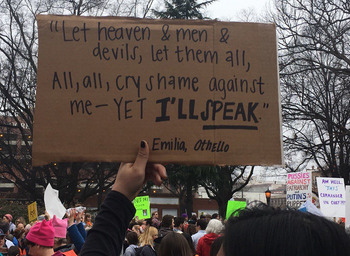
T is a truck driver who spends a long time on the road. Like Harrison, his road stories are hilarious, sometimes risqué, and sometimes hair-raising. And because of Harrison I think to ask him about what it's like to travel alone so much of the time and how safe it feels. I show him the sign a scholar tweeted at me from the rally with a line from Othello’s Emilia: “Let heaven and men and devils, let them all, /All, all, cry shame against me, yet I'll speak” (Figure 1). I've both been delighted by and stewing over it on the ride to Virginia. On one hand – hey, the perfect quote at the perfect time! Shakespeare and political activism! But it also reactivates my anger at white women, who it turns out were a significant factor in Trump's election and no one wants to talk about that. Albeit unknowingly, Emilia colludes with her husband while he unleashes the racist, misogynist fears of others to destroy Othello. She didn't know his end game, but she knew not returning the handkerchief would cause Desdemona pain and possibly hurt her marriage. When the Woman's March was announced, I was angry: NOW you speak out? With this seething anger, I see Emilia, ordinarily one of my favorite characters, as someone who “goes along to get along,” choosing the path of comfort and male favor before realizing the horror that choice can bring. ninety-four percent of black women voters turned out for Hillary Clinton, many of us grudgingly, despite her activation of racism and her role in selling a faux-progressive agenda based on the idea that black women don't work hard enough. Black women are generally not afraid of powerful women or women's leadership, but many white women, it turns out, still are.
Protest sign held aloft at the 2017 Women's March in Durham, North Carolina. Photo by Marlene Daut.

T hadn't realized that, while our family was driving from all points to celebrate my aunt's life, people all over the world were turning out to protest the direction of our country (“I thought it was just a women's lib thing”). I give him context for the quote: this is another moment of dark confusion in the play, but one of hot fury and dismay (unlike Othello's calm, misplaced confidence in Act I) that resists the forces of armed power and insists on truth. Maybe these modern Emilias aren't too late.
And maybe in this church hall, we just experienced a phenomenon similar to moments created by Richard Berry Harrison, Henrietta Vinton Davis, and other traveling elocutionists. With Shakespeare as our vehicle, Harrison and Douglass, my cousin and I, talk performance, race politics, national politics, family and community. We are “valuing Shakespeare, Shakespearean texts and Shakespearean performances and critical dialogues/debates about constructions of race.”Footnote 9 I have no doubt that, while they discussed details of a play about the twisting of a black man's love for a white woman and how racism and minstrelsy impeded their mutual love of the stage, Harrison and Douglass are also talking about the ongoing narrative of black male desire for white women that was often the pretext for the vast numbers of lynchings being protested at the convention. A narrative that makes white women precious, something to fight and kill over – and binds them to white supremacy and white male power.
The church hall, particularly during Reconstruction and Jim Crow, is both a sacred and a secular space for black people for whom mere “congregating” was seen as dangerous. In the church, black people, denied humanity and autonomy almost everywhere else, could find a respite from hardship and deprivation, restoring their dignity and self-worth as they psychologically prepared for another week of battling white supremacy.Footnote 10 The church hall is a space for homegoings, reunions and wedding receptions, but also for political speeches and Shakespeare performance. These Shakespeare moments are fragmentary, yet powerful autonomous spaces – physical and intellectual – of communion, pleasure, analysis and political critique. In that black space, Shakespeare is neither sacred, nor primary, yet he is still valued and valuable. That Shakespeare is “collective, participatory and life-affirming.”Footnote 11