INTRODUCTION
Various reducing deep-sea environments such as hydrothermal vents and hydrocarbon seeps have received much attention due to their specialized fauna with associated symbiotic microorganisms (e.g. Van Dover, Reference Van Dover2000; Levin, Reference Levin2005; Desbruyères et al., Reference Desbruyères, Segonzac and Bright2006). In recent years, whale-, wood- and kelp-falls have been intensely studied for similar reasons (e.g. Smith & Baco, Reference Smith and Baco2003; MacAvoy et al., Reference MacAvoy, Carney, Morgan and Macko2008). Wood and whale falls also have been suggested to be evolutionary stepping stones for taxa inhabiting hydrothermal vents and seeps (e.g. Smith et al., Reference Smith, Kukert, Wheatcroft, Jumars and Demning1989; Baco et al., Reference Baco, Smith, Peek, Roderick and Vrijenhoek1999; Kiel & Goedert, Reference Kiel and Goedert2006). Examples of symbioses between bacteria and macrofauna are numerous in the literature (e.g. Distel et al., Reference Distel, DeLong and Waterbury1991; Hoffmann et al., Reference Hoffmann, Rapp and Reitner2006; Dubilier et al., Reference Dubilier, Bergin and Lott2008; Schöttner et al., Reference Schöttner, Hoffmann, Wild, Rapp, Boetius and Ramette2009), but examples of symbioses between macroorganisms in the deep sea are rare. Scaleworm annelids living inside bivalves in vent and seep areas is one such example (e.g. Dreyer et al., Reference Dreyer, Miura and van Dover2004; Desbruyères et al., Reference Desbruyères, Segonzac and Bright2006; Kádár et al., Reference Kádár, Costa, Santos and Powell2006; Ravara et al., Reference Ravara, Cunha and Rodrigues2007). An interesting association is also found in the limid bivalve Acesta oophaga feeding on siboglinid eggs (Järnegren et al., Reference Järnegren, Tobias, Macko and Young2005, Reference Järnegren, Rapp and Young2007a, Reference Järnegren, Schander, Sneli, Rönningen and Youngb).
Here we report an observation of co-occurrence between a wood-boring bivalve and a siboglinid annelid from a Norwegian wood-fall. Both siboglinids (e.g. Webb, Reference Webb1964a, Reference Webbb; Ivanov, Reference Ivanov1991; Schulze & Halanych, Reference Schulze and Halanych2003) and Xylophaga bivalves (e.g. Dons, Reference Dons1940; Voight, Reference Voight2008, Reference Voight2009) are known to be associated with sunken wood. Although neither of these use wood for nutrition directly, both groups are presumed to use symbiotic bacteria as an intermediate step to harvest energy from the wood (e.g. Distel & Roberts, Reference Distel and Roberts1997; Halanych et al., Reference Halanych, Feldman and Vrijenhoek2001).
MATERIALS AND METHODS
The material was collected in Storfjord, Norwegian west coast (62°23.30 N 06°54.58) at a depth of 660–667 m using an Agassiz-trawl onboard the RV ‘Håkon Mosby’ during the campaign ‘Møre 2005’. Upon recovery, pieces of wood, (ranging in size from small twigs to pieces of several kilograms) were placed in buckets of water, examined and dissected. Only a few pieces showed marked discoloration from anoxic conditions. All pieces were heavily drilled by bivalves. The wood and the association between bivalves and siboglinids were photographed and samples of siboglinids and bivalves were fixed both in 96% ethanol and in 7% formalin.
Upon return to the laboratory, bivalves were morphologically examined and determined to species by J.A.S. and C.S. and the siboglinids by K.M.H. Because morphological identification of siboglinids is difficult, we also used molecular tools to verify the identification, i.e. DNA barcoding (Schander & Willassen, Reference Schander and Willassen2005; Mikkelsen et al., Reference Mikkelsen, Schander and Willassen2007). Thus, we sequenced the 18S nuclear ribosomal gene for the obtained siboglinids using protocols given in Halanych et al. (Reference Halanych, Feldman and Vrijenhoek2001). Results were blasted against available resources in GenBank Sequences. Unfortunately, the manner of collection was not appropriate to allow ribotyping of microbial symbionts.
Vouchers of the bivalve have been deposited at the Bergen Museum, Natural History collections under the catalogue number ZMBN 85732.
RESULTS
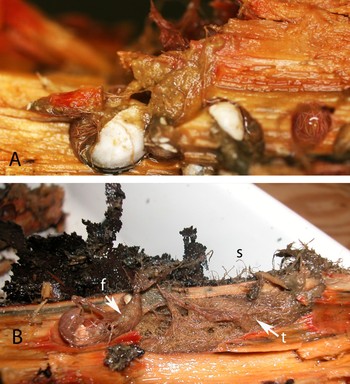
Dissection of sunken wood revealed heavy penetration by a living bivalve identified as Xylophaga dorsalis (Turton, 1819). At least two size-classes were observed. The vast majority of Xylophaga specimens were living. Some wood also had tubes drilled by a species of Teredo, but no living specimens of this bivalve were found. More interesting, we found that hollow tubes made by Xylophaga, as well as the cavity that hosted bivalves themselves, were lined with a dense mat of a siboglinid with a structure reminiscent of glomeruli of the mammalian kidney (Figure 1).
Xylophaga dorsalis surrounded by strands of Sclerolinum brattstromi. (A) Detail of X. dorsalis surrounded by S. brattstromi. Siboglinids visible as red to pink thread-like structures on X. dorsalis are in the left of the picture; (B) X. dorsalis surrounded by S. brattstromi. Photograph documenting density of siboglinid tubes in X. dorsalis burrows. f, faecal plug surrounded by Sclerolinum; t, tube drilled by Xylophaga dorsalis; s, specimens of Sclerolinum brattstromi protruding from between the bark and wood. Bivalve diameter ~1 cm.

Morphology suggested the recovered siboglinid was a species of Sclerolinum. GenBank blast results from our DNA sequencing of the18S nuclear ribosomal gene revealed a best match of 98% similarity to a specimen identified as Sclerolinum brattstromi Webb, 1964 (AF315061) from the Bergen area (Halanych et al., Reference Halanych, Feldman and Vrijenhoek2001).
DISCUSSION
Wood-falls collected in Storfjord, Norway are suggestive of an intimate association between the bivalve Xylophaga doralis and the siboglinid Sclerolinum brattstromi. Interestingly, both of these taxa are known to be specific to sunken wood and similar matter (e.g. Dons, Reference Dons1940; Webb, Reference Webb1964a, Reference Webbb) but have previously only been recorded to occur individually. Xylophaga has been recorded to co-exist with species of Teredo (Dons, Reference Dons1940; Knudsen, Reference Knudsen1961) but no living specimens of Teredo were recovered in our samples. We believe that Teredo was accumulating before the wood sunk, and that specimens subsequently died when the wood fell to the bottom. Such tubes from shallow water Teredo are common also in wood-falls from the deeper parts of the Norwegian Sea, but none of the authors of this paper have ever encountered living specimens of Teredo in deep sea wood-falls from the area.
Dense glomerus-like networks formed within bivalve burrows and around the bivalves themselves indicate that, at least in the recovered wood, these siboglinids are responding to some environmental parameter. Both species host symbiotic bacteria (e.g. Southward et al., Reference Southward, Southward, Dando, Barrett and Ling1986; Distel & Roberts, Reference Distel and Roberts1997), but whether the same phylotypes, or even metabolic pathways, are used in both hosts is not clear. Unfortunately, our samples were not in a state that allowed us to perform sequencing of bacterial endosymbionts. The siboglinid is obviously utilizing a well-protected environment, and mechanical degradation of the wood by the bivalve may possibly modify the microenvironment in a way that is advantageous to the siboglinid–bacterial symbiosis. Some species of Xylophaga form cone-shaped plugs of faecal pellets within their tubes (Purchon, Reference Purchon1941 figure 1B). These cones were readily identified in the Xylophaga drillings, and were also covered by a mat of siboglinids (Figure 1B). These plugs clearly form a suitable habitat for the siboglinids, but the bivalves themselves, as well as the entire length of the tubes, were covered with worms. Thus, S. brattstromi appear to be using more then faecal pellets. To the best of our knowledge the density of the siboglinid is exceptional.
ACKNOWLEDGEMENTS
We thank the crew of RV ‘Håkon Mosby’ for excellent working conditions during the cruise and Solveig Torkildsen for assistance in the laboratory. We thank Karin Pittman and two anonymous referees for constructive comments on the manuscript. This paper is contribution No. 64 to the AU Marine Biology Programme.