Introduction
The genus Bromus is found within tribe Bromeae, subfamily Pooideae within the Poaceae family (Pavlick Reference Pavlick1995). Bromus can be divided into several sections, of which Bromus, Ceratochloa, and Genea (Smith Reference Smith, Tutin, Heywood, Burgues, Moore, Walter and Webb1980) stand as harboring important weed species. For example, sect. Ceratochloa includes important perennial weed species such as rescuegrass (Bromus catharticus Vahl), while the most relevant self-pollinating annual weed species occur in sect. Genea, such as ripgut brome (Bromus diandrus Roth) (Oja and Laarmann Reference Oja and Laarmann2002). The Bromus genus is globally distributed and well known to be taxonomically complex (Smith Reference Smith, Tutin, Heywood, Burgues, Moore, Walter and Webb1980), particularly within sect. Genea, due to hybridization, morphological variations, and plasticity (Fortune et al. Reference Fortune, Pourtau, Viron and Ainouche2008). The most important Bromus weed species worldwide are found in this section: B. diandrus, compact brome (Bromus madritensis L.), red brome (Bromus rubens L.), poverty brome (Bromus sterilis L.), and cheatgrass (Bromus tectorum L.) (Borger et al. Reference Borger, Torra, Royo-Esnal, Davies, Newcombe and Chauhan2021; Davies et al. Reference Davies, Hull, Moss and Neve2019; Vázquez-García et al. Reference Vázquez-García, Castro, Cruz-Hipólito, Millan, Palma-Bautista and De Prado2021a).
Bromus madritensis [syn.: B. madritensis L. ssp. madritensis, Anisantha madritensis (L.) Nevski] is native to the Mediterranean region in southern Europe (Tutin et al. Reference Tutin, Heywood, Burgues, Moore, Walter and Webb1980). It is accepted as being a separate species from the related B. rubens (Oja Reference Oja2002; Tutin et al. Reference Tutin, Heywood, Burgues, Moore, Walter and Webb1980), although some taxonomists recognize both as two subspecies of B. madritensis. Compared with the brush-like condensed and erect panicles of B. rubens or the very loose flexible and nodding panicles of B. diandrus, the panicles of B. madritensis exhibit intermediate characters (Castroviejo et al. Reference Castroviejo, Aedo, Cirujano, Laínz, Montserrat, Morales, Muñoz Garmendia, Navarro, Paiva and Soriano1993). Therefore, B. madritensis is often confounded with one of the other two related Bromus species, particularly B. rubens. The literature often fails to distinguish between B. madritensis sensu stricto and B. rubens in areas where their distributions overlap, whether in their native range or in regions colonized by both species, such as North America (Horn et al. Reference Horn, Bishop and Clair2017). In fact, to best of our knowledge, there have been no studies focused on B. madritensis as a weed, its management, or its herbicide resistance.
The presence of B. madritensis is increasing in several cropping systems. The implementation of conservation tillage together with low diversity of crop rotations would explain its spread throughout Europe, North America, and Australia (Borger et al. Reference Borger, Torra, Royo-Esnal, Davies, Newcombe and Chauhan2021; Recasens et al. Reference Recasens, García, Cantero-Martínez, Torra and Royo-Esnal2016). Conservation tillage increases crop water-use efficiency and moisture availability in rainfed Mediterranean regions, along with reducing costs and improving soil health (Borger et al. Reference Borger, Torra, Royo-Esnal, Davies, Newcombe and Chauhan2021; García et al. Reference García, Royo-Esnal, Torra, Cantero-Martinez and Recasens2014). For these reasons, farmers have been implementing no-till techniques, such as direct drilling or cover crops, in the last decades in several perennial crops, but also in arable crops (Vázquez-García et al. Reference Vázquez-García, Castro, Torra, Alcántara-de la Cruz and Prado2020a). Due to the lack of soil disturbance in no-till cropping systems, weeds present at preseeding are usually managed with glyphosate, the sole nonselective herbicide available and the most applied herbicide in Europe. Moreover, there are few selective herbicides for Bromus species in cereals, most of them being nonselective for barley (Hordeum vulgare L.) (Royo-Esnal et al. Reference Royo-Esnal, Recasens, Garrido and Torra2018).
Glyphosate is the most used herbicide in the world (Duke and Powles Reference Duke and Powles2008). Its mode of action (MOA) is the inhibition of the chloroplast enzyme 5-enolpyruvylshikimate-3-phosphate synthase (EPSPS; Group 9 HRAC/WSSA), which catalyzes the synthesis of phenylalanine, tryptophan, and tyrosine, essential amino acids for plants (Boocock and Coggins Reference Boocock and Coggins1983; Steinrücken and Amrhein Reference Steinrücken and Amrhein1980). At present, 56 glyphosate-resistant species are already reported globally (Heap Reference Heap2022). Most of these cases occur in agricultural systems in which genetically modified crops tolerant to glyphosate (GMOs) are cultivated, but also in non-cropped areas or perennial crops with high selection pressures (Beckie Reference Beckie2011). In Europe, GMOs are banned; therefore, glyphosate is usually applied in perennial crops, mostly under the row, and in annual crops at preseeding (Collavo and Sattin Reference Collavo and Sattin2012, Reference Collavo and Sattin2014).
In Spain, glyphosate resistance has been reported in seven grass weed species (Torra et al. Reference Torra, Montull, Calha, Osuna, Portugal and de Prado2022), such as rigid ryegrass (Lolium rigidum Gaudin) and Italian ryegrass [Lolium perenne L. ssp. multiflorum (Lam.) Husnot] (Fernández et al. Reference Fernández, Alcántara, Osuna, Vila-Aiub and De Prado2016), johnsongrass [Sorghum halepense (L.) Pers.] (Vázquez-García et al. Reference Vázquez-García, Palma-Bautista, Rojano-Delgado, De Prado and Menendez2020b), barnyardgrass [Echinochloa crus-galli (L.) P. Beauv.] (Vázquez-García et al. Reference Vázquez-García, Rojano-Delgado, Alcántara-de la Cruz, Torra, Dellaferrera, Portugal and De Prado2021b), and false barley (Hordeum murinum L.) (Vázquez-García et al. Reference Vázquez-García, Castro, Torra, Alcántara-de la Cruz and Prado2020a). Regarding the genus Bromus in Spain, glyphosate resistance has recently been reported in B. rubens from several perennial crops (Vázquez-García et al. Reference Vázquez-García, Castro, Cruz-Hipólito, Millan, Palma-Bautista and De Prado2021a), and some other cases have been reported throughout the world: namely, B. diandrus and B. rubens from Australia, B. tectorum from Canada, B. sterilis from the United Kingdom, and B. catharticus from Argentina (Davies et al. Reference Davies, Hull, Moss and Neve2019; Heap Reference Heap2022). Among those, resistance levels were well established and/or resistance mechanisms were revealed only in B. diandrus, B. sterilis, and B. catharticus, with overexpression of EPSPS and non–target site mechanisms conferring glyphosate resistance in B. diandrus and B. catharticus, respectively (Davies et al. Reference Davies, Hull, Moss and Neve2019; Malone et al. Reference Malone, Morran, Shirley, Boutsalis and Preston2016; Yanniccari et al. Reference Yanniccari, Vázquez-García, Gómez-Lobato, Rojano-Delgado, Alves and De Prado2021). On the other hand, irrespective of the resistance mechanism to glyphosate or the weed species, resistant plants accumulate significantly less shikimate than susceptible plants, because EPSPS is not or is less inhibited than in susceptible plants (Sammons and Gaines Reference Sammons and Gaines2014). Therefore, determination of shikimate acid accumulation (SAA) levels can be employed to rapidly screen for glyphosate-resistant biotypes (Shaner et al. Reference Shaner, Nadler-Hassar, Henry and Koger2005).
Up to 2018, the unique herbicide-resistance case for B. madritensis reported worldwide was, in fact, the glyphosate-resistant populations studied and described in depth in the present research, and they remain the only reported case in this species (Heap Reference Heap2022). From 2017, failures in the field regarding B. madritensis control with glyphosate were reported by farmers in Spain, mainly in perennial crops such as olive (Olea europaea L.), almond [Prunus dulcis (Mill.) D.A. Webb], or citrus (Citrus spp.), but also a few cases in winter cereals under direct drilling. The glyphosate resistance of these populations could have been selected due to a long history of selection pressure with this herbicide. Because the number of herbicides available for Bromus management is limited in all these cropping systems, this continued selection pressure from glyphosate is very threatening.
Due to the intermediate characters of B. madritensis between B. rubens and B. diandrus, and the taxonomic complexity of the Bromus genus, particularly sect. Genea, the aims of this research were: (1) discriminate several species of the genus Bromus using molecular markers to confirm that the studied populations from Spain belong to B. madritensis; (2) check for glyphosate resistance in these B. madritensis populations using rapid SAA screening and dose–response experiments; and (3) test in field trials the efficacy of alternative herbicides with different MOAs to manage them.
Materials and Methods
Samples Collection
In summer 2018, 12 suspected populations of B. madritensis were harvested from different locations on the Iberian Peninsula. Two populations (labeled Bms8 and BmS14) were collected from sites never treated with herbicides (Portugal and Spain, respectively). The remaining populations were collected from fields with different cropping systems and herbicide application histories (Table 1). Samples were placed in paper bags and stored in a cold chamber (4 C) until needed (June 2018 to January 2019).
Population information: code assigned, location (province, country), application history, and coordinates of Bromus madritensis used in this investigation.

a Farmers indicated preemergence use of flazasulfuron (acetolactate synthase inhibitor) or oxyfluorfen (protoporphyrinogen oxidase inhibitor). In addition, application of auxin mimics was sometimes reported.
Germination and Growth Conditions
The 14 B. madritensis populations were scarified manually. Seeds were put in trays (196 by 147 by 27 mm) pre-filled with peat moss and were placed in a greenhouse (University of Cordoba) at 28/18 C day/night temperature, and a 12/12-h photoperiod under 350 µmol m−2 s−1 photosynthetic photon flux density. After 5 d, emerged seedlings were sown in individual pots with sand:peat moss (1:1) substrate. Plants were grown in the greenhouse under the conditions described earlier and fertilized and watered as needed.
Characterization by Simple Sequence Repeat Markers
Bromus populations from six different species were used in this trial. The samples were collected in different sites (Table 2). Seeds were germinated in June 2018 and grown as described earlier. Nineteen populations were characterized using simple sequence repeat (SSR) markers (Ramakrishnan et al. Reference Ramakrishnan, Coleman, Meyer and Fairbanks2002). Ten plants at the BBCH-13 stage were collected from each population for DNA isolation. For each plant, 100 mg of tissue was taken and placed in an Eppendorf tube (2 ml) containing four steel balls. Samples were frozen in liquid nitrogen after collection. DNA isolation, primer labeling, and PCR conditions were as described by Vázquez-García et al. (Reference Vázquez-García, Castro, Cruz-Hipólito, Millan, Palma-Bautista and De Prado2021a). The PCR products were sent to Animal Breeding Consulting S.L. (ABC S.L., University of Cordoba, Spain) for analysis. Results were analyzed using Genotyper software (v. 3.7, Applied Biosystems, Waltham, MA, USA). The fragment size of the alleles was determined using a DNA standard (400HD-ROX) for each SSR primer. Alleles were scored as present or absent (1 or 0) for each marker/species, and a binary data matrix was created. Jaccard’s similarity coefficient was used to calculate genetic distances between populations. The unweighted pair group method with arithmetic mean was employed to determine the grouping of the Bromus species. Finally, a dendrogram was generated with the NTSYS program (Rohlf Reference Rohlf1998).
Locations of the species used in molecular characterization.

Shikimic Acid Trial
Ten plants at BBCH-13 stage from the 14 B. madritensis populations were selected for shikimic acid extraction (SAE). This trial was divided into three steps: (1) The first and second leaves of each plant were cut into 5-mm pieces and pooled (∼50 mg). (2) Samples were placed into Eppendorf tubes (1.5 ml) containing 990 ml of monoammonium phosphate plus 10 µl of glyphosate (100 µM) for 24 h with the photoperiod described in section “Germination and Growth Conditions.” (3) The SAE was undertaken according to Vázquez-García et al. (Reference Vázquez-García, Rojano-Delgado, Alcántara-de la Cruz, Torra, Dellaferrera, Portugal and De Prado2021b). Six technical replicates with/without herbicide were used in a completely randomized test. Obtained data were transformed and reported as milligrams of shikimic acid per gram of fresh tissue. A histogram was generated to discriminate high and low shikimate–accumulating populations.
Whole-Plant Bioassay
A whole-plant bioassay was performed in 2019 to determine the response of B. madritensis populations to glyphosate. Glyphosate (480 g ae L−1, Roundup Ultimate®) was applied on plants at BBCH-13 to BBCH-14 stages. For each population, eight doses ranging from 31.25 to 1,500 g ha−1 were applied to 10 plants per dose, with 10 additional plants maintained without herbicide treatment acting as controls. At 21 d after herbicide application (DAHA), plant growth and mortality were evaluated. To determine the 50% growth inhibition rate (GR50), plants were cut at ground level, and fresh weight was recorded. The 50% death rate (LD50) was evaluated based on plant survival (binary data: 1 = live, 0 = dead) in each population. All fresh weight data were converted to percentage of weight compared with the weight of untreated plants. The experiment was repeated once.
Field Trials
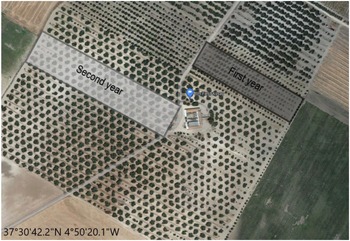
The field management of B. madritensis was performed on the farm where population BmR4 was collected, in Cordoba, Spain, during seasons 2019 to 2020 and 2020 to 2021 (Figure 1). Five herbicide treatments (plus an untreated control) (Table 3) were applied in a total of 24 plots of 20 m2 in a completely randomized block design with four replicates. Two treatments were applied in November (time A, TA) at preemergence or early emergence of the weed. The other three treatments were applied in December (time B, TB), at postemergence stages of the weed (BBCH-13 to BBCH-14 stages) in separate plots. The herbicide rates are shown in Table 3. The application was performed with a Pulvexper (Pulvexper, Ramerupt, France) backpack sprayer equipped with four flat-fan nozzles TeeJet® 11002 (TeeJet Technologies GmbH, Schorndorf, Germany), at a spraying pressure of 200 kPa and calibrated to deliver a volume of 200 L ha−1. Finally, B. madritensis control was evaluated at 15, 30, 60, and 90 DAHA. The visual estimation of plant damage/death was performed by the same person for all evaluations. Control ratings were expressed on a 0 (no control) to 100 (all plants dead) scale.
Location of the plots (Cordoba, Spain) where Bromus madritensis control was evaluated.

Herbicides and rates applied on farm with Bromus madritensis resistant to glyphosate.

a Application dates: TA = first year: November 15, 2019; second year: November 20, 2020. TB = first year: December 16, 2019; second year = December 18, 2020.
b Manufacturers: Terafit (Syngenta, Spain); Roundup Ultimate (Monsanto, Spain); Musketeer (Bayer CropScience, Spain); Agil (ADAMA, Spain).
Data Statistical Analysis
For the whole-plant trials, because no significant interaction and statistical differences were obtained between the two replications (ANOVA), pooled data were fit to three-parameter nonlinear regression analysis to determine the GR50 and LD50:
 $Y = c + {(d - c)/[1 + (x/g)b]} $
where Y is the weight or the survival, c (set to zero) and d parameters are the lower and upper asymptotes, b is the slope of the curve, g is the herbicide dose to inhibit the growth of or kill 50% of the population, and x is the herbicide rate. The analysis was performed using the drc package (Ritz et al. Reference Ritz, Baty, Streibig and Gerhard2015) in the R software program (v. 4.1.3).
The resistance factor (RF) was then estimated based on the GR50 and LD50 values according to the following equation:
 $${\rm{RF = (GR_{50} \ or \ LD_{50} R/GR_{50}\ or \ LD_{50} \ S) }}$$
where “R” is the resistant population and “S” is the susceptible population. In addition, a box plot was performed to visually group populations (arbitrarily based on the GR50 RF).
Once it had been established that normality and homoscedasticity requirements were met, shikimic acid and field management assays were submitted to one-way and two-way ANOVA, respectively, followed by a multiple mean comparison using Tukey’s test to separate the different groups (at P < 0.05). All ANOVAs were performed with Statistix 10 (Analytical Software, Tallahassee, FL, USA).
Results and Discussion
Bromus Species Characterization
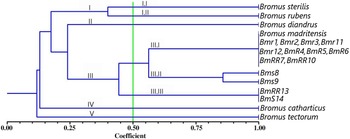
The dendrogram obtained using the similarity matrix and Jaccard’s coefficient revealed five groups. In Group I, two species were characterized, B. sterilis and B. rubens, named I.I and I.II, respectively. Group II corresponds to B. diandrus alone. The 14 populations of B. madritensis were included in Group III. However, these populations can be separated in three subgroups; the Andalusian populations (III.I), the Portuguese populations (III.II), and the populations from Lleida (III.III). Bromus catharticus and B. tectorum were separated into Groups IV and V, respectively (Figure 2).
Dendrogram of the six considered Bromus species. The 14 populations studied in this work are included within Bromus madritensis (Bm).

Bromus madritensis sensu lato, including B. rubens, forms a group of morphologically close taxa with erect and small lemmas and more or less contracted inflorescences. These characters separate the B. madritensis complex from other species in sect. Genea (Oja Reference Oja2002). Molecular markers such as SSRs or others have been widely used in the assessment of genetic diversity in weeds, both within and between related species (O’Hanlon et al. Reference O’Hanlon, Peakall and Briese2000); in the present research, seven SSR markers (Ramakrishnan et al. Reference Ramakrishnan, Coleman, Meyer and Fairbanks2002) were used to discriminate among six Bromus species (Table 2). These SSRs were transferable to the six considered species and polymorphic. Using estimated genetic distances, the six species were clearly differentiated (Figure 2), such as B. catharticus sect. Ceratochloa, but also the five species of sect. Genea, like B. madritensis, B. rubens, and B. diandrus, which are often confounded. Moreover, within the 14 B. madritensis populations included, the constructed dendrogram was able to discriminate among them according to their geographic areas (Portugal, Andalusia in the south of Spain, or Catalonia in northeastern Spain), but not according to their glyphosate-resistance status (susceptible or resistant). Overall, we confirmed that the 14 populations belong to B. madritensis and that they are genetically different from the other five Bromus species.
Glyphosate Resistance
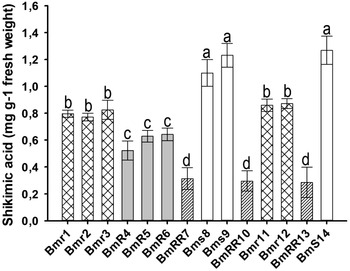
The response of the 14 B. madritensis populations to glyphosate was diverse, with different levels of SAA (Figure 3). Populations Bms8, Bms9, and BmS14 accumulated significantly more shikimic acid (>1,000 µg g−1) than the rest, rendering putative susceptibility. Among the remaining 11 populations, six had 600 µg g−1 or lower levels of SAA, clearly pointing to glyphosate resistance, while five had around 800 µg g−1, with a low resistance profile. Populations BmRR7, BmRR10, and BmRR13 showed the lowest SAA levels (around 300 µg g−1).
Shikimic-acid accumulation in 14 Bromus madritensis populations from Spain and Portugal. Different letters denote significant differences between means. Bars represent the standard error of the mean (n = 6).

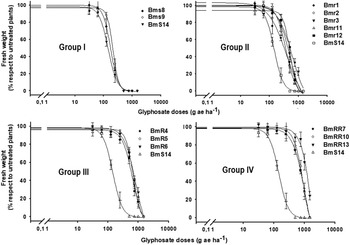
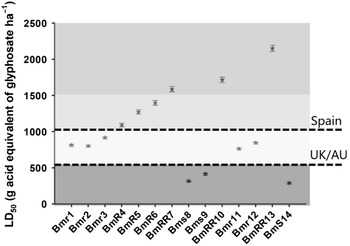
Different resistance levels were obtained for the 14 B. madritensis populations (Figure 4; Table 4). Significatively the most susceptible population was BmS14, with GR50 and LD50 values of 144 and 291 g ae ha−1, respectively (Supplementary Tables 2s and 3s). Populations Bms8 and Bms9 could also be designated susceptible (Group I in Figure 4), with RFs from 1.1 to 1.4, depending on the parameter analyzed (Supplementary Table 1s; Supplementary Figure 1s). This group of susceptible populations is well defined, as LD50 values were lower than the lowest recommended rate used for glyphosate. Six populations had resistance factors above 4, both for survival and fresh weight data, and could be classified as resistant, with LD50 values always above 1,080 g ae ha−1, the minimum registered rate in Spain for perennial crops (five populations) (Figure 5). Among these, two subgroups of populations with different resistance levels could be defined: (1) BmRR7, BmRR10, and BmRR13 were highly resistant, with GR50 and LD50 values ranging between 757 to 2,153 g ae ha−1 and RFs between 5.3 and 8.0 (Table 4; Group IV in Figure 4); and (2) BmR4, BmR5, and BmR6, with GR50 and LD50 values between 593 and 1,398 g ae ha−1 and RFs below 5 but above 3 (Table 4; Group III in Figure 4). Finally, the remaining five populations showed RFs below 3 (Table 4), and could not be clearly designated resistant. In this group, GR50 and LD50 values were also lower compared with those of the resistant populations (Groups III and IV in Figure 4). Group II with very low resistance levels had LD50 values ranging between the Spanish minimum registered rate in perennial crops (1,080 g ae ha−1) and those for Australia or the United Kingdom (Figure 5), which correspond to minimum label doses in Spain in arable crops in pre-sowing for annual weeds (540 g ae ha−1).
Response to glyphosate of eight resistant and three susceptible (Bms8, Bms9, and BmS14) populations of Bromus madritensis. Populations are grouped according to resistance levels: Group I, susceptible; Group II, low resistance; Group III, medium resistance; Group IV, high resistance. Bars represent the standard error of the mean (n = 20). Note that the most susceptible population (BmS14) is plotted in all the graphs for a better comparison.

Results of different parameters that define resistance to glyphosate in Bromus madritensis. a

a d is the upper coefficient; b is the slope of the curve; GR50 is the 50% growth inhibition rate; LD50 is the 50% death rate; and RF the resistance factor.
LD50 values for the 14 Bromus madritensis populations from Spain and Portugal. Dotted lines represent the minimum recommend rate in Spain in perennial crops (1,080 g ae ha−1) and in the United Kingdom and Australia (540 g ae ha−1), respectively, which is also the minimum dose in arable crops before sowing for annual weeds in Spain (the case for BmRR13).

Dose–response trials confirmed glyphosate resistance in at least six B. madritensis populations from Spain, with resistance levels 4- to 8-fold those of the susceptible populations (Table 4; Figure 4). SAA experiments also confirmed resistance to glyphosate in these populations, which showed the lowest levels compared with susceptible populations (more than 1,000 µg g−1 of shikimic acid) (Figure 3). Nevertheless, shikimic acid accumulated to some level in both susceptible and resistant plants, indicating that glyphosate was inhibiting the EPSPS enzyme, although at significantly different extents among populations (Figure 3). SAA is widely used to screen for glyphosate resistance (Shaner et al. Reference Shaner, Nadler-Hassar, Henry and Koger2005). Accordingly, those populations with higher LD50 and GR50 values also showed lower levels of SAA. Overall, considering the RFs (both for LD50 and GR50) and SAA, two groups of glyphosate-resistant B. madritensis populations could be established, one with moderate resistance levels and one with higher resistance levels, each having three populations (Table 4; Figures 3 and 4). In the first group, RFs ranged between 4 and 5 with around 600 µg g−1 of shikimic acid, while in the second group, RFs ranged between 5 and 8 with around 300 µg g−1 of shikimic acid. It has been proposed that different SAA patterns between susceptible and resistant plants can provide information about the target site–based resistance mechanism to glyphosate (Adu-Yeboah et al. Reference Adu-Yeboah, Malone, Fleet, Gill and Preston2020). In the case of the three populations with higher glyphosate resistance, SAA was also lower, suggesting a mechanism related to the EPSPS enzyme. Finally, there was a third group of B. madritensis populations with low levels of resistance (Group II in Figure 4), which could not be fully designated glyphosate resistant, with RFs below 4 (Table 4) and around 800 µg g−1 of shikimic acid (Figure 3). Interestingly, while glyphosate had been applied for at least 10 yr in the resistant populations, in this Group II of low-resistance populations, the herbicide had not been applied for more than 5 yr. Conservation agriculture and no-till practices are spreading in different crops of the Iberian Peninsula; thus more glyphosate applications can be expected. Moreover, higher glyphosate selection pressure can be predicted in those fields under no-till for more years. Previous studies also reported different levels of glyphosate resistance between populations with different intensities of glyphosate selection pressure in crops of the study area (Vázquez-García et al. Reference Vázquez-García, Castro, Torra, Alcántara-de la Cruz and Prado2020a, Reference Vázquez-García, Castro, Cruz-Hipólito, Millan, Palma-Bautista and De Prado2021a, Reference Vázquez-García, Rojano-Delgado, Alcántara-de la Cruz, Torra, Dellaferrera, Portugal and De Prado2021b).
The minimum registered rates for glyphosate in Spain are 1,080 g ae ha−1 and 540 g ae ha−1 in perennial crops and arable fields, respectively, and are usually the rates that are applied. The former rate is 2-fold higher than the label doses for glyphosate in countries like United Kingdom or Australia (Davies et al. Reference Davies, Hull, Moss and Neve2019; Malone et al. Reference Malone, Morran, Shirley, Boutsalis and Preston2016). The six B. madritensis populations (one from winter cereals) classified as resistant had LD50 values above the registered rate in Spain, as shown in Figure 5. It is accepted that a classification of “resistant” requires that the resistant population must survive the herbicide label dose under normal field conditions (HRAC 2022; Heap Reference Heap2022), which was in-field corroborated for one of the populations (Figures 6 and 7). On the other hand, five populations could not be fully designated resistant, with LD50 values between registered doses in Spain and those of the United Kingdom and Australia (Figure 5). Thus, these populations might have been classified as resistant according to the recommended field rates of those countries. Consequently, as registered doses can vary between countries, one must be cautious when referring to a resistant population from an agronomic perspective by the LD50 value (HRAC 2022; Heap Reference Heap2022).
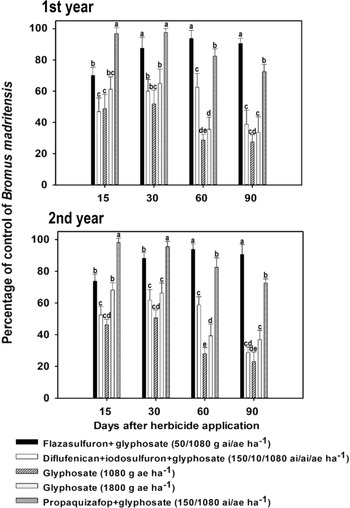
Field efficacies for the control of Bromus madritensis in 2019–2020 (top) and 2020–2021 (bottom). Different letters denote significant differences between treatments. Bars represent the standard error of the mean (four plots). The first two treatments were in preemergence–early postemergence (timing TA) (*), while the remaining three were in postemergence (timing TB).

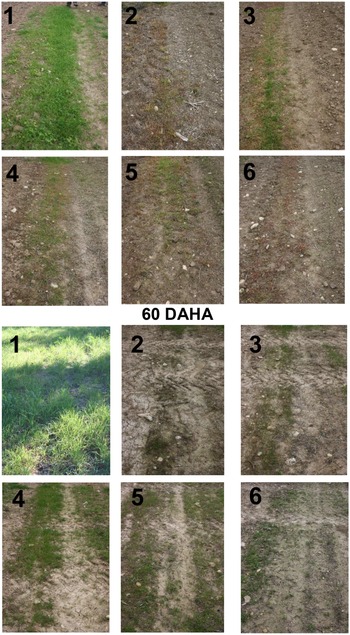
Bromus madritensis infestation and visual efficacy images in field treated with different herbicides (alone or mix) 30 and 60 d after herbicide application (DAHA). (1) Untreated; (2) flazasulfuron + glyphosate; (3) diflufenican + iodosulfuron + glyphosate; (4) glyphosate (1,080 g ae ha-1); (5) glyphosate (1,800 g ae ha-1); (6) propaquizafop + glyphosate. Treatments 2 and 3 in preemergence–early postemergence; 4 to 6 in postemergence.

This study confirms and details the first case of herbicide resistance in the weed species B. madritensis. The presence of glyphosate-resistant populations was established across different crops and geographic areas in Spain, except for the two Portuguese populations. Of the six B. madritensis populations classified as resistant (RFs > 4), five were located in the south of Spain (Cordoba, Sevilla, and Malaga), and one was found in northeastern Spain. Most were found in olive orchards, one came from a citrus grove, and another from winter cereals under no-till. Therefore, this research demonstrates that there is a great threat of glyphosate resistance continuing to evolve in this species and spreading to several cropping systems under conservation agriculture. High glyphosate selection pressures are expected to persist both in perennial crops and cereals at preseeding in the region (Beckie Reference Beckie2011; Collavo and Sattin Reference Collavo and Sattin2012, Reference Collavo and Sattin2014).
Field Trials
Field trials showed that there are some potential herbicide alternatives to glyphosate for the chemical management of B. madritensis, though they were tested in only 1 of the 14 populations. Overall, the control percentage of B. madritensis was similar in both years (Figure 6). In TA (preemergence or early emergence), only flazasulfuron plus glyphosate achieved acceptable control levels at 90 DAHA (≥90%), while in TB (postemergence) none of the three herbicide treatments reached 90% of efficacy at 90 DAHA. In both years, the best treatment in TB was glyphosate plus propaquizafop, which controlled almost 100% of B. diandrus at 15 and 30 DAHA, but these efficacies dropped below 80% at 90 DAHA. Figure 7 presents images showing the control efficacies reported quantitatively in Figure 6. Note the high efficacy achieved by flazasulfuron plus glyphosate applied at TA, particularly at 90 DAHA.
To the best of our knowledge, there is no information available concerning herbicide efficacies for the control of B. madritensis. Moreover, little information is available about the application of gramicides for the control of Bromus spp. (Brewster and Spinney Reference Brewster and Spinney1989; Royo-Esnal et al. Reference Royo-Esnal, Recasens, Garrido and Torra2018; Vázquez-García et al. Reference Vázquez-García, Castro, Cruz-Hipólito, Millan, Palma-Bautista and De Prado2021a). The present study included some herbicide alternatives at pre- or postemergence. The only treatment with efficacies consistently ≥90% in both years was flazasulfuron (acetolactate synthase inhibitor) plus glyphosate preemergence, while the acetyl-CoA carboxylase (ACCase) inhibitor propaquizafop postemergence, also mixed with glyphosate, showed decreasing control levels from >90% to below 80% at 15 to 90 DAHA, respectively. Previous studies showed that flazasulfuron could be a good alternative to manage glyphosate-resistant B. rubens populations, although ACCase inhibitors were also effective (Vázquez-García et al. Reference Vázquez-García, Castro, Cruz-Hipólito, Millan, Palma-Bautista and De Prado2021a). Few chemical tools are currently available to control B. madritensis, particularly glyphosate-resistant populations, a fact that should encourage farmers to switch their focus to integrated weed management strategies.
The glyphosate-resistant cases reported in Spain and Portugal have escalated rapidly in the last two decades (Torra et al. Reference Torra, Montull, Calha, Osuna, Portugal and de Prado2022). This research is the first report of herbicide resistance in B. madritensis in six populations that evolved glyphosate resistance in perennial orchards as well as in no-till winter cereals after more than a decade of continuous glyphosate use. The existing nonselective chemical options to control B. madritensis in these crops are crucial for farmers, because there are limited (selective) herbicides available. Therefore, to control this and other glyphosate-resistant species already reported in their fields (Torra et al. Reference Torra, Montull, Calha, Osuna, Portugal and de Prado2022), growers must employ a diverse integrated approach. The use of crop rotation or nonchemical methods, such as mechanical weeding, among others, is essential to reduce the impact of glyphosate-resistant weeds in the future in these cropping systems.
Supplementary material
To view supplementary material for this article, please visit https://doi.org/10.1017/wsc.2023.9
Acknowledgments
This work was supported by the Asociacion de Agroquimicos y Medio Ambiente, Spain. JT acknowledges support from the Spanish Ministry of Science, Innovation, and Universities (grant Ramon y Cajal RYC2018–023866-I) and from the Spanish State Research Agency, Spain (AEI) and the European Regional Development Fund, EU (ERDF) through the projects AGL2017-83325-C4-2-R and PID2020-113229RB-C42. No conflicts of interest have been declared.