Introduction
Historically, patient care “zones” in hazardous material (HazMat) events have been designated as hot, warm, and cold.Reference Noll and Hildebrand 1 , Reference Kenar and Karayulanoglu 2 Minimal care is delivered in the hot zone, which represents the site of maximal and uncontained contamination. Rather, the objective in this zone is rapid extraction of the patient from the source of on-going exposure. The warm zone is a transitional area defined by a patient decontamination corridor. During the extraction and decontamination processes, HazMat-rated personal protective equipment (PPE) is worn. Warm zone care may occur in the field or in a hospital decontamination facility. After decontamination is complete, the patient is transferred to the cold zone, an area in which no further contamination risk exists, and conventional patient care occurs.
Although traditionally patient care has been deferred according to the schema described above, unstable patients may require aggressive management in either the hot or warm zones. Failure to perform life-saving interventions is associated with an increased risk of avoidable death, frequently secondary to reversible respiratory failure following chemical agent exposure.Reference Baker 3 , Reference Muskat 4
By definition, any procedures occurring in the warm zone are performed by providers in HazMat PPE. Previous studies have demonstrated that PPE may increase the difficulty of airway management, even when using intubation aids or airway adjuncts.Reference Flaishon, Sotman, Ben-Abraham, Rudick, Varssano and Weinbroum 5 - Reference Castle, Pillay and Spencer 8 In recent years, the use of video laryngoscopy (VL) has become more commonplace in emergency airway management.Reference Griesdale, Liu, McKinney and Choi 9 The goal of the current study was to compare the efficiency by which an endotracheal tube could be placed properly by a patient care provider using VL or direct laryngoscopy (DL) while wearing HazMat PPE. A secondary goal was to assess provider perceptions of ease of use and feasibility with VL versus DL approaches to airway management while wearing HazMat PPE.
Methods
Study Population and Setting
The study population consisted of post-graduate year (PGY) 1-3 Emergency Medicine residents from a single residency program. The study was conducted while the residents participated in scheduled HazMat education and training in the use of PPE at a multi-disciplinary, high-fidelity simulation center. Inclusion criterion was consent to participate in the study. Exclusion criteria were refusal to consent, or presence of medical concerns precluding ability to participate, including pregnancy and claustrophobia. The study was reviewed and approved by the Mayo Foundation Institutional Review Board (Rochester, Minnesota USA).
Study Design
A randomized, crossover study with accompanying pre- and post-intervention questionnaires was conducted. Participants were de-identified and data were collected by pre-assigned numbers only. Prior to beginning the simulation center portion of the study, all participants were asked to complete a short questionnaire concerning previous experiences with different endotracheal intubation (ETI) techniques.
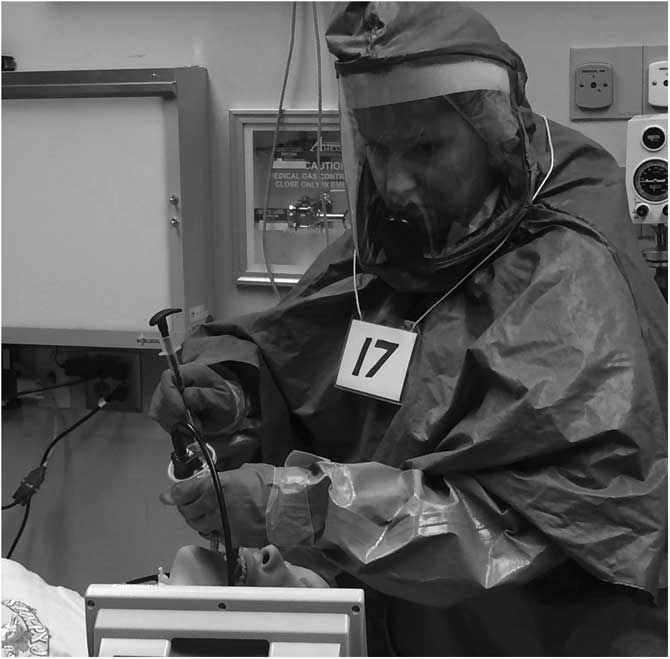
After completing the questionnaire, participants were randomized to VL or DL while wearing a Tychem F CPF 2 (DuPont USA; Wilmington, Delaware USA) encapsulating suit, Breathe Easy Butyl Hood System (3M Corporation; Maplewood, Minnesota USA) hooded powered air-purifying respirator (PAPR), nitrile gloves (Thermo Fisher Scientific; Waltham, Massachusetts USA), and Ongard Boots (Thermo Fisher Scientific) as PPE (Figure1). The primary intervention was the use of VL versus DL to perform ETI. Direct laryngoscopy was performed using standard fiberoptic laryngoscope blades (Heine USA LTD; Dover, New Hampshire USA) based upon the preference of the participant. Video laryngoscopy was performed using the GlideScope Cobalt AVL video laryngoscope (Verathon Inc; Bothell, Washington USA). Intubations were performed on a SimMan 3G (Laerdal Inc; Wappinger Falls, New York USA).
HazMat PPE Worn by Study Participants (see Methodology Section for Full Details about HazMat PPE Components). Abbreviations: HazMat, hazardous materials; PPE, personal protective equipment.

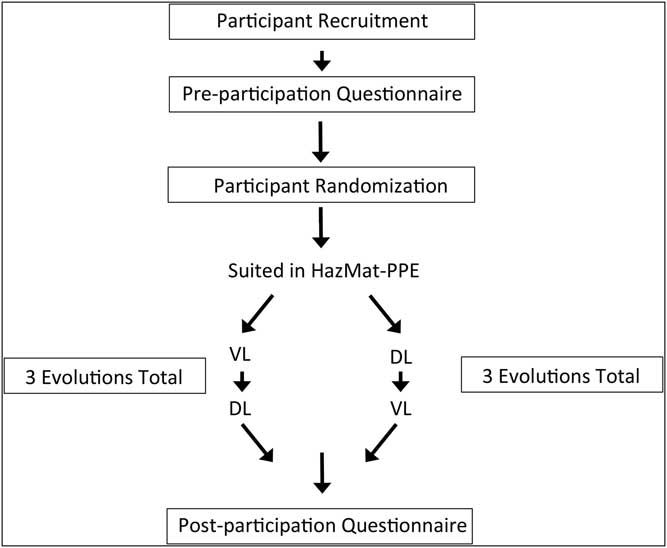
Having completed the initial VL or DL ETI procedure, as determined by randomization, participants then performed the remaining intubation method. Each participant completed a total of six alternating ETI procedures, three using VL and three using DL (Figure 2). Each participant served as his/her own control. The study sessions were recorded on video for ease of review and in a manner that allowed for de-identification of resident participants.
Schematic of Study Randomization Protocol. Abbreviations: DL, direct laryngoscopy; HazMat, hazardous materials; PPE, personal protective equipment; VL, video laryngoscopy.

Upon completing the simulation portion of the study, each participant completed a post-intervention questionnaire regarding perceptions of ease of use and feasibility for each ETI modality while wearing PPE.
Due to time and resource constraints of the HazMat education process and residency schedules, data were collected over four separate, yet standardized, simulation center sessions.
Outcome Measures
The primary outcome measure was time to successful endotracheal tube placement. Three time points were utilized in the analysis: Time 0= blade at lips/insertion, Time 1= blade removed from lips after endotracheal tube placement, and Time 2= bag valve mask (BVM) attached to endotracheal tube. Successful endotracheal tube placement was confirmed using lung expansion monitoring of the high-fidelity simulation mannequin. The secondary outcome measures were perception of ease of use and feasibility of VL versus DL ETI modalities.
Data Collection
Simulation center video recordings were captured using liteCam HD (v5.0.0.2; Rsupport; Englewood Cliffs, New Jersey USA). Frame times were identified subsequently and recorded for Time 0, Time 1, and Time 2 using Apple iMovie software (v9.0.8; Apple Inc; Cupertino, California USA). De-identified participant data were entered into a Microsoft Excel Database (Microsoft Excel for Mac 2011, v14.4.3; Microsoft Corporation; Redmond, Washington USA). Data were correlated with questionnaire response data by use of pre-assigned participant numbers.
Statistical Analysis and Sample Size Calculations
Times were compared using either Wilcoxon signed rank or paired t-tests (SAS v 9.3; SAS Institute; Carey, North Carolina USA). When including the single outlier event, the three attempts per subject were averaged prior to analysis and P value calculated using Wilcoxon signed rank test. For analysis after exclusion of the single outlier, the two attempts (outlier excluded) or three attempts (remaining subjects) were averaged prior to analysis and P value calculated using a paired t-test. Fisher Exact Tests were used to compare resident survey responses. All tests were two-sided and P values <.05 were considered statistically significant. Continuous features were summarized with means and standard deviations. Categorical features were summarized with frequency counts and percentages. Statistical analyses were performed using the SAS software package (SAS Institute).
Sample size calculations were performed based on a two-sided paired t-test assuming 80% power and a significance level of .05. Assumptions for expected results were based upon the work of Shin et al.Reference Shin, Choi, Na, Cho and Han 10 The calculations indicated that a sample size of 17 would be required to power the study adequately to detect a difference of eight seconds between the two modalities. This assumed a mean time to success using one modality of 23 seconds and 15 seconds with the other modality with a pooled standard deviation of 10. If the standard deviation was 12, a sample size of 24 would have been required.
Results
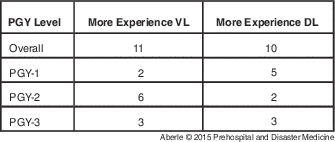
Twenty-one of 23 (91.3%) eligible residents participated in the study; two residents were excluded due to medical concerns. One resident was excluded because she was an investigator in this study. By training year, seven PGY-1, eight PGY-2, and six PGY-3 residents participated (Table 1). Eleven (52.4%) residents reported more experience with VL than with DL on the pre-intervention questionnaire (Table 1).
Summary of Participants by Post-graduate Year Level and Reported Intubation Experience with VL versus DL

Abbreviations: DL, direct laryngoscopy; PGY, post-graduate year; VL, video laryngoscopy.
Mean time to ETI was 10.0 seconds (SD=5.3 seconds) in the DL group and 7.8 seconds (SD=3.0 seconds) in the VL group (P=.08). The mean difference between the two groups was 2.2 seconds (SD=6.0 seconds). Mean times from blade insertion until BVM attachment were 17.4 seconds (SD=6.0 seconds) and 15.6 seconds (SD=4.6 seconds), respectively (P=.30). A single participant required several attempts prior to successful ETI during one DL trial. The remainder of participants demonstrated first pass success during all attempts. After accounting for this single DL attempt outlier, the mean times to ETI (Time 1) and from blade insertion until BVM attachment (Time 2) were 9.4 seconds (SD=3.5 seconds; P=.08) and 16.8 seconds (SD=5.0 seconds; P=.21), respectively.
After completing the experimental protocol, 20 participants completed the post-study survey; 17 (85.0%) participants perceived VL to be the easier method when performing ETI while using PPE, including seven participants who reported more experience using DL (P=.56). In contrast, 12 (60.0%) participants felt that DL was more feasible during actual HazMat events, including eight participants who reported more experience with VL (P=.36).
Discussion
The need for patient decontamination due to HazMat exposure is a relatively uncommon occurrence in the emergency department (ED). Although specific numbers are difficult to determine, a study of HazMat events in Washington State (USA) found that 457 unique events occurred over a 5-year period, resulting in 2,654 victims.Reference Burgess, Kovalchick, Harter, Kyes, Lymp and Brodkin 11 Seventy percent of these patients were transported by Emergency Medical Services (EMS) to health care facilities. A hospital survey of HazMat preparedness reported management of an average of 2.4 chemically contaminated patients per year.Reference Cone and Davidson 12
Although ideally these patients would be decontaminated at the scene prior to transport, this does not always occur. In some cases, patients transport themselves directly to the hospital, bypassing the EMS response. This was noted after the nerve agent attack on the Tokyo (Japan) subway, in which ambulatory victims independently presented for medical care.Reference Okumura, Takasu and Ishimatsu 13 Even when transported by EMS, a 6-year study of HazMat events demonstrated that none of 72 patients presenting to the hospital received prehospital decontamination.Reference Kirk, Cisek and Rose 14 This lack of decontamination makes secondary contamination of hospital personnel an unfortunate reality.Reference Horton, Berkowitz and Kaye 15 In many circumstances, the exposure is irritating but not life threatening.Reference Horton, Burgess, Rossiter and Kaye 16 However, during the Tokyo subway incident, 11 of 15 medical staff on duty at a single ED developed symptoms consistent with nerve agent exposure, and six required atropine therapy.Reference Nozaki, Hori and Shinozawa 17 A study of hospital evacuations due to HazMat incidents identified 11 incidents, including two evacuations due to secondary contamination of ED staff.Reference Burgess 18
In order to address this potential threat, regulatory agencies have specified requirements for the emergent hospital-based management of chemically contaminated victims. 19 , 20 Amongst the emphasis for staff safety is appropriate selection of PPE for warm zone decontamination processes.Reference Koenig, Boatright and Hancock 21 , Reference Hick, Hanfling, Burstein, Markham, Macintyre and Barbera 22 While PPE serves to protect the wearer from secondary contamination effects, it has the disadvantage of limiting dexterity and vision, thereby impairing the ability to perform medical interventions.Reference Castle, Owen, Hann, Clark, Reeves and Gurney 23 - Reference Berkenstadt, Arad and Nahtomi 26 This intrinsic limitation is compounded by lack of familiarity with PPE operational posture. As a consequence, in the civilian sector, medical interventions are often deferred until the patient is decontaminated and brought from the decontamination area (warm zone) into the ED (cold zone).
A foreseeable consequence of this process of deferring care until the cold zone is reached is the potential for patient decompensation due to lack of timely life-saving interventions. Previous studies have noted this possibility, especially in terms of respiratory compromise.Reference Baker 3 , Reference Muskat 4 Direct laryngoscopy in traditional HazMat PPE, including military style respirators, has proven challenging.Reference Flaishon, Sotman, Ben-Abraham, Rudick, Varssano and Weinbroum 5 A prospective controlled study of anesthesiologists demonstrated an intubation time of 47.3 seconds (SD=6.0 seconds) without PPE versus 69.2 seconds (SD=7.0 seconds) with PPE. Quality of intubation view was described as very good in 6.25% while wearing PPE compared with 62.5% without PPE.6 As a consequence, attention has turned to the use of airway adjuncts, and especially blindly inserted supraglottic airway devices.Reference Goldik, Bornstein, Eden and Ben-Abraham 27 - Reference Wayne and McDonnell 29 A study of anesthetists versus non-anesthetists demonstrated that the mean time for ETI was 28.6 seconds, compared with 3.6 seconds for laryngeal mask airway (LMA) insertion (P<.0001).Reference Ben-Abraham and Weinbroum 28 Failed intubation while wearing chemical PPE occurred in 35% of anesthetists and 55% of non-anesthetists (P=.17). No failures were noted with LMA insertion.
While supraglottic devices appear to mitigate some of the effects of the PPE, they do not provide definitive airway management. Recently, VL has become a more readily available alternative to DL in establishing a definitive airway, even in austere medical settings.Reference Cooper, Pacey, Bishop and McClusky 30 - Reference Nouruzi-Sedeh, Schumann and Groeben 35 A meta-analysis of VL versus DL for ETI demonstrated that use of VL was associated with improved airway visualization, particularly in patients with potential difficult airways and in non-expert performers.Reference Griesdale, Liu, McKinney and Choi 9 The penetration of VL into the skill set of Emergency Medicine residents is such that 11 of 21 (52.4%) residents in this study reported more intubation experience with VL than with DL.
The improved visualization noted with VL may serve to mitigate the previously noted difficulties with airway visualization in PPE, allowing rapid establishment of a definitive airway. A study of 31 participants using the Pentax-AWS (Pentax; Hamburg, Germany) VL device demonstrated that although intubation times suited in PPE were longer than non-suited times, suited intubations using VL were faster than suited intubations using DL.Reference Shin, Choi, Na, Cho and Han 10 Interestingly, suited VL intubations were faster than non-suited DL.
The current study used the GlideScope (Verathon Inc) VL device, a commonly used system in North America. No significant difference was observed between times to ETI with DL and VL, as measured by time from first inserting the device until time of removal. Times to ETI were rapid in both groups with a mean difference between the two groups of only 2.2 seconds (SD=6.0 seconds). Although the trend was towards statistical significance, the clinical significance is doubtful. Recent studies have suggested that the use of a hooded PAPR does not impair vision to the degree previously noted with military style Chemical, Biological, Radiological, Nuclear, and Explosive (CBRNE) PPE.Reference Brinker, Gray and Schumacher 36 This improved visualization ability might neutralize the noted benefits of VL.Reference Griesdale, Liu, McKinney and Choi 9
The rapidity of intubation (Time 1), even with DL, was unexpected. Intubation times were 17.4 seconds (SD=6.0 seconds) for DL and 15.6 seconds (SD=4.6 seconds) for VL from blade insertion until BVM attachment (Time 2). In the study by Ben-Abraham and Weinbroum,Reference Wayne and McDonnell 29 intubation times in protective gear were 26.4 seconds (SD=7.5 seconds) and 37.9 seconds (SD=7.1 seconds) for anesthetists and non-anesthetists, respectively. However, that study defined the time period as the time from first grasping the laryngoscope until manual positive pressure was achieved. The current study measured the time from the blade first crossing the threshold of the lips until removal of the blade (Time 1), and until attachment of the BVM device to the endotracheal tube (Time 2). As such, compared with the study by Ben-Abraham and Weinbroum,Reference Wayne and McDonnell 29 the current study was truncated at both ends of the intubation process. Time points were selected based upon the stated goal of determining speed and ease of intubation, and as such, attempted to remove unnecessary variables, including the time to grasp the blade and bring it into position and the time required to initiate the bagging process. These are both gross motor movement skills and are unlikely to be affected by PPE.
Seventeen (85%) of 20 participants who completed post-study surveys perceived that VL was easier to perform while in PPE than DL, including seven who reported more experience with DL. As such, in an unfamiliar clinical situation, such as patient care while wearing PPE, VL might increase operator comfort. Despite this, the majority of participants felt that DL was a more feasible airway management technique in a decontamination room environment. The rationale for this perception was not studied. Logistically, the use of an electrically powered device in an environment with large amounts of water might pose potential hazards to both patient and providers. Additionally, the technical decontamination of a VL device would be expected to be far more complex than that of a traditional DL device. In a worst-case scenario, the cost to discard and replace DL supplies would likely be considerably less than a VL device.
Limitations
This study has several important limitations. Twenty-one residents participated in the study. Although this represented 91.3% of possible participants, the power to detect a statistically significant difference between the two modalities was limited. Although an approximately two second difference between the two modalities in time to ETI was observed, the study was not powered adequately to detect statistical significance for this small of a difference. However, it is unlikely that a two second difference would be relevant clinically.
The participants were not blinded to airway device. They were also aware that they were being observed directly and recorded on video, potentially creating a Hawthorne effect. The net result might lead to subtle biases regarding the use of the airway devices.
The study involved a single high-fidelity simulation mannequin rather than actual patients. The mannequin did not have airway secretions or other clinical signs or symptoms likely present in the setting of chemical agent exposure with airway compromise. The mannequin had consistent airway anatomy between participants and between individual attempts. Although airway mannequins have been used in other PPE studies, the Emergency Medicine residents who participated in this study had twice-quarterly simulation training using the same mannequin, and had familiarity with the airway anatomy.
This study used PAPR devices rather than military style CBRNE respirators for the airway protection component of PPE. In contrast to military style respirators, PAPRs have a greater field of view and are less likely to fog. Although many institutions use PAPRs as part of the PPE ensemble, both for ease of use and familiarity, the results of this study may not translate to other PPE ensembles.
Conclusions
In this preliminary study comparing intubation methods using a high-fidelity simulation model while wearing HazMat PPE, no statistically significant difference was found between time to successful ETI using VL or DL. These preliminary findings suggest that both DL and VL are reasonable modalities for use in HazMat situations, and the choice of modality could be based on the clinical situation and provider experience. Larger studies are needed to confirm or refute these findings.