There is traditional and empirical knowledge amongst people in goat-farming communities that milk from a goat during oestrus may clot easily once it is heated for pasteurization. The practical significance is that, during this period, thermally treated milk is inappropriate for drinking because of altered physical characteristics due to clotting. Milk clotting during the thermal treatment may also be viewed as an indication of mastitis. Though consumption of goat milk is low, the potential market is large, since such milk is a good substitute for consumers allergic to cow milk (Zadow et al. Reference Zadow, Hardham, Kocak and Mayes1983).
Milk is heat stabile for a given heat treatment when coagulation (clotting) does not occur during that treatment. Goat milk has naturally lower heat stability than cow milk (Montilla & Calvo, Reference Montilla and Calvo1997; De la Fuente et al. Reference De la Fuente, Olano, Casal and Juarez1999; Morgan et al. Reference Morgan, Micault and Fauquant2001; Bouhallab et al. Reference Bouhallab, Leconte, Le Graet and Garem2002; Raynal-Ljutovac et al. Reference Raynal-Ljutovac, Massouras and Barbosa2004). However, as for cow milk, goat milk must be submitted to thermal treatment before further utilization as drinking milk, manufacturing of yoghurt, or making cheese. Consequently, it is important for the goat milk industry to be aware that the physical properties of the milk, and especially its heat stability, are subject to variation due to stage of the oestrous cycle. In the case of drinking milk, the importance of milk heat stability during thermal treatment is obvious, as clotted milk is not desirable for drinking. For making yogurt, the milk should not clot after the thermal treatment. Additionally, the physical properties of milk are important since they can influence the design and operation of cheese processing equipment or can be used to assess the extent of biochemical changes in the milk during processing (Fox & McSweeney, Reference Fox and McSweeney1998).
In relation to the stage of oestrous cycle, the goat milk parameter that has been studied to some extent is somatic cell count (SCC). Increases in SCC have been reported to coincide with the onset of the seasonal mating period (Lerondelle et al. Reference Lerondelle, Richard and Issartial1992; Calderini et al. Reference Calderini, Colafrancesco, Fagiolo, Reitano and DeMichelis1994; Moroni et al. Reference Moroni, Pisoni, Savoini, van Lier, Acuna, Damian and Meikle2007) and associated with induction of oestrus in dairy goats (Aleandri et al. Reference Aleandri, Fagiolo, Calderini, Colafrancesco, Giangolini, Rosati and De Michelis1994; McDougall & Voermans, Reference McDougall and Voermans2002). The influence of oestrus on SCC has been studied in dairy cows but the results have been contradictory. One study reported an increase in SCC at oestrus (King, Reference King1977), whereas other studies neither demonstrated an effect of oestrous cycle stage on SCC (Guidry et al. Reference Guidry, Paape and Pearson1975; Anderson et al. Reference Anderson, Smith, Spahr, Gustafsson, Hixon, Weston, Jaster, Shanks and Whitmore1983) nor on milk yield and composition (Cowan & Larson, Reference Cowan and Larson1979).
The main objective of the present study was to define the effects of oestrus in dairy goats on heat stability of milk. The effects of oestrus on SCC, pH, fat, protein and lactose content of the milk were also investigated.
Materials and Methods
The study herd
The study was conducted on a farm of 115 Saanen-cross dairy goats, 3 to 6 years old, in Central Greece. The farm was located on a plain and the goats were housed in a modern barn with machine milking facilities. Each animal was identified by an ear tag. The herd had a seasonal breeding pattern which started at the end of August and finished by the end of September. Therefore, the kidding period started approximately in February and does suckled their kids for 20 to 50 d, when the kids were abruptly weaned. Subsequently, all goats were machine milked twice daily for 7 months. There was no teat preparation before milking, but a 0·5% iodine disinfectant was applied by to each teat after milking. According to the farm records, the average annual milk yield per doe for 2005 was 575 l. Milk was exclusively sold for production of pasteurized-fresh milk and cheese.
The herd was grazed under various pasture regimens for only 2 h daily, due to a shortage of grazing land. Pasture was supplemented with 500 g corn silage per head and cereal hay was offered ad libitum. Additionally, during the last month of pregnancy and during the sucking period, each doe was given a daily supplement of 500 g compound feed, while during the milking period this amount was increased to 1000 g.
The herd was certified free of brucellosis, Mycoplasma agalactiae infection and also free of caprine arthritis and encephalitis virus. This field trial was approved by the Animal Ethics Committee of District Veterinary Service of Karditsa prefecture, Greece.
Experimental design
On 15 June 2006, milk samples were collected from both halves of the udder of all the 115 does and subjected to bacteriological examination. Thereby, the goats were assigned by intramammary bacteriological status as infected or uninfected. Subsequently, only the uninfected animals ranked on the average SCC of three tests that were carried out on three composite (from both halves of the mammary gland) milk samples taken from each doe on 20, 22, and 24 June 2006. Each sequential pair of goats in the rank formed a pair and, within a pair, the goats were assigned by flipping a coin to be either oestrus synchronized or left as unsynchronized non-oestrus controls.
On 26 June 2006, the goats to be synchronized were transported and housed in a different external paddock with no contact with the unsynchronized control goats. The synchrony consisted of insertion of an intravaginal sponge containing 0·45 g progesterone (CHRONOJET; Intervet, Athens, Greece) for a period of 17 d, starting on 1 July 2006 (D-17). On 18 July 2006 (D0), the intravaginal sponges were removed and bucks were placed with the does.
The goats were monitored for signs of oestrus by the herd owner for the period between 26 June 2006 and 1 August 2006. Oestrus was defined as having occurred when a goat repeatedly vocalized, rotated its tail, had vulva swelling or urinated frequently. Furthermore for the goats in the synchronized group and for the days that bucks were present, oestrus was defined as having occurred when a doe mated with a buck.
The oestrus group comprised the synchronized goats which showed oestrus on 20 July 2006 (D2). Mates in each sequential pair identified on 24 June 2006 to the does in the oestrus group comprised the control group.
A composite milk sample (~100 ml) was collected from each doe on D-4, -3, -2, -1, 0, 1, 2, 3, 4, 5, 6 and 10. The samples were analysed for heat stability, SCC, pH, fat, protein, and lactose content. Additionally, on D-4, 1 and 10, milk samples (~10 ml) were collected from each doe for bacteriological examination.
Goats found to be infected on the bacteriological examinations of D-4, 1 and 10 were excluded from the experiment together with their corresponding pair mates. Also, goats in the control group that were defined as showing oestrus between 26 June 2006 and 1 August 2006 were excluded from the experiment together with their corresponding pair mates.
Milk sampling
For heat stability, SCC, pH, fat, protein and lactose content, a composite milk sample (~100 ml) was collected during the morning milking. Approximately 6 to 8 sec after the initiation of machine milking, the teat cups were removed and the milk sample was collected by hand milking of the both halves of the mammary gland (equal volumes from the two halves for a composite sample).
For the bacteriological examination, a composite milk sample (~10 ml) was collected before the morning milking by hand milking. The teats had been prepared before sampling by scrubbing with 70% methanol.
The milk samples were immediately sent to the Laboratory of Hygiene of Animal Origin Foods, School of Veterinary Medicine, University of Thessaly, Karditsa, Greece. The analyses for heat stability, SCC, pH, fat, protein and lactose content were performed on the same day. Bacteriological examination was started the same day of the sampling.
Analyses
The heat stability of the milk samples was determined according to the protocol reported by Bouhallab et al. (Reference Bouhallab, Leconte, Le Graet and Garem2002). Samples of 1 ml were sealed in glass capillary tubes and gradually heat-treated in an oil bath at temperatures in the range of 80 to 140°C, at increments of 2 deg C min−1. The heat coagulation temperature (HCT) was defined as the maximum temperature at which the sample was stable for 1 min+1°C. Three replicates were performed for each sample and the average measurement was used for statistical analysis.
SCC were determined using a Fossomatic 360 (Fosselectric, Hillerød, Denmark). Fat, protein, and lactose contents were measured by using an infra-red milk analyzer (Milkoscan FT120; Fosselectric, Hillerød, Denmark). The pH was measured by use of a pH meter (PH 525, LAB pH meter, WTW, Weilheim, Germany).
For the bacteriological determination, milk was streaked aseptically on blood agar (5% sheep blood) as well as on McConkey's agar. Both Petri dishes were incubated aerobically at 37°C for 48 h. The cultured bacteria were identified on the basis of Gram stain, colony morphology, type of haemolysis and from the results of hippurate and esculin hydrolysis, tube coagulase, catalase, and CAMP tests. A milk sample was considered as infected when it yielded at least one colony of a pathogen that could produce primary mammary infections or occasional causes of mastitis (Filioussis et al. Reference Filioussis, Christodoulopoulos, Thatcher, Petridou and Bourtzi-Chatzopoulou2007). Any infected milk sample was considered to originate from an animal with clinical or subclinical mastitis, and the animal and its pair-mate were excluded from the study.
Statistical analyses
The data were analysed by using the statistical program SPSS (version 13 for windows). The normality of the data was tested by the Kolmogorov-Smirnov test and the homogeneity of variances by the Levene test. The repeated measurements analysis of variance model included the effect of group (oestrus or control), doe, sample day, the group×sample day interaction, and random error. Group and sample day were fixed effects and doe was a random effect so that the mean square for doe was used to test the group effect and the random error was used to test the effects of sample day and the interaction. The SCC value on D-4 was used as a covariate. Pearson correlation tested for associations between heat stability and the other measurements. A significance level of P⩽0·05 was used in all comparisons.
Results
Seventy eight goats out of 115 tested were found to be mastitis free during sampling on 15 June 2006. On D2, 22 out of 39 goats that were synchronized showed oestrus. No goat in the control group showed oestrus signs during the period between 26 June and 1 August 2006. On D-4, one milk sample from an unsynchronized goat was found infected. This goat was the pair-mate of a synchronized goat that showed oestrus on D2 and data for both goats were excluded from the data set leaving 21 goats in each group. The average (±sd) age of goats in the control and oestrus groups was 4·12±1·06 and 4·43±1·03 years, respectively.
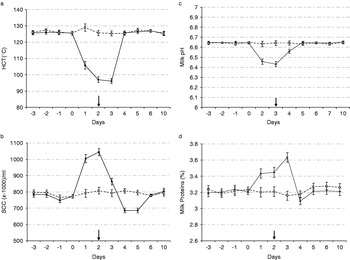
The repeated measurements analysis showed that the group×day interaction affected HCT (P<0·001), SCC (P<0·001), milk pH (P<0·001), and milk protein (P<0·05), indicating that the difference between the oestrus and control groups depended upon the day of experiment. Thus, when the goats were in oestrus, milk heat stability (Fig. 1a), SCC (Fig. 1b), pH (Fig. 1c), and protein values (Fig. 1d) were different from those for the control group. HCT was lower in the oestrus group compared with the control group on D1, 2 and 3 (P<0·001). The SCC were higher on D1, 2 and 3 (P<0·001) and lower on D4 and 5 (P<0·001) in the oestrus group compared with the control group. Milk pH was lower in the oestrus group compared with the control group on D1, 2 and 3 (P<0·001). Milk fat (mean±se: 3·31 and 3·02±0·020%) and lactose (4·50 and 4·48±0·009% for oestrus and control groups, respectively) were unaffected by oestrus. In contrast, milk protein percentage was significantly higher in the oestrus than in the control group on D1, 2 and 3 (P<0·05).
Marginal means±se of (a), heat coagulation temperature (HCT) in °C; of (b), somatic cell count (SCC); of (c), pH and of (d), protein percentage in milk samples of two groups of goats (◆, oestrous and □, control groups) obtained on D-3, -2 and -1 (before the sponge removal), on the D0 (sponge removal) and on D1 to 10 (after the sponge removal). The arrow indicates the day of oestrus (D2).

Heat stability was linearly correlated only with milk pH (r=0·490, P<0·001), SCC (r=−0·340, P<0·001) and milk protein percentage (r=−0·394, P<0·001).
Discussion
Our data show that caprine milk associated with oestrus has reduced heat stability. The recorded increase of SCC as affected by oestrus is in accordance with several previous reports (Lerondelle et al. Reference Lerondelle, Richard and Issartial1992; Aleandri et al. Reference Aleandri, Fagiolo, Calderini, Colafrancesco, Giangolini, Rosati and De Michelis1994; Calderini et al. Reference Calderini, Colafrancesco, Fagiolo, Reitano and DeMichelis1994; McDougall & Voermans, Reference McDougall and Voermans2002; Moroni et al. Reference Moroni, Pisoni, Savoini, van Lier, Acuna, Damian and Meikle2007). Also, our findings about protein, fat and lactose content of the milk during oestrus are in accordance with the findings by Moroni et al. Reference Moroni, Pisoni, Savoini, van Lier, Acuna, Damian and Meikle2007. Information on milk pH during oestrus has not been reported previously.
It is generally acknowledged that goat milk is more sensitive to high thermal treatment than cow milk. The available reports suggest that pH (Zadow et al. Reference Zadow, Hardham, Kocak and Mayes1983; Ram & Sindhu, Reference Ram and Sindhu1991; Montilla & Calvo, Reference Montilla and Calvo1997; Anema & Stanley, Reference Anema and Stanley1998), genetic polymorphism of α−S1 casein (Tziboula, Reference Tziboula1997), non-protein nitrogen (Mukherjee et al. Reference Mukherjee, Bandyopadhay and Ghatak1993), salt balance (Ram & Sindhu, Reference Ram and Sindhu1991), and ionic calcium (Zadow et al. Reference Zadow, Hardham, Kocak and Mayes1983; Montilla & Calvo, Reference Montilla and Calvo1997) could be directly or indirectly involved in the heat sensitivity of caprine milk.
The physiological reasons for the reported reduction in heat stability associated with oestrus were not examined extensively in this study. The significant linear associations of heat stability with pH, SCC and milk protein percentage provide some evidence that these factors could contribute to the reduction of milk heat stability during oestrus.
The recorded reduction of the pH in the milk samples on D1, D2 and D3 as well as its positive correlation with heat stability, suggests that reduced pH is possibly the most important factor associated with the observed reduction in heat stability. There are few reports about the effect of pH on the heat stability of goat milk. Zadow et al. (Reference Zadow, Hardham, Kocak and Mayes1983) indicated that goat milk at a given pH had a reduced stability for UHT processing compared with cow milk. Fox & Hoynes (Reference Fox and Hoynes1976), Zadow et al. (Reference Zadow, Hardham, Kocak and Mayes1983) and Montilla & Calvo (Reference Montilla and Calvo1997) reported that the heat stability of goat milk increased with increased pH value. More recently, Morgan et al. (Reference Morgan, Micault and Fauquant2001) reported that the typical heat stability v. pH profiles obtained for goat milk showed marked maximum heat stability at pH 6·9 to 7·0, which is significantly higher than the natural pH (6·6 to 6·7).
Heat stability was negatively correlated with SCC in the present study. Increased SCC were associated with reduced heat stability in previous reports but the explanation offered can not account for the phenomenon. Proteinases are known to reduce heat stability in milk (Fox, Reference Fox and Fox1989). Plasmin is the major proteinase normally present in milk (Manjunath & Bath, Reference Manjunath and Bhat1990). In cows, milk from quarters with subclinical mastitis showed elevated SCC and higher activity of plasmin than milk from healthy quarters (Urech et al. Reference Urech, Puhan and Schallibaum1999). Thus, any milk sample with high SCC would also be likely to show raised levels of plasmin activity and therefore reduced heat stability.
The recorded increase of the protein percentage during oestrus and its negative relation with heat stability suggests proteins may be another contributory factor for the reduction of the heat stability. The increased levels of protein associated with oestrus appear reasonable, because of the positive effect of oestrogens on milk protein anabolism (Moroni et al. Reference Moroni, Pisoni, Savoini, van Lier, Acuna, Damian and Meikle2007). However, the protein content has been found to be of minor importance for goat milk heat stability at its natural pH (pH 6·6 to 6·7), but was promoted at more elevated pH of 6·9 (Morgan et al. Reference Morgan, Micault and Fauquant2001).
Dairy goat lactations range from 7 to 9 months, depending on the management system, and the breeding period usually occurs during the milking period. Consequently, the investigation of the physical and chemical properties of milk during the breeding period is of practical significance. The reduction of heat stability, as reported here for D1, 2 and 3 of oestrus, increases the risk for milk coagulation during the necessary thermal treatment and suggests that the milk of goats during the mating period is sensitive to thermal treatment. To ensure that milk from goats in oestrus will not clot during high thermal treatment, as for making yogurt when high temperature is required to denature whey protein, milk from goats in oestrus should be properly diluted into bulk tanks.