

Recent political developments, like the election of President Trump and the so-called European “refugee crisis,” have sparked renewed interest in the question of how citizens form opinions about immigration. This manuscript contributes to ongoing debates and examines if correcting misperceptions about immigrants can change citizens’ opinions on immigration policies. Our analysis draws on published work by Lawrence and Sides (Reference Lawrence and Sides2014) and Hopkins et al. (Reference Hopkins, Sides and Citrin2019) but extends it in several ways. Empirically, we move the analysis to Denmark and use data from a large representative sample to test the generalizability of earlier findings. Theoretically, we examine whether different types of correct information about non-Western immigrants – including their crime and welfare dependency rates – affect natives’ immigration preferences. We also examine the mental strategies people can use to refrain from updating their immigration opinions when confronted with correct information. Like earlier work, we find that people update their factual beliefs in light of correct information about the costs and benefits of immigration but reject to change their policy opinions. Importantly, our final test offers a novel explanation for this pattern of results: even when people acknowledge new facts, they reinterpret them to maintain their existing policy views.
Correcting misperceptions, immigration beliefs, and policy opinions
Citizens often exaggerate the prevalence of immigrants in their surroundings (Wong et al. Reference Wong, Bowers, Williams and Simmons2012), just as they tend to hold inaccurate beliefs about the broader social and economic impacts of immigration. Moreover, people who overestimate problems with immigration are more likely to support anti-immigration policies (Sides and Citrin Reference Sides and Citrin2007; Nadeau et al. Reference Nadeau, Niemi and Lavine1993). Taken together, this invites the question we examine here: Would citizens hold more favorable immigration policy opinions had they been better informed?
According to two prominent studies, the answer is no. Lawrence and Sides (Reference Lawrence and Sides2014) and Hopkins et al. (Reference Hopkins, Sides and Citrin2019) recently showed that native-born Americans overestimate the share of the foreign-born population, and that offering correct information about the size of the immigrant population does little to change their policy opinions. Instead, their findings suggest that immigration attitudes are rooted in deeply held convictions that make people discard counter-attitudinal information. Accordingly, they complement a long line of research on directional motivated reasoning (e.g., Kunda Reference Kunda1990; Taber and Lodge Reference Taber and Lodge2006). Nonetheless, the studies have – as the authors themselves note – some limitations. First, the studies focus on “immigrants,” without identifying specific immigration groups. This may matter since people may feel hostility toward some immigrants (e.g., non-Western immigrants) but not others (e.g., Western immigrants) (Dennison and Geddes Reference Dennison and Geddes2018; Hainmueller and Hangartner Reference Hainmueller and Hangartner2013). Second, they only examine the effects of information about the size of immigrant groups. Yet, correcting misperceptions that touch upon cultural or economic threats posed by immigrants may have stronger effects on citizens’ policy opinions. Third, the studies do not examine why corrective information fails to change opinions. One explanation for the lack of effects is that people simply refuse to accept information that challenges their opinions, even when the information is correct. Another explanation is that people acknowledge correct information and update their factual beliefs but reinterpret the information in a selective fashion that justifies their existing opinions (Gaines et al. Reference Gaines, Kuklinski, Quirk, Peyton and Verkuilen2007). This latter explanation is especially troublesome for democracy: if people can interpret information as they wish, they can always distort the causal chain from factual reality to political judgments.
Our study presents an experiment that isolates the effects of correct information about non-Western immigrants on native-born Danes’ immigration policy opinions. We situate our study in Denmark to examine if findings from the USA travel to other settings. We focus on non-Western immigrants because they differ the most ethnically and culturally from native Danes and because they form the group that has received the greatest amount of attention in Europe, including in Denmark (Dinesen and Sønderskov Reference Dinesen and Sønderskov2015). Our information treatments provide participants with correct information about non-Western immigrants’ crime and welfare dependency rates. Welfare information taps into the economic consequences of immigration, while crime information arguably touches upon cultural and security threats posed by immigrants. Consequently, we assume that natives use welfare and crime information as cues for the integration success of non-Western immigrants into Danish society. Finally, we examine one potentially important mental tool that citizens can use to rationalize existing (anti)-immigration opinions in light of corrective information: Interpretations.
Lastly, we highlight two unpublished studies that pursue the same research agenda as us. The first is an impressive multicountry study by Alesina and colleagues (Reference Alesina Alberto and Stancheva2018), showing that information about (non-Western) immigrants – including information about a hardworking immigrant woman, akin to our welfare treatment – often fails to change immigration attitudes, even when they cause people to update factual beliefs. Second is an excellent study by Barrera Rodriguez et al. (Reference Barrera Rodriguez, Guriev, Henry and Zhuravskaya2020), showing that “alternative immigration facts” promoted by right-wing Presidential candidate Marine Le Pen (MLP) move voting intentions closer to MLP, while fact-checking corrections fail to reduce this effect. Despite design similarities, the two papers differ from ours in important ways, including the information treatments they use (e.g., they do not examine crime information) and – in some instances – the outcomes of interest (e.g., voting intentions). Importantly, they also differ from us in that neither of them examine how interpretations may help explain why people acknowledge new immigration facts but still fail to change their policy views.
Research design
Our design follows a three-step sequence where participants first reported their “best estimates” (prior beliefs) of three types of immigrant facts, described below. Second, we randomly assigned participants to receive or not receive correct information about the same facts. Third, participants reported again their best estimates of the immigration facts (posterior beliefs), their immigration policy opinions as well as how they interpreted the immigration facts.
Participants and procedure
We embedded our experiment in a survey administered to a nationally representative sample of Danes. Responses were collected in June 2017 by Survey Sampling International (n = 1,747). The sample was drawn to match the broader population of Denmark with respect to age, gender, income, and education (see appendix B.1 for sample characteristics and appendix A for all question wordings). We only include participants where at least one of the parents were born in Denmark and held Danish citizenship (n = 1,638).
Pretreatment measures
Before treatment exposure, participants stated their prior beliefs about non-Western immigrants’ crime rate, their welfare dependency rate, and the size of the non-Western population living in Denmark. Regarding crime, we asked “In 2016, out of 100 crimes in Denmark, how many do you think were committed by immigrants or descendants from non-Western countries?” Regarding welfare, we asked “In 2016, out of 100 people receiving social benefits in Denmark, how many do you think were immigrants or descendants from non-Western countries?” Regarding size, we asked “In 2016, out of 100 people living in Denmark, how many do you think were immigrants or descendants from non-Western countries?”Footnote 1 We randomized the question order, and, for each question, participants used a sliding cursor to choose any number between 0 and 100.Footnote 2
Treatments
Following a series of filler questions, we assigned participants to either a “no-information” control condition (n = 410) or one of three treatment conditions. In the three treatment conditions, participants received information about either the number of crimes committed by non-Western immigrants in Denmark (crime condition, n = 409), the number of non-Western welfare recipients in Denmark (welfare condition, n = 410), or the share of non-Western immigrants (size condition, n = 409). The three information treatments included the same preamble: “We are interested in whether you have heard about a story that has recently been in the news. The story is …” For the crime condition, participants subsequently read “[a] new report from Statistics Denmark shows that 21 out of 100 people who were convicted of committing a criminal offense in Denmark in 2016 were immigrants or descendants from non-Western countries.” The welfare condition stated that 14 out of 100 welfare beneficiaries were non-Western immigrants, and the size condition stated that 8 out of 100 people living in Denmark were non-Western immigrants. All statistics were based on true information from the official government agency Statistics Denmark, which is generally regarded as a trustworthy information source.
Post-treatment measures
All participants received the same post-treatment questions.
Policy preferences
First, in the context of an eight-item battery tapping a number of policy preferences, participants saw two items related to immigrants and crime (e.g., “Politicians should make it easier to expel criminal immigrants”), two items related to immigrants and welfare (e.g., “Refugees and immigrants who live in Denmark should have the same right to economic support as ethnic Danes”), and two items related to the preferred number of immigrants in Denmark (e.g., “Denmark should receive more refugees than is the case today”). All answers to the immigration-related questions were summed into an index, scaled to range from 0 to 1, with higher values indicating greater support for anti-immigration policies.
Posterior beliefs
Second, we relied on the prior beliefs measures from the pretreatment questionnaire and asked participants to report again their best guess on each of the three issues.
Interpretation of immigration information
Finally, participants indicated on five-point scales how they interpreted the immigration information presented to them. For example, participants in the crime condition were asked “Thinking back on the report from Statistics Denmark, which showed that 21 of 100 crimes in Denmark were committed by immigrants or descendants from non-Western countries, do you think that number is very low, low, neither nor, high, or very high?” We asked participants in the welfare and size conditions similar questions. We presented participants in the control condition with three questions, one for each of the immigration quantities, and asked them to “imagine that a report from Statistics Denmark showed …”, followed by the same correct statistics used in the treatment conditions.
Results
Posterior beliefs
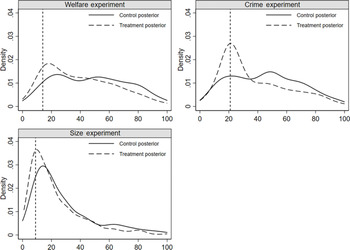
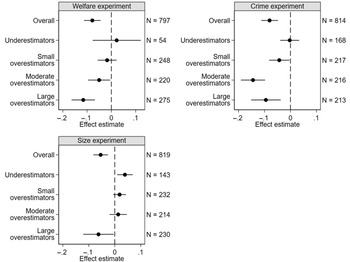
Did corrective information cause citizens to update their factual beliefs about non-Western immigrants? Figure 1 answers this question by comparing the posterior beliefs of participants in the treatment groups to the posterior beliefs in the no-information control group. The three panels show that compared to participants in the control group – who overstated problems associated with non-Western immigration – the treatments moved the respective posterior beliefs downward toward the true proportions (i.e., the vertical dotted lines). In particular, the crime and welfare treatments had an average effect of about 8% points (p’s < 0.0001), while the size treatment had an effect of about 5.5% points (p < 0.0001). These findings show that people do not simply reject disconfirming information. We reinforce this claim in Figure 2, where we use information on participants’ prior beliefs to show that the treatment effects were largest among participants who initially overestimated problems with immigrants the most (see appendix B.4–B.5 for codings and supporting results). In all the three experiments, moderate or large overestimators updated their posterior beliefs the most (about 8%–15% points each).Footnote 3
Posterior Beliefs by Treatment Status.
Note: Differences in posterior beliefs between control group and treatment groups in the three experiments. Vertical dotted lines give the true proportions of non-Western immigrants.

Effects on Posterior Expectations.
Note: Effects of information treatments on posterior beliefs for the three experiments. “Overall” gives the average treatment effects, while the other coefficients give effects broken down by participants’ prior beliefs. Ninety-five percent confidence intervals. Outcomes range from 0 to 1.

Policy preferences
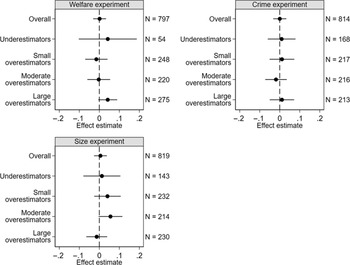
Corrective information made participants update their factual beliefs but did it also cause them to change their policy opinions? To examine this, Figure 3 presents estimated coefficients from models where we regress immigration-related policy opinions on our treatment conditions (see appendix B.6 for supporting results). In stark contrast to the previous findings, Figure 3 shows that none of the information treatments affected participants’ immigration policy opinions. In all three panels, the coefficient for the average treatment effect (labeled “Overall”) is statistically insignificant and close to zero. The same results emerge when we subset the analysis based on participants’ prior belief: The effect estimates are insignificant, irrespective of participants’ initial beliefs about the problems associated with immigration. We reach the same conclusion, when we in Figure B.9 in the appendix analyze each of the policy questions separately: there is no consistent effect of corrective information on policy opinions. Taken together, these results replicate earlier studies (e.g., Alesina et al. Reference Alesina Alberto and Stancheva2018; Hopkins et al. Reference Hopkins, Sides and Citrin2019; Lawrence and Sides Reference Lawrence and Sides2014): correct information about non-Western immigrants cause people to hold more accurate factual beliefs but fails to affect immigration policy opinions.
Effects on Policy Preferences.
Note: Effects of information treatments on immigration policy preferences for the three experiments. “Overall” gives the average treatment effects, while the other coefficients give effects broken down by participants’ prior beliefs. Ninety-five percent confidence intervals. Outcomes are scaled from 0 to 1 where higher values indicate anti-immigration preferences.

Interpretations
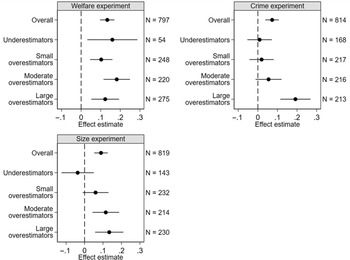
Why did correct information fail to change policy opinions? One possibility is that people acknowledge new facts but choose to interpret them in a highly selective fashion. For example, consider a “treated” participant who at the outset held unfavorable views on immigration. She may feel forced to accept the corrective information but may nevertheless – to justify her negative immigration opinions – choose to interpret the new number as high (e.g., “the number is smaller than I thought, but still much too high”). In contrast, if that same person had been a “control” participant, she would have no need to adjust her factual beliefs and thus would have no reason to reinterpret the numbers. One observable implication of this view is that people who initially overestimated the problems and received correct information will interpret the treatment information as more worrisome than control participants who did not receive corrective information. To test this proposition, Figure 4 shows results from models where we regress interpretations of the correct numbers on the treatment conditions (see appendix B.7 for supporting results). The “overall” estimates show that across all conditions, participants who received correct information interpreted the numbers as higher and more troublesome compared to participants in the control condition who had no reason to adjust their interpretations (bwelfare = 0.14, p < 0.0001; bcrime = 0.07, p < 0.0001; bsize = 0.08, p < 0.0001). While the effects are similar across subgroups in the welfare experiment, we see that the effects increase as prior biases grow larger in both the crime and size experiments. Taken together, these results suggest that people use interpretations to justify their existing attitudes. As such, they help explain why getting the facts right may in itself be insufficient to change people’s policy views.
Effects on Interpretations.
Note: Effects of information treatments on interpretations for the three experiments. “Overall” gives the average treatments effects, while the other coefficients give effects broken down by participants’ prior beliefs. Ninety-five percent confidence intervals. Outcomes are scaled from 0 to 1, where higher values indicate that participants interpret the number as high.

Conclusion
In this study, we examined whether corrective information about the consequences of immigration could alter natives’ immigration policy opinions. We sought to replicate and extend prior work by moving the analysis to a new country (i.e., Denmark) and by examining reactions to different types of immigrant information (i.e., welfare dependency rates, crime rates) about a specific and hotly contested immigrant group (i.e., non-Western immigrants). Importantly, we also examined the information processing strategies people can use when exposed to correct information. Our findings support the conclusions from earlier work that people update their factual beliefs in light of correct information but fail to change their policy views. As a novel finding, we demonstrate that the link between facts and policy beliefs break down because people interpret information in a belief-consistent manner. Together, our findings suggest that immigration attitudes are highly stable and persistent (see also Kustov et al. Reference Kustov, Laaker and Reller2019), like many other types of political preferences (e.g., partisanship). Of course, our study has limitations. Perhaps exposure to information over an extended period would yield larger effects. Perhaps other information types that speak directly to natives’ cultural concerns about immigrants (e.g., their willingness to learn the Danish language) matter more. And perhaps participants may have viewed non-Western immigrants more favorably if we had presented the information differently (e.g., relative comparisons of non-Western immigrants versus ethnic Danes) or together with other types of information, like party cues (e.g., Barrera Rodriguez et al. Reference Barrera Rodriguez, Guriev, Henry and Zhuravskaya2020). That said, we believe our results contribute to our understanding of how people evaluate information with political consequences and how they use (or avoid using) information to guide their policy preferences.
Supplementary Material
To view supplementary material for this article, please visit https://doi.org/10.1017/XPS.2020.35