Sentence repetition is apparently an easy and simple task. It only implies listening to the target sentences and reproducing them immediately as accurately as possible. From an early age, most children readily repeat words and sentences in their spontaneous interactions. However, in spite of this apparent simplicity, there is not yet a theoretical agreement on the cognitive processes underlying the task and different researchers discuss which is its nature and relationship with other language skills. Some of them emphasize the memory processes underlying sentence repetition (Adams & Gathercole, Reference Adams and Gathercole2000; Alloway et al., Reference Alloway, Gathercole, Willis and Adams2004; Alloway & Gathercole, Reference Alloway and Gathercole2005; Pierce et al., Reference Pierce, Genesee, Delcenserie and Morgan2017), whereas others argue that the task provides a measure of language processing skills and not necessarily of a separate memory component (Klem et al., Reference Klem, Melby‐Lervåg, Hagtvet, Solveig-Alma, Gustafsson and Hulme2015; Nag et al., Reference Nag, Snowling and Mirković2018; Polišenská et al., Reference Polišenská, Chiat and Roy2015; Riches, Reference Riches2012).
Beyond this disagreement, sentence repetition tasks have been widely used in the last years as a diagnostic tool in developmental language disorders. In fact, some authors consider that sentence repetition scores are better clinical markers of Specific Language Impairment (SLI) than other used assessments, such as non-word repetition and past tense elicitation tasks (Archibald & Joanisse Reference Archibald and Joanisse2009; Conti-Ramsden et al., Reference Conti-Ramsden, Botting and Faragher2001; Seeff-Gabriel et al., Reference Seeff-Gabriel, Chiat and Dodd2010). Bilingual and multilingual children with language impairment also perform poorly on this task (Chiat et al., Reference Chiat, Armon-Lotem, Marinis, Polišenská, Roy and Seeff-Gabriel2013; Nag et al., Reference Nag, Snowling and Mirković2018; Simón-Cereijido, Reference Simón-Cereijido, Schwartz and Benavides2017).
In the last decade, sentence repetition tasks have been developed for different languages and age groups. English is the one that counts with a higher number of studies (Baddeley et al., Reference Baddeley, Hitch and Allen2009; Chiat et al., Reference Chiat, Armon-Lotem, Marinis, Polišenská, Roy and Seeff-Gabriel2013; Riches, Reference Riches2012; Seeff-Gabriel et al., Reference Seeff-Gabriel, Chiat and Roy2008; Stokes et al., Reference Stokes, Wong, Fletcher and Leonard2006 – comparing English and Cantonese), but there are studies in other languages (i.e., Catalan: Gavarró, Reference Gavarró2017; Czech: Polišenská et al., Reference Polišenská, Chiat and Roy2015; French: Leclercq et al., Reference Lecrercq, Quémart, Magis and Maillart2014; Italian: Devescovi & Caselli, Reference Devescovi and Caselli2007; Kannada: Nag et al., Reference Nag, Snowling and Mirković2018; Norwegian: Klem et al., Reference Klem, Melby‐Lervåg, Hagtvet, Solveig-Alma, Gustafsson and Hulme2015; Hungarian: Gábor & Lukács, Reference Gábor and Lukács2012; Icelandic: Thordardottir, Reference Thordardottir2008).
In Spanish, to our knowledge, there is only one pilot study (Moreno-Torres et al., Reference Moreno-Torres, Madrid and Moruno2013) with 18 typically developing (TD) children and 10 deaf children with cochlear implant (ages: 2 to 4 years). A total of 24 sentences (18 simple and 6 complex) were presented to the children to repeat them. Qualitative analysis revealed that the children made typical errors observed in spontaneous language, as omissions of unstressed words, use of protoarticles and morphological generalizations. Most children with cochlear implant scored very poorly in the task, but mean length of utterance of the repeated sentences was significantly correlated with that of spontaneous language. Although as the authors recognize, this was a preliminary research, the task seemed to be potentially useful in evaluation of early language development in Spanish.
Regarding standardized tests, there are some instruments adapted to Spanish, not specifically designed as a sentence repetition tasks, but that include a few number of items to be repeated as part of a broad language assessment. Among them, there is a Spanish version of the Clinical Evaluation of the Language Fundamentals (CELF) test for preschool children aged 3 through 6 years 11 months (Wiig et al., Reference Wiig, Secord and Semel2009). The standardization sample was comprised of 464 individuals from across the United States and Puerto Rico and 122 out of them were reported to be bilingual (p. 153). Therefore we understand that the scores and norms are not specifically adapted to the participants in Spain. The Developmental Neuropsychological Assessment (NEPSY–II; Korkman et al., 2007/Reference Korkman, Kirk and Kemp2018) adapted into Spanish also includes a sentence repetition task for children 3 to 6 years of age and there are norms for Spanish monolingual population. There are some problems derived from the direct translation of the items in both tests, specifically the representative value of the sentences for assessing Spanish grammar knowledge. For bilingual English-Spanish (Mexican) children (4 to 6 years) there is an instrument for language assessment that includes a sentence repetition task (Bilingual English-Spanish Asessment, BESA; Peña et al., Reference Peña, Gutiérrez-Clellen, Iglesias, Goldstein and Bedore2014), standardized for this particular bilingual population. From the best of our knowledge there are not standardized tasks or any experimental assessment of sentence repetition with children of 2 years old in Spanish.
It is difficult to compare previous results derived from studies that specifically use sentence repetition tasks. However, in spite of the diversity of languages, ages of the participants and tasks’ designs, researchers coincide in highlighting the potential of this task to provide valid information on children’s linguistic knowledge and to discriminate between typically developing children and children with language delays or disorders (Seeff-Gabriel et al., Reference Seeff-Gabriel, Chiat and Dodd2010). In this vein, Devescovi & Caselli, (Reference Devescovi and Caselli2007) showed that performance in sentence repetition varied significantly by age in a study with Italian preschoolers. At the age of 2 years children produced incomplete sentences for all sentence types (simple and complex). Regarding Mean Length of Utterances (MLU), the average length of children’s sentence imitation increased gradually from 2.13 words at 2 years to 4.42 at the age of 4 years. More detailed analysis demonstrated that the increase in sentence length was due to a gradual decrease in omission errors. Specifically, for the youngest group, omission of articles, preposition and modifiers were very frequent. For the age of 3 years 6 months the mean number of omissions in children’s repetitions was very low in all grammatical categories. By contrast, the incidence of morphological errors and/or substitutions was low even for the youngest groups. These results, obtained in a language typologically similar to Spanish, are in agreement with the assumption that, in the early stages of development, language is characterized by the presence of content words, but few function words.
Regarding this imbalance between content and function words in early language, in English, Chiat & Roy (Reference Chiat and Roy2008) administered a sentence repetition task to a sample of 187 clinically referred children aged 4–5 years. The repetition performance of these participants was influenced by morphosyntax, with children better able to repeat content than function words. This same pattern of repetition was found by Seeff-Gabriel et al., (Reference Seeff-Gabriel, Chiat and Roy2008) in a study with English typically developing children aged 2 to 4.
Nonword and Sentence Repetition
There are some studies including Non-Word Repetition (NWR) Tasks compared to Sentence Repetition (SR). Non-word repetitions tasks, both in monolingual and bilingual children, are usually considered as a measure of verbal short-term memory, working memory (Alloway & Gathercole, Reference Alloway and Gathercole2005; Archibald & Joanisse, Reference Archibald and Joanisse2009; Baddeley et al., Reference Baddeley, Hitch and Allen2009) and a measure of the ability to form sub-lexical representations based on phonotactic characteristics of a given language (Szewczyk et al., Reference Szewczyk, Marecka, Chiat and Wodniecka2018). Sentence repetition tasks require engagement of comprehension and production processes involving phonological, morphosyntactic and semantic representations, as well as the capacity to store and retrieve linguistic material from memory (Marinis & Armon-Lotem, Reference Marinis, Armon-Lotem, Armon-Lotem, de Jong and Meir2015; Polišenská et al., Reference Polišenská, Chiat and Roy2015). Both repetition measures are moderately to highly correlated in different studies and children with Developmental Language Disorders (DLD) performed below typically developing children (TD) in NWR and SR tasks (see Zebib et al., Reference Zebib, Tuller, Hamann, Abed Ibrahim and Prévost2020 - for French monolingual and bilingual children with TD and DLD profiles; Rujas et al., Reference Rujas, Mariscal, Casla, Lázaro and Murillo2017 – for monolingual Spanish Late Talkers). The relative advantage of sentence repetition as a diagnostic marker over non-word repetition seems to rely on the involvement of prior language knowledge (phonological, lexical and morphosyntactic) residing in long-term memory. Length and morphosyntactic complexity play a role in SR accuracy, but there are studies that have shown that performance in SR is affected by syntactic complexity independent of sentence length due to the reliance on long-term linguistic representations (Riches, Reference Riches2012). Both factors should be considered when designing a sentence repetition task in any language.
The Present Study
Sentence repetition tasks seem to reflect well-known characteristics of early language developmental stages, as the difference between acquisition of content versus function word or typical error patterns. Besides, they seem to draw upon a wide range of language processing skills (Klem et al., Reference Klem, Melby‐Lervåg, Hagtvet, Solveig-Alma, Gustafsson and Hulme2015; Nag et al., Reference Nag, Snowling and Mirković2018). Methodologically, repetition tasks allow the examiners to control a range of selected targets in a more systematic way and to obtain evidence on children’s linguistic performance beyond other repetition tasks, as NWR. In practical terms, this is a more efficient method, as it constitutes an alternative to more time-consuming procedures as spontaneous language sampling analysis and/or the application of general linguistic tests.
Excepting Moreno-Torres et al., (Reference Moreno-Torres, Madrid and Moruno2013) pilot study, no previous study has, to our knowledge, examined Spanish typically developing children under 4 years of age, using a specific sentence repetition task. Given the reliability, validity and predictive value of this kind of instruments to detect language delays and disorders, this study was designed aiming at:
-
1. Building a new sentence repetition task in this language, appropriate and engaging for very young children.
-
2. Including a set of sentences with different length and morphosyntactic complexity, adequate to assess and discriminate grammar development of Spanish children from 2 to 4 years of age.
-
3. Presenting evidence of its concurrent validity with another measure based on repetition (non-word repetition task).
In this study we take into account sentence length (number of words), the familiarity of content words that form the sentences and the complexity of the items in morphosyntactic terms. Considering the typological characteristics of Spanish, the sentences built up contain a wide range of function words, inflections and syntactic structures representative of the language and of the participant’s developmental levels (see details in Procedure).
We expect a good internal consistency for the whole set of sentences developed, and, consequently, that the task is appropriate to assess morphosyntactic development of the participants in our study. We also expect to get age effects showing the capacity of this tool to discriminate between different developmental levels; that is, that older children obtain significantly better scores than younger ones. Moreover, differences between errors affecting open and close words are expected. Errors affecting function words are hypothesized to be more frequent than errors affecting content words, but differences between both kinds of errors are expected to decrease as children grow older. Finally, positive and significant correlations with non-word repetition task are hypothesized.
Method
Participants
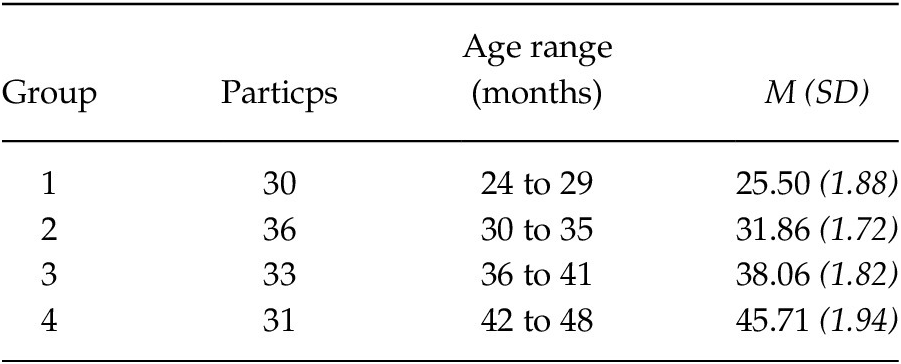
The participants were 130 children (56 boys and 74 girls) between 24 to 48 months of age. They were divided into 4 groups of age (see Table 1). All participants were recruited from kindergartens and municipal nursery schools from Madrid and Toledo (Spain). All participants were monolingual Spanish-speaking children, with no history of hearing loss and no referral to speech or language therapy services. All of them were typically developing children with no language delay, as shown by the two standardized tools used (see Procedure). The sample is typical of a middle socio-economic class.
Distribution of Participants by Age

Families signed consent forms to participate in this study, which was approved by the Research Ethical Boards of the Universidad Nacional de Educación a Distancia where this project was carried out.
Procedure
Materials and Tasks
Children under 2 years 6 months of age were assessed with the MacArthur Communicative Development Inventories (Spanish-European version; López-Ornat et al., Reference López-Ornat, Gallego, Gallo, Karousou, Mariscal and Martínez2005), as this parent report can be administered up to 30 months of age. Only children with vocabulary and grammatical percentiles within normal ranges were included in the sample (Group 1); so children with percentile ≤ 20 were excluded. For older children (2 years 6 months to 4 years; Groups 2 to 4) Receptive and Expressive Language subscales evaluated by examiner and parents, both from the Merrill-Palmer-Revised Scales of Development (Roid et al., 2004/Reference Roid, Sampers, Anderson, Erickson and Post2011), were used to assess language level. As for the case of Group 1, only participants scoring within normal ranges were included (i.e., children scoring 2 standard deviation bellow the mean were excluded).
A subsample of 92 children was also evaluated using a non-word repetition task used in previous studies (Mariscal & Gallego, Reference Mariscal and Gallego2013; Rujas et al., Reference Rujas, Mariscal, Casla, Lázaro and Murillo2017). This task has not been standardized, but the only pseudoword repetition task standardized in Spanish starts at the age of 4 (Lázaro et al., Reference Lázaro, Rujas, Montero, Murillo and Casla2018).
For sentence repetition a list of 33 sentences was built up, controlling length and phonological complexity of content words. The set of words included are frequent items used by Spanish children in their acquisition process and were taken from López-Ornat et al., (Reference López-Ornat, Gallego, Gallo, Karousou, Mariscal and Martínez2005) MacArthur-Bates Communicative Development Inventories (MCDI) database. Specifically, they were words used by 50% or more of the children included in this database. Lexical items contain early acquired phonemes and, when possible, consonant clusters were avoided and simple syllabic structure (CV) was chosen to elude the impact of articulatory difficulties to produce the words. To develop the list of sentences and their ordering, a developmental criterion was taken into account, graduating the difficulty of the items according to the acquisition of morphosyntactic structures in children’s language. Thus, simple declarative sentences with noun phrase (NP) + verb phrase (VP) structure were included at the beginning of the list, and then sentence length was gradually increased together with the number of morphemes and modifiers. More complex sentences including a greater number and variety of bound morphemes and coordinated and subordinate sentences of later appearance in children’s language were included in the second part of the list. The sentences were presented in the same order to children (see Appendix for the list of Spanish sentences and its translation into English).
After getting to know with the researcher, each child was administered the task in the school she/he attended (in some cases at home, with the presence of one parent). All the participants completed the task in less than 20 minutes and their performance showed their comprehension of the instructions. Similarly to Seeff-Gabriel et al., (Reference Seeff-Gabriel, Chiat and Roy2008), for the repetition task a puppet was used to help children to get involved. Specifically, children were seated in front of the researcher, the puppet was introduced and children were asked to teach him to talk. The sentences were read out by the experimenter in the same order to all the children, at a normal utterance pace and clearly articulated. Stamps and stickers were used to reinforce them every 5 items. It could be that children did not respond after the first attempt. In these cases, a second opportunity was provided. If there was no answer, next item was presented. All children’s answers were audio or video recorded for transcription and coding.
Transcription, Coding and Scoring
Children’s sentence repetitions were recorded and transcribed off-line. Given the transparency of Spanish orthographic system, children’s responses were transcribed orthographically.
After transcription, all children’s repetitions were first coded at sentence level (i.e., correct or incorrect sentence repetition) and then at word (content vs. function words) and morpheme level (Noun and Verb bound morphemes). To be considered ‘correct’ at sentence level, all words comprising each sentence have to be repeated, without considering articulation errors. For word level coding, three different kinds of errors were coded: Substitution, omission and addition. For morpheme level, substitution errors were coded considering its grammaticality. We also included the code XXX for unintelligible segments, NR for non-responses and considered word order errors. For this study, we only report analysis at sentence and word level (see Result). According to this coding system, two measures were defined: (a) A sentence level accuracy measure: Number and proportion of correctly repeated sentences, compared to the number of targets attempted by each child, and, (b) measures of the number and kind of errors of children’s repetitions of content words (CWs) and function words (FWs).
A second rater (a trained speech and language therapist) coded 11.54 % of the children’s repetitions and inter-coder agreement for sentence level coding was calculated (Kappa = .84).
Results
Reliability
Cronbach’s coefficient alpha was computed for the set of items as a whole. For the sentence level measure of global accuracy the alpha was .97. This result shows that the task achieved a good level of internal consistency.
Responsiveness
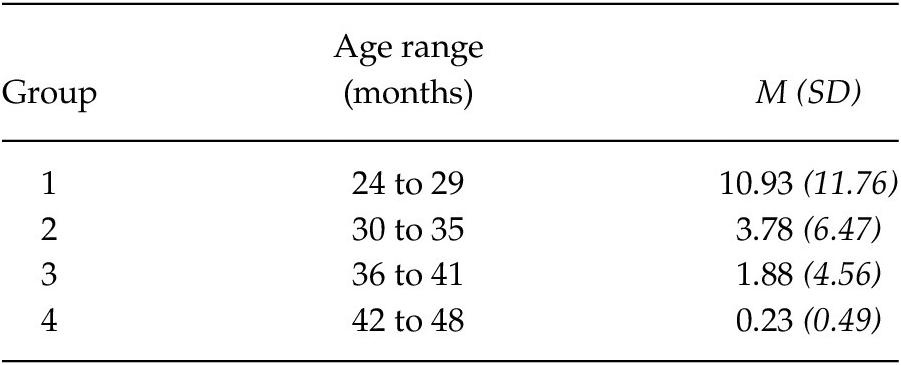
Children’s responsiveness was high compared to other studies (Seeff-Gabriel et al., Reference Seeff-Gabriel, Chiat and Roy2008), especially for children older than 30 months of age. Table 2 shows the mean number of nonresponses and standard deviation by age group for the task. The mean rate of non-responses was age related. Variability is especially high for younger children (Group 1) and it decreases through ages. This result has clear consequences for interpreting scores (see Discussion).
Mean Number of Nonresponses for the Sentence Repetition Task by Age Group (Maximum Score = 33)

Developmental Effects
The analyses are reported separately for sentence and word level measures.
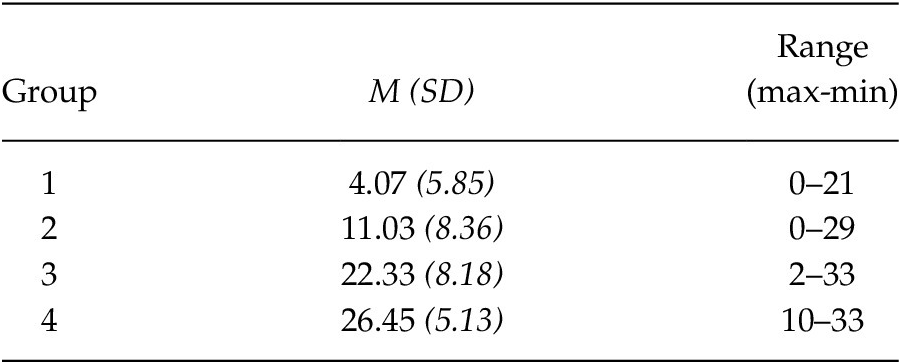
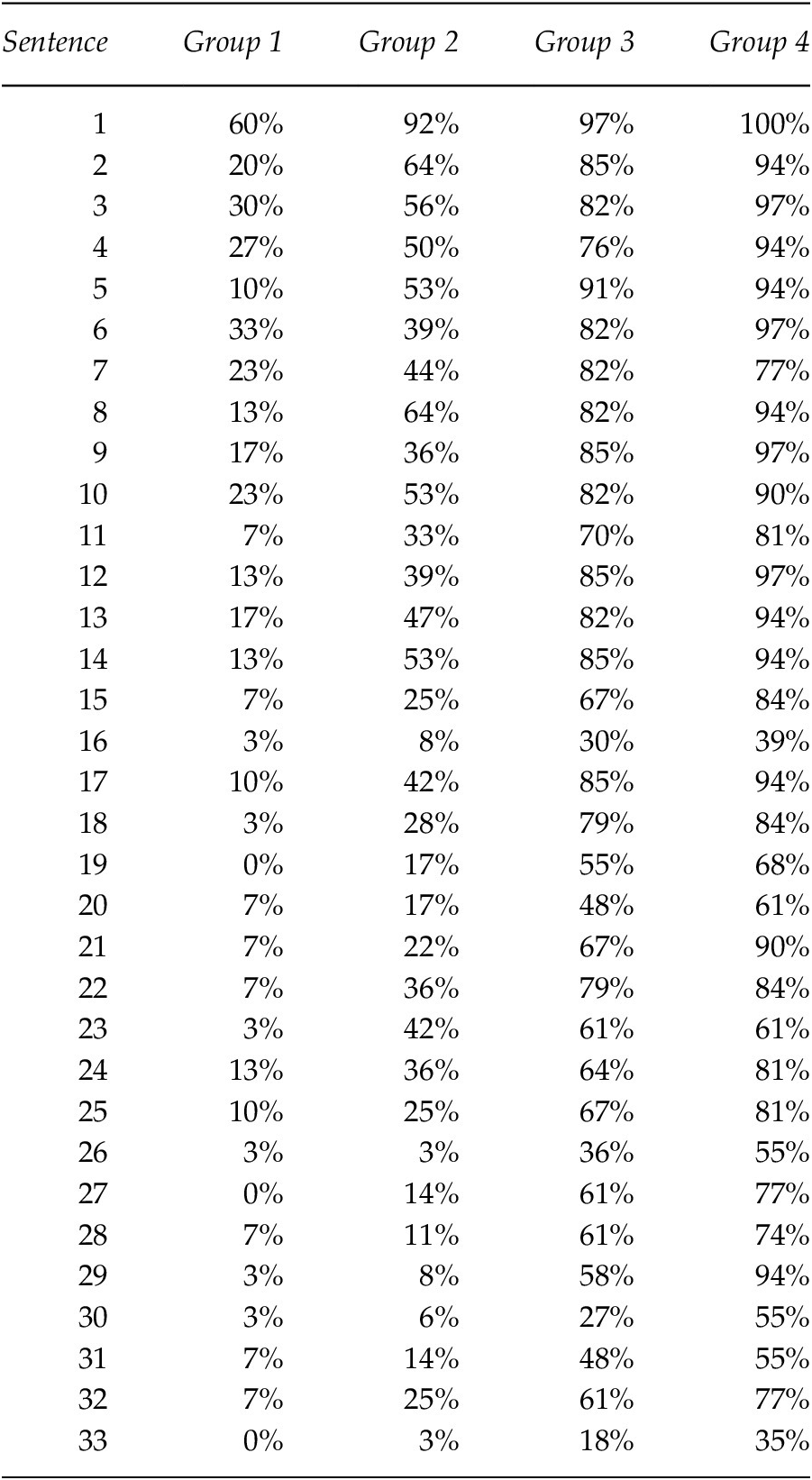
Firstly, for the accuracy measure on sentence repetition, total number of correctly repeated items and proportion scores (calculated out of the total number of items attempted by each child) were obtained. Given the positive and high correlation between both sets of scores, absolutes and proportions, (r = .963; p < .001, bilateral) the following results and analysis only refer to absolute scores. Table 3 shows descriptive statistics regarding performance for the 4 age-groups. Only 3 (out of 31) children from Group 4 obtained the maximum score, so a ceiling effect was not reached. One-way analysis of variance shows a clear age effect, F (3, 126) = 63.1, p < .001, η2 = .600, 1–β= .999. As expected, sentence repetition accuracy increases developmentally. Post-hoc comparisons (Bonferroni) show significant differences (p < .01) between all age groups, except between Groups 3 (M = 22.33) and 4 (M = 26.45) (p = .18). More detailed information regarding the percentages of correct responses for each sentence is shown in Table 4.
Total Number of Correctly Repeated Sentences

Percentage of Correct Repetitions per Sentence by Age Group

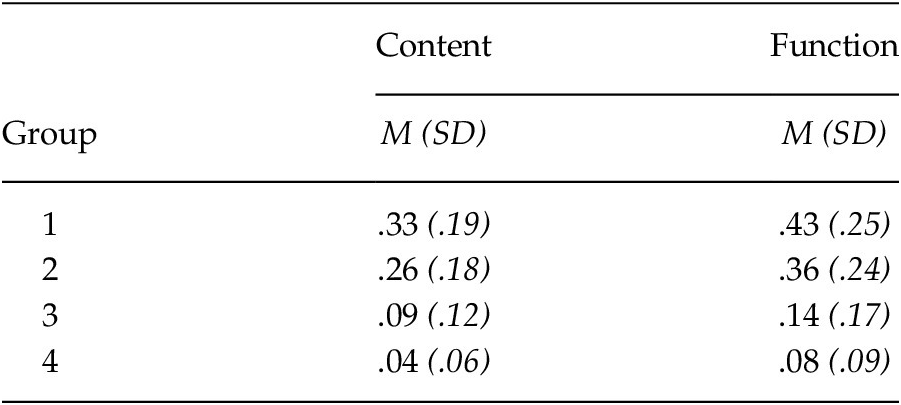
Secondly, number of errors regarding children’s repetition of Content and Function words (CW & FW) were computed separately. Given the different number of both kinds of words in the set of sentences (106 content words and 86 function words), proportion scores were obtained and used for analysis.
Table 5 shows descriptive statistics regarding errors in CWs and FWs for the 4 age-groups. A mixed analysis of variance shows a clear effect of the word type, F(1, 126) = 124.55, p < .001, η2 = .505, 1–β= .999. As expected children of all ages produce more errors when repeating function words than content words. Besides, there is an interaction between age-group and word type, F(3, 126) = 7.23, p < .001, η2 = .151, 1–β= .981. As age increases differences between content and function words decreases, but the difference between CW and FW scores is only significant (p < .001) for Groups 1, 2 and 3, but it does not have significance for Group 4, as it is indicated by Bonferroni test (p = .007).
Proportion of Repetition Errors in Content and Function Words

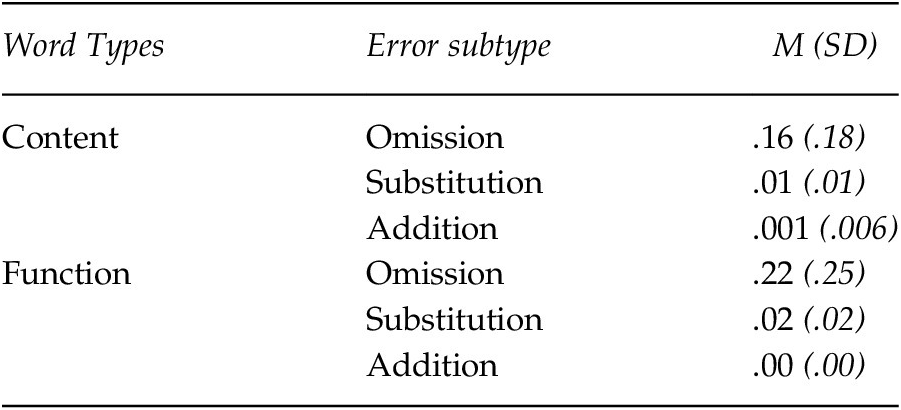
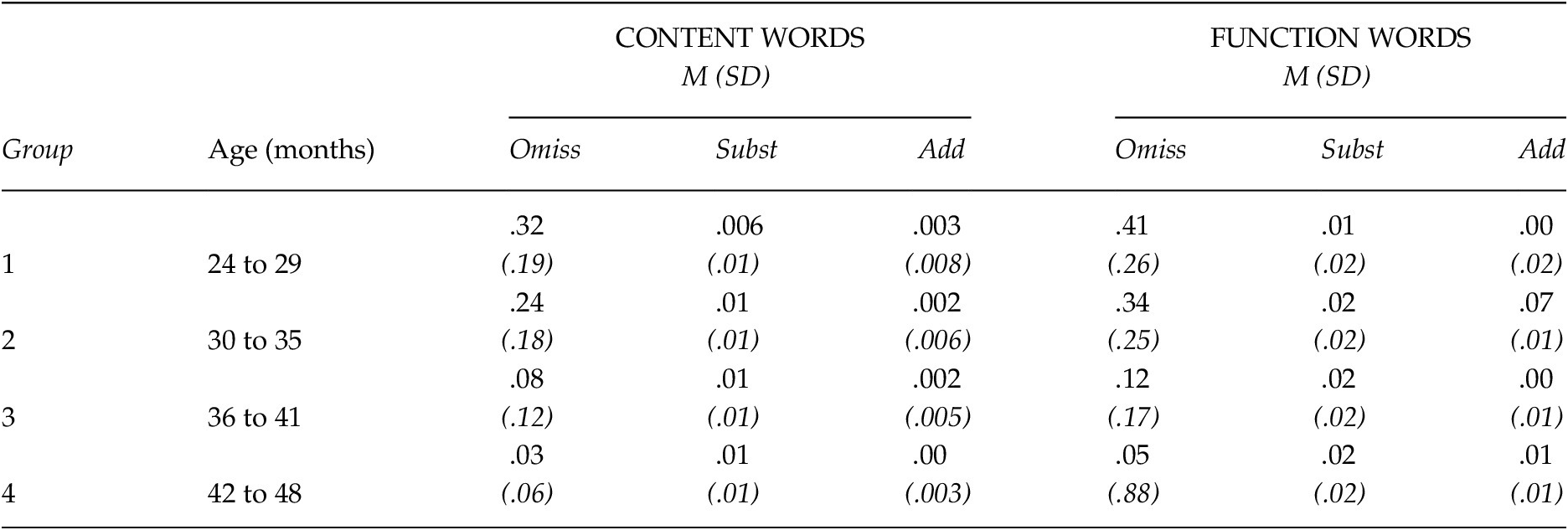
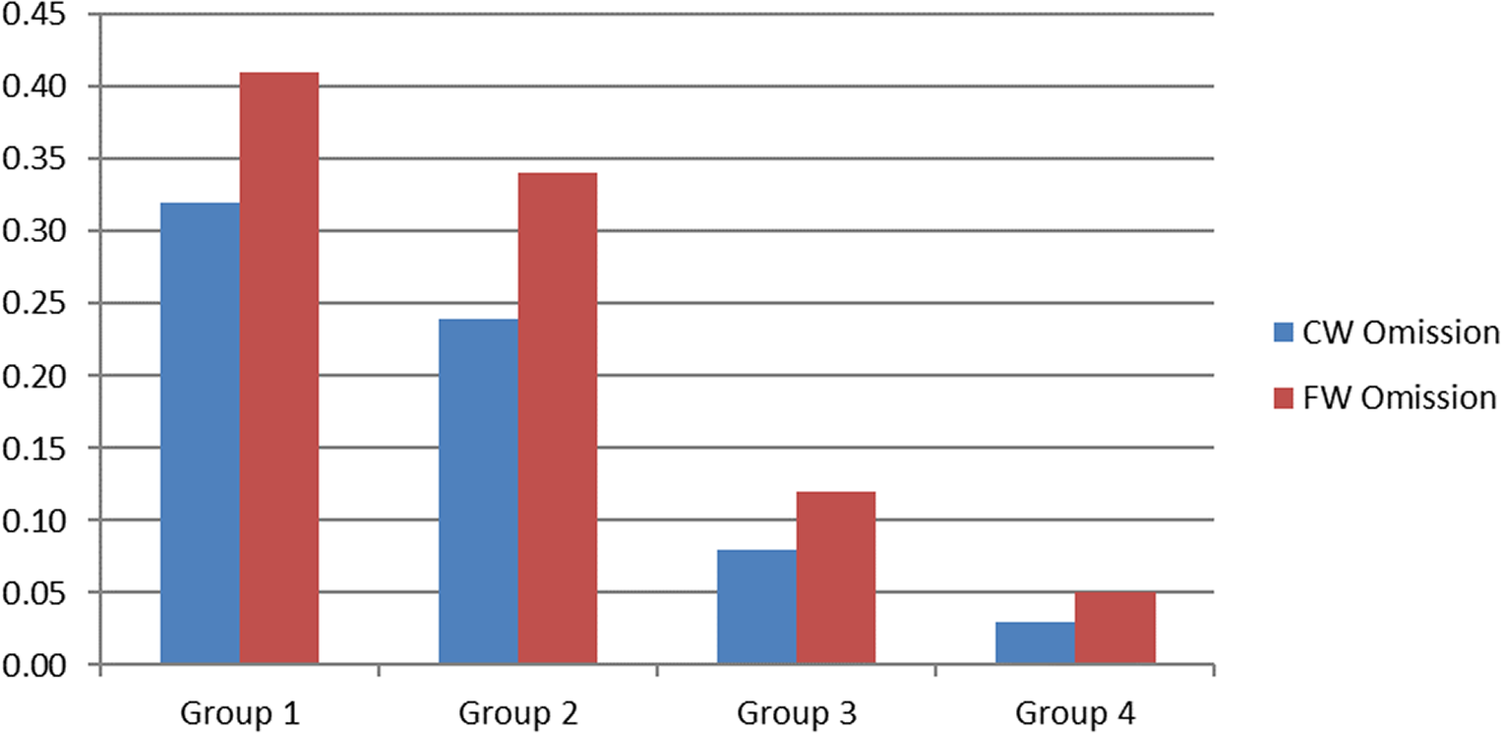
Different subtypes of errors in sentence repetition were also computed. Tables 6 and 7 display the distribution of omissions, substitutions and additions for the whole sample and for group-age, respectively. Omissions are the most frequent errors, followed by substitutions and additions, whose proportions are quite low for all the children. This pattern is common to CW and FW and to all age-groups. Proportions for Groups 1 and 2 are considerably higher than for Groups 3 and 4, and there is also a clear decrease from Group 3 to 4 (see Table 7 and Figure 1). The oldest children (Group 4: 3 years 7 months to 4 years only produce 3% and 5% of omission in CW and FW, respectively.
Different Subtypes of Errors (Proportions*) in Sentence Repetition for the Whole Sample

Note. *Number of errors in content and functions words divided by total number of content and function words, respectively.
Different Subtypes of Errors (Proportions) in Sentence Repetition by Age Group

Proportion of Content and Function Word Omission Errors in Sentence Repetition by Age Group.

Concurrent Validity
In order to obtain an index of concurrent validity of the sentence repetition task the correlation between sentence level scores (i.e., total number of items correctly repeated) and a measure of accuracy of non-word repetition was obtained. Results indicate a high correlation between both scores (r = .710; p < .001, bilateral) for the whole sample, and medium or high correlations for each age-group (G1: r = .536; p < .005; G2: r = .355; p = .069; G3: r = .720; p < .001; G4: r = .534; p < .001; all bilateral).
Discussion
The aim of this study was to present a sentence repetition task developed for early language assessment of Spanish children and to evaluate: (a) Its adequacy for children from 2 to 4 years of age; (b) its capacity to discriminate between different developmental levels, both at sentence and word level; and, (c) its concurrent validity with another measure based on repetition (non-word repetition task).
Regarding its adequacy to evaluate young children, the task has proved to be engaging even for very young children, as nonresponse rates shows. Children’s responsiveness in this sample is high compared to other studies (Seeff-Gabriel et al., Reference Seeff-Gabriel, Chiat and Roy2008) and it increases through ages. However, inter-subject variability, especially in the youngest age group is remarkable, although expected. Rate of nonresponse to individual items needs to be taken into account when assessing children’s linguistic performance, as a low score where every item has been attempted cannot have the same meaning as this same score where a high proportion of items have been refused. For future research a more in-depth analysis of nonresponse pattern, especially for the youngest children, could be accounted.
Analysis at sentence level show that the task discriminates well in the age range considered here. Children are able to produce more accurate repetition of the sentences that comprise the task as they grow older. But, as post-hoc comparison shows, developmental differences are not significant when comparing Groups 3 (M = 22.33) and 4 (M = 26.45) (p = .18). This result could be explained by the nature of this accuracy measure. Given it is a superficial or broad index of sentence repetition abilities (0 point for incorrect repetition, whatever the number of errors, vs. 1 point for correct repetition of the whole sentence), it is arguably that it does not capture subtle differences in performance between children in Group 3 (3 to 3 years 6 months) and Group 4 (3 years 7 months to 4 years). Besides, the sample size of our groups is close to 30 participants, so we believe that with a larger number of participants per group the current differences might have emerged as significant. However, Devescovi and Caselli (Reference Devescovi and Caselli2007) in their study with Italian children obtained comparable results as ours: The most important changes appeared between 2 years 6 months and 3 years and between 3 and 4 years of age. Post-hoc comparisons did not show differences between 2 and 2 years 6 months or between 3 years 6 months and 4 years of age.
Regarding analysis of repetition of content and function words, our results are consistent with our hypotheses and provide evidence that individual differences in performance are influenced by word category. As expected, content words are better repeated than function words through all ages, but this difference is only significant for younger children (Groups 1, 2 and 3). For the oldest children in our sample (Group 4), difference between correct repetitions of CW vs. FC is not significant. Descriptive analysis of error subtypes (omission, substitution and addition) do show a common pattern for all age-groups, being omissions the most frequent kind of error both for CW and FW. Proportion of errors decrease considerably from Groups 1 and 2 to Groups 3 and 4, and the percentage of omissions for the oldest children (Group 4) in the study is quite low. These differences in favor of content words are completely in line with the task nature, as it aims at assessing development of morphosyntactic knowledge or/and use in young children. As function words create syntactic structure and the hierarchical relation between words within sentences, whereas content words give lexical content to the sentences, results obtained are in agreement with the expected developmental trajectory. As age and linguistic competence of the participants increase, error scores for function words decrease, together with the difference between content and function words scores.
Considered as a whole, the set of results obtained for this study converge with developmental evidence gathered using spontaneous sample analysis and elicitation tasks in different languages, and they reflect properties of early language production in typically developing children (Devescovi & Caselli, Reference Devescovi and Caselli2007; Gábor & Lukács, Reference Gábor and Lukács2012; Gavarró, Reference Gavarró2017; Moreno-Torres et al., Reference Moreno-Torres, Madrid and Moruno2013; Nag et al., Reference Nag, Snowling and Mirković2018). Additionally, a significant and high correlation between sentence repetition and non-word repetition was obtained in this study. This last measure has been taken as an index of verbal short-term memory in previous research and/or as a measure of phonological knowledge (Alloway & Gathercole, Reference Alloway and Gathercole2005; Archibald & Joanisse, Reference Archibald and Joanisse2009; Baddeley et al., Reference Baddeley, Hitch and Allen2009). In fact, there is a theoretical discussion about what mechanisms and/or knowledge underlies sentence repletion task. Although correlational results obtained for the present paper do not give an answer to this debate, they add evidence on the concurrent validity of the sentence repetition task (SRT) in Spanish. More data and analysis are needed to tease apart if the SRT can be interpreted as a measure of verbal short-term memory, a measure of Phonological Working Memory or as a general index of linguistic (phonological, lexical and/or morphosyntactic) knowledge. Future studies taking NWR scores - and not age - as the criteria to form the groups could be informative, together with a comparison between SR and others tasks measuring working memory, as the classical digit task. Another possible analysis that could be relevant to the above mentioned theoretical question is to explore the relation between sentence length and complexity and repetition scores. Even though our design do not intentionally control these variables, our set of sentences include short and long sentences (2 to 9 words) and simple and complex items, that could be recoded for future and interesting analysis with a broader sample.
Out of the results obtained for this study, we can conclude that the new Spanish Sentence Repetition task designed to assess linguistic level of very young monolingual Spanish children seems to be adequate, reliable and valid for this developmental period. This is the first study developed in Spanish with a numerous sample and very young children (under 4 years of age). Additional studies will add more (and needed) evidence on its predictive validity and its capacity to differentiate children with typical development from children with any kind of developmental language disorder. Hopefully, future analysis will also provide evidence on the discussion about which cognitive processes and kind of knowledge are involved in this apparently simple task.
Appendix
List of Sentences and Their Translation into English
Number of words per sentence: 2 to 9.
Number of syllables per sentence: 4 to 16.
Total number of words: 192.
Total number of content words: 106 (nouns, verbs and adjectives).
Total number of function words: 86 (determinants, adverbs, prepositions, pronouns and conjunctions).
-
1. Mamá come (Mom eats).
-
2. Papá dice hola (Daddy says hello).
-
3. El coche es azul (The car is blue).
-
4. Es bonito el gato (Is beautiful the cat) (in Spanish the pronoun drop is correct).
-
5. Tienes que comer ya (You) have to eat just now).
-
6. Mi silla no es roja (My chair is not red).
-
7. ¿Qué mira tu papá? (What is your daddy looking at?).
-
8. La niña va al parque (The girl goes to the park).
-
9. El oso come mucha miel (The bear eats a lot of honey).
-
10. Pon el pan en la mesa (Put the bread on the table).
-
11. Ahora vamos a coger los peces. (We are going to take the fishes now).
-
12. Los niños son muy guapos (The children are very smart).
-
13. Aquí se sentó Ana (Ann sat here).
-
14. No quiero que me saques (I don’t want you take me out).
-
15. Esa señora come pan y jamón (That lady eats bread and ham).
-
16. Luis quiere leche y galletas para merendar (Luis wants milk and cookies for a snack).
-
17. Hoy estará el abuelo (Grandpa will be today).
-
18. Dice mamá que cojas el babi (Mommy says to you to take the smock).
-
19. Aquí hay más zumo que en tu casa (There’s more juice here than in your house).
-
20. Vamos al cole en el coche de papá (We go to school in dad’s car).
-
21. Cuando quieras nos vamos a casa. (Whenever you want we go home).
-
22. La niña llora porque quiere agua (The girl cries because she wants water).
-
23. Todos querían una galleta (Everyone wanted a cookie).
-
24. No deberías ir al patio (You shouldn’t go to the playground).
-
25. El niño tiene que comer una pera (The boy has to eat a pear).
-
26. Esa niña lleva los zapatos que me gustan (That girl is wearing the shoes that I like).
-
27. Ven a verme cuando salgas del cole (Come see me when you leave school).
-
28. Se cayó al suelo y se hizo mucho daño (He fell down and felt a lot of pain).
-
29. Los niños son más altos que las niñas (The boys are taller than the girls).
-
30. El chocolate no te gusta pero a mí sí. (You don’t like chocolate but I do).
-
31. Si hace calor irás a la playa (If it is warm you will go to the beach).
-
32. ¿Cuándo se ha caído el niño? (When has the child fallen?).
-
33. Las niñas que llevan el vestido son mis vecinas (The girls who are wearing the dress are my neighbours).