How should we study citizenship in the absence of political rights and associational freedoms? These forms of political participation are nearly synonymous with democratic citizenship,Footnote 1 but individuals in illiberal states have few opportunities to cast meaningful votes or to join social movements. Citizenship research in authoritarian states has therefore focused either on regimes of citizenship imposed by political elitesFootnote 2 or on periods of political upheaval, when new demands are raised and the relationship between state and society is in flux.Footnote 3 We have fewer templates for studying citizenship in times of stable authoritarian rule.
We propose studying authoritarian citizenship through the “public transcript”—everyday interaction between ordinary people and political authorities.Footnote 4 We argue that these strategic communications are performances of citizenship, which are meaningful because they have real stakes for the people trying to persuade officials to intercede in their lives. We then apply this approach to contemporary China, drawing evidence from an original database of over 8,000 letters from ordinary people to local authorities. Our discourse analysis identifies three “scripts” of authoritarian citizenship: subjecthood, legal citizenship, and socialist citizenship.
Our research offers three contributions to the study of citizenship under nondemocratic rule. First, it provides a framework for understanding what public transcripts teach us about citizenship regimes. The public transcript reveals how individuals play the roles of citizens—or in some cases, subjects—who merit attention and assistance from political authorities. These performances offer a bottom-up perspective on citizenship, and their real-world relevance distinguishes them from what can be learned through opinion surveys or interviews. This framework for studying public transcripts opens new opportunities for research across the wide array of nondemocracies that enable contact between ordinary people and political authorities.
Second, our study reveals three “scripts” of authoritarian citizenship in China. These three ideal-types are not mutually exclusive, but each captures a distinct logic of the citizen-state relationship. Although these scripts emerged from the study of a particular country—with its own political institutions, culture, and history—we present them as ideal-types using general terms that allow for their application elsewhere. We anticipate that variants of subjecthood, legal citizenship, and social citizenship may be observed in other non-democracies.
Finally, by identifying three scripts of citizenship in contemporary China, the study shows that even monolithic political regimes engender diverse, occasionally conflicting, logics of political membership and state legitimacy. This perspective differs from classifying citizenship regimes based on formal political arrangements. Instead, the public transcript approach relies on observation and interpretation of how people behave in the face of state power. We hope that this exercise opens the path for additional research on how performances of citizenship under authoritarian rule emerge and evolve.
Authoritarian Citizenship
If “authoritarian citizenship” has an oxymoronic ring, it is because citizenship is sometimes used almost interchangeably with democracy. T.H. Marshall’s work on citizenship described an evolutionary march toward increased rights for individuals, tightly linked to the trends of expanding political participation and the political mobilization of new social classes in Great Britain.Footnote 5 Phrases like “struggles for citizenship”Footnote 6 imply that certain political regimes or social classes have citizenship and others do not.
Yet there is also a more relational concept of citizenship that is useful for understanding the varying relationahips of individuals to governmental authority across different regimes. This concept of citizenship characterizes the “set of institutionalized and/or contractual promises between the polity and its membership.”Footnote 7 This includes regimes in which those promises do not include meaningful political rights, opening up the possibility to discuss authoritarian and even totalitarian citizenship arrangements.Footnote 8 This view of citizenship as a value-neutral set of relationships between individuals and the state—rather than a democratic ideal—underlies Mann’s classic essay on the citizenship regimes observed in monarchic, fascist, and socialist regimes.Footnote 9
Political transitions offer compelling cases of change in the citizenship relationship. In this vein, an important body of research studies the citizen-state relationship in post-Communist transitions. In Eastern Europe, civil society actors challenged incumbents and effectively redefined regimes of citizenship during the transition period and in its aftermath.Footnote 10 Yet citizenship in these states did not follow a Marshallian evolution through civil, political, and social rights. Instead, the “Leninist legacy” bestowed a political culture of limited civic participation and deep mistrust of the state.Footnote 11 The free and fair elections associated with political citizenship were severely curtailed in some states, triggering subsequent waves of protest and renegotiation of the citizen-state relationship.Footnote 12 This research tradition sheds light on citizenship through the lens of civic participation and struggle in periods of political change.
Markedly less research examines citizenship in authoritarian regimes that have not undergone such transformations. The stability of these regimes does not invite the same type of inquiry. Citizenship expectations are on dramatic display during periods of transition, as new channels for political participation open and new social groups mobilize politically. Clashes between citizens and officials shed light on struggles to achieve new political rights, but they reveal little about the citizenship arrangements under stable authoritarian rule. In states where grassroots mobilization is effectively suppressed, we cannot use the same techniques to understand the citizen-state relationship.
Public Transcripts and Performances of Citizenship
Our study treats citizenship as a dimension of state-society relations involving the “mutual rights and obligations directly binding governmental agents to whole categories of persons defined by their relationship to the government in question.”Footnote 13 Although “rights” are often associated with liberal democracy, this relational definition opens up a range of citizenship possibilities under diverse political regimes.Footnote 14 In this view, “citizenship is a feature of all state-society relations, encompassing those adhering to democratic rules and pluralism, but also many other types, including authoritarian citizenship.”Footnote 15
If citizenship characterizes the relationship between individuals and powerholders, public transcripts are the on-stage exchanges between both parties to the relationship.Footnote 16 These communications are not earnest; they are strategic and strongly influenced by the power relationships between citizens and officials. Therefore, as a source of data about citizenship, public transcripts differ from other common sources of data. Surveys and interviews attempt to directly access the beliefs and cognition of the surveyed actors (although accomplishing this in practice can be challenging). For example, such research might ask respondents whether “good citizens” should vote, serve on juries, follow the laws, etc., and treat responses as true reflections of their beliefs.Footnote 17 In contrast, public transcripts are “shaped to appeal to the expectations of the powerful.”Footnote 18 By definition, they are constrained by power dynamics and strategic considerations. Public transcripts should almost never be interpreted as reflecting the true feelings of either citizens or officials.
What, then, can public transcripts teach us about the relationship between individuals and political authority? Public transcripts show real, direct encounters between citizens and officials. These encounters have real stakes for the citizens; they hope that officials will intervene on their behalf to solve problems or provide useful information. The discursive content of public transcripts can reveal things about both sides of the state-society relationship. On the state side, because public transcripts are shaped around officials’ expectations for desirable citizen behavior, the diversity and idiosyncrasy of the public transcript is informative about what powerholders are willing to tolerate. In Scott’s words, “the greater the disparity in power between dominant and subordinate . . . the more the public transcript of subordinates will take on a stereotyped, ritualistic cast.”Footnote 19 Public transcripts also reveal something important about society: how the people who make appeals expect powerholders to behave in reality, rather than an idealized, normative conception of how powerholders should behave in some imaginary world. Even when the public transcript contains expressions of how officials should behave, this communication was chosen because it was believed to have an effect on official behavior.
The public transcript reveals what citizens believe to be both politically acceptable and effective in eliciting a response from unelected officials. Studying the public transcript therefore departs from previous research on authoritarian citizenship using surveys, interviews, or focus groups.Footnote 20 These methods ask individuals to describe their beliefs and behavior privately, out of view from authorities and with no meaningful outcome hanging on their words. Our approach also departs from analyzing state-society relations through state propaganda and patriotic education. Those documents offer a view of citizenship as envisioned by the state, not how it is enacted on a daily basis by ordinary people.
This view of public transcripts builds upon on the concept of political performances, “linking at least two actors, a claimant and an object of claims.”Footnote 21 The performative dimension of politics is acknowledged in well-known scholarship on contention and the formation of national identity.Footnote 22 We adopt a similar approach by examining the public transcript as an everyday performance of citizenship, in which ordinary individuals engage with political authorities to induce the latter to act. However, unlike Tilly’s contentious performances,Footnote 23 the public transcript does not always involve contention. It can also serve simply to reflect and reinforce power disparities between ordinary people and the state: “[individuals] are daily reminded of their position vis-à-vis the state . . . through interaction with agents of the state such as police officers, taxmen, or social workers.”Footnote 24 These daily engagements reaffirm the promises between the polity and its members that constitute the citizenship relationshipFootnote 25 and can also contribute to transforming public ethics, as in Mansbridge’s “everyday talk.”Footnote 26 This performative approach to citizenship also opens the door for comparative research without strong priors about the centrality of democratic institutions.Footnote 27
Studying the performance of citizenship through the public transcript can reveal otherwise concealed, informal promises between citizens and state. Laws and national policies have enjoyed pride of place in citizenship research, but informal norms also shape state-society relations. In weaker states, poor enforcement of laws and strong informal institutions can shape the relationship between citizens and the state,Footnote 28 resulting in a lesser role for formal law in the state’s relationship with its citizens.Footnote 29 Because public transcripts are strategic (rather than expressive) and behavioral (rather than formalistic), they offer a close-to-the-ground record of people playing the roles of citizens that merit attention and assistance from officials. By learning about citizenship through how it is performed, we are responding to calls by comparative politics scholars to see the state in societyFootnote 30 as well as to political theorists who view political participation as constitutive of citizenship.Footnote 31
At the same time, there are important limitations to the public transcript as a source of data on authoritarian citizenship. Because these performances are naturally occurring interactions, we only observe performances by individuals who have grievances, appeals, questions, or suggestions for officials. The views of individuals who avoid engagement with the state are absent from the public transcript. Previous research suggests that people who contact officials tend to be more educated and enjoy higher socioeconomic status.Footnote 32 Public transcripts data therefore likely underrepresent the less educated and less affluent.
Data: Public Transcripts in China
We use this approach to study performances of citizenship in contemporary China, the world’s largest and most powerful authoritarian state. Political rights in China are highly circumscribed, with effectively no elected officials beyond the township level and no meaningful political alternatives to the ruling Communist Party. China is one of a host of nondemocratic regimes in Asia—including Vietnam, Cambodia, and Myanmar—that combine authoritarian rule with an embrace of market reforms. Yet it is also distinctive in its size and high capacity for coercion.Footnote 33
Previous research on state-society relations in China has fruitfully examined how a variety of social groups claim rights, including intellectuals, rural villagers, aggrieved workers, legal professionals, rural-to-urban migrants, entrepreneurs, and online activists.Footnote 34 Similar to the studies of post-Communist regimes discussed earlier, many of these studies focus on claims for citizenship during contentious episodes such as democracy movements and protest campaigns.Footnote 35
Our study moves away from highly engaged activists and protestors to explore how more ordinary individuals perform citizenship. Specifically, we gathered a sample of over 8,000 publicly posted letters from Chinese citizens to local authorities across 293 prefectures. These letters were filed and published online via Mayors' Mailboxes (Shizhang Xinxiang), local websites that allow ordinary people to make appeals to local Mayors’ offices across China.Footnote 36 This participatory institution emerged as part of the “Government Online” campaign of the State Economic and Trade Commission. By 2014, various Mayor’s Mailbox portals appeared on the webpages of 98% of China’s prefectural governments.Footnote 37
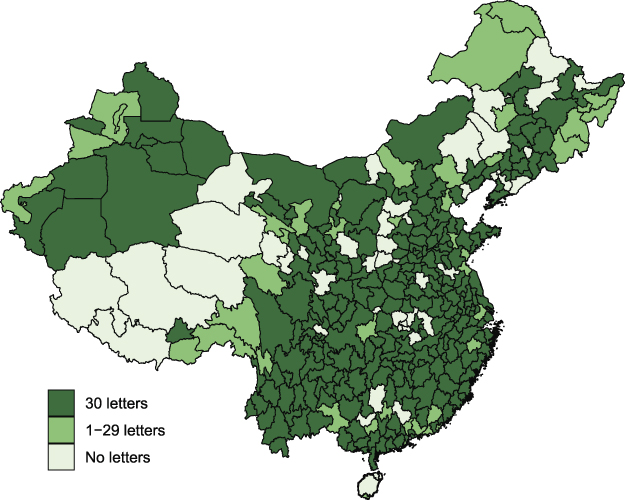
Recent research on the Mailbox has focused on the logic and rate of official responsiveness to citizen appeals.Footnote 38 By contrast, we turn our attention to the discursive content of citizen appeals and what they reveal about grassroots performances of citizenship. To do so, we sought to collect a national sample of publicly posted letters. A team of researchers visited the local websites of every prefectural government in China. They were given a random date in 2013 and instructed to gather the first 30 letters available after that date. If they failed to gather sufficient letters after that date, they would work backwards from that date until they obtained 30 letters (figure 1). Under the assumption that seasonality effects introduced by anchoring on randomly assigned dates were uncorrelated with variation by locality, the resulting sample was representative of publicly posted letters in the average prefecture.Footnote 39
Letters collected in the sample
Notes: Geographical sources of the Mayor’s Mailbox letters in the sample. Researchers visited the official websites of 348 local governments (344 prefectural jurisdictions plus the 4 provincial-level municipalities of Beijing, Tianjin, Shanghai, and Chongqing). They attempted to collect 30 publicly-posted letters beginning from a randomly selected date in 2013. As shown in the map, 55 prefectures did not make any letters publicly available, with clusters of missing data in west, north-central, and north-east China. The sampled jurisdictions contain 90% of China’s population.

A few considerations are important when interpreting findings from this sample. First, because local governments control the websites where these letters are posted, they have an opportunity to censor letters deemed politically offensive. Recent research on Chinese internet censorship suggests that its primary goal is to stymie the spread of collective action rather than delete criticism of government officials and policies.Footnote 40 If there are individuals who seek to use the Mailbox to incite collective action around shared grievances, we expect many of those letters to be censored before we are able to collect them.
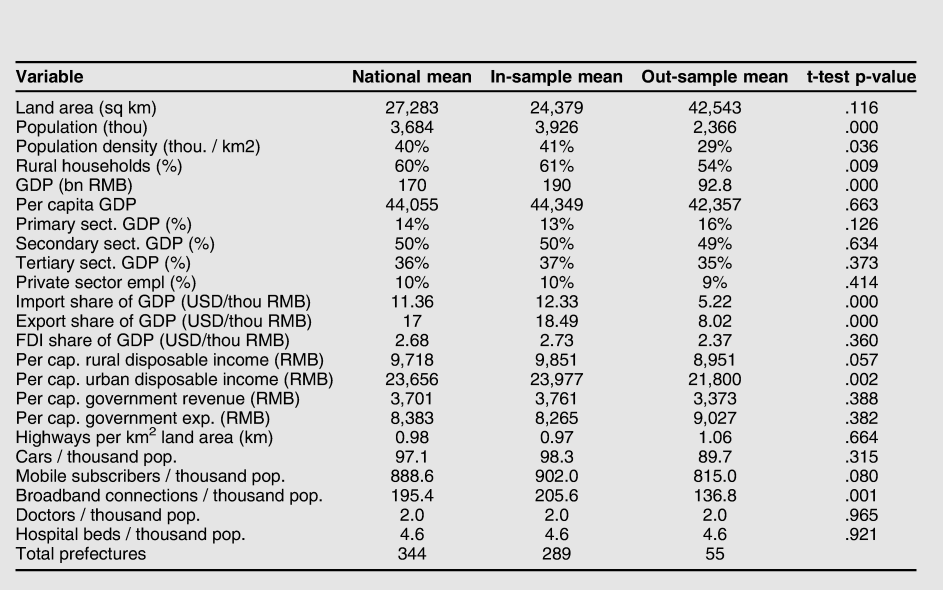
Second, some localities did not make any letters available to the public. Figure 1 shows that large prefectures in the West and Northeast did not make any letters publicly available. Table 1 analyzes the demographic and economic features of localities where no public correspondence between citizens and officials was available. It shows that larger jurisdictions with lower population density and less exposure to the international economy were less likely to make letters available to the public. Per capita GDP is only marginally higher in sampled localities, but disposable incomes are markedly higher. Thus, less prosperous localities are underrepresented in this data. Even so, the sample means are quite close to national prefectural means.
Prefecture characteristics in and out of public transcripts sample

Notes: Compares 289 prefectures from which public transcripts were retrieved to 55 from which none could be retrieved; the four province-level jurisdictions of Beijing, Tianjin, Chongqing, and Shanghai are excluded from these data. The rightmost column reports the results of a two-sided t-test for differences in means between in- and out-sample prefectures assuming unequal variances.
Finally, the Mayors' Mailboxes are just one venue for observing public transcripts in China. Open exchange between the powerful and ordinary people occurs in other settings such as the courtroomFootnote 41 and government offices.Footnote 42 These venues may favor different populations of individuals, and each channel may encourage different rhetorical approaches (e.g., the legal process is structured to privilege invocation of laws and rights). In addition, there is ample evidence that Chinese citizens think differently about local and central government authorities, expressing widely varying levels of trust across levels of government.Footnote 43 Scripts of citizenship might also vary along with this variation of trust. Thus, we must exercise caution when interpreting the external validity and exhaustiveness of these findings.Footnote 44 Future work may profitably compare our findings to performances of citizenship in different venues and before different political authorities.
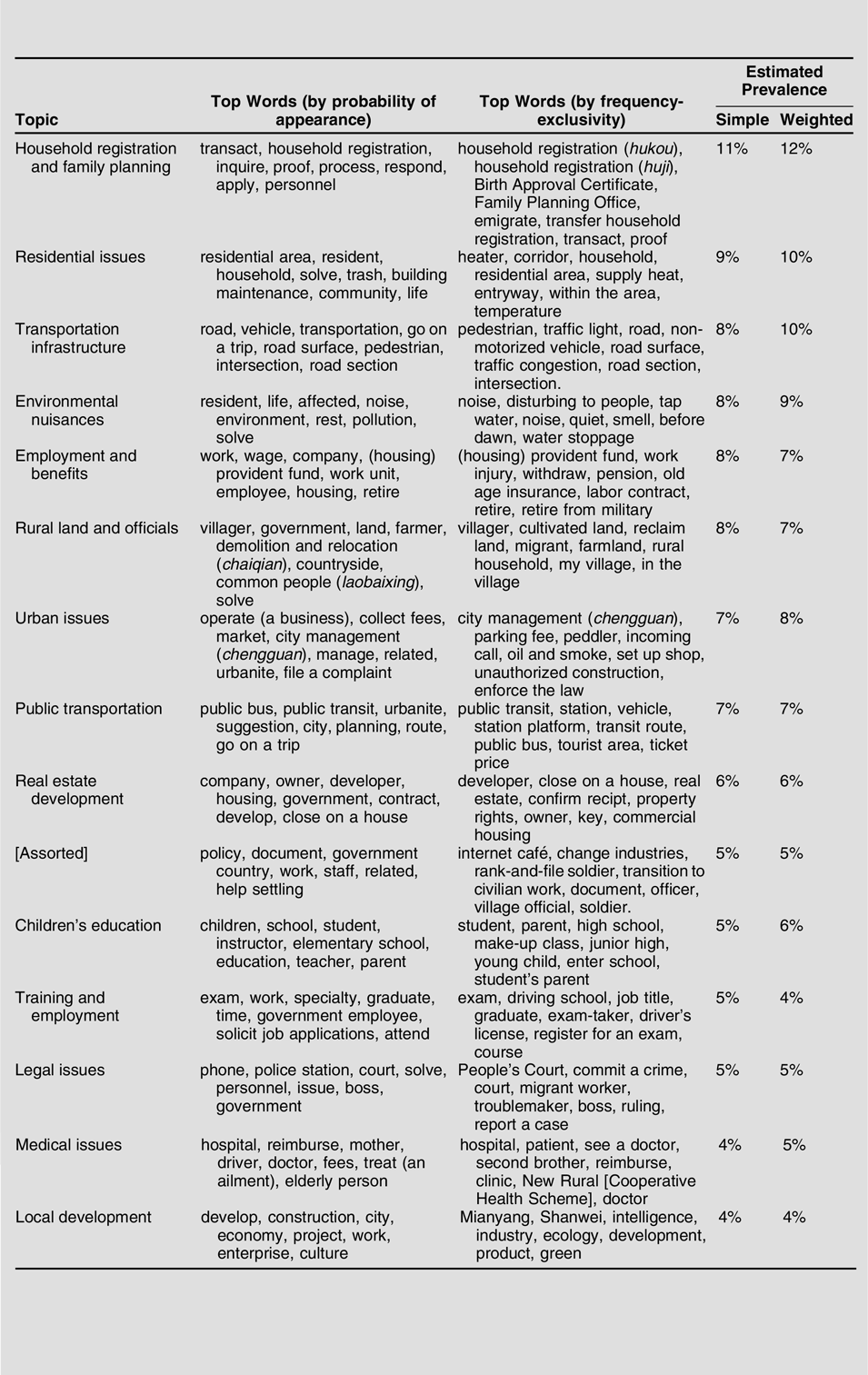
A topical summary of the public transcripts dataset appears in table 2. We fit a structural topic model—selected by examining quantitative indicators (semantic coherence and exclusivity) and subjective interpretability of alternative models—of fifteen topics.Footnote 45 The topics include well-known public policy issues such as household registration (hukou), housing maintenance disputes, environmental nuisances like garbage and noise pollution, dissatisfaction with medical care and education, and labor issues. In total, 4.2% of all letters mention “wages” (gongzi) and 2.5% reference “demolition and relocation” (chaiqian). The topic models suggest that these are citizens raising everyday issues for which they expect the local government to be accountable.
Citizen appeals topics by estimated prevalence

Notes: Topic model summary for 8,120 appeals to local officials in China. The top eight words in each model are displayed by the highest probability of appearance and the frequency-exclusivity metric (FREX) defined in Roberts, Stewart, and Airoldi Reference Roberts, Stewart and Airoldi2016. The stratified sampling technique yields prevalence estimates for the average prefecture, not the average letter nationwide, as localities with high volumes of letters are underweighted. The final column therefore reports topic prevalence after reweighting documents by the estimated annual volume of letters published in each locality.
Because we analyze public transcripts as performances intended to persuade officials to intercede on the behalf of letter-writers, the focus of our inquiry is not the topics of complaints, but rather the varying types of discourse citizens use when speaking to officials. This required interpreting the representations that letter-writers make to officials. We therefore drew a simple random sample of 500 letters for interpretive analysis.Footnote 46 We then closely read each letter, analyzing the language writers used to describe themselves and to appeal to powerholders.
Scripts of Authoritarian Citizenship
Our analysis revealed three citizenship scripts, each containing different articulations of the state’s obligations to the public and activating different sources of state legitimacy: subjecthood, legal citizenship, and social citizenship. These ideal-types are not mutually exclusive, but each offers a distinct and coherent conception of the relationship between ordinary people and authoritarian officials.
Scripts of Subjecthood
Some appeals follow a script of subjecthood in which letter-writers plead with officials to act out of pity or magnanimity, rather than demanding fulfilment of rights conferred by law. They engage in self-denigration, portraying the complainant as weak, unfortunate, or helpless and establish officials as powerful and virtuous and non-officials as subordinate. These performances are similar the public transcripts analyzed in Scott,Footnote 47 including fixed linguistic conventions for beautifying relationships of domination.
In this ideal type, the power asymmetry between the ruler and the ruled is not only stark; it is the raison d’etre of the appeal. Individuals emphasize this unequal relationship in the hope that it elicits favorable intervention at the discretion of the official. In this setting, “the more menacing the power, the thicker the mask” worn by the weak,Footnote 48 and therefore these exchanges are marked by highly-euphemistic language when discussing both officials and citizens. One such letter seeking official intervention begins by offering ornate praise for the ruling party:
We are villagers from Hengyang County, Qulan Township, Hezhong Village. The Party shows infinite care, loves the people, has formulated a series of policies to love the people, has taken many measures to love the people, and in elections has patiently admonished the people to select leaders of honesty and integrity.Footnote 49
The level of obsequiousness is extreme, but similar language emphasizing the status and benevolence of the mayor appears frequently within this subset of letters. Mayors are commonly referred to as “Respected Mayor” (zunjingde shizhang) or in some cases “The Great Personage of the Mayor” (shizhang daren), a rhetorical convention that traces its roots to Imperial China. The mayor is then asked to “help” (bangzhu) or “take charge of” (zuozhu) the situation for the letter writers, making explicit both the power gap between official and citizens and the voluntary nature of an officials’ decision to assist. A letter written by peasants asked for the mayor to make decisions on their behalf:
This year, we have collectively petitioned with a number of village leaders and party secretaries but we haven’t resolved the issue yet—we hope that the mayor can take charge for (zuozhu) the peasants, we thank the mayor in advance.
The term “zuozhu” signals deference to an authority figure; it literally translates to “be the master of.” Another letter complaining about the price of meat uses similar language:
As a consumer, I really can’t stand it anymore . . . I heard that since the Lianjiezheng butcher house moved, they’re charging more than three times their previous prices, who gives them this kind of right? In the end, it is the commoners who suffer . . . we respectfully ask that the great personage of the mayor (shizhang daren) to take charge (zuozhu) for us!
Despotic power is “the range of actions which the elite is empowered to undertake without routine, institutionalized negotiation with civil society groups.”Footnote 50 Performances of subjecthood affirm the state’s despotic power, suggesting that officials may act at their own discretion and without significant constraints from law or society. While rhetorically bowing to the state’s power, these letters nevertheless express hope that officials would use it for benevolent ends.
Accompanying this aggrandizement of the state is the simultaneous performance of self-denigration of the supplicants. In the script of subjecthood, individuals reduce themselves to lowly subjects whose wellbeing depends on intercession from powerful officials. For example, one letter from a migrant worker seeking compensation for severe injuries suffered at work begins by identifying himself as a “peasant worker” (nongmingong) and concludes: “Thank you, leader. I hope you can help out a member of the weak and disadvantaged group (ruoshi qunti).” By invoking the term disadvantaged group, the writer echoes government discourse about pitiable social classes in China that require additional assistance and self-identifies as a member of that class. It is not only ordinary citizens who perform this script; some officials also use deprecating language when seeking help from the mayor. The following letter comes from a local cadre seeking intervention around wage arrears:
We hope that our most respected Mayor Wang would take notice on our pitiful cadres who face the severe problem of not getting paid on time.
We do not assume that the affirmation of unequal power relationships in public transcripts means that individuals actually believe themselves to be dominated by officials. Admittedly, the power of the ruling party is in many ways despotic, with the unilateral appointment of key officials, harsh repression of independent labor organizations,Footnote 51 and arbitrary expropriation of land.Footnote 52 Yet there is also ample evidence that subjecthood is used strategically to persuade and oppose state power. For example, rural activists have invoked the image and language of “slavery” in their calls for resistance, harkening back to pre-Communist revolutionary slogans.Footnote 53 Li notes that a group of retirees “sounded as though they had faith in the city government, pledging to organize a demonstration ‘after obtaining the city government’s permission and protection.’ In fact, they had no illusions about city officials.”Footnote 54 Even the subject-like act of kneeling before imperial officials is repurposed today for contentious confrontations with authority.Footnote 55 Although it is impossible to get inside individuals’ heads, a letter writer may perform the role of a subject simply because they believe it will elicit attention and assistance from officials.
Scripts of Legal Citizenship
In contrast to scripts of subjecthood, individuals also perform what we term “legal citizenship.” They invoke the state’s formal, legal commitments and emphasize horizontal equality among citizens when appealing for official attention. These letter-writers portray themselves as individuals who know the law, can identify deviations from law, and believe that the government is duty-bound to both follow and enforce the law.Footnote 56 This manifests in demanding equal treatment under the law, chastising officials or third parties who violate the law, recommending new policies or enforcement measures, and invoking the language of “rights” to press for claims.
This script invokes and implicitly challenges the rational-legal authority of the state, in which legitimacy is derived from an impersonal, legal order.Footnote 57 Yet in contrast to the liberal tradition of citizenship emphasizing a private sphere and freedom from state interference (negative liberty), authoritarian legal citizenship entails an invocation of the law to hold the state accountable for enforcing its own laws and policies. The legal citizenship we observe does not presume freedom from state interference, but instead reflects an expectation that civil servants will, at a minimum, follow the formal rules and policies laid out by the state. In the setting of protest and mobilization, beseeching the state to enforce its own commitments has been termed “rightful resistance.”Footnote 58 Of course, these performances of citizenship are not always contentious. A typical example appears in this letter from anxious parents inquiring about the cost of education:
Both the “Preschool Education Three Year Development Plan” and “Key Points of the Laiwu City Bureau of Education 2012 Work Plan” published last year by the Laiwu Bureau of Education clearly state that new kindergarten fee schedules were to be published last year. A year and a half have passed; exactly when will this policy be published?
The appeal is for the government to disclose a fee schedule, but the logic that binds the state to respond is simply an existing formal commitment that government agencies would do so. Adherence to law is contrasted with arbitrary use of state power, in some cases with scornful language impugning the motives of government officials. Consider this complaint about rising health insurance fees:
Today I received a notice from the community that urban health insurance now costs 500 RMB. I don’t know what document this is based on, [the fee] just rises. If the “Jinhua Government [2012] Document No. 50” is no longer used, you need to issue another document. This is a problem with direct bearing on the personal interests of the common people. Can government departments casually hoodwink the people like this? Should Mr. Mayor look into it?
Performances of legal citizenship do not necessarily indicate that letter-writers believe the state actually enforces its own laws. Yet regardless of whether the individual believes in the power of the law, the script implies that the state’s legitimacy rests on the degree to which it keeps its own promises, as codified in formal law. Failing to enforce the law on private actors can also be presented as a challenge to the rational-legal authority of the government. For example, the following letters both cite violations of labor law by private enterprises as evidence that the government is failing to enforce laws and protect worker rights:
On the Internet we read, “Notice on the Guizhou People’s Government Implementing State Council Opinions on Solving Migrant Workers Problems.” Did our [employers’] project contribute to the migrant workers wage guarantee as required? Did it implement illegal subcontracting? Did the local government truly implement and honestly protect our interests?
Currently the reality among Zhengzhou employers is that law-abiders are few, and law-violators are many. I suggest that the relevant departments adopt effective measures to implement standards and protect the great people’s interests. They should sternly penalize those that do not sign labor contracts with their employees, those that do not contribute to social insurance plans, and other types of illegal activities. Start practically from the people’s interests and protect their lawful rights and interests.
Legal citizenship also emphasizes the transparency and integrity of government processes, rather than outcomes:
Liaocheng News has announced that the construction for the People’s Square has started. When will the final urban planning maps be released? When will construction start? . . . We need to aim for a just, open, equal, and transparent project, letting society function as monitors. [The government] should not be kicking the ball around, saying that the construction of the People’s Square is the responsibility of the municipal People’s Congress one minute, then saying that we should inquire with the Dong Chang District Government’s Office of Removal. Comrades of the planning bureau, do you dare tell the truth?
As noted above, authoritarian legal citizenship does not presume a set of negative freedoms and restrictions on government involvement in civic life. However, performances of legal citizenship can still be used to challenge government intervention in economic or personal life. In this example, a citizen questions the legality of a property lease issued by a government agency:
Is it legal for the Civil Air Defense to offer a one-time, fifty-year lease [on a parking lot]? If it is legal, could you announce the legal basis to the great people, in order to resolve their confusion?
With its emphasis on legal compliance, authoritarian legal citizenship implies a form of vertical accountability to the public: the state is bound to enforce its own laws and not to act arbitrarily.
In addition, performances of legal citizenship tend to emphasize horizontal equality among citizens who should receive equal treatment under the law, regardless of social class, personal network, gender, ethnicity, or urban/rural status. Consider the following complaints about unequal access to schools and utilities among taxpayers.
Why do local kindergartens directly admit [children of parents] from municipal work units, while residents or holders of district household registrations and property rights need to draw lots? Public kindergartens built using public finances only serve the minority of children of civil servants? In principle shouldn’t they admit students in order [of application date] or treat everyone equally and let everyone qualified to draw lots? . . . Raising a child is not easy and perhaps from the moment they are born their fate is sealed. Is this fair?
The water company replied that our building has very low water pressure and their leaders can’t help. They, according to some Shandong provincial document, only guarantee water to the fourth floor . . . As taxpayers, we pay taxes covering water fees et cetera the same as the fourth floor and below. Can it really be that our rights (quanli) are ignored or even trampled upon?
These letters invoke both the principle of equality and a classic fiscal contract as the basis for their claims to assistance. Not only is the state bound to enforce its own laws, but these laws should be enforced equally for all individuals, including in the allocation of benefits.
Performances of legal citizenship extend well beyond activist communities to the wider population of citizens engaging with political authorities. We estimate that 14% of the public transcripts we collected reference the law or legal rights.Footnote 59 Complaints that cite laws and rights may be tempting to view as bottom-up demands on an authoritarian state to be more law-abiding. However, Chinese citizens are not the sole authors of the script of legal citizenship. The state has actively promoted legal reform and legal discourse as a means for claiming rights and disciplining local officials.Footnote 60 Although using the law to advocate for certain sensitive issues places activists in peril, many grassroots actors nonetheless embrace the law to pursue activism.Footnote 61 Thus, the legal consciousness documented by many scholars reflects both state-led initiatives and grassroots pressures.Footnote 62
Scripts of Socialist Citizenship
Apart from subjecthood and legal citizenship, we observe a third ideal-type that we term, “socialist citizenship.” This draws upon Mann’s classification of authoritarian socialist regimes that promise social citizenship in the absence of civil and political rights.Footnote 63 While Mann’s study viewed citizenship regimes as a product of elite arrangements, we examine how socialist citizenship is also reflected in the discourse of ordinary people. In performances of socialist citizenship, individuals invoke the obligations of the state to provide for collective welfare. Unlike legal citizenship, this script does not hold officials accountable through legal obligations and the principle of equality. Instead, officials are bound by moral obligations and the principle of reciprocity.
This script reflects a power dynamic in which the subordination of individuals to officials is conditional on officials’ ability to fulfill basic social welfare needs. In that sense, it follows a logic of reciprocity: citizens will be compliant so long as officials guarantee their wellbeing. Citizens’ loyalty to the state is contingent upon the latter’s ability to fulfill a moral obligation to provide subsistence and development.Footnote 64 Citizens profess loyalty to the state on the condition that their rulers satisfy the basic needs of the people. When the state fails to deliver on these promises—including food, water, shelter, healthcare, and education—individuals can threaten to withdraw their loyalty. They may do so through criticism, noncompliance with state policy, and in extreme cases, protest.
Threatening to withdraw consent to be governed distinguishes the performance of socialist citizenship from subjecthood, although both often reference subsistence issues. In the subjecthood script, people depict themselves at the mercy of government officials. Socialist citizenship empowers these same individuals to withdraw compliance and protest. This opportunity for recourse implies a more balanced power relationship.
By pinning citizen loyalty to the satisfaction of social welfare needs, the script of socialist citizenship taps into the state’s performance legitimacy—the right to govern as secured through delivering “satisfactory outputs.”Footnote 65 This differs from the logic surrounding rational-legal authority that we observe in legal citizenship because it emphasizes the delivery of favorable outcomes over the means or processes that the authorities use to achieve those outcomes. Although socialist citizenship may still acknowledge a role for law and regulations, authorities’ moral obligation to the citizenry takes primacy over legal obligations. These letters appeal to the core duty of power-holders to be morally accountable to citizens by ensuring their survival and welfare, not necessarily to follow laws and implement them equally.
Letter writers invoking this script often reference the duty of the government to relieve the public from everyday hardships such as rising consumer prices, inadequate housing, sanitation, food and water safety, and pollution. A particularly common phrase is that of “return to us” (huangei women) a certain public good or service. Consider this complaint about a local business polluting the environment:
[T]here is a sweet liquor workshop that is seriously polluting the environment. They burn toxic plastics and electrical wires to steam the liquor. Whenever they produce they emit a large amount of toxic smoke, having a major impact on the health of surrounding residents. I earnestly ask your bureau to solve this matter and return a harmonious living environment to the residents of Nanmenwei village.
Environmental pollution is an area of significant government regulation, legal education, and litigation.Footnote 66 Yet the legality of pollution is completely absent from the appeal. Instead, the letter emphasizes the threat to the health and well-being of local residents and asks the officials to restore a healthful living environment. The following letters about local elementary schools, traffic lights, and high-voltage power lines all follow similar scripts, eschewing questions of legality and instead highlighting the officials’ moral duty to guarantee public education and health:
In the winter, it’s so cold that their fingers get chill blains. In the summer, they stream with sweat. As a parent, who often cannot be at your child’s side, can any parent rest easy knowing their child is studying in that environment? I hope that you can return to our children a safe and happy childhood. I sincerely ask the Cangzhou Municipal Government leadership to attend to this matter!
I hope the relevant departments can add a traffic light to that intersection and return a safe intersection to local residents.
I went online and learned that a high voltage power line so close to the home is a bad thing. The common people support the government in relocation and demolition [of urban housing]. We didn’t realize that we traded for a high voltage power line swinging outside the window each day . . . I earnestly ask for the relevant departments to change the route of the high voltage lines. Return a safe living environment to the people!
The final letter references compliance and loyalty on the other side of the reciprocal relationship: the “common people” have supported the broader work of government in demolition policy. By emphasizing citizens' support of the government in the difficult and controversial project to demolish homes, the letter writer implies that support may be withdrawn if officials fail in their moral obligation to provide a safe living environment. This reciprocal logic distinguishes socialist citizenship from the superficially unconditional self-denigration that appears in the script of subject citizenship.
The threat to withdraw loyalty can be quite explicit. Here, the writer admonishes the mayor’s office that should it fail to investigate an illegal coal mine in the village, it would face an angry, ungovernable crowd:
The mayor need only send someone to [the village] to have a look and it will be even clearer . . . If you do not go investigate, it won’t be enough to quench the anger of the people (ping minfen.)
Such anger can also spill into actual conflict:
Since this factory began production in 2010, the Yuzhai villagers have repeatedly demanded they stop directly emitting air pollution and waste water. Finally, it escalated to a conflict in which villagers locked the gate of the plant . . . The common people all believe that the government’s attraction of investment is to develop the local economy, and not to attract a genocidal killer (miezu de shashou). I earnestly ask the relevant departments to fully examine this matter. Restore a healthy, safe home to the common people.
Withdrawing consent to be governed can take other forms besides collective action. The following complaints about overdue road repairs and traffic fines threaten to expose unresponsiveness and possible corruption through the news media and petitioning higher-ups:
I want to ask here: first, why hasn’t it [the road] been repaired? Second, is it going to be repaired? Third, when will it be repaired? Is this also an issue of the funds for road repair being gobbled by corrupt officials (allegation). I’m not ruling out going to a journalist to complain or using other channels to protect the rights of all the villagers . . . .
If I don’t receive an answer, I will personally contact the media and go to the provincial police station to petition!
These are not performances of helpless subjects pleading with benevolent officials. Embedded in their action is a logic of consent to be governed, conditional upon the state’s guarantee of basic social rights.
Withdrawing consent is not always confrontational; it can also come in the form of noncompliance through inaction. The following complaint about compensation for housing demolition draws a direct link between the grievance and compliance with another government priority: the one-child policy.
Great Mayor, is there demolition and relocation in the countryside? If there is, are the policies fair? Those of us who answered the call from government and Party to only have one child now suffer a loss. Next time who will you call to action?
Because the script of socialist citizenship emphasizes the moral rather than legal dimension of good governance, these appeals often attribute governance problems to moral deficiencies, either among officials or in the broader society. For example, this complaint about the promotion of local civil servants invokes heavenly justice, a concept derived from the “mandate of heaven” which has been the basis of ruling legitimacy since imperial times.Footnote 67
As I understand it, the group that was promoted to the formal public payroll was primarily composed of sons, daughters, and relatives of political leaders. There were also many rich businesspeople . . . Where is heaven’s justice (tian li he zai)? I hope the municipal leader and relevant departments clearly investigate and give an impartial account to the public.
The citizen implies that the state’s failure to govern also includes moral misconduct, which could be met with punishment from above.Footnote 68
Whereas the script of subjecthood tends to elide the unsavory dimensions of state power, socialist citizenship can highlight failures and ridiculousness of ineffective bureaucracy. This letter, dripping with sarcasm, questions the legitimacy of a local government that neglects to solve simple problems of its public:
Greetings to the most respectable officials: I want to praise you for your high efficiency. On November 5th, 2012, I wrote a letter to secretary Liu reporting that my family land has been grabbed and my housing demolished by force. Until today, nobody has helped me resolve this . . . Is this how the government is supposed to help the people, perfunctorily? Like talking about military tactics on paper? If I could resolve it through a phone call, would I need your help? I was born in a poor peasant family . . . I don’t have any connections with cadres . . . Is the government really blind, not even caring about our livelihoods? How can we live?
This contemptuous language directly calls into question the moral authority of public officials, implying they only respond to the needs of those with wealth and political connections. In addition to incompetence and favoritism, perhaps the most scorned element of political domination is the widespread assumption that officials use their power to line their pockets and those of their family and friends. However, only the Chinese Communist Party can make the determination of which officials are “corrupt” and which are not. Despite the likely censorship of many citizen letters related to official corruption, accusations or implications of corruption appear in 5% of our sample.Footnote 69 Consider this letter discussing an unmonitored lot in an urban area:
Clearly, some government agents have accepted payment from land developers, or it’s that some of the city leaders received bribes, or perhaps for some deeper reason they speak for the developers. We need a clean living environment! We need a satisfactory response! We look forward to a satisfying outcome. Do you dare to publish this letter?
Evidently, they dared. But the ordinariness of these vitriolic criticisms suggests these exchanges do more than simply reinforce state dominance. Although we observe some beautification of state power in these performances, they do not present a uniform, ritualized transcript that normalizes the arbitrary power of state officials. Instead, they assert a set of social outcomes that good officials are duty-bound to deliver.
The script of socialist citizenship we observe in China draws on historical legacies in its concept of state legitimacy. For example, “the idea that good governance rests upon guaranteeing the livelihood of ordinary people has been a hallmark of Chinese political philosophy and practice from Mencius to Mao—and beyond.”Footnote 70 Legitimation of state power through performance appeared in both the economically socialist Mao era (1949–1976) and grew more central during the period of market reforms (1977–present).Footnote 71 Uprightness and “serving the people” (wei renmin fuwu) remain key components of performance legitimacy in contemporary China where “virtuous rule” (dezhi) became a yardstick for official behavior under Jiang ZeminFootnote 72 and continues under Xi Jinping’s anti-corruption drive. Challenging the performance legitimacy of the state differs both from subjecthood, which affirms the state’s despotic power, and from legal citizenship, which holds the state accountable using a rational-legal conception of political authority.
Monolithic Regimes, Diverse Citizenships
This study develops and applies a new approach for using public transcripts—strategic communication between individuals and political authorities—to study the performance of citizenship. Scott memorably illustrated how public transcripts deviate from subaltern speakers’ actual beliefs.Footnote 73 Yet the high stakes for the speakers that lead them to conceal their true beliefs also makes public transcripts informative about state-society relations in an authoritarian setting. Appeals from individuals to government authorities seek to spur officials to action. They shed light on how individuals play the roles of citizens that deserve state attention and assistance, whether those roles are troublemakers, legal eagles, indignant victims, or groveling subjects. These performances correspond to different power dynamics between authorities and citizens and underscore the different sources of legitimacy attributed to the authoritarian state.
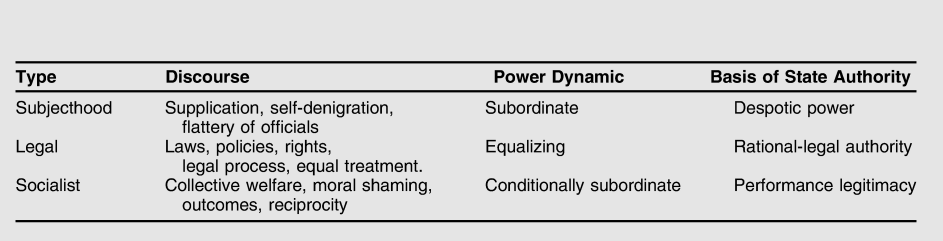
Mann famously argued that citizenship regimes survive and perish due to geopolitics—national power and success in war—rather than internal coherence.Footnote 74 If so, the authoritarian citizenship regime of a rising China is of potentially historic significance. However, our approach to understanding authoritarian citizenship differs from Mann’s, which characterized each state as possessing a single, largely elite-driven citizenship regime. Similar approaches to classification remain on the citizenship research agenda today,Footnote 75 but examining public transcripts reveals a spectrum of citizenship performances rather than a single classification (table 3). These varied performances show not only the ingenuity of individuals in crafting public transcripts but also that there is more than one mode of “authoritarian citizenship,” even within a monolithic political regime.
Three scripts of authoritarian citizenship

This approach to citizenship analysis is applicable across a range of illiberal polities, so long as researchers can observe communication between ordinary people and authoritarian elites. Singapore’s face-to-face “Meet the People” sessions for legislatorsFootnote 76 and complaint letters to the Russian Commissioner for Human RightsFootnote 77 may offer similarly rich transcripts for understanding citizen-state relations under other authoritarian arrangements.Footnote 78 Myanmar also offers varied channels for citizen complaints, ranging from the courts to the military to human rights authorities. Diverse scripts may be performed here as well, as individuals move from “supplication to stridency, emerging as a citizen from behind the mask of supplication.”Footnote 79 In the Soviet Union during the 1930s, letter writers assumed both roles of “supplicants” and “citizens,” at times employing similarly sarcastic language to jab at the gap between the Soviet state’s promises and disappointing realities.Footnote 80 A similar empirical approach may even be applied in totalitarian states such as North Korea, although we expect the extreme power asymmetry between individual and state to produce more uniform, ritualistic performances that draw on official juche ideology.Footnote 81 Archival records from post-Soviet states such as Bulgaria and the recent expansion of online media in Cuba may offer additional opportunities for studying expressions of citizenship under authoritarian rule.Footnote 82
The typology of citizenship performances we develop from studying China is not exhaustive. In authoritarian regimes where elections play a more prominent role in political life,Footnote 83 performances of citizenship based on electoral accountability or the fiscal contract may be more widespread than in China. Although we can only present evidence from this clearly authoritarian setting, moral appeals, legal demands, and self-denigration may also appear in encounters with political authority in democratic regimes. We leave these questions to future research.
Studying the public transcript helps us understand how ordinary people—not just boundary-pushing activists—understand power relations and attempt to elicit assistance in encounters with authoritarian elites.Footnote 84 This approach can be adopted in any political setting, but it is especially valuable in authoritarian states or weakly institutionalized political regimes where avenues for participation are limited and the formal institutions of political life may belie lived realities. Even within the evidently narrowing space for political engagement in China, we find a rich landscape of performed citizenship. These multiple performances raise new questions for research in comparative politics and political behavior. How are performances of authoritarian citizenship shaped by identity, social class, and culture? Do economic development and modernization lead to convergence on certain scripts? Do authority figures respond more readily to certain types of citizenship performances than others? Can elites shape grassroots performances of citizenship by channeling participation into certain venues and forms, or do such efforts backfire as suggested by recent studies of labor rights enforcement?Footnote 85 By combining the performative lens on citizenship with new sources of data on public transcripts, researchers may construct new models of how citizenship evolves under authoritarian rule.Footnote 86