INTRODUCTION
New host and geographical records have recently been established for the protostrongylid parasites Parelaphostrongylus odocoilei (muscleworm) and Protostrongylus stilesi (lungworm) in wild thinhorn sheep (Dall's sheep, Ovis d. dalli, and Stone's sheep, O. d. stonei) in Subarctic and Arctic North America (Kutz et al. 2001; Hoberg et al. 2002; Jenkins et al. 2005a). Like all protostrongylid nematodes, these parasites have indirect life-cycles, where 1st-stage larvae (L1) are shed in the faeces of the mammalian definitive host, invade a gastropod intermediate host, and develop to infective 3rd-stage larvae (L3). The life-cycle of P. odocoilei has been described in experimentally infected thinhorn sheep (Jenkins, Hoberg and Polley, 2005b), but the epidemiology (including seasonal patterns of larval development, transmission, prevalence, and intensity) of protostrongylid parasites in populations of wild thinhorn sheep has not been investigated. Seasonal aspects of transmission of P. odocoilei in mule deer (Odocoileus h. hemionus) and P. stilesi in bighorn sheep (Ovis c. canadensis) at temperate latitudes in North America have been characterized (Samuel, Platt and Knispel-Krause, 1985; Robb and Samuel, 1990).
Development of protostrongylid larvae within the poikilothermic intermediate host is temperature-dependent and can be predicted using degree-day models, which assume that a fixed amount of heating accumulated above a critical threshold temperature is necessary for development (Saunders, Tompkins and Hudson, 2002; Harvell et al. 2002). A degree-day model has been developed and validated in the field for the protostrongylid Umingmakstrongylus pallikuukensis, a lungworm of muskoxen (Ovibos moschatus) (Kutz et al. 2002), whereas similar models for P. stilesi and P. odocoilei have been developed but not yet validated (Samson and Holmes, 1985; Jenkins et al. 2005c). Such models are powerful tools for comparing development of protostrongylid species across latitudinal gradients, isolating factors that are potentially limiting parasite distribution, and determining the potential for range expansion. A degree-day model for U. pallikuukensis has also been used to describe historical patterns of parasite development and to predict responses of protostrongylid-host systems to climate change (Kutz et al. 2005). Climate change, especially of the magnitude projected in northern regions, will profoundly influence ecosystems, including the ecological relationships between hosts and parasites (Harvell et al. 2002; Dobson et al. 2003; Hassol, 2004). The distribution of thinhorn sheep in Canada (see Bowyer and Leslie, 1992) corresponds to the 2 districts (i.e., North British Columbia Mountains/Yukon and Mackenzie District) currently experiencing the strongest warming trends in Canada (http://www.msc-smc.ec.gc.ca/ccrm/bulletin/, accessed April 2005).
Our objectives were (i) to describe the epidemiology of P. odocoilei and P. stilesi in Dall's sheep in the Mackenzie Mountains, Northwest Territories (NT), Canada, (ii) to validate a degree-day model for development of larvae of P. odocoilei in an important gastropod intermediate host and (iii) to apply degree-day models to describe and predict trends in development of P. odocoilei and P. stilesi throughout the geographical range of Dall's sheep in northern North America, and in a future of climate warming.
MATERIALS AND METHODS
Patterns of larval shedding
Every 1–3 months from March 2000 to April 2003, we collected approximately 30 separate faecal piles that appeared to have been deposited within the previous 48 h by Dall's sheep in the Katherine Creek study area, Mackenzie Mountains, NT (65 °01′N; 127 °35′W; elevation ca. 610–1100 m) (Fig. 1). Faecal pellets were sealed in plastic bags and frozen for 2–31 weeks before recovery of L1 from 5 g samples using a modified beaker Baermann technique (Forrester and Lankester, 1997; Jenkins et al. 2005a). Samples with high numbers of free-living nematodes, insect larvae, or dead L1 were assumed to have been on the ground for longer than 48 h and results were not used in analyses. The prevalence (percentage of samples positive) and mean intensity (mean number of L1 per gram of wet faeces, or LPG) were calculated separately for P. odocoilei and P. stilesi.

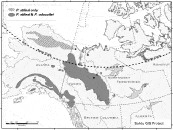
Fig. 1. Distribution of protostrongylid parasites in Dall's sheep (extrapolated from Worley et al. 2004; Jenkins et al. 2005a) and locations of weather stations and study areas in northern Canada: (a) Ivvavik National Park, Yukon Territory (YT) (to the immediate left are the British Mountains, continuous with the Brooks and Baird Mountains in Alaska, USA); (b) Inuvik, Northwest Territories (NT) (to the left are the Richardson Mountains, NT and YT); (c) Norman Wells, NT; (d) Fort Simpson, NT; (e) Palmer Lake study area, Mackenzie Mountains, NT; (f) Katherine Creek study area, Mackenzie Mountains, NT.
Development of P. odocoilei in D. laeve
Using methods adapted from Kutz et al. (2002), in 2002 and 2003 we determined the rates of development for larvae of P. odocoilei in experimentally infected native slugs (Deroceras laeve) at the Palmer Lake study area, Mackenzie Mountains, NT (64 °28′N; 129 °37′W, elevation 1100 m) (Fig. 1). Slugs were collected from a wet sedge meadow separated by a packed trail from the 20×40 m study site, which was enclosed by a battery-powered electric fence to deter animals (e.g., grizzly bears, Ursus arctos horribilis, and woodland caribou, Rangifer tarandus caribou). The study site was a wet-mesic sedge meadow covered by 5–15% standing water depending on the time of year, and the vegetation was composed primarily of sedge and moss, with mats of mountain aven (Dryas sp.) and some willow (Salix spp.), dwarf birch (Betula sp.), and white spruce seedlings (Picea glauca).
Slugs were collected 1–3 times each day for 7–14 days prior to the start of each experiment (Table 1), except for Exp. 4, when slugs were collected for 26 days in May 2003 because the ground was still frozen, and traps were occasionally frozen or obscured by fresh snow. Slugs were measured at full extension and grouped into 1 of 3 size classes: small, up to 9 mm; medium, 10–14 mm; and large, greater than or equal to 15 mm (modified from Samuel et al. 1985). Slugs were housed in buckets containing native vegetation at mean temperatures of 6–12 °C.

First-stage larvae of P. odocoilei (originally from the Mackenzie Mountains) were recovered from faeces of experimentally infected Stone's sheep (Jenkins et al. 2005b). Groups of 12 slugs were exposed to 3000 motile L1 for 3 h (Hoberg et al. 1995), except for uninfected control slugs that were otherwise treated in a similar fashion. According to the size ratios at collection in each experiment, infected and uninfected slugs were housed in groups of 10 in separate enclosures randomly placed within the study site. Each enclosure consisted of a turf plug (approximate height 16 cm) inside a 5 litre, high- density polyethylene bucket (21 cm top diameter, 18 cm base diameter, height 19 cm; Ropak Packaging, Fullerton, California, USA) with drainage holes. Each bucket also contained a cut-down aluminum tomato cage (composed of 2 wire circles connected by 3 vertical rods, 24 cm top diameter, 18 cm base diameter, height 28 cm), and the entire enclosure was lined with white nylon/polyester netting. To expel wild slugs, turf plugs were flooded for at least 24 h prior to addition of experimental slugs.
Starting at 14 days post-infection (p.i.), every 7 days in 2002, and every 14 days in 2003, infected slugs were recovered by visual examination and sequential flooding for 3 days of 3 randomly selected enclosures from each experiment (Table 1). In 2002, starting at 21 days p.i., uninfected control slugs were recovered from 3 enclosures from each experiment every 14 days, and in 2003, starting at 28 days p.i., uninfected slugs were collected from control enclosures every 28 days. In May–June 2003, overwintered enclosures (3 with infected slugs and 3 with uninfected slugs) from each experiment established in 2002 were collected at 308 days p.i., and 3 overwintered enclosures with infected slugs from each experiment were collected on June 16 (Exp. 1, 336 days p.i.), July 7 (Exp. 2, 350 days p.i.), and July 21 (Exp. 3, 357 days p.i.) (Table 1).
Slugs recovered from enclosures were held at approximately 6 °C for up to 7 days before individual digest in a pepsin-hydrochloric acid solution to recover, count, and classify stages of larvae (Hoberg et al. 1995; Jenkins et al. 2005c). In 2003, the seasonal abundance of infective L3 was calculated for slugs from Exps 4–7 by multiplying the mean number of infective L3/slug by the number of slugs recovered in each collection. In 2003, vegetation from enclosures containing infected slugs was examined for emerged infective L3 on July 28 (Exp. 4), August 11 (Exps 4–6), and August 25 (Exps 4–7) (Kutz, Hoberg and Polley, 2000). Any L3 recovered from uninfected control slugs were identified using molecular techniques (Jenkins et al. 2005a).
To ensure that larvae were viable, 10 infected and 10 uninfected slugs from each experiment (according to the size ratios at collection) were housed indoors at the warmest ambient temperatures possible under field conditions (Exps 1–3 and 6–9, average 19·5 °C, range 9–28 °C; Exps 4 and 5, average 15·5 °C, range 3–24 °C). These slugs were examined for survival and digested at 19 days p.i. in 2002, and 24 days p.i. in 2003, except for Exp. 4 where, because of cooler temperatures, slugs were examined for survival at 24 days p.i. and digested at 36 days p.i.
Validation of model
Temperatures 2 cm below and at the soil surface were recorded inside and outside 3 enclosures containing no slugs placed randomly within the study area. Temperatures were recorded every 1 h using external probes from HOBO XT monitors (Onset Computer Corporation, Pocasset, Massachusetts) (15 July to 25 August 2002), every 4 h using HOBO XT monitors (25 August 2002 to 7 May 2003), or every 1 h using HOBO H08 Pro monitors (7 May to 8 September 2003). The means for each temperature measurement for the 3 enclosures were used for further calculations, except for surface temperatures inside enclosures over the winter of 2002–2003, from which data were available from only 2 enclosures. Air temperatures 1·5 m above ground level were recorded every 0·5 h (15 July to 25 August 2002) or every 1 h (25 August 2002 to 8 September 2003) by a HOBO weather station in the study area.
To predict when infective L3 should have been present in experiments in 2002 and 2003, we used recorded temperatures (soil, surface, and air), the laboratory-derived threshold temperature (To: 8·5 °C) and thermal constant (minimum amount of heating necessary for development of infective larvae, 163 degree days, or DD) (Jenkins et al. 2005c), and a degree-day model for protostrongylid larval development incorporating slug avoidance of microhabitat temperatures exceeding 21 °C (Dainton, 1989; Kutz et al. 2002). Temperatures above 21 °C were converted to 21 °C, the threshold temperature subtracted from all temperatures, and positive values summed to determine the amount of heating above threshold on a daily basis. These were converted to degree-days (DD) by dividing by 48 for temperatures recorded every 0·5 h, 24 for temperatures recorded every 1 h, or 6 for temperatures recorded every 4 h. For each experiment, we calculated cumulative DD based on soil, surface, and air temperatures, and compared dates of predicted (based on the thermal constant) versus observed development of the first infective L3.
Application of model
We obtained hourly air temperature data from Environment Canada weather stations at 4 locations in Subarctic and Arctic Canada, starting in the year that consecutive hourly temperature data were first recorded at each location (Fig. 1). These included the following: Ivvavik National Park, Yukon Territory (69 °09′N; 140 °09′W; elevation 244 m; 1996–2004); Inuvik, NT (68 °18′N; 133 °29′W; 68 m; 1961–2004); Norman Wells, NT (65 °17′N; 126 °48′W; 169 m; 1955–2004); and Fort Simpson, NT (61 °52′N; 121 °21′W; 132 m; 1955–1963; and 61 °45′N; 121 °14′W; 74 m; 1963–2004). We used temperature data between 1 April and 31 October for the 3 northernmost locations, and between 1 March and 30 November for Fort Simpson. Similar to Kutz et al. (2005), at each location we used degree-day models to describe historical trends and variation for theoretical development of larvae of P. odocoilei and P. stilesi, for the latter using laboratory-derived parameters (To: 7·8 °C, 305 DD) from Samson and Holmes (1985). To adjust temperatures recorded at the northernmost location (Ivvavik), we used a crude correction factor of −1 °C per 200 m gain in elevation (http://www.atmosphere.mpg.de/enid/16h.html, accessed Apr 2005), and an altitude of 1000 m for Dall's sheep winter range, which assumed that animals winter at altitudes closer to the valley bottoms than the high elevation summer range (http://www.taiga.net/wmac/consandmanagementplan_volume1/mlandscape.html, accessed Aug 2005).
We used surface temperatures recorded outside enclosures at Palmer Lake in 2003 as the baseline for climate change projections. The last date before 5 consecutive days with average surface temperatures below 0 °C was assumed to be the last day for gastropod activity in each year (see Kutz et al. 2005). From a climate change scenario (Canadian Centre for Climate Modeling and Analysis Global Coupled Model 2, A21 Special Report on Emission Scenarios, Economic Regional Focus Simulation 1) yielding mid-range values for the grid box incorporating the study site, we projected mean temperature increases of 1·2 °C by 2020, 3·3 °C by 2050, and 4·9 °C by 2080 (http://www.cics.uvic.ca/scenarios/, accessed Feb. 2005). By adding these values to the observed temperatures in 2003, and using degree-day models for development of larvae of P. odocoilei and P. stilesi, we predicted future trends in development of protostrongylids in the Mackenzie Mountains.
RESULTS
Patterns of larval shedding
Larvae of P. odocoilei were present in 96% (84–100%), and P. stilesi in 82% (18–100%), of 650 faecal samples collected from March 2000 to April 2003 (9–47 samples per collection). The mean intensities of L1 of P. odocoilei and P. stilesi over all collections were, respectively, 568 LPG (141–1350 LPG per collection) and 348 LPG (32–1075 LPG per collection). The prevalence of L1 of P. stilesi fell in August of each year, and rose again each fall (Fig. 2). Larval intensity for both parasites peaked in the spring of each year, decreased in summer, and gradually increased throughout fall and winter (Fig. 2).

Fig. 2. (A) Prevalence (%) and (B) mean intensity (larvae per gram of faeces, or LPG) of 1st-stage larvae of Parelaphostrongylus odocoilei and Protostrongylus stilesi shed by Dall's sheep in the Katherine Creek study area, March 2000–April 2003.
Development of P. odocoilei in D. laeve
Pre-infective, but not infective, larvae developed under field conditions in Exps 1–3 in 2002, and were recovered from live and dead slugs examined in 2003 after overwintering. In 2003, infective L3 were first observed on 28 July from Exps 4–6, on 8 September from Exp. 7, and were not recovered from Exp. 8 or 9 (for corresponding days p.i., see Table 1). Abundance of infective L3 pooled from all experiments was highest in August and September 2003 (Fig. 3). Emerged protostrongylid larvae were not recovered from any enclosures. One L3 was recovered from each of 2 uninfected control slugs collected in late July from Exp. 6, which were identified as P. odocoilei and an unnamed protostrongylid species endemic in caribou. One unidentified protostrongylid L3 was recovered from an uninfected control slug collected in late August from Exp. 8.

Fig. 3. Seasonal abundance (number of slugs×mean number of L3/slug) of infective larvae (L3) of Parelaphostrongylus odocoilei in the slug Deroceras laeve for Exps 4–7 in 2003.
Recovery of uninfected versus infected slugs from enclosures in the field did not differ consistently or substantially for any experiments, but decreased with the passage of time in all experiments. In enclosures from Exps 1–3 that overwintered, slug recoveries were low, and dead slugs were frequently observed. Slug recoveries were also low in Exps 4, 5, 6, and 9, even at 14 and 28 days p.i. (Table 1). Moribund or dead slugs were often observed in collections in May and June 2003, especially those in the medium size class. Ratios of size classes of slugs were similar for experiments starting in July 2002 (Exps 1–3) and 2003 (Exps 6–8) (Table 1). In 2003, ratios were approximately the same for all 3 size classes in May (Exp. 4), the relative proportion of medium slugs dropped to its lowest in early June (Exp. 5), and the largest relative proportion of small slugs (60%) was observed in early August (Exp. 9). Eggs were observed in collection dishes and field enclosures from late May until early September in 2003, most noticeably in June and July. Many newly hatched slugs were observed on traps in late July and early August, and were recovered from field enclosures from mid-July to September 2003.
Survival of both uninfected and infected slugs housed indoors ranged from 80–100% for Exps 1–3 and 7–9, and 40–80% for Exps 4–6. Most (74–95%) larvae recovered from indoor control slugs were infective L3, except in Exp. 5, in which 82% of larvae were early L3. Mean infection intensity in indoor controls ranged from 11–43 larvae/slug for the 9 experiments.
Validation of model
Based on all sources of temperature data (soil, surface, and air), larvae were not predicted to develop to infective stage for experiments starting in 2002 until 19 May 2003 (Exp. 1, 308 days p.i.), 9 June 2003 (Exp. 2, 322 days p.i.), and 23 June 2003 (Exp. 3, 329 days p.i.) at the earliest (Fig. 4). For experiments starting in 2003, both air and surface temperatures adequately predicted when infective larvae were first observed, although air temperatures predicted somewhat slower development (Fig. 5). Degree-days based on soil temperatures did not accumulate rapidly enough to explain observed rates of development.

Fig. 4. Predicted cumulative degree-days (Cum DD) for larvae of Parelaphostrongylus odocoilei in experiments starting in 2002 using hourly surface temperatures inside enclosures at Palmer Lake. Thermal constant (hatched line)=163 DD.

Fig. 5. Predicted cumulative degree-days (Cum DD) for larvae of Parelaphostrongylus odocoilei in experiments starting in 2003 at Palmer Lake using (A) hourly surface temperatures inside enclosures and (B) hourly air temperatures. Circled markers indicate the first dates that infective larvae were observed. Thermal constant (hatched line)=163 DD.
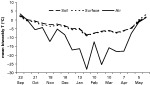
In the summer of 2003, among the 3 enclosures where hourly soil and surface temperatures were monitored, the mean standard deviation for soil temperature was approximately 0·75 °C (range 0–4·6 °C), while surface temperatures were more variable, with a mean standard deviation of approximately 1·25 °C (range 0·01–8·8 °C). In general, surface temperatures in summer were higher than either soil or air temperatures, except in July 2003, when air and surface temperatures were comparable. In winter, soil temperatures were slightly higher than surface temperatures, and both were less variable and much warmer than air temperatures (Fig. 6). Surface and soil temperatures were marginally lower inside versus outside enclosures, except in summer, when soil temperatures inside enclosures were slightly warmer. Summer temperatures at Palmer Lake were, on average, 5 °C cooler than at Norman Wells.

Fig. 6. Mean biweekly air, surface, and soil temperatures (T, °C) outside enclosures at Palmer Lake from September 2002 to May 2003.
Application of model
For P. odocoilei, the length of the ‘growing season’, when temperatures were above the threshold for larval development, and maximum number of cumulative degree-days had an inverse relationship with latitude (Table 2). As well, moving from north to south, larvae were predicted to develop to infective stage earlier in the year and could begin development later in the year and still reach infective stage. At Inuvik, Norman Wells (Fig. 7), and Fort Simpson, the maximum number of cumulative degree-days and the length of the growing season for development has increased over the last 4–5 decades. Despite annual variability, this relationship was statistically significant for cumulative degree-days at all 3 locations (Inuvik R2=0·14, F=6·8, P=0·013; Norman Wells R2=0·15, F=8·7, P=0·005; Fort Simpson R2=0·18, F=10·3, P=0·002), but not growing season.

Fig. 7. Historical trend and annual variability for development of Parelaphostrongylus odocoilei using hourly air temperatures recorded in Norman Wells, NT, 1955–2004. (A) Length of parasite growing season (linear regression, relationship not significant). (B) Maximum number of cumulative degree-days (linear regression, F=8·7, P=0·005).

Using recorded air temperatures, larvae of both P. odocoilei and P. stilesi could have developed within 1 season at all locations in every year, although the thermal constant for P. stilesi was only narrowly exceeded at the 2 Arctic locations (Ivvavik and Inuvik). The two high-elevation data sets (Ivvavik corrected for elevation, and Palmer Lake) yielded approximately half the DD accumulated using uncorrected or nearby low elevation data sets (Norman Wells for Palmer Lake) (Table 2). Using elevation corrected data from Ivvavik, L3 of P. odocoilei would not have developed within a single summer in 5 of 9 years (1996–2004), and L3 of P. stilesi would not have developed within a single summer in any year.
Under a climate warming scenario, the maximum number of cumulative degree-days at Palmer Lake increased through the 2020, 2050, and 2080 time slices for both P. odocoilei and P. stilesi (Table 3). As warming progressed, the transmission period lengthened (due to infective larvae becoming available earlier in the year and gastropod activity extending later in the year), and larvae could begin development later in the year and still reach infective stage. In all time slices, infective L3 of P. stilesi would be available approximately 3 weeks later in the year than P. odocoilei, and the last date that larvae of P. stilesi could begin development and reach infective stage larvae occurred approximately 3 weeks earlier in the year (Table 3).

DISCUSSION
Epidemiology of protostrongylid parasites
Parasites
In the Mackenzie Mountains, large numbers of L1 of P. odocoilei and P. stilesi were deposited by Dall's sheep over winter, with peaks in March–May. Using the mean intensity of larval shedding for November 2000–April 2001 (~600 LPG for each protostrongylid), and an average daily faecal production of ~300 grams (Jenkins et al. 2005b), each sheep would deposit approximately 30 million L1 of each protostrongylid species on the winter range. Based on laboratory investigation of the effects of temperature and humidity on survival of L1 of P. odocoilei, and laboratory and field trials with L1 of a related protostrongylid (P. tenuis) as well as P. stilesi (Forrester and Senger, 1963; Uhazy, Holmes and Stelfox, 1973; Shostak and Samuel, 1984; Forrester and Lankester, 1998), a proportion (20–60%) of these L1 would survive overwinter in faeces and be available to infect gastropods at snowmelt. Subsequently, gastropod infection may continue throughout summer, although L1 survival decreases with freeze-thaw cycles, increasing temperature, and exposure to sunlight (Rose, 1957; Shostak and Samuel, 1984; Lorentzen and Halvorsen, 1986). Larval shedding by sheep in the Mackenzie Mountains declined precipitously over the summer, especially for P. stilesi. Although a summer decline in prevalence and intensity of Protostrongylus spp. has been reported in some bighorn sheep populations (Uhazy et al. 1973; Yde, Brown and Worley, 1988), the marked decline that we observed is unusual, and could be due to seasonal factors in combination with an interspecific interaction between parasites (Pybus et al. 1990; Ball, Lankester and Mahoney, 2001; Lello et al. 2004).
In slugs infected on 2–30 June 2003 (Exps 4, 5, and 6), infective larvae of P. odocoilei were first present in all 3 experiments on 28 July 2003. As well, 2 uninfected control slugs collected at this time contained L3 of P. odocoilei and an unnamed protostrongylid endemic to caribou in the Mackenzie Mountains, suggesting that L3 are available in naturally infected gastropods by late July. Long periods of minimal development at cooler temperatures are likely interspersed with rapid bursts of development at warmer temperatures, leading to ‘pulses’ of infective larvae. In slugs infected in mid-July 2003 (Exp. 7), but not in those infected in mid-July 2002 (Exp. 1), infective larvae developed in early September. The summer of 2003 was approximately 0·5 °C warmer than the summer of 2002, a normal year for this region of the Mackenzie District (http://www.msc-smc.ec.gc.ca/ccrm/bulletin/archive_e.cfm, accessed April 2005). Therefore, even small differences in overall temperature between years led to different seasonal patterns in larval development and availability.
Infective larvae had high abundance in experimentally infected D. laeve in August–September 2003, similar to the pattern observed in gastropods naturally infected with P. odocoilei and P. stilesi in temperate regions (Samuel et al. 1985; Robb and Samuel, 1990), as well as U. pallikuukensis in Arctic Canada (Kutz et al. 2002). Infective larvae in gastropods would remain available to sheep until late fall/early winter, when gastropods enter hibernation. Transmission after this point is theoretically possible, because a small proportion of infective larvae of both P. odocoilei and P. stilesi emerged from experimentally infected gastropods in the laboratory, and L3 of P. odocoilei survived in the environment for months under conditions simulating the subnivean environment (Monson and Post, 1972; Jenkins et al. 2005c). Although we did not observe emergence of larvae of P. odocoilei in the field, this may reflect poor slug survival and methods used for examination. Emergence may play a lesser role in transmission of P. odocoilei in the Subarctic than for U. pallikuukensis at higher latitudes, where emergence significantly extends both the spatial and temporal windows of transmission (Kutz et al. 2000). Further investigation of the role of larval emergence and the possibility of overwinter transmission for P. odocoilei and other protostrongylids is indicated, as overwinter transmission of L3 of gastrointestinal nematodes occurs even in the High Arctic (Halvorsen et al. 1999).
Gastropods
The slug Deroceras laeve is important in transmission of elaphostrongylines in Canada (Lankester and Anderson, 1968; Samuel et al. 1985; Ball et al. 2001), and, along with the snails Catinella sp. and Euconulus fulvus, is probably an important intermediate host for P. odocoilei in the Mackenzie Mountains (Jenkins et al. 2005c). Based on temperature data and observations in the Mackenzie Mountains, slugs were active from May until September, as compared to April–November in temperate regions (Aitchison, 1979; Rollo and Shibata, 1991; Lankester and Peterson, 1996). In the current study, slugs of all size classes survived overwinter, with mortality of older individuals in May–June and recruitment primarily in July–August, as observed in temperate areas (Lankester and Anderson, 1968; Samuel et al. 1985). This pattern, and the appearance of moribund slugs consistent with senescence and shrinkage (Rollo and Shibata, 1991), likely account for low slug recoveries from field and laboratory enclosures for Exps 4, 5, and 6. In Exp. 9, as 90–100% of indoor control slugs were recovered, low recoveries from field enclosures may have been due to the escape of small slugs (which constituted 60% of slugs in this experiment). Few slugs were recovered from overwintered enclosures (see Kutz et al. 2002), which may reflect natural mortality in combination with colder soil and surface temperatures inside enclosures, probably due to decreased snow cover and limited options for microhabitat selection (South, 1989).
We observed a large cohort of slugs hatching in late summer/early fall, as has been reported in temperate areas (Lankester and Anderson, 1968; Boag and Wishart, 1982). This cohort would be immediately available to L1 the following spring and is likely the most important source of infective larvae of P. odocoilei later in the summer, because young of the year slugs would not be available until July. This is consistent with the observation that larger, older slugs (versus young of the year) had higher prevalence of infective larvae of P. odocoilei in an endemic region at temperate latitudes (Samuel et al. 1985). The late-summer cohort may survive a second winter and die the following spring (i.e., a life-span of ~1·5 years). This differs from the conventional view that D. laeve is an annual species (Lankester and Anderson, 1968; Boag and Wishart, 1982; Rollo and Shibata, 1991), although longer life-spans for D. laeve and terrestrial snails have been described (Getz, 1959; Robb and Samuel, 1990).
Dall's sheep
In April–May, Dall's sheep leave their low elevation winter range (subalpine shrubs and boreal meadows), following the melting snow to higher elevations, where lambing occurs in late May (Hoefs and Cowan, 1979; Simmons, 1982). In June–early August, sheep primarily feed on alpine tundra, where suitable gastropod habitat is thought to be scarce (Hoefs and Cowan, 1979; Boag and Wishart, 1982), although heavily used, naturally-occurring mineral licks and water sources may provide suitable gastropod habitat and thereby serve as foci of protostrongylid transmission. In late August, nursery groups of sheep (lambs, ewes, and yearlings) begin to return to the low elevation winter range, habitat more suitable for hydrophilic terrestrial gastropods like D. laeve and Catinella sp. (Hoefs and Cowan, 1979; Simmons, 1982). Upon their return, lambs are likely to become infected by consuming infective L3 in gastropods. Therefore, the observed increase in intensity of L1 shedding in November in all 3 years of the study may be due to the exponential rise in larval counts following the 70 day pre-patent period in newly infected lambs (Jenkins et al. 2005b), in combination with increased larval shedding by adult males under rutting stress (Halvorsen, Skorping and Hansen, 1985). Intensity of larval shedding continued to rise throughout winter, which may in part reflect immunological compromise due to nutritional stress, and/or increased parasite fecundity due to seasonal triggers (Halvorsen et al. 1985; Slomke, Lankester and Peterson, 1995; Grenfell et al. 1995).
Based on seasonal overlap of protostrongylid larvae, gastropods, and Dall's sheep in the Mackenzie Mountains, the majority of Dall's sheep likely become infected in the fall on their winter range, as suggested for P. odocoilei in mule deer and Protostrongylus spp. in bighorn sheep in temperate areas (Samuel et al. 1985; Robb and Samuel, 1990). Transmission in spring is also possible, most likely from infective larvae of P. odocoilei that have overwintered in gastropods. In the current study, pre-infective larvae of P. odocoilei that overwintered in slugs were predicted to develop to L3 in late May and June, by which time sheep have left the winter range, nor did we observe development to L3 in overwintered slugs in Exp. 1 in mid-June (336 days p.i.). This, in combination with overwinter mortality of slugs, suggests that such larvae contribute only minimally to transmission of P. odocoilei. In contrast, overwinter survival and resumption of development of larvae of U. pallikuukensis in D. laeve are important for maintenance of this Arctic parasite in years when L3 do not develop in a single summer (Kutz et al. 2002).
Historical and future development of protostrongylid parasites
Model validation
Using a degree-day model, we successfully predicted rates of development of larval P. odocoilei in the summers of 2002 and 2003. Infective L3 were present in 1 enclosure in Exp. 6 somewhat earlier than anticipated, possibly due to heterogeneity of microhabitat within the study area, especially for soil surface temperatures. Despite concerns about a non-linear relationship at lower temperatures and the effects of stochasticity (Saunders et al. 2002; Jenkins et al. 2005c), degree-day models have been validated for larval development of U. pallikuukensis (Kutz et al. 2002) and now P. odocoilei, which represent different subfamilies (Muellerinae and Elaphostrongylinae) in different hosts (muskoxen and Dall's sheep) and habitats (Arctic tundra and Subarctic alpine). Such models, validated under field conditions, may have broad applicability to other protostrongylids, and perhaps other host-parasite systems (Kutz et al. 2005).
We used air temperatures from weather stations located nearest to Dall's sheep habitat to describe trends in protostrongylid development over the last 50 years, and to compare parasite development on a latitudinal gradient. These stations were located at lower elevations than are typically used by Dall's sheep, but long-term data sets from high elevations are unavailable for northern Canada. This overestimated the cumulative degree-days; for example, summer temperatures were ~5 °C cooler, and approximately half the number of degree-days were accumulated, at Palmer Lake in the Mackenzie Mountains than at Norman Wells in the Mackenzie River valley. Likewise, summer temperatures recorded at Ivvavik, when adjusted for elevation, were 4 °C cooler, and the number of degree-days decreased by a half.
Air temperatures, while predictive at Palmer Lake in 2003, generally produce conservative estimates of development rates (Kutz et al. 2002). Therefore, we used surface temperatures recorded at Palmer Lake in 2003 as the baseline for climate change projections. This was probably a ‘warm start’ scenario, based on the 1955–2004 trend line for DD accumulated at Norman Wells and Environment Canada data, which indicated that average temperatures in the summer of 2003 were 0·4 °C above the baseline since 1948 in the Mackenzie District (http://www.msc-smc.ec.gc.ca/ccrm/bulletin/archive_e.cfm, accessed April 2005).
Spatial patterns
We validated the degree-day model for development of larvae of P. odocoilei in gastropods at the northern limits of its range (the northern Mackenzie Mountains in Subarctic Canada), and applied the degree-day model to determine if larvae of P. odocoilei could develop within 1 summer at the northern limits of the distribution of Dall's sheep in Canada (the British Mountains, Ivvavik National Park in Arctic Canada). At Ivvavik, using the degree-day model and temperatures corrected for elevation, development to infective larvae could have occurred within 1 summer in only 4 of the last 9 years. Under current temperature conditions at high elevation at Arctic latitudes, larvae of P. odocoilei would therefore have to survive overwinter in slugs and resume development the following summer (a multi-year cycle); however, it is not clear that P. odocoilei can undergo a multi-year cycle in D. laeve, based on poor slug survival and failure of larvae to resume development after overwintering in the current study. If this, in combination with geographical barriers (isolation by distance), currently excludes P. odocoilei from Arctic latitudes, further climate warming may soon release this constraint on range expansion.
Under conditions suitable for larval development, P. odocoilei would likely establish at Arctic latitudes, as L1 are resistant to dessication and freezing (Shostak and Samuel, 1984), and gastropod species suitable as intermediate hosts for P. odocoilei are present in Alaska and on the Arctic coast (Pilsbry, 1948; Dau, 1981; Hoberg et al. 2002). If introduced, either through translocation or natural movements of definitive hosts (such as cervids), warming could allow P. odocoilei to establish in naïve populations of Dall's sheep in the Arctic. Such range expansions have been associated with increased prevalence and severity of clinical disease associated with elaphostrongylines, and even epizootics and population declines (Ball et al. 2001).
While P. odocoilei is absent in Dall's sheep populations in the Arctic ranges (Richardson, British, Brooks, and Baird), P. stilesi is present in all wild sheep populations surveyed in Subarctic and Arctic North America (Jenkins et al. 2005a). Based on a degree-day model (using parameters from Samson and Holmes, 1985), larvae of P. stilesi, with its higher DD requirements, would not have developed to infective stage in 1 summer at Ivvavik, the northernmost location, in any of the last 9 years. This suggests that P. stilesi must undergo a multi-year cycle at Arctic latitudes, as described for another Arctic parasite, U. pallikuukensis (Kutz et al. 2002). Alternatively, transplacental transmission (involving hypobiosis of L3 in ewes, possibly unique to this species of protostrongylid) may allow maintenance of P. stilesi in Dall's sheep at these latitudes (Hibler et al. 1974). The degree-day model for P. stilesi should be validated in the field using a native intermediate host before it is broadly applied; the parameters derived by Samson and Holmes (1985) for P. stilesi were based on development in a snail species that may not be a natural intermediate host, potentially accounting for slower development and the higher thermal constant. A longer developmental period for P. stilesi may also reflect evolutionary constraints. Protostrongylus spp. are thought to have evolved with caprines in Eurasia, and later became distributed at high latitudes in North America (Jenkins, 2005).
Through application of a degree-day model, we have examined temperature as a potentially limiting factor for parasite distribution and identified a wildlife population at risk. This provides the basis for wildlife managers to avoid translocation of thinhorn sheep, a common practice for bighorn sheep in North America, and eliminates the need for experimental translocation of parasites to determine if establishment is possible in non-endemic regions (Zarnke et al. 1990; Hoffmann and Blows, 1994).
Temporal trends
Based on our findings and a previous study on U. pallikuukensis (Kutz et al. 2005), climate warming has already increased the length of the growing season for protostrongylid development and the amount of heating available for larval development in Subarctic and Arctic Canada. Transmission of protostrongylids to Dall's sheep in the fall likely occurs in a narrow window between mid-August, when sheep return to winter range, and mid-September, when gastropods go into hibernation. Climate warming will cause L3 to be available earlier in the year, but this may have little significance if sheep do not return to the winter range before mid-August. Climate warming may have its most significant effects by extending gastropod activity earlier and later in the season, and by increasing the absolute numbers of infective larvae available to infect sheep. As well, at high elevations at Arctic latitudes, climate warming may increase the number of years when development within 1 summer is possible, facilitating a shift from a multi- to a 1-year cycle, similar to that described for U. pallikuukensis (Kutz et al. 2005).
Climate warming could lead to amplification of parasite populations and increased transmission to sheep, possibly resulting in disease outbreaks in endemic regions (Hoberg, Kocan and Rickard, 2001; Kutz et al. 2004). Outbreaks of clinical cerebrospinal elaphostrongylosis (caused by E. rangiferi) in reindeer in northern Norway occurred in years when summer temperatures were 1·5 °C above normal (Handeland and Slettbakk, 1994). Recent findings suggest that, in addition to muscular and respiratory pathology, P. odocoilei also has the potential to cause neurological disease in thinhorn sheep (Jenkins et al. 2005b). Based on its higher DD requirements and distribution at Arctic latitudes, climate warming could have disproportionately greater effects on transmission of P. stilesi as compared to P. odocoilei. Protostrongylus stilesi is a ubiquitous lungworm of bighorn and thinhorn sheep, and in thinhorn sheep, may cause additive or even synergistic pulmonary pathology in conjunction with eggs and larvae of P. odocoilei (Uhazy et al. 1973; Kutz et al. 2001; Jenkins, 2005). Healthy Dall's sheep populations (total 14000–26000 animals) in the Mackenzie Mountains (140000 km2 area) are valuable resources for subsistence harvest and trophy hunting (Veitch et al. 1998).
Although our investigation focused on the positive effects of warming on larval development, warming may also increase mortality of free-living L1 (Levine, 1963), which could in part compensate for amplification of L3 numbers. However, L1 may be produced in sufficient numbers that increased mortality would have little effect on larval abundance in gastropods. Based on our field trials, there was no evidence that infected slugs experienced higher mortality than uninfected controls, suggesting that increased host mortality would not compensate for increased L3 availability.
In addition to temperature, humidity would also influence survival of L1 and the distribution and abundance of gastropods. It was excluded from our model for larval development within gastropods because it was assumed that slugs would buffer larvae from extremes of dessication through microhabitat selection, behaviour, and obligate maintenance of water homeostasis (Rollo, 1991). Precipitation was the limiting factor for transmission of Fasciola sp., another gastropod-transmitted parasite, in temperate England (Ollerenshaw and Smith, 1969), and is important in the Mackenzie Mountains, which receive a desert-like 25–30 cm of rainfall each year, primarily in July and August (Simmons, 1982). However, all climate scenarios project wetter conditions for this region (http://www.cics.uvic.ca/scenarios/, accessed Feb. 2005), which favours protostrongylid transmission by increasing gastropod abundance and contact rates with L1 (Uhazy et al. 1973; Forrester and Littell, 1976).
In conclusion, the high prevalence of protostrongylid infections in Dall's sheep in Subarctic and Arctic North America bears testament to the success of these parasites at northern latitudes. This may in part reflect abundance and environmental resistance of free-living stages, seasonal concentration of hosts and parasites on winter range, and mobile intermediate hosts capable of microhabitat selection (Inglis, 1965; Dobson et al. 2003). Under a regime of climate warming, these parasites may undergo amplification in endemic regions, and range expansion into naïve host populations. Without targeted surveillance programs, such signs may go undetected, especially in remote northern regions. Predictive models are key to determining vulnerabilities of wildlife due to climate warming, and to monitoring and proactively managing wildlife diseases (Kutz et al. 2004). Unfortunately, few empirically-derived and field-validated models are available for the broad range of pathogens that will be affected by climate change. As well, such models must be complemented by sound knowledge of the biology and temporal and spatial patterns of availability of both pathogens and hosts (Morgan et al. 2004). Such data are critically lacking for northern wildlife, where survey and inventory of pathogen biodiversity (Hoberg et al. 2003), as well as baseline data on biologically relevant parameters recorded in appropriate microhabitat types (Danks, 1992), are still desperately needed.
We gratefully acknowledge the financial and logistical support of Bill and Carol McKenzie and the Grinde family (Gana River Outfitters), and the Association of Mackenzie Mountain Outfitters, without whom this research would not have been possible. We also thank Michelle Swallow, Arianna Zimmer, Jenny Skific, Ariel Brunn, Aaron Genest, Richard Popko, Sean Tutcho, Nancey Stevens-Whiteman, James Auld, and Brent Wagner for invaluable assistance. We are grateful to North-Wright Airways, Canadian Helicopters, and Sahtu Helicopters for transporting researchers, mail, and field supplies. Don Ryback at the Meteorological Service of Canada provided weather data. Mathew Herperger and Greg Appleyard performed molecular identification of larvae.
This project was funded by the following organizations: Arctic Institute of North America Grant-in-Aid; Association of Mackenzie Mountain Outfitters; Northern Scientific Training Program; Department of Environment and Natural Resources, Government of the NT; Foundation for North American Wild Sheep, national and regional chapters of Alberta, Iowa, Utah, and Washington; Fraternity of the Desert Bighorn; Safari Club International (Pittsburgh Chapter); Western College of Veterinary Medicine (WCVM) Interprovincial Graduate and Undergraduate Student Scholarships; WCVM Wildlife Health Fund; and the Wild Sheep Society of British Columbia.