Introduction
Attention deficit hyperactivity disorder (ADHD) is a common, early-onset, impairing, clinically and genetically heterogeneous neuropsychiatric disorder. The endophenotype approach has been proposed to reduce the complexity of the phenotype and its potential genetic heterogeneity and to increase linkage or association signals because the endophenotype is proximal to gene products and has the potential to target the possible pathophysiological deficits that combine to create the overall conditions of ADHD (Doyle et al. Reference Doyle, Faraone, Seidman, Willcutt, Nigg, Waldman, Pennington, Peart and Biederman2005a, Reference Doyle, Willcutt, Seidman, Biederman, Chouinard, Silva and Faraoneb).
Proposed criteria for useful endophenotypes in ADHD vary somewhat but share several key elements: they should (1) be correlated with ADHD in the probands; (2) be measured by tools with good psychometric properties; and (3) show familial–genetic vulnerability, that is be shared with ADHD, as indexed by appearing in unaffected relatives (Doyle et al. Reference Doyle, Willcutt, Seidman, Biederman, Chouinard, Silva and Faraone2005b). Neuropsychological functions, such as working memory, temporal processing and shortened delay gradient, have been proposed as candidate endophenotypes for ADHD (Castellanos & Tannock, Reference Castellanos and Tannock2002). Despite the promises raised by the endophenotypic approach in genetic studies, the search for cognitive endophenotypes in ADHD has not yielded definitive findings (Kebir et al. Reference Kebir, Tabbane, Sengupta and Joober2009).
Two of the most striking neuropsychological impairments in ADHD are in executive function (Gau et al. Reference Gau, Chiu, Shang, Cheng and Soong2009) and memory (Karatekin, Reference Karatekin2004). Executive function describes cognitive processes that mediate the ability to maintain an appropriate problem-solving set for attainment of a future goal (Pennington & Ozonoff, Reference Pennington and Ozonoff1996). Although previous studies have shown that executive function deficits are useful cognitive endophenotypes for ADHD (Gau & Shang, Reference Gau and Shang2010), a substantial number of patients with ADHD fail to show impairments in executive function, suggesting that executive function deficits are not found universally in ADHD (Doyle et al. Reference Doyle, Biederman, Seidman, Weber and Faraone2000). In addition to executive function, impairments in memory have been proposed to contribute in large part to ADHD (Rapport et al. Reference Rapport, Chung, Shore and Isaacs2001). Several studies on the integrity of memory in ADHD have found impairments in visual memory (Rhodes et al. Reference Rhodes, Coghill and Matthews2005). The visual memory tasks consist of both a memory search and a visual search component, and the subject is required to alternate searches between the visual search and memory sets to locate a match, thus placing high demands on effortful processing (Berman et al. Reference Berman, Douglas and Barr1999).
Several rationales endorse further examination of deficits in visual memory as ADHD endophenotypes. First, there is growing evidence for poor performance on visual memory tasks in ADHD, including impairment in spatial recognition memory (SRM; Kempton et al. Reference Kempton, Vance, Maruff, Luk, Costin and Pantelis1999), delayed matching to sample (DMS; Kempton et al. Reference Kempton, Vance, Maruff, Luk, Costin and Pantelis1999; Rhodes et al. Reference Rhodes, Coghill and Matthews2004; Barnett et al. Reference Barnett, Maruff and Vance2009), pattern recognition memory (PRM; Rhodes et al. Reference Rhodes, Coghill and Matthews2004) and paired associates learning (PAL; Chang et al. Reference Chang, Klorman, Shaywitz, Fletcher, Marchione, Holahan, Stuebing, Brumaghim and Shaywitz1999). These studies support the extension of the range of neuropsychological deficits associated with ADHD to visual memory functioning. Second, for neuropsychological measures to be useful endophenotypes for ADHD, they should demonstrate evidence of heritability (Doyle et al. Reference Doyle, Willcutt, Seidman, Biederman, Chouinard, Silva and Faraone2005b). Although data on the heritability of specific neuropsychological functions are limited, the heritability of visual memory is estimated as 0.53, somewhat greater than that for verbal and perceptual speed ability (Alarcon et al. Reference Alarcon, Plomin, Fulker, Corley and DeFries1998). Third, methylphenidate, despite being ineffective in improving performance on executive tasks (Rhodes et al. Reference Rhodes, Coghill and Matthews2006), is effective in improving visual memory performance in children with ADHD (Rhodes et al. Reference Rhodes, Coghill and Matthews2004, Reference Rhodes, Coghill and Matthews2006). Fourth, no data on visual memory function have been reported in unaffected siblings.
Age of onset has been used as an informative phenotype for studying the genetic basis of ADHD (Lasky-Su et al. Reference Lasky-Su, Anney, Neale, Franke, Zhou, Maller, Vasquez, Chen, Asherson, Buitelaar, Banaschewski, Ebstein, Gill, Miranda, Mulas, Oades, Roeyers, Rothenberger, Sergeant, Sonuga-Barke, Steinhausen, Taylor, Daly, Laird, Lange and Faraone2008). For example, the variants surrounding the human D5 dopamine receptor (DRD5) may influence the age of onset in ADHD (Lasky-Su et al. Reference Lasky-Su, Biederman, Laird, Tsuang, Doyle, Smoller, Lange and Faraone2007). In a study by Faraone et al. (Reference Faraone, Biederman, Doyle, Murray, Petty, Adamson and Seidman2006), the late-onset ADHD group performed worse in the verbal and performance IQ tests than the early-onset group, implying that the age of onset might be related to the neuropsychological functioning in ADHD.
To date, few studies have examined the stability of neuropsychological deficits in children with ADHD. One way to address this important issue is to examine the course of neuropsychological deficits as a function of the course of ADHD in its persistent and remitting form. In adult patients with persistent ADHD, deficits in executive function and visual memory have been found (Muller et al. Reference Muller, Gimbel, Keller-Pliessnig, Sartory, Gastpar and Davids2007). In a 10-year follow-up study, Biederman et al. (Reference Biederman, Petty, Ball, Fried, Doyle, Cohen, Henderson and Faraone2009) found the relative independence of executive function deficits in probands with ADHD from the course of this disorder, indicating that neuropsychological impairment in ADHD may represent a trait component.
The Cambridge Neuropsychological Test Automated Battery (CANTAB), a computerized test battery targeting multiple neuropsychological functions, has been used in studies of diverse clinical groups (Egerhazi et al. Reference Egerhazi, Berecz, Bartok and Degrell2007) and normally developing children (De Luca et al. Reference De Luca, Wood, Anderson, Buchanan, Proffitt, Mahony and Pantelis2003). The present study aimed to investigate whether visual memory formed a potential candidate endophenotype for ADHD in a large ethnic Chinese sample, by assessing the visual memory measured by the CANTAB in ADHD probands, their unaffected siblings, and unaffected controls. We hypothesized that the unaffected siblings would perform more like the ADHD probands than the controls would, in visual memory tasks such that the performance of the ADHD probands, unaffected siblings and control participants on the visual memory would be on a continuum.
Method
Participants
The sample consisted of 279 probands with ADHD (male, 85.7%), 108 unaffected siblings, and 173 school controls. The probands had had overt symptoms of ADHD noted at the mean age of 4.2±1.6 years by their caregivers, and were clinically diagnosed with ADHD according to DSM-IV diagnostic criteria at the mean age of 6.7±2.9 years. They were recruited consecutively mainly from the child psychiatric clinic of National Taiwan University Hospital (n=240, 86%) or referred by board-certificated child psychiatrists specialized in assessing and treating children with ADHD. Their current and lifetime ADHD and other psychiatric diagnoses were confirmed by the Chinese Kiddie Schedule for Affective Disorders and Schizophrenia – epidemiological version (K-SADS-E) at the mean age of 12.5±1.6 years.
We recruited 136 biological siblings (unaffected, 108), who were ⩾8 years old and assessed by using the Chinese K-SADS-E at the mean age of 12.2±3.3 years, and 173 healthy controls (male, 72.8%) from the same school district as the ADHD probands, who were assessed to be without lifetime ADHD by inquiring into childhood and current symptoms using the Chinese K-SADS-E at the mean age of 12.6±1.5 years. All participants who had a clinical diagnosis of psychosis or autism spectrum disorders or an IQ score <80 were excluded from the study (Supplementary Table 1).
We categorized probands with a childhood diagnosis of ADHD (n=279) into (1) probands with persistent ADHD (n=250), if their current symptoms reached the definite category (meeting all DSM-IV ADHD diagnostic criteria including impairment), based on the best estimate by S.S.G., and (2) probands without persistent ADHD (n=29). The interview training and best estimate procedures have been described elsewhere in detail (Gau et al. Reference Gau, Ni, Shang, Soong, Wu, Lin and Chiu2010).
Measures
The neuropsychological test battery was administered in a single session by a psychologist at a laboratory specially designed for the assessment. The testing lasted approximately 90 min, and tests were administrated in a fixed order to all participants. Task administration in this study was according to standard protocols. The tasks of the CANTAB, including executive function (Gau & Shang, Reference Gau and Shang2010) and visual memory, were used. The four visual memory tasks selected from the CANTAB were the DMS, SRM, PAL and PRM.
DMS
The DMS task assessed the participant's ability to remember the visual features of a complex and abstract target stimulus in a four-choice delayed recognition memory paradigm (Egerhazi et al. Reference Egerhazi, Berecz, Bartok and Degrell2007). At the outset of each trial, a sample pattern appeared in the center of the screen for 4.5 s. At the simultaneous matching condition, the sample pattern remained on-screen when four choice patterns appeared. At the delayed condition, a delay of 0, 4 or 12 s was introduced between covering the sample pattern and showing the choice patterns. The participant was instructed to touch the pattern that matched the sample. If the first choice was incorrect, the participant had to make a second choice, and so on, until a correct choice was made. After three practice trials, there were 20 counterbalanced test trials in a pseudo-random order, including five simultaneous trials and five trials at each of the three delay intervals. This ensured comparable encoding across all task conditions, as the participant could not predict which task condition would follow and all conditions were identical until after stimulus presentation. Four indices were reported: (1) B″, a signal detection measure of the strength of trace required to elicit an error; (2) the mean latency, that is the mean time taken to respond in correct responses; (3) the number of correct responses in the total, simultaneous and three delay trials; and (4) the probability of an error after a correct and an error response.
SRM
The SRM task assessed recognition memory for spatial locations in a two-choice forced discrimination paradigm (Sahakian et al. Reference Sahakian, Morris, Evenden, Heald, Levy, Philpot and Robbins1988). In the presentation phase, empty boxes were presented at different locations on the screen, and the participant was required to remember the places where the boxes were presented. The participant then saw five stimuli in succession at different screen locations for durations of 3 s each. Following a 5-s pause, in the recognition phase, the participant then saw two boxes, one of which was in a remembered location and the other was novel. The participant was required to touch the box located in a place that was previously targeted while avoiding the distractor. The subtest was repeated three more times, each time with five new locations. Two major indices were presented: (1) the percentage of correct responses; and (2) the mean response latency for correct responses.
PAL
The PAL test assessed simple visual pattern and visuospatial associative learning, and contained aspects of both a delayed response procedure and a conditional learning task (Egerhazi et al. Reference Egerhazi, Berecz, Bartok and Degrell2007). The PAL had eight stages that a participant had to complete in order. For each stage, boxes were displayed on the screen, and all were open in a randomized order. One or more of the boxes contained a pattern. The patterns shown in the boxes were then displayed in the center of the screen, one at a time, and the participant had to touch the box where the pattern was originally located. Each stage might have up to 10 trials in total. If the participant made an error, the patterns were re-presented to remind the participant of their locations. When the participant got all the locations correct, they proceeded to the next stage. If the participant could not complete a stage correctly, the test terminated. Three target indices were included: (1) total errors; (2) total trials required to locate all the patterns correctly in all stages; and (3) first trial memory scores.
PRM
The PRM was a test of visual recognition memory in a two-choice forced discrimination paradigm (Sahakian et al. Reference Sahakian, Morris, Evenden, Heald, Levy, Philpot and Robbins1988). At the center of the screen, a series of geometric patterns were presented one after the other with a 3-s viewing interval. These patterns were designed so that they could not easily to be given verbal labels. Following the presentation of the pattern series, the screen paused for a duration of 5 s, after which the participant was presented with two geometric patterns. One of the two designs was from the previously viewed list, and the other was a novel stimulus. The two designs differed in shape but not in color. The participant was told to touch the design that had been seen. In this recognition phase, the test patterns were presented in a reverse order to the original order of presentation. Two major indices were presented: (1) the percentage of correct responses; and (2) the mean response latency for correct responses.
Procedure
The Research Ethics Committee of the university hospital approved this study prior to its implementation. Written informed consent was obtained from both the participants and their parents. All of the participants and their mothers were interviewed using the Chinese K-SADS-E for the child's DSM-IV psychiatric diagnoses at baseline and at adolescence (past 6 months). The participants also underwent the CANTAB. The participants who were taking methylphenidate (50.9%) were asked to halt their medication for at least 24 h before the tests.
Statistical analyses
We used SAS version 9.1 (SAS Institute Inc., USA) to conduct the data analysis. The proc mixed procedure was used to perform the linear multi-level model with random and fixed effects to compare the CANTAB performance among the three comparison groups, treated as a fixed effect, because of lack of independence of probands and unaffected siblings within the same family, treated as a random effect. We used the Bonferroni correction method to adjust p values in a post-hoc analysis for multiple comparisons. In addition, we tested the significance of the linear trend across the three groups in the order of unaffected controls, unaffected siblings and ADHD probands on the CANTAB performance after we found these three groups could be treated as an ordinal variable using the goodness-of-fit test. The potential confounding factors, including sex, age, full-scale IQ (FSIQ), co-morbidity, ADHD symptoms and parental educational levels, were controlled in the statistical models. We also calculated the effect sizes using Cohen's d, with the small, medium and large effect sizes as d=0.2 to <0.5, ⩾0.5 to <0.8, and ⩾0.8 respectively (Cohen, Reference Cohen1988).
For the DMS with different levels of difficulties (simultaneous and three delays: 0, 4 and 12 s), we further adjusted the repeated measures within the same participants while we examined the interaction between the three groups and different levels of task difficulty. We also examined the effects of persistent ADHD, co-morbidities, and current use and duration of methylphenidate treatment on visual memory in the ADHD probands. We have tested the interaction between the three groups and sex or age at assessment, and found that none was significant. Therefore, we did not conduct stratifying analysis by sex and age. The α value was preselected at the level of adjusted p values <0.05.
Results
Comparisons of visual memory among probands with ADHD, unaffected siblings, and unaffected controls
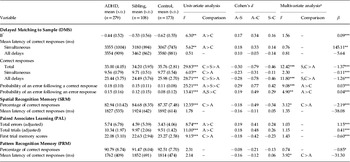
Table 1 presents the three group comparisons of the four visual memory tasks.
Comparisons of visual memory among probands with ADHD, unaffected siblings and unaffected controls

ADHD, Attention deficit hyperactivity disorder; s.d., standard deviation; B″, a signal detection measure of the strength of trace required to elicit an error; A, ADHD; S, sibling; C, control; β, regression coefficient estimates for linear trend from the controls, unaffected siblings, to patients with ADHD.
a Controlling for sex, age, full-scale IQ (FSIQ), co-morbidity, ADHD symptoms, and parental educational levels.
* p<0.05, ** p<0.01, *** p<0.001.
DMS
ADHD probands, including 250 probands with persistent ADHD and 29 probands with non-persistent ADHD, had a higher probability of an error given an error (B″; d=0.34); a longer mean latency of correct responses in simultaneous tasks, and a smaller number of correct responses in simultaneous tasks with small effect sizes (absolute values of Cohen's d=0.31–0.33); and had fewer total correct responses and a smaller number of correct responses in all delay tasks than the controls with large effect sizes (d=−0.78 to −0.79). Moreover, ADHD probands had a smaller number of correct responses in all delays (d=−0.28) than their unaffected siblings (Table 1). These differences remained significant after controlling for all confounding factors except B″ and the mean latency of correct responses (Table 1).
ADHD probands and their unaffected siblings had a higher probability of an error following a correct response and following an error response than the controls. Unaffected siblings had a smaller number of correct responses in total (d=−0.46) and all delays (d=−0.46) than the controls (Table 1). However, the statistical significance disappeared after controlling for confounders.
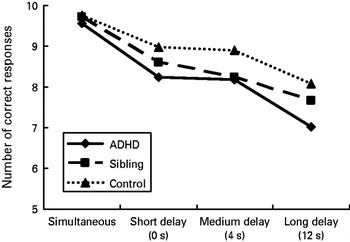
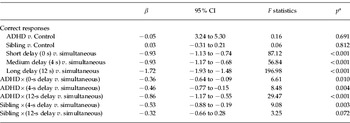
Further interaction analyses revealed significant main effects for group (ADHD, unaffected siblings, controls) and task difficulty (simultaneous, and 0-, 4- and 12-s delays), and interactions between group and task difficulty in number (Fig. 1). Table 2 presents the significance of each level of interaction by backward model selection, revealing interactions between ADHD (v. control) and task difficulty (0-s delay v. simultaneous, 4-s delay v. simultaneous, 12-s delay v. simultaneous), and between unaffected sibling (v. control) and task difficulty (4-s delay v. simultaneous, 12-s delay v. simultaneous), controlling for all confounding variables.
Number of correct responses in the simultaneous, short delay, medium delay, and long delay problems of the Delayed Matching to Sample (DMS) task for probands with attention deficit hyperactivity disorder (ADHD), unaffected siblings, and controls. Group: F 2,1775=29.81, p<0.001; task: F 3,1775=272.61, p<0.001; group×task: F 6,1775=6.50, p<0.001.

A model integrating task difficulties and controlling for confounding factors for the DMS task

DMS, Delayed Matching to Sample; ADHD, attention deficit hyperactivity disorder; β, regression coefficient estimates; CI, confidence interval.
a Controlling for sex, age, full-scale IQ (FSIQ), co-morbidity, ADHD symptoms, and parental educational levels.
SRM
Both univariate and multivariate analyses revealed that ADHD probands had a lower percentage of correct responses than the controls (d=−0.49, Table 1), without a group difference in mean latency of correct response. There were no significant differences in SRM performances between unaffected siblings and probands with ADHD, or between unaffected siblings and controls.
PAL
ADHD probands had more adjusted total errors, more total trials to success, and lower first trial memory scores (absolute values of Cohen's d=0.41–0.48, Table 1). All the patterns of significant differences disappeared in the multivariate analyses. There were no significant differences in PAL performances between unaffected siblings and probands with ADHD, or between unaffected siblings and controls.
PRM
We did not find any significant group differences in the percentage of correct responses. However, ADHD probands had a shorter mean latency of correct responses than the controls in the multiple analyses (Table 1).
Linear trend and sibling correlations
There were significant linear trends across the three groups in the indices of the visual memory tasks (all p<0.01, Table 1) except for the mean latency in all delays in the DMS, and the percentage of correct responses in the SRM. The sib–sib correlation coefficients were 0.48–0.63 for DMS, 0.65–0.74 for SRM, 0.55–0.64 for PAL, and 0.55–0.70 for PRM (all p<0.001, Supplementary Table 2).
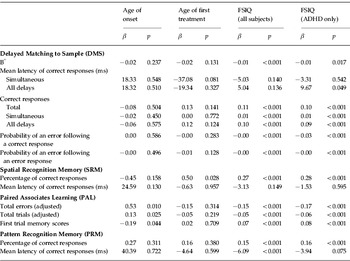
Correlations with age of onset and IQ (Table 3)
FSIQ correlated positively with performance on the four visual memory tasks. Older age of onset was correlated to increased total and mean trials to success, total and mean errors to success, and decreased first trial memory scores in the PAL. Older age in the first treatment for ADHD was associated with a higher percentage of correct response in the SRM.
Association between visual memory and age of onset, age of first treatment, and IQ among 279 participants with ADHD

ADHD, Attention deficit hyperactivity disorder; FSIQ, full-scale IQ.
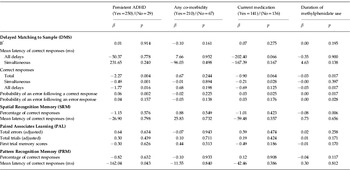
Effect of persistent ADHD, methylphenidate and co-morbidity (Table 4)
Probands with persistent ADHD (n=250) had fewer correct responses in total and all delays, a higher probability of an error following a correct response in the DMS, and a shorter mean latency of correct responses in the PRM than probands without persistent ADHD (n=29). There was no statistical difference between probands with (n=210) and without (n=67) any psychiatric co-morbidity.
Effect of persistent ADHD, methylphenidate and co-morbidity on visual memory

Probands currently treated with methylphenidate in the past 6 months (n=141) had a smaller number of correct responses at the simultaneous condition, and a higher probability of an error following a correct response in the DMS, and fewer stages completed on the first trial in the PAL than their counterparts (n=136). Increased duration of treatment with methylphenidate correlated with an increased probability of an error following a correct response and following an error response, and decreased correct responses in total and all delays in the DMS; and a decreased percentage of correct responses in the SRM.
Discussion
As one of few studies investigating whether visual memory forms a potential candidate endophenotype for ADHD, our results provide strong evidence to support the notion that visual memory measured by the DMS could be a cognitive endophenotype for ADHD. Our findings demonstrated that, in univariate analyses, the unaffected siblings, like the ADHD probands, performed significantly worse than the controls in visual memory measured by the DMS task. In multivariate analyses, the unaffected siblings occupied an intermediate position between the ADHD probands and the controls in the probability of an error following a correct response and following an error response in the DMS, and in the percentage of correct responses in the SRM. Although the impairments in visual memory were modest in the unaffected siblings and the tasks in the CANTAB are multifactorial (Robbins et al. Reference Robbins, James, Owen, Sahakian, McInnes and Rabbitt1994), to the best of our knowledge this is the first study to report that visual memory measured by the CANTAB may be a useful cognitive endophenotype for ADHD.
Our results confirm Western findings (Chang et al. Reference Chang, Klorman, Shaywitz, Fletcher, Marchione, Holahan, Stuebing, Brumaghim and Shaywitz1999; Kempton et al. Reference Kempton, Vance, Maruff, Luk, Costin and Pantelis1999; Chelonis et al. Reference Chelonis, Edwards, Schulz, Baldwin, Blake, Wenger and Paule2002) that children and adolescents with ADHD perform worse in some visual memory tasks, such as the DMS, SRM and PAL than controls. In addition, the vulnerability to impaired DMS performance in ADHD probands emerged more remarkably with longer delays, indicating that these recognition memory deficits might result from difficulties in retention or recall.
Our data consistently demonstrated that, despite no diagnosis of ADHD, unaffected siblings, like ADHD probands, performed significantly worse than the unaffected controls in some measures of DMS, which was therefore suggested to be familial in ADHD (Slaats-Willemse et al. Reference Slaats-Willemse, Swaab-Barneveld, de Sonneville and Buitelaar2007). In addition, significant sibling correlations were obtained for all the indices of the DMS task. These findings strongly suggest that DMS measured by the CANTAB fulfilled some of the important criteria for endophenotypes for ADHD (Doyle et al. Reference Doyle, Faraone, Seidman, Willcutt, Nigg, Waldman, Pennington, Peart and Biederman2005a, Reference Doyle, Willcutt, Seidman, Biederman, Chouinard, Silva and Faraoneb); visual memory deficits co-occurred with ADHD and were manifested in unaffected relatives. In addition, similar to ADHD probands, the vulnerability to impaired DMS performance in unaffected siblings emerged more remarkably with longer delays. Successful performance of the DMS requires intact visual memory processing, and is sensitive to temporal lobe and amygdalo-hippocampal damage (Owen et al. Reference Owen, Sahakian, Semple, Polkey and Robbins1995). Previous imaging studies report that temporal lobes (Wolosin et al. Reference Wolosin, Richardson, Hennessey, Denckla and Mostofsky2009), the amygdale (Lopez-Larson et al. Reference Lopez-Larson, Michael, Terry, Breeze, Hodge, Tang, Kennedy, Moore, Makris, Caviness and Frazier2009) and the hippocampus (Plessen et al. Reference Plessen, Bansal, Zhu, Whiteman, Amat, Quackenbush, Martin, Durkin, Blair, Royal, Hugdahl and Peterson2006) may play a role in the pathophysiology of ADHD. Durston et al. (Reference Durston, Hulshoff Pol, Schnack, Buitelaar, Steenhuis, Minderaa, Kahn and van Engeland2004) also found that the unaffected siblings of children with ADHD displayed a trend toward a reduction in temporal gray matter volume. Further functional imaging studies in ADHD probands and their unaffected siblings are required to identify the distinct pattern of activations in the performance of the DMS.
Unlike the negative findings of a previous study with a much smaller sample (Kempton et al. Reference Kempton, Vance, Maruff, Luk, Costin and Pantelis1999) but consistent with the study of Rhodes et al. (Reference Rhodes, Coghill and Matthews2004), ADHD probands were also impaired at the simultaneous condition besides delay-dependent deficits on the DMS task. At the simultaneous condition of the DMS task, individuals must attend to and discriminate among the different stimuli (Moody et al. Reference Moody, Wise, di Pellegrino and Zipser1998). Our findings suggest that the neurocognitive deficits in ADHD relate not only to memory but also to attentional competency (Nigg, Reference Nigg2005).
Given that the ADHD probands had worse performances in the DMS and SRM tasks than the unaffected controls in the multivariate analyses, the findings of no differential performances for the unaffected siblings from the ADHD probands or from the unaffected controls in the probability of an error following a correct response and following an error response in the DMS, and in the percentage of correct responses in the SRM, may reflect that the unaffected siblings occupy an intermediate position between the probands with ADHD and the unaffected controls.
By contrast, ADHD probands performed worse than unaffected siblings and controls in the correct responses in total and all delays in the DMS task. These cognitive deficits may not relate to a familial predisposition for ADHD and may not be suitable for an ADHD endophenotype. These deficits may be caused by the presence of ADHD itself or may be the cause of ADHD, or relate to some risk factors not shared between the probands and their unaffected siblings (Durston et al. Reference Durston, Hulshoff Pol, Schnack, Buitelaar, Steenhuis, Minderaa, Kahn and van Engeland2004).
Consistent with previous studies (Kempton et al. Reference Kempton, Vance, Maruff, Luk, Costin and Pantelis1999), our findings did not provide evidence to support a worse performance in PRM in ADHD. The PRM task has its putative neural circuitry located in the medial temporal lobe (Luciana & Nelson, Reference Luciana and Nelson1998). Although volumetric reductions (Brieber et al. Reference Brieber, Neufang, Bruning, Kamp-Becker, Remschmidt, Herpertz-Dahlmann, Fink and Konrad2007) and regional cerebral perfusion abnormalities (Kim et al. Reference Kim, Lee, Shin, Cho and Lee2002) have been found in medial temporal lobe structures of patients with ADHD, neuropsychological deficits associated with medial temporal lobe functioning have not been observed (Barnett et al. Reference Barnett, Maruff and Vance2005). A recent animal study using behavioral and imaging measures also demonstrated that medial temporal lobe functioning was normal in the spontaneously hypertensive rat exhibiting an ADHD-like phenotype (Wells et al. Reference Wells, Janes, Liu, Deschepper, Kaufman and Kantak2010). Taken together, our negative findings supported the notion that medial temporal lobe functioning might not be affected in ADHD.
Effect of IQ, persistent ADHD, methylphenidate and age
Our data provide strong evidence to support positive correlations between visual memory function and FSIQ. IQ is thought to play a moderating role in understanding the ability of ADHD children to compensate for their biological deficits (Mahone et al. Reference Mahone, Hagelthorn, Cutting, Schuerholz, Pelletier, Rawlins, Singer and Denckla2002). However, on the contrary, the biological deficits in ADHD may cause abnormal performance on tasks measuring IQ (Rommelse et al. Reference Rommelse, Altink, Oosterlaan, Buschgens, Buitelaar and Sergeant2008). Hence, further investigation of the relationship between visual memory and IQ in ADHD is warranted.
In general, our results showed no significant difference in visual memory between patients with and without persistent ADHD except for the correct response and probability of an error following a correct response of the DMS and the mean latency of correct responses of the PRM, suggesting that the underlying cognitive dysfunction associated with visual memory may be enduring into adolescence, regardless of a reduction in ADHD symptoms. These findings indicate that deficits in visual memory may be independent of ADHD symptoms, and these neuropsychological deficits can possibly be treated as trait markers for ADHD (Biederman et al. Reference Biederman, Petty, Ball, Fried, Doyle, Cohen, Henderson and Faraone2009).
Our findings showed that methylphenidate use was associated with worse visual memory functioning, and first use of methylphenidate at an older age was associated with better SRM. Methylphenidate treatment was not designed to be randomized in this study, so confounding self-selective factors, such as ADHD status and co-morbidity, might determine continued medication use (Epstein et al. Reference Epstein, Conners, Hervey, Tonev, Arnold, Abikoff, Elliott, Greenhill, Hechtman, Hoagwood, Hinshaw, Hoza, Jensen, March, Newcorn, Pelham, Severe, Swanson, Wells, Vitiello and Wigal2006). As baseline and current ADHD symptoms were significantly associated with ever and current use of methylphenidate (all p<0.01, Supplementary Table 3), treatment may indeed stand as a proxy for the severity of ADHD (Kessler et al. Reference Kessler, Adler, Barkley, Biederman, Conners, Faraone, Greenhill, Jaeger, Secnik, Spencer, Ustun and Zaslavsky2005).
Our findings only demonstrated an association between older age onset of ADHD and poorer PAL, without age effects on other visual memory function. Therefore, this study lends limited evidence to support that ADHD patients with later onset age may be more cognitively impaired than those with earlier onset age (Faraone et al. Reference Faraone, Biederman, Doyle, Murray, Petty, Adamson and Seidman2006).
Methodological considerations
Several features of this large-scale study constitute its strengths: the first to investigate visual memory in unaffected siblings of ADHD, comprehensive assessments of a wide range of visual memory functions using standardized neuropsychological tests (CANTAB), and direct interviews with the participants and their mothers to minimize the misclassification of the psychiatric diagnosis (e.g. ADHD in siblings).
The methodological limitations of this study include the lack of ability of the sibling design to distinguish genetic influences from shared environmental influences, and some concerns about the effects or withdrawal of methylphenidate in 50.9% of the probands on the visual memory function. In addition, urine drug-level testing was not used to insure that the patients with ADHD had complied with the request to halt medication.
Summary and implications
Our findings indicate that several measures of visual memory function, such as the probability of an error following a correct response and following an error response in the DMS, and the percentage of correct responses in the SRM, may constitute a novel cognitive endophenotype for ADHD. Our findings also support the sensitivity and usefulness of the CANTAB tasks in assessing the visual memory deficits in ADHD probands and their unaffected siblings.
Note
Supplementary material accompanies this paper on the Journal's website (http://journals.cambridge.org/psm).
Acknowledgements
This study was supported by grants from the National Health Research Institute (NHRI-EX94-9407PC, NHRI-EX95-9407PC, NHRI-EX96-9407PC, NHRI-EX97-9407PC) and a grant from the National Science Council (NSC96-2628-B-002-069-MY3), Taiwan. We thank M.-F. Cheng for her assistance in data analysis and manuscript preparation.
Declaration of Interest
None.