


Introduction
Social anxiety disorder
Social anxiety disorder (SAD) is characterised by an intense and persistent fear of negative judgement in social or performance situations (DSM-V; American Psychiatric Association, 2013). Individuals fear that they will appear or behave embarrassingly, avoiding social situations or enduring them with intense anxiety. Common concerns include appearing dull or stupid, or looking anxious (Stein and Stein, Reference Stein and Stein2008). Development of SAD typically occurs during the early to mid-teens, although a small subgroup of people develop the condition in later years (Stein and Stein, Reference Stein and Stein2008). It is one of the most common anxiety disorders, with a lifetime prevalence rate of approximately 12% (Kessler et al., Reference Kessler, Berglund, Demler, Jin, Merikangas and Walters2005). SAD is associated with economic disadvantages and poorer quality of life (Dryman et al., Reference Dryman, Gardner, Weeks and Heimberg2016; Patel et al., Reference Patel, Knapp, Henderson and Baldwin2002). Despite the considerable suffering, impediment and cost associated with SAD, only about 45% of individuals with the condition ever seek treatment, and most often do so after two decades (Wang et al., Reference Wang, Berglund, Olfson, Pincus, Wells and Kessler2005).
In the UK, cognitive behavioural therapy (CBT) is the first-line psychological treatment for SAD (National Institute for Health and Care Excellence, 2013). Two well-established CBT models, Clark and Wells’ model (Reference Clark, Wells, Heimberg, Liebowitz, Hope and Scheier1995) and Rapee and Heimberg’s model (Reference Rapee and Heimberg1997), are recommended by NICE. These models of SAD, as well as Hofmann’s model (Reference Hofmann2007), which extends their work, indicate that negative self-imagery (NSI) plays a pivotal role in maintaining the disorder. NSI involves distorted images linked to memories of significant, negative social experiences (Hackmann et al., Reference Hackmann, Clark and McManus2000) where a social schema is formed that encapsulates negative appraisals (Cili and Stopa, Reference Cili and Stopa2015). These images are commonly recurrent, spontaneous and from a third-person’s perspective (Hackmann et al., Reference Hackmann, Clark and McManus2000). Research has found that, during an anxiety-provoking social task, high social anxiety individuals more commonly experienced negative images and memories (Chiupka et al., Reference Chiupka, Moscovitch and Bielak2012) and were more likely to report an observer’s perspective (Ashbaugh et al., Reference Ashbaugh, Fishman and Houle-Johnson2019) compared with low social anxiety individuals. Studies have found that holding an NSI (compared with a neutral self-image) is associated with an increase in safety-seeking behaviours, anxiety and critical appraisals of social performance (Hirsch et al., Reference Hirsch, Meynen and Clark2004; Ng et al., Reference Ng, Abbott and Hunt2014).
The intrusive nature of NSI may be explained by neurobiological theories, such as the revised dual representation theory (DRT; Brewin et al., Reference Brewin, Gregory, Lipton and Burgess2010). The DRT proposes that overwhelming experiences can be processed in two memory systems that work in parallel: contextual accessible memories (Creps) and situationally accessible memories (Sreps). Creps are coherent, accurate in spatial and temporal context, voluntarily retrieved, updated over time and transferred to long-term memory. In contrast, Sreps consist of largely perceptual and affective information stored primarily in the amygdala and insula, disconnected from areas of the brain that provide contextual information, such as the hippocampus. Thus, uncontextualised Sreps may form the basis of intrusive imagery, such as NSI.
Imagery rescripting
Imagery rescripting (IR) – an intervention used to treat NSI – has received increased attention from researchers in recent years (Arntz, Reference Arntz2012; Holmes et al., Reference Holmes, Arntz and Smucker2007; Stopa, Reference Stopa2011). IR is a collection of therapeutic imagery techniques aiming to update negative appraisals encapsulated in memories of painful past events. IR is thought to modify negative mental self-representation by meeting the younger self’s unfulfilled needs within a memory (Arntz and Weertman, Reference Arntz and Weertman1999; Arntz, Reference Arntz2012). IR was first used to treat SAD by Clark et al. (Reference Clark, Ehlers, Hackmann, McManus, Fennell, Grey and Wild2006) among a subgroup of patients who had a modest response to standard interventions. The authors believed that IR contributed to the positive results observed, but as they did not evaluate IR separately they could not support this hypothesis. Wild et al. (Reference Wild, Hackmann and Clark2007, Reference Wild, Hackmann and Clark2008) assessed IR’s effects as a stand-alone intervention for SAD and found that it was associated with significant improvements to the vividness and disturbance of imagery and memories as well as negative encapsulated beliefs. An encapsulated belief can be understood as a summary of beliefs about the self, others and the world in relation to the imagery and/or memory (Wild et al., Reference Wild, Hackmann and Clark2007).
Different theoretical frameworks can explicate IR’s underlying working mechanisms. Contemporary learning models assume negative memories to be unconditioned stimuli (UCS), their triggers conditioned stimuli (CS) and symptomatology the conditioned response (CR; Mineka and Zinbarg, Reference Mineka and Zinbarg2006). Davey’s conditioning theory (Reference Davey1997) hypothesises that the UCS mediates the strength of the CR to CS. When the subjective meaning of the UCS is altered in IR, so is the CR. This theory has been termed US-revaluation (Davey, Reference Davey1989; Arntz and Weertman, Reference Arntz and Weertman1999). Alternatively, Brewin’s (Reference Brewin2006) retrieval competition hypothesis suggests that rather than modifying the negative memory, IR may develop a new adaptive memory that competes with the original memory during instances of subsequent retrieval. From a DRT perspective, IR utilises the contextualised Crep memories to project a memory representation while incorporating the sensory-bound Sreps. This supports the contextualisation of the Srep memory before a new, positive, more elaborated memory is formed that wins the retrieval competition, reducing distress (Brewin et al., Reference Brewin, Gregory, Lipton and Burgess2010).
IR has been administered in individual and group settings as a stand-alone intervention and part of a CBT protocol to treat SAD. As a stand-alone approach, IR has been shown to reduce fear, avoidance, negative evaluation, performance anxiety and social anxiety (Lee & Kwon, Reference Lee and Kwon2013; Nilsson et al., Reference Nilsson, Lundh and Viborg2012; Norton and Abbott, Reference Norton and Abbott2016; Reimer and Moscovitch, Reference Reimer and Moscovitch2015; Wild et al., Reference Wild, Hackmann and Clark2007). Hyett et al. (Reference Hyett, Bank, Lipp, Erceg-Hurn, Alvares, Maclaine and McEvoy2018) has evaluated IR as a stand-alone intervention in group sessions and found no significant differences in self-report measures of SAD between a single session of group IR, group cognitive restructuring (CR) and a waitlist. However, compared with CR and a waitlist, IR was associated with modulating heart rate variability, an indicator of greater emotion regulation. As part of multi-component CBT intervention for individuals, IR was associated with significant reductions in the frequency and severity of socially anxious beliefs and fear of negative evaluation (Takanashi et al., Reference Takanashi, Yoshinaga, Oshiro, Matsuki, Tanaka, Ibuki and Shimizu2020; Wild et al., Reference Wild, Hackmann and Clark2007).
Two studies have integrated IR into a group CBT intervention. McEvoy and Saulsman, Reference McEvoy and Saulsman2014) study found imagery-enhanced CBT, compared with non-imagery CBT, was associated with reliable improvements in social interaction anxiety at post-treatment and 1-month follow-up. However, no group differences were found in improvements to performance anxiety. Ahn and Kwon (Reference Ahn and Kwon2018) found that IR-influenced group CBT was comparable to standard group CBT on all measures post-treatment. However, IR-influenced group CBT was associated with significant improvements in interaction and performance anxiety at 3-month follow-up.
Rationale and aims
Given the central role of imagery in the development, maintenance and treatment of SAD, an increased understanding of the relationship between IR and NSIs will facilitate more advanced treatment approaches to modify this maintaining factor. This may be particularly valuable for more chronic cases of SAD where traditional verbal-based techniques have limited effect.
This study had two aims; firstly, to conduct a systematic review to synthesise and critically evaluate empirical literature on IR used for patients with SAD; and secondly, to perform a meta-analysis to calculate pooled estimates of the effects of IR on imagery, memories and encapsulated beliefs linked to NSI based on the available evidence. It was hypothesised that, across studies, those who receive IR would report a reduction in anxiety associated with the imagery, reduced image vividness and frequency and less memory distress. With respect to encapsulated beliefs, it was expected that there would be a significant change in these appraisals, becoming more positive.
Method
Database search
Following ethical approval, a comprehensive literature search was conducted in February 2021. Searches were completed in the following databases: Academic Search Complete, ProQuest, Medline, Scopus and PubMed.
Search terms
The search terms used were ‘social anxiety disorder’ OR ‘social phobia’ AND ‘imagery rescripting’ AND ‘memory’ OR ‘negative imagery’. A manual search was also conducted.
Inclusion and exclusion criteria
One hundred and sixteen articles were generated in total. All came from the five databases as no further articles were identified through the manual search. Search results were first imported to RefWorks, where 34 duplicates were removed. Upon completing screening of the titles and abstracts, 53 articles were excluded as they met the exclusion criteria. The remaining articles were selected for full-text analysis, where a total of 10 articles were deemed acceptable. Figure 1 shows the procedure used for selecting articles following the PRISMA guidelines (Moher et al., Reference Moher, Liberati, Tetzlaff, Altman and Group2009).
PRISMA flow diagram of study selection procedure.

Systematic search results
Quality assessment of studies
The Standard Quality Assessment Criteria for Evaluating Primary Research Papers from a Variety of Fields (Kmet et al., Reference Kmet, Cook and Lee2004) was used to assess the quality of the 10 articles. This assessment tool was used as it allowed for the appraisal of multiple research designs. It uses 14 items for quantitative studies and 10 items for qualitative studies. Fully, partially and not-met criteria scored 2, 1 and 0, respectively. If a criterion was not applicable it was excluded from the summary score. Two reviewers independently evaluated the included studies and discussed any difference in ratings until a consensus was reached.
Results of quality appraisal
Assessment scores ranged from 60 to 96%, indicating good quality. Inter-rater reliability tests were carried out on all papers. The Cohen’s kappa value was .780, demonstrating moderate to strong inter-rater agreement (Altman, Reference Altman1990).
Results
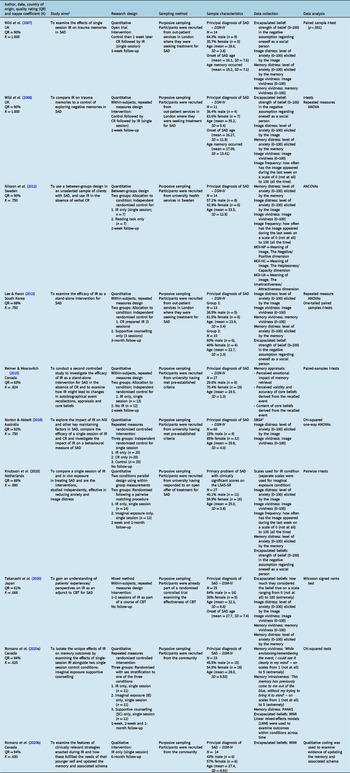
See Table 1 for a summary of the reviewed studies.
Characteristics of reviewed studies

1 Relevant to the review.
2 Acronym at the end of the table.
SBSA, Self-Beliefs Related to Social Anxiety Scale (Wong et al., Reference Wong, Gregory, Norton, Shikatani, Boulton, Torok and Antony2021); PANAS, Positive and Negative Affect Schedule (Watson et al., Reference Watson, Clark and Tellegen1988); WIMI, Waterloo Images and Memories Interview: Core beliefs module (Moscovitch et al., Reference Moscovitch, Gavric, Merrifield, Bielak and Moscovitch2011); LSAS-SR, Liebowitz Social Anxiety Scale (Liebowitz, Reference Liebowitz1987).
Synthesis of the findings
Where studies used the same measurements and reported the necessary data, generic inverse variance meta-analysis were used to derive conclusions about that body of research. Where this was not possible, a narrative summary was made. Nilsson et al. (Reference Nilsson, Lundh and Viborg2012) and Knutsson et al. (Reference Knutsson, Nilsson, Eriksson and Järild2019) did not report the necessary data for inclusion in some of the meta-analyses.
Images
Image vividness
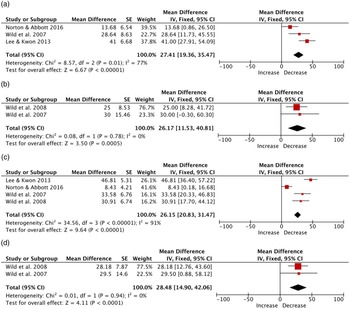
Eight studies examined the impact of IR on image vividness (Knutsson et al., Reference Knutsson, Nilsson, Eriksson and Järild2019; Lee and Kwon, Reference Lee and Kwon2013; Nilsson et al., Reference Nilsson, Lundh and Viborg2012; Norton and Abbott, Reference Norton and Abbott2016; Takanashi et al., Reference Takanashi, Yoshinaga, Oshiro, Matsuki, Tanaka, Ibuki and Shimizu2020; Wild et al., Reference Wild, Hackmann and Clark2007). Considering the three studies that performed pre-session versus within-session comparisons, meta-analysis showed an overall decrease in image vividness [weighted mean difference (WMD) 27.41, 95% confidence interval (CI) 19.36 to 35.47; standardised mean difference (SMD) 0.98, Z = 3.21, p = 0.001] and the presence of heterogeneity among studies (I 2 = 77%, p = 0.01) (Fig. 2A). Considering the two studies that performed pre-session versus 1-week follow-up comparisons (Wild et al., Reference Wild, Hackmann and Clark2007; Wild et al., Reference Wild, Hackmann and Clark2008), there was again an overall decrease in image vividness (WMD 26.17, 95% CI 11.53 to 40.81, SMD 0.58, Z = 3.50, p = 0.0005), with no heterogeneity between studies (I 2 = 0%, p = 0.78) (Fig. 2B). Likewise, Takanashi et al. (Reference Takanashi, Yoshinaga, Oshiro, Matsuki, Tanaka, Ibuki and Shimizu2020) found that median within-session image vividness scores were lower than median pre-IR scores (p = 0.05), and Lee and Kwon (Reference Lee and Kwon2013) found that a decrease in mean image vividness scores was maintained at 3-month follow-up (p<0.001). By contrast, no significant changes in image vividness were found in studies that performed a post-session IR versus control group comparison (Nilsson et al., Reference Nilsson, Lundh and Viborg2012); a pre-session versus immediate post-session, 2-week follow-up, and 1-month follow-up comparisons (Knutsson et al., Reference Knutsson, Nilsson, Eriksson and Järild2019); and a pre-session versus 1-week follow-up comparison (Nilsson et al., 2020).
A, image vividness pre- versus within -session; B, image vividness pre- versus 1-week follow-up; C, image distress pre- versus within-session; D, image distress pre- versus 1-week follow-up.

Image distress
Seven studies examined the impact of IR on image distress (Knutsson et al., Reference Knutsson, Nilsson, Eriksson and Järild2019; Lee and Kwon, Reference Lee and Kwon2013; Nilsson et al., Reference Nilsson, Lundh and Viborg2012; Norton and Abbott, Reference Norton and Abbott2016; Takanashi et al., Reference Takanashi, Yoshinaga, Oshiro, Matsuki, Tanaka, Ibuki and Shimizu2020; Wild et al., Reference Wild, Hackmann and Clark2007; Wild et al., Reference Wild, Hackmann and Clark2008). Considering the four studies that performed pre-session versus within-session comparisons (Lee and Kwon, Reference Lee and Kwon2013; Norton and Abbott, Reference Norton and Abbott2016; Wild et al., Reference Wild, Hackmann and Clark2007; Wild et al., Reference Wild, Hackmann and Clark2008), meta-analysis showed an overall decrease in image distress (WMD 26.15, 95% CI 20.83 to 31.47; SMD 0.77, Z = 9.64, p < 0.0001) and the presence of heterogeneity among studies (I 2 = 91%, p < 0.00001) (Fig. 2C). Considering the two studies that performed pre-session versus 1-week follow-up comparisons (Wild et al., Reference Wild, Hackmann and Clark2007; Wild et al., Reference Wild, Hackmann and Clark2008), there was again an overall decrease in image distress (WMD 28.48, 95% CI 14.90 to 42.06; SMD 1.14, Z = 4.11, p < 0.0001) with no heterogeneity between studies (I 2 = 0%, p = 0.94) (Fig. 2D). Likewise, Nilsson et al. (Reference Nilsson, Lundh and Viborg2012) reported that IR reduced image distress compared with a control group (p = 0.03), and Takanashi et al. (Reference Takanashi, Yoshinaga, Oshiro, Matsuki, Tanaka, Ibuki and Shimizu2020) found that median within-session image distress scores were lower than median pre-IR scores (p < 0.001). Furthermore, Lee and Kwon (Reference Lee and Kwon2013) found a decrease in image distress between a pre-IR session and 3-month follow-up (p < 0.001). By contrast, no significant changes in image distress were found in a study that performed a post-IR versus control group comparison and pre-IR versus 2-week and 1-month follow-up comparisons (Knutsson et al., Reference Knutsson, Nilsson, Eriksson and Järild2019).
Image frequency
Three studies examined the impact of IR on image frequency (Knutsson et al., Reference Knutsson, Nilsson, Eriksson and Järild2019; Nilsson et al., Reference Nilsson, Lundh and Viborg2012; Wild et al., Reference Wild, Hackmann and Clark2008). Wild et al. (Reference Wild, Hackmann and Clark2008) and Nilsson et al. (Reference Nilsson, Lundh and Viborg2012) found a non-significant reduction in image frequency immediately after IR and at 1-week follow-up, although the authors of both studies proposed that stronger effects of IR on image frequency would be observed with longer follow-ups. Indeed, Knutsson et al. (2020) found a significant reduction in image frequency at 4-week follow-up (p < 0.001).
Memory
Memory vividness
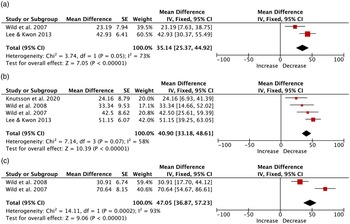
Four studies examined the impact of IR on memory vividness (Lee and Kwon, Reference Lee and Kwon2013; Romano et al., Reference Romano, Moscovitch, Huppert, Reimer and Moscovitch2020a; Takanashi et al., Reference Takanashi, Yoshinaga, Oshiro, Matsuki, Tanaka, Ibuki and Shimizu2020; Wild et al., Reference Wild, Hackmann and Clark2007). Considering the two studies that performed pre-session versus within-session comparisons (Lee and Kwon, Reference Lee and Kwon2013; Wild et al., Reference Wild, Hackmann and Clark2007), meta-analysis showed an overall decrease in memory vividness (WMD 35.14, 95% CI 25.37 to 44.92; SMD 0.73, Z = 7.05, p < 0.00001) and the presence of heterogeneity between studies (I 2 = 73%, p = 0.05) (Fig. 3A). Likewise, Takanashi et al. (Reference Takanashi, Yoshinaga, Oshiro, Matsuki, Tanaka, Ibuki and Shimizu2020) found that median within-session memory vividness scores were lower than median pre-IR scores (p = 0.015), and Wild et al. (Reference Wild, Hackmann and Clark2007) and Lee and Kwon (Reference Lee and Kwon2013) found that this decrease was maintained at 1-week (p = 0.004) and 3-month follow-up (p < 0.001), respectively. By contrast, Romano et al. (Reference Romano, Moscovitch, Huppert, Reimer and Moscovitch2020a) found that IR, imaginal exposure, and supportive counselling decreased memory vividness over time, but the main effects of condition and time and their interaction were not significant.
A, memory vividness pre- versus within-session; B, memory distress pre- versus within-session; C, memory distress pre- versus 1-week follow-up.

Memory distress
Eight studies examined the impact of IR on memory distress (Knutsson et al., Reference Knutsson, Nilsson, Eriksson and Järild2019; Lee and Kwon, Reference Lee and Kwon2013; Nilsson et al., Reference Nilsson, Lundh and Viborg2012; Reimer and Moscovitch, Reference Reimer and Moscovitch2015; Romano et al., Reference Romano, Moscovitch, Huppert, Reimer and Moscovitch2020a; Takanashi et al., Reference Takanashi, Yoshinaga, Oshiro, Matsuki, Tanaka, Ibuki and Shimizu2020; Wild et al., Reference Wild, Hackmann and Clark2007; Wild et al., Reference Wild, Hackmann and Clark2008). Considering the four studies that performed pre-session versus within-session comparisons, meta-analysis showed an overall decrease in memory distress (WMD 40.90, 95% CI 33.18 to 48.61; SMD 0.68, Z = 10.39, p < 0.00001) with no significant heterogeneity among studies (I 2 = 58%, p = 0.07) (Fig. 3B). Considering the two studies that performed pre-session versus 1-week follow-up comparisons (Wild et al., Reference Wild, Hackmann and Clark2007; Wild et al., Reference Wild, Hackmann and Clark2008), there was again an overall decrease in memory distress (WMD 47.05, 95% CI 36.87 to 57.23; SMD 0.54, Z = 9.06, p < 0.00001) with the presence of heterogeneity between studies (I 2 = 93%, p = 0.0002) (Fig. 3C). Likewise, Nilsson et al. (Reference Nilsson, Lundh and Viborg2012) reported that IR decreased memory distress compared with a control group (p = 0.01), and Takanashi et al. (Reference Takanashi, Yoshinaga, Oshiro, Matsuki, Tanaka, Ibuki and Shimizu2020) observed that median within-session memory distress scores were lower than median pre-IR scores (p = 0.006). At 1-week follow-up, Nilsson et al. (Reference Nilsson, Lundh and Viborg2012) found less memory distress in the IR group compared with the control group (p = 0.01) and Reimer and Moscovitch (Reference Reimer and Moscovitch2015) observed higher ratings for positive emotions (p = 0.003) and lower ratings for negative emotions (p < 0.001) as a result of IR. Furthermore, Lee and Kwon (Reference Lee and Kwon2013) found that a reduction in memory distress was maintained at 3-month follow-up (p < 0.001). By contrast, Romano et al. (Reference Romano, Moscovitch, Huppert, Reimer and Moscovitch2020a) found that IR was associated with a non-significant reduction in memory distress at 3-month follow-up.
Encapsulated beliefs
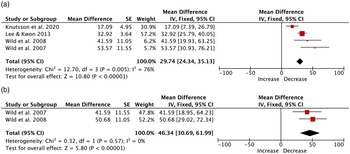
Ten studies examined the impact of IR on encapsulated beliefs (Knutsson et al., Reference Knutsson, Nilsson, Eriksson and Järild2019; Lee and Kwon, Reference Lee and Kwon2013; Nilsson et al., Reference Nilsson, Lundh and Viborg2012; Norton and Abbott, Reference Norton and Abbott2016; Reimer and Moscovitch, Reference Reimer and Moscovitch2015; Romano et al., Reference Romano, Moscovitch, Huppert, Reimer and Moscovitch2020a; Romano et al., Reference Romano, Hudd, Huppert, Reimer and Moscovitch2020b; Takanashi et al., Reference Takanashi, Yoshinaga, Oshiro, Matsuki, Tanaka, Ibuki and Shimizu2020; Wild et al., Reference Wild, Hackmann and Clark2007; Wild et al., Reference Wild, Hackmann and Clark2008). Considering the four studies that performed pre-session versus within-session comparisons (Knutsson et al., Reference Knutsson, Nilsson, Eriksson and Järild2019; Lee and Kwon, Reference Lee and Kwon2013; Wild et al., Reference Wild, Hackmann and Clark2007; Wild et al., Reference Wild, Hackmann and Clark2008), meta-analysis showed an overall decrease in encapsulated beliefs (WMD 29.74, 95% CI 24.34 to 35.13; SMD 0.62, Z = 10.80, p < 0.00001) and the presence of heterogeneity among studies (I 2 = 76%, p = 0.005) (Fig. 4A). Considering the two studies that performed pre-session versus 1-week follow-up comparisons (Wild et al., Reference Wild, Hackmann and Clark2007; Wild et al., Reference Wild, Hackmann and Clark2008), there was again an overall decrease in encapsulated beliefs (WMD 46.34, 95% CI 30.69 to 61.99; SMD 0.86, Z = 5.80, p < 0.0001), with no heterogeneity between studies (I 2 = 0%, p = 0.57) (Fig. 4B). Likewise, Takanashi et al. (Reference Takanashi, Yoshinaga, Oshiro, Matsuki, Tanaka, Ibuki and Shimizu2020) found that median within-session encapsulated belief scores were lower than median pre-IR scores (p < 0.001), and Lee and Kwon (Reference Lee and Kwon2013) found that a reduction in encapsulated beliefs was maintained at 3-month follow-up (p < 0.001). Nilsson et al. (Reference Nilsson, Lundh and Viborg2012) found that IR led to beneficial shifts in statements about the meaning of memories and images, with significant differences in negative/positive (p < 0.001), helplessness/capacity (p < 0.001), and unattractiveness/attractiveness (p < 0.001) dimensions compared with the control group. Furthermore, Reimer and Moscovitch (Reference Reimer and Moscovitch2015) found that IR produced positive changes in perceived validity of core beliefs about the self (p < 0.001), others (p = 0.001), and the world (p = 0.001).
A, encapsulated belief rating pre- versus within-session; B, encapsulated belief rating pre- versus 1-week follow-up.

Norton and Abbott (Reference Norton and Abbott2016) investigated the impact of IR following an impromptu public speaking task and found that IR resulted in a moderate yet non-significant decrease in the strength of beliefs from pre-speech to immediately post-IR, but this decrease was not observed at 1-week follow-up. Romano et al. (Reference Romano, Moscovitch, Huppert, Reimer and Moscovitch2020a) found that IR was more likely to lead to updating of core beliefs about the self compared with supportive counselling (p = 0.024), but there was no significant difference between IR and imaginal exposure. Also, there were no significant differences among groups for updating core beliefs about others. Finally, in a qualitative follow-up study, Romano et al. (Reference Romano, Hudd, Huppert, Reimer and Moscovitch2020b) interviewed 12 participants to understand their perception of memory changes due to IR. Nine participants reported changes in their experience of the memory as a result of IR, including changes in its emotional salience and/or its effect on their lives. Two participants reported that the memory had not come to mind during the follow-up period, and one reported no change in the memory.
Limitations of the studies
There were several limitations to the studies. While findings are promising, sample sizes were small, with the majority of studies consisting of university students or non-treatment-seeking participants (Knutsson et al., Reference Knutsson, Nilsson, Eriksson and Järild2019; Nilsson et al., Reference Nilsson, Lundh and Viborg2012; Norton and Abbott, Reference Norton and Abbott2016; Reimer and Moscovitch, Reference Reimer and Moscovitch2015; Romano et al., Reference Romano, Moscovitch, Huppert, Reimer and Moscovitch2020a; Romano et al., Reference Romano, Hudd, Huppert, Reimer and Moscovitch2020b). These samples may differ from samples of treatment-seeking individuals in a primary care or hospital setting and were not designed to investigate clinical or sociodemographic moderators. This resulted in a narrow age range, high education levels and risk of selection bias, limiting the strength of the conclusions. Interventions generally had short follow-ups (1 week; Nilsson et al., Reference Nilsson, Lundh and Viborg2012; Norton and Abbot, 2016; Reimer and Moscovitch, Reference Reimer and Moscovitch2015; Takanashi et al., Reference Takanashi, Yoshinaga, Oshiro, Matsuki, Tanaka, Ibuki and Shimizu2020; Wild et al., Reference Wild, Hackmann and Clark2007; Wild et al., Reference Wild, Hackmann and Clark2008). Studies would have benefited from a longer follow-up period to track duration of changes and how they unfolded as stronger effects were anticipated to occur over time (Nilsson et al., Reference Nilsson, Lundh and Viborg2012; Wild et al., Reference Wild, Hackmann and Clark2008). It is unclear which aspects of IR are most effective, as none of the studies analysed separate components of the procedure. Non-specific factors may play some role in positive outcomes of IR, e.g. imagery interview or support from the therapist. Although not technically a component of IR, the imagery interview may help participants link NSI and earlier memories, leading to a re-appraisal of the image, memory, and the encapsulated belief. Equally, the support of the therapist may contribute to therapeutic changes. The majority of measures used across the studies were single-item measures. Although there was some evidence to suggest that the correlations of the association between the ratings before and after the control session were moderate to strong (Wild et al., Reference Wild, Hackmann and Clark2008), single items are more vulnerable to random measurement errors. The general nature of these measures may not capture more personal changes resulting from IR. Furthermore, unmeasured variables may have significantly contributed to IR’s effectiveness, such as mental imagery ability or the severity of the traumatic experience. Lee and Kwon’s (2013) findings showed that mental imagery ability and the severity of the traumatic experience did not influence the outcome of IR, but more research is needed. Nilsson et al. (Reference Nilsson, Lundh and Viborg2012), Norton and Abbott (Reference Norton and Abbott2016) and Knutsson et al. (Reference Knutsson, Nilsson, Eriksson and Järild2019) gave limited information, meaning that future studies would not be reproducible.
Discussion
We conducted a systematic review and meta-analysis to synthesise and evaluate the empirical literature on the use of IR for treating individuals with SAD, which extends previous reviews by Arntz (Reference Arntz2012) and Morina et al. (Reference Morina, Lancee and Arntz2017), and to calculate pooled estimates of the effects of IR on imagery, memories and encapsulated beliefs linked to NSI across studies. Our results indicate that IR reduces aspects of imagery, memory, and associated beliefs among individuals with SAD. This analysis adds to the growing body of evidence showing that IR is an effective CBT intervention for various psychological disorders (Holmes et al., Reference Holmes, Arntz and Smucker2007).
The results of our meta-analysis indicate that IR significantly reduces image and memory vividness and distress for up to 1 week post-IR. However, Knutsson et al. (Reference Knutsson, Nilsson, Eriksson and Järild2019) and Takanashi et al. (Reference Takanashi, Yoshinaga, Oshiro, Matsuki, Tanaka, Ibuki and Shimizu2020) reported little evidence that IR reduces image and memory vividness and distress and vividness, perhaps due to a mismatch between the individual’s memory and current imagery. Therefore, more careful consideration and psychoeducation during the preparation phases may increase therapeutic benefits. By contrast, there was no significant reduction in image frequency 1 week following IR. Wild et al. (Reference Wild, Hackmann and Clark2008) speculated that as participants undergoing IR spend more time thinking about images during treatment, thoughts about the images may also arise more frequently during the subsequent week. However, Knuttson et al. (2019) found a 50% decrease in image frequency at 4-week follow-up, suggesting that image frequency may decrease after the week following IR.
Our meta-analysis also indicated that IR significantly reduces negative encapsulated beliefs for up to 1 week post-IR, which is supported by studies employing other measures of encapsulated beliefs such as memory appraisal (Reimer and Moscovitch, Reference Reimer and Moscovitch2015), imagery meanings (Nilsson et al., 2016) and core beliefs (Romano et al., Reference Romano, Moscovitch, Huppert, Reimer and Moscovitch2020a; Romano et al., Reference Romano, Hudd, Huppert, Reimer and Moscovitch2020b). Interestingly, Norton and Abbott (Reference Norton and Abbott2016) reported that IR does not reduce maladaptive self-beliefs. They posit that CR, which is designed to address verbal cognitive processes, is necessary to achieve changes in maladaptive self-beliefs and also suggest that changing longstanding core self-beliefs requires multiple sessions. However, multiple studies included in this review show that a single session of IR without CR can significantly reduce negative self-beliefs (Knutsson et al., Reference Knutsson, Nilsson, Eriksson and Järild2019; Nilsson et al., Reference Nilsson, Lundh and Viborg2012; Reimer and Moscovitch, Reference Reimer and Moscovitch2015; Romano et al., Reference Romano, Moscovitch, Huppert, Reimer and Moscovitch2020a; Romano et al., Reference Romano, Hudd, Huppert, Reimer and Moscovitch2020b). Therefore, together with previous research, our findings suggest that IR is a powerful and efficient method for accessing, addressing and reducing negative beliefs (Arntz, Reference Arntz2012; Arntz and Weertman, Reference Arntz and Weertman1999; Stopa, Reference Stopa2009).
Limitations
This systematic review has some limitations. First, the number of included studies was small, and each included study tended to have a small (average of 14) number of participants per IR condition. Thus, the relatively large effect sizes found were probably due to studies’ within-subjects designs. Second, there was variation among studies in how IR was conducted, with studies differing in when they first elicited imagery, whether they used CR prior to IR, and whether they used a specific memory or a representation of a memory, which could explain the significant heterogeneity among studies found for several outcome measures. However, estimates of the I 2 measure of heterogeneityFootnote 1 can be inaccurate when included study sizes are small (Borenstein et al., Reference Borenstein, Cooper, Hedges and Valentine2009) and biased when a small number of studies is included in a meta-analysis (von Hippel, Reference von Hippel2015), which can result in over-estimations of the degree of heterogeneity present among studies. Third, search results were confined to studies published or accepted for publication in English peer-reviewed journals. Fourth, inter-rater reliability was not calculated for data selection.
Clinical implications and research recommendations
Our findings support the use of IR as a brief stand-alone treatment that can alleviate patients’ negative self-imagery, early traumatic memories, and related beliefs. The potential efficacy of IR is complemented by its efficiency, as only one to two sessions were applied in most of the included studies, indicating that IR may have both clinical and economic advantages.
IR is a unique alternative treatment in that it does not rely on social engagement. This is particularly relevant during the COVID-19 pandemic, during which physical distancing recommendations pose difficulties for treating SAD with CBT, which largely relies on the use of in vivo exposure therapy (National Institute for Health and Care Excellence, 2013). Traditional exposure also requires the patient’s commitment and motivation to continue therapy and relies on them actively working on their problems between sessions. Indeed, homework non-compliance is considered a main reason for unsuccessful CBT (Helbig and Fehm, Reference Helbig and Fehm2004), with non-adherence reaching 20–50% (Helbig and Fehm, Reference Helbig and Fehm2004; Kazantzis et al., Reference Kazantzis, Lampropoulos and Deane2005). Because it does not require exposure or homework, IR may reduce the drop-out rate, although future research is needed to investigate this possibility.
Future research should also address at which point in therapy IR might be most usefully introduced. Core beliefs, potentially encapsulated in images and memories, are not usually appropriate early treatment targets due to how entrenched and rigid they can be (Beck et al., Reference Beck, Emery and Greenberg2005). The therapist risks losing credibility and endangering the therapeutic relationship if they question the validity of core beliefs too early (Beck and Beck, Reference Beck and Beck1995). However, the available evidence base suggests that a single session of IR could result in substantial changes in patients’ core beliefs without requiring the scaffolding that is generally considered necessary for such work. Future research would help ascertain for whom, using which variation, and at what stage in therapy IR would be most effective.
To improve the rigor, generalisability, and impact of future studies, larger samples of participants representative of patients in clinical settings could be examined in comparison with a standardised control group, which would help provide stronger conclusions and provide more robust indications of the true effect size of IR. Temporally sequenced longitudinal designs accompanied by follow-up assessments at regular intervals would help examine IR’s effectiveness across time. The conclusions of future research could be strengthened by assessing test–re-test reliability on single-item measures, using valid and reliable multiple-item measures such as the Vividness of Visual Imagery Questionnaire (Marks, Reference Marks1973), or by developing and validating new scales, such as a memory distress scale. Furthermore, as there are multiple factors involved in IR, a component analysis study is needed to clarify the effect of each component and elucidate the underlying mechanism of IR.
Conclusion
This review aimed to explore and synthesise the therapeutic effects of IR on NSI in individuals with SAD; more specifically, the images, memories and beliefs linked to NSI. Reductions in distress and vividness of images and memories were observed, as well as affirmative changes to encapsulated beliefs. Image frequency was the one dimension with opposing results, although given the trajectory of continued improvement in IR conditions, longer follow-ups, as evidenced by Knutsson et al. (Reference Knutsson, Nilsson, Eriksson and Järild2019), may have demonstrated more reductions in image frequency. Preliminary data are promising, but further research, including larger sample sizes, longer follow-ups and point of therapy use are warranted. It is hoped that the findings of this review will increase clinicians’ understanding, expectations and confidence in the effectiveness of IR to ensure that evidence-based treatment is being provided to individuals with SAD.
Supplementary material
To view supplementary material for this article, please visit: https://doi.org/10.1017/S135246582200008X
Data availability statement
The data that support the findings of this study are available from the corresponding author, J.L., upon reasonable request.
Acknowledgements
None.
Author contributions
James Lloyd: Conceptualization (lead), Data curation (lead), Formal analysis (lead), Investigation (lead), Methodology (lead), Project administration (lead), Writing – original draft (lead), Writing – review & editing (lead); Magda Marczak: Conceptualization (supporting), Data curation (supporting), Formal analysis (supporting), Methodology (supporting), Project administration (supporting), Supervision (lead), Writing – review & editing (supporting).
Financial support
This research received no specific grant from any funding agency, commercial or not-for-profit sectors
Conflicts of interest
James Lloyd and Dr Magdalena Marczak have no conflicts of interest with respect to this publication.
Ethics statement
The authors have abided by the Ethical Principles of Psychologists and Code of Conduct as set out by the BABCP and BPS.





Comments
No Comments have been published for this article.