Introduction
Progress over the past 20 years in the development of behavioural interventions to encourage people to stop smoking has been limited (Rigotti, Reference Rigotti2002; Lancaster, Hajek, Stead, West, & Jarvis, Reference Lancaster, Hajek, Stead, West and Jarvis2006; US Department of Health and Human Services CDC, 1990). At six months, brief interventions increase smoking cessation rates by 2% and behavioural support programmes by some 5–10% (Lancaster & Stead, Reference Lancaster and Stead2005; Stead & Lancaster, Reference Stead and Lancaster2008). One model of behaviour change, the Transtheoretical Model (TTM) (West, Zatonski, Przewozniak, & Jarvis, Reference West, Zatonski, Przewozniak and Jarvis2007; Larabie, Reference Larabie2005; Al'absi, Hatsukami, Davis, & Wittmers, Reference Al'absi, Hatsukami, Davis and Wittmers2004) has dominated the literature over this period (Al'absi et al., Reference Al'absi, Hatsukami, Davis and Wittmers2004). It postulates that smokers move through various stages with pre-quit stages being identifiable in terms of the timescale of future intentions to quit and post-quit stages linked to how long they have been quit for (Diclemente et al., Reference Diclemente, Prochaska, Fairhurst, Velicer, Velasquez and Rossi1991). However, this model has been widely criticised (Etter & Sutton, Reference Etter and Sutton2002; Rollnick, Butler, & Stott, Reference Rollnick, Butler and Stott1997; West, Reference West2005a, Reference West2005b; Abrams, Herzog, & Emmons, Reference Abrams, Herzog and Emmons2000).
A major criticism of the TTM is that the process of behaviour change is much more variable and fluid than proposed by this model. Moreover, future intentions concerning behaviour change seem to play a smaller role in behaviour change than the TTM proposes (Larabie, Reference Larabie2005; West, Reference West2006; West & Sohal, Reference West and Sohal2006). Many successful quit attempts occur without pre-planning as smokers’ goals to stop smoking can change quickly in response to the immediate situation and are stimulus dependent (Larabie, Reference Larabie2005; West, Reference West2006). Indeed, triggers to quit smoking can present themselves unexpectedly, thus leading smokers to act ‘in the moment’. This means that smokers who had not been intending to quit may accept an offer of help and stop smoking successfully (Pisinger, Vestbo, Borch-Johnsen, & Jorgensen, Reference Pisinger, Vestbo, Borch-Johnsen and Jorgensen2005).
The PRIME theory of motivation aims to provide an integrative account of the mental processes that energise and direct behaviour which can be applied to understanding behaviour change (West, Reference West2006). It argues that purposive behaviour arises out of the strongest of potentially competing wants and needs at that moment. These are feelings of attraction and aversion involving anticipated pleasure or satisfaction in the case of wants and anticipated relief in the case of needs. Beliefs about what is good or bad and prior plans or intentions influence our actions if they generate wants or needs at the relevant moment that are strong enough to overcome any competing wants and needs. Deliberate behaviour change involves making a particular kind of plan, a ‘personal rule’. The extent to which change is sustained depends on the rule creating sufficiently strong wants or needs to adhere to it at relevant moments to overcome competing wants and needs driving the old behaviour pattern. Personal rules are part of an individual's identity and derive their motivational strength from their link to other aspects of identity about which the individual feels strongly. PRIME theory recognises that motivations can be subject to sudden change as a result of the immediate situation or other mental changes that take place. It also recognises that aspects of individuals’ identities need not be coherent and often conflict. Therefore, the extent to which behaviour change is sustained can be influenced by coherence of a new identity to which the individual is emotionally attached (West, Reference West2006).
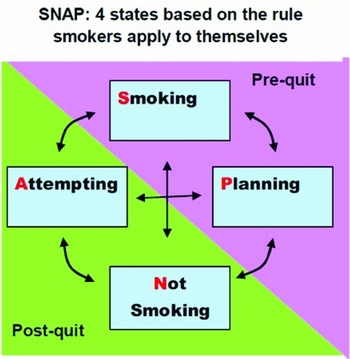
Applying PRIME theory to smoking cessation, a useful model should be one that centres on the personal rule that the individual is currently applying and the degree of coherence with regard to motivations, behaviour and identity in relation to that rule. Given that smokers can make sudden decisions to stop and that, having stopped, they can renounce that decision equally suddenly; the model needs to recognise the potential for instant shifts from one personal rule to another. Moreover, the nature of the personal rule would be expected to play a major role in driving motivation to refrain from smoking. An absolute rule in which the person was ‘not smoking’ should be more likely to create the necessary momentary motivations than one in which the person was ‘attempting not to smoke’. These considerations suggest a four-state ‘SNAP’ model as shown in Figure 1. Under this model, smokers’ self-descriptions could be captured in three conceptual domains of ‘identity’, ‘behaviour’ and ‘motives’ subsumed under the four states (Figure 1).
SNAP Model.

The first question that arises with regard to this model is whether its main conceptualisations fit smokers’ descriptions of themselves while they are in the process of quitting. This paper aimed to explore smokers’ beliefs and feelings during the process of quitting qualitatively, assessing if the SNAP Model could provide an adequate conceptual framework. The goal ultimately is to identify best approaches and strategies to improve smoking cessation interventions.
Methods
Sample
The participants in this study were smokers who attended quit smoking clinics in Malaysia. The sample of smokers was purposively selected to discover, understand and gain insight into the process of smoking cessation and to provide a rich source of relevant data (Patton, Reference Patton1990). Only those who sought treatment for the first time with the clinic were selected. Eight participants were interviewed twice, during the first visit and four weeks after the quit date. Each session lasted about an hour. For this kind of research, a sample size of eight would generally be considered sufficient to generate enough data to address the central research questions (Chang, Voils, Sandelowski, Hasselblad, & Crandell, Reference Chang, Voils, Sandelowski, Hasselblad and Crandell2009).
The average age of participants was 44.5 years (range: 25 to 69 years). Six were male, six were married and one was unemployed. The mean number of cigarettes smoked was 23 (range: 10 to 40). Two participants had other smokers in the household. The Fagerstrom Test for Cigarette Dependence (FTCD) (Fagerstrom & Schneider, Reference Fagerstrom and Schneider1989) mean score was 6.13 (SD 1.81). Three participants had previously made quit attempts. The main reasons for the current quit attempt were health concerns, pressure from family and friends and religious beliefs. Four chose to quit abruptly while the other four chose to stop by gradually cutting down. Two were abstinent at the post quit interview.
Design and Procedure
In-depth one-to-one interviews were conducted. Interviews were guided by an interview schedule, tape recorded, transcribed verbatim and checked by an independent researcher. The transcribed data were analysed using the N-VIVO 7 software. Written consent was obtained from participants prior to the interviews including the agreement to record interviews to be used in the analysis. At the end of the interview, participants were given another chance to discuss their concerns, which may have arisen during the course of the interview. The study received ethical approval from the National Medical Research Registry (NMRR-09-747-4556) the Ministry of Health Malaysia.
Interview Schedules
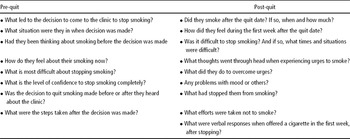
The interview schedules were guided by the PRIME theory. Table 1 provides an overview of the main topics addressed.
Interview topics

A pilot interview was carried out with one participant and the interview schedule revised in the light of this.
Analysis and Interpretation
The transcripts were analysed using a variant of Template Analysis (King, Reference King, Saymon and Cassell1998, Reference King2008). It involved the development of coding `templates’, which were based on the summarised themes identified as important in the data set, in this case the four SNAP categories and within these the themes of identity, motivation and behaviour. The initial templates were modified as the analysis progressed to accommodate the data. The final template served as the basis for the researcher's interpretation of the data set.
Since the analysis was theoretically driven, this process was ‘top-down’ with data attempting to fit if possible a pre-existing conceptual framework. If statements could not be classified using this framework they were recorded as such.
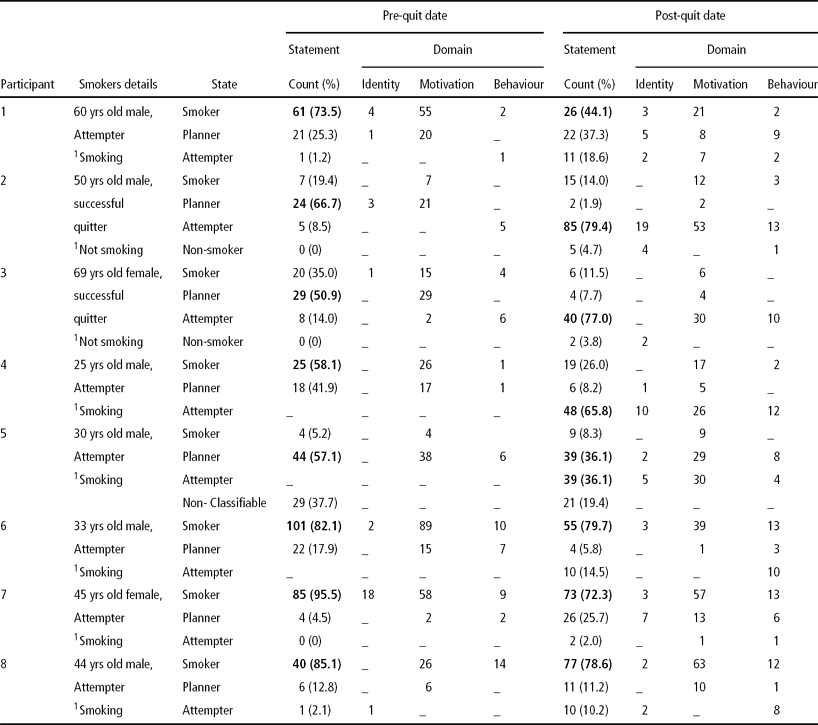
The template coding frame that was developed was used to code statements from transcripts according to state (Smoker, Non-smoker, Attempter, Planner) and conceptual domain (behaviour, motivation, identity) of the SNAP model of smoking cessation. Examples of statements relating to ‘Behaviour’ (e.g. I don't buy any more cigarettes now; Non-smoker state); ‘Motivation’ (e.g. ‘I enjoy smoking’, Smoker state) and ‘Identity’ (e.g.’ I am trying to stop smoking’; Attempter state) were classified and counted. The distribution of statements of the eight participants across the different states was assessed (see Table 2).
SNAP States (Smoker, Non-smoker, Attempter, Planner) and domains (Identity, Motivation, Behaviour) at pre-quit and post quit attempt
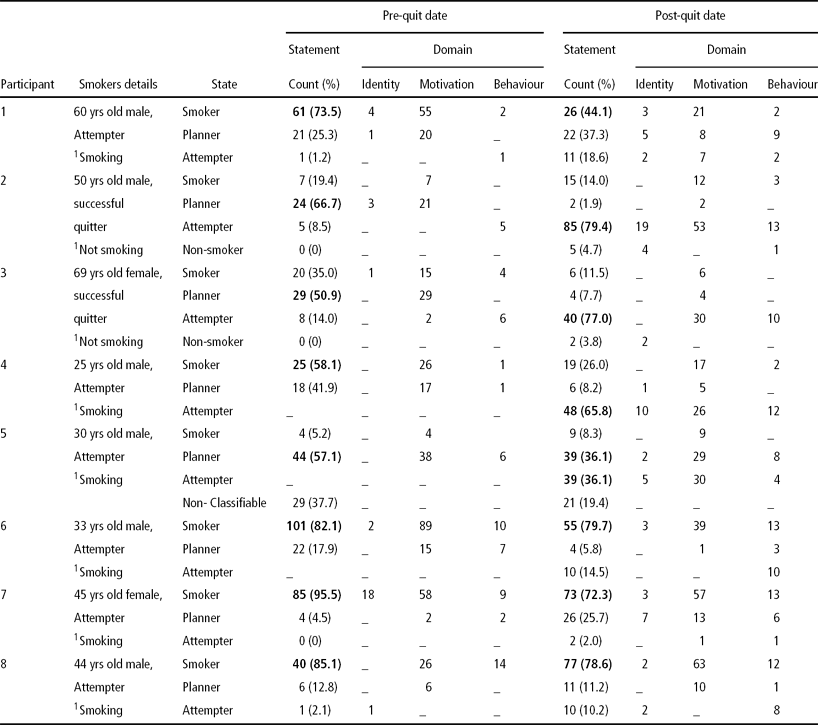
Notes: Each cell shows the number of statements coded as belonging to a particular state and domain. Numbers in bold refer to the modal SNAP state; 1smoking and no-smoking refer to post-quit date smoking status.
To assess inter-coder reliability, the pre-quit and post-quit interview transcripts of one randomly selected participant were analysed and placed into themes independently by two coders. Statements were coded into the four states of the SNAP model and conceptual domains (behaviour, motivation and identity). Percentage agreement was calculated.
Results
Almost all participants’ self-statements could readily be allocated to one of the four SNAP states and participants differed in the extent to which statements clustered in a single state. There was 95.1% and 98.1% agreement for the pre-quit and post-quit reliability check respectively. The distribution of statements in the different categories is given in Table 2. Overall, motives dominated participants’ responses both at the pre-quit and post-quit interview.
As would be expected, smoker or planner state dominated at the pre-quit interview. Motivation statements dominated. Except for Participant 7, explicit identity statements were rare. Box 1 gives examples of pre-quit statements and their classification.
‘I have to smoke first before I go start my briefing, what I am going to do one by one, tell the things. . .this is smoking habits. Yeah, I know all the smokers will do this. . . .’
(Participant 4; Pre-quit - State: Smoker, Parameter: Motivation)
“Well, I wanted to quit a long time ago but what I mean is that I had to consult, I really, I wanted to quit a long time ago for my family, I wanted to quit now because of the signboard I'm seeing now.”
(Participant 4; Pre quit – State: Planner, Parameter: Motivation)
‘when I get up in the morning I need to smoke. . .within the coffee shop, I need to smoke . . . it stressful at night, I need to smoke too, very-very badly because at night you alone, you know, . . . being by myself in the darkness. . . . I don't have anything else . . . practically like talking to myself and then I need a solution . . . .which I try to get answer which make me happy . . . .’
(Participant 6; Pre-quit - State: Smoker, Parameter: Motivation)
‘. . .honestly, I am not ashamed when I am with friends who smoke. I smoke, he smokes, don't feel ashamed. The shame is because of respect for the person. So when I think like that, when I watch TV, he smokes, you see him smoke you don't feel ashamed anymore’.
(Participant 7; Pre quit – State: Smoker, Parameter: Identity)
‘When I can't sleep, I keep thinking of smoking to pass time’.
(Participant 8; Pre quit – State: Smoker, Parameter: Motivation)
Post quit, participants differed in their progression, but there was a general movement towards ‘attempter’ state (Table 2 and Box 2). In no cases was there a predominance of ‘non-smoker’ statements, even in the two participants who were not smoking. Motivation statements predominated as with pre-quit.
‘There are times when you are waiting for somebody you are expected to meet and to talk something. . . then sort of you became fidgety. . .the urges will come. . . and you tend to put a cigarette in the mouth’.
(Participant 1; Post quit - State: Smoker, Parameter: Motivation)
‘I'm confident now because I know the number of sticks I smoke now and I have my willpower’.
(Participant 4; Post-quit – State: Attempter, Parameter: Motivation)
‘Well, I just fight the urges. . . especially dinner, as well as lunch hour, I never smoke because when I finished my lunch, I go straight to entertain my customers, make myself busy lah’.
(Participant 4; Post quit – State: Attempter, Parameter: Behaviour)
‘With friend in the afternoon. My friends will call me out for lunch or have tea. That is the time I will smoke’.
(Participant 8; Post quit – State: Smoker, Parameter: Behaviour)
‘After I came here (the clinic). I have that feeling. Feeling guilty of myself. . . . . I have planned (to quit smoking)’.
(Participant 7; Post quit – State: Planner, Parameter: Motivation)
‘I bought cigarettes and kept in my car to challenge myself) . . . I wanted to fight the urges, I knew that if I open it (box of cigarette) . . .I will never stop (smoking)’.
(Participant 2; Post-quit - State: Attempter, Parameter: Identity)
‘. . . The first few days . . . I mean it was traumatic for me . . . .I fought the urge . . . it went off. Now completely I don't have the urge to smoke. I don't have the urge to put a cigarette in my mouth. . .’
(Participant 2; State: Non-smoker, Parameter: Identity)
‘Different, everybody knows I used to be a smoker ok, different in the sense I'm a non-smoker now’.
(Participant 2; State: Non-smoker, Parameter: Identity)
Discussion
Participants’ self-descriptions could be reliably classified in terms of four states set out in the SNAP model and few statements could not be coded using the framework. There were varying degrees of coherence in the states that each statement was ascribed to with some individuals showing greater clustering than others. There was evidence of transitions between states from pre- to post-quit interview in the two participants who were not smoking but they tended to regard themselves as ‘Attempting’ to stop rather than as ‘Non-smokers’.
During this short-term quitting process, participants related their emotional states and difficulties that accompanied smoking cessation. The difficulties reported by them were consistent with findings from other qualitative studies such as deprivation of comfort, fear of failure, shame of not being able to quit, the perception that withdrawal symptoms are too difficult to overcome and descriptions of strong cue-driven urges and the need to smoke (Thompson, Thompson, Thompson, Fredickson, & Bishop, Reference Thompson, Thompson, Thompson, Fredickson and Bishop2003; Yong & Borland, Reference Yong and Borland2008).
This study had a number of limitations. As with any qualitative study it can only point to what might happen and make no comment on how prevalent it is. However a start has been made and it appears that there may be merit in exploring the use of this interview and coding approach further.
Clinically, it may be worthwhile to discuss the observed pattern of statements with respondents to make them aware of their possibly implicit resistance to behaviour change despite their explicit choice to attempt to stop smoking. This may encourage them to form patterns of thoughts and feelings that are more conducive to sustain change. Moreover, further research is required to verify the predictive utility of SNAP model constructs. For example, those with more coherent self-descriptions as non-smokers should be more likely to remain in that state.
It would also be interesting to assess participants’ responses at a later follow-up to determine predictors of quit success at the intermediate and late stage of quit attempts. If consistent patterns can be identified in further qualitative research, it may be useful to develop questionnaire items and to quantitatively test findings in a larger sample in a prospective, longitudinal study.
Funding
This work was supported by the Institute of Health Management, Ministry of Heath Malaysia and Cancer Research UK.
Competing Interests
Lion Shahab has received an honorarium for a talk and travel expenses form Pfizer. Robert West undertakes research and consultancy for the following developers and manufacturers of smoking cessation treatments; Pfizer, J7J, McNeil, GSK, Nabi, Novartis and Sanofi-Aventis. Robert West also has a share in the patent of a novel nicotine delivery device.
Acknowledgements
We thank the Director General of Health, Ministry of Health Malaysia for permission to publish this study, the Department of Health, Federal Territories, and the Putrajaya Hospital for allowing this research to be carried out in their clinics.
Financial Support
This work was supported by the Institute of Health Management, Ministry of Heath Malaysia (Grant number NMRR-09-747-4556). We are grateful for Cancer Research UK for partly funding this project.
Conflict of Interest
Lion Shahab has received an honorarium for a talk and travel expenses form Pfizer. Robert West undertakes research and consultancy for the following developers and manufacturers of smoking cessation treatments; Pfizer, J7J, McNeil, GSK, Nabi, Novartis and Sanofi-Aventis. Robert West also has a share in the patent of a novel nicotine delivery device.
Ethical Standard
The authors assert that all procedures contributing to this work comply with the ethical standards of the relevant national and institutional committees on human experimentation and with the Helsinki Declaration of 1975, as revised in 2008.