During the eighteenth century a particular kind of subject became increasingly common in the world of opera: works would focus more or less exclusively on the mechanisms by which operas themselves were created and staged. This kind of ‘opera about opera’ or ‘meta-opera’ was extremely popular. From Metastasio's L'impresario delle Canarie (1724) to Palomba's Orazio (1737), Goldoni's Le virtuose ridicole (1752), Calzabigi's L'opera seria (1769), Casti's Prima la musica poi le parole (1786) and Diodati's L'impresario in angustie (1789) – to cite only the most famous ones – hundreds of librettos staged the world of opera with its stereotypical characters such as illiterate tenors, competitive sopranos, ridiculous castrati and greedy impresarios.
The characters of meta-operas are often shown in the act of rehearsing or performing passages from other (real or fictional) operas, so that what they sing is realistic music, that is, music that they too hear as ‘music’.Footnote 1 In early eighteenth-century meta-operatic intermezzos, the characters are represented singing short operatic scenes that mostly consist of accompanied recitatives and arias.Footnote 2 Later in the century, embedded performances become more elaborate (they go hand in hand with the evolution of opera buffa in general), growing in size and importance from discontinuous rehearsals to continuous performances of entire embedded works (some occupying whole acts of their framing operas).Footnote 3
The presence of embedded operatic scenes (especially longer ones) complicates the overall structure of the opera that contains them: when characters enact a separate dramatic narrative, they duplicate the fictional levels of the work they inhabit. In spoken theatre, this technique is called the ‘play within a play’. A well-known example is in Shakespeare's Hamlet: the insertion of The Murder of Gonzago (Act 3 Scene 2), the show enacted in front of Hamlet's uncle and his court, deepens the theatrical narrative, creating a fiction of second degree, which, in this particular case, significantly influences the course of the principal action. The framing drama (Hamlet) corresponds to a first level of fiction – reality for the characters of Hamlet – while the embedded drama (The Murder of Gonzago) corresponds to a second-level fiction, considered fictional by those characters. For the real-life audience, both levels are fictional, with the inset performance somehow more fictional than the framing one.
Because what is embedded within meta-opera is usually another opera, however, the duplication of representational levels is here accompanied by realistic music played and sung on stage at key points in the plot, when the dramatic structure is complicated by the presence of a play within a play.Footnote 4
‘PERFORMED’ MUSIC WITHIN META-OPERA
While Italian opera of the eighteenth century is set to music throughout, only a fraction of it is heard as music by the characters on stage: when the characters hear music, however, what we as spectators hear is its representation. For instance, in the second act of Le nozze di Figaro, when Cherubino sings a song and Susanna accompanies him on her guitar, Cherubino, Susanna and the Countess hear a guitar; we hear its orchestral representation (Act 2 Scene 2). Realistic songs like that of Cherubino are heard and recognized as such also because their textual and musical form sets them apart from the rest of the music. (Realistic songs often have strophic texts and settings with harp, mandolin or guitar accompaniment, although, of course, not all realistic singing is strophic, nor all strophic singing realistic.)
What happens in meta-opera is rather different: what is sung and performed by the characters within a meta-opera are not songs but operatic arias and recitatives, which do not differ substantially from the other numbers of the opera. This formal similarity can more easily spawn ambiguities as to whether, in a particular moment, a character on stage is ‘singing’ or ‘speaking’. This confusion obviously plays on the basic convention of the operatic genre, on the lack of distinction between speech and song to the spectators' ears. That ambiguity, potential in all opera, is exploited by meta-opera as a metatheatrical device that contributes to the confusion of fictional levels: not knowing whether characters are speaking or singing in their world often corresponds to a more general confusion about whether what is being represented is real or fictitious for them.
Some help in avoiding confusion can come from the dramatic context and/or from verbal clues (for example, ‘Let's start the aria’, ‘To the duet’), or from the presence in the librettos of typographical devices such as italics or inverted commas to mark out the embedded text. In some cases, differences between ‘performed’ arias and the rest of the arias are signalled by the use of stylistic types: the first are set in seria style (with da capo, elaborate coloratura and, at times, a prefatory accompanied recitative), whereas the latter are arie buffe (this because the opera performed internally is seria, while the framing one is comic).Footnote 5 But this is not always the case: first, there are many examples in which the embedded opera is buffa too;Footnote 6 moreover, the presence of different styles is a characteristic of comic opera in general and does not necessarily constitute a sign of realistic performance.Footnote 7
Countless examples show that operatic characters are usually able to tell the difference between speech and song within their own world. This convention is at the core of the operatic genre and is explained by the paradox intrinsic to all opera: while the singers impersonating operatic characters do sing, the characters themselves (in their fictional world) are only speaking (while Luciano Pavarotti in the role of Idomeneo does sing, the character Idomeneo – in his fictional world – is only speaking).Footnote 8 Although passages that blur the distinction between speech and song can be found in opera,Footnote 9 they represent exceptional cases in which this convention is flouted,Footnote 10 and therefore confirm that such a convention does exist in the first place.
Part of the metatheatrical game is the tendency to blur the boundaries between multiple fictional levels, thus creating situations in which it is difficult to distinguish between different degrees of reality: in some cases, in fact, the characters on stage are the victims of this lack of clear-cut distinction, mistaking performance for real life. La Dirindina, an intermezzo in two parts by Domenico Scarlatti (text by Girolamo Gigli; Rome, 1715),Footnote 11 features the characters of the singer Dirindina, her singing teacher Don Carissimo and Liscione, a castrato singer. In the second part, Dirindina, in order to show her singing and acting qualities, rehearses a passage of recitative in front of Liscione, interpreting the role of Dido and addressing Aeneas– Liscione with harsh words.Footnote 12 Don Carissimo, who arrives in the middle of the scene, is confronted with a mixture of fiction (Dirindina's singing) and reality (Liscione's spoken comments and suggestions) and seems unable to tell the difference:

Dir. Cruel and deceitful Aeneas… (Don Carissimo arrives and spies on them from a distance) | Lisc. Take up a more defiant stance. | Car. So they're still at it! (to himself) | Dir. Go hence, traitor, go… | Car. What the hell is up? She wants to kill him! Go, have at him! I'll hide here just for a bit. | Dir. Go, for if Heaven is just, may lightning strike you down, villain… | Car. He's still there, the rascal! (Liscione shows that he is pleased with the acting and sits down) | Dir. And avenge the insults with which you falsely repaid my trust… | Car. The rogue is laughing and still sitting! | Dir. My zeal, my honour, perfidious traitor, my stained bed. | Car. Ah, dirty pig! | Lisc. You didn't speak those words about a stained bed loudly enough for people to hear. | Car. Astounding effrontery! To want to broadcast such things aloud! What a knave, what a madman! | Dir. Do you trample upon the holy laws of Heaven in the same way that you mock and break the holy vows of marriage? | Car. Marriage to Liscione! | Dir. Can you so easily tear yourself away from this breast, scoundrel, while you leave me fecund and replete by you? | Car. I'll see this first, and then the end of the world!Footnote 13
At the end, Don Carissimo, never realizing his mistake, tries to persuade Dirindina not to kill herself, but instead to marry Liscione in order to avoid dishonour.
Carissimo's misunderstanding, however egregious and unrealistic it may be, is the result of his mixing up the two levels of fiction (or reality and fiction from his point of view). His confusion is made even more paradoxical because he does not seem to hear Dirindina's singing. Since the virtuosa is rehearsing an operatic scena, we must assume that she is actually singing, even though the audience of La Dirindina is, of course, unable to tell the difference. Don Carissimo, on the other hand, should hear her lines for what they are: passages from a (sung) operatic scene. That Don Carissimo seems to hear Dirindina's performance as spoken, however, contradicts the very basic convention according to which speech and song sound clearly different to the characters inhabiting the world of opera – and an experienced operatic audience is likely to get the paradox of this situation.Footnote 14 The presence of music realistically performed on stage can therefore be used in meta-opera as a metatheatrical device that, by contravening a basic operatic convention, contributes to the confusion between different levels of fiction.
Realistic music can also underline the double function of accompanimental music embedded within meta-opera. In the one-act divertimento teatrale Prima la musica e poi le parole (libretto by Giovanni Battista Casti and music by Antonio Salieri; Vienna, Schönbrunn Palace, Orangery, 1786) Poeta and Maestro have been requested to put on an opera in four days. The music already exists, but the poet has to compose a new libretto for it, and (because of pressures from influential figures) two women, one seria and one buffa, have to be accommodated in the cast. In Scene 2 Poeta and Maestro audition the virtuosa seria Donna Eleonora, who, in order to prove her singing abilities, performs a few pieces from Giulio Sabino (an opera seria by Sarti turned into a pasticcio).Footnote 15 The virtuosa begins by singing the cavatina ‘Pensieri funesti’, and Maestro accompanies her at the harpsichord. At the end of her audition Eleonora chooses the rondò ‘Cari oggetti del mio core’ and asks Poeta and Maestro to help her with the action; if Maestro is acting, however, nobody can accompany the performance at the harpsichord:
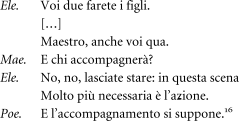
Ele. The two of you will act as the children. […] Maestro: you, too, come here. | Mae. But who will accompany? | Ele. Never mind: in this scene action is the most important thing. | Poe. The accompaniment will be imagined.
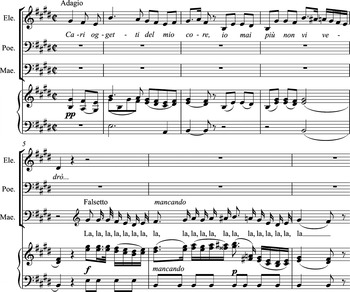
In order not to give up the accompaniment altogether, especially during those bars in which the voice is silent and the orchestra alone would play, Maestro supplies the accompaniment by singing the violin part in falsetto (Example 1). By filling the gap, Maestro avoids an even more paradoxical solution: the real-life audience would have to imagine complete silence on stage when the virtuosa is not singing, and yet hear the orchestra play those ‘silent’ bars – perhaps something too implausible even for experienced opera-goers.
Ele. Dear objects of my love, I will never see you again. | Mae. La, la, la …
‘Cari oggetti del mio core’, bars 1–7, from Antonio Salieri, Prima la musica, poi le parole: Divertimento teatrale in einem Akt von Giambattista Casti, vocal score by Friedrich Wanek, German translation by Josef Heinzelmann (Mainz: Schotts Söhne, 1972), 56. Used by permission

What is interesting in this example is that, whereas during the cavatina ‘Pensieri funesti’ the orchestra played music that represented Maestro's harpsichord accompaniment (heard by the characters), in the second number (the rondò ‘Cari oggetti’, in which no realistic accompaniment is played) the orchestra we hear represents the ‘real’ music that is absent (or, perhaps, the music that the characters hear with their minds' ears). In similar cases, the presence of the orchestra underlines the simultaneous existence of two different realities: ‘Cari oggetti’ is at the same time the rehearsed aria of Giulio Sabino (and as such has no instrumental accompaniment at all at this point of the fictional rehearsal) and a real (performed on stage) aria of Prima la musica (where at this point it does have an orchestral accompaniment).
As we begin to see, the duality peculiar to spoken metadrama – the more or less extended presence of different degrees of fiction – is reflected in meta-opera in the complex nature of the musical scores.
IDEAL VERSUS PERFORMANCE SCORE
Most of the realistic singing in meta-opera takes place during fictional rehearsals or auditions. On these occasions, the virtuosi exhibit their abilities by performing in front of a small audience (the other characters on stage), but very often they do not manage to finish their pieces, as they are interrupted by their spectators' comments, laughter, requests and so on. In these cases, an important distinction is to be drawn between the piece's ‘original’ or ‘ideal’ form – the piece as we would find it in its imaginary score (that is, in its entirety) – and the form in which it is recorded in the only score we have, the actual score of the meta-opera (with its interruptions, repetitions and incompleteness). In order to analyse the latter, we need first to reconstitute the former in our imaginations.
In the intermezzo L'impresario delle Canarie (libretto by Pietro Metastasio and music by Domenico Sarro; Naples, Teatro San Bartolomeo, 1724) the virtuosa Dorina, after having listed the usual excuses for not singing (a cold, the spinet out of tune and so on), finally agrees to perform an aria to Nibbio (the impresario) while accompanying herself at the spinet. While she sings her number, however, Nibbio continuously butts in with comments on the performance:
Dor. Come, love, prepare… | Nib. O dear! | Dor. Thy chains divine… | Nib. O fine! | Dor. To thee my freedom I resign… | Nib. How round a shake; how sweet a beat was there! A wonder! Prodigy of nature! | Dor. You still possess me… | Nib. O bless me! | Dor. Tho' from my fetters freed… | Nib. That's fine indeed! | Dor. Nor can I end, but with my life, my pain. | Nib. Ah! For heaven's sake! That! That again! Dear creature.Footnote 18
The text of the ideal represented aria can be extracted from that of its performance as we have it, and is composed of two quatrains of quinari:
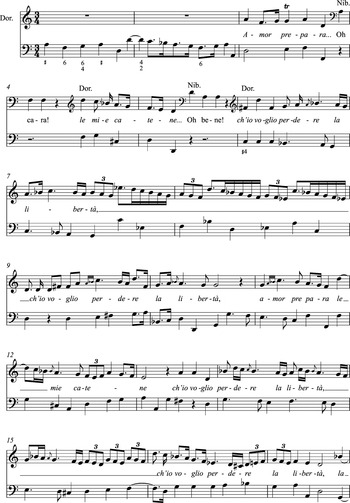
The addition of Nibbio's comments dismantles this original text and inserts it into a new text of a different metrical structure. The ideal lyrical passage (two quatrains of quinari) is thus embedded into what could be seen as a passage in recitative verse (with a bit of stretching, it can fit both settenari and endecasillabi). Despite the impresario's interjections, however, both text and music of the aria sung by Dorina are still clearly recognizable within the resulting number (Example 2).Footnote 19
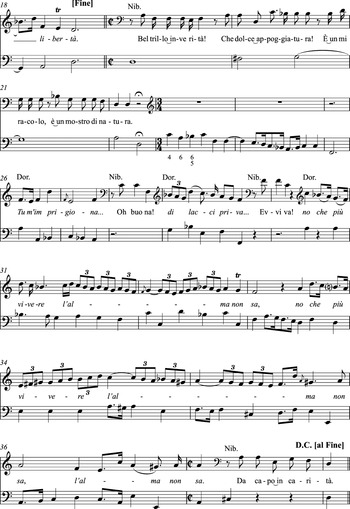
‘Amor prepara – Oh cara’, from Domenico Sarro, Dorina e Nibbio (L'impresario delle Canarie) (1724), Naples, Biblioteca del Conservatorio San Pietro a Majella, Ms. 31.3.19, 71v–72


At this point in the score of L'impresario delle Canarie, we can discern two different numbers, or, better, a number containing another number from the framed work: ‘Amor prepara… – Oh cara!’ includes, broken into pieces, the aria ‘Amor prepara’. The continuous conflict between Dorina's aria in 6/4 and Nibbio's interjections in 3/4 shows the tension between the embedded aria and the number that results from the aria and the interjections combined.Footnote 20
As hinted above, we need to bear in mind the double nature of these meta-representations. When a drama is performed within another framing one, the latter does not disappear. Rather, a continuous dialectic is established between the two: the inset narrative may be brought to the foreground while the framing one is left in the background or vice versa. Meta-operatic scores mirror this narrative process: when realistic music is performed, the music that supports the entire opera is still there – it may be confined to the background for a while, but does not go away. The conflict arises when the two levels of fiction (and of music) are brought to the foreground at the same time, and fixed (or recorded) within the same closed number, with occasionally paradoxical results (such as the metrical shifts mentioned above).
The fact that meta-operatic scores often represent the fictional performance of a piece rather than presenting the piece itself can also be seen by variations between one performance and the next of a given passage. For example, in Act 2 Scene 6 of the opera buffa L'opera seria (libretto by Ranieri de' Calzabigi and music by Florian Leopold Gassmann; Vienna, Burgtheater, 1769) all characters gather at the impresario's residence to rehearse the third act of the fictional opera seria L'Oranzebe. Although there is no mention in the libretto of the presence of an orchestra on site (which would be unlikely anyway), all of a sudden the maestro di musica Sospiro addresses the orchestral musicians directly, explaining to them how to perform the number that is about to be rehearsed (a duet). Delirio (the poet) and Stonatrilla (the prima donna) find Sospiro's instructions excessive:
Sosp. And now to the duet. Please (to the orchestra), in the first bar mind that forte. You have to play with legato bows. | Del. (What a fraud!) (to Sto.) | Sto. (For two stupid notes he says so many useless words!) (to Del.) | Sosp. I want to hear those violas.
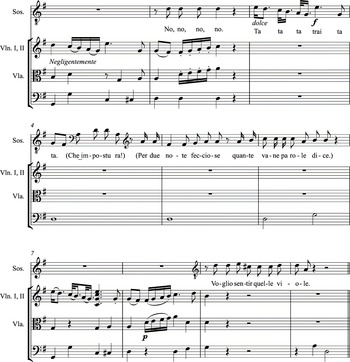
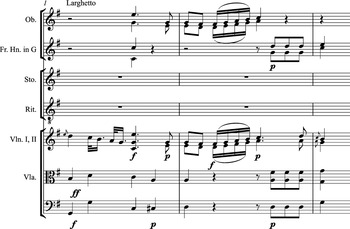
After these few lines, the duet begins. What in the libretto appears as a brief remark (‘in the first bar mind that forte. You have to play with legato bows’) is in the score transformed into a lesson on phrasing: after Sospiro has asked the strings to play with ‘arco legato’, the violins begin the instrumental introduction to the duet playing ‘negligentemente’ (carelessly); Sospiro, dissatisfied with this execution, interrupts them (‘No, no, no…’) and sings the passage as he would like it to be played (Example 3, bars 1–4).Footnote 22 Delirio and Stonatrilla intervene with their comments in recitative; the strings play the first two bars of the introduction again, with the violins following Sospiro's directions (bars 7–8); but the maestro is still not fully satisfied (‘I want to hear those violas’).
‘No, no, no’, bars 1–10, from Florian Leopold Gassmann, L'opera seria, Introduction by Eric Weimer, Italian Opera, 1640–1770, volume 89 (New York: Garland, 1982), transcribed from the facsimile edition of the manuscript score held at the Österreichische Nationalbibliothek, Vienna, Ms. 17775, 275–276

The duet is finally performed from the beginning. This time, the violins carefully follow Sospiro's directions and the violas play fortissimo (Sospiro wanted to ‘hear’ them), but the passage differs substantially from the two heard before (see Example 4). The differences are not a matter of phrasing, but involve a complete rewriting: in the second bar the semiquavers have passed from the violas to the second violins, while the violas (and the bass) join the rhythm of the horns.
Gassmann, L'opera seria, 276, bars 1–3 (second version)

What score do the fictional instrumentalists addressed by Sospiro have in front of them? Have they ignored a (written) opening acciaccatura because they play ‘negligentemente’ (Example 3, bar 1), or is it an expressive touch added by the maestro during the rehearsal (Example 3, bar 3)? The same question could be asked of the reverse-dotted rhythm: is it notated but not played the first time round because of negligence, or is it added by Sospiro as a performance indication? Should this passage be taken as a document of some eighteenth-century performance practice?
Be that as it may, the violins get both right (acciaccatura and rhythm) at once. As for the forte in the first bar, we know they had it in their score from the beginning (‘Nella prima battuta quel forte’), and its absence in their first reading (Example 3, bar 1) is no doubt a result of their ‘negligenza’ and a further confirmation of the difference between what we see and what the fictional performers of L'Oranzebe have in front of them on their stands. What we see here is in fact the representation of a performance: those details suggest to the (real-life) spectators that the fictional performance becomes less negligent, more accurate and more expressive as the rehearsal goes on. Once again, the stratified nature of meta-opera is not confined to its dramatic plot, but is also reflected in its musical dimension: in the score we have, two ‘realities’ (the imaginary score and its fictional performance) cohabit and at times overlap in complex ways.
MUSICO-DRAMATIC FORMS
Meta-opera also achieves both wit and critical sharpness by undermining the musico-dramatic forms of conventional eighteenth-century Italian opera seria and buffa, such as the normal succession of recitatives and closed numbers. This is especially the case when metatheatrical procedures lead to the overlapping of different levels of the operatic discourse, levels that are usually kept strictly separate in terms of their technical features and their musico-dramatic function.
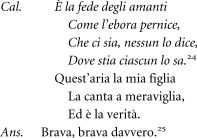
The first variation on standard practices prompted by the presence of realistic music can be observed within closed numbers. One interesting example is in the opera buffa L'amore in musica (music by Antonio Boroni to a text by an unknown librettist; Venice, Teatro San Moisè, 1763). In Act 1 Scene 4 Calandra, mother of the virtuosa Reginella, in praising her daughter's singing skills, ‘quotes’ (mangling all the words) from one aria by Metastasio (or ‘Metanasio’, as the fictional maestro di cappella later calls him), receiving the compliments of another character, Anselmo:Footnote 23
Cal. Faith in love is like the Eborian Partridge: no-one claims that it exists, though everyone knows where it is found. My daughter sings this aria wonderfully, it's the truth. | Ans. Good, very good.
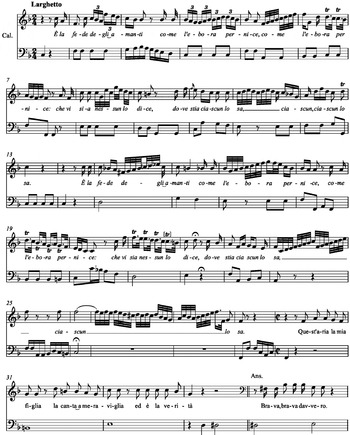
This aria text contains two parts. The ottonari represent a fictional aria text, the settenari Calandra's comments on it. From looking at the text alone, however, it is impossible to know whether Calandra will imitate her daughter by singing (that is, ‘performing’ the fictional aria), or will simply quote from its text (therefore ‘speaking’ throughout). Only the score indicates what will happen on stage: see Example 5.Footnote 26
‘È la fede degli amanti’, from Antonio Boroni, L'amore in musica (1764), Naples, Biblioteca del Conservatorio San Pietro a Majella, Ms. 25.6.8–10, 61v–64

As the musical setting clearly indicates, Calandra sings the first stanza (with a parody of seria style, especially in the long, farcical cadenza on the vowel ‘u’, ridiculously awkward to sing), and then she speaks in the second part, where the music continues in secco recitative.Footnote 27 The setting in simple recitative of the second stanza of the aria is quite unexpected because it takes place within a set piece, to a text in versi lirici. (It is important to note, however, that settenari are a hybrid type of verse, at home both in versi sciolti and in versi lirici: many examples of versi lirici set as secco recitative appear in correspondence with settenari, exploiting precisely this ambivalence.) The choice of setting the second stanza of Calandra's aria as recitative is quite unconventional, a sign of the increased flexibility in the treatment of set pieces prompted by dramaturgical motivations – in this case the presence of a performance within a performance and the consequent need to differentiate musically the two moments, that of ‘fiction’ and that of ‘real life’.
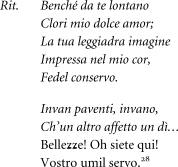
Various examples of unusual solutions in the musical setting when realistic music is present are found in L'opera seria. The character Ritornello (primo musico) makes his first appearance in Act 1 Scene 7, entering the impresario's house while singing the aria ‘Benché da te lontano’ to himself. Before the end of the aria he notices the presence of two other characters, Smorfiosa and Porporina, and greets them. Ritornello's aria represents his performance of most of a song addressed to ‘Clori’ (the pastoral name of a nymph who is the protagonist of many cantatas) by a faraway lover. Interestingly, the last two lines of the aria's second stanza do not belong in the song for Clori, but express Ritornello's real-life surprise in realizing that he is not alone in the house:
Rit. Although far away from you, Clori, my sweet love, I faithfully keep your graceful image engraved in my heart. In vain do you fear that one day another love… Beauties! Ah, you are here! I'm your humble servant.
In terms of content, these last two lines take us back to (and represent) ordinary speech. In terms of versification, however, they still belong to the text of Ritornello's aria, as they are a settenario and a quinario perfectly integrated with the preceding text (the settenario rhymes with the settenario of the previous line, and the quinario rhymes with the quinario concluding the first stanza). Combined, however, these last two lines can also be read as an endecasillabo (that is, as part of a recitative). In other words, the text of the second stanza above could also have appeared this way:
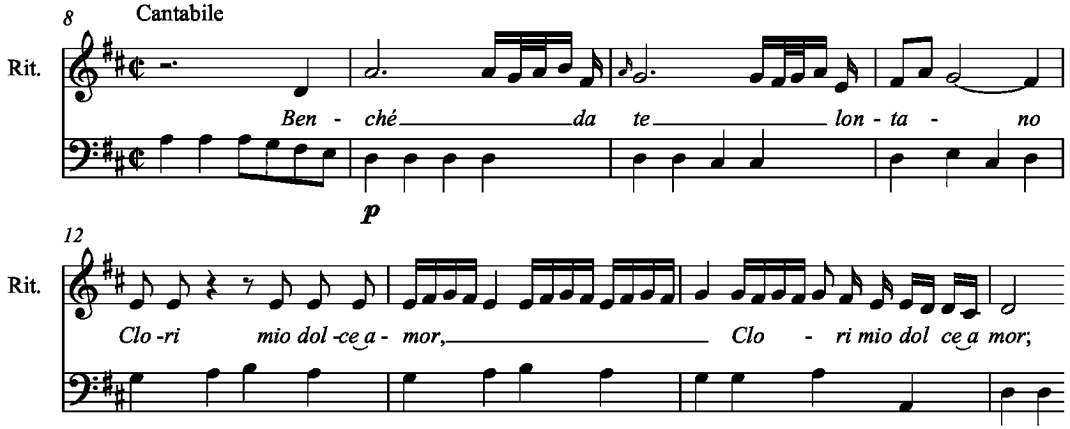
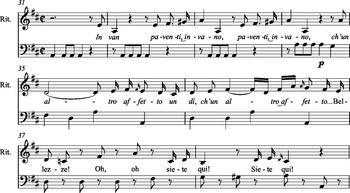
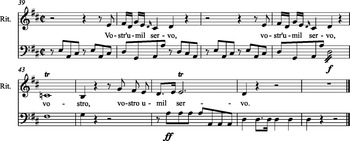
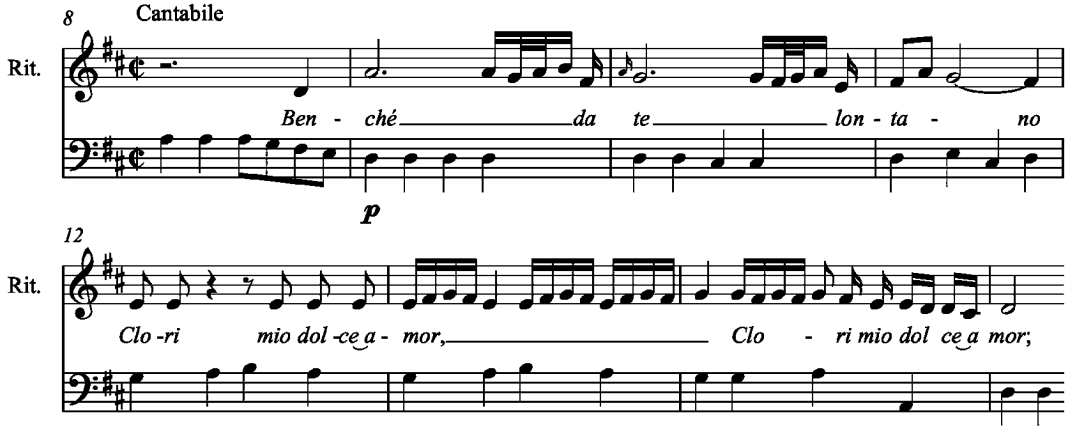
The beginning of Ritornello's song is given in Example 6. Towards the end of the number, at the words ‘Bellezze, Oh! siete qui’, the song is interrupted and there is a change in texture (see Example 7). The lyrical form dissolves; the words are set syllabically in a declamatory, broken style that brings this passage closer to simple recitative, setting it apart from the expressivity of the song for Clori.
‘Benché da te lontano’, bars 8–15, from Gassmann, L'opera seria, 105–106
‘Benché da te lontano’, bars 31–38, from Gassmann, L'opera seria, 108–110

This change of musical style reflects the dramaturgical passage from the fictional performance of the song to the addressing of the other characters. (The change, therefore, is similar to that found in Example 5, from L'amore in musica.) After the moment of surprise, however, Ritornello returns to a sort of (mock-)opera-seria aria style to conclude his performance (Example 8). One wonders whether the other characters hear Ritornello sing throughout, or hear him speak during the last two lines. The setting seems to suggest that after the moment of surprise – in which he is more likely to speak – he jokingly sings to his colleagues the words ‘I'm your humble servant’.
‘Benché da te lontano’, bars 39–47, from Gassmann, L'opera seria, 110

Thus some confusion of musico-dramatic levels takes place within this number: whereas most of Ritornello's aria is a performance of the original song for Clori (with its static emotional contemplation), its last two lines (and their setting) break the lyrical parenthesis in order to carry on with the dramatic action, as Ritornello returns to (his) real life and directly addresses the other characters on stage. This number, like that from L'amore in musica, therefore seems to work across the conventional oppositions recitative/closed number, ‘real-life’/‘performed’ and ‘spoken’/‘sung’: the musical settings of texts in versi lirici move from lyrical passages to more declamatory ones in order to reflect the distinction between different layers of ‘reality’ present in the plot.
MULTI-SECTIONAL STRUCTURES
The alternation of contrasting musico-dramatic modes we have observed within closed numbers can sometimes extend to occupy longer portions of meta-operas, which display a multi-sectional structure constituted by a sequence of truncated set pieces interspersed with recitative. This usually occurs when the fictional singers rehearse or audition their pieces in front of other characters, who often interrupt the performance.
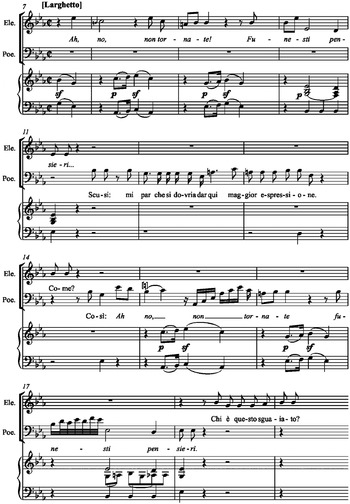
An interesting example is in Prima la musica, in which the whole of Scene 2 is composed of fragments of potentially closed numbers alternating with passages of secco recitative. As we have seen above, Poeta and Maestro are auditioning Donna Eleonora, who sings the cavatina ‘Pensieri funesti’. After a few bars, however, she is interrupted by Poeta, who asks her for more expression, singing the passage himself (see Example 9):Footnote 29

Ele. Ah no, sorrowful thoughts, do not come back, leave for a while my heart in peace. | Poe. Excuse me, but I think that here one should give more expression. | Ele. How? | Poe. Like this: Ah, no, sorrowful thoughts do not come back. | Ele. Who is this boisterous man?
‘Pensieri funesti’, bars 7–19, from Salieri, Prima la musica, 36–37

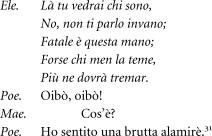
The action goes on in simple recitative until Eleonora is requested by Maestro to sing a bravura aria with its opening recitative. She starts by singing the accompanied recitative ‘Non dubitar verrò’ (‘Doubt not, I'll come’). At the end of it, she is interrupted once again by Poeta because he has spotted some nonsense in the text. The poet is shushed by the other two characters and the singer moves on to the aria ‘Là tu vedrai chi sono’. A new interference by Poeta leaves the aria incomplete:

Ele. You will see who I am, no, I'm not talking to you in vain; this hand is fatal; perhaps the one who fears it less, will tremble at it more. | Poe. Tut-tut! | Mae. What is it? | Poe. I've heard a bad alamirè.
The long section of the aria sung before the interruption concludes on the dominant. We never hear the rest of it (with the presumed return to the tonic). Rather, the action goes on in simple recitative.
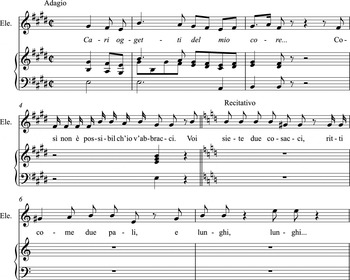
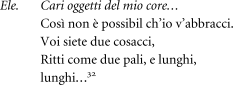
The audition continues and Donna Eleonora wants to perform a scena in which Sabino, condemned to death, bids his wife and children farewell. In order to perform it properly, she asks Poeta and Maestro to act as the silent children. Two more characters (Epponina and Annio) will be impersonated by two chairs. Eleonora begins to sing the opening adagio of her number (a rondò) ‘Cari oggetti del mio core’, but has to stop in the middle of her very first sentence: the ‘children’ are too tall and she cannot embrace them (see Example 10):
Ele. Dear objects of my love… I cannot embrace you in this position. You are two odd contraptions, standing there like two poles and tall, tall…
‘Cari oggetti del mio core’, bars 1–7, from Salieri, Prima la musica, 54

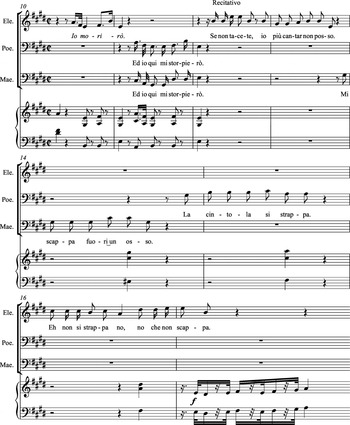
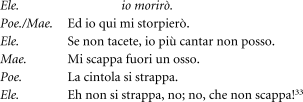
After having repositioned the two ‘children’, Eleonora starts the piece again from the beginning. Poeta and Maestro intervene in the instrumental coda, complaining about the uncomfortable position they have to hold. This remark obviously interrupts the performance, and the ‘number’ slips into five bars of secco recitative in which Eleonora orders the two to keep quiet (Example 11).
Ele. I will die. | Poe./Mae. And I will become crippled. | Ele. If you don't shut up, I cannot sing. | Mae. A bone is about to come out! | Poe. My belt is about to tear! | Ele. Don't worry, it won't come out, it won't tear!
‘Cari oggetti del mio core’, bars 10–17, from Salieri, Prima la musica, 57

The adagio resumes; Poeta and Maestro quickly leave their positions in order to give voice to Annio and Epponina (the two chairs), who briefly reply to Eleonora/Sabino. Then the two resume their role as children. The scene is so comically unrealistic that Eleonora herself breaks into recitative saying: ‘Siete per verità due gran buffoni’ (‘You are two real jesters’: bars 26–27, not shown).
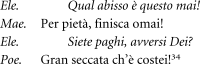
The second part of the rondò is an allegro. Eleonora is now too deeply absorbed in her character to care about Poeta's and Maestro's complaints. In this section we do not find any interruption in simple recitative; instead, the first level of fiction (the uncomfortable presence of Poeta and Maestro) is completely integrated into the texture of the seria piece. The effect is comic (see Example 12):

Ele. What is this abyss!… | Mae. For pity's sake, stop now! | Ele. Are you satisfied, hostile gods? | Poe. What a pain she is!
‘Qual abisso è questo mai!’, bars 10–17, from Salieri, Prima la musica, 60

Later, Maestro and Poeta sing a short melody in response to Eleonora; the expression of their suffering produces a disjunction between the serious style of her piece and the overall situation itself: the libretto ironically sets the deep sorrow for Sabino, who is going to die, against the pain of these two comic figures, forced to hold an uncomfortable posture (see Example 13):
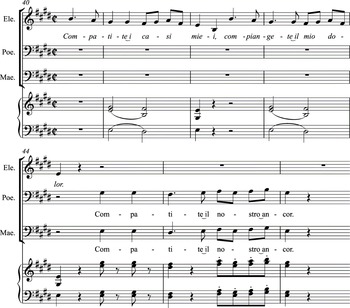
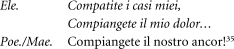
Ele. Pity me in my misery, in my pain. | Poe./Mae. Pity us in ours, too!
‘Compatite i casi miei’, bars 40–46, from Salieri, Prima la musica, 61

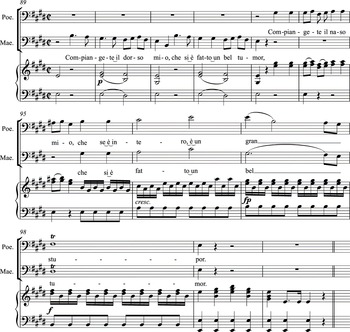
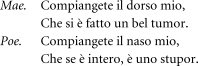
The comic climax is achieved when the two, not able to hold their postures any longer, fall – one forwards, the other backwards. The number ends with poet and composer singing Sabino's tune ‘Compatite i casi miei’ (‘Pity me in my misery’), begging for compassion for their aching back and nose, thus distorting with their coda the situation depicted in the aria (see Example 14):
Mae. Have pity on my back, which now has a nice lump. | Poe. Have pity on my nose: it's a miracle if it's still in one piece.
‘Compiangete il dorso mio’, bars 89–100, from Salieri, Prima la musica, 65–66

Once again the overlap of first and second level of fiction no longer determines an interruption of the performance of Eleonora's piece. Rather, the interjections from Poeta and Maestro are completely integrated into the flow of her fictional performance, interwoven with the music of Sabino's seria number.
As the long Scene 2 from Prima la musica shows, the relatively free alternation of lyrical passages and recitatives observed within closed numbers can be extended to larger portions of meta-operas, thus creating multi-sectional passages that look quite different from the structures found in contemporary opera. These passages fulfil an important function: opera buffa is generally considered to have greater verisimilitude than opera seria, not only for its settings and plots from everyday life, but also for its musical structures – especially the ensemble pieces, which can picture different events and reactions occurring at the same time. The multi-sectional passages from meta-opera discussed above are, in this sense, highly mimetic: they provide a vivid and close theatrical representation of what could happen during rehearsals (or auditions), with people interrupting each other to comment on and judge the performances. The fundamental characteristic of these passages – their flexible use (and abuse) of operatic practices – produces a high degree of mimesis on stage. By bypassing the conventional obligation to distinguish between recitative and closed numbers, these sections provide a type of representation in which the flow of the action is remarkably close to reality.
The presence of realistic music can fulfil a number of different functions in meta-operatic scores, and its analysis can help us unravel some of the mechanisms at work in this repertoire. The ambivalence of the operatic medium – the continuity between music and ‘music’ to the spectator's ear – can be exploited in order to enhance the confusion between different levels of fiction, a confusion on which so many metatheatrical works play.
Meta-operatic scores take part in the narrative stratification typical of metatheatre, and we can use realistic music to detect the simultaneous presence of different types of musical performance, pertaining to both the framing opera and the embedded piece. We can stress the duality of the music by pointing at a series of incongruities found in the score and related to its nature: in those passages in which realistic music is played, meta-operatic scores offer the representation of a particular performance of a piece, and not the piece in any ‘original’ form that one might imagine. All these examples provide meaningful insights into the way in which meta-operatic scores function: realistic music does not make the rest of the music disappear, as one may think, but engages with it in a continuous dialectic.
Furthermore, the presence of a performance within a performance increases the complexity of the medium, encouraging a relaxation in the syntactical articulation of the musico-dramatic structures of opera. Dramaturgical reasons justify the unusual passage within closed number from realistic to non-realistic music, which produces set pieces that overcome the standard oppositions between recitative and closed number, ‘real-life’ and ‘performed’, ‘spoken’ and ‘sung’. In longer passages, this relative flexibility provides a living and realistic picture of the passing of time.
In all these cases, purely musical means can be used to underline the presence of more than one layer of reality – music can go above and beyond the dramatic narrative itself in delineating or dissolving the imaginary fourth wall between embedded and embedding representations. Thus the complex nature of meta-operatic scores and their musico-dramatic structures can be seen to be a full match for the complexity of their librettos, along with all their multi-layered plots and the games they play with dramatic conventions and levels of fiction.