INTRODUCTION
The study of post-disturbance community recovery is an important task in ecology and one that is highly relevant to understanding how secondary succession and the assemblage of plant communities proceed. Compared with the focus on plant communities composed of herbs, shrubs and trees, there is a lack of knowledge from both basic and applied perspectives in terms of the resilience of epiphyte communities to disturbance. Epiphytes are vulnerable to forest disturbance and fragmentation (Holbrook Reference HOLBROOK1991, Wolf Reference WOLF2005, Zhu et al. Reference ZHU, XU, WANG and LI2004), because of their total dependence on established vegetation, such as trees, to complete their life cycle (Benzing Reference BENZING1998), and to climate change (Zotz & Bader Reference ZOTZ and BADER2009). However, there has been little research regarding the recovery of epiphyte communities following natural or human-induced removal from the canopy, which represents a common disturbance for these communities (Hietz Reference HIETZ1997, Nadkarni Reference NADKARNI2000, Toledo-Aceves et al. Reference TOLEDO-ACEVES, GARCÍA-FRANCO, HERNÁNDEZ-ROJAS and MACMILLAN2012a). Different agents, including large mammals and hurricanes, can remove epiphytes from the canopy but they are also deliberately removed as part of management practices (e.g. in coffee plantations) or by plant collectors (Haeckel Reference HAECKEL2008, Rodríguez-Robles et al. Reference RODRÍGUEZ-ROBLES, ACKERMAN and MELÉNDEZ1990, Toledo-Aceves et al. Reference TOLEDO-ACEVES, GARCÍA-FRANCO, HERNÁNDEZ-ROJAS and MACMILLAN2012a).
Few studies have evaluated recolonization capacity in the vascular epiphyte community. Nadkarni (Reference NADKARNI2000) found that up to 10 y were required for establishment of the first seedlings of vascular epiphytes following experimental removal in small branch plots in a cloud forest in Costa Rica. In contrast, a study in a shade-coffee plantation in Mexico reported a 35% recovery of biomass and the presence of 40 epiphyte species at 8–9 y after the complete removal of epiphytes from entire trees (Toledo-Aceves et al. Reference TOLEDO-ACEVES, GARCÍA-FRANCO, HERNÁNDEZ-ROJAS and MACMILLAN2012a). The inconsistent results of previous studies may be related to the degree of forest disturbance. These few data suggest that in primary habitats the community of epiphytes is quite fragile and its resilience is low, while epiphytic plant communities of secondary habitats are more resilient. A positive relationship between the abundance of generalist epiphytic species and resilience could be expected, resembling similar patterns in terrestrial forest assemblages (Guariguata & Ostertag Reference GUARIGUATA and OSTERTAG2001, Norden et al. Reference NORDEN, CHAZDON, CHAO, JIANG and VÍLCHEZ-ALVARADO2009).
Speed of recovery depends on magnitude and frequency of disturbance, while the capacity of species to persist is expected to depend on their colonization ability. The composition of the recolonizer ensemble is mainly determined by the availability and identity of the surrounding epiphyte populations (Cascante-Marín et al. Reference CASCANTE-MARÍN, WOLF, OOSTERMEIJER and DEN NIJS2008, Nadkarni Reference NADKARNI2000, Yeaton & Gladstone Reference YEATON and GLADSTONE1982). The nearest neighbours of epiphytes are normally conspecifics since the areas closest to fruiting individuals receive the highest number of seeds (Valencia-Díaz et al. Reference VALENCIA-DÍAZ, FLORES-PALACIOS, RODRÍGUEZ-LÓPEZ and JIMÉNEZ-APARICIO2012, Yeaton & Gladstone Reference YEATON and GLADSTONE1982). Disturbance as a result of stripping can simultaneously cause the decline of certain species while providing an opportunity for others to establish. In transformed environments, and even in isolated trees in pastures, sensitive species restricted to more humid microsites of mature forest are replaced by more xerotolerant species. In conditions of greater disturbance, some bromeliads that are tolerant to higher radiation tend to proliferate, while groups that are sensitive to drought (e.g. Pleurothallidinae, Hymenophyllaceae) tend to decline (Cascante-Marín et al. Reference CASCANTE-MARÍN, WOLF, OOSTERMEIJER, DEN NIJS, SANAHUJA and DURÁN-APUY2006, Flores-Palacios & García-Franco Reference FLORES-PALACIOS and GARCÍA-FRANCO2004, Hietz et al. Reference HIETZ, BUCHBERGER and WINKLER2006, Larrea & Werner Reference LARREA and WERNER2010).
Over-exploitation is an important disturbance affecting epiphyte populations (Flores-Palacios & Valencia-Díaz Reference FLORES-PALACIOS and VALENCIA-DÍAZ2007, Haeckel Reference HAECKEL2008). Many epiphytic species are harvested from the wild for trade as ornamental plants, as well as for nutritional, medicinal and ceremonial purposes (Flores-Palacios & Valencia-Díaz Reference FLORES-PALACIOS and VALENCIA-DÍAZ2007, Ghorbani et al. Reference GHORBANI, GRAVENDEEL, NAGHIBI and DE BOER2014, Subedi et al. Reference SUBEDI, KUNWAR, CHOI, DAI, VAN ANDEL, CHAUDHARY, DE BOER and GRAVENDEEL2013). Over-collection of epiphytic bromeliads and orchids frequently occurs in Mexico and Guatemala (Flores-Palacios & Valencia-Díaz Reference FLORES-PALACIOS and VALENCIA-DÍAZ2007, Schippmann & Zizka Reference SCHIPPMANN and ZIZKA1994); this involves wholesale removal of the accompanying flora, including immature plants, which are unused and often simply abandoned on the forest floor (Haeckel Reference HAECKEL2008, Toledo-Aceves et al. Reference TOLEDO-ACEVES, GARCÍA-FRANCO and LÓPEZ-BARRERA2014a). Despite the negative impact of this common practice, the resilience of tropical epiphytes to human-induced removal is poorly understood.
We analysed the recovery of vascular epiphytes following experimental removal as well as the influence of the surrounding epiphyte community on the recolonization process, emulating the removal practices employed by plant collectors in secondary tropical montane cloud forest fragments. Based on previous studies, we hypothesized that: (1) the epiphyte recolonization rate will be high in this secondary forest, (2) the community of recolonizer epiphytes will reflect the relative abundance of the epiphytic species on neighbouring trees, and (3) the more xerotolerant bromeliad species will constitute the main recolonizer group.
METHODS
Study area
The study was conducted in the upper watershed of the La Antigua River, in central Veracruz, Mexico. Annual precipitation ranges from 1350 to 2200 mm and annual mean temperature is between 12°C and 18°C (Williams-Linera et al. Reference WILLIAMS-LINERA, MANSON and VERA2002). The landscape comprises fragments of secondary tropical montane cloud forest in a matrix of pastures and cultivated areas. The forests of the region have been subjected to continuous disturbances including deforestation, selective logging and illegal collection of epiphytes, among others (Gerez et al. Reference GEREZ, FUENTES, VIDRIALES, CHAN, TOLEDO-ACEVES, PÉREZ, Paré and Gerez2012). Since it was not possible to find fragments with similar form, size and management history, we chose two secondary fragments of tropical montane cloud forest that were representative of the landscape: (1) a 4.1-ha forest fragment (19°31′03′′N, 97°00′25′′W, 1660 m asl, tree basal area = 37.1 ± 12 m2 ha−1; mean ± 1 SE); and (2) a 1.2-ha forest fragment (19°30′26′′N, 96°59′09′′W, 1460 m asl, tree basal area = 35.7 ± 11.3 m2 ha−1) (Toledo-Aceves et al. Reference TOLEDO-ACEVES, GARCÍA-FRANCO, WILLIAMS-LINERA, MACMILLAN and GALLARDO2014b). The dominant tree species in the region include Quercus cortesii, Q. delgadoana, Q. lancifolia, Liquidambar styraciflua and Clethra macrophylla (Toledo-Aceves et al. Reference TOLEDO-ACEVES, GARCÍA-FRANCO, WILLIAMS-LINERA, MACMILLAN and GALLARDO2014b).
Experimental stripping of epiphytes
Epiphyte extraction normally consists of their removal from different zones of the trees, but the size of the area harvested depends on the abundance of target species. Collectors throw ropes over the branches and drag them along, dislodging the target species and causing them to fall, along with neighbouring epiphytes. This harvesting method generates trunk/crown sections of the trees that are largely stripped of epiphytes, although some non-vascular epiphytes do remain on the stripped branches. In order to simulate this activity, we conducted a removal experiment in 2009. In each site, we selected five trees at random from examples that fulfilled the following criteria: they could be climbed using single-rope techniques, they had at least four primary branches of diameter ≥ 4 cm and angle ≤ 45°, and they belonged to the dominant species of the fragments evaluated. The diameter at breast height (dbh) of the selected trees was 43.9 ± 7.6 cm and 51.4 ± 2.9 cm, at sites 1 and 2, respectively.
On each tree, we delimited seven plots of length 1 m, covering the entire surface area of the 1-m-long section of trunk or branch on which it was established; three plots were distributed evenly along the length of the trunk and one plot was located on each of the four primary branches (2 fragments × 5 trees × 7 plots). We measured the diameter at the two extremes of each plot in order to determine the sampled area with the formula for a truncated cone. In each plot, we removed all of the vascular epiphytes. Non-vascular epiphytes were not removed since these are ignored during illegal extraction. The vascular epiphytes present in the removal plots were recorded prior to removal in 2009. For ethical reasons, we avoided large collection plots, and we adopted a sample size that was representative of the collection methods used in the area and similar to that used in other studies (Nadkarni Reference NADKARNI2000).
In the months of May to July of each year from 2009 to 2014, we identified and measured all the vascular epiphyte seedlings that colonized the stripped plots. We measured the height of all seedlings from the base to the apex of the longest leaf. We marked the seedlings and recorded their survival from 2013 to 2014. In order to identify the seedlings, the shape and size of the rosettes were considered, as well as the shape, texture, indumentum type and colouration of the leaves. Seedlings that could not be identified were reported to genus (Catopsis, Tillandsia, Peperomia) or family (Orchidaceae and Polypodiaceae).
Community of established epiphytes
To assess the similarity between the established epiphyte community (EC) and the colonizer epiphyte community 5 y after removal (CC), we evaluated the richness and abundance of vascular epiphytes in five trees that had not been subjected to epiphyte removal in each fragment. The trees of the removal experiment were not used in order to avoid dislodging or damaging the seedlings of the monitored plots. The criteria of selection of the trees matched those of the removal experiment. The dbh of the EC trees was 45.6 ± 3.8 cm (mean ± SE) and 44.7 ± 2.5 cm in sites 1 and 2, respectively. We sampled the epiphytes in the same way as in the removal experiment. We defined an individual epiphyte as one that is not physically attached to another (Sanford Reference SANFORD1968).
Microhabitat
Due to the fact that non-vascular epiphytes can serve as a substrate that permits the establishment of vascular epiphytes (Nadkarni Reference NADKARNI2000), we visually recorded the percentage of cover of mosses and lichens in each plot in 2013. Furthermore, to characterize the micro-environment of the colonizer community in both sites, we used data loggers (Onset Hobo Pro and iButtons DS1923) with sensors for photosynthetically active radiation (PAR), temperature and relative humidity. We placed the data loggers on the monitored branches of three trees in each forest site for 5 d in November 2013 (dry season). As a reference, the variables described above were simultaneously recorded in an open site located in an area close to the fragments. The highest relative humidity (91.4% ± 0.2%), lowest temperature (16.8°C ± 0.1°C) and lowest PAR (122 ± 4.9 μmoles m−2 s−1) values were recorded in the forest sites compared with the open site (humidity = 80.5% ± 0.9%; temperature = 19.7°C ± 0.4°C; PAR = 487 ± 32.7 μmoles m−2 s−1).
Data analysis
Given that the areas of the plots evaluated on the trees differed, we standardized the density of individual epiphytes on each plot by reporting that value with respect to the average area of all the plots (0.66 ± 0.05 m2). To evaluate the influence of the area of the stripped segments on recolonization we carried out a regression. We generated two General Linear Models (GLMs) to evaluate the effect of forest site and position within the tree on the standardized density of the colonizer communities and survival of the colonizer epiphytes. Forest site was considered as a random factor, position within the tree as a fixed-effect factor and the tree as a random factor nested within the site. We added non-vascular epiphyte cover as a covariable with a quadratic term, as suggested by a graphical exploratory analysis. The standardized density of epiphytes was transformed with Box-Cox (λ = 0) and proportion surviving was transformed by arcsine-square root in order to obtain a normal distribution of residuals. The software Minitab 16 was used for these analyses (2010 Minitab Inc.).
We assessed the completeness of the species inventories by calculating sample coverage, which is a measure of inventory completeness. Sample coverage is based on the total number of epiphytes recorded, and on the number of rare species, particularly singletons (f1) and doubletons (f2), which are the species represented by one and two individuals, respectively. This method guaranteed comparison between samples of equal quality and completeness and allowed us to make more robust and detailed inferences regarding the sampled communities (Chao & Jost Reference CHAO and JOST2012). For this, we used the program iNEXT 1.0, with 40 knots and 100 bootstraps. We used the variable number of individuals, which enabled the analysis to be independent of sample size.
We used the exponential of the Shannon index (1D), which is the true diversity of order q = 1, to determine the diversity of the community (Jost Reference JOST2006). The true diversity conserves the intuitive properties of the concept of diversity and allows improved interpretation of the diversity of the communities and comparisons to be drawn between them (Jost Reference JOST2006). We estimated the diversity for each community with the program EstimateS 9.0 and compared them using diversity accumulation curves (Chao et al. Reference CHAO, GOTELLI, HSIEH, SANDER, MA, COLWELL and ELLISON2014). These curves allow the establishment of significant differences at the level of α = 0.05, considering a lack of overlap of the 95% confidence intervals as a criterion (Colwell et al. Reference COLWELL, CHAO, GOTELLI, LIN, MAO, CHAZDON and LONGINO2012). For this analysis, we used the variable of species abundance in each community.
In order to determine whether the relative abundances of the colonizer community (CC) reflected the relative abundances of the established community (EC), we produced range-abundance curves for each community (Magurran Reference MAGURRAN2004). To evaluate similitude in the composition of species between colonizer and established communities, we used the Morisita-Horn index for the standardized density of each species in each community. This index gives more weight to abundant species than to rare species (Jost Reference JOST2006). This is important since ecological processes, such as recolonization, are influenced by species abundance (Jost et al. Reference JOST, CHAO, CHAZDON, Magurran and McGill2011).
RESULTS
Post-stripping epiphyte recolonization
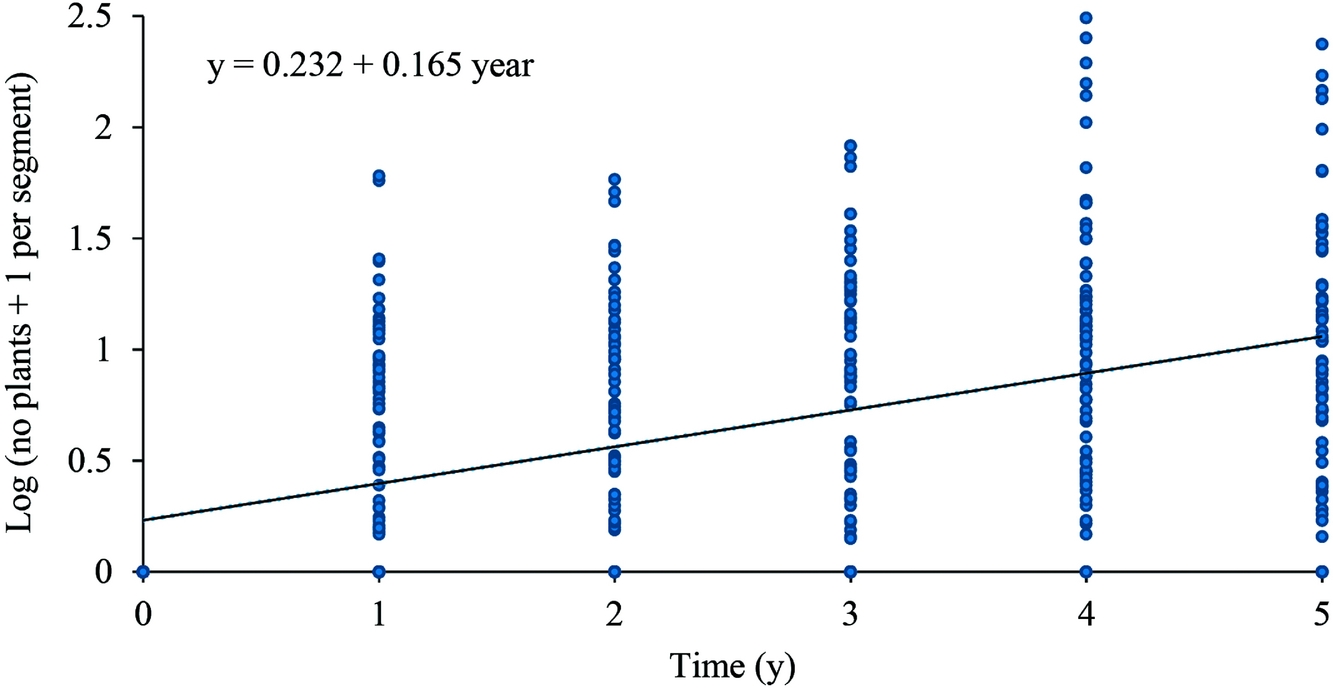
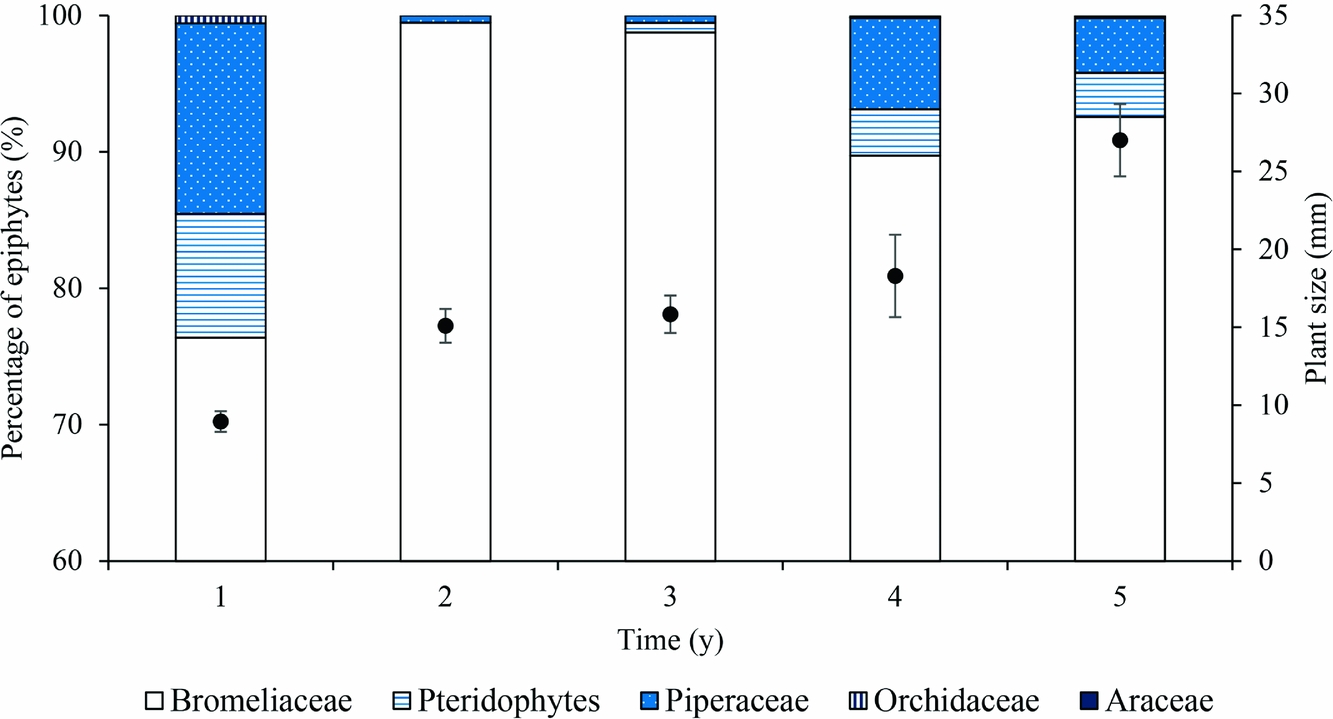
The size of the stripped segment had no significant effect on the number of colonizing plants (R2 = 0.019, P = 0.257). Over the 5 y of monitoring, the density of colonizer epiphytes increased with time (R2 = 0.222, P < 0.0001; Figure 1). The size of the epiphytes also increased with time; those recorded after 5 y (2014) were two to three times the size of those recorded 1 y after removal (2010) (Figure 2).
Relationship between density of colonizer epiphytes and time (R2 = 0.222, P < 0.0001) following experimental removal of vascular epiphytes in tropical montane cloud forest in Veracruz, Mexico.

Percentage of colonizer epiphyte families plotted together with colonizer epiphyte seedling size (mean ± SE), over 5 y of monitoring following removal in tropical montane cloud forest in Veracruz, Mexico.

Survival of the seedlings in the final year of monitoring (2013–2014) was 73%. The proportion of survivors did not differ among the different positions on the tree (F = 0.91, df = 5, P = 0.51). Seedling survival of bromeliads (75%) and pteridophytes (77%) was greater compared with that of the Piperaceae seedlings (49%).
Ensemble of the colonizer and established epiphyte communities
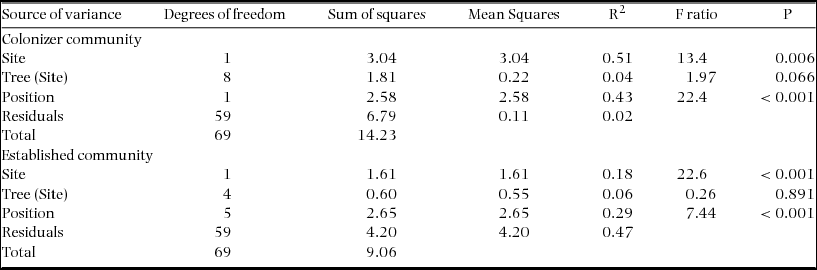
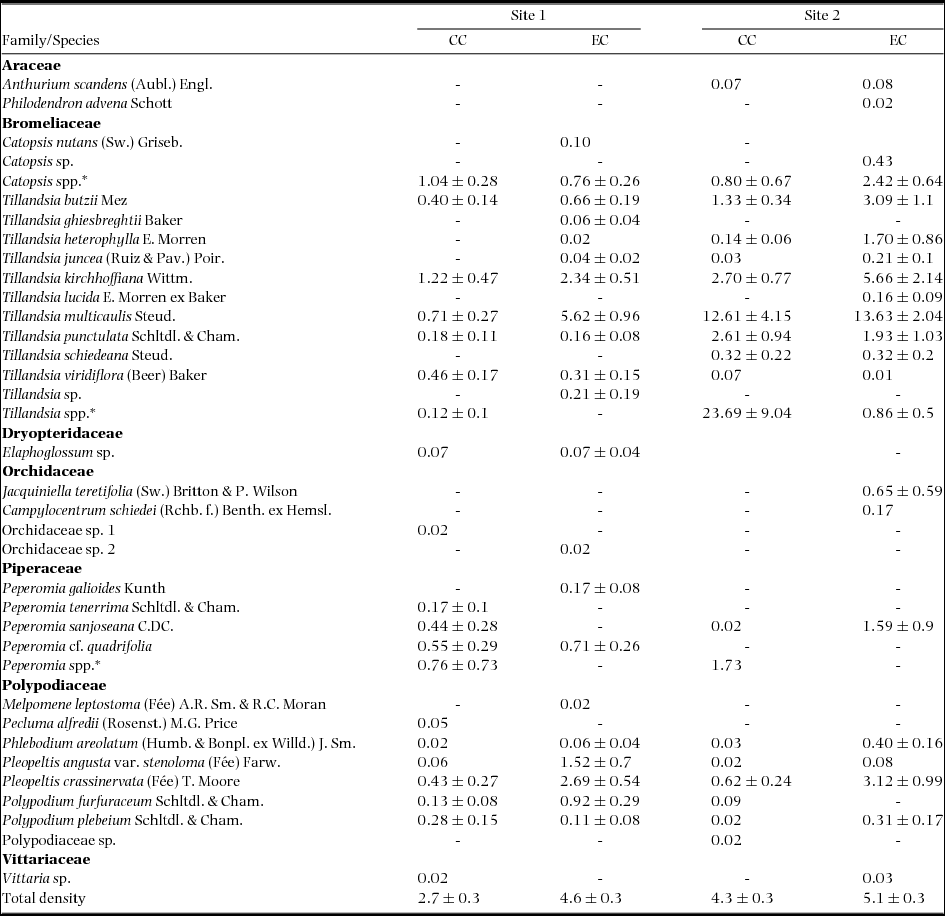
Epiphyte density of the colonizer community reached similar values to those of the established community after 5 y: CC = 27.4 ± 6.8 and EC = 26.7 ± 3.3 (number of individuals per 0.66 m2). Density was significantly greater on the branches than on the trunk in both colonizer and established communities (branches = 42.9 ± 11.4, trunk = 6.9 ± 1.7 and branches = 36.7 ± 5.1, trunk = 13.7 ± 2.1 individuals per 0.66 m2, respectively; Table 1). Non-vascular epiphyte cover, included in the GLM as a covariable, did not explain epiphyte density (F = 1.92, df = 1, P = 0.17), and it was therefore removed from the model.
Results of the General Linear Model generated to evaluate the effect of forest site, tree and position in the canopy (branch and trunk) on the density of two epiphyte communities (colonizer and established) in tropical montane cloud forest in Veracruz, Mexico.

The sample coverage estimator indicated that our inventories included 96% of the colonizer community and 98% of the established community. The richness of the established and colonizer communities was similar; in the colonizer community, 21 identified species were found, along with two morphospecies of Bromeliaceae, one of Piperaceae, one of Orchidaceae and one of Polypodiaceae (Appendix 1). In the established community, a total of 28 identified species were recorded, as well as two morphospecies of Bromeliaceae and one of Orchidaceae. The principal groups of colonizer epiphytes were Bromeliaceae, Piperaceae and pteridophytes. Bromeliaceae dominated, both in density and richness, followed by Piperaceae and pteridophytes (Figure 2). Orchidaceae and Araceae were the families of lowest density and richness. Regarding density, all of the groups presented temporal fluctuations in both sites.
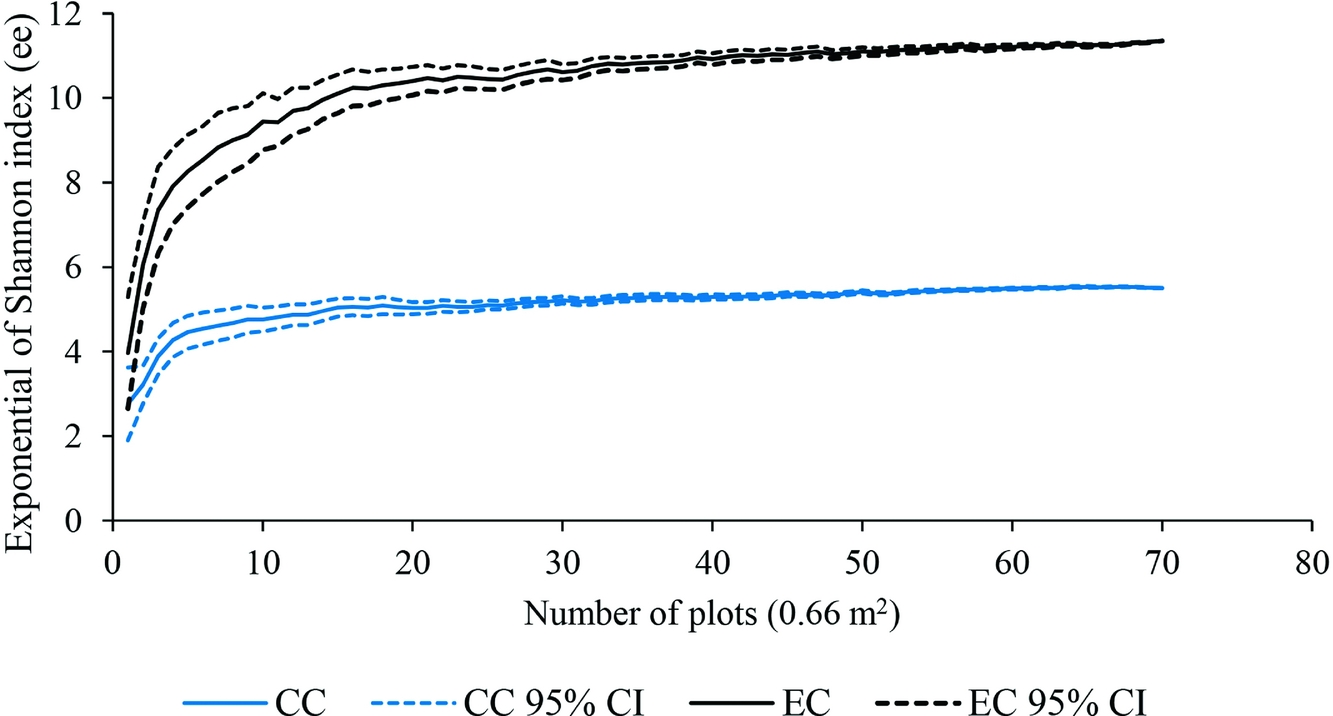
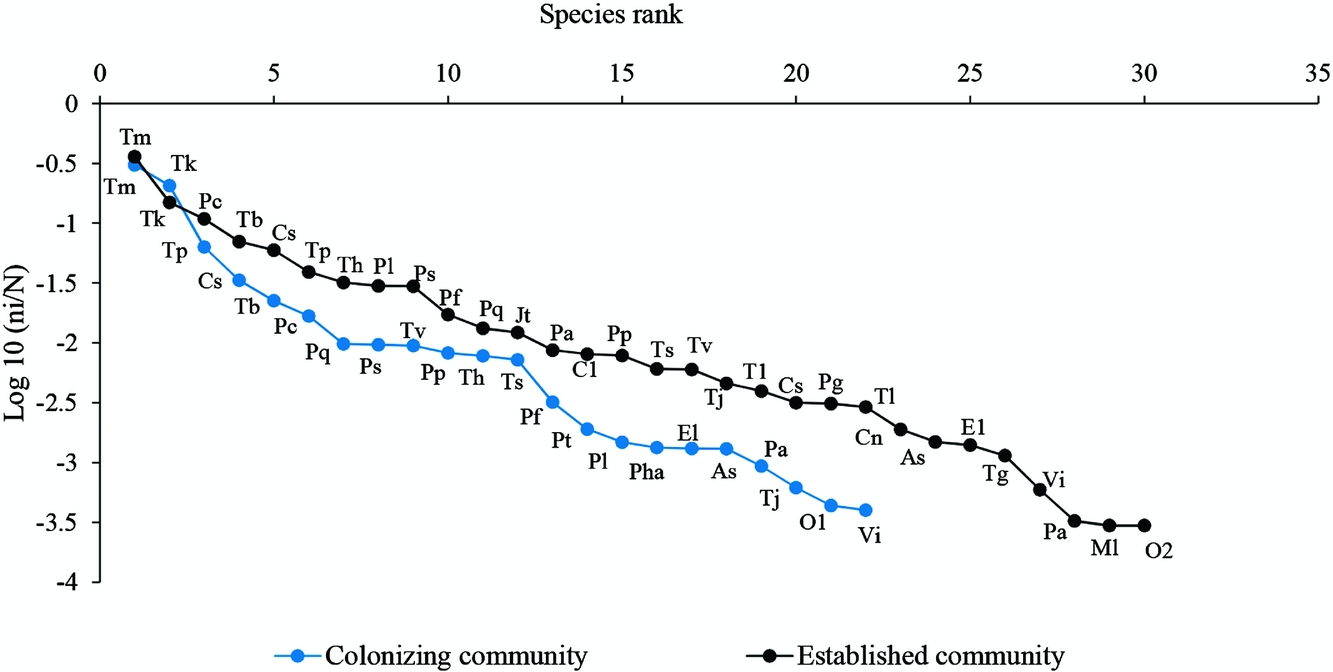
According to the Morisita–Horn index, similarity between the original community prior to removal and the colonizer community after 5 y was 56%. Similarity between the neighbouring established community and colonizer community was 81%. The diversity accumulation curves indicated that the colonizer community (5.5 equivalent species) presents a lower diversity of epiphytes than the established community (11.4; Figure 3). In both communities, Tillandsia multicaulis and T. kirchhoffiana were the dominant species. Species with medium densities were shared between communities, but varied in terms of their position within the order of dominance. Species of lower density were not shared between the communities (Figure 4).
Accumulation curves of epiphytic species diversity based on the exponential of the Shannon index of the colonizer (CC) and established (EC) communities in tropical montane cloud forest in Veracruz, Mexico. The 95% confidence intervals of each community (CC 95% CI, EC 95% CI) were obtained by a bootstrap method based on 100 replications.

Rank/abundance plots for the colonizer and established epiphyte community in tropical montane cloud forest Veracruz, Mexico. The relative abundance of each species is plotted on a logarithmic scale against the species’ rank. As = Anthurium scandens, Csc = Campylocentrum schiedei, Cn = Catopsis nutans, C1 = Catopsis sp. 1, Cs = Catopsis spp., El = Elaphoglossum sp. 1, Jt = Jacquiniella teretifolia, Ml = Melpomene leptostoma, O1 = Orchidaceae sp. 1, O2 = Orchidaceae sp. 2, Pa = Philodendron advena, Pg = Peperomia galioides, Pt = Peperomia tenerrima, Ps = Peperomia sanjoseana, Pq = Peperomia cf. quadrifolia, Ph = Phlebodium areolatum, Pl = Pleopeltis angusta, Pc = P. crassinervata, Pf = Polypodium furfuraceum, Pp = P. plebeium, Pr = Pecluma alfredii, Tb = Tillandsia butzii, Tg = T. ghiesbreghtii, Th = T. heterophylla, Tj = T. juncea, Tk = T. kirchhoffiana, Tl = T. lucida, Tm = T. multicaulis, Tp = T. punctulata, Ts = T. schiedeana, Tv = T. viridiflora, T1 = Tillandsia sp. 1, Vi = Vittaria sp.

DISCUSSION
Post-stripping epiphyte recolonization
Our results show that, in secondary habitats, vascular epiphyte recolonization is relatively rapid. Notwithstanding the speed of this process, some groups of epiphytes were infrequent during the first 5 y of recolonization. The vascular epiphyte recolonization rate was very high compared with that recorded in a cloud forest in Costa Rica (Nadkarni Reference NADKARNI2000), where the first vascular epiphyte seedlings (bromeliad, Peperomia and orchid) were recorded up to 10 y after their experimental removal. In this study, bromeliads, pteridophytes, orchids and peperomias were found from the first year after removal onwards. The high rate of recolonization observed could have been influenced by the presence of non-vascular epiphytes. While we found no significant influence of non-vascular epiphyte cover on recolonization of vascular epiphytes, lichens and moss, being the primary colonizers, have been found to facilitate the germination and establishment of vascular epiphytes (Cascante-Marín et al. Reference CASCANTE-MARÍN, WOLF, OOSTERMEIJER and DEN NIJS2008, Nadkarni Reference NADKARNI1984, Reference NADKARNI2000). The non-vascular epiphyte layer could facilitate the recovery of the community by a seed/seedling bank (e.g. bromeliad seeds, gametophytes of ferns, protocorms of orchids) by retaining water or hosting mycorrhizal fungi in the plots. This would confer an advantage for early establishment, and thus accelerate the recolonization process, in contrast to findings of Nadkarni (Reference NADKARNI2000). The results coincide with the high capacity of recuperation of vascular epiphytes reported in a shade-coffee plantation in Mexico where, after 8–9 y, 77% of the richness had recovered (Toledo-Aceves et al. Reference TOLEDO-ACEVES, GARCÍA-FRANCO, HERNÁNDEZ-ROJAS and MACMILLAN2012a).
The high abundance of bromeliads in the colonizer community contributed to the high overall recolonization observed; during the 5 y of monitoring, bromeliads were found to be the main colonizers. Bromeliad diversity has been reported to peak in drier lower montane forests rather than in cloud forests (Hietz Reference HIETZ, Bruijnzeel, Scatena and Hamilton2011) and various bromeliad species have been found to increase in abundance and contribute greatly to the diversity of disturbed montane forests (Hietz et al. Reference HIETZ, BUCHBERGER and WINKLER2006, Wolf Reference WOLF2005). The fragments studied here are secondary forests, located in the lower belt of cloud forest. These conditions could favour the establishment and survival of the bromeliads, as has been reported in other studies (Cascante-Marín et al. Reference CASCANTE-MARÍN, WOLF, OOSTERMEIJER and DEN NIJS2008, Winkler et al. Reference WINKLER, HÜLBER and HIETZ2005). Species such as Tillandsia butzii, T. juncea, T. kirchhoffiana, T. multicaulis and T. punctulata present or even increase in abundance in disturbed forests, isolated trees in pastures and coffee plantations of the region (Flores-Palacios & García-Franco Reference FLORES-PALACIOS and GARCÍA-FRANCO2004, Hietz et al. Reference HIETZ, BUCHBERGER and WINKLER2006). Some morphological and physiological adaptations of the dominant species could influence their success in terms of establishing in the xerophytic habitats presented by the evaluated fragments. Tillandsia punctulata has thick leaves, while T. juncea and T. butzii present dense trichomes and CAM-type photosynthesis (Benzing Reference BENZING1990, Hietz et al. Reference HIETZ, AUSSERER and SCHINDLER2002). The other groups, such as the Piperaceae, are succulent plants, while the pteridophytes found were poikilohydric with coriaceous leaves (e.g. Pleopeltis) or presented deciduous leaves with a succulent rhizome (Phlebodium aerolatum) (Werner & Gradstein Reference WERNER and GRADSTEIN2008).
The low number of orchid and pteridophyte species recorded coincides with their reported low abundance in the region (Flores-Palacios & García-Franco Reference FLORES-PALACIOS and GARCÍA-FRANCO2004, Hietz et al. Reference HIETZ, BUCHBERGER and WINKLER2006). Moreover, the reduced abundance of these groups could be associated with the low tolerance of these groups to conditions of low moisture. Most pteridophytes are dependent on humidity during their life cycle; the generation of the sporophyte, in particular, depends upon a film of water for movement of the gametes (Kessler Reference KESSLER2001). In less humid environments, the richness of this group declines drastically (Barthlott et al. Reference BARTHLOTT, SCHMIT-NEUERBURG, NIEDER and ENGWALD2001, Carvajal-Hernández et al. Reference CARVAJAL-HERNÁNDEZ, KRÖMER and VÁZQUEZ-TORRES2014, Larrea & Werner Reference LARREA and WERNER2010). It should also be considered that, for orchids in disturbed environments such as the studied forests, mortality increases and growth decreases, and high rates of local extinction occur (Scheffknecht et al. Reference SCHEFFKNECHT, WINKLER, HÜLBER, MATA ROSAS and HIETZ2012, Turner et al. Reference TURNER, TAN, WEE, IBRAHIM, CHEW and CORLETT1994).
We found that recolonization of the epiphytes after removal is strongly influenced by the epiphytes that dominate the established community. Tillandsia multicaulis and T. kirchhoffiana were the dominant species of the colonizer communities and present the highest abundance in the region (Toledo-Aceves et al. Reference TOLEDO-ACEVES, GARCÍA-FRANCO, WILLIAMS-LINERA, MACMILLAN and GALLARDO2014b). Given that probability of establishment increases with the number of seeds produced (Cascante-Marín et al. Reference CASCANTE-MARÍN, WOLF, OOSTERMEIJER, DEN NIJS, SANAHUJA and DURÁN-APUY2006), it is possible that these species produce greater quantities of seeds compared with other species. Tillandsia multicaulis produces more seeds per plant than T. butzii and T. punctulata (Toledo-Aceves et al. Reference TOLEDO-ACEVES, GARCÍA-FRANCO, LANDERO, LEÓN and MACMILLAN2012b), which could explain its high dominance in the colonizer community. Other studies report the important influence of nearby reproductive individuals on the colonization of wind-dispersed epiphytes (Cascante-Marín et al. Reference CASCANTE-MARÍN, WOLF, OOSTERMEIJER and DEN NIJS2008, Yeaton & Gladstone Reference YEATON and GLADSTONE1982). On the other hand, the low representativeness of orchids and Araceae in the colonizer community could most probably be the result of the low abundance of these groups in the established community of the forests studied. In a few plots, we did observe orchid seedlings, which demonstrates that if orchid seeds arrive at the site the mycorrhizal fungi required for germination are present.
While the recolonization rate was considered high, after 5 y we only recorded seedlings, indicating that several years are required before the established seedlings reach the adult stage. The epiphytes are an important group in the tropical montane cloud forest and are crucial for the diversity of other organisms (Nadkarni & Matelson Reference NADKARNI and MATELSON1989). The orchids and pteridophytes in particular contribute the greatest richness to the epiphyte flora (Barthlott et al. Reference BARTHLOTT, SCHMIT-NEUERBURG, NIEDER and ENGWALD2001, Bøgh Reference BØGH1992, Catchpole & Kirkpatrick Reference CATCHPOLE, KIRKPATRICK, Bruijnzeel, Scatena and Hamilton2010, Kelly et al. Reference KELLY, TANNER, LUGHADHA and KAPOS1994). The species of these groups that were found are xerotolerant and it is likely that the most sensitive taxa either require a longer time period to recover or do not establish at all. With time, it could be expected that colonizer communities would tend to become similar to the established community. However, in order to better understand the effects of removal on the epiphyte community, it is necessary to evaluate the long-term dynamics of the assembly of the colonizer community and to consider different stripping intensities and contrasting conditions of forest disturbance.
CONCLUSIONS
The community of vascular epiphytes in the secondary cloud forest studied presented rapid recolonization following partial removal. Bromeliads were found to be the main colonizers, probably due to both the capacity of xerotolerant species to establish themselves in secondary environments and their dominance in the neighbouring epiphyte community. Epiphytes such as the orchids and pteridophytes, which are more sensitive to disturbance and dependent on humidity, presented lower recovery. Given that the reported process of recolonization is relatively early, it is unknown whether the colonizer community in disturbed forests simply requires more time to recuperate or if it will eventually form a different community.
ACKNOWLEDGEMENTS
We are grateful to CONABIO for funding the project (No. HQ001). M Acuña-Tarazona thanks CONACYT for the grant awarded (280642) for her Master's degree. We thank R. Hernández and R. Acosta for permission to work on their properties. We thank K. MacMillan, S. Landero, L. Monge, R. Ramírez, A. León, H. Hernández and J. Vázquez for their help with the fieldwork, and J. P. Moctezuma for his help with data analysis. J. G. García-Franco, A. Damon and two anonymous reviewers provided very helpful comments and constructive criticism to a previous version of the manuscript.
Epiphyte densities (individuals per 0.66 m2, mean ± 1 SE) recorded in the colonizer community (CC) 5 y after removal and in the established community (EC) in two cloud-forest fragments, in central Veracruz, Mexico. *, Immature plants that could not be identified to species level and could belong to an already identified species.