
Since the 2007 economic crisis, central bank independence (CBI) has again become a topical issue. Jens Weidmann, the president of the Bundesbank, defended the European Union's lack of reflationary policy by stressing the need for central bank credibility: “Delivering on its primary goal to maintain price stability is the prerequisite for safeguarding the most precious resource a central bank can command: credibility.”Footnote 1 The European Union (EU) also denied a bailout package to Hungary until the government restored the central bank's independence to EU standards. By contrast, after decades of moderate deflation, Japan's politicians are questioning the Bank of Japan's independence, debating whether politicians need to be more active in monetary policy. The underlying assumption is that CBI effectively ensures price stability.
Historically, such stable prices have not been easy to accomplish. Across time periods, developed and developing nations alike have struggled to restore confidence in their currencies. Examples stretch from the United States and Western Europe in the 1970s to Latin America in the 1970s and 1980s and postcommunist countries in the 1990s. Because delegating monetary policy to an independent central bank has been a key institutional mechanism believed to help achieve low inflation,Footnote 2 bank independence has increased worldwide since the 1990s.Footnote 3
Despite this trend, few studies examine whether reforms contribute to price stability and, if so, how. Existing research focuses on a single regionFootnote 4 or two points in time.Footnote 5 In this study we update the Cukierman, Webb, and Neyapti index of central bank independence for seventy-eight countries from the end of the Bretton Woods system until the present.Footnote 6 The result is an original data set that codes independence annually and covers legislation changes in the past twenty-five years. We also take the opportunity provided by the central bank reforms over the past decades to reevaluate and extend the political economy literature on CBI. Specifically, we investigate the mechanisms through which bank independence affects price stability, and we explore whether CBI's effect on monetary outcomes is conditional on a country's political institutions.
From its inception, the CBI literature has been concerned with the divergence of de facto independence from legal provisions.Footnote 7 In some countries, governments circumvent the legal delegation of monetary policy because they can easily replace bank governors or credibly threaten to change the central bank law. As measures of de facto independence, the economics literature looks at turnover rates of bank governors or central bank surveys. Because long governor tenures can suggest either independence or subservience, and surveys cover few countries and periods, much of the political economy literature has focused instead on the conditions that provide legal central bank independence with a de facto bite.Footnote 8
The political economy work has yielded theoretical approaches and empirical results that barely speak to each other. Broz argues that in political systems where decision making is transparent (that is, democracies), independent central banks can contribute to low inflation.Footnote 9 The empirical evidence strongly supports this hypothesis, yet the likely mechanisms that contribute to the democratic transparency—“the attentive public or the political opposition”—remain unaddressed.Footnote 10 Keefer and Stasavage, on the other hand, focus solely on the narrower role of meaningful political opposition in enhancing the credibility of legally independent central banks.Footnote 11 Their evidence shows that legal independence reduces inflation only in the presence of multiple constitutional checks and balances.Footnote 12
Our study provides a unifying approach to previous political economy research. Democracies and dictatorships differ significantly in their application of the rule of law and the process of changing laws. The strong constitutional constraints and greater transparency prevailing in democracies enhance the de facto enforcement of the law and make threats and actual legislative amendments more difficult and less reflective of short-term interests. We argue that the process of law implementation and amendment in democracies has implications for the binding effect of central bank legislation both on government behavior and on public expectations. First, delegation of monetary policy to an independent central bank in democracies allows the bank to actually behave in a conservative fashion that is reflected directly in lower rates of money supply growth. That is, the central bank can increase interest rates or target the exchange rate or money supply to ensure, most prominently, price stability, regardless of short-term government pressure. Moreover, with multiple veto players and a press that can report freely on the position of the government, the opposition, the central bank, and other key constituencies, the central bank is likely to be more credible. This will ensure a more robust money demand by reducing public inflation expectations, leading to lower inflation above and beyond the decline in money supply.
We test our argument on a sample of seventy-eight democracies, mixed regimes, and dictatorships from 1973 to 2008. The empirical results are robust to different estimation techniques and specifications, and broadly conform to expectations. There is a strong interactive effect between CBI and democracy and its mechanisms. In democracies and in countries with constitutional checks and balances and a free media, CBI has a strong negative effect on money supply growth rates. Inflation results support our theory as well: CBI has a strong, stand-alone, negative effect on inflation beyond the central bank's control of the money supply and this effect is not driven by Organisation for Economic Cooperation and Development (OECD) countries. The marginal effect of independence is, however, negative and statistically significant only for democracies and countries with constraints on the government and a press that can report freely.
Our research note makes several contributions. Theoretically we have a unifying framework linking CBI to price stability across political regimes. Also, more than earlier research, our theory accurately reflects the sources of inflation and distinguishes the role of simply printing less money (discipline) from the public belief about what the monetary authority is likely to do (credibility). We are most innovative in theorizing and evaluating the interactive effect of CBI and domestic political institutions on rates of money growth—the discipline effect. Although parts of our credibility hypothesis have been derived in earlier work,Footnote 13 we test such hypotheses by accounting for the theoretical sources of inflation, thus getting closer to capturing the notion of credibility. Very importantly, we test our hypotheses with new author-coded data on yearly central bank independence. These data identify more precisely the relationship between price stability and the central bank than the period averages prevalent in previous research.
Background and Theory
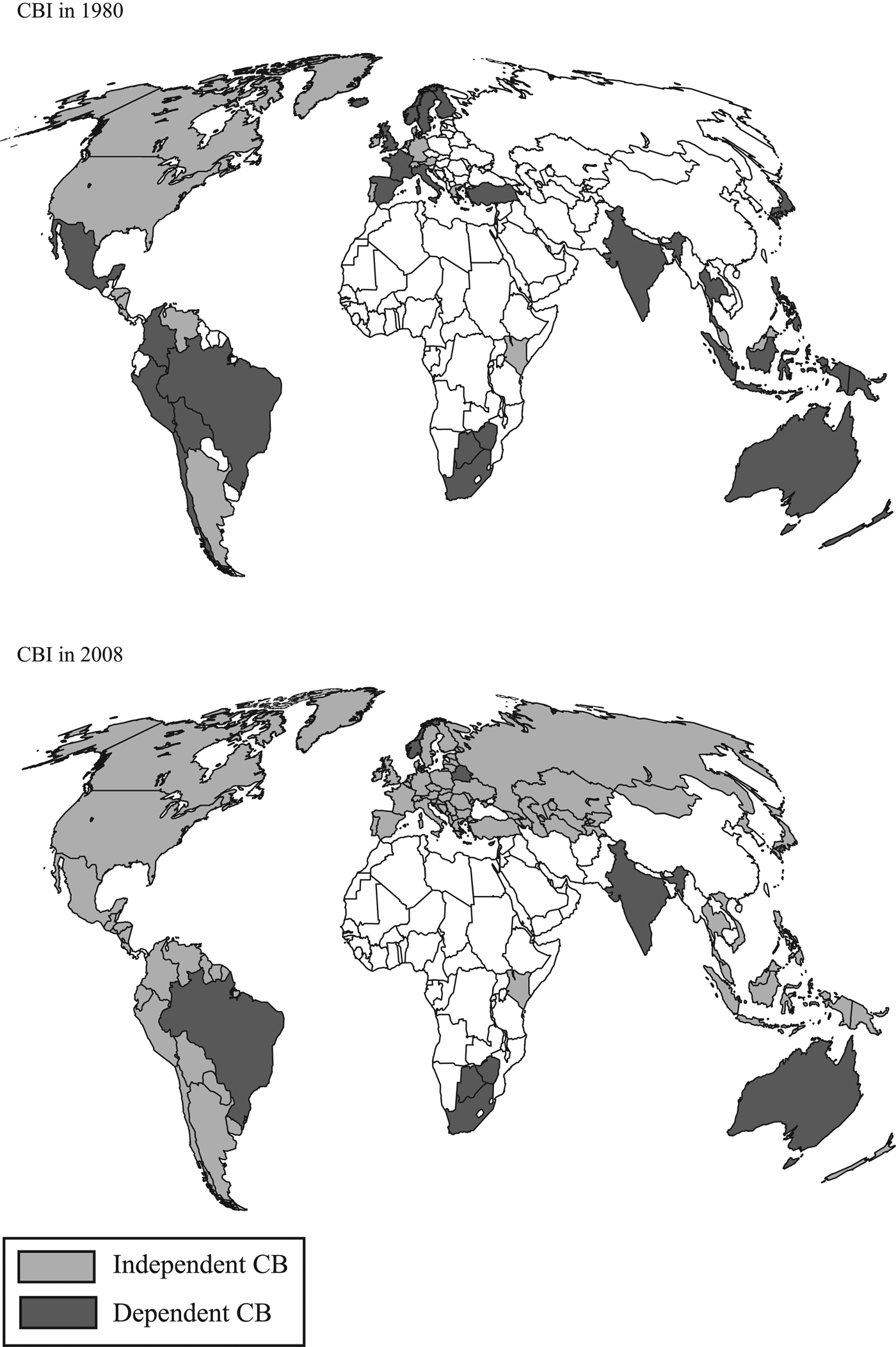
In the past twenty years, countries have reformed the legislation governing their central banks, delegating monetary policy to a greater extent. This trend coincides with the publication of studies showing a correlation between CBI and lower inflation in developed countries. Figure 1 compares central bank independence in 1980 and 2008, using a score on the Cukierman, Webb, and Neyapti CBI index of 0.4 or above as the independence cutoff.Footnote 14 As it shows, although governments in a few large countries, notably, Brazil, India, and Australia, have retained control over their central banks, countries in most regions have made their banks more independent. The only region lagging behind is Africa.
CBI in 1980 and 2008

Theoretically CBI keeps inflation in check because it reduces the risk of time inconsistency in monetary policy.Footnote 15 Time inconsistency emerges because governments have incentives to generate economic growth through surprise inflation. Therefore, government announcements about monetary policy and its commitment to price stability have little credibility. Independent central bankers, on the other hand, are much less sensitive to the political electoral cycle, and are, on average, more concerned about risks to price stability than elected politicians are.Footnote 16
The time-inconsistency approach has been critiqued in developed countries because, presumably, monetary policy has been delegated to the central bank in these countries and the bank has no incentives to create surprise inflation.Footnote 17 Also, more recent explanations for monetary policy delegation to independent central banks focus on information asymmetries between ministers and backbench legislators and coalition partners;Footnote 18 diverse political coalitions;Footnote 19 more checks and balances;Footnote 20 federal systems and party veto players;Footnote 21 the presence of powerful coalitions in favor of price stability;Footnote 22 or a more transparent political system.Footnote 23
Reflecting the potentially multiple causal arguments for delegation of monetary policy, the evidence for an association between CBI and inflation has been mixed with a particularly weak relationship in developing countries.Footnote 24 The early work on the topic shows a strong negative relationship between inflation and CBI in developed countries.Footnote 25 This relationship lacks robustness in some of the later work.Footnote 26 On the other hand, Crowe and Meade, using data as recent as 2003, account for country heterogeneity and potential endogeneity of CBI and find a robust negative relationship across developed and developing countries.Footnote 27
The political economy literature suggests that political institutions significantly influence the extent to which an independent bank will reduce inflation. In addition to the Broz and Keefer and Stasavage research we cited,Footnote 28 Franzese shows that the effect of central bank independence on inflation depends on features of the political environment in which banks operate, including government partisanship and labor market organization.Footnote 29 Similarly, other work shows that strong institutional checks and balancesFootnote 30 or the quality of political institutionsFootnote 31 affect the ability of independent central banks to keep inflation low.
Although these explanations all point to the importance of political institutions, they highlight different aspects of these institutions that make it difficult to distinguish their interrelatedness. Our argument provides a unifying approach to previous research by explicitly focusing on the role of political interference. Because monetary policy has distributional effects, politicians can use it to influence the economy in the short run. Therefore, delegation is costly and will be continuously contested in the political arena. Early on in the CBI literature, Cukierman, Webb, and Neyapti argue that “first, the laws are incomplete in that they cannot specify explicitly the limits of authority between the central bank and the political authorities under all contingencies. These voids are filled by tradition at best and by power politics at worst. Second, even when the law is quite explicit, actual practice may deviate from it.”Footnote 32 Political interference has been an issue even for the Bundesbank, the most acclaimed independent central bank after World War II. For example, Lohmann notes that the “behavioral independence of the German central bank fluctuates over time with the party control of federalist veto points.”Footnote 33 After the 1957 central bank law reform, the Bundesbank undertook an active role in the political system, trying to consolidate its conservative reputation and publicly debating the government on the sources of inflation.Footnote 34
Democracies and dictatorships differ significantly in their enforcement of the rule of law and the process of law amendment, with implications for the central bank law's effect on restraining government behavior and anchoring public expectations. Specifically, the broad rule of law is stronger in democracies than in other states because of ex post constraints and greater transparency regarding the government's actions. These distinctive characteristics of democracies are likely to have two effects. First, delegation of monetary policy to an independent central bank in democracies allows the bank to be more conservative, which is reflected directly in lower rates of growth for the money supply. In addition to being directly more disciplinarian, a central bank whose credibility is enhanced by institutions that limit political interference is also likely to ensure a more robust money demand via lower inflation expectations, leading to stable prices.
At the most basic level, in democracies the prevalence of the rule of law generates confidence in contract enforcement broadly and, especially, when the government is a party to the contract, as is the case with central bank legislation.Footnote 35 In democracies, the government realizes that its tenure in office depends partly on the perception that it is playing by the rules and excessive violations may lead to removal from office. The political opposition, or “leading rivals of the administration in power,”Footnote 36 has an interest in the enforcement of the law granting independence to the central bank because it denies the incumbent the opportunistic use of monetary policy. Indeed, in a system with two or more veto players there is a low probability that the central bank will be overridden on any of its decisions.Footnote 37 In addition, government coalition partners, backbench legislators, and the opposition have an interest in the enforcement of the law and a de facto independent bank because such an institution provides balanced information, solving the problem of asymmetric information.Footnote 38 Thus, the presence of a strong opposition will allow the central bank greater leeway in conducting policy and one would expect a stronger relationship between CBI and control of the money supply and price stability.Footnote 39
Second, enforcement of the central bank law is helped by the fact that in democracies individuals as well as the key contenders to power have significant freedom of speech and the press is free to report on the government's actions. Central banks often lack a high degree of transparency with respect to internal decision making and it is difficult to determine directly their “true” independence.Footnote 40 However, freedom of speech allows the opposition to blow the whistle on government interference in central bank decisions. It also allows the bank to use the media to publicize conflicts with the government, attribute the sources of the inflationary phenomenon to expansionary fiscal policy, and consolidate and expand constituencies favorable to price stability.Footnote 41 Ultimately, freedom of speech allows voters to be better informed and to eventually punish at the ballot box government transgressions against the law, including central bank law.Footnote 42 Both the presence of an opposition and a free press, therefore, make the central bank law more enforceable by making it more difficult for a government to interfere with the central bank.
The direct consequence of a central bank law that has a de facto bite is that the bank can be disciplinarian and use the instruments of monetary policy to achieve the legal mandate in the delegation contract, most prominently low inflation. This may mean an independent setting of the interest rates at which the central bank lends directly to financial institutions or an independent determination of the quantity of government securities to be sold or bought on secondary markets. Changes in monetary policy instruments directly affect the amount of liquidity available in the financial system and the supply of money. Therefore, countries with independent central banks and institutional configurations that guarantee the rule of law will have lower rates of growth of the money supply, reflecting the preference of the central bank for price stability.Footnote 43 From this, we derive our first hypothesis:Footnote 44
H1
(Discipline): Money growth rates are lower when the central bank is independent and the country is a democracy; there are multiple veto players; and the press is free.
Although central bank actions have a relatively direct effect on the money supply, the bank has only imperfect control of inflation.Footnote 45 Inflation is a result of money supply increases that in the longer run exceed demand for cash balances. An independent central bank that is credibly conservative ensures a more robust money demand that reduces the inflationary effects of a monetary expansion.Footnote 46 This moderates broad public inflation expectations, in particular, inflationary expectations negotiated in wage contracts. Thus, workers are likely to renounce frequent renegotiation of contracts and forego demands of indexation to past inflation and the public will want to hold relatively more of the money controlled by a trusted central bank. How much the public trusts the central bank depends not only on the government interfering directly in central bank decisions as we discussed, but also on the likelihood that the central bank law will be changed randomly, within short time spans and without proper public debate.
Again, the institutional mechanisms that ensure application of the rule of law will limit changes to the law. The veto player literature argues that a larger number of relevant veto points (with distinct preferences) increases policy stability.Footnote 47 Central bank independence that is granted through regular legislation cannot be amended in a sweeping manner when the political system has many different actors who can veto a policy proposal. Keefer and Stasavage show that in the presence of multiple veto players, central bank independence always lowers inflation expectations.Footnote 48 Treisman finds that fiscal decentralization and, implicitly, federal veto points perpetuate either low or high inflation in part by preserving existing institutions.Footnote 49
Freedom of speech and a free media are also likely to contribute to higher legislative predictability. Free media are likely to present competing views of any proposed changes to the central bank law. Even in countries with legislative majorities for the executive, due process is likely longer when differing views on the central bank can be expressed and different public constituencies need to be convinced that law changes act in their favor. Thus, even if law changes pass the legislature, free speech and press freedom can at least postpone or prevent changes driven by short-term interests. In addition, the central bank itself can use the public arena to make the case for its independence, as can the political opposition and conservative circles, including the banking industry or the financial press.
The role of both veto players and freedom of the media is illustrated in the 1957 change in the Federal Republic of Germany's Bundesbank law. Although “many members of the CDU [Christian Democratic Union] government were intent upon making the Bundesbank more responsive to government preferences, and after the 1957 elections they arguably had the votes to do so,”Footnote 50 two key factors contributed to the preservation (in large part) of the Bundesbank's independence. A first was German federalism and the veto power of the upper chamber of parliament, the Bundesrat, representing the states.Footnote 51 Because the Social Democratic Party controlled several of the state governments and the CDU was split internally on the issue of making the central bank more dependent on the federal government, negotiations for the passage of the 1957 law lasted for several years. This prolonged negotiation allowed the central bank to utilize the media to forge its position on price stability and explain the contribution of government policies to inflation.Footnote 52 In the run-up to the 1957 elections, for example, the Bundesbank raised interest rates several times, publicly linking their actions to the threat of inflation that election-related fiscal overspending posed. Goodman cites a German central banker as saying that “we have established such credibility that anytime there is a conflict with the government, at least 70 percent of the financial writers in the country would be on our side.”Footnote 53 Moreover, the central bank forged alliances with conservative government ministers and contributed actively to plans for a federal-level stabilization program.
With this in mind, we derive the following second hypothesis:Footnote 54
H2
(Credibility): Inflation (controlling for money supply growth) is lower when the central bank is independent and the country is a democracy; there are multiple veto players; and the press is free.
Data, Operationalization, and Methods
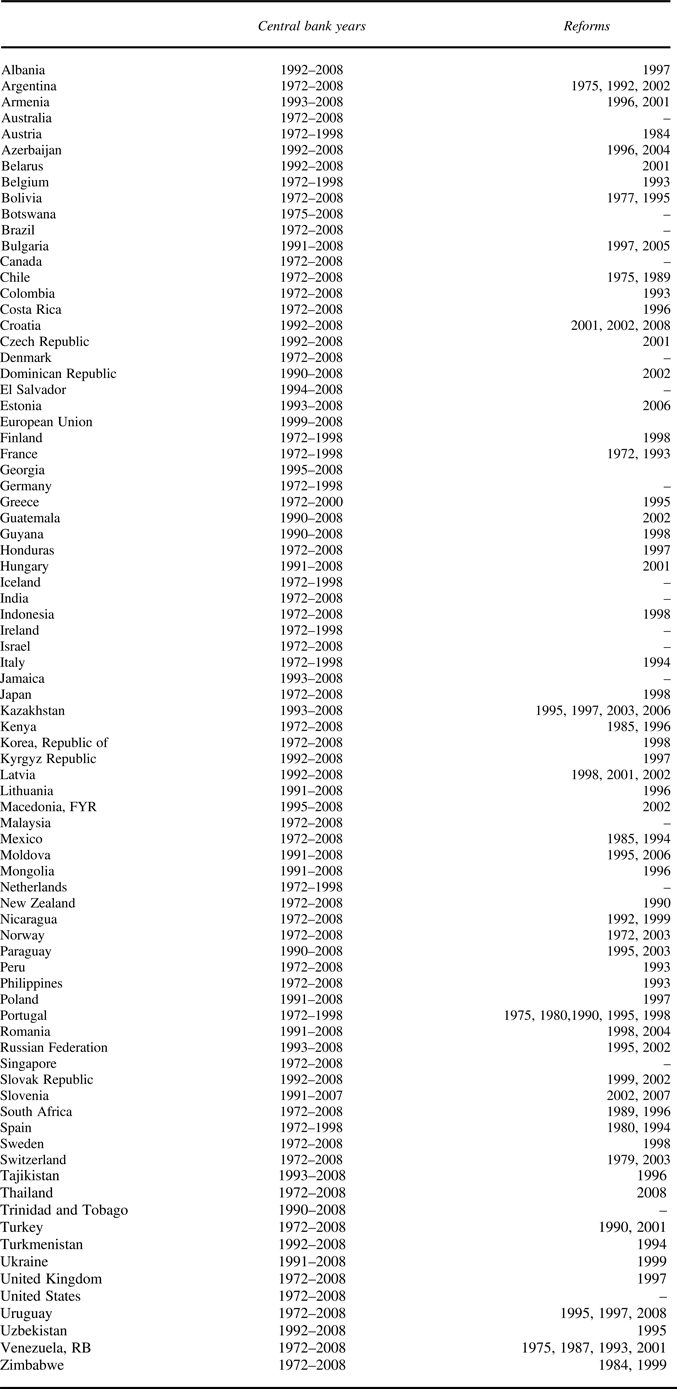
Despite the popularity of CBI measures, there have been few attempts to code independence annually, directly identify reform years, or even, beyond a handful of countries, to code the reforms of the past twenty-five years. Our data accomplish exactly this. Cukierman, Webb, and Neyapti's original data cover seventy-two countries for four decades (1950–59, 1960–72, 1973–79, and 1980–89). The annual coverage of CBI has been extended to the central banks of postcommunist countries from 1990 to 2002Footnote 55 and to twenty-four Latin American and Caribbean countries for 1989 to 2002.Footnote 56 We update the CBI scores for seventy-eight countries for 1973 to 2008. Appendix 1 lists the countries and reform years.
The core dependent variables are the change in money supply (M2) and the inflation rate. M2 is an intermediate monetary aggregate (currency in circulation and short-term deposits);Footnote 57 data are from the International Monetary Fund's International Financial Statistics (IFS), supplemented with the World Bank's World Development Indicators (WDI). We use the log of M2 growth rates, taking the log of 1 plus the absolute value. For the eighty-one negative values of M2 change, we then add a minus sign to the logged value.Footnote 58 The inflation measure is the yearly change in the consumer price index (WDI, OECD statistics, IFS). We use the logged inflation rate as the dependent variable, and, for consistency we treat negative values (twenty-five observations) similar to negative M2 changes.Footnote 59
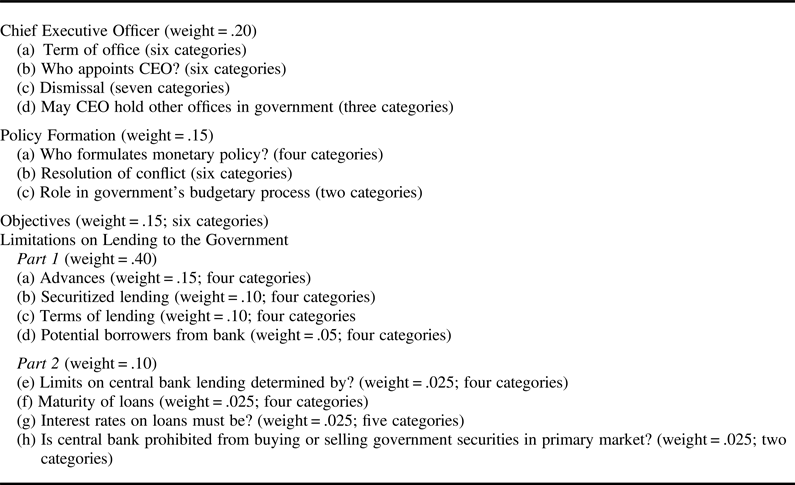
The key explanatory variables operationalize the independence of the central bank and features of countries' political regime. We code the level of central bank independence based on the Cukierman, Webb, and Neyapti original index. The CBI scores are based on a weighted aggregated calculation of sixteen indicators in four categories: the Chief Executive Officer, Policy Formation, Objectives, and Limitations on Lending to the Government (see Appendix 2 for more details). The CBI index ranges from 0 to 1, with 1 representing the most independent central bank. A bank has more legal independence when the governor's term in office is longer; the appointment and dismissal procedures are insulated from the government; the bank's mandate is focused on price stability; the formulation of monetary policy is in the hands of the central bank; and the terms on central bank lending to the government are more restrictive.
Our main measure for democracy is the Polity 2 score from the Polity IV database (0 to 20 range). We supplement the Polity 2 score with Freedom House data. This measure is the average of a country's political rights and civil liberties score. Originally, lower Freedom House scores indicated democracies but we reverse the scale so that a value of 7 is most democratic and a value of 1 is least democratic.
We use several variables to determine whether the presence of meaningful opposition or press freedom increases the effectiveness of legal CBI. Although our key conditioning variable is democracy, testing the posited causal mechanisms strengthens the support for our theory and reduces concern that CBI is conditioned by other factors such as economic development (which is highly correlated with democracy but less so with constraints). A first measure is executive constraints from Polity IV that measures “the extent of institutionalized constraints on the decision-making powers of chief executives, whether individuals or collectivities.”Footnote 60 Scores on the variable range from 1 (no limits to an executive power) to 7 (other political actors are as equally strong or stronger than the executive). A second measure is the checks variable from the Database of Political Institutions (DPI), which measures the checks and balances in the political system. As with executive constraints, the more places in the political system where legislation can be blocked, the higher the value of the variable.Footnote 61 Our final measure of checks and balances is political constraints.Footnote 62 This ranges from 0 to 1 and quantifies the feasibility of policy change by tracking the number of independent veto players in the executive and legislative chambers. Again, a higher score represents stronger constraints. To measure media freedom, we use Freedom House's Freedom of the Press measure available since 1980, with values of 0 (not free), 1 (partially free), and 2 (fully free).
In addition, all models include: the lagged logged value of gross domestic product (GDP; WDI); lagged trade openness (WDI); a dummy variable for a fixed exchange rate regime based on the IMF's official classification;Footnote 63 the lagged value of a country's fiscal budget deficit/surplus relative to GDP;Footnote 64 and indicator variables for presidential and legislative election years.Footnote 65
For the main models, we use ordinary least squares (OLS) regressions with country fixed effects and a lagged dependent variable.Footnote 66 The lagged dependent variable controls for the backward indexation of inflation and potentially serially correlated error terms.Footnote 67 For the inflation models, we also include the lag log of the change in M2 to control for the disciplinarian effect of central bank on inflation. This way, the CBI index coefficient more likely reflects an additional credibility effect via a robust money demand and anchored inflation expectations.Footnote 68 To control for time-specific factors, we include decade dummies in the M2 models and the lagged change of the world GDP deflator in the inflation models.Footnote 69 The fixed effects estimation controls for time-invariant country characteristics not captured by our regressors. Using country fixed effects in an OLS regression with a lagged dependent variable may introduce bias,Footnote 70 a problem aggravated by the short time duration for some countries in the sample, which does not allow for shocks to fixed effects to diminish over time.Footnote 71 Our robustness section therefore presents models with panel-corrected standard errors that include the lagged dependent variable and regional and decade dummies.
Results and Discussion
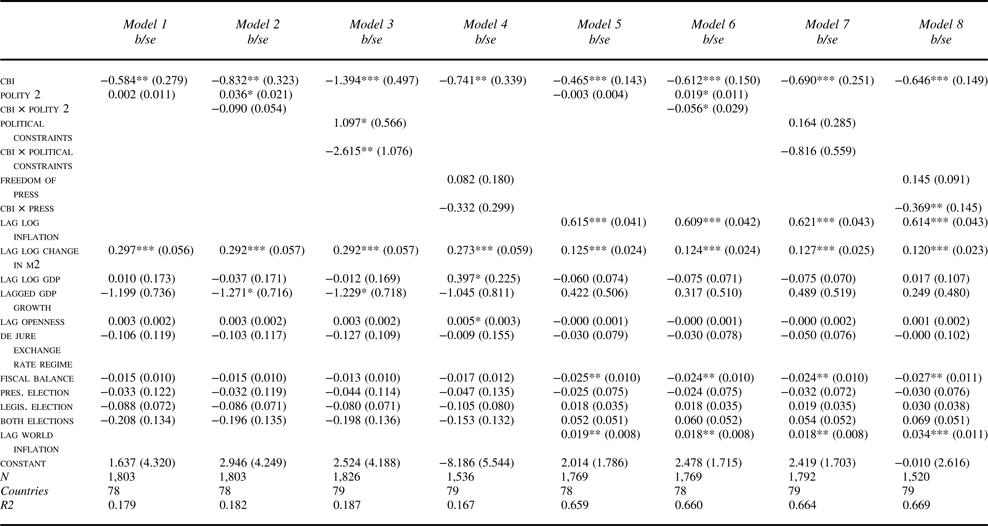
In Table 1, we examine whether CBI, democracy, and democratic mechanisms affect a central bank's control of the money supply and inflation. The dependent variable is the logged rate of growth of money supply (Models 1 to 4), and the logged inflation rate (Models 5 to 8). In Model 1 we include a country's Polity score and the cbi index as stand-alone variables. The Polity score by itself does not significantly affect the growth rate of M2, while central bank independence does have a negative and statistically significant effect.Footnote 72 Across all models, the only other sometimes-significant factor is economic growth: positive growth decreases the growth rate of M2.
Effect of CBI contingent on democratic mechanisms

Notes: ** p < .05; *** p < .01. The dependent variable is Models 1 to 4 is the log of the change in M2. In Models 5 to 8 it is the log of inflation. Decade dummies are included in Models 1 to 4, but not shown.
Although CBI appears to have an independent effect on money growth rates, Models 2 to 4 test our first hypothesis by considering the conditional effect of the cbi index on money growth rates. Model 2 introduces the interaction between the cbi index and polity. To facilitate interpretation, we transform the polity score by subtracting 20 from each value. This does not change the substantive impact of the variables or the interaction;Footnote 73 it changes the interpretation of the CBI coefficient only. With the original polity variable, the CBI coefficient is the effect of a one-unit change in CBI when polity is equal to 0, or a dictatorship. With the transformed data, the coefficient is the effect when polity is still at 0, but 0 now represents full democracies.
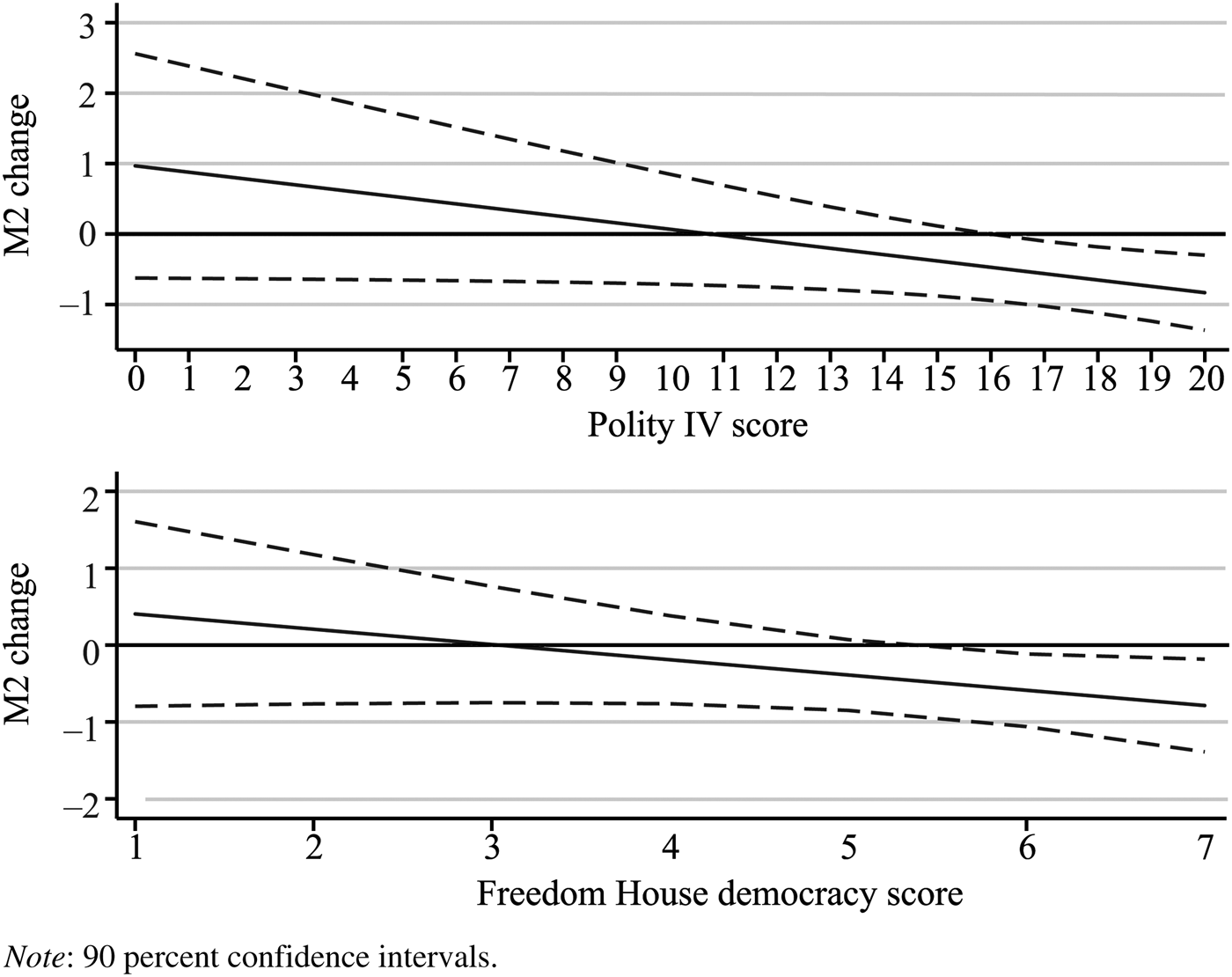
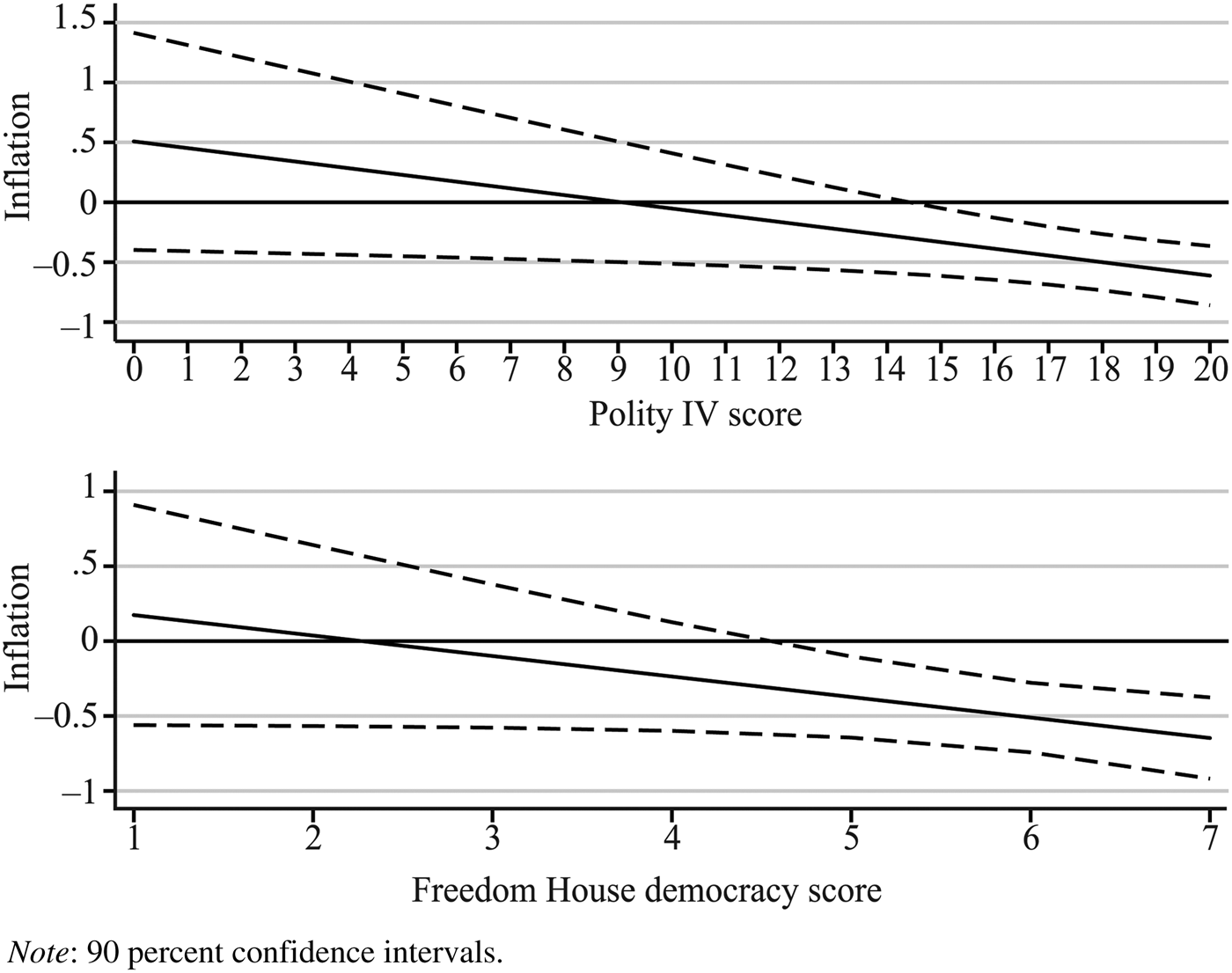
Brambor, Clark, and Golder prescribe that for multiplicative interaction models such as ours, inference should involve meaningful marginal effects and standard errors to determine the conditions when the key variables have a statistically significant effect.Footnote 74 Consequently, we focus our discussion on the graphs in Figures 2 to 5, showing the marginal effect of the CBI index (and the 90 percent confidence interval) as the conditioning variables change. Figure 2 shows the marginal effect of CBI as polity and freedom house democracy vary.Footnote 75 The graphs confirm our expectations; the marginal effect of CBI is downward sloping but it is negative and statistically significant at high levels of democracy only (polity scores above 16). At low levels of polity, the marginal effect of CBI is positive but statistically insignificant. Similarly, the marginal effect of CBI is negative and significant only when the freedom house score is greater than about 5.
Marginal effect of CBI on change in M2

Marginal effect of CBI on change in M2

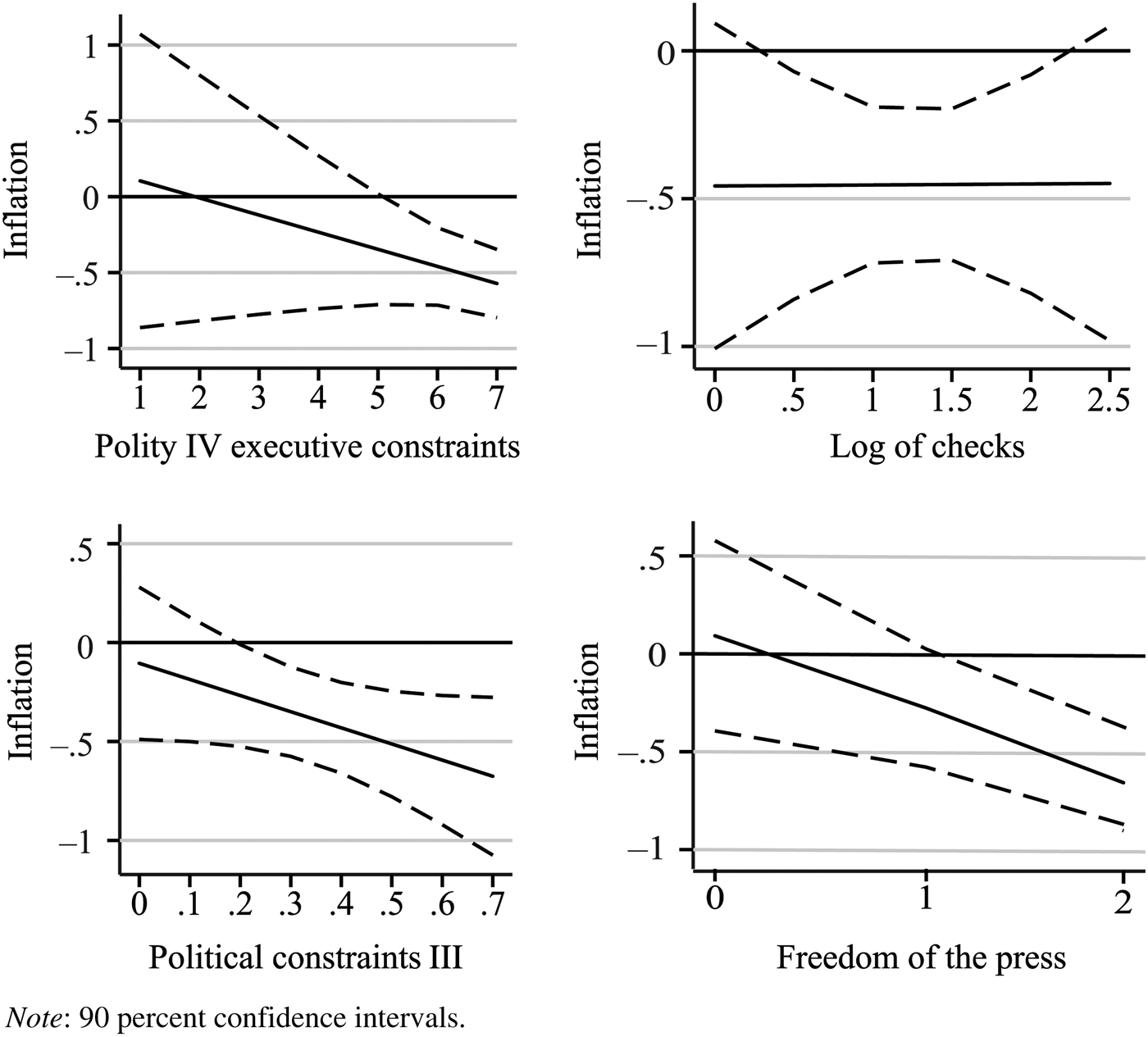
Marginal effect of CBI on inflation

Marginal effect of CBI on inflation.

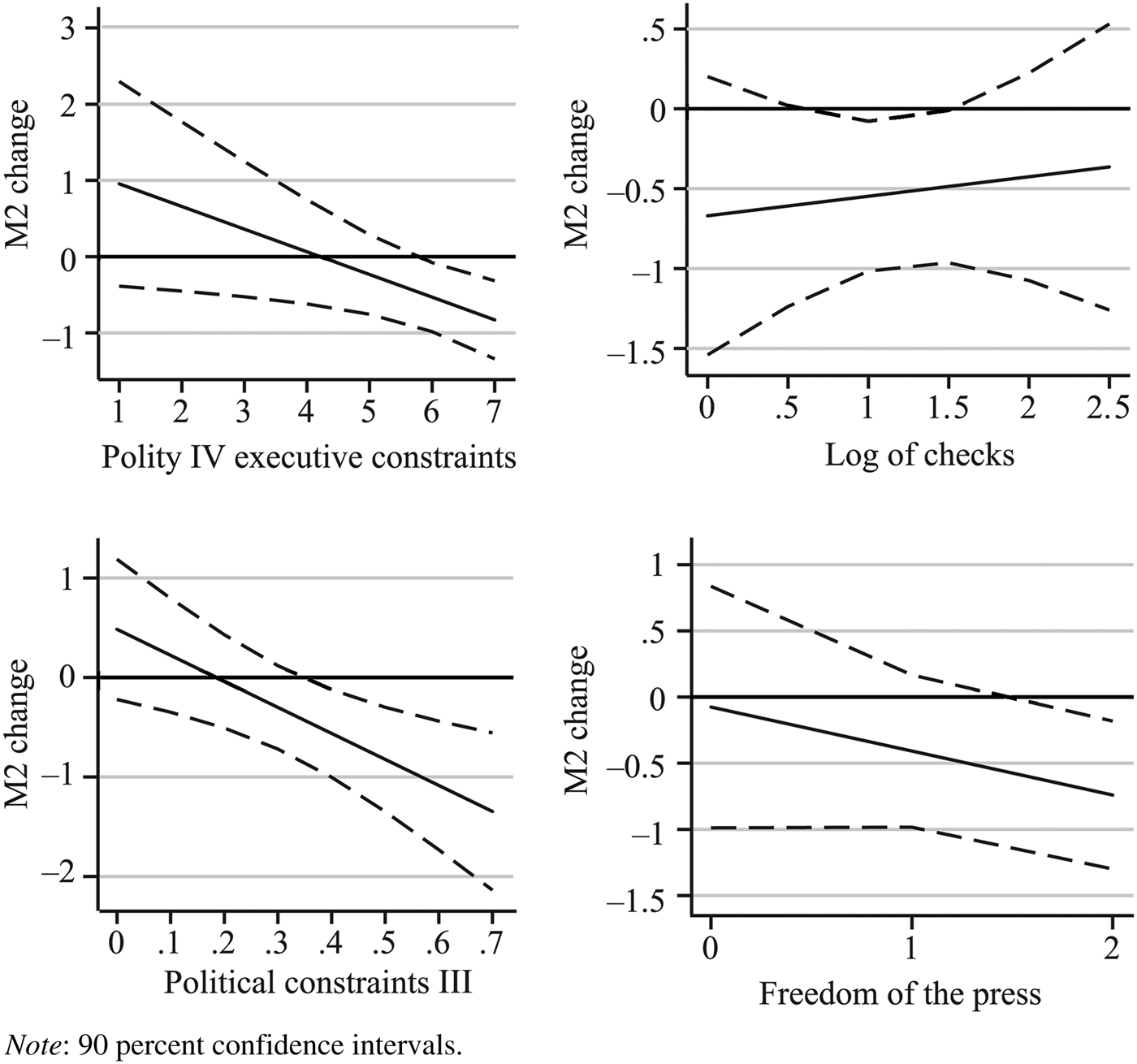
Models 3 and 4 interact the CBI index with the different operationalizations of democratic mechanisms.Footnote 76 Model 3 includes Henisz's political constraints and Model 4 includes press freedom. The democratic mechanisms are recoded so that the highest values are converted to a 0, as with the democracy score transformations. Again, the results conform to expectations. The coefficient on the CBI index is negative and significant and the interaction is negative and significant for political constraints. For both models, CBI has a strong effect on changes in M2 at the highest values of the democratic mechanisms. The marginal effect of CBI at different levels of each of the democratic mechanisms is shown in Figure 3.
For all the conditioning variables except the log of checks, the slope of the marginal effect is downward and, when significant, is negative. The CBI index has a significant effect on changes in M2 only at the highest levels of executive constraints, political constraints, and freedom of the press. checks has a significant effect for logged values between 1 and 2, corresponding to values of about 3 to 7 of the nonlogged measure, which represents most of the range of checks. Overall, then, legal CBI influences M2 changes when there are constraints on government's power and the press is free.
Next, we use the log of inflation as the dependent variable, showing the results in Models 5 to 8 and Figures 4 and 5. All models include the lagged inflation rate and the lagged change in M2, both logged. As shown in Model 5, CBI has an independent effect on inflation. Greater central bank independence leads to lower inflation, even controlling for the lagged change in M2 and political institutions. When we run the analysis separately for OECD and non-OECD countries, we find a significant and negative effect in both samples. Also, the results continue to hold if instead of the consumer price inflation we use the GDP deflator to measure overall price changes. With regard to the control variables, only fiscal deficits are shown to consistently contribute to domestic inflation.
Unlike the M2 models, with inflation we are concerned about the possible reverse causality between inflation and CBI. In countries such as Bulgaria in 1997 or Argentina in 1992, the central bank was given more legal independence during larger stabilization efforts aimed at controlling rampant inflation. We perform several tests to ameliorate such concerns. First, we use lagged values of the CBI index up to the third lag and our results do not change. Unsurprisingly, the size of the effect is smaller the farther we go with the lags, but the effect remains negative and statistically significant.Footnote 77 Additionally, we exclude from the estimation observations for the two years preceding the reform of the central bank law, or the reform year and the following two years—the results remain similar. We also ran a seemingly unrelated regression for the inflation and M2 change models and findings do not change.
Models 6 to 8 test the effect of CBI conditional on democracy and democratic mechanisms. Again, the coefficient of the CBI index is negative and significant at the highest levels of democracy. The interaction effect of the CBI index with polity (Model 6) is negative and statistically significant. Figure 4 shows, however, that the marginal effect of CBI is significant only at high levels of Polity and freedom house. The marginal effect line is downward sloping, suggesting that only for Polity scores greater than about 14 (freedom house scores greater than about 4.5) does CBI significantly reduce inflation. As with the M2 growth rates, there is evidence that the combination of democratic mechanisms and CBI has a strong effect on inflation, as Figure 5 illustrates. The marginal effect of CBI is negative and significant at higher levels for all four of the democratic mechanisms.
Based on extant work specificationsFootnote 78 we attempt to capture empirically the credibility effect of CBI on inflation by controlling for changes in M2. We find that money supply changes significantly contribute to inflation, but that CBI has an additional important effect mediated by domestic political institutions. However, it is worth mentioning that if we place our autoregressive distributed lag model in an error-correction model framework, inflation has a relatively low speed of adjustment to equilibrium (1 minus the coefficient on the lagged dependent variable).Footnote 79 Compared with inflation, for M2 changes, the speed of adjustment is considerably faster, telling us that inflation tends to react slowly to more discipline from the central bank, as well as to legal CBI and the domestic configuration of institutions.
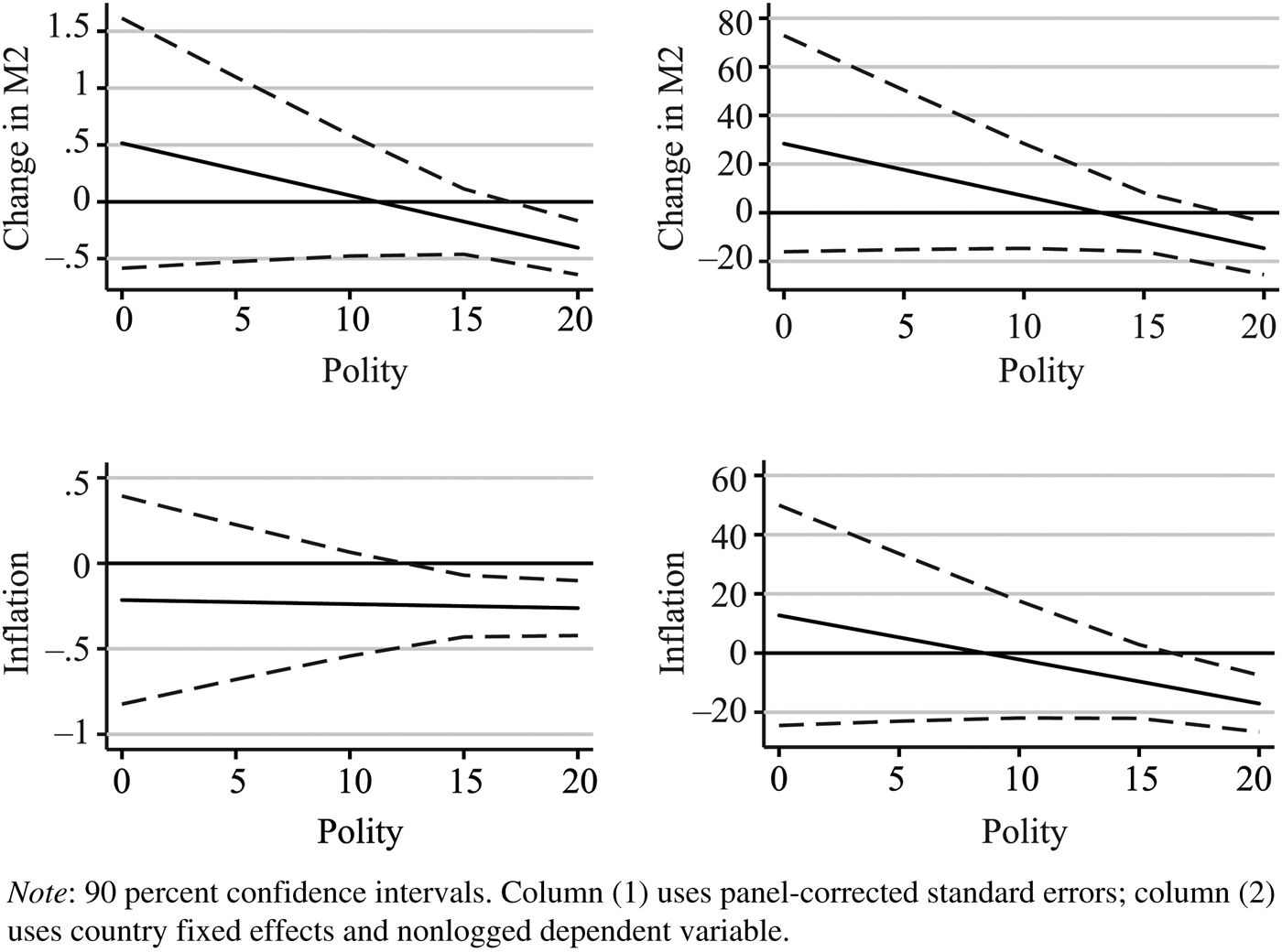
Finally, we perform other analyses to determine the robustness of the findings. First we use panel-corrected standard errors with region dummies instead of the country fixed effects. Second, we limit the sample to observations with money growth rates or inflation rates lower than 150 percent. Our results (the marginal effect of CBI when democracy scores vary) are shown in Figure 6 and are robust to both changes, for M2 changes and inflation.Footnote 80
Marginal effect of CBI

Because omitted variable bias is a valid concern, we use additional controls in our models, including a dummy variable for membership in the EU; dummy variables for countries with proportional representation electoral systems (DPI); dummy variables indicating government partisanship (DPI); a measure of polarization (DPI); and indicator variables for riots, antigovernment demonstrations, and strikes (cross-national time-series); and per-capita GDP. Our key findings do not change. We also include a measure for the direct targeting of inflation by the central bankFootnote 81 and our findings are robust. Furthermore, our model of inflation is based on a money demand function, so inflation should be a function of interest rates and parts of M2 should also respond to interest rates. Including the deposit interest rate (WDI) makes us lose 16 percent of the sample, while the key results remain robust and the deposit rate is statistically significant both for M2 change and inflation models.
Finally, democracy and economic development are highly correlated. Although it is possible that economic development and not democracy is driving the conditional results,Footnote 82 additional tests bolster our confidence that it is democracy at the wheel. First, although we see a similar marginal effect between GDP per capita and CBI on inflation, there is not one for change in M2. For M2 changes the marginal effect is significant only for the midrange values of GDP per capita and upward sloping, contrary to expectations. Second, for both M2 changes and inflation our results hold for the subsample of non-OECD countries. That is, even for countries with lower levels of economic development where we have significant variation in Polity scores, we continue to obtain a downward-sloping marginal effect of CBI that is statistically significant only for democracies. Finally, the checks and balances and press freedom mechanisms we use are more highly correlated with Polity than with economic development.Footnote 83 Because we find a similar effect with these democratic mechanisms, we have greater confidence that democracy drives the results. Nevertheless, we cannot completely rule out an economic development argument.
Conclusion
We use new yearly data on de jure central bank independence and examine whether CBI has a greater effect on price stability when a country has institutional mechanisms that limit political interference in central banks' activities. Institutions such as checks and balances or freedom of the press differ significantly across political regimes and allow the central bank to highlight and resist attempts by the government to influence it. This should have two consequences. First, by limiting interference, these institutions allow a central bank to be more disciplinarian, leading to lower rates of money growth. Second, if the public believes that the central bank is free from interference and that the law is unlikely to change swiftly and without debate, it will also lower inflationary expectations, leading to price stability above and beyond the control of the money supply. We use different estimation techniques, multiple operationalizations of the dependent variables, and a large number of controls to test the empirical implications. The results show strong support for our argument.
Prompted by the IMF or the EU, but also driven by competition in international trade and investment,Footnote 84 countries have delegated monetary policy to independent bureaucrats. This trend has caught on not just in countries with rule of law, a free press, and meaningful opposition. Nondemocracies such as Venezuela, Kazakhstan, or Russia have also adopted legislation giving their central banks nominal independence. Our results show that for such countries, the central bank cannot be expected to discipline the government and have lower rates of money growth. This finding is novel and important, given the imperfect control that central banks have on inflation. Our results also strengthen and extend the findings of the political economy literature.Footnote 85 With new data and a research design reflecting the sources of inflation, we show that the effect of CBI on inflation expectations is unlikely to hold in nondemocratic countries. Additional research is needed to understand the credibility effect of central banks, including careful examination of the costs of disinflation. Moreover, as we noted, our results on either inflation or M2 changes are not driven by the OECD sample, extending our knowledge beyond that of CBI's effect on inflation in developed countries.
Future work needs to better understand whether there are other benefits for nondemocracies from de jure delegation to the central bank (such as access to credit and foreign direct investment)Footnote 86 or whether dictatorships enjoy political benefits from delegation (that is, longer survival and less need to manipulate elections). Our research has additional implications for democracies that have delegated monetary policy only partially (Uruguay, South Africa, Mongolia, and South Korea). For such countries further reform of the central bank law is likely to aid price stability with both a discipline and a credibility effect.
Supplementary Material
An appendix with replication data is available at http://dx.doi.org/10.1017/S0020818314000277 and on the authors' websites: <www.princeton.edu/~rhicks/> and <http://polisci.msu.edu/index.php/people/faculty/item/faculty/cristina-bodea>.
Central bank years covered and years of reform

Components of the Cukierman, Webb, and Neyapti Index

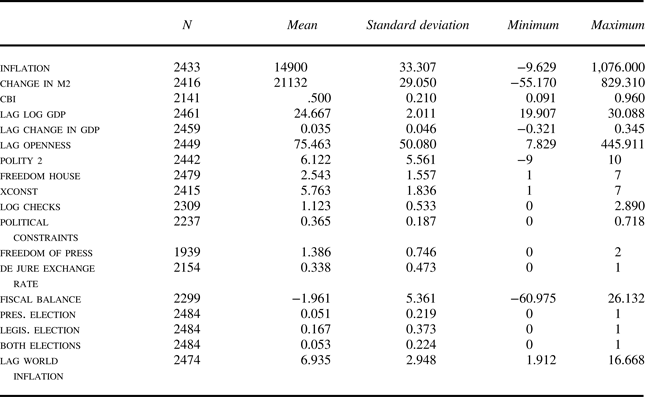
Summary statistics