Introduction
When a family member is afflicted with cancer in the palliative stage, it affects the daily lives of the entire family (Fjose et al., Reference Fjose, Eilertsen, Kirkevold and Grov2016), and each family member exerts an influence on the others (Northouse, Reference Northouse2012). All family members can experience both physical and emotional adjustments in their daily lives and challenges in family relationships (Fjose et al., Reference Fjose, Eilertsen, Kirkevold and Grov2016; Möllerberg et al., Reference Möllerberg, Sandgren, Swahnberg and Benzein2017). Furthermore, partners of persons with cancer face an increased risk of poor physical and mental health (Goren et al., Reference Goren, Gilloteau, Lees and DaCosta Dibonaventura2014; Möllerberg et al., Reference Mollerberg, Sandgren, Lithman, Noreen, Olsson and Sjovall2016). Therefore, it is important to acknowledge strengths and resources within the family and adapt an approach that promotes health such as salutogenesis.
A salutogenic orientation focuses on health resources rather than disease risks. Salutogenesis is a way of thinking, being, and acting and involves engaging with people in a manner that encourages health. The sense of coherence is the core concept in Antonovsky's salutogenic model (Antonovsky, Reference Antonovsky1987), and is thought to explain why some people remain healthy when they encounter stressors. The sense of coherence consists of three interrelated concepts: comprehensibility (i.e., ability to understand the situations clearly), manageability (i.e., access to sufficient resources to manage challenging situations), and meaningfulness (i.e., challenges are worthy of the corresponding energy investment). It is a global orientation to view life as structured, manageable, and meaningful (Eriksson, Lindström & Lilja, Reference Eriksson, Lindström and Lilja2007).
Initially, the concept was considered applicable only on an individual level. However, Antonovsky later proposed that it could also be used with groups and social units (Antonovsky, Reference Antonovsky1987). He stressed that sense of coherence within families could be described as a health-protective behavior pattern and an effective stress buffer. The resources that the individual and family use depend on the characteristics of the individual, the group, and/or an environment that facilitates effective stress management (Antonovsky, Reference Antonovsky1987). Antonovsky developed the Sense of Coherence Scale (SOC) for individual measure (Antonovsky, Reference Antonovsky1993) and the Family Sense of Coherence Scale (FSOC) to capture the sense of coherence within families (Antonovsky & Sourani, Reference Antonovsky and Sourani1988).
Subsequently, a less elaborated 12-item version of the FSOC (FSOC-S) was developed by Sagy (Reference Sagy1998). Some studies have shown that the concept of the sense of coherence within families is useful in promoting family functioning and well-being (Moen & Hall-Lord, Reference Moen and Hall-Lord2016; Ngai & Ngu, Reference Ngai and Ngu2011), reducing experiences of psychological distress (Ngai & Ngu, Reference Ngai and Ngu2014), and predicting the quality of family life (Hsiao, Lu, & Tsai, Reference Hsiao, Lu and Tsai2018). The FSOC-S has been psychometrically evaluated in different samples: students in Turkey, showing satisfactory internal consistency and factor structure (Cecen, Reference Cecen2007), childbearing families in China, showing satisfactory stability, internal consistency, factor structure, and content and construct validity (Ngai & Ngu, Reference Ngai and Ngu2011), and parents of children aged between 12 and 13 years with and without attention deficit hyperactivity disorder in Norway, showing satisfactory stability, internal consistency, and content and construct validity (Moen & Hall-Lord, Reference Moen and Hall-Lord2016).
However, living with cancer in the palliative stage is a challenging situation. No studies have evaluated the FSOC-S in this context. The aim of the study was to translate, culturally adapt, and validate the FSOC-S in a Swedish sample of families living with cancer in the palliative stage. The validation of FSOC-S included homogeneity, internal consistency, construct validity, convergent validity, and test-retest reliability.
Method
This study was conducted in three stages: translation and cultural adaptation, content validity assessment, and psychometric evaluation. This study was approved by the regional ethical review board in Linköping, Sweden (No. 2014/70-31).
FSOC-S
The FSOC-S, developed by Sagy (Reference Sagy1998), includes twelve items. An example of the items is “To what extent do you feel that you can influence what happens in your family?” Responses are provided using a numerical rating scale ranging from 1 (not at all) to 7 (to a great extent). The questionnaire is completed individually, and responses are summarized to provide a total score ranging from 12 to 84, with higher scores indicating higher levels of perceived family sense of coherence.
Step 1: Translation and cross-cultural adaptation
Translation and cross-cultural adaptation of the FSOC-S into Swedish was conducted in accordance with the World Health Organization's guidelines (World Health Organization, 2013). Five researchers translated the instrument from English into Swedish independently. All translations were then analyzed and discussed within the research group until consensus was reached and a first draft was created. A bilingual researcher (a native English speaker familiar with both cultures) compared the Swedish and English versions. An independent, authorized translator then performed back translation. The two versions were compared by the research group and some minor corrections were made in the Swedish version. This version was then pretested in a group of fifteen Swedish university teachers and administrative staff to evaluate the clarity of the instructions, items, and response format. A common critique was that some items were reversed scored. Therefore, the response scale was reversed for six items, to ensure that all items were scored in the same direction (i.e., higher scores indicating higher levels of perceived family sense of coherence).
Step 2: Examination of content validity
Cognitive interviews, which involved the think-aloud method (Willis, Reference Willis2015), were used to determine how participants responded to the FSOC-S items, which is an important aspect of content validity from the respondents’ perspectives (Streiner, Norman & Cairney, Reference Streiner, Norman and Cairney2014). The inclusion criteria were: Swedish speaking, more than 18 years of age, and a person with cancer in the palliative stage (defined as advanced cancer and receiving palliative care) in the family. Nine persons with cancer and one family member agreed to participate. Thus, 4 men and 6 women aged between 41 and 73 years, who had lived with cancer in the family between 4 and 16 years participated. Six participants had education below university level. Five interviews were conducted at the hospital, and five in participants’ homes. The interviews were conducted during April and May 2014 and lasted between 17 and 35 minutes. The participants were explicitly instructed to think aloud as they answered the FSOC-S. They began to read each item aloud and described the internal process involved in answering each item. The researcher interjected with probing questions (e.g., “Tell me what you are thinking”). The researcher made field notes during each interview. All interviews were recorded and transcribed verbatim by the first author. The transcripts and researchers’ field notes were analyzed item by item, to identify and correct potential problems with the Swedish version of FSOC-S.
The content validity index (CVI) was used to examine the content validity of the FSOC-S. Ten Swedish experts, including professors and senior researchers with extensive experience with using theory regarding the sense of coherence, were invited to participate. Seven CVI evaluations were performed. All experts rated each item from 1 (entirely irrelevant) to 4 (highly relevant) according to their relevance to the sense of coherence. CVI values were calculated at item (I-CVI) and scale (S-CVI\Ave) levels. I-CVI values were calculated for each item by dividing the number of experts who provided ratings of either 3 or 4 by the total number of experts (n = 7). S-CVI\Ave values were calculated by adding the ratings and dividing the result by the number of scale items. Cutoff scores of >0.78 and >0.90 for I-CVI and S-CVI\Ave values, respectively, were used to determine acceptable content validity (Polit & Beck, Reference Polit and Beck2006).
Results and Revisions
The questionnaire instructions required clarification, and there were problems in understanding four items (2, 3, 4, 7). Participants had difficulty knowing how they should answer; they also felt unsure if they interpreted the question correctly. These four items also exhibited I-CVI values lower than 0.78, and the experts considered that they were weakly connected to the theory regarding the sense of coherence. The S-CVI\Ave value was 0.86 for the overall scale, and the I-CVI values ranged from 0.66 to 1.00. The instructions were clarified and items 2, 3, 4, and 7 were adapted to suit the Swedish language while remaining as faithful as possible to theory regarding the sense of coherence.
Step 3: Psychometric evaluation
Sample and Procedure
The inclusion criteria for this phase were: diagnosis of cancer in the palliative stage, more than 18 years of age, Swedish speaking, and willingness to invite one family member to participate. Participants were recruited from May 2015 to October 2016 from two oncology clinics and two palliative centers in three regions in the south of Sweden. In total, 650 persons with cancer were invited to participate in the study with a family member. Of these, 179 (27.5%) persons with cancer and 165 (25.4%) family members agreed to participate. The participants were informed that their data would remain confidential and they could withdraw from the study at any time without explanation. Of the entire sample, sixty persons with cancer and fifty-four family members agreed to complete the FSOC-S again within a two-week period.
Data collection
The questionnaire included demographic characteristics and three self-report instruments: the FSOC-S, the Herth Hope Index (HHI) (Herth, Reference Herth1992), and the Hospital Anxiety and Depression Scale (HADS) (Zigmond & Snaith, Reference Zigmond and Snaith1983). The HHI and HADS were included for validation purposes, since sense of coherence relates to both hope (Post-White, Reference Post-White, Ceronsky, Kreitzer, Nickelson, Drew, Mackey, Koopmeiners and Gutnecht1996) and psychological distress (Del-Pino-Casado, Reference Del-Pino-Casado, Espinosa-Medina, Lopez-Martinez and Orgeta2019).
Self-Report questionnaires
The HHI was developed to measure experiences of hope (Herth, Reference Herth1992). It consists of twelve items, the total score ranges from 12 to 48, and higher scores indicate higher levels of hope. The scale has demonstrated satisfactory psychometric properties in a palliative context (Benzein & Berg, Reference Benzein and Berg2003). In the present study, internal consistency measured with ordinal alpha was 0.86 for persons with cancer and 0.88 for family members.
The HADS was developed to measure anxiety and symptoms of depression (Zigmond & Snaith, Reference Zigmond and Snaith1983). It consists of fourteen items, seven about anxiety and seven about symptoms of depression. The total scores for both subscales range from 0 to 21, higher scores indicating higher levels of anxiety and symptoms of depression (Zigmond & Snaith, Reference Zigmond and Snaith1983). The HADS has been translated into Swedish (Lisspers, Nygren & Soderman, Reference Lisspers, Nygren and Soderman1997) and has demonstrated satisfactory psychometric properties (Djukanovic et al., Reference Djukanovic, Carlsson and Årestedt2017). In the present study, internal consistency for the HADS, which was measured with ordinal alpha, were 0.91 for anxiety and 0.90 for symptoms of depression in persons with cancer, and 0.89 for anxiety and 0.84 for symptoms of depression in family members.
Data analysis
Participants’ demographic characteristics and study variables are presented using descriptive statistics. Data quality was evaluated regarding distributions of item and scale scores. Skewness and kurtosis statistics were used to describe the shape of the distribution of the item-score (Altman, Reference Altman1991). The skewness value in normal distribution is close to 0, and the kurtosis value is close to 3. The D'Agostino-Pearson normality test was used to evaluate if the FSOC-S scores deviated from a normal distribution (D'Agostino, Belanger & D'Agostino, Reference D'Agostino, Belanger and D'Agostino1990).
Homogeneity refers to scaling assumptions and was assessed using inter-item and item-total correlations based on polychoric and polyserial correlations (rho). Inter-item correlations between 0.15‒0.85 (Clark & Watson, Reference Clark and Watson1995) and item-total correlation coefficients higher than 0.30 were considered acceptable (Streiner et al., Reference Streiner, Norman and Cairney2014).
To evaluate the factor structure of the FSOC-S for persons with cancer and family members, exploratory factor analyses based on weighted least square estimation (WLS) and polychoric correlations were used. The correlations among items was sufficient to conduct a factor analysis for persons with cancer and family members, respectively, according to the Kaiser-Meyer-Olkin test (KMO = 0.88 and KMO = 0.89) and Bartletts's test (χ2(66) = 888.2, p < .001 and χ2(66) = 974.1, p < .001). The number of factors to extract was based on a parallel analysis, using the 95th percentile eigenvalue and 500 replications.
Internal consistency refers to the interrelatedness of items and was estimated using an ordinal variant of Cronbach's alpha coefficient, described by Gadermann et al. (Reference Gadermann, Guhn and Zumbo2012). Ordinal alphas can be interpreted as traditional alphas, in that values higher than 0.70, 0.80, and 0.90 represent acceptable, good, and excellent internal consistency, respectively, but values close to 1.00 indicate redundancy (Streiner, Reference Streiner2003).
Absolute agreement (%) and quadratic weighted kappa statistics (Kw) were used to evaluate test-retest reliability on an item level, while intra-class correlations (ICC, 2-way mixed effect model, absolute agreement) was used on the scale level. To increase the power of analyses, a pooled sample of persons with cancer and their family members was included in these analyses. The kappa statistics were interpreted as follows: <0.2 poor, 0.2‒0.4 fair, 0.4‒0.6 moderate, 0.6‒0.8 good, >0.8 very good reliability (Altman, Reference Altman1991). The ICC was interpreted as follows: <0.5 poor, 0.5‒0.75 moderate, 0.75‒0.9 good, >0.9 excellent reliability (Koo & Li, Reference Koo and Li2016).
Convergent validity was evaluated via the examination of associations between FSOC-S, HHI, and HADS scores, using Spearman's correlation coefficients (rs). Based on theoretical and empirical findings (Post-White et al., Reference Post-White, Ceronsky, Kreitzer, Nickelson, Drew, Mackey, Koopmeiners and Gutnecht1996; Del-Pino-Casado, Reference Del-Pino-Casado, Espinosa-Medina, Lopez-Martinez and Orgeta2019), we hypothesized that FSOC-S scores would be positively correlated with HHI scores and negatively correlated with HADS scores. We expected the strength of these correlations to be moderate or strong (rs ≥ 0.3).
Finally, as FSOC-S aims to measure sense of coherence on a family level, the scores were hypothesized to be correlated within the dyads. As the members in each dyad were distinguishable, data was rearranged in a dyad level structure and nonindependence was then evaluated using the Spearman correlation coefficient, as recommended by Kenny et al. (Reference Kenny, Kashy and Cook2006).
Data were analyzed using IBM SPSS Statistics 23.0 (IBM Corp, Armonk, NY, USA) and R 3.5.1 (the R Foundation for Statistical Computing, Vienna, Austria) including the Psych package. The significance level was set at p < .05.
Results
Participant characteristics
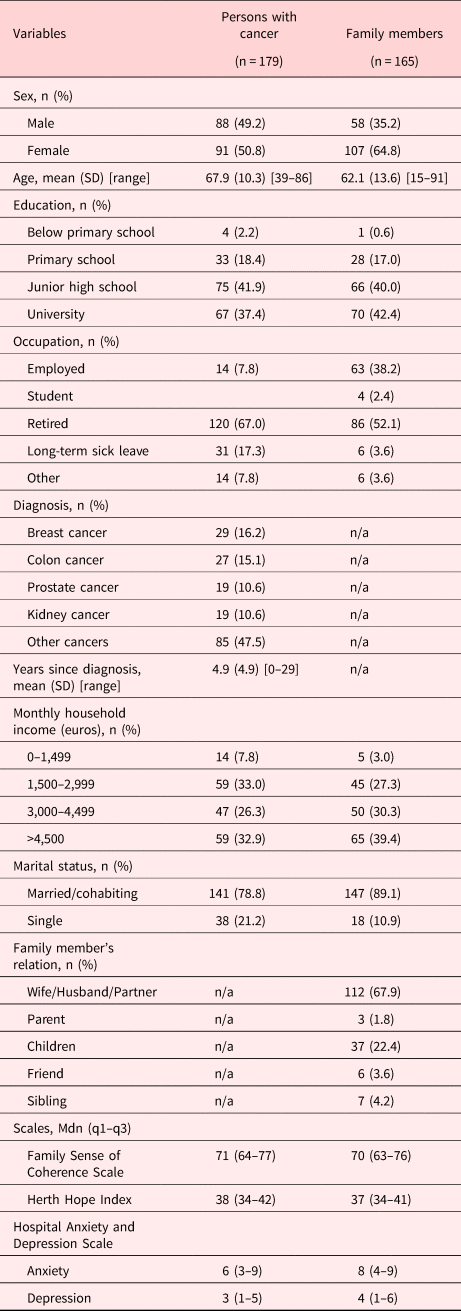
Participant's sociodemographic characteristics are presented in Table 1. In persons with cancer (n = 179), their mean age was 68.0 (SD = 10.2) years, and 51% were women. In family members (n = 165), their mean age was 62.0 (SD = 13.6) years, and 65% were women.
Participant characteristics

Mdn = median; n/a = not applicable; SD = standard deviation; q1-q3 = quartiles.
Persons with cancer and family members reported similar levels of family sense of coherence (Mdn = 71 vs. 70) and hope (Mdn = 38 vs. 37) (Table 1). Moderate-to-severe anxiety was reported by 13% (n = 24) of persons with cancer and by 19% (n = 31) of family members. Moderate-to-severe depression was reported by 9% (n = 16) of persons with cancer and by 3% (n = 5) of family members.
Data quality
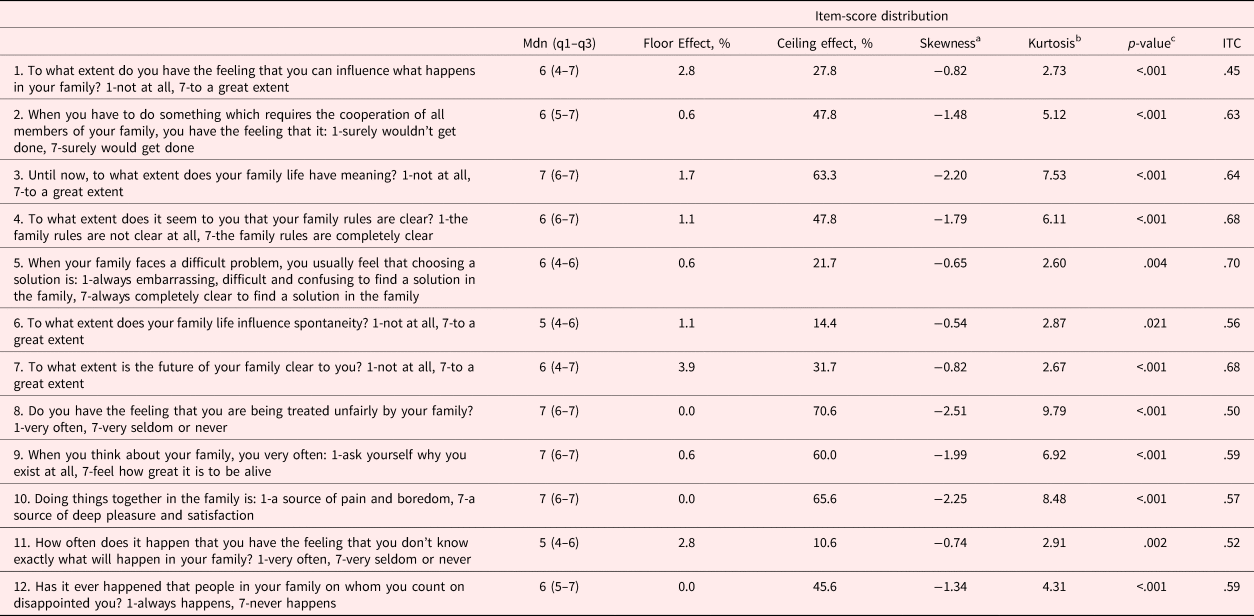
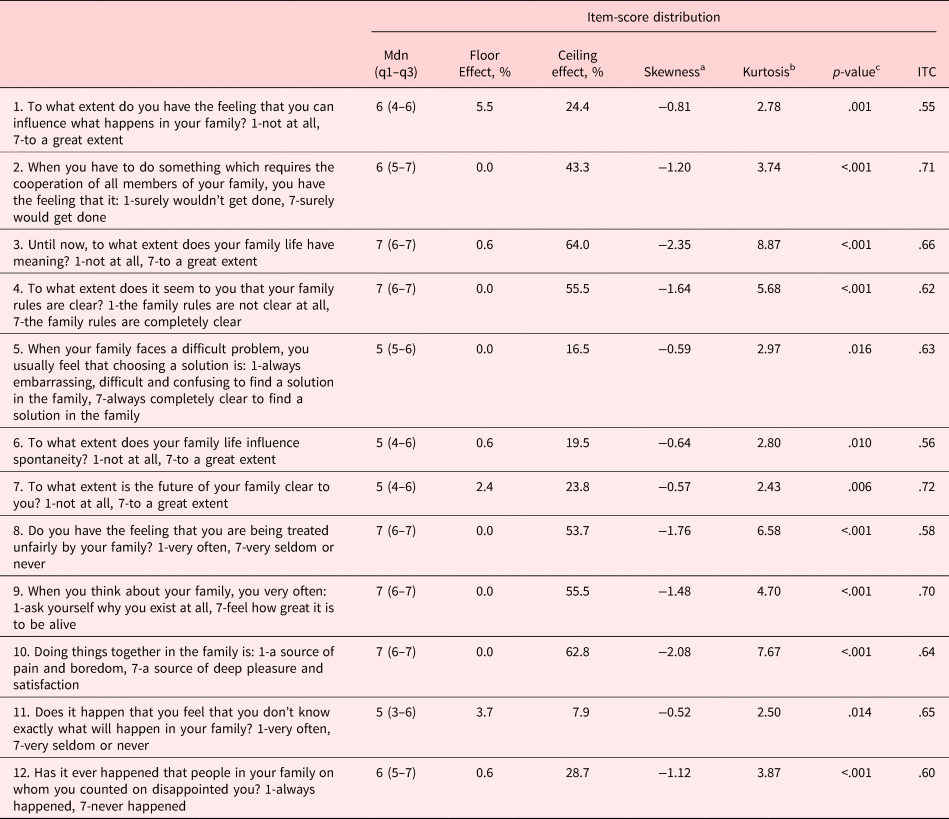
All FSOC-S items demonstrated skewed distributions with ceiling effects for both persons with cancer (Table 2) and their family members (Table 3). The results showed that 50% of persons with cancer scored 6 or 7 for most items, with the exception of items 6 and 11. In addition, 50% of family members scored 6 or 7 for most items, with the exception of items 5, 6, 7, and 11. No missing data were observed in the completed questionnaires in either participant group. The distribution of the scale scores were negatively skewed and deviated significantly from a normal distribution for persons with cancer (skewness = −1.06, kurtosis = 3.74, χ2(2) = 23.0, p < .001) and family members (skewness = −1.07, kurtosis = 4.29, χ2(2) = 24.2, p < .001).
Item-score distribution and item-total correlations for the Family Sense of Coherence Scale in persons with cancer (n = 179)

ITC = item-total correlation; Mdn = median; q1–q3 = quartiles.
aValues close to 0 support normality.
bValues close to 3 support normality.
cD'Agostino test for normality.
Item-score distribution and item-total correlations for the Family Sense of Coherence Scale in family members (n = 165)

ITC = item-total correlation; Mdn = median; q1–q3 = quartiles.
aValues close to 0 support normality.
bValues close to 3 support normality.
cD'Agostino test for normality.
Homogeneity
Inter-item correlations were satisfactory for persons with cancer (mean rho = 0.48, range = 0.25 to 0.74) and family members (mean rho = 0.52, range = 0.34 to 0.74). No item-total correlation coefficients were below 0.30 (Tables 2 and 3).
Factor structure
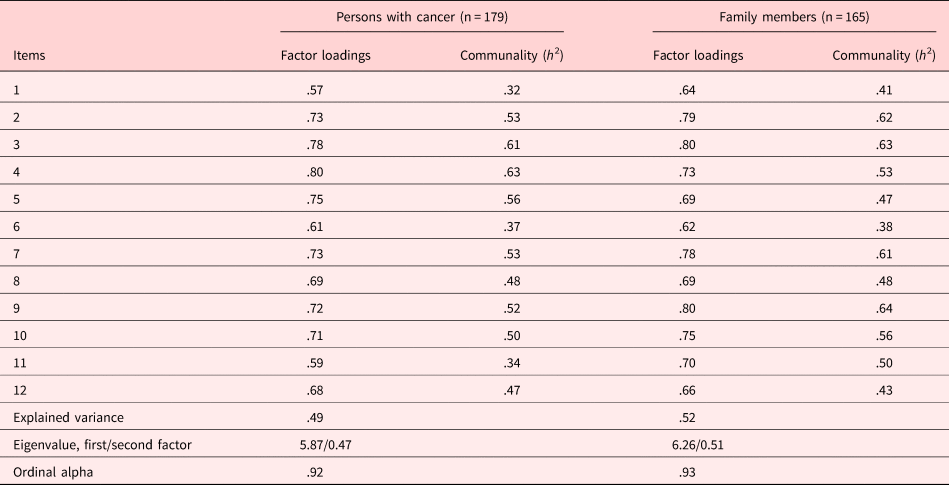
The parallel analyses supported a one-factor solution for both persons with cancer and their family members, as supported by the Kaiser criteria with eigenvalue >1 (Table 4) and the scree plot (not presented here). The one factor model for persons with cancer explained 49% of the total variance and the factor loadings ranged between 0.57 and 0.80. The one factor model for family members explained 52% of the total variance and the factor lodgings ranged between 0.62 and 0.80 (Table 4).
Exploratory factor analyses of the Family Sense of Coherence – Short version, in persons with cancer and family members

The factor analyses were based on a weighted least square estimation and polychoric correlations.
Internal consistency
Ordinal alpha was excellent, 0.92 for persons with cancer and 0.93 for family members (Table 4).
Test-Retest reliability
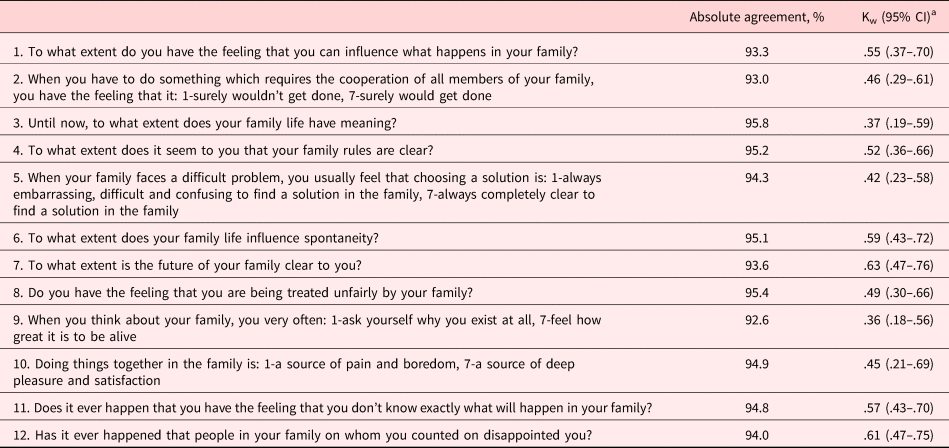
In general, the test-retest reliability for items was satisfactory. Absolute agreement ranged between 93.0% and 95.5%. Nine of the items demonstrated moderate test-retest reliability (Kw = 0.42 to 0.61). Two items had fair test-retest reliability (Kw = 0.35 to 0.37) and one item showed good agreement (Kw = 0.63) (Table 5). The test-retest reliability on the scale level was moderate (ICC = 0.64, 95% CI = 0.52‒0.74).
Test-retest reliability for the items in the Family Sense of Coherence Scale (pooled sample of persons with cancer and family members, n = 114)

aWeighted kappa statistics and its 95% confidence interval. Interpretation: <.20 poor, .21–.40 fair, .41–.60 moderate, .61–.80, good, and >.80 very good agreement.
Convergent validity
The correlation pattern between FSOC-S, HHI, and HADS supported convergent validity. In persons with cancer, FSOC-S scores were positively correlated with HHI (rs = 0.50, p < .001) and negatively correlated with HADS anxiety (rs = −0.38, p < .001) and HADS depression (rs = −0.46, p < .001), as hypothesized. A similar trend in correlations was observed for family members, as FSOC-S scores were positively correlated with HHI (rs = 0.60, p < .001) and negatively correlated with HADS anxiety (r = −0.38, p < .001) and HADS depression (rs = −0.41, p < .001).
Within dyad correlations in FSOC-S scores (nonindependence)
The FSOC-S score correlated strongly (rs = 0.54, p < .001) between persons with cancer and family members within the dyads, which supports the instrument measure sense of coherence on a family level.
Discussion
The aim of this study was to translate, culturally adapt, and validate the FSOC-S in a Swedish sample of families living with cancer in the palliative stage. The results showed that the FSOC-S was easy to use and demonstrated satisfactory measurement properties in this setting.
Various methods are used to translate scales (Streiner et al., Reference Streiner, Norman and Cairney2014), and there is no consensus among researchers regarding a gold standard translation technique (Koo & Li, Reference Koo and Li2016). Previous findings indicated that individuals’ cultural beliefs and values shaped their understanding of a concept (Maneesriwongul & Dixon, Reference Maneesriwongul and Dixon2004). The translation procedure was guided by recommendations from WHO (World Health Organization, 2013), with focus on conceptual equivalence rather than literal translation. The adaptation of an existing scale from one culture to another implies that the adapter assumes that the same constructs will lead to the same or similar interpretations and predictions in the new culture (Sidani et al., Reference Sidani, Guruge, Miranda, Ford-Gilboe and Varcoe2010). Therefore, it might not always be necessary to address all validity concerns in the scale adaptation, as some concepts could be more sensitive to cultural influences, relative to other concepts, and therefore require comprehensive examination of conceptual equivalence (Streiner et al., Reference Streiner, Norman and Cairney2014). This study showed that some language issues that were not observed during the translation process emerged during the cognitive interviews. Therefore, the FSOC-S requires cross-cultural validation to ensure that it can be used as an invariant measure of perceived family sense of coherence.
The evaluation of content validity in the present study was inconsistent with that performed in previous studies, both from experts and persons with cancer. Also, the S-CVI\Ave value was below the cutoff score of 0.90 suggested by Polit and Beck (Reference Polit and Beck2006), but acceptable (0.80) according to Weijters and Baumgartner (Reference Weijters and Baumgartner2012). In addition, four FSOC-S items showed I-CVI values that were lower than but close to the cut-off score of 0.78 (Grant & Davis, Reference Grant and Davis1997; Polit & Beck, Reference Polit and Beck2006). The same four items received criticism regarding either the Swedish translation or cross-cultural equivalence during the cognitive interviews. This finding could be explained by poor conceptual connections with the theory regarding the sense of coherence, as family sense of coherence is more complex, relative to the general sense of coherence as it includes family members and a systemic approach.
The change in the direction of the reverse-scored items in the existing scales during the adaptation process could be regarded as problematic. Respondent confusion and complication of the interpretations of the results are well-known problems associated with the use of reverse-scored items (Streiner et al., Reference Streiner, Norman and Cairney2014). Items scored in the same direction generate stronger item-total correlations relative to those observed for reverse-scored items, and scales with reverse-scored items tend to demonstrate poor reliability (Geisinger, Reference Geisinger1994), particularly in older adults (Carlson et al., Reference Carlson, Wilcox, Chou, Chang, Yang, Blanchard, Marerella, Kou and Clark2012). Considering the study population and comments provided during the translation process contributed to our choice to ensure that all items were scored in the same direction.
Data quality in terms of absence of missing data was satisfactory and indicate that the items were easy to understand and completion of the instrument was not overly extensive or burdensome. This was also confirmed by the cognitive interviews. In addition, participants may have completed the questionnaire in the hope that by sharing their experiences they may contribute to improving palliative care both generally and for themselves, in the future (Aoun et al., Reference Aoun, Slatyer, Deas and Nekolaichuk2017). The distribution of item responses was highly skewed and distributed toward higher scores, a problem demonstrated also in other studies (Cecen, Reference Cecen2007). This is a potential problem, as skewed distribution could have negative effects on sensitivity (i.e., to detect differences between groups) and responsiveness (i.e., to detect changes over time) (Streiner et al., Reference Streiner, Norman and Cairney2014). A possible explanation to the skewed distribution may be that the participants were more likely to approach the demands of living with cancer in the palliative stage as challenges, or a selection bias where the participants may not represent the entire population of families living with cancer in the palliative stage. However, almost all the response options for each item were selected at least once, indicating variation in the responses.
Basic scaling assumptions were met in the present study since the inter-item and item-total correlations showed satisfactory homogeneity. These findings were supported by the factor analysis that suggested a one-factor model. Despite this, the explained variance was somewhat low for both patients with cancer and family members. Based on exploratory factor analyses, previous studies have also suggested that the FSOC-S is a unidimensional rather than multidimensional measure, but the explained variance was even lower in these studies (Cecen, Reference Cecen2007; Ngai & Ngu, Reference Ngai and Ngu2011). Altogether, these findings address a need to confirm the factor structure in future studies.
In relation to the scaling assumptions, the FSOC-S also demonstrated good internal consistency, which is consistent with previous studies (Cecen, Reference Cecen2007; Moen & Hall-Lord, Reference Moen and Hall-Lord2016; Ngai & Ngu, Reference Ngai and Ngu2011; Sagy, Reference Sagy1998; Terry et al., Reference Terry, Olson, Ravenscroft, Wilss and Boulton-Lewis2006). In contrast to previous studies, we used ordinal alpha, which is a suitable method for use with ordinal data (Gadermann et al., Reference Gadermann, Guhn and Zumbo2012).
As expected, our hypotheses regarding convergent validity were supported. Family sense of coherence was negatively associated with psychological distress and positively associated with hope, supporting Antonovsky's (Reference Antonovsky1987) claim that successful coping with family stressors is a crucial resource that contributes to improved psychological adjustment.
Methodological limitations
The study was subject to some limitations. The response rates were low for persons with cancer (27.5%) and their family members (25.4%). In psychometric studies, low response rates seldom present a problem, provided that they do not affect variation in the data (Streiner et al., Reference Streiner, Norman and Cairney2014). In the context of palliative care, it is unlikely to receive high response rates because of the families’ current life situation. The sample size was appropriate for the performed analyses, but a larger sample size may lead to more confident results. This study was based on classical test theory, which is known to be sample dependent (Streiner et al., Reference Streiner, Norman and Cairney2014); whereby psychometric properties could vary between different samples.
Clinical implications
The FSOC-S could provide several advantages in clinical use to identify vulnerable family members who experience low levels of perceived family sense of coherence; it is a short-form measure and a time-efficient tool. However, the psychological impact of completing the FSOC-S in a palliative context requires clarification. Using the FSOC-S as a screening tool in this manner could help health care professionals facilitate interventions that strengthen family resources and provide insight into family members’ ability to live with the palliative stage of cancer.
The translated and adapted Swedish version of the FSOC-S demonstrated satisfactory measurement properties in the present study. This suggests that the FSOC-S is a useful instrument to assess family sense of coherence in persons with cancer and their family members. However, the number of studies that have validated the FSOC-S is limited. More evaluations in different groups and context are needed.
Acknowledgments
We are grateful to all families who participated in the study. We also want to thank Dr. Christen Erlingson and the family nursing research group at Linnaeus University for participating in the translation process.