





Introduction
In recent years, the Church of England has placed great weight on developing the role of lay people in ministry.Footnote 1 The emphasis has tended to fall on licensed or accredited ministries, especially those related to preaching and teaching, pastoral care or evangelism. People called to these ministries have been resourced through selection, training and on-going professional development. In most dioceses, these roles cannot be undertaken without the permission of the bishop, and there are structures and processes in place to promote the quality of lay people’s work in these roles. However, such ministers are not the only lay people who have responsibilities of leadership within local congregations. Alongside clergy and lay ministers in a parish, there is a plethora of volunteers who help to run parishes in a variety of roles. It is these lay leaders who are the subject of this study. They are a relatively under-studied group within the Church of England, yet they are becoming increasingly important, not least because of the now embedded emphasis on the discipleship of all members of the Church.Footnote 2 This sense of being called to follow Christ carries with it the call to serve, and that means some lay people have to take the lead in running particular aspects of congregational life. By leadership, we refer to a role that requires someone to do more than just help with a ministry or belong to a group; they also have a role in leading others or directing a particular ministry or task within the congregation.
Leadership by lay people in the Church of England is not new. Its roots lie in the emergence of churchwardens in the fourteenth century, though some sort of lay office probably existed before then.Footnote 3 Churchwardens were initially responsible for maintaining the various vestments and ornaments required for worship, but gradually acquired other roles related to wider responsibilities within the parish.Footnote 4 The Early Modern period saw the duties of churchwardens increasingly shared with other lay people in elected bodies that became known as ‘vestries’ (because they usually met in the parish church vestry). Vestries in some areas were effectively a form of local government, with control over both church and secular matters.Footnote 5 The Local Government Act 1894 created secular parish councils, which took on many of the non-ecclesial roles and responsibilities originally held by the vestries. The separation of power between Church and State was given further impetus by the Enabling Act of 1919, the culmination of reforms in the Church of England that led to the creation of the National (later Church) Assembly, the forerunner of the present day General Synod.Footnote 6 The appendix to the Act set out provision for the creation of Parochial Church Councils (PCCs), which were formally introduced through the PCCs (Powers) Measure in 1921. This transferred the church-related powers of vestries and churchwardens to PCCs, including financial control and the care and maintenance of church buildings and churchyards.
The revision of the Measure in 1956 outlined the duties and functions of a PCC, which point to important and wide-ranging responsibilities beyond those related to financial control or the maintenance of the fabric of parish churches:
It shall be the duty of the minister and the parochial church council to consult together on matters of general concern and importance to the parish.
The functions of parochial church councils shall include
-
(a) co-operation with the minister in promoting in the parish the whole mission of the Church, pastoral, evangelistic, social and ecumenical;
-
(b) the consideration and discussions of matters concerning the Church of England or any other matters of religious or public interest, but not the declaration of the doctrine of the Church on any question;
-
(c) making known and putting into effect any provision made by the diocesan synod or the deanery synod, but without prejudice to the powers of the council on any particular matter;
-
(d) giving advice to the diocesan synod and the deanery synod on any matter referred to the council;
-
(e) raising such matters as the council consider appropriate with the diocesan synod or deanery synod;
-
(f) appointing sidesmen (who are also known as assistants to the churchwardens).Footnote 7
The key leadership roles within PCCs are the offices of churchwardens, secretary, treasurer and (more recently) parish safeguarding officer. Churches also have lay leaders who are not necessarily part of the PCC but nonetheless exercise important roles in running areas of church life such as work with children and young people, music or leading home groups. Together, these people keep parishes functioning whether alongside an incumbent or during a vacancy. Some will have legal responsibilities to maintain parish life, and all are crucial in enacting the mission of the Church at local level.
This study is not about how well lay leaders perform their roles but how they feel about doing those roles. Are they stressed by trying to do their job? Do they feel supported by their congregations and clergy? Were they well prepared to carry out their roles? These are volunteers who could refuse to help or walk away from the role at any time. Our experience suggests very few do and are more likely to carry on if they are asked to, especially if there is little prospect of anyone else stepping forward. Understanding how lay leaders perceive their roles and what factors predict those most likely to be thriving or struggling may be important for the Church of England at a time when it is increasingly looking to lay people to take more active roles in running parishes.
Fragile Churches and Recruiting Lay Leaders
Part of the motivation for this research comes from findings of studies in the Church of England into what has become known as ‘fragile churches’. This began with a series of interviews with incumbents of multi-parish rural benefices that pointed to the sorts of factors that threatened the long-term viability of their churches.Footnote 8 Besides the obvious financial pressures, lack of resources and pressure to maintain historic buildings, two frequently mentioned issues were the inability to replace churchwardens and the lack of volunteers to take on other church responsibilities. Surveys of the Church of England during the COVID-19 pandemic indicated that although the perceived difficulty in replacing key lay people was generally higher among those in rural churches, it was not confined to them. In a survey in the first pandemic lockdown, 23% of rural laity considered key lay people would step down and be difficult to replace; equivalent figures were 18% for inner city parishes, and 17% elsewhere.Footnote 9 A second survey taken during the third national lockdown in 2021 showed that both clergy and lay people were increasingly pessimistic on the issue of replacing key lay people.Footnote 10 A third survey in 2024 (in which the data presented here were collected) suggested pandemic fears were being realized, with 72% of clergy and 51% of laity agreeing that key lay people were proving difficult to replace.Footnote 11 The figures from the three surveys were based on perceptions of clergy and laity rather than directly addressing views of these ‘key lay people’ themselves. Clearly, it would be useful to know if lay leaders are under role-related stress and how this varies between different roles and in different contexts.
One way to try and understand lay leaders would be to listen to the detailed accounts of particular individuals in order to paint a picture of what might be true across the Church more generally. Our approach has been to draw on the Church 2024 dataset, which was collected through an online survey, and which included some questions directed specifically at non-licensed lay leaders. The dataset also included personal details such as sex and age, an assessment of personality, contextual variables such as the size of their congregation and its location and self-assessed church tradition. The aim was to use these variables to predict how lay leaders perceived their roles and what factors might enable churches to support them more effectively.
Research Questions
Given the lack of any previous research in this area, the study aimed to answer three main questions:
-
1. What proportion of lay leaders felt stressed, unsupported or trained inadequately for their roles?
-
2. What factors (personal, psychological, contextual or ecclesial) most closely predicted stress levels among lay leaders?
-
3. Did stress levels, perceptions of support or adequacy of training vary between lay leaders with different roles?
Method
Procedure
The Church 2024 survey was an online survey delivered using the Qualtrics platform, which ran from March to November 2024.Footnote 12 It was mainly promoted through the Church Times, the main newspaper of the Church of England, but also through the Church of England Newspaper and directly through diocesan communications officers. Of the total 5,141 responses, 3,826 (74%) were from Anglicans living in England who identified as being part of the Church of England. Of the 3,826 responses from the Church of England, 2,328 (60%) were laity. The online format of the survey allowed some sections to be shown only to particular people, based on their answers to certain key items that required a response. Church of England affiliates who were not ordained were asked the following question: ‘Are you in any of these church leadership roles? (Please select any that that apply to you, but only if you lead a group rather than simply being part of a group)’. This was followed by a list of nine specific roles, plus ‘other’. Those who selected ‘other’ could specify the role in a text box, and answers here were used to adjust the other options where the text indicated a role that fell under one of the suggested categories, but which had not been selected. A total of 717 people indicated that they had at least one leadership role and also answered all the other items used in this analysis.
Core Variables
Lay Leadership Roles
The nine options for lay leadership roles presented in the survey were churchwarden, PCC secretary, PCC treasurer, safeguarding officer, lead children, lead youth, lead worship group, lead choir and lead group. Respondents could select more than one role. The list was roughly in order of likely demands of time, so we used the first selected choice on the list to assign a main role for those individuals who selected more than one. Analysis of the 483 respondents who chose just one role gave similar results to the full sample, suggesting the procedure was justified.
The Lay Leader Stress Scale
Those identified as lay leaders were offered eight statements relating to their role, each with a five-point response scale ranging from ‘Agree Strongly’ to ‘Disagree Strongly’. Factor analysis (principal components extraction followed by varimax rotation) suggested four items loaded on a single component related to stress: ‘I am often stressed in managing what has to be done’, ‘I am spiritually drained by the work I do for my church’, ‘I am overwhelmed by administration’ and ‘I would give up if there was someone else to do it’. Scores for these four items were used to calculate the Lay Leader Stress Scale (LLSS). The scale had a good internal consistency reliability of .79 as measured by Cronbach’s alpha.Footnote 13 The other four items were analysed individually by collapsing responses into agreement (‘Agree’ or ‘Strongly Agree’ =1) versus others (‘Not Certain’, ‘Disagree’ or ‘Strongly Disagree’ = 0).
Predictor Variables
Personal Factors
Sex was coded: female (=1), male (=0). Age was coded: 18-19 (1), 20s (2), 30s (3), 40s (4), 50s (5), 60s (6), 70s (7) and 80s+ (8).
Psychological Factors
Psychological variables were assessed using the revised shortened version of the Francis Psychological Type and Emotional Temperament Scales (FPTETS).Footnote 14 This is a 30-item instrument comprising four sets of six forced-choice items related to each of the four components of psychological type theory: orientation (extraversion or introversion), perceiving process (sensing or intuition), judging process (thinking or feeling), and attitude toward the outer world (judging or perceiving), and six items related to emotional temperament (calm or volatile, a measure of trait neuroticism).Footnote 15 Previous studies have demonstrated that the parent instrument (which contains just the four psychological type scales) functions well as a measure of psychological type preferences in a range of church-related contexts.Footnote 16 In this sample, the alpha reliabilities were .80 for the EI scale, .65 for the SN scale, .78 for the TF scale, .77 for the JP scale, and .82 for the emotional temperament scale.
Contextual Factors
Highest level of education was coded: no school qualifications (1), school-level (2), university certificate or diploma (3), undergraduate degree (4), master’s degree (5), and doctoral degree (6). Location was used to create dummy variables of rural (=1, other = 0) and inner city (=1, other = 0), with suburban/town as the reference category.
Ecclesial Factors
Church tradition was assessed using a seven-point bipolar scale labelled ‘Anglo-Catholic’ at one end and ‘Evangelical’ at the other. It is a good indicator of differences in belief and practice in the Church of England and was used to identify Anglo-Catholic (scoring 1–2), Broad Church (3–5) and Evangelical (6-7) respondents.Footnote 17 Respondents were asked about the size of the congregation at the service they usually attend, which was used as a proxy for congregation size.
Participants
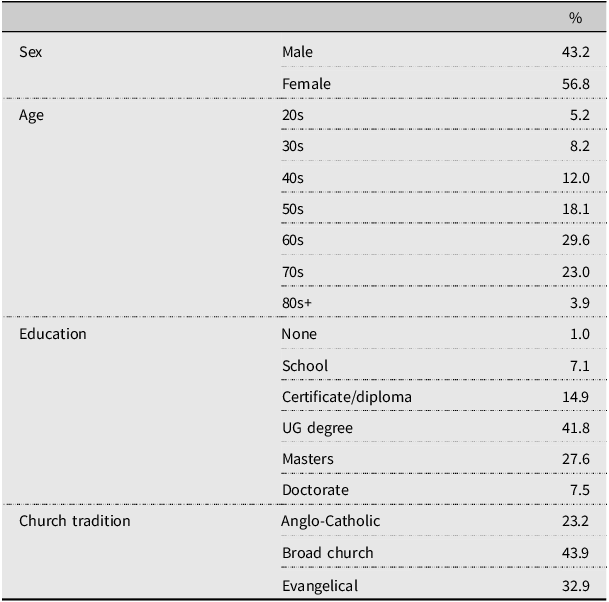
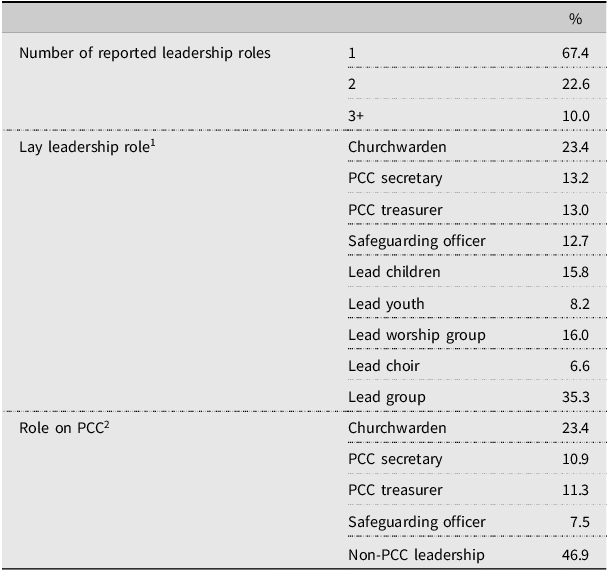
Table 1 presents the personal profile of the 717 participants included in the analyses: 57% were female, 53% were in their 60s or 70s, and 77% had a university degree. In terms of church tradition, the largest group identified as Broad Church (44%), followed by Evangelical (33%), and Anglo-Catholic (23%). Table 2 presents the leadership roles occupied by the 717 participants. Two thirds (67%) selected just one role, 23% selected two roles, and 10% selected more than two roles.
Profile of lay leaders in the Church of England

Table 1. Long description
The table presents the personal profiles of 717 participants. It has four main categories: Sex, Age, Education, and Church tradition. The table has 13 rows and 2 columns. The columns are labeled ‘Sex’ and ‘%’. The rows under ‘Sex’ are Male with 43.2 percent and Female with 56.8 percent. The rows under ‘Age’ are 20s with 5.2 percent, 30s with 8.2 percent, 40s with 12.0 percent, 50s with 18.1 percent, 60s with 29.6 percent, 70s with 23.0 percent, and 80s+ with 3.9 percent. The rows under ‘Education’ are None with 1.0 percent, School with 7.1 percent, Certificate/diploma with 14.9 percent, UG degree with 41.8 percent, Masters with 27.6 percent, and Doctorate with 7.5 percent. The rows under ‘Church tradition’ are Anglo-Catholic with 23.2 percent, Broad church with 43.9 percent, and Evangelical with 32.9 percent.
Note: N = 717.
Lay leadership roles

Table 2. Long description
A table with three rows and three columns. The table is divided into three sections: Number of reported leadership roles, Lay leadership role, and Role on PCC. The first section lists the number of leadership roles reported by participants: 1 role (67.4 percent), 2 roles (22.6 percent), and 3 or more roles (10.0 percent). The second section details specific lay leadership roles and the percentage of participants in each role: Churchwarden (23.4 percent), PCC secretary (13.2 percent), PCC treasurer (13.0 percent), Safeguarding officer (12.7 percent), Lead children (15.8 percent), Lead youth (8.2 percent), Lead worship group (16.0 percent), Lead choir (6.6 percent), and Lead group (35.3 percent). The third section lists roles on the PCC and the percentage of participants in each role: Churchwarden (23.4 percent), PCC secretary (10.9 percent), PCC treasurer (11.3 percent), Safeguarding officer (7.5 percent), and Non-PCC leadership (46.9 percent).
Note: N = 717. 1Includes those with more than one role. 2Based on main role only.
Analysis
The first stage of analysis was to examine responses to the eight items that assessed how far lay leaders felt stressed, supported, or trained adequately for their roles. The second stage of analysis explored the factors predicting scores on the Lay Leaders Stress Scale. Bivariate correlations indicated that some of the predictor variables were correlated. For example, those identifying as Evangelical tended to be younger, to come from larger congregations, and score lower on feeling than thinking. For this reason, multiple regression was used to identify the independent effects of personal, psychological, contextual and ecclesial factors on stress. The third stage of analysis compared mean levels of the LLSS between various categories of main role. Roles were collapsed into five categories: churchwarden, PCC secretary, PCC treasurer, parish safeguarding officer, and non-PCC leadership roles. Differences between mean stress scores for those in different roles were tested using a range of post-hoc tests (Tukey, Duncan, and Least Significant Difference). This identified those with scores that were significantly higher or lower than those of leaders in other roles. The fourth stage of analysis explored perceptions of support, training, and likelihood of finding a replacement for the same five categories of role. Results were reported as levels of agreement by role and tested individually using 2 × 2 contingency tables and chi-squared analysis for each role compared with the rest.
Results
Levels of Stress, Support and Training
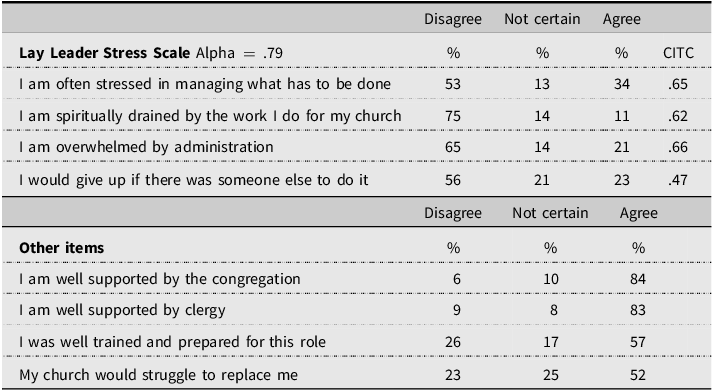
The majority of the 717 lay leaders did not indicate excessive stress in their roles (Table 3). For example, 54% disagreed that they were ‘often stressed in managing what has to be done’ and 75% disagreed that they were ‘spiritually drained by the work I do for my church’. Nonetheless, there were some who indicated problems, with 34% agreeing they were often stressed, 21% that they felt overwhelmed by administration, and 23% that they would give up if there was someone else to do their role. This suggests that stress is not an uncommon experience for lay leaders in the Church of England. Lay leaders did not report that they felt unsupported, with 85% feeling well supported by their congregations and 83% by their clergy. Nonetheless, far fewer (57%) felt well trained for their role and over half (52%) felt their church would struggle to replace them. These figures suggest that the Church of England has issues to address when it comes to finding and preparing lay people to lead.
Lay leader views of role items

Table 3. Long description
A table with two sections: Lay Leader Stress Scale and Other items. The Lay Leader Stress Scale section has four rows and four columns, including percentages for Disagree, Not certain, Agree, and CITC values. Row labels include statements about stress, spiritual drain, and administrative overwhelm. The Other items section has four rows and three columns, with percentages for Disagree, Not certain, and Agree. Row labels cover support from congregation and clergy, training preparation, and replaceability. Notable trends include high agreement on support from congregation and clergy, and lower agreement on being well trained and prepared.
Note: N = 717. The five-point response scale has been collapsed for ease of presentation. CITC = Corrected Item-Total Correlation.
Predictors of Stress
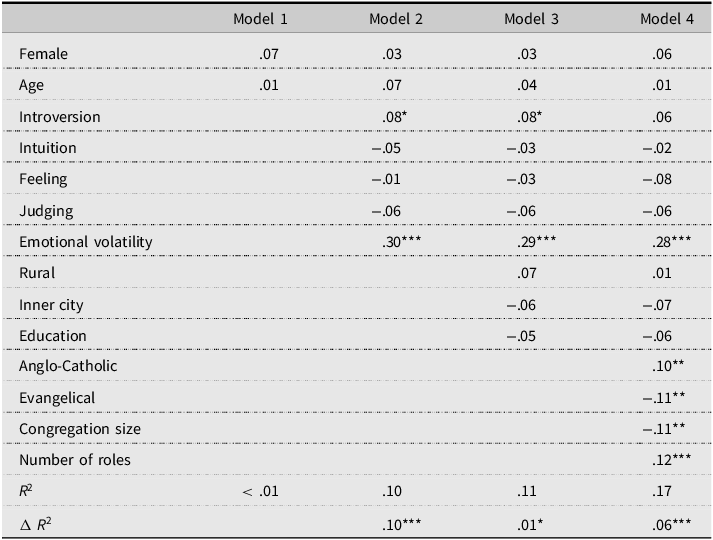
Multiple regression of LLSS scores (Table 4) showed that personal, psychological and contextual factors had little association with role-related stress, apart from emotional volatility, which was a significant predictor of stress. Ecclesial factors were more likely to predict stress. Anglo-Catholics were more likely, and Evangelicals less likely, to be stressed when compared with those identifying as Broad Church. Those who reported worshipping in larger congregations tended to be less, not more stressed, even after allowing for the fact that Evangelicals tended to worship in larger congregations. Those who had more than one role in leadership also reported significantly higher levels of stress.
Hierarchical multiple regression of the Lay Leaders Stress Scale

Table 4. Long description
The table presents the results of a hierarchical multiple regression analysis of the Lay Leaders Stress Scale, showing the association of different factors with role-related stress. It includes four models with various predictors. The table has 15 rows and 4 columns. The columns are labeled Model 1, Model 2, Model 3, and Model 4. The rows include factors such as Female, Age, Introversion, Intuition, Feeling, Judging, Emotional volatility, Rural, Inner city, Education, Anglo-Catholic, Evangelical, Congregation size, and Number of roles. Each cell contains a value representing the association strength of the factor with role-related stress. Notable trends include significant predictors like Emotional volatility, Anglo-Catholic, Evangelical, Congregation size, and Number of roles.
Note: N =717. *p < .05; **p < .01; ***p < .001.
Differences between Roles
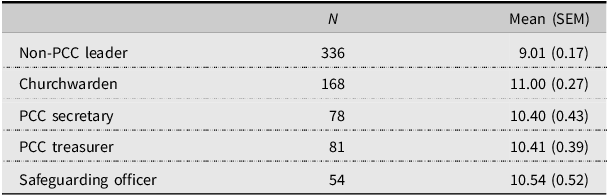
Analysis of variance of LLSS scores by main roles suggested significant differences in stress between different sorts of lay leaders (Table 5, F 4, 712 = 11.8, p < .001). The effect was small (η 2 = .06), but post-hoc tests confirmed that PCC officers had similar mean stress scores that were significantly higher than for those with other leadership roles such as leading music or work with children (Table 5).
Mean Lay Leader Stress Scale scores by main role

Table 5. Long description
A table comparing mean stress scores by different lay leader roles. The table has five rows and three columns. The columns are labeled N, Mean (SEM). The rows are labeled Non-PCC leader, Churchwarden, PCC secretary, PCC treasurer, and Safeguarding officer. Row 1: Non-PCC leader, 336, 9.01 (0.17). Row 2: Churchwarden, 168, 11.00 (0.27). Row 3: PCC secretary, 78, 10.40 (0.43). Row 4: PCC treasurer, 81, 10.41 (0.39). Row 5: Safeguarding officer, 54, 10.54 (0.52).
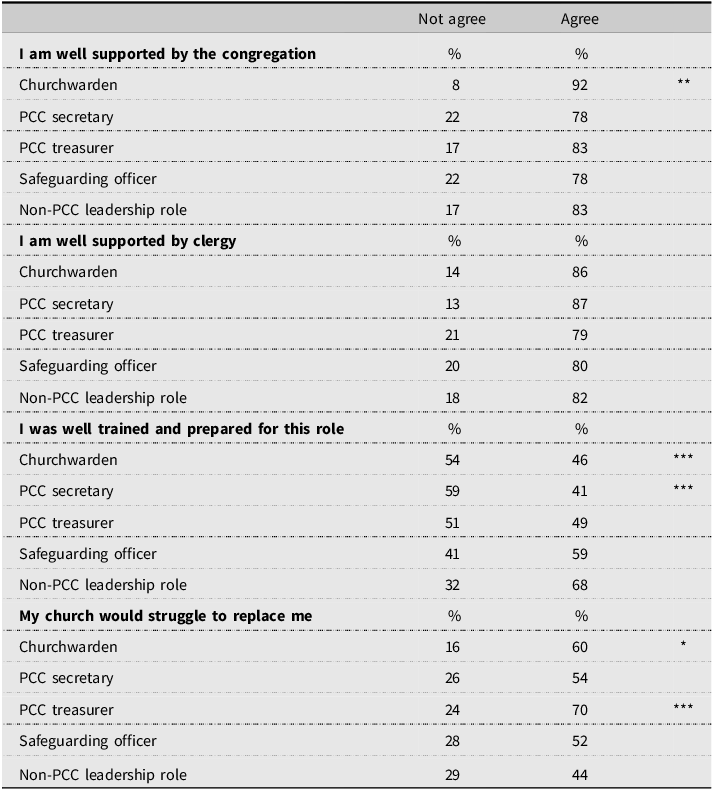
Contingency analysis of the individuals items related to support and training suggested there were a few differences (Table 6). Feeling supported by clergy was uniformly high across all roles. Similarly high support from congregations seemed evident for all roles, though 92% of churchwardens felt supported by their congregations, a significantly higher figure than for other roles. The results for training suggested that less than half of churchwardens and PCC secretaries felt adequately prepared for their roles, figures that were significantly lower than for other roles. When it came the likelihood of finding replacements, over half of PCC officers felt their church would struggle to find someone to take on the role, with churchwardens (60%) and treasurers (70%) most likely to agree with this statement.
Views of support, training, and replacement by lay leadership role

Table 6. Long description
The table has four sections, each with different statements about support and training. Each section contains five rows for different roles: Churchwarden, PCC secretary, PCC treasurer, Safeguarding officer, and Non-PCC leadership role. Each row has two columns: Not agree (percent) and Agree (percent). The first section, ‘I am well supported by the congregation,’ shows high agreement percentages, with Churchwardens at 92 percent. The second section, ‘I am well supported by clergy,’ also shows high agreement, with Churchwardens at 86 percent. The third section, ‘I was well trained and prepared for this role,’ shows lower agreement, particularly for Churchwardens at 46 percent and PCC secretaries at 41 percent. The fourth section, ‘My church would struggle to replace me,’ shows high agreement for Churchwardens at 60 percent and PCC treasurers at 70 percent.
Note: N = 717. Based on main role. Differences between a given role and the rest tested by chi-squared analysis with 1 df. *p < .05; **p < .01; ***p < .001.
Discussion
This study of 717 lay leaders in the Church of England was the first of its kind and indicated a number of important findings related to levels of role-related stress, support, training for role and likelihood of finding replacements.
Stress among Lay Leaders
Responses to four items related to stress suggested that although most participants did not evidence signs of stress, a significant proportion did. A third agreed or strongly agreed with the item ‘I am often stressed in managing what has to be done’, indicating that volunteering to help run a parish church can be a difficult and stressful way to serve the mission of the Church. Fortunately, this stress seemed not to affect the spiritual well-being of lay leaders, with only 11% agreeing that they were spiritually drained by their role. Nonetheless, 21% felt overwhelmed by administration and 23% would give up if they could find a replacement. The picture that emerged was of a majority who seemed to cope well with their role, but a sizeable minority who may be struggling to fulfil their vocation in a leadership role.
Creating a scaled measure of stress using four items allowed a more incisive analysis of how stress varied between these lay leaders. There was no evidence that stress varied with age or between men and women, but there was a significant correlation with levels of emotional volatility, which is a measure of trait neuroticism.Footnote 18 This might be expected because it suggests that some lay people may be psychologically disposed to cope better with leadership than others. People who are generally likely to be anxious, have mood swings or feel guilty will find it difficult to cope with the demands of being a lay leader. While this should not exclude people from taking on such roles, it is important for clergy and congregations to realize that not everyone will react in the same way to a given role. Just because one person finds a role easy to fulfil does not mean that everyone will.
Stress levels were also related to church traditions, with Anglo-Catholics being relatively more stressed, and Evangelicals less stressed, compared with the rest of the sample. Why this should be so is not altogether obvious, but it may be that it relates to levels of clericalism in these different traditions. Evangelicals draw their inspiration from the Reformed tradition, where the ‘priesthood of all believers’ has given high status and priority to lay people. Anglo-Catholics lean towards a tradition that tends to valorize the ordained priesthood, perhaps at the expense of other kinds of leadership. Evangelicals in this sample tended to be part of larger congregations, but this may not have entirely explained why those from larger congregations tended to be less stressed than those from smaller congregations. This may be an effect related to the shortage of volunteers in smaller congregations, where pressure to find volunteers can be felt most keenly. There was no evidence that this was a largely rural issue, and it may be that it relates to greater workload for lay leaders when there are fewer people in the congregation to share the load. Perhaps unsurprisingly, stress levels were also higher among those who reported more than one leadership role. It seems obvious that it would be better to ensure people had just one role, but this is not always realistic in small congregations, where a few able and willing people can end up carrying a heavy load.
Comparing stress levels between different roles suggested that PCC officers tend to have higher stress than leaders of children’s work, music or home groups. It was not clear why this was so, and further work is needed to understand this difference better. It might be that PCC officers carry responsibilities related to the whole of their church (and beyond it), whereas the more limited scope of other forms of leadership is less likely to induce stress. It does point to the load carried by PCC officers: if the Church has legally created these roles and insists they are present in every parish, it needs to do what it can to make the roles sustainable and attractive to volunteers.
Support and Training for Lay Leaders
Nearly all lay leaders felt well supported by their clergy and congregations. It was good to see that such a high percentage of churchwardens felt supported by their congregations, possibly because this is a high-profile role that carries crucial responsibilities, especially during a vacancy. Such support is surely important and welcomed, but it does not necessarily mean that the stress of the role is eliminated. It is also important to note that some 16% of our participants did not sense support from their clergy or their congregations. If this is typical across the Church of England as a whole, then there must be hundreds or even thousands of lay leaders who do not feel supported in what they do.
One way of showing support is to prepare people adequately to take on their role and to ensure there is ongoing development training where needed. Over half of churchwardens, secretaries and treasurers felt ill-prepared for their roles. How often are churchwardens elected at Annual Parochial Church Meetings and then left to discover for themselves what a churchwarden is meant to do. Being given a handbook and told to get on with the job may not be enough. Many parishes will have had the experience of new churchwardens being elected for the first time shortly before the benefice goes into vacancy. Experience suggests that at such moments the level of support from rural deans or archdeacons can be crucial but variable. The job of PCC secretary is no longer simply taking minutes at meetings, but do churches have procedures for explaining the legalities of running a PCC and parish? Many churches have a financial turnover equivalent to small- or medium-sized businesses, and the role of treasurer is far more than banking the weekly collection. Many PCCs are fortunate to have treasurers who are also trained accountants or financial managers, but where such skills are not available in the congregation, the task of managing parish finances can be daunting, with little or no training available.
Finding Replacements
Most parishes will have had the experience of struggling to replace a lay leader when one retires from the role. Just over half the respondents in this sample felt their congregation would struggle to replace them, and nearly a quarter were only doing the role because they could not find a replacement. This is in line with the findings of the fragile church research, where replacing key lay people has been identified as a widespread worry in the Church of England at the moment.Footnote 19 In this survey it was churchwardens (60%) and treasurers (70%) who were most likely feel their church might not be able to find anyone else to do their role. For churchwardens this might be related to the sheer level of responsibility and complexity of the role. For treasurers it might be both the technical skill needed and the level of stress in dealing with budgets that are so often in deficit. These results show that the idea that key lay people are hard to replace is not just in the minds of clergy, it is also understood by those in those roles. If lay leaders become trapped in roles that carry increasing levels of stress, they may be vulnerable to burnout and resigning, leaving posts vacant and unfillable. Worse still, they may feel used by the Church and leave altogether.
Limitations
The main limitation for the present study concerning role-related stress among non-licensed lay leaders in the Church of England is that the data were derived from a broad wide-ranging survey of lay and ordained Anglicans. While surveys of this nature tend to attract a good response, each of the issues explored is covered by a relatively restricted range of items. One of the consequences of this approach is that role-related stress was assessed by an impromptu four-item unvalidated measure. Future more strategically focused studies could employ a validated measure like the Francis Burnout Inventory for People-Workers.Footnote 20
Conclusions
Study of lay leaders in the Church of England has lagged well behind that of clergy or licensed lay ministers. This study suggests there is an urgent need for more detailed work to try and understand what seems to be a potentially beleaguered group of volunteers. The results point to several areas for such research. First, the difference between PCC officers and other lay leaders suggests that the former may be under greater stress and in need of better training for their roles. Dedicated surveys of different sorts of lay leaders may help to understand better the particular issues they face in carrying out their roles. Second, the variations in stress levels between those in different traditions need testing more rigorously to determine if they are related to theological assumptions and/or the status of lay people generally in Evangelical versus Anglo-Catholic churches. Third, difficulty in recruiting to roles seems to be a growing issue that needs monitoring. There may be statistics kept at diocesan level that would indicate how many parishes lack churchwardens or other PCC officers.
Acknowledgements
We thank the Church Times and others for helping to promote the survey, and for the lay leaders took time to complete it.
Competing interests
No conflicts of interest were reported by the authors.
Ethical standards
Ethical approval for the Church 2024 survey was granted by the Research Ethics Committee for the School of Humanities, Religion and Philosophy at York St John University (approval code: ETH2324-0130). All participants had to affirm they were 18 or over and give their informed consent by ticking a box that gave access to the rest of the survey.

 Open access

