The movement of service jobs abroad has generated considerable public anxiety, but how this trend affects different classes of workers remains unclear. The subject invites confusion because “offshoring” and “outsourcing” are mostly interchangeable in popular discourse. Offshoring, the focus of this article, refers to the location where production occurs: it is the relocation of the provision of a service or part of a manufacturing process to another country.Footnote 1 Understanding the distributional effects of this new form of trade in services helps to illuminate political reactions to it—notably, the recent (and growing) phenomenon of lobbying campaigns against offshoring.
The emergence of offshoring is significant for two long-standing debates in international political economy. First, a large literature considers the sources of wage inequality in developed countries. The consensus of this research is that, while trade accounts for some of the growth in wage inequality in the United States and Europe since 1970, the spread of information technologies and structural shifts toward more skill-intensive services are the main causes of these widening disparities. Empirical studies of wage inequality, however, focus on manufacturing and omit services due to data limitations.Footnote 2 As services become more tradable, it is important to know whether the trade-inequality link extends beyond manufacturing—particularly since trade in services is a crucial feature of today's globalization that was not seen before 1914 or in 1945–70.
Second, the political responses of trade-exposed domestic groups have been an area of substantial theoretical development and empirical testing. Much of this research focuses on the conditions under which labor will be united as a class or divided along industry lines.Footnote 3 However, cleavages within industries between classes of labor have received little attention. Even if trade economically divides workers according to skill, it is not known whether political behavior reproduces these rifts.
This article addresses the larger puzzles of how offshoring affects labor markets and shapes labor's political response in an analysis of one industry: motion picture services in the United States. While an examination of the universe of cases—all service industries—would yield more general results, the focus on motion picture services allows precision that eludes multi-industry studies, which express key variables such as trade preferences, wage inequality, and levels of offshoring as proxy measures. This article measures these variables directly thanks to the paper trail offshoring leaves in motion picture services and the highly visible reactions to it in Hollywood's tightly defined guild system, which exposes political divisions in organized activity.
The first part of the analysis examines occupational data to evaluate whether wage disparities for U.S. workers in motion pictures coincided with the level of filming abroad. A bootstrap simulation finds statistically significant increases in inequality in the industry through 2004, then a decline and leveling of inequality in the next two years. While the short time period of the data set prevents multivariate testing, changes in wage inequality are correlated with changes in import volumes. This result is consistent with skill-biased distributional effects in services offshoring.
The second part of the analysis uses labor market outcomes to explain political mobilization for trade measures to curtail offshoring. A coalition of U.S. labor groups formed in 1998 to pursue countervailing duties on productions filmed abroad and Section 301 action against foreign subsidies—a campaign that many workers in the industry declined to join. If the labor market effects of trade in services drive political activity, then low-skilled service and crew labor should have been more favorable to protectionist measures than high-skilled managerial, technical, and creative workers. An ordered probit analysis of labor-group support for these petitions finds that skill differences indeed were a critical dividing factor in collective action against offshoring.
The case of motion picture services indicates that some low-skilled workers have strong incentives to seek barriers to trade in services. But while services are becoming increasingly tradable, organized campaigns to limit imports remain unusual. I therefore consider the implications for service industries generally. This section concludes that political agitation against offshoring will continue to grow in the United States—to wit, protectionist pressures seen in motion picture services are likely to be repeated elsewhere—as long as the demand for Trade Adjustment Assistance (TAA) remains unfulfilled in services. If other countries experience similar difficulty adjusting to the new politics of trade in services, there is good reason to expect the controversy will rise to the World Trade Organization (WTO) because the General Agreement on Trade in Services (GATS) lacks both a safeguard clause and mechanisms for countries to counteract the effects of foreign subsidies.
This article is among the first to link the distributional effects of trade to political divisions among labor groups. Existing approaches to trade and domestic politics treat labor as a homogenous unit, ignoring the possibility that different classes of workers have conflicting interests.Footnote 4 Trade in services, as opposed to manufacturing and agriculture, also has been overlooked. In spite of this omission, the article demonstrates that theories of trade lobbying can be extended to offshoring in services with interesting implications: the key fault lines are occupations, not factors of production or industry-based sectors.
The next section reviews research on the economic and political effects of offshoring. The second section presents two testable propositions: (1) offshoring disproportionately harms low-skilled labor, aggravating wage inequality; (2) these labor market effects place low-skilled and high-skilled workers at odds on trade issues. The third section evaluates the impact on labor in motion picture services and finds that changes in wage inequality have been correlated with the level of offshoring. The fourth section examines how differences in labor skills created political divisions over trade remedies; and the final section draws inferences for U.S. trade policy and multilateral rules in the WTO.
Offshoring: The Economics and the Politics
Offshoring is not a new phenomenon. In manufactured goods such as microchips, cell phones, computers, and automobiles, production routinely involves multiple locations. Even a Barbie doll undergoes processing in six countries before reaching the toy store shelf.Footnote 5 One early study on the topic found that high wages for low-skilled U.S. labor caused firms “to look to other countries, breaking production into stages and carrying out the labor-intensive processes in countries where wages were low.”Footnote 6 As a response to differences in relative labor costs, the movement of manufacturing jobs abroad primarily affected manual labor in industries with mature technologies.
Offshoring has become noteworthy of late due to its impact on white-collar jobs, as service providers increasingly relocate work that uses information technology. The source of this shift is the ease of transmitting voice, data, and images through telecommunication lines and the Internet. Just as twentieth-century advances in freight, shipping, and air travel lowered the cost and time associated with transporting physical goods, recent technological improvements in routing and switching and the advent of broadband, satellite, and computer networks have made the distribution and sharing of information easier and less expensive. Previously services had to be located near the customer; now the availability of a global communications infrastructure enables companies to move tasks whose outputs can be phoned, faxed, or digitized almost anywhere. Thus, services that once were nontradable have been exposed to the competitive pressures of the global marketplace.Footnote 7
Scholarly research has just started to evaluate how this emerging trend affects labor markets. One area of focus is job loss due to offshoring. Amiti and Wei find evidence that industries engaged in offshoring have shed jobs in the United States and the United Kingdom, but they conclude that the employment effects have been minimal in the aggregate.Footnote 8 Offshoring also accounts for a small proportion of layoffs in Schultze's analysis of displaced workers in the United States.Footnote 9 A second strand of research identifies types of service jobs that potentially could be moved offshore. These studies produce different estimates depending on the methods employed, reflecting diversity of opinion on the factors thought to be conducive to offshoring: Van Welsum and Vickery find that 18 percent of U.S. service jobs are potentially tradable, based on the intensity of use of information and communication technologies; Jensen and Kletzer, emphasizing the geographic concentration of employment in tradable services, conclude that 28 percent of service labor works in tradable occupations and 39 percent in tradable industries; and Blinder, using a self-described “subjective ranking,” settles on a range of 26 to 29 percent.Footnote 10
The distributional impact on workers has received less consideration. Theoretical models of materials offshoring conclude that the labor market effects in skilled-labor-rich countries, such as the United States, are the same as for trade in end products: the lower relative price of inputs intensively using low-skilled labor depresses home-country demand for low-skilled labor and stimulates demand for high-skilled labor. This shift in labor demand creates adjustment costs for low-skilled workers as wages fall and jobs are lost, while high-skilled labor gains higher wages and more employment opportunities. Materials offshoring therefore produces Stolper-Samuelson outcomes: high-skilled workers gain and low-skilled workers lose.Footnote 11
Empirical tests support these expectations. Feenstra and Hanson conclude that offshoring accounts for up to 40 percent of relative wage changes in U.S. manufacturing between 1979 and 1990.Footnote 12 Feenstra, Hanson, and Swenson's analysis of U.S. imports under the Offshore Assembly Program shows that offshoring has been concentrated in unskilled labor-intensive tasks.Footnote 13 Hijzen, Görg, and Hine likewise find skill biases due to offshoring in the United Kingdom.Footnote 14
The labor market effects of offshoring services, however, remain in dispute. Because services are difficult to physically transport from one location to another, they are usually supplied, or traded, electronically. Services are more easily traded the less that human interaction is necessary (reducing the need for proximity to customers); the more that job functions can be codified into standardized, routine tasks (making outputs easier to monitor and verify); and the more that information and communication technologies are used (facilitating electronic delivery). These factors make certain tasks more tradable than others: some jobs still require face-to-face contact, or cannot be codified and digitized. According to Blinder, “the dividing line between the jobs that produce services that are suitable for electronic delivery (and are thus threatened by offshoring) and those that do not does not correspond to traditional distinctions between high-end and low-end work.”Footnote 15 How task trade in services affects labor demand at different skill levels therefore stands as an important yet unanswered question.
Resolving this puzzle is critical to understanding the implications for political mobilization on trade issues. If the offshoring of services is skill-biased, as in manufacturing, there is reason to expect political rifts between classes of labor: low-skilled workers will have incentives to seek policy remedies, such as restraints on imported services, which are not of interest to high-skilled workers. If it is not, then the effects on trade lobbying and policy will be harder to specify.
Theoretical work on trade and domestic politics has been mostly silent on the issue of political divisions between classes of labor. Empirical research duplicates this omission by emphasizing antagonism between labor and capital in the United States over trade liberalization generally,Footnote 16 protectionism against intrafirm trade,Footnote 17 and lobbying on the North American Free Trade Agreement (NAFTA).Footnote 18 Midford's modification of Rogowski's model of political alignments is one of the few theoretically inspired investigations of the trade preferences of different labor groups.Footnote 19 In sum, the distributional effects of trade in services remain uncertain and there have been few analyses of political divisions between classes of labor—in either manufacturing or services—to date.
Theoretical Approach: Distributional Effects and Political Responses
Studies of trade lobbying begin with the distributional effects of trade, which are specified in economic models. These distributional effects then provide a foundation for understanding the political responses of organized groups.Footnote 20 This section addresses these issues in sequence and develops observable implications for offshoring in services.
Distributional Effects of Offshoring
In standard trade models, offshoring creates two kinds of labor market problems for low-skilled workers in skilled-labor-rich countries. First, as the previous section explains, offshoring shifts labor demand at the industry level from low-skilled workers to high-skilled workers, reducing relative wages for low-skilled labor while raising them for high-skilled labor. Offshoring therefore produces changes in compensation that favor high-skilled workers and harm low-skilled workers. Importantly, this distributional effect does not depend on the mobility of labor between industries because trade in intermediate goods shifts labor demand within the industry that is moving production abroad.Footnote 21
Second, the ability to shift production offshore creates volatility in labor markets, making workers less secure. The substitutability of domestic and foreign labor, Rodrik explains, increases the elasticity of demand for low-skilled workers in the domestic labor market. Because “employers can move abroad, but employees cannot,”Footnote 22 marginal differences between countries in wages, benefits, or working conditions can cause production to move to areas where labor costs are lower. This exit option makes employment and wages more susceptible to outside shocks, shifts nonwage costs such as taxes from capital onto labor, and undermines labor's bargaining leverage to negotiate wage increases, better benefits, or improved working conditions. Thus, “capital mobility exacerbates the risks to which immobile groups are exposed.”Footnote 23
In this representation, production moves to foreign locations where low-skilled processes can be performed more cheaply, thereby shifting relative labor demand domestically. The unresolved issue in the study of services offshoring is whether low-skilled tasks are as tradable as high-skilled tasks. If skill-intensive tasks are easier to deliver electronically, as some contend, then low-skilled workers are less vulnerable and wage inequality will decline. Alternatively, if task trade is independent of skill, there may be no discernible effect on wages for different types of work. Ultimately the question is an empirical one: the stronger the correlation between offshoring and wage inequality, the stronger the evidence of skill biases that leave low-skilled workers relatively worse off.Footnote 24
Political Responses to Offshoring
Theories of political activity by trade-exposed domestic groups predict that labor and capital will divide over trade when factors of production are mobile and unite when factors are industry-specific. For modern societies with highly specialized productive assets, this suggests that labor and capital tend to cohere on trade issues. Consistent with this expectation, Magee, Brock, and Young's analysis of congressional testimony on the 1974 Trade Act finds that business associations and labor unions took the same position in nineteen of twenty-one industries.Footnote 25 Hiscox questions the validity of these tests but still concludes that low factor mobility has produced industry-based coalitions in recent U.S. trade politics.Footnote 26 Other studies analyze trends in trade-related cleavages between labor and capital in multiple countries over long time periods.Footnote 27 However, political divisions between classes of labor—as distinct from labor and capital—are, as I mentioned earlier, an unexplored topic.
The distributional effects detailed earlier provide expectations about the political responses of different types of labor. To generalize from labor market effects to political behavior, I assume that the motivation for labor groups to seek policy remedies increases with their anticipated adjustment costs from offshoring. If offshoring mostly harms low-skilled workers, then collective action on policy issues will tend to reflect differences in occupational skills: controlling for other influences on trade preferences (such as the ease with which job tasks can be traded internationally), the incentives to lobby for restraints on offshoring increase as labor skills decline. This suggests that low-skilled workers are more likely than high-skilled workers to support barriers to trade in services.
In this theoretical approach, distributional effects shape policy preferences, which motivate political responses. However, outside factors could break the links in this causal chain. Two issues stand out. First, collective action may require a trigger to incite labor groups to mobilize politically. If a rising tide is lifting all boats, groups that gain overall but lose relative to others will have few incentives to lobby for policy change. When there is actual or potential injury, on the other hand—job loss, declining wages, and the like—the motivation to lobby increases. As a result, negative adjustment costs, not just growing inequality, are a likely precondition for political activity.
Second, preferences may not be revealed in political behavior if collective action costs are high relative to a group's potential gains from policy remedies. Factors such as union density and geographic concentration affect the capacity for labor groups to organize in pursuit of political objectives.Footnote 28 The lower the level of union density and the more geographically dispersed the labor force, the harder it is for labor groups to mobilize. In geographically dispersed services with fragmented labor unions, political activity may take longer to mobilize, if it occurs at all. Thus, political campaigns against offshoring should be more prevalent in service industries that are densely unionized and geographically concentrated.
Then again, organizational factors may be correlated with offshoring and its distributional effects, if not endogenous to them. For example, recent work surmises that offshoring costs decline with geographic concentration because tradable services can be spatially clustered to exploit economies of scale, while nontradable services must be scattered around the various points of consumption.Footnote 29 Even more so, union representation is a choice variable, not an exogenous condition. When the occupational branches of a trade union have conflicting policy interests, they can split into separate pressure groups. The more that offshoring injures specific types of workers, the greater their motivation to form ad hoc pressure groups that will pursue policy remedies single-mindedly.
To summarize the argument's main points, increased wage inequality implies greater distributional conflict between low-skilled and high-skilled workers. The more that labor market outcomes divide different classes of labor, the higher the probability that political activity reproduces these rifts. If wage inequality grows with offshoring, low-skilled workers can be expected to pursue policy remedies more intensely than high-skilled workers. Moreover, if labor skills drive trade preferences, then workers with different skills—even when joined in the same unions—will have incentives to lobby separately to advance their policy interests.
Offshoring and Wages in U.S. Motion Picture Services
To understand the labor market effects of offshoring in motion picture services, it is useful to distinguish three phases in film and television production: preproduction, production, and postproduction. Preproduction includes developing the script, preparing the budget, choosing the location for filming, and hiring the principals and cast. Production is the shooting of the film—as Scott puts it, “an intense period in which large numbers of workers are mobilized in directing, acting, camera-operating, and numerous allied functions from set construction to lighting and make-up.”Footnote 30 Postproduction involves editing the picture and sound, recording the soundtrack, creating visual special effects, and other processes to prepare a feature film or television program for exhibition.
The impetus for task trade in motion picture services is the ability to separate the production phase from preproduction and postproduction. Just as improvements in the transmission of data, voice, and video have made it feasible to move call centers, billing, and other back-office operations abroad, these same advances have revolutionized how filmed entertainment is created. Audiovisual content shot on film or videotape now can be converted to digital form, stored on computers, CD-ROM, or DVD, and transmitted at low cost, without loss of quality or fidelity, via broadband, satellite, or phone lines. The advent of digital compression reduces the costs of producing offshore because “[t]he use of digital cameras and the growth in the bandwidth available to transmit video instantaneously [make] it much easier for directors, editors, and their collaborators to work together even while being thousands of miles apart.”Footnote 31 After filming on location, the raw images and sound can be sent over the Internet for editing and postproduction elsewhere.
Because of these technological developments, offshoring is most prevalent in production—specifically, the shooting of film. It is therefore noteworthy that different phases in the process of making a feature film or television program vary in skill intensity: preproduction and postproduction generally use more high-skilled workers and pay higher wages than production. With the introduction of technologies such as computer-generated visual effects and digital compositing, postproduction has become particularly intensive in the employment of engineers and skilled technicians. Front-end project creation and financing, meanwhile, require relatively more managers, lawyers, and business and financial officers than other parts of the industry.
Production, to be sure, uses skilled professionals trained in photography, lighting, sound, art, and design, and may involve large fees for producers, directors, lead actors, and other “above-the-line”Footnote 32 creative talent. But overall it is a labor-intensive process employing scores of “below-the-line” workers—carpenters, electricians, painters, prop builders, costume designers, seamstresses, makeup artists, caterers, drivers, mechanics, security guards, and the like. Many of these workers perform highly specialized tasks: the fixed investment to become a pyrotechnician, animal trainer, or dental special-effects artist may be large. But skill requirements in terms of education and cognitive ability tend to be relatively low for these jobs. Below-the-line labor is typically hired on location because workers with the required talents can be found in most major population centers.Footnote 33 This enhances the incentives for U.S. studios to move low-skilled production tasks offshore while keeping preproduction and postproduction onshore.
Theoretical expectations about the distributional effects of offshoring, which were detailed in the previous section, suggest that employment will shift away from low-skilled occupations and toward high-skilled occupations. Demand for low-skilled workers will decline, forcing wages down, while demand for high-skilled workers will increase, pushing wages up. With these labor market effects, the distribution of wages in the industry will become less equal. The first step in the analysis is to determine how well these expectations describe labor market outcomes in motion picture services and the extent to which labor market trends can be attributed to offshoring.
Data and Methods
Instead of calculating wage inequality directly, empirical studies of trade and wages generally seek evidence of structural shifts in labor markets by examining prices for products of different skill intensityFootnote 34 or changes in the wage share of nonproduction labor.Footnote 35 Whether the proxies employed in this research are good measures of labor skills remains debatable. In any event, analyzing wage trends across occupations, rather than across products or industries, allows stronger inferences about labor market outcomes for specific skill groups. This article therefore seeks more definite evidence of wage inequality in the distribution of wages for different types of work.
To examine wage inequality in motion picture services, the analysis employs the Occupational Employment Statistics (OES) data set of the Bureau of Labor Statistics (BLS). The OES program conducts a biannual survey to estimate occupational employment and wages at the industry level.Footnote 36 The units of observation are standard occupational categories in the North American Industry Classification System (NAICS) code 5121, “Motion Picture and Video Industries.”Footnote 37 The Standard Occupational Classification (SOC) system contains 821 detailed occupations organized by six-digit codes.Footnote 38 Of these occupations, the number appearing in the data for motion picture services ranges from 102 in 1999 (the first year in the sample) to 156 in 2004.
Measuring wage inequality is not easy because, as Cowell explains, “inequality … is not self-defining.”Footnote 39 Inequality has to do with the distribution of resources across units—in this case, wages as payment for work—and inequality measurement is designed to allow comparisons of distributions. Probably the most popular inequality measure is the Gini coefficient. However, the Theil index is more useful when the units of observation have been aggregated into groups, as is the case with compensation data due to confidentiality requirements.Footnote 40 The analysis therefore employs the Theil index to measure inequality in wage distributions.
The Theil index T is given by the equation:

where n is number of people in the population; y i is the wage of the person indexed by i; and μ is the average wage of the total population. This general formulation treats all observations equally. If the units of observation are groups rather than individuals, then the index can be weighted by the size of each group such that:

where p i is the population of the group indexed by i; P is the total population of all n groups; y i is the wage of the group indexed by i; and μ is the average wage of the total population. In both equations, the lower bound is normalized to T = 0 when each person (or group) earns the same wage. The upper bound, when one person earns all of the wages, is T = log(n) in equation (1). This becomes T = log(P/p i(min)) in equation (2), or the log of the total population divided by the population of the smallest group. In each case, larger values for T mean higher levels of inequality in the wage distribution.
The data analysis that follows uses the general formulation in equation (1). While both equations produce similar results for the Theil index in a given year, there are three reasons to prefer the unweighted version for comparisons across years. First, inequality measurement in equation (2) gives unusually large weight to SOC 27-2011, “Actors,” because this is by far the largest occupational group. Second, variability in employment across groups produces larger standard errors in equation (2) so the statistical significance of inequality changes declines accordingly. Third, equation (2) drops an unacceptably large number of observations due to missing data because several occupational groups include data for wages but not employment. The general formulation in equation (1) therefore allows a more comprehensive analysis of inequality trends across the entire industry.
The statistic of interest in this part of the analysis is the change in wage inequality across time, not its level in a given year. The method employed is a bootstrap test of equality of yearly Theil indices T. The bootstrap method re-samples from the data some large number of times (1,000 replications in this analysis) to estimate the difference of two Theil measures, D T = T 2 − T 1. The resulting bootstrap distribution allows a confidence interval for D T to be calculated. If zero does not fall within this confidence interval, then D T is significant at the specified statistical level.Footnote 41 Positive values for D T indicate that wage inequality increased, while negative values indicate that it declined.
Statistical Results
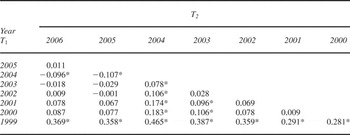
Table 1 presents the results of the bootstrap test of equality of Theil indices for all year pairs from 1999 to 2006, with statistically significant changes at p < .05 marked with an asterisk. Reading along the diagonal from the bottom right, the largest year-on-year change in wage inequality (0.281) occurred from 1999 to 2000, the first observation in the sample. While the value of the observation is not meaningful by itself and cannot be translated into a magnitude, values are comparable across year pairs—higher values indicate larger changes. Table 1 shows that wage inequality increased steadily through 2004 before declining in 2005 and then leveling off in 2006. This result appears graphically in Figure 1, which displays cumulative changes in wage inequality after 1999. Because expectations about the distributional effects of trade focus on long-run trends, results cannot be expected to show up all at once. In the case of motion picture services, however, a large share of the growth in wage inequality occurred in one year. Moreover, this increase has persisted to the present.
Bootstrap test of changes in wage inequality

Notes:
Theil differences and bootstrap confidence intervals were generated with 1,000 bootstrap replications in Stata 9.0 using diff_ge, as described in Biewen Reference Biewen2002.
* Statistically significant estimates at p < .05.
Cumulative change in wage inequality, 1999–2006

The next question is whether changes in the amount of offshoring are related to trends in wage inequality during this period. Studies of trade and wages in manufacturing estimate the offshoring of materials by proxy: the most sophisticated measure is Feenstra and Hanson's, which uses input-output matrices to calculate input purchases from each supplier industry as a share of all inputs, multiplied by the supplier industry's import share of consumption and summed over all supplier industries.Footnote 42 While this may be the best measure devised to date, it assumes that materials offshoring is proportionate to the overall ratio of imports to consumption. Applying this method to the offshoring of services further suffers from the absence of industry-level import data, which leads Amiti and Wei to use economy-wide import shares as a “best guess.”Footnote 43 An underlying problem is that “trade in services requires, unlike trade in goods, no physical package to cross borders, frequently has no description of content, or information on quantity, origin or destination, and critically has no administrative system based on customs duty collection measuring it.”Footnote 44 Current survey design and measurement in the United States and elsewhere therefore preclude reliable official figures on offshoring in services.Footnote 45
Fortunately in the case of motion pictures, guessing is unnecessary because offshoring leaves a more visible paper trail than in most services industries. There are two reasons for this. First, while services frequently are delivered electronically via satellite, cable, or the Internet, motion picture services can be stored in a physical package (a film, tape, or disk) and traded as a good. Second, within the broad category of business, professional, and technical services—the area where services offshoring has increased most significantly—the U.S. Bureau of Economic Analysis (BEA) records “miscellaneous disbursements” to fund production costs for motion picture films and television programs. Reliable data therefore exist for motion pictures traded as goods and transmitted as services.
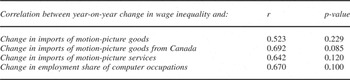
The first three rows of Table 2 display Pearson correlations between the year-on-year changes in wage inequality presented earlier in this section and changes in the volume of imported motion pictures. While correlation coefficient analysis is less convincing than multivariate statistical testing, the small number of years in the sample (eight years, which yields seven observations of year-on-year changes) precludes the estimation of a robust empirical model. But despite the small size of the sample, the Pearson correlations nevertheless suggest that wage inequality strongly coincides with offshoring in motion picture services.
Pearson correlations for possible causes of wage inequality

Notes:
All import variables are lagged one time period; this means that changes in imports from 1998–1999 influence changes in inequality from 1999–2000 and so on. Computer-related employment is not lagged. N = 7.
Starting with offshoring measured in terms of trade in goods, the correlation between year-on-year changes in imports from all sources and changes in wage inequality produces a Pearson's r of 0.523, which is not statistically significant. However, changes in imports from Canada—by far the largest supplier country—are highly correlated with changes in wage inequality (Pearson's r = 0.692) and this figure is statically significant at the p < .1 level.Footnote 46 The results are similar for motion pictures traded as services, where the correlation with changes in wage inequality (Pearson's r = 0.642) falls just shy of statistical significance.Footnote 47
Studies of wage inequality in manufacturing generally assign higher importance to skill-biased technological changes, such as greater use of computers and the Internet, than to trade.Footnote 48 The fourth row of Table 2 shows that annual changes in the employment share of computer occupations are also strongly and statistically significantly correlated with changes in wage inequality (Pearson's r = 0.670). The problem is disentangling the independent impacts of trade and technological change because the two effects are observationally equivalent: trends in computer use and changes in services imports both cause structural shifts in the relative importance of skilled technicians. Uncovering the relative impact of services offshoring on wage inequality therefore requires a multivariate statistical model with instrumental variables to account for endogeneity between offshoring and technological change.Footnote 49 Because of the small number of years in the sample, I do not attempt to estimate such a model.
While I cannot prove causality, the statistical analysis at least demonstrates that offshoring and wage inequality have gone together in motion picture services. These results are consistent with the first hypothesis, which is that offshoring produces larger wage disparities between workers of different skill levels (though technological change is at work simultaneously). The findings also bolster the expectation that offshoring is likely to affect political behavior. Because different occupations are affected differently, the incentives to seek policy measures to limit trade in tasks will be more intensely felt by some than others—motivating lobbying activity on policies toward offshoring.
Trade Lobbying in U.S. Motion Picture Services
The previous section's finding that offshoring trends have coincided with changes in wage inequality indicates that labor market outcomes have favored high-skilled workers and harmed low-skilled workers. Yet while trade always has distributional effects, similarly affected individuals sometimes fail to mobilize in pursuit of their collective interests. In part because of this, recent scholarship has taken to studying individual preferences rather than observing them in political behavior.Footnote 50 These studies usefully test whether perceived self-interests match the expectations of theoretical models; but in political terms, preferences are interesting mainly as a motivator for collective action. In short, the larger purpose is to understand how and why groups lobby.
My theoretical argument emphasizes two preconditions for individuals to act on their trade preferences and form or join groups to seek policy remedies for offshoring. First, the expected benefits of lobbying for policy change increase with the adjustment costs of offshoring: there must be tangible harm, not simply loss relative to others. Second, the expected costs of lobbying for policy change decline with union density and geographic concentration. All else equal, geographically concentrated, unionized labor groups find it easier to lobby.
Both factors point to a high likelihood of collective action in U.S. motion picture services. Adverse labor market fortunes during the period when offshoring was expanding undoubtedly led certain classes of workers to suspect that this trend was damaging their job prospects. From 1999 to 2002, employment in motion picture services declined 14.7 percent in Los Angeles County, where more than half of the industry's jobs were located; nationally, employment fell by 4.3 percent.Footnote 51 The growth in wage inequality in this period, which peaked in 2004 (as Figure 1 illustrates), suggests that the weak labor market hit low-skilled labor particularly hard. In short, it is no surprise that some workers would blame offshoring for their labor market adversity.
While the labor market effects of offshoring increased the expected benefits of lobbying, union density and geographic concentration reduced the costs of collective action. Union membership in motion picture services is higher than in private-sector services overall—15 percent compared to 7 percent.Footnote 52 More significantly, the seat of motion picture production, Los Angeles County, accounted for 53 percent of employment and 64 percent of wages paid nationally in 2001.Footnote 53 Jensen and Kletzer place the industry in the top eight most geographically concentrated of eighty-three private services.Footnote 54 Because jobs and production are highly localized, the labor market effects of trade are intensely felt in a small geographic area. This spatial clustering puts workers in close proximity, which facilitates collective action.
The case of motion picture services therefore allows political divisions over trade in services to be systematically observed in organized activity. After recounting the political campaign for countervailing duties and Section 301 action, the next part of the analysis employs ordered probit models to demonstrate that political pressure to block offshoring in motion picture services has drawn support mostly from low-skilled workers, while high-skilled workers have opposed measures against offshoring or taken no position.
Political Activity against Runaway Production
Recent political activity against runaway production dates to 1998, the year that Canada's federal government and several provinces expanded tax credits for locally filmed motion pictures and television programs. In Hollywood in December 1998, an out-of-work production designer formed the Film and Television Action Committee (FTAC), a nonprofit “social welfare” organization whose “sole purpose is to keep all aspects of film production in the United States.”Footnote 55 FTAC held its first major event in April 1999, a “Bring Hollywood Home” rally in Burbank's Johnny Carson Park that drew a crowd of 1,500.Footnote 56 In August 1999, an estimated 5,000 people protested runaway production in an FTAC-sponsored march down Hollywood Boulevard.
FTAC merged grassroots organizing with direct political activity in December 2001, when it petitioned for countervailing duties on film and television productions entering the United States from Canada. The complaint alleged that Canadian subsidies materially injured U.S. workers producing feature films for release in theaters, movies of the week for cable and television, and television and cable series. FTAC further asserted that Canadian tax credits for film and television productions were illegal bounties under U.S. trade law and the WTO Agreement on Subsidies and Countervailing Measures.Footnote 57
In its filing, FTAC cited the backing of the 118,000-member Screen Actors Guild (SAG). The Studio Utility Employees Local 724 of the Laborers International Union and five locals of the International Brotherhood of Teamsters added another 5,875 supporters. However, FTAC could not cite the support of the 101,000-member International Alliance of Theatrical and Stage Employees (IATSE), which had defeated a resolution to condemn foreign subsidies and endorse countervailing duties at its July 2001 convention. Other groups such as the Producer's Guild of America (PGA), the Director's Guild of America (DGA), and the American Federation of Television and Radio Artists (AFTRA) openly opposed the petition as a threat to their lobbying efforts to secure tax credits from the U.S. Congress and the California State Assembly.
Five weeks into the U.S. International Trade Commission (USITC) investigation, FTAC abruptly withdrew its countervailing duty claim. The group's leaders vowed to strengthen and resubmit the petition.Footnote 58 But FTAC instead shifted its focus to planning a Section 301 filing to pressure the U.S. Trade Representative (USTR) to challenge Canadian film and television subsidies in the WTO. With the help of a $100,000 donation from the International Brotherhood of Teamsters, FTAC hired the Washington, D.C., law firm Stewart and Stewart to prepare its complaint.Footnote 59 Finally in September 2007, Stewart and Stewart submitted the group's Section 301 petition to the USTR.Footnote 60
In the intervening five years, FTAC expanded its base of support among film industry unions. Two international unions joined its movement: the International Brotherhood of Teamsters and the Laborers International Union of North America. Though the IATSE International did not change its stance against trade measures to block runaway production, six IATSE locals signed on to the FTAC campaign. A seventh IATSE local filed a letter with the U.S. Department of Commerce's Unfair Trade Practices Task Force and then endorsed Section 301 action in a “Resolution on Runaway Production.”Footnote 61 FTAC also gained the backing of three other union locals in the industry.
Evidence suggests that labor market adversity—weakening demand for low-skilled labor reflected in growing wage inequality—motivated this lobbying for trade remedies. It should be noted that the FTAC filings do not specifically mention wage disparities. Yet this omission does not falsify the causal link between wage inequality and protectionist lobbying. Petitioners for trade remedies must show that they represent an industry as a whole, not a narrow constituency within it.Footnote 62 In its countervailing duty filing, for example, FTAC claimed the support of “more than 12,000 individuals employed in the film and television industry” who were not members of any of the co-petitioning organizations to meet statutory requirements for standing.Footnote 63 Moreover, petitioners for trade remedies must demonstrate “injury” or “adverse effect,” which can be illustrated in terms of lost jobs more persuasively than lower wages for particular classes of workers. Thus, the Section 301 petition alleged the loss of 138,684 job opportunities (17,335 per year) due to Canadian subsidies and called for measures to “keep valuable production dollars and good jobs in the U.S., while leveling the playing field for American workers and businesses whose livelihoods depend on a vibrant and competitive domestic film and television production industry.”Footnote 64
Without mentioning wage inequality, the FTAC filings nevertheless allude to distributional outcomes in terms of losses for less-skilled production and crew labor. The countervailing duty petition identifies those most injured as “gaffers (lighting directors), grips, cameramen, carpenters, painters and electricians to build sets, makeup artists, sound engineers, musicians, actors, caterers, drivers and many other skilled and semi-skilled workers.”Footnote 65 The Section 301 complaint likewise describes the petitioners as “rank and file workers, actors, and entertainment industry vendors and producers,” noting that “those who lose out when a feature film moves to Canada are U.S. small businesses and workers such as electricians, cinematographers, set builders, etc.”Footnote 66 The important question is whether labor-skill differences systematically explain protectionist lobbying in political campaigns against offshoring.
Probit Analysis of ftac support
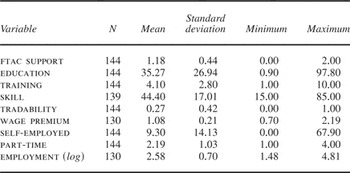
The pattern of labor support for and opposition to the FTAC filings provides the dependent variable for the statistical analysis. The dependent variable, ftac support, is a categorical measure coded “2” if labor groups representing employees in the occupation supported the FTAC campaign for countervailing duties and Section 301 action; “1” if labor groups in the occupation were neutral on the FTAC campaign or no position could be determined; and “0” if they publicly opposed the FTAC campaign. The units are occupations (defined in terms of SOC codes) in motion picture services.
Labor-group preferences were assigned to SOC codes in two steps. First, labor groups supporting and opposing the FTAC campaign for policy remedies were identified through submissions to the USITC in December 2001, the U.S. Department of Commerce's Unfair Trade Practices Taskforce in June 2004, and the USTR in September 2007. Second, the labor groups expressing a position on the FTAC petitions were matched to SOC codes based on information about the occupations that the group represented.Footnote 67 Out of 144 occupations, twenty-nine were coded “2” for support and three were coded “0” for oppose. In one occupation, “Actors” (SOC 27-2011), labor groups representing workers in the occupation adopted opposing positions; this occupation therefore was coded “1” for neutral or no position.Footnote 68 Because no position could be determined for 111 other occupations (77 percent of the sample), these cases were coded “1.” In 70 of these 111 occupations, a union or guild could be identified, but the relevant group issued no public position on FTAC petitions.Footnote 69 In the other forty-one occupations (primarily management, financial, and a handful of professional and technical occupations), no union or guild could be identified. Excluding these forty-one occupations did not change the statistical significance of any of the independent variables in the models reported in this part of the analysis, so the results are presented for the full sample.Footnote 70
In evaluating how offshoring affects labor-group preferences, one critical issue is how to specify and measure labor skills in different occupations. Conceptually, skill is not an industry-specific attribute because individuals facing labor market adversity can seek work in another industry. Generally speaking, the most important labor-market skill is the ability to learn: completion of a program of education or training for one occupation demonstrates the capacity to be retrained for another; because unskilled workers, relatively lacking in the ability to learn, are not well educated or highly trained, they are harder to retrain. Though the analysis here focuses on motion picture services, the skill to learn—not acting talent, artistic creativity, or dexterity with a camera—is the key determinant of political responses to labor market pressures.
Because the skill to learn is not easily observed, it is necessary to devise proxy measures. One approach is to use wages as a proxy for skill on the premise that the two will be correlated. However, it is better to measure skill independent of compensation. One popular measure is educational attainment: many studies presume that workers who have received a college degree are more skilled than those who have not. A second potential measure of skill is the level of training required for a given occupation. Finally, there are ways to measure raw skill without being specific to any particular type of work.
My data analysis employs three different proxy measures of the level of skill in an occupation. The first measure, education, is the percentage of workers aged twenty-five to forty-four who have completed a college degree. The second measure, training, is a categorical variable adapted from the BLS Occupational Outlook Handbook, which assigns a category “that best describes the education or training needed by most workers to become fully qualified” in an occupation.Footnote 71 The third measure, skill, is the level of “complex problem solving skills” required in an occupation. This variable comes from the U.S. Department of Labor's Occupational Information Network, which ranks occupations based on the importance and level of knowledge, skills, and abilities required to perform the typical job functions.Footnote 72
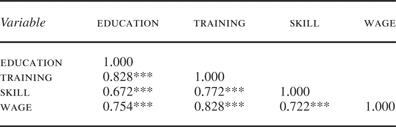
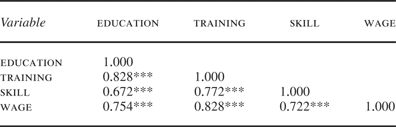
These three measures each capture important elements of labor skills that are not contained in the others. There is also substantial overlap among the different measures and all are correlated with wages. Table 3 displays pairwise correlations for education, training, skill, and wage (mean hourly wages). All are significant at the p < .001 level, as the correlations vary from 0.672 to 0.828. To demonstrate the robustness of the results, the probit analysis estimates separate models for each of the three skill measures, with no preconceptions about which best approximates skill levels in an occupation.
Pairwise correlations for education, training, skill, and wage
Notes:
Cell entries are Pearson correlations and significance levels for 144 SOC codes in Motion Picture Production and Allied Services.
*** p < .001;
** p < .01;
* p < .05.
To assess the impact of labor skills on trade preferences, it is necessary to control for the ease with which job functions can be traded internationally. If the measures of skill levels are correlated with tradability—for example, if high-skilled jobs are more easily moved offshore, as some have suggested—then failing to control for tradability could bias the estimates for labor skills. The data analysis therefore includes a measure of “potential offshoring,” labeled tradability. Van Welsum and Reif designate sixty-seven census occupations as “tasks that could be potentially carried out anywhere.”Footnote 73 These occupations are weighted by employment and aggregated into SOC codes to produce tradability, which varies continuously from 0 (no workers in the occupation are potentially affected) to 1 (all workers in the occupation are potentially affected).Footnote 74
The models account for the industry specificity of labor skills using wage premium, which is the mean hourly wage for the occupation in motion picture services divided by the mean hourly wage for the occupation in all industries. Interindustry wage differentials, which arise when an occupation is paid more in one industry than the same occupation in other industries, suggest the presence of labor market rents for workers with industry-specific skills.Footnote 75 Generally industry-specific factors are thought to have the strongest incentives to engage in protectionist lobbying.Footnote 76
The analysis includes three other control variables. self-employed is the percentage of workers in the occupation that are self-employed. part-time ranks the prevalence of part-time employment in the occupation.Footnote 77employment is the natural log of employment for the occupation in motion picture services.
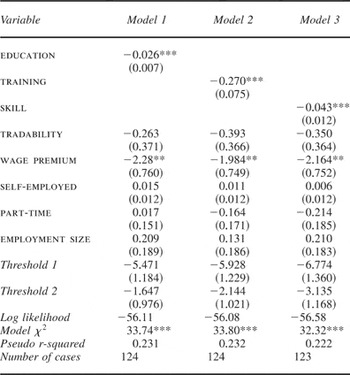
Because the dependent variable, ftac support, is ordered categorically, ordered probit is an appropriate method of analysis. Table 4 displays the ordered probit results. The three models are identical except that each uses a different proxy measure for labor skills—education, training, and skill respectively. All three skill measures are negatively signed and statistically significant at the p < .001 level. In contrast, tradability has the incorrect negative sign and is not statistically significant in any of the models. This suggests that workers in motion picture services should be organized according to labor skills, not the ease with which job functions could be moved offshore: even if tradable occupations are more exposed to offshoring (a claim that the model cannot test), collective action in this case reflects differences in skill levels.
Ordered probit estimates for ftac support

Notes:
Cell entries are maximum likelihood estimates and asymptotic standard errors (in parentheses).
*** p < .001;
** p < .01;
* p < .05.
In addition to the skill measures, wage premium is statistically significant in all of the models. The negative coefficient on this variable is inconsistent with the expectation that industry-specific factors tend to be more protectionist. In the case of motion picture services, workers in occupations earning labor market rents tended not to support FTAC. Generally, these occupations have the largest concentrations of “above-the-line” labor—creatively talented individuals earning higher salaries than workers performing similar job functions in other industries. This suggests that trade in generalized, routine production tasks sustains the wage premium for workers with industry-specific skills, whose jobs are less affected by offshoring. In these occupations, for example, studios may be more inclined to transport domestic workers to the location of the shoot rather than hiring foreign labor to perform these duties.
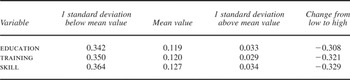
Because the ordered probit coefficients for the different skill measures are not comparable, Table 5 displays marginal effects for these coefficients expressed in terms of the probability that workers in an occupation supported FTAC. The marginal effects are similar for the three measures. skill has the largest marginal effect: the probability of ftac support declines by 0.329 as skill changes from low to high. The marginal effects for education and training, respectively 0.308 and 0.321, also are large.
Marginal effects of education, training, and skill on ftac support

Notes:
Cell entries are predicted probabilities of ftac support = 2 from the models in Table 4, minus and plus one standard deviation of the reported variable, holding all other variables constant at their mean values.
Overall, the probit models strongly support the hypothesis that labor skills are a key determinant of labor-group preferences for policies toward offshoring. In the FTAC campaign for countervailing duties and Section 301 action, the groups that lobbied to restrain offshoring represented low-skilled occupations. Labor groups in high-skilled occupations generally opposed these measures or took no position.
The New Politics of Trade in Services: Domestic and International Implications
I have developed and tested two main insights thus far. The first point is that task trade in services has predictable and visible labor market effects: distributional outcomes divide workers according to occupational skill. Second, aggrieved workers often want policy remedies to mitigate the costs of labor market adjustment; in these debates, low-skilled and high-skilled workers tend to be at odds, creating incentives to organize and lobby separately.
These findings have important implications for U.S. trade policy and the global trade regime. If domestic institutions are equipped to accommodate demands for welfare compensation in services, for example, through the favorable interaction of left governments, strong unions, and corporatist intermediation,Footnote 78 labor market adjustment to growing services trade may be relatively smooth. But wherever the state is incapable of cushioning the effects of globalization on labor—not the least, in the United States—the new politics of trade in services could get divisive and messy. The more that countries struggle domestically to adapt, the greater the probability that national problems will be channeled upward to the WTO in the form of pressure to modify trade rules in the GATS.
Effects on U.S. Trade Policy
Task trade in services is likely to be most contentious politically in countries where trade and labor-market policies are unprepared to meet the needs of displaced and at-risk services workers. Responsiveness is particularly lacking in the United States because of high-entry barriers for service industries in the trade remedy process.
Protectionist campaigns such as the FTAC movement for countervailing duties face significant obstacles in services. Because petitioners in trade remedy cases must identify a Harmonized Tariff System (HTS) code for their product, import barriers at national borders are feasible only for services that can be encased in a physical package such as a film, tape, or disk; electronically traded services are not even classified in the HTS nomenclature that catalogs national tariff schedules. Even services that are traded as goods face challenges, such as the statutory requirement that a majority of an industry's workers support a trade remedy petition. As the article illustrates, offshoring primarily injures low-skilled workers in the segment of production that is being moved abroad; capital and high-skilled labor benefit from offshoring, while low-skilled workers in activities that remain onshore may not experience any immediate loss. With the costs concentrated on narrow categories of workers, broad political mobilization to protect jobs is difficult in services fragmented by differences of occupation and skill. Petitions for old-fashioned trade remedies are therefore destined to produce the same failure that FTAC experienced, which helps to explain why more such efforts have not been tried to date.
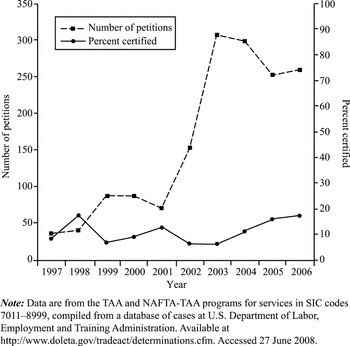
The problem for U.S. workers in services is that transitional assistance under the TAA (Trade Adjustment Assistance) program is unavailable. According to the Department of Labor's statutory interpretation only “workers who produce articles” qualify for benefits. However, Congress declined to extend coverage to services in the TAA Reform Act of 2002.Footnote 79 As a result, unsatisfied demand for TAA in services has swelled with the growth of services trade. As Figure 2 illustrates, TAA petitions in service industries nearly doubled between 1998 and 1999 and then tripled from 2001 to 2003. Yet certification rates continue to range between 10 percent and 20 percent—which means that more than 200 petitions have been denied annually since 2003.
TAA petitions and certifications rates in U.S. services, 1997–2006

Since its inception in 1962, expanding and reforming TAA has aimed to build support for trade liberalization in the U.S. Congress.Footnote 80 At present, extending TAA to services is probably a prerequisite for the renewal of the now-expired fast-track negotiating authority. Yet labor leaders have long decried TAA as mere “burial insurance” and it is not clear that the program would work any better in services. Moreover, transitional assistance helps workers only after their jobs have been lost, which preserves the motives for labor groups to mobilize to prevent jobs from migrating abroad in the first place. This leaves room for protectionist alternatives to restrict trade in services and policies to punish companies for moving jobs abroad or reward them for keeping work onshore, particularly through the tax code. How the global trade regime will handle the resourceful measures likely to emerge from national efforts to cope with expanded trade in services is therefore an important but unresolved issue.
Effects on the Global Trade Regime
Theoretical studies demonstrate how flexibility in global trade rules helps to build and maintain political support for freer trade in the face of uncertainty about the domestic effects of liberalization. In the General Agreement on Tariffs and Trade (GATT), loopholes such as the inclusion of an escape clause allowed countries to temporarily suspend commitments that produced unanticipated domestic costs; while this opened the door to cheating, it also made acceptance of trade liberalization easier to sustain domestically.Footnote 81 Though the WTO contains higher levels of precision and obligation than the GATT, with delegation to a more powerful dispute resolution authority,Footnote 82 the old political compact remains in place: countries may still freely employ safeguards, even when their use is inconsistent with WTO rules (as the Bush Administration's steel tariffs illustrate), because penalties for nonconforming practices are not retrospective.
This formula of liberalization with exceptions is more precarious in services, however. One problem is the absence of an emergency safeguards clause in the GATS. Following the logic of the rational design of international institutions, this omission makes it harder to persuade countries to liberalize sensitive services sectors—particularly given the political dynamics of the positive list, which obligates countries to grant market access and national treatment only in the specific sectors and modes of delivery included in their commitment schedules. Another problem is that, while GATS places few limits on subsidies, it provides no remedies for countries harmed by them. If arrangements to discipline subsidies cannot be worked out in the ongoing trade round, then pressure to develop rules for countervailing measures is bound to intensify. Both problems suggest that the WTO is not prepared to manage conflicts over trade in services that may arise.
In the case of safeguards, Article X of the GATS set a deadline of January 1998 for members to consider “the question of emergency safeguard measures.”Footnote 83 Today these discussions continue with no consensus on whether to add emergency safeguards to the GATS. The WTO Secretariat has recognized the benefits of a safeguard clause for future liberalization:
The security of knowing that appropriate safeguards were available against unforeseen developments might induce higher levels of commitment than Members would otherwise be willing to assume. Viewed in this manner, it would seem essential that any safeguard measures be accessible enough to make Members confident that their commitments can be modified if extenuating circumstances so demand, but not flexible to the point where the value of the underlying commitments themselves is called into question.Footnote 84
However, some WTO members consider safeguards undesirable because international transmissions of services are so different from trade in goods.Footnote 85 In these debates, the position that safeguards reduce the risks of liberalization has been more popular among developing countries while developed countries, notably the United States, maintain that the GATS already allows sufficient flexibility to temporarily withdraw certain obligations. Insofar as task trade in services occurs mostly between developed economies—the ferment about India and China notwithstanding—this resistance to the creation of a safeguard clause could soften. In the meantime, the present arrangement limits the occasion for opportunistic reneging but at the expense of a safety net for countries to adjust to unforeseen shocks in services trade, thereby reducing the incentives for WTO members to add more sensitive services to their scheduled commitments.
Subsidies and countervailing measures in services also remain unfinished business of the Uruguay Round. GATS Article XV acknowledged that subsidies can distort services trade but left the “appropriateness of countervailing procedures” for future negotiations. While members “adversely affected” by another's subsidies may request consultations, the responding country is obligated merely to address the matter with “sympathetic consideration.”Footnote 86 This means that no remedy is available to complainants if the country granting the subsidy made no commitments in that sector, or limited its commitments to preserve the subsidy.Footnote 87 As a result, pressure to incorporate countervailing measures in the GATS is bound to grow as more countries experience subsidized competition in services, as occurred in the case of the FTAC challenges to Canadian subsidies in motion picture services. Indeed, the WTO Secretariat finds considerable state support for service industries in member countries.Footnote 88 Yet to date, agreement on how to deal with subsidies that distort trade in services remains elusive.Footnote 89 Moreover, the absence of a safeguard clause further enhances the attractiveness of subsidies as a response to market disruption from services trade—increasing the probability of disputes over services subsidies in the WTO.
Conclusion
The political economy of offshoring remains understudied despite the attention the issue has received of late. This study of motion picture services provides a foundation for analyzing the labor market effects of offshoring and the political responses to it in other services. In future research, three sets of questions appear to be fertile lines of inquiry.
First, debates continue over whether task trade in services transmits the same skill biases as in manufacturing. The analysis of this study finds evidence that offshoring brings growing wage inequality, at least in motion picture services, with the implication that tradability operates at the level of the sector more than the specific occupation. But in other services—particularly where tasks migrate abroad in small, discrete pieces rather than large, team-oriented projects such as a motion-picture shoot—the effects may be different. Unraveling the impact of skills and tradability on wages for different types of work therefore requires systematic study of several industries.
Second, it is critical to understand the circumstances under which workers feel threatened enough to act politically and are able to do so. Future research should explore whether collective action is more prevalent in services with cohesive, geographically concentrated labor organizations. In the case of U.S. motion picture services, union membership is higher than in most services and employment is highly localized in the Los Angeles area, creating a likely case for political mobilization. Because labor is contracted on a project basis, the industry also features an extensive guild system that differentiates according to job functions. Collective action could be more difficult in service industries with more encompassing labor organizations, where cleavages across skill and occupation fragment industry preferences. In such cases, labor groups may be predisposed to accept their fate passively through “exit” rather than seeking transitional support, trade restraints, or other policy remedies by “voice.”
Third, there is the broader political dimension: if offshoring has an impact on specific constituencies, then certain types of elected representatives will feel pressure to respond. Appeals from organized labor in the United States to protect manufacturing jobs mostly have affected Democrats, contributing to greater partisanship on trade issues in the past thirty years. White-collar services employees are not so tightly mobilized within one political party, so the continued expansion of trade in services may begin to wear down this partisan cohesiveness. Moreover, services offshoring in the United States disproportionately affects metropolitan areas, raising the specter of urban-rural conflicts rarely seen in recent trade politics.Footnote 90
Further research is needed to inform policy debates about how to respond to growing trade in services. Proposals advanced in the United States include not only trade restraints against offshoring and the extension of TAA to services, but also changing the tax code to end tax deferrals on income earned abroad and introduce financial incentives to keep jobs onshore.Footnote 91 France already offers tax breaks for companies to keep jobs onshore or return work previously relocated abroad, while the European Union recently established a €500 million “globalization adjustment fund.”Footnote 92 But the costs, benefits, and scope of the various policy alternatives will remain uncertain until more is known about task trade in services and its effects on different types of workers.
Appendix: Sources of Study Variables
Dependent Variable
FTAC Support
Support for the FTAC campaign for countervailing duties and Section 301 action is coded from three sources: (1) the petitioners for countervailing duties listed in Joseph Reference Joseph2001; (2) comments on the Unfair Trade Practices Task Force at the U.S. Department of Commerce, International Trade Administration, available at ⟨http://ia.ita.doc.gov/download/utptf/utptf-cmts-index.html⟩, accessed 27 June 2008; and (3) the petitioners for the Section 301 complaint listed in Stewart, Dunn, and Fennell Reference Stewart, Dunn and Fennell2007 and the roster of groups endorsing the petition in “The Facts about FTAC's Section 301(a) Filing,” FTAC, available at ⟨http://www.ftac.net/html/301a-2.html⟩. Accessed 27 June 2008.
Descriptive statistics

Independent Variables
Education; Training
“Occupational Projections and Training Data, 2004–05 Edition” (Table I-1: Educational attainment cluster, most significant source of postsecondary education or training, and educational attainment distribution, by occupation), BLS, available at ⟨http://www.bls.gov/emp/optd/optdtabi_1.zip⟩. Accessed 27 June 2008.
Skill
“Skills–Complex Problem Solving,” O*Net Online, available at ⟨http://online.onetcenter.org/find/descriptor/result/2.B.2.i⟩. Accessed 27 June 2008.
Tradability
Occupations potentially affected by offshoring are listed in Welsum and Reif Reference Welsum, Reif, Collins and Brainard2006, Table A-3. Census Occupational Classification System Codes were weighted by 2000 employment totals and aggregated to SOC codes using data and crosswalk files in U.S. Bureau of the Census 2003.
Wage Premium; employment size
“2001 Occupational Employment and Wage Estimates, 2001 National 3-Digit SIC Industry-Specific Estimates,” BLS, available at ⟨ftp://ftp.bls.gov/pub/special.requests/oes/oes01in3.zip⟩. Accessed 27 June 2008; “2001 Occupational Employment and Wage Estimates, 2001 National Cross-Industry Estimates,” BLS, available at ⟨ftp://ftp.bls.gov/pub/special.requests/oes/oes01nat.zip⟩. Accessed 27 June 2008.
Self-Employed; Part-Time
“Occupational Projections and Training Data, 2004–05 Edition” (Table III-1: Occupational employment and job openings data, 2002–12, and worker characteristics, 2002), BLS, available at ⟨http://www.bls.gov/emp/optd/optdtabiii_1.zip⟩. Accessed 27 June 2008.