Introduction
After the Tōhoku earthquake and tsunami, and the following nuclear disaster at the Fukushima Daiichi Nuclear Power Plant (NPP) on 11 March 2011, high activity concentrations of radiocesium (134Cs, 137Cs), radioiodine (131I) and other radionuclides were reported from eastern Japan. Measurements came mainly from the atmosphere, surface soil, water and vegetables (MEXT 2013). However, lichens have not yet been investigated after the Fukushima NPP accident. Lichens are known to accumulate radionuclides and to reflect the total amount of fallout, since 1) they have no root and accumulate radionuclides in a passive way through the entire thallus, 2) they spread on a wide variety of substrata such as tree bark, rock, soil and concrete, and 3) they are long-lived organisms (Nimis Reference Nimis1996; Thomas & Gates Reference Thomas and Gates1999; Seaward Reference Seaward, Nimis, Scheidegger and Wolseley2002).
This paper reports on the activity concentrations of radionuclides (131I, 134Cs and 137Cs) in lichens collected in Tsukuba City (c. 170 km south of the Fukushima NPP) using a low background gamma-ray detector. For comparison, we also measured these radionuclides in a specimen of Phaeophyscia spinellosa Kashiw. collected at the same locality one year before the Fukushima NPP accident.
Materials and Methods
Collection of lichen samples
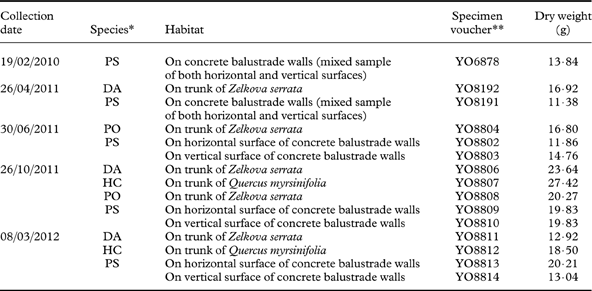
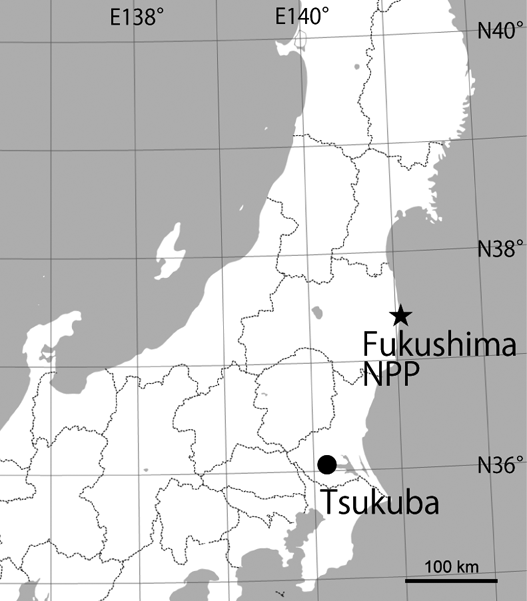
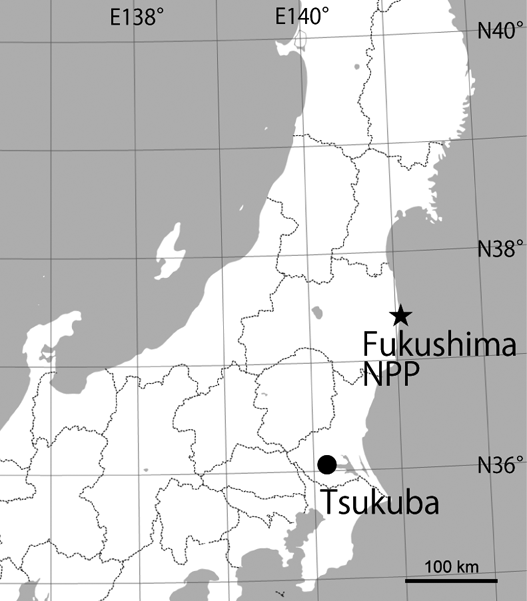
Collection information is summarized in Table 1. Lichen samples were collected after the Fukushima NPP accident in Tsukuba City, Ibaraki, Japan (36°06′N, 140°06′E; c. 25 m alt.) (Fig. 1) on 26 April, 30 June and 26 October 2011, and on 8 March 2012. A total of four lichen species from various habitats and substrata were investigated. The investigated species included Dirinaria applanata (Fée) D. D. Awasthi from trunks of Zelkova serrata (Thunb.) Makino, Hyperphyscia crocata Kashiw. from trunks of Quercus myrsinifolia Blume, Physcia orientalis Kashiw. from trunks of Z. serrata, and Phaeophyscia spinellosa from concrete balustrade walls. The samples of P. spinellosa from 26 April 2011 were mixed collections both from the horizontal and vertical surfaces of the balustrade walls, while on and after 30 June 2011, the samples were collected separately from the horizontal and vertical surfaces of the balustrade walls, respectively. A single specimen of P. spinellosa collected at the same locality on 19 February 2010, one year before the Fukushima NPP accident, was also examined. All voucher specimens are housed in the National Museum of Nature and Science, Tsukuba, Japan (TNS).
Collection information for lichen samples
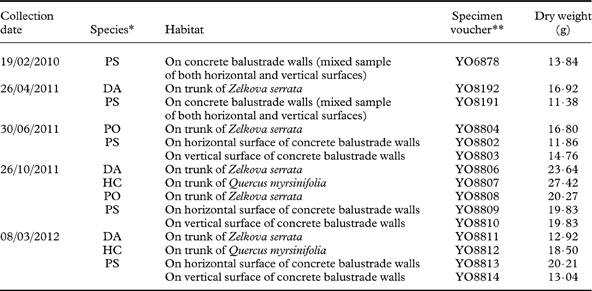
* DA=Dirinaria applanata, HC=Hyperphyscia crocata, PO=Physcia orientalis, PS=Phaeophyscia spinellosa.
** Number after YO=specimen number of Yoshihito Ohmura. All specimens are housed in TNS.
Map of eastern Japan showing the locations of Tsukuba and the Fukushima NPP.
Radionuclide measurement
The lichen samples were dried at 40°C for 48 h and crushed by hand into small pieces c. 5 mm square. Cylindrical 100 ml plastic bottles (6·5 cm high, 5 cm diameter; U-8, AS ONE) were then filled with each crushed sample for radionuclide measurement. The dry weight of the samples is shown in Table 1. Radionuclide activity concentration (Bq kg–1, dry weight) of 131I, 134Cs and 137 Cs was measured at the Center for Research in Isotopes and Environmental Dynamics, University of Tsukuba, using a low background gamma-ray detector for 2000 or 5000 s (IGC25190, Princeton Gamma Tech; MSA7800, SEIKO EG&G). The samples collected on 19 February 2010 and 26 April 2011 were measured after 2000 s, while the other samples were measured after 5000 s. The unique energies of the γ-rays (365 KeV for 131I ; 604 KeV for 134Cs; 661 KeV for 137Cs) allowed identification and quantification of the radionuclides.
Results
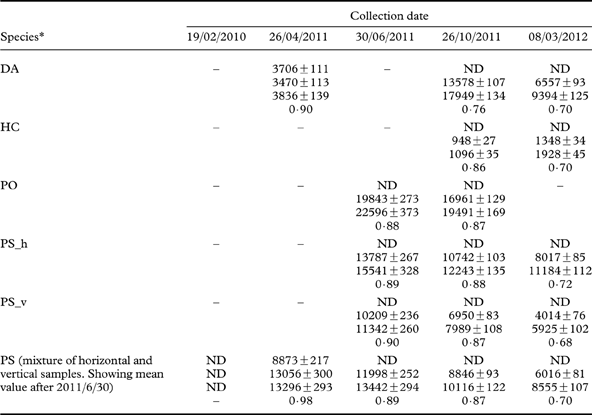
The radionuclide activity concentrations of 131I, 134Cs and 137Cs in the lichens examined differed depending on species and habitat (Table 2). The maximum activity concentrations of 137Cs measured were 22596±373 Bq kg–1 in Physcia orientalis (collected from the trunk of Zelkova serrata on 30 June 2011), 17949±134 Bq kg–1 in Dirinaria applanata (collected from the trunk of Z. serrata on 26 October 2011), 15541±328 Bq kg–1 in Phaeophyscia spinellosa (collected from the horizontal surface of concrete balustrade walls on 30 June 2011), 11342±260 Bq kg–1 in P. spinellosa (collected from the vertical surface of concrete balustrade walls on 30 June 2011), and 1928±45 Bq kg–1 in Hyperphyscia crocata (collected from the trunk of Quercus myrsinaefolia on 8 March 2012).
Activity concentrations of radionuclides in lichens collected from Tsukuba City. Values in each cell show from the top activity concentrations (Bq kg–1, dry weight) of 131I, 134Cs, 137Cs, and the ratio of 134Cs/137Cs.
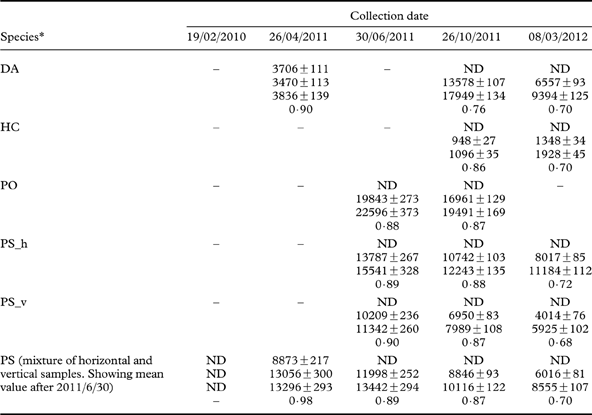
ND=not detected (below detection limit). *See Table 1 and Fig. 2 for the abbreviations.
Phaeophyscia spinellosa collected at the monitoring site on 19 February 2010 (c. one year before the Fukushima NPP accident) showed no measurable radionuclide activities, while after the NPP accident, high activity concentrations of 131I, 134Cs and 137Cs were detected for this species. 131I was detected in D. applanata and P. spinellosa collected on 26 April 2011, but not in samples collected on and after 30 June 2011. The activity concentrations of 134Cs and 137Cs were almost equal in all samples on 26 April 2011: 3470±113 and 3836±139 Bq kg–1 in D. applanata (134Cs/137Cs=0·90), and 13056±300 and 13296±293 Bq kg–1 in P. spinellosa (134Cs/137Cs=0·98). The activity concentrations of 134Cs decreased with time and became much lower than those of 137Cs for all samples by 8 March 2012, on which date the ratio of 134Cs/137Cs reached 0·68–0·72 (i.e., D. applanata: 0·70; H. crocata: 0·70; P. spinellosa on horizontal surface of balustrade walls: 0·72; P. spinellosa on vertical surface of balustrade walls: 0·68).
The activity concentration of radiocesium in D. applanata from the trunk of Z. serrata increased from 26 April to 26 October 2011, and then decreased to 8 March 2012, while that of P. spinellosa from balustrade walls stayed constant from 26 April to 30 June 2011 and then decreased. The activity concentrations of 137Cs in samples of P. spinellosa from vertical surfaces of balustrade walls were 73% lower than in those from horizontal surfaces on 30 June 2011, 65% lower on 26 October 2011, and 53% lower on 8 March 2012.
Discussion
Radionuclides in lichens collected at Tsukuba City after the Fukushima NPP accident at the investigated sites were apparently derived from the NPP because 1) one specimen collected at Tsukuba one year before the accident did not contain detectable radionuclides, 2) high activity concentrations of radionuclides were detected after the accident, 3) 131I, which has a short half-life of 8 days, was detected one and a half months after the accident, and 4) the ratio of 134Cs/137Cs in lichens was 0·90–0·98 on 26 April 2011, which is consistent with values reported for radiocesium derived from the Fukushima NPP accident [e.g. 0·8–0·9 in Kinoshita et al. (Reference Kinoshita, Sueki, Sasa, Kitagawa, Ikarashi, Nishimura, Wong, Satou, Handa and Takahashi2011); 0·9 in Masson et al. (Reference Masson, Baeza, Bieringer, Brudecki, Bucci, Cappai, Carvalho, Connan, Cosma and Dalheimer2011); 1·0 in Yamamoto et al. (Reference Yamamoto, Takada, Nagao, Koike, Shimada, Hoshi, Zhumadilov, Shima, Fukuoka and Imanaka2012)]. In comparison, the ratio of 134Cs/137Cs in the Chernobyl fallout in 1986 was reported at 0·5–0·6 (Arvela et al. Reference Arvela, Markkanen and Lemmelä1990; De Cort et al. Reference De Cort, Dubois, Fridman, Germenchuk, Izrael, Janssens, Jones, Kelly, Kvas-nikova and Matveenko1998).
The radionuclide activity concentrations in the lichens examined were much higher (e.g., 22596±373 Bq kg–1 for 137Cs in Physcia orientalis) than the values reported in mushrooms, plants and soil collected in Tsukuba City, among which the highest value was 335 Bq kg–1 for 137Cs in a soil sample (Tsukuba City 2013). The capacity of lichens for accumulating radionuclides from atmospheric deposition has been well documented, particularly for ‘Reindeer Moss' (Cladonia spp.), since the period of maximum atmospheric nuclear weapons fallout in the early 1960s (Nimis Reference Nimis1996; Seaward Reference Seaward, Nimis, Scheidegger and Wolseley2002). The main reasons why lichens accumulate high activity concentrations of radionuclides are their lack of roots, large surface area, and longevity (Thomas & Gates Reference Thomas and Gates1999). In addition, sampling design may have caused the differences in activity concentration of radionuclides. While the lichens in this study were only 2–3 mm thick and grew exposed on the surface of the substrata, the soil samples, for example, were collected at a depth of 5 cm below the soil surface (Tsukuba City 2013).
The activity concentrations of radionuclides were different depending on species and habitat. The four species examined in this study are similar in gross morphology, all being foliose and adnate to the substratum. The radiocesium activity concentrations in Hyperphyscia crocata growing on the trunk of Quercus myrsinaefolia, an evergreen tree, were much lower than those in the lichen taxa growing on concrete balustrade walls or trunks of Zelkova serrata, a deciduous tree. However, it is uncertain whether the differences in radiocesium activity concentration were due to differences in lichen species or habitat. Phaeophyscia spinellosa had different activity concentrations of radiocesium when growing on horizontal or vertical substratum surfaces (Table 2). A similar difference in activity concentrations of radiocesium was also reported for Hypogymnia physodes (L.) Nyl. after the Chernobyl accident (Guillitte et al. Reference Guillitte, Melin and Wallberg1994). The higher values in the samples from horizontal surfaces are consistent with the general notion that lichens reflect the total amount of fallout (Nimis Reference Nimis1996), as lichens growing on horizontal substrata present a larger surface area available for fallout accumulation, compared to lichens from vertical substrata. The trends of radiocesium activity concentrations in Dirinaria applanata were distinctive; that is, they first increased and then decreased. The samples were collected from the trunks of the deciduous tree Zelkova serrata, bearing no leaves at the time of the accident, and, because of this, may have been accumulated in the lichen by stem flow from the branches and twigs during the initial fallout. Later, after the radionuclides had been blown off the branches and twigs, the radiocesium activity concentrations in D. applanata might have decreased, probably by being washed out from the lichen thalli. The other species investigated in this study might be less affected by radionuclide accumulation by run-off water as they either grow on low balustrade walls, or on the trunk of an evergreen tree which might accumulate the radionuclides on their leaves (Hashimoto et al. Reference Hashimoto, Ugawa, Nanko and Shichi2012) and thus shelter the lichens.
Although lichens still hold high activity concentrations of radionuclides one year after the Fukushima NPP accident (maximum 11184 Bq kg–1 of 137Cs on 8 March 2012), the activity concentration of 137Cs drastically decreased (c. 50%) in D. applanata and P. spinellosa, especially in samples growing on vertical habitats. Since the half-life of 137Cs is c. 30 years, the loss of radiocesium from lichens might be caused by washing off by rain during the first year after the NPP accident. An exponential loss of 137Cs was reported for Cladonia stellaris (Opiz) Pouzar & Vězda (Puhakainen et al. Reference Puhakainen, Rahola, Heikkinen and Illukka2007), but 137Cs has still been detected in this species 18 years after the Chernobyl accident (e.g. 94400 Bq kg–1 in 1987 and 1560 Bq kg–1 in 2004). A similar decrease in 137Cs concentration in lichens might be observed in the polluted areas around the Fukushima NPP in the future, and long-term monitoring of lichens in Japan should be conducted for further data collection on the Chernobyl and Fukushima NPP accidents.
We express our gratitude to H. Matsumoto for giving us the opportunity to measure radionuclides at the Center for Research in Isotopes and Environmental Dynamics, University of Tsukuba; two anonymous reviewers for their valuable comments and suggestions for improving the quality of this paper; A. Frisch for checking the English; T. Dohi for her helpful comments on radionuclide measurements; and K. Matsukura, K. Nishibori, M. Ohtsuka, K. Tsukagoshi, and K. Uno for their kind help during the field surveys. This study was partly supported by Grant-in-Aid of the Japan Society for the Promotion of Science (no. 24651043).