INTRODUCTION
The topics reviewed below are divided into a number of themes related to the response of plants to their environment and to their underlying genetic and physiological potential. In the words of Phillips (Reference Phillips2009), ‘breaking the yield barrier can be achieved in two ways: Increasing “Operational yield” such as from insect resistance, etc. and from “Intrinsic yield” such as raising the base yield due to changes in physiological processes. Transgenics thus far appear to have raised operational yield’.
Although the emphasis of this review will be on agronomic (input) traits, there is also a wealth of important and interesting research being conducted on crop quality (output) traits, some of which are summarized below.
AGRONOMIC TRAITS
Water use efficiency, thermal tolerance, nitrogen utilization and acid soils
There are multiple genetic (Papdi et al. Reference Papdi, Joseph, Salamó, Vidal and Szabados2009) and epigenetic (Chinnusamy & Zhu Reference Chinnusamy and Zhu2009) mechanisms that control plant resistance to abiotic stress.
Limited available water is the single most important factor that reduces global crop yields, with far-reaching socioeconomic implications (Edmeades Reference Edmeades and James2008). It was demonstrated recently that expression of related cold shock proteins (CSPs), such as CspA from Escherichia coli and CspB from Bacillus subtilis, promotes stress adaptation in multiple plant species (Castiglioni et al. Reference Castiglioni, Warner, Bensen, Anstrom, Harrison, Stoecker, Abad, Kumar, Salvador, D'Ordine, Navarro, Back, Fernandes, Targolli, Dasgupta, Bonin, Luethy and Heard2008). Drought-tolerant maize, based on a Csp gene, is the most advanced of the drought-tolerant crops under development, and is expected to be launched commercially in the USA in 2010. In addition, a private/public-sector partnership hopes to release the first biotech drought-tolerant maize (Zea mays) by 2017 in sub-Saharan Africa, where the need for drought tolerance is greatest.
Another extensive project in the public sector is under way in Australia. In January 2010, an application was submitted for the field testing of 1161 genetically modified (GM) wheat (Triticum spp.) lines and 1179 GM barley (Hordeum spp.) lines, each containing one of 35 genes that will enhance tolerance to various forms of abiotic stress (for further information see http://www.ogtr.gov.au/internet/ogtr/publishing.nsf/Content/dir102; verified 21 September 2010).
Such projects will also be aided by an increase in the fundamental understanding of molecular mechanisms that underlie a plant's perception of the environment. For example, it has recently been shown that nucleosomes containing H2A.Z play a major role in the regulation of the temperature-related transcriptome in plants (Kumar & Wigge Reference Kumar and Wigge2010). Such information may be a key step towards breeding crops able to withstand climate change. Longer term approaches will also be based on an understanding of the signalling pathways affected by environmental stress. For example, one plant hormone, abscisic acid (ABA), co-ordinates responses to stresses such as drought, extreme temperature and high salinity, as well as regulating non-stress responses including seed maturation and bud dormancy (Sheard & Zheng Reference Sheard and Zheng2009). Because of its essential function in plant physiology, targeting the ABA signalling pathway has great promise for future application in agriculture (Fujii et al. Reference Fujii, Chinnusamy, Rodrigues, Rubio, Antoni, Park, Cutler, Sheen, Rodriguez and Zhu2009).
Improved management of nitrogen in food crop production is of major significance, both directly because of increasing costs of supplying N fertilizers, and indirectly because of the implications for environmental pollution by reactive N, particularly nitrous oxide emissions, a major anthropogenic contributor to global climate change (Ma et al. Reference Ma, Li, Ma, Wang, Sisák, Cushman and Zhang2009). There is already considerable commercial activity in transgenic crops that express a range of genes affecting nitrogen uptake and transport (Beatty et al. Reference Beatty, Shrawat, Carroll, Zhu and Good2009), and this will continue. In addition, longer term projects are targeting bacteria-mediated acquisition of atmospheric N2 and the prospect of transferring this trait to non-legumes.
Soil acidity is a major obstacle to sustainable food production around the world (Ryan et al. Reference Ryan, Raman, Gupta, Horst and Delhaize2009). In Australia, soil acidity has been identified as the most serious land degradation issue affecting agricultural production, with almost 0·5 of its agricultural land having a surface pH of 5·5 or lower. Plants growing in acid soils are denied important nutrients and are exposed to toxic elements. Transgenic approaches include the secretion by roots of organic acids able to detoxify the aluminium ions (Liu et al. Reference Liu, Magalhaes, Shaff and Kochian2009).
Improving the tolerance/resistance to plant pests/diseases
The first generation of transgenic crops included those expressing insecticidal Bt proteins. Although this approach will continue, with additional novel proteins being discovered on a regular basis, the next generation of crops will be based on a greater range of transgenes. For example, down-regulation of the expression of specific genes through RNA interference (RNAi) has been widely used for genetic research in insects (Price & Gatehouse Reference Price and Gatehouse2008). The method has relied on the injection of double-stranded RNA (dsRNA), which is not possible for practical applications in crop protection. However, expression of dsRNA directed against suitable insect target genes in transgenic plants has now been shown to give protection against pests, opening the way for a new generation of insect-resistant crops.
When attacked by herbivorous insects, plants emit volatile compounds that attract natural enemies of the insects. It has been proposed that these volatile signals can be manipulated to improve crop protection. Recently, the full potential of this strategy was demonstrated by restoring the previously suppressed emission of a specific belowground signal emitted by insect-damaged maize roots (Degenhardt et al. Reference Degenhardt, Hiltpold, Köllner, Frey, Gierl, Gershenzon, Hibbard, Ellersieck and Turlings2009). This demonstrates that plant volatile emissions can be manipulated to enhance the effectiveness of biological control agents in a novel and ecologically sound manner.
Following the well-known examples of virus-resistant papaya (Carica papaya), squash (Cucurbita spp.) and plum (Prunus spp.) (all now deregulated by the USDA), novel approaches such as those involving RNAi methods to generate lines of common bean (Phaseolus vulgaris) with resistance to the geminivirus bean golden mosaic (Aragão & Faria Reference Aragão and Faria2009) are now being employed. The work of Aragão & Faria (Reference Aragão and Faria2009) is also a notable example of a public-sector effort to develop useful traits, namely resistance to a devastating disease in an ‘orphan crop’ cultivated by poor farmers throughout Latin America.
At a basic level, increasing the natural defences of plants may reduce the impact of phytopathogens on agricultural productivity (Gust et al. Reference Gust, Brunner and Nürnberger2010). Pattern-recognition receptors detect microbes by recognizing conserved pathogen-associated molecular patterns (PAMPs) (Millet et al. Reference Millet, Danna, Clay, Songnuan, Simon, Werck-Reichhart and Ausubel2010). Encouraging recent results in controlled laboratory conditions (Lacombe et al. Reference Lacombe, Rougon-Cardoso, Sherwood, Peeters, Dahlbeck, Van Esse, Smoker, Rallapalli, Thomma, Staskawicz, Jones and Zipfel2010) suggest that heterologous expression of PAMP recognition systems could be used to engineer broad-spectrum disease resistance to important bacterial pathogens, potentially enabling more durable and sustainable resistance in the field.
Analysis and exploitation of heterosis (hybrid vigour)
The most fundamental aim in the study of intrinsic yield was to exploit the phenomenon of heterosis, the increased yield that can be obtained from the hybrid between two selected inbred parents. Many current projects, mostly on maize, are designed to understand the genetic basis of this process. For example, hybrids between the maize inbred lines B73 and Mo17 exhibit heterosis regardless of the direction of the cross. These reciprocal hybrids differ from each other phenotypically, and 0·30–0·50 of their genes are differentially expressed. Recently, a study described c. 4000 expression quantitative trait loci that allowed the identification of markers linked to variation in expression (Swanson-Wagner et al. Reference Swanson-Wagner, Decook, Jia, Bancroft, Ji, Zhao, Nettleton and Schnable2009).
Heterosis is not only observed in adult traits such as yield or plant height, but can be detected during embryo and seedling development. Hence, the maize primary root, which is the first organ that emerges after germination, is a suitable model to study heterosis manifestation (Paschold et al. Reference Paschold, Marcon, Hoecker and Hochholdinger2009). Proteome profiling experiments of maize hybrid primary roots revealed non-additive accumulation patterns that were distinct from the corresponding RNA profiles and emphasized the importance of post-transcriptional processes such as protein modifications that might be related to heterosis.
It is very likely that the underlying causes of heterosis will be revealed in the next few years and the existing methods for producing and exploiting hybrids will be greatly improved and extended beyond the existing crops such as maize and rice.
Concurrent with the study of heterosis are investigations designed to improve the isolation of haploids that act as the source of homozygous lines required as parents for the production of F1 hybrids (Dunwell Reference Dunwell2010a). Some of these novel methods, such as exploiting modified centromeric proteins (Ravi & Chan Reference Ravi and Chan2010), involve the use of transgenic plants.
Improvements in photosynthetic efficiency
Theoretical models suggest that the yield increases required to match the projected population growth can only be achieved by increasing the efficiency with which photosynthesis uses solar energy (Hibberd et al. Reference Hibberd, Sheehy and Langdale2008). Many of the most productive crops in agriculture use the C4 rather than C3 photosynthetic pathway. As a morphological and biochemical innovation, the C4 photosynthetic pathway is proposed to have been an adaptation to hot, dry environments or CO2 deficiency (Wang et al. Reference Wang, Gowik, Tang, Bowers, Westhoff and Paterson2009), and appeared independently at least 50 times during angiosperm evolution. Such multiple origins of the C4 pathway within some angiosperm families imply that its evolution may not be complex, perhaps suggesting that there may have been genetic predisposition in some C3 plants to C4 evolution. This has led to the radical suggestion that the C4 photosynthesis pathway should be introduced into rice (Sheehy et al. Reference Sheehy, Mitchell and Hardy2008).
Many studies have examined the theoretical maxima of solar energy conversion efficiencies and productivities in oxygenic photosynthesis (Sun et al. Reference Sun, Yang, Wang and Ort2009). These are contrasted with actual measurements in a variety of photosynthetic organisms, including green microalgae (Peers et al. Reference Peers, Truong, Ostendorf, Busch, Elrad, Grossman, Hippler and Niyogi2009), cyanobacteria, and C4 and C3 plants. Light is necessary for photosynthesis, but its absorption by pigment molecules such as chlorophyll can cause severe oxidative damage and result in cell death (Murchie et al. Reference Murchie, Pinto and Horton2009). Data indicate that plants and algae use different proteins to dissipate harmful excess light energy and protect the photosynthetic apparatus from damage. This information may lead to novel transgenic strategies designed to improve photosynthesis in crop plants.
Ideotype
In addition to modifications to the process of photosynthesis, the modulation of plant hormones is a potential target for genetic improvement of plant stature, leaf orientation and crop yield. The ‘green revolution’ genes were primarily involved with the suppression of the gibberellic acid (GA) response pathway, through reductions in either GA responses or GA biosynthesis, which led to new varieties with short statures, lodging resistance, high seed yield and high harvest index. The reduced GA response in wheat is due to mutation of one of the reduced height loci (rht-1), which are orthologues of the Arabidopsis transcription factor GA insensitive (delta GAI) and associated with the GA signalling pathway. Transgenic rice plants containing the delta GAI gene possess morphological changes such as short stature. The semidwarf 1 gene (sd1) in rice is due to mutation of GA20 oxidase (GA20ox), a key enzyme for GA synthesis.
Improved techniques for modelling the interactions between biochemical characteristics and ideotype will undoubtedly lead to novel transgenic approaches to optimizing the overall performance of crops. It is hoped that this process will be aided by research on model crops, such as the recent results on factors controlling the final number of cells in leaves (Rodriguez et al. Reference Rodriguez, Mecchia, Debernardi, Schommer, Weigel and Palatnik2010).
Flowering and apomixis
Control of flowering is also an area of great research activity and the increased understanding of the genetic and epigenetic (He Reference He2009) basis of this process will undoubtedly be exploited in future years.
As reviewed by D'Erfurth et al. (Reference D'Erfurth, Jolivet, Froger, Catrice, Novatchkova and Mercier2009), apomixis, or asexual reproduction through seeds, results in progeny that are genetic clones of the maternal parent. Apomixis is thus of great interest because of its potential application in crop improvement (Albertini et al. Reference Albertini, Barcaccia, Mazzucato, Sharbel, Falcinelli, Pua and Davey2009). By introducing apomixis into sexual plants, any desired genotype, however complex, could be perpetuated through successive seed generations. This notably different approach to utilization of heterosis and hybrids (see above) has been advocated for many years by researchers who propose the use of apomixis to generate self-reproducing maize hybrids (Duvick Reference Duvick, Coors and Pandey1999). It was suggested that farmers who cannot afford to buy hybrid maize seed could instead plant apomictic hybrids and save part of their grain production as seed for replanting. Several different systems for making apomictic plant hybrids have been proposed; each has potential advantages, but to date none of them are ready for exploitation in practical agriculture.
To obtain apomixis, parthenogenesis will have to be introduced, in addition to apomeiosis (Ravi et al. Reference Ravi, Marimuthu and Siddiqi2008), and the problem of endosperm formation must also be overcome. However, mutations that mimic early parthenogenesis or give rise to functional autonomous endosperm have been reported in Arabidopsis, suggesting that it should be ultimately feasible to introduce apomixis into a sexual plant species. It should be noted that a US Patent (7541514) entitled ‘Methods for producing apomictic plants’ was granted on 2 June 2009.
Gene targeting and directed mutation methods
The ability to produce complete genome sequences of plants at relatively low cost is leading to a revolution in the ability to identify and then to manipulate specific genes (Gore et al. Reference Gore, Chia, Elshire, Sun, Ersoz, Hurwitz, Peiffer, Mcmullen, Grills, Ross-Ibarra, Ware and Buckler2009). Central to this process is the concept of targeted silencing or mutation of specific gene(s). To date, crop biotechnology is limited by the inefficiencies of conventional random mutagenesis and transgenesis. Because targeted genome modification in plants has been intractable, the introduction of transgenes remains a laborious, time-consuming and unpredictable undertaking. Recently, considerable progress has been reported in the utilization of designed zinc-finger nucleases (ZFNs) that induce a double-stranded break at their target locus (Weinthal et al. Reference Weinthal, Tovkach, Zeevi and Tzfira2010). These results therefore establish a new strategy for plant genetic manipulation in basic science and agricultural applications.
Unlike ZFNs, the DNA-binding domains of most homing endonucleases are not clearly separated from the catalytic domains. This makes protein engineering procedures more complex but may confer greater selectivity for the desired target site than is possible with ZFNs. Therefore, there is great interest in re-engineering natural homing endonucleases to develop reagents for targeted genome modification. It has now been shown that rational re-design of an endonuclease can produce a functional enzyme capable of introducing double-strand breaks at selected chromosomal loci (Gao et al. Reference Gao, Smith, Yang, Jones, Djukanovic, Nicholson, West, Bidney, Falco, Jantz and Lyznik2010). In combination with DNA repair mechanisms, the system produces targeted mutations with sufficient frequency that dedicated selection for such mutations is not required. Such endonuclease-targeted genome modification could greatly accelerate the production of transgenic crop varieties.
An extension to this series of technologies is recombinase-mediated DNA cassette exchange that has been successfully used for inserting transgenes at previously characterized genomic sites in plants (Li et al. Reference Li, Moon, Xing, Liu, Mccardell, Damude and Falcoin press). This procedure allows the ‘stacking’ of transgenes at a single site within the genome of the recipient plant and is likely to be useful in the increasing trend towards the commercialization of products with multiple transgenes. For example, SmartStaxTM, a maize line with eight transgenes, is being sold under the GenuityTM brand by Monsanto, and the Mycogen brand by Dow.
Another related technology is the development of autonomous maize minichromosomes (Yu et al. Reference Yu, Han, Gao, Vega and Birchler2007). This novel approach for plant transformation can facilitate crop biotechnology by (i) combining several trait genes on a single DNA fragment, (ii) arranging genes in a defined sequence context for more consistent gene expression and (iii) providing an independent linkage group that can be rapidly introgressed into various germplasms.
Biofuels
There are several examples of commercial companies that are currently developing (Heaton et al. Reference Heaton, Flavell, Mascia, Thomas, Dohleman and Long2008) and marketing biofuel-optimized feedstock. For example, Syngenta has developed a GM maize variety (Event 3272; now named Enogen™) that contains a thermostable amylase enzyme that rapidly breaks down starch, and Monsanto plans to sell a transgenic maize variety with high starch content for ethanol production. Similarly, Monsanto, in a joint venture with Ceres, is also developing new switchgrass (Panicum virgatum) varieties with a higher yield. Exploitation of transgenic non-food crops may help to alleviate the pressures associated with using food crops for biofuel.
Patents
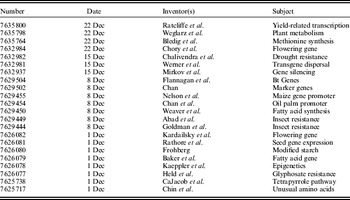
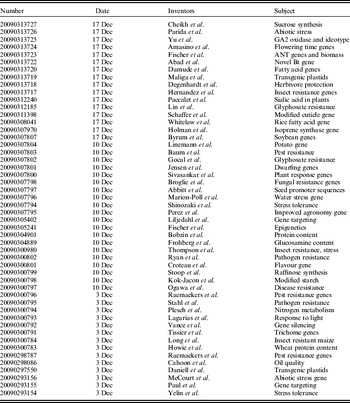
The present status and future prospects of transgenic crops have been the subjects of several recent reviews. Although these reviews included some information extracted from patent databases in order to provide a commercial perspective, this analysis has been necessarily limited in extent. The most recent review is that of Dunwell (Reference Dunwell, Kole, Michler, Abbott and Hall2010b); this includes a discussion of IPR relevant to the research scientist and to those interested in international development, globalization, and sociological and ethical aspects of the public- and private-sector relationships. The extent of patent activity in the area of transgenic plants is exemplified by the selection of recent US patents and patent applications that are provided in Tables 1 and 2. The subject matter of these patents covers all the major themes discussed in this review.
Selection of US patents on transgenic plants, granted in December 2009

Selection of US patent applications from December 2009

It is necessary to point out the commercial reality that few, if any, of the patents and applications in these lists will ever produce a financial profit. The most common reasons for this lack of success are unexpected additional costs of development or failure of the underlying science during the transfer from laboratory to field scale.
PRODUCT QUALITY TRAITS
Although genetically modified tomato (Solanum lycopersicum) with an altered processing characteristic was one of the first GM products on the market, there has been relatively little emphasis on product quality (output) traits until comparatively recently. Currently, there is much progress, particularly with efforts to modify the oil quality of soybean (Glycine max). On 8 June 2010, a high-oleic soybean, developed by DuPont and under consideration by the US Department of Agriculture since 2006, was approved for ‘deregulation’, the process that allows unrestricted sale in the USA. Currently, Monsanto is also seeking approval for two varieties of GM soybeans with modified oil quality that are designed to eliminate trans fats and produce oil with omega-3 fatty acids for use in yogurt, granola bars and spreads.
Other recent advances in this area include the production of tomatoes with greatly increased amounts of anthocyanins (Butelli et al. Reference Butelli, Titta, Giorgio, Mock, Matros, Peterek, Schijlen, Hall, Bovy, Luo and Martin2008); it was reported that, in a pilot test, cancer-susceptible mice fed a diet supplemented with these tomatoes lived significantly longer.
Another area of significant commercial activity is the use of plants for the production of high-value pharmaceutical products. The most recent and well-developed examples in this category are the field cultivation of safflower (Carthamus tinctorius) for the production of human pro-insulin used in the treatment of diabetes (Nykiforuk et al. Reference Nykiforuk, Shen, Murray, Boothe, Busseuil, Rhéaume, Tardif, Reid and Moloneyin press) and the growth in culture of carrot (Daucus carota) cells that produce the enzyme glucocerebrosidase, a product used in the treatment of Gaucher's disease (Aviezer et al. Reference Aviezer, Brill-Almon, Shaaltiel, Hashmueli, Bartfeld, Mizrachi, Liberman, Freeman, Zimran and Galun2009). On 1 December 2009, Pfizer became the first big pharmaceutical company to commit to take to market a drug produced in plant cells when it acquired rights to a form of this enzyme from Protalix Biotherapeutics, Carmiel, Israel.
COMMERCIAL GM PIPELINE
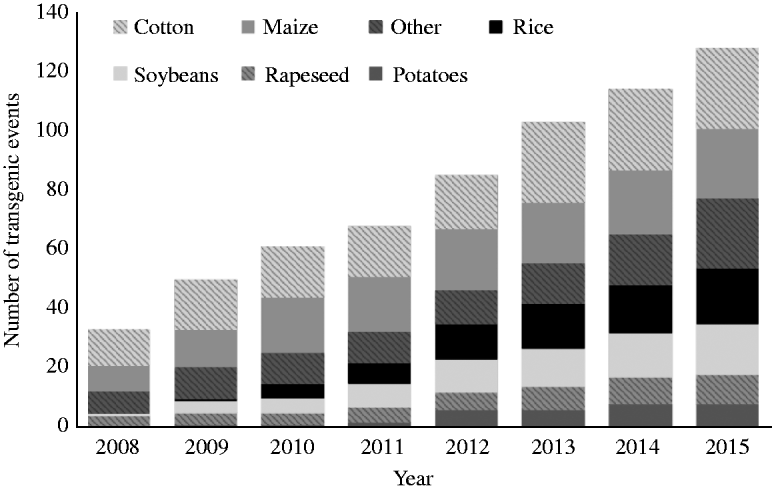
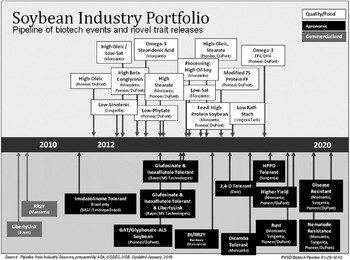
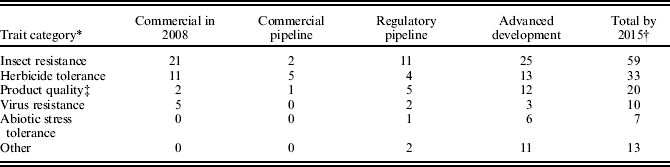
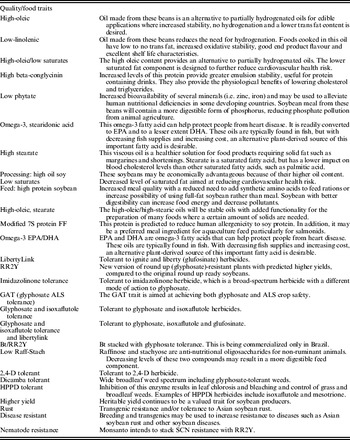
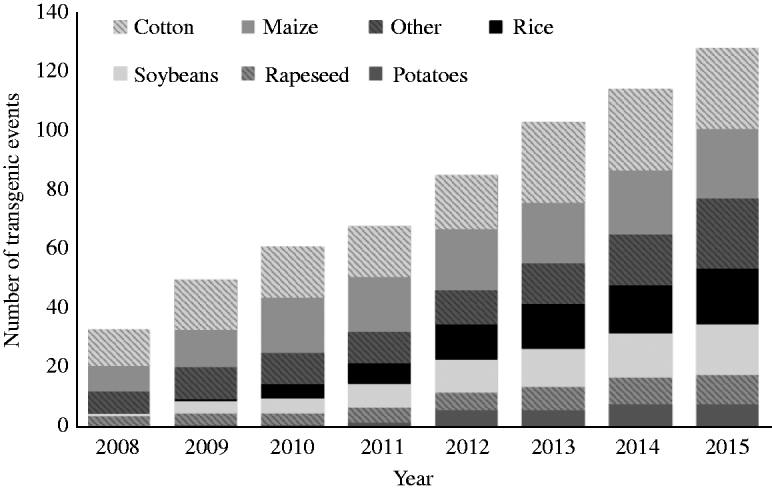
While the analysis of patent databases is a valuable aid in determining longer term trends, the extensive period of time required for the development of any new cultivar, and the associated regulatory process for GM material, means that the pipeline of GM products for the next few years is already determined. Such global data, showing numbers of individual transgenic events for the period up to 2015, are summarized in Table 3 and Fig. 1 (Stein & Rodríguez-Cerezo Reference Stein and Rodríguez-Cerezo2010). It is interesting to note the predicted increase in commercialization of rice (Oryza sativa) and potato (Solanum tuberosum) lines over this period. A more specific set of predictive data for soybean up to 2020, with an associated list of individual traits, is given in Fig. 2 and Table 4, respectively. The scale of commercial activity in this single crop can be estimated from the latest Monsanto APHIS application (10-091-101), submitted for field trials of GM soybean. This application covers various lines with a total of 28 phenotype categories and an unknown number of transgenes, to be grown on 200 acres.
Current numbers and future estimates of GM crops worldwide. Reproduced with permission from Stein & Rodríguez-Cerezo (Reference Stein and Rodríguez-Cerezo2010).
Predicted pipeline of GM soybean traits. For details on individual traits, see Table 4. Data provided by the US Soybean Export Council.

Numbers of current and expected GM traits worldwide (modified and reproduced with permission from Stein & Rodríguez-Cerezo Reference Stein and Rodríguez-Cerezo2010)
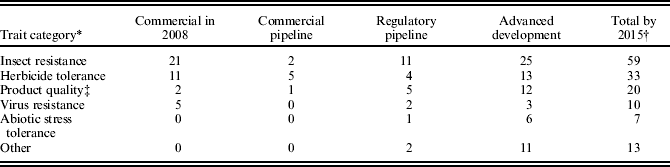
* Crops in the commercial pipeline are already authorized in at least one country but not yet marketed by the developer; crops in the regulatory pipeline are submitted for authorization in at least one country but are not yet authorized anywhere; crops in advanced development are not yet submitted for authorization but it is expected that they will pass the regulatory process by 2015.
† Numbers do not add up to total numbers given in Fig. 1 because of stacking of traits in some new GM crops.
‡ Product quality comprises crop composition traits as well as improved shelf life; crop composition is optimized for maize, oilseed rape, soybeans, potatoes and rice, and the targeted compounds cover fatty acids, amino acids, starch, beta-carotene and enzymes (these crops are optimized for use as food, feed, biofuel or industrial inputs).
List of GM soybean (G. max) traits in development pipeline (see Fig. 2)

Data from: ASA – American Soybean Association; USSEC – US Soybean Export Council; USB – United Soybean Board; EPA – Eicosapentaenoic acid; DHA – Docosahexaenoic acid; ALS – Acetolactase synthase; HPPD – Hydroxyphenylpyruvate dioxygenase; HPPDi – Hydroxyphenylpyruvate dioxygenase-inhibitor.
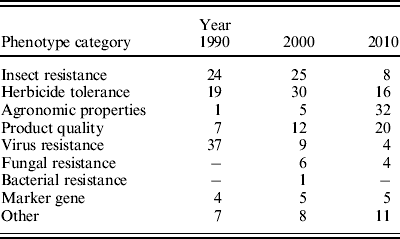
Another approach to the prediction of longer term trends is to examine the databases for GM field trial applications. These are available for the USA at http://nbiap.biochem.vt.edu/search-release-data.aspx (verified 1 October 2010), where links are also provided to other international sites. A brief summary of trends for the USA over a period of 20 years is given in Table 5, which demonstrates how trials of virus-resistant and insect-resistant material have declined, whereas trials of material with modified agronomic properties and product quality traits have increased substantially. Data for the EU in 2010 (up to 15 April) show a total of 70 trials from 11 countries: Czech Republic, France, Germany, Hungary, Netherlands, Portugal, Romania, Slovakia, Spain, Sweden and the UK. Among them are trials of maize with modified lignin, grape (Vitis vinifera) with resistance to grapevine fanleaf virus, cotton (Gossypium spp.) with insect resistance, apple (Malus×domestica) and pear (Pyrus spp.) rootstocks designed to modify scion growth and potato lines with modified starch, blight resistance (John Innes Centre, UK) or nematode resistance (University of Leeds, UK).
Trends in GM field applications in USA
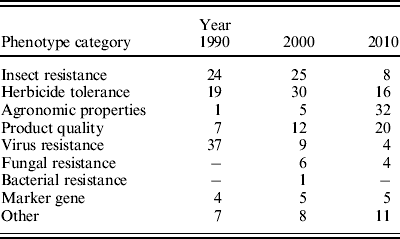
Data represent the percentage of trials in each category (http://nbiap.biochem.vt.edu/search-release-data.aspx; verified 1 October 2010).
CONCLUSION
This brief review has highlighted some of the many novel transgenic approaches being taken in the race to improve the performance of crop plants at a time of potential food insecurity (Royal Society 2009). Which of these technologies is successful depends on many factors. It will partly be dependent on the ability of the commercial sector to develop and protect significant transgenic traits. However, in a global context it is important that the public sector also maintains its ability to exploit the most effective combination of traditional and novel approaches to plant breeding (Phillips Reference Phillips2009). Additionally, the regulatory framework and associated political processes that interact with the science will play a critical role.