Introduction
Although foreign policy has long been considered to be a policy domain exempted from parliamentary contestation, recent research has proved otherwise. Military deployment decisions have been subject to politicization and both left-right dynamics as well as government opposition dynamics are of importance in explaining this contestation (Wagner et al., Reference Wagner, Herranz-Surrallés, Kaarbo and Ostermann2018). Nevertheless, deployment decisions are still not as contested as decisions on domestic policy and not all decisions on military deployment are equally contested (Wagner et al., Reference Wagner, Herranz-Surrallés, Kaarbo and Ostermann2018). This begs the question as to which other factors are at play when deciding about military deployment. Especially, since various countries have seen an increase in parliamentary involvement in decision-making on military policy, knowing what drives these decisions will be all the more relevant in explaining foreign policy behaviour.
A comprehensive body of literature has emerged on the link between party politics and foreign and security policy, which has not only shown that substantial party political differences on the use of force in international relations exist, but has also suggested that these differences often have an impact on foreign policy decisions of established democracies (Palmer et al., Reference Palmer, London and Regan2004; Rathbun, Reference Rathbun2004; Wagner et al., Reference Wagner, Herranz-Surrallés, Kaarbo and Ostermann2017). Nevertheless, academic studies that focus on the exact conditions under which military deployment decisions become politically contested are relatively rare and various questions have remained unanswered. In a recent study, Böller and Müller (Reference Böller and Müller2018) have examined the conditions that shape congressional assertiveness during US-led military interventions. However, given the unique geopolitical position and political system of the US, their conclusions cannot easily be generalized to other established democracies, especially not to the European countries that are governed by parliamentary or semi-presidential regimes. The analysis of Wagner et al. (Reference Wagner, Herranz-Surrallés, Kaarbo and Ostermann2018) of parliamentary deployment votes, in turn, has shown that the level of political contestation of deployment decisions varies significantly, but focused on cross-party differences rather than on variation across military deployment decisions. In consequence, a systematic analysis that compares the level of political contestation of military deployment decisions across different European countries and operations has not yet been produced.
In this article, we aim to address this gap in the literature by focusing on the level of agreement in national parliaments in Europe’s parliamentary and semi-presidential regimes when deciding about military deployment. We build upon the work of Wagner et al. (Reference Wagner, Herranz-Surrallés, Kaarbo and Ostermann2018) by including a broader array of conditions that might explain varying levels of parliamentary contestation and by examining which conditions are at play under which circumstances. We thus ask ourselves ‘why do some military deployment decisions lead to high levels of contestation in parliament, whereas others do not?’, or, put differently, ‘when does politics stop at the water’s edge?’. To answer this question, we build on research on the domestic-level determinants of the use of force, parliamentary voting, and opposition behaviour to arrive at an integrated theoretical framework, which we test with fuzzy set Qualitative Comparative Analysis (fsQCA). Our analysis shows that characteristics of the military mission are of crucial importance for explaining the pattern of political contestation. However, domestic variables, such as the ideological orientation and level of fractionalization of parliament, parliamentary involvement in the decision-making process and the strength of a government, need to be taken into account as well to fully comprehend the level of political contestation of military deployment decisions.
The article is structured as follows. The first section introduces our theoretical framework. The second section justifies the case selection, introduces the methodological approach, and discusses the operationalization of the outcome and the conditions. The third section presents the results of the analysis, which are interpreted in the fourth section. Lastly, the conclusions recapitulate the study’s major findings and set out paths for future research.
Theoretical framework
Since the 1990s, there has been a general trend towards greater parliamentary involvement in decisions to deploy armed forces abroad (Ruys et al., Reference Ruys, Ferro and Haesebrouck2019). Even in the absence of a legal obligation to do so, governments have increasingly sought parliamentary approval for troop deployments. Initiatives have also been undertaken to formally upgrade the ‘war powers’ of numerous parliaments. Nevertheless, there is still significant variation in the actual involvement of the legislative branch in the decision-making process. While some parliaments have a legal ex ante veto over military deployments, others only need to be consulted prior to troop deployments or only vote after the troops have already been deployed. Irrespective of the formal competences of parliaments in this domain, governments can generally be expected to be reluctant to initiate deployment votes that are unlikely to secure a parliamentary majority (Wagner, Reference Wagner2018: 123). Nevertheless, the analysis of parliamentary deployment votes by Wagner et al. (Reference Wagner, Herranz-Surrallés, Kaarbo and Ostermann2017) shows significant variation in parliamentary agreement on military deployments. This suggests that international-level factors, like alliance obligations or threats to national interests, can force governments to propose potentially controversial deployments.
This section derives plausible determinants of political contestation of military deployments from different lines of research. More specifically, a theoretical framework is introduced that integrates three categories of conditions. The first category focuses on government features, the second category on the parliament, and the third on the military deployment decision.
Structural and situational weakness of the government
Whether or not a military deployment decision is politically contested can be expected to depend on features of the ruling government. More specifically, we expect weak governments to have strong incentives for seeking opposition support, resulting in logrolling between parliaments and governments. Legislative logrolling does not involve reaching a political compromise on the issue at hand (Oktay and Beasley, Reference Oktay and Beasley2017), but concerns policy pay-offs on other issues and/or office pay-offs, which can lead to higher levels of parliamentary consensus for controversial proposals.Footnote 1
Government coalitions can suffer from structural and situational weaknesses (Oktay, Reference Oktay2018). Considering the former, we presume governments with a large majority of parliamentary seats to take more contested deployment decisions than governments that control a smaller share of parliamentary seats. Prior research has demonstrated that minority governments will search for support among opposition parties, will be more hesitant to put controversial decisions to a vote, and are less likely to resort to the use of force than majority governments (Prins and Sprecher, Reference Prins and Sprecher1999; Oktay, Reference Oktay2018; Wagner, Reference Wagner2018). Moving away from the minority–majority dichotomy, Mújica and Sánchez-Cuenca (Reference Mújica and Sánchez-Cuenca2006) found that the levels of parliamentary consensus varied according to the size of the government relative to the size of the opposition, while the analysis of Tuttnauer (Reference Tuttnauer2018) showed that surplus coalitions take more controversial decisions. Beasley and Kaarbo (Reference Beasley and Kaarbo2014: 735), in turn, concluded that the overall level of parliamentary support has more impact on the foreign policy of parliamentary democracies than the difference between majority and minority governments, while Palmer et al. (Reference Palmer, London and Regan2004: 13) showed a significant positive effect of the percentage of seats held by the government on the dispute involvement of parliamentary democracies. This leads us to the first hypothesis:
HYPOTHESIS 1: Military deployment decisions of strong governments, with a large majority in parliament, will be subject to a high level of political contestation.
Recent scholarship has also pointed towards the relevance of situational weaknesses. As argued by Oktay (Reference Oktay2018: 110), ‘structurally strong coalitions become situationally weak when the partners diverge on ideology or policy preferences’. Coalitions of ideological opposing parties are often fragile, which creates an incentive to reach out to opposition parties to secure a broader majority for military deployments (Auerswald and Saideman, Reference Auerswald and Saideman2014: 69; Oktay, Reference Oktay2018: 110). Moreover, deployment decisions of ideologically less coherent governments are likely to be the negotiated compromise between different coalition partners and are therefore likely to become less controversial (Auerswald and Saideman, Reference Auerswald and Saideman2014: 68–69). This leads us to the second hypothesis:
HYPOTHESIS 2: Military deployment decisions of ideologically homogeneous governments spur a high level of political contestation.
Involvement, fractionalization, and ideological orientation of the parliament
Whether or not a military deployment decision is contested can also be expected to depend on both the composition and the institutional powers of parliament. On the one hand, these factors determine the incentives and opportunities of governments to secure wide support, whereas, on the other hand, they determine the incentives of the opposition to vote against a government proposal.
First of all, the overall level of parliamentary involvement can be expected to influence the incentives of government parties to reach out to opposition parties to secure broad support for participation in a military operation. As demonstrated by Tuttnauer (Reference Tuttnauer2018: 283), the intensity of conflict between government and opposition depends on the degree to which ‘the parliamentary institutional framework gives the opposition power to influence decision- and policy-making’. Wagner (Reference Wagner2018: 123), in turn, argues that parliamentary involvement encourages governments ‘to reach out, address concerns and ultimately compromise to secure broad support’. The case studies of Lagassé and Mello (Reference Lagassé and Patrick2018: 153) on Canada’s and Germany’s Afghanistan deployments confirmed that parliamentary involvement can lead to the anticipation of legislative preferences. Deployment decisions following strong involvement of the legislative branch are therefore likely to be a negotiated compromise between government and the main opposition parties. In consequence, we can expect them to be less politically contested, which leads us to the third hypothesis:
HYPOTHESIS 3: Weak parliamentary involvement prior to military deployment decisions results in a higher level of political contestation.
Whether or not parliamentary involvement will result in broad support for military deployment depends on the composition of the legislative branch. Securing political support of a large number of parties is more challenging than securing political support of one or two large opposition parties. In this connection, Reiter and Tillman (Reference Reiter and Erik2002: 814) hypothesized that states are less likely to initialize international conflicts as the number of parties in parliament increase. Likewise, Palmer et al. (Reference Palmer, London and Regan2004: 13) concluded that coalitions with multiple pivotal parties are less likely to become involved in international conflict, which suggests that it is more difficult to find agreement on military deployments as the number of parties in parliament increases. In contrast, Tuttnauer (Reference Tuttnauer2018) argued that large opposition parties are more likely to vote against government proposals because they are better poised to compete for office in upcoming elections and, therefore, have an incentive to highlight how they are different from the government. However, parties competing for office also need to demonstrate that they are able to influence policy and might, thus, be more inclined to engage in legislative logrolls (Mújica and Sánchez-Cuenca, Reference Mújica and Sánchez-Cuenca2006: 107). Moreover, logrolls among a small number of large parties are more feasible than among a large number of small parties. In consequence, we expect to find a higher degree of political contestation in more fractionalized parliaments:
HYPOTHESIS 4: A high level of parliamentary fractionalization results in more political contestation.
Lastly, the level of parliamentary involvement may turn out to be inconsequential if opposition parties support a military deployment decision (Oktay, Reference Oktay2018: 108). Opposition parties located at the ideological right of the government should be less likely to vote against military deployments (Palmer et al., Reference Palmer, London and Regan2004; Wagner et al., Reference Wagner, Herranz-Surrallés, Kaarbo and Ostermann2017, Reference Wagner, Herranz-Surrallés, Kaarbo and Ostermann2018). However, this does not necessarily translate into greater support for every single military deployment. In fact, research has suggested that right-wing parties will only support the use of force if national interests are at stake, while left-wing parties may support military deployment that are launched for humanitarian reasons, do not violate international law, and are deployed under a multilateral framework (Rathbun, Reference Rathbun2004: 18–21; Haesebrouck, Reference Haesebrouck2015, Reference Haesebrouck2017, Reference Haesebrouck2018). Nevertheless, right-wing opposition parties are unlikely to vote against military deployments. Rightist parties might be concerned that the lack of parliamentary support for a military deployment decision sends the wrong signal towards allies and potential adversaries and negatively affects their country’s credibility when there are tangible national interests at stake (Rathbun, Reference Rathbun2004: 198).
More recent literature has suggested that the traditional left-right axis might not fully capture party political conflict on the use of force. Support for military interventions is expected to follow a curvilinear pattern, with lower support among political parties at the two extremes of the political spectrum. Wagner et al. (Reference Wagner, Herranz-Surrallés, Kaarbo and Ostermann2018), for example, have shown that country experts generally consider far-left parties to be the least supportive of peace and security missions, followed by radical-right and green parties. However, while their analysis of parliamentary voting data confirms that radical-left parties tend to oppose military deployments, their data only include four MPs of radical-right parties, who never voted against military deployment. The case studies of Verbeek and Zaslove (Reference Verbeek and Zaslove2015) and Coticchia and Davidson (Reference Coticchia and Davidson2016) on the impact of radical parties in Italian government coalitions suggested that extreme parties were less supportive of the use of force, but that this did not prevent the government from deploying military force. Given that empirical research has not yet arrived at conclusive results on the foreign policy preferences of radical parties, the fifth hypothesis is based on the more traditional left-right axis:
HYPOTHESIS 5: A political opposition that is located at the ideological left of the government will spur political contestation.
Divisiveness of the deployment decision
Features of the executive and legislative branch determine the incentives and opportunities of governments for securing parliamentary support. However, even in the absence of legislative logrolls, parliamentary support for a deployment decision might be high if the decision itself is not potentially divisive. Scholarship on the ‘parliamentary peace’ suggests two reasons for parliamentary involvement in troop deployment decisions to result in a ‘less bellicose policy’ (Wagner, Reference Wagner2018: 123). First of all, compared to members of the executive branch, members of parliaments are expected to be more responsive to public opinion, which is generally assumed to be more averse to the use of force (Bennett et al., Reference Bennett, Lepgold and Unger1994; Dieterich et al., Reference Dieterich, Hummel and Marschall2015: 45). Second, a parliamentary veto on the use of force might constrain governmental decisions because it opens up the decision-making process to opposition parties (Wagner, Reference Wagner2018: 123). In consequence, we only expect political contestation to occur if either the public or the political opposition does not support the deployment decision. This, in turn, depends on features of the military operation and the risk these troops face at getting involved in combat.
As argued above, research on party politics suggests that left-wing parties are more likely to oppose military interventions than right-wing parties, but will support operations that pursue humanitarian goals, do not violate international law, and are deployed under a multilateral framework. In consequence, we may expect such operations to be less contested than operations that pursue other goals and/or are not legal under international law. The level of public support, in turn, may vary substantially depending on the nature of the military operation. First of all, research has suggested that the international legitimacy of an operation is a crucial determinant of public opinion on military deployment decisions (Eichenberg, Reference Eichenberg2005: 146; Everts and Isernia, Reference Everts and Isernia2015: 213; Haesebrouck, Reference Haesebrouck2019). More specifically, operations that are in line with international law have a UN mandate and/or operate under a multilateral framework enjoy a higher degree of popular support. In addition, scholarship on the impact of the principle policy objective of military operations on public support has consistently concluded that, in general, public opinion is negative towards operations that pursue internal political change in a third state and positive towards humanitarian interventions and operations launched in response to the aggressive behaviour of another state (Jentleson, Reference Jentleson1992; Jentleson and Britton, Reference Jentleson and Britton1998; Eichenberg, Reference Eichenberg2005).
Assuming that parliamentary opposition to military deployment decisions is a function of anticipated public discontent and the foreign policy preferences of left-wing parties, we expect operations that are in line with international law and/or pursue an objective that is perceived as more legitimate by the general public to be less politically divisive and thus give rise to a lower degree of political contestation. Both the legal status and principle policy objective of an operation can be politically contested, with proponents of operations invoking dubious legal justifications or a questionable rationale for the intervention. However, opposition parties can be expected to try to inflict reputational costs on governments by contesting the invoked legal grounds and objectives of the operation. This leads us to the sixth hypothesis:
HYPOTHESIS 6: Military deployment decisions that involve participation in potentially divisive operations, characterized by dubious legal grounds and unpopular objectives, spur a higher degree of political contestation.
The degree of political contestation of a deployment decision can also be expected to depend on the type of military forces deployed in the operation. We expect party political disagreement to increase if forces run a higher risk of getting killed or wounded, given that left-wing parties generally prefer to impose more constraints on deployed forces to reduce the risks for their countries’ troops (Auerswald and Saideman, Reference Auerswald and Saideman2014: 69). Moreover, research on the public opinion/foreign policy nexus has suggested that a rising number of casualties results in declining public support for military deployment and carries negative electoral ramifications for political leaders (Eichenberg, Reference Eichenberg2005: 158; Everts and Isernia, Reference Everts and Isernia2015).
HYPOTHESIS 7: Military deployment decisions that involve deploying forces that face a high risk of getting involved in combat spur a higher degree of political contestation.
Integrated model
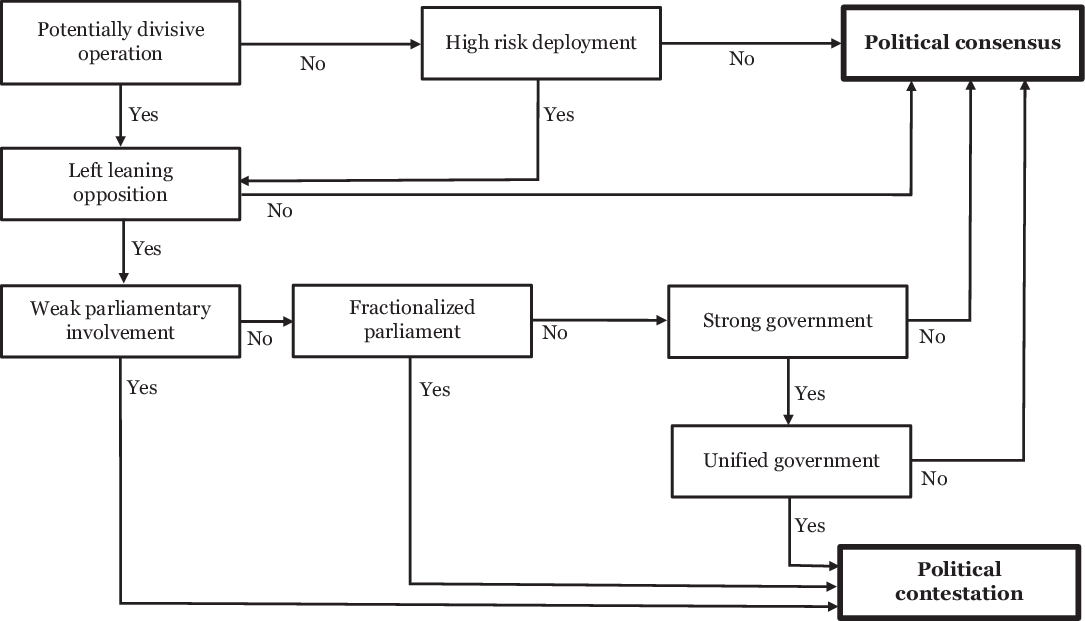
The political contestation of military deployment decisions can thus be expected to result from a complex interplay between the aforementioned conditions, as summarized in Figure 1. First of all, only potentially divisive decisions are expected to spur political contestation. In consequence, political contestation requires either a proposal that entails a high-risk deployment or participation in a divisive operation. Whether or not potentially divisive issues actually result in political contestation depends on domestic conditions. Firstly, only opposition parties located at the ideological left of the government can be expected to contest military deployments. Moreover, opposition parties are unlikely to oppose a decision in which they were involved, which will be the case in countries with strong parliamentary war powers. However, government parties are unlikely to successfully secure broad support if parliamentary seats are divided among many smaller opposition parties, so parliamentary involvement will only result in political agreement if parliament is not fractionalized. Lastly, while we expect that weak and polarized governments will want to secure parliamentary support, governments that hold a large share of parliamentary seats and are not polarized are expected to make more contested deployment decisions.
Integrated model.

Research design
This section justifies the case selection, introduces the methodological approach, and discusses the operationalization and calibration of the conditions and outcome.
Case selection
Cases were selected from the Parliamentary Deployment Votes Database according to the following criteria (Wagner et al., Reference Wagner, Ostermann, Onderco, Böller, Christiansen, Coticchia, Fonck, Herranz-Surralles, Kaarbo, Kučmáš and Deschaux-Dutard2019).Footnote 2 First of all, the pattern of political contestation of military deployment decisions in the US is expected to depend on conditions that are not relevant for the other cases. Not only does its status as a superpower make it stand out significantly from our other cases, the US is also the only country in the database with a presidential system. The recent study by Böller and Müller (Reference Böller and Müller2018) indicated that whether or not the party of the president had a majority in parliament was a crucial determinant for congressional assertiveness. Given that a similar condition of ‘divided government’ is unlikely to be present in the parliamentary or semi-presidential regimes included in our analysis, the US was excluded from our study. The scope of our study is, thus, limited to semi-presidential and parliamentary regimes. Second, the focus is on decisions that concern new military engagements, rather than on decisions that enhance or extend earlier commitments. Political agreement on prolonging or extending military deployments can be expected to be dependent on other conditions than decisions on new engagements, such as the perceived success of the operation, the number of civilian and military casualties, and whether or not political parties had previously endorsed military deployment (Lagassé and Mello, Reference Lagassé and Patrick2018). Third, if two chambers of parliament voted on military deployment, only votes in the House of Representatives are taken into account in cases. Fourth, votes that concerned multiple operations or military exercises were not included in our data. Applying these criteria resulted in a dataset of 69 cases.
Methodological approach
Whether or not the theoretical framework depicted in Figure 1 explains the pattern of political contestation in the selected cases was examined with fuzzy set fsQCA. QCA allows to systematically compare an intermediate to large number of cases to draw conclusions on causal relations between a set of conditions, that is plausible causally relevant factors, and an outcome, that is the phenomenon under study. QCA is particularly apt at capturing a complex form of causation, generally referred to as multiple conjunctural causation (Schneider and Wagemann, Reference Schneider and Wagemann2012: 77). Conjunctural causation implies that causally relevant factors generally do not bring about their effects in isolation, but in combination with other factors. Multiple causation, or equifinality, implies that there are generally several combinations of factors that cause the same effect. Because of its ability to capture this type of causal complexity, QCA constitutes an adequate methodological choice for testing our theoretical framework. In line with the notion of equifinality, our framework comprises several pathways towards political contestation; in line with conjunctural causation, these are consistent with combinations of conditions.
This study applied the fuzzy set version of QCA, which allows to account for both qualitative and quantitative differences between cases. Fuzzy membership scores vary between 1 and 0, depending on the degree to which a condition or outcome is present in a given case. A fuzzy score of 1 indicates that a condition is fully present in a case, and a score of 0 indicates that it is completely absent. The qualitative status of a condition depends on its position towards the 0.5 anchor, which determines whether or not a condition or outcome is more present than absent in a case.
Measurement and calibration
The assignment of fuzzy membership scores, or calibration, is of utmost importance in QCA. The outcome, political contestation, and the conditions, government strength, government polarization, parliamentary fractionalization, and right opposition were calibrated with the direct method of calibration. This was carried out with the QCA 3.3 package for R (Duşa, Reference Duşa2018), which employs a logistic function to fit raw data in between three qualitative anchors: full set inclusion (1), the crossover point (0.5), and full set exclusion (0). The calibration of the three remaining conditions, legitimate operation, high risk, and parliamentary involvement, was based on categorical differences between the cases.
Political contestation
The calibration of the outcome, political contestation, takes into account the level of parliamentary agreement and the share of parliamentary votes that does not reflect government opposition dynamics. The voting data are derived from the Parliamentary Deployment Votes Database (Wagner et al., Reference Wagner, Ostermann, Onderco, Böller, Christiansen, Coticchia, Fonck, Herranz-Surralles, Kaarbo, Kučmáš and Deschaux-Dutard2019). In this database, parliamentary consensus is calculated with an agreement index (AI) that was originally developed by Hix et al. (Reference Hix, Noury and Roland2005) to measure party cohesion in the European parliament (Wagner et al., Reference Wagner, Herranz-Surrallés, Kaarbo and Ostermann2018).Footnote 3 However, the AI has two disadvantages for measuring the contestation of military deployment decisions. First of all, the index assigns lower values as votes become more divided between three options (yes, no, and abstain) rather than as more MPs vote against a resolution. Second, the AI does not take into account government size. As with other parliamentary votes, deployment votes tend to follow a government opposition dynamic (Louwerse et al., Reference Louwerse, Otjes, Willumsen and Öhberg2017: 749; Wagner et al., Reference Wagner, Herranz-Surrallés, Kaarbo and Ostermann2018: 15). In consequence, we consider decisions by small governments that secure a large portion of yes votes to be less politically contested than larger governments that secure an equal share of yes votes.
Our base variable for political contestation equals the weighted sum of (1) the yes votes divided by the total votes (accounting for 60% of the variable) and (2) the yes votes subtracted by the number of seats of government parties divided by the share of opposition seats (accounting for 40%). The political contestation of military deployment decision i is calculated according to the following equation, in which Y i is the number of yes votes, N i is the number of no votes, A i is the number of abstain votes, S i is the total number of parliamentary seats, GSi is the number of seats of government parties, and OSi is the number of seats of opposition parties.
 $${\rm{PCi}} = 0.6*\left( {{{{Y_i}} \over {{Y_i} + {N_i} + {A_i}}}} \right) + 0.4 \times \left( {{{{{{Y_i} - {\rm{G}}{{\rm{S}}_i}} \over {{Y_i} + {N_i} + {A_i}}}} \over {\left( {{{{\rm{O}}{{\rm{S}}_i}} \over {{S_i}}}} \right)}}} \right)$$
Our political contestation index reaches unity if all MPs vote ‘yes’ and decreases as more MPs do not support the military deployment decision. The political contestation index assigns equal weight to abstentions and no votes, given that both can be considered non-agreement with military deployment decisions. Yes votes of MPs of opposition parties have a stronger positive impact on the index than yes votes of MPs of government parties, while lack of support of government parties has a stronger negative impact on the index.
The following qualitative thresholds were used to calibrate the base variable. The crucial 0.5 crossover point was fixed at 0.6, in a large gap in raw data between Denmark’s decision to contribute to MINUSMA (0.65) and the UK’s Iraq vote (0.55). The threshold for full inclusion was fixed at 0.5, corresponding to a situation in which half of the weighted average of yes votes and yes votes that do not follow government opposition dynamics is below 50%. The threshold for full exclusion was fixed at 1, which corresponds to a parliament that unanimously supports a military deployment decision.
Government strength and polarization, right opposition, and parliamentary fractionalization
The conditions government strength and polarization, parliamentary fractionalization, and right opposition were calibrated with the direct method of calibration. Government strength is operationalized as the share of parliamentary seats controlled by members of government parties.Footnote 4 The crucial 0.5 anchor was fixed at 65%, in the large gap in the raw data. Given that minority governments are fully out of the set of strong governments, the threshold for full exclusion was fixed at 50%. Governments that control 75% of the seats of the parliament are considered to be fully in the set.
Government polarization was operationalized as the weighted average of the differences between each government party’s ideological position and the government’s ideological centre of gravity. The assessment of ideological positions draws on the Right-Left (RILE) indicator of the Comparative Manifesto Project, which is based on quantitative content analyses of election programmes (Volkens et al., Reference Volkens, Krause, Lehmann, Matthieß, Merz, Regel and Weßels2018). Party positions were aggregated into an overall measure of executive ideological centre of gravity (ICGi) by summing up each government party’s (j) ideological position on the RILE scale (rl), weighted by its proportion of the total number of government seats (s), as specified in the following equation:
 $${\rm{IC}}{{\rm{G}}_{\rm{I}}} = \sum {{{{\rm s}_j}{\rm rl}_j} \over s}$$
Subsequently, the overall polarization of the government was calculated as the sum of the differences between the executive’s ideological centre of gravity (ICGi) and each government party’s ideology position (rl) relativized by each government party’s seat share, as specified in the following equation:
 $${\rm{GPi}} = \sum {{\left| {{\rm{ICGi}} - {\rm{rl}}j} \right|*sj} \over S}$$
The following thresholds were used to calibrate the base variable: the 0.5 crossover point was fixed at 10 units difference, the inclusion threshold at 20, and the exclusion threshold at 0, the latter corresponding to a completely ideologically homogeneous government.
Right-leaning opposition is measured as the difference between the ideological centre of gravity of the government and the ideological centre of gravity of the opposition. Right-leaning opposition was, thus, calculated according to the following formula, in which SGj and OGj respectively refer to the seats of government and opposition party (j); rl to the parties’ ideological position; and SG and OG to the number of parliamentary seats controlled by government and opposition, respectively.
 $${\rm{R}}{{\rm{O}}_i} = \sum {{{s_{{\rm{gj}}}}{\rm rl}_{{\rm gj}}} \over {{\rm GS}}} - \sum {{{s_{{\rm{oj}}}}{\rm rl}_{{\rm oj}}} \over {{\rm SO}}}$$
The 0.5 anchor was fixed at 0, the value at which the opposition and government have exactly the same ideological centre of gravity. The inclusion threshold was located at −20 and the exclusion threshold at 20.
Lastly, the calibration of parliamentary fractionalization was based on the effective number of parties measure of Laakso and Taagepera (Reference Laakso and Taagepera1979), which is calculated according to the following formula, in which PF is the degree of parliamentary fractionalization of case (i) and S j is the proportion of parliamentary seats of party j.
 $${\rm{PFi}} = {1 \over \sum S_j^2}$$
The 0.5 anchor was fixed at 3, corresponding to a hypothetical situation in which there are three equally large influential parties. The threshold for full exclusion was fixed at 2 and the threshold for full inclusion at 5.
Divisiveness deployment decision and parliamentary involvement
The calibration of potentially divisive operation, high-risk deployment, and parliamentary involvement was based on categorical differences between the cases. Whether or not a case was assigned a score above the crucial 0.5 threshold on divisive operation depended on its legality under international law.Footnote 5 The international legality of an operation will not be contested in clear cases of self-defence, if there is a UN Security Council mandate or if there is an invitation of the local government. Furthermore, the potential divisiveness of legal and illegal operations might still vary depending on their principle policy objectives. A score of 0.33 was assigned to legal operations that pursue domestic political change and a score of 0 to legal operations that did not have an impact on the domestic authority structure of the area of operations. Illegal operations that pursued a controversial objective were assigned a score of 0.67. In line with literature on the principle policy objective, these are humanitarian interventions and operations that aim to constrain an adversary that poses an active threat against a country or its allies’ interests. A score of 1 was assigned to illegal operations that pursued a more controversial objective.
The calibration of high risk estimates the risk of military and civilian casualties. Whether or not a score above the crucial 0.5 threshold was assigned depended on whether combat forces were deployed during an armed conflict. More fine-grained distinctions were made based on the level of risk the deployed units were expected to face (Mello, Reference Mello2014: 72–76; 112–115). The deployment of ground forces involves a higher risk of military casualties than the provision of combat aircraft. In consequence, cases that involved either the deployment of combat forces on the ground during an armed conflict or the combination of combat aircraft and non-combat ground forces were considered to be fully in the set of high-risk military deployment (fuzzy score of 1). Cases that only involved the deployment of fighter aircraft received a score of 0.67. Participation with logistical or medical units, military instructors, and deployments after the end of an armed conflict are associated with a lower risk of military or civilian casualties and were therefore assigned a score of 0.33. Finally, naval units or transport aircraft hardly run any risk and were assigned a score of 0.
Countries in which prior parliamentary approval is an obligation were assigned a score above the crucial 0.5 threshold on the condition parliamentary involvement. Cases with a comprehensive parliamentary veto were assigned a score of 1. Parliament had a veto on all military deployments included in our dataset in Denmark, Germany, Spain, and Finland (Wagner et al., Reference Wagner, Peters and Glahn2010; Wagner, Reference Wagner2018). In Slovakia, this was the case until legislative changes restricted parliamentary veto powers in 2001. Military deployment votes that took place before this amendment were assigned a score of 1, and votes after parliamentary involvement was curbed a score of 0.67. Likewise, cases in which there is a strong convention of seeking parliamentary approval before military deployment or where specific political circumstances forced governments to seek parliamentary approval were assigned a score of 0.67. This was the case for the UK after the government’s defeat over military action in Syria in 2013 and for Belgium at the time of the Libya intervention and operation against Daesh, when it was governed by a caretaker government (Reykers and Fonck, Reference Reykers and Fonck2018; Strong, Reference Strong2018). A score of 0.33 was assigned to cases where parliamentary consent was sought after troops were deployed or that lacked a legal requirement of parliamentary approval and where governments put their decision to vote without there having been any prior involvement of parliament. This was the case for the deployment votes in Italy and for the votes in the UK’s House of Commons on Iraq, Libya, and Syria (Mello, Reference Mello2017; Coticchia and Vignoli, Reference Coticchia and Vignoli2018; Strong, Reference Strong2018). A score of 0 was assigned to deployment votes in France, where voting on military deployment is only required after 4 months, and to Belgium’s parliamentary vote on the French-led operation Serval, which was an ex post legitimatization of a government’s decision without parliament having an actual impact on the decision (Ostermann, Reference Ostermann2017; Reykers and Fonck, Reference Reykers and Fonck2018: 690).
Analysis and results
This section presents the results of the analysis, which was carried out the with QCA 3.3 package for R (Duşa, Reference Duşa2018).Footnote 6 In line with standards of good practice, the outcome’s presence and absence were analyzed in two separate analyses (Schneider and Wagemann, Reference Schneider and Wagemann2012: 279). An indispensable step in both analyses is the construction of a truth table, which first requires calculating the cases’ membership scores with fuzzy multiplication. Rows in which none of the cases have a fuzzy membership score above 0.5 are considered logical remainders. The other rows are assigned an outcome value based on their consistency. The latter is a parameter that indicates the extent to which a combination of condition consistently leads to (i.e. is sufficient for) an outcome. Subsequently, Boolean algebra is used to minimize the truth table. Depending on the remainders included in the process, minimization results in different solution types. This study focuses on the parsimonious solution, which it is the only solution type that can identify the conditions that meet the regularity theoretical definition of causal relevance (Baumgartner, Reference Baumgartner2015: 854).Footnote 7
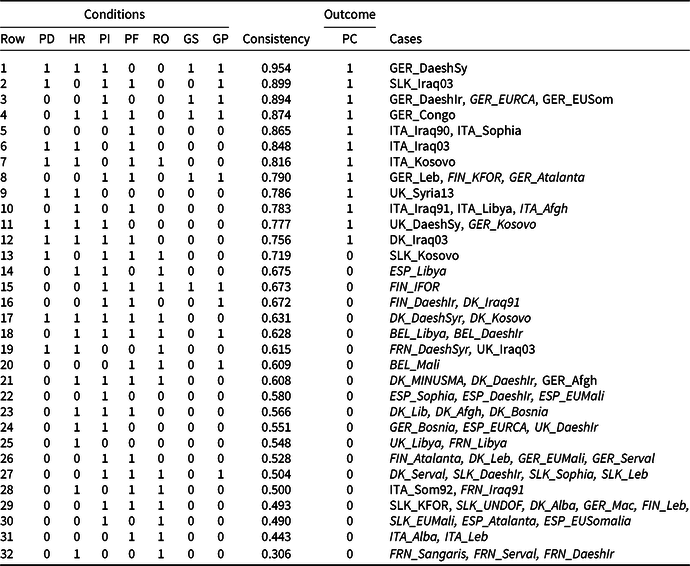
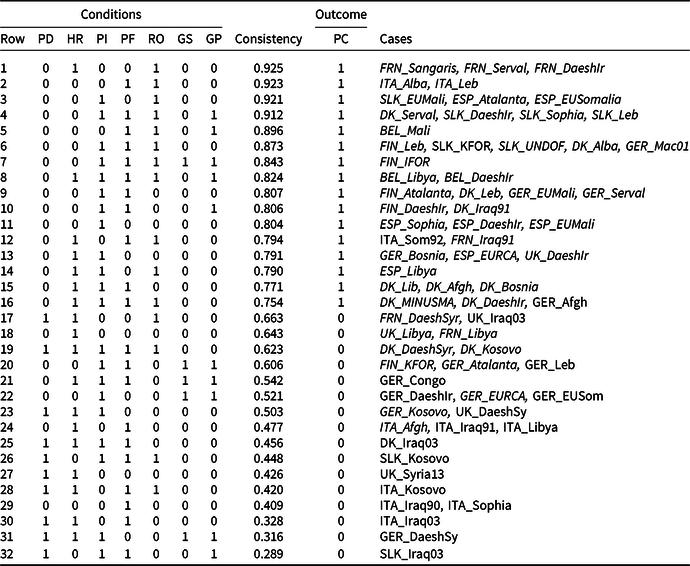
Tables 1 and 2 present the truth tables of the outcome’s presence and absence. Cases with a score below 0.5 in the outcome (in which political contestation is absent) are marked in italic, cases where the outcome is present in regular font. The consistency cut-off point was fixed at the minimum advisable value of 0.75 (Schneider and Wagemann, Reference Schneider and Wagemann2012: 279). Inspection of the truth table makes clear that several rows above this threshold include contradictory cases, which will need to be explained in the interpretation of the results.
Truth table political contestation

PD = potentially divisive operation; HR = high risk; PI = parliamentary involvement; PF = parliamentary fractionalization; RO = right opposition; GS = government strength; GP = government polarization; PC = political contestation.
Truth table ~political contestation

PD = potentially divisive operation; HR = high risk; PI = parliamentary involvement; PF = parliamentary fractionalization; RO = right opposition; GS = government strength; GP = government polarization; PC = political contestation.
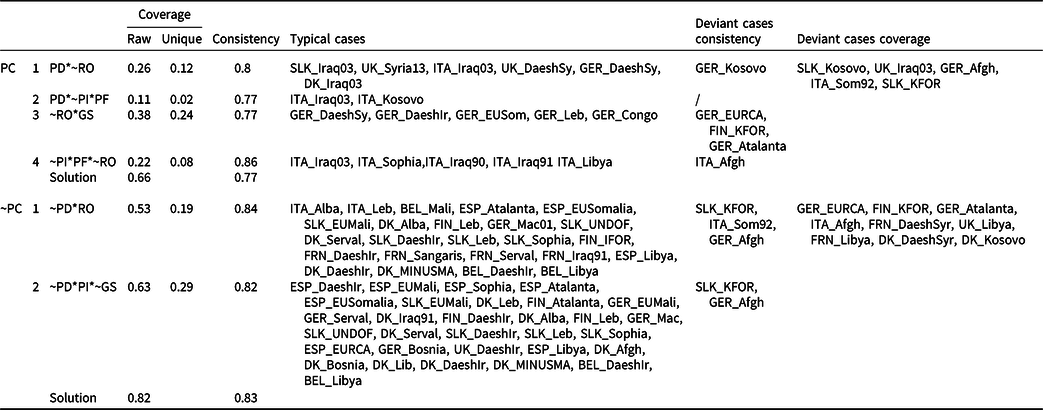
The parsimonious solutions for the outcome’s presence and absence are presented in Table 3. The solution for political contestation shows four combinations of conditions that are associated with the outcome. Combination 1 shows that the combination of a potentially divisive operation (PD) with an opposition that is not located at the ideological right of the government (~RO) leads to political contestation. The second path combines a potentially divisive operation with the absence of parliamentary involvement (~PF) and parliamentary fractionalization (PF). The third combination indicates that the absence of a right opposition (~RO) results in political contestation if combined with a strong government (GS). The fourth pathway shows that political contestation also results if the absence of parliamentary involvement (~PI) is combined with a fractionalized parliament (PF) and the absence of a right-leaning opposition (~RO). The parsimonious solution for the absence of political contestation shows two combinations. The first shows that the combination of the absence of a potentially divisive operation (~PD) with a right-leaning opposition (RO) is consistently associated with the absence of the outcome. The second combination shows that decisions to participate in a non-divisive operation (~PD) are not contested if the government is weak (~GS) and parliament is involved in troop deployment decisions (PI).
QCA solutions

PD = potentially divisive operation; HR = high risk; PI = parliamentary involvement; PF = parliamentary fractionalization; RO = right opposition; GS = government strength; GP = government polarization; PC = political contestation. [~] Absence condition; [*] logical AND; deviant cases consistency concern cases that are covered by one of the solutions even though the outcome was absent; deviant cases coverage cases that are not covered by the formula in which the outcome was present.
Interpretation
This section interprets the minimal solutions against the backdrop of the theoretical expectations and relates them back to the cases.
Structural and situational weakness of the government
The first two hypotheses suggest that strong governments take more contested decisions than weak governments. More specifically, Hypothesis 1 focuses on structural strength and expects governments with a large majority in parliament to take more contested decisions, Hypothesis 2 focuses on situational strength and expects decisions of ideologically homogeneous governments to be subject to a higher level of political contestation.
The results of the analysis provide strong support for the first hypothesis. First of all, the third path towards contestation suggests that government strength can be a crucial determinant of political contestation. Remarkably, this path exclusively covers German cases in which the government consisted of both the CDU/CSU and SPD. In fact, Germany was governed by a grand coalition in five out of six times that a military deployment decision was politically contested. The only exception is the vote on participation in Operation Enduring Freedom in Afghanistan, in which a decision by the Red-Green coalition was contested by the CDU/CSU. However, these parties only opposed the resolution because the government combined this decision with a parliamentary vote of confidence. In fact, both the CDU and the CSU were in favour of the deployment and would have voted yes on a simple vote call (Longhurst, Reference Longhurst2004: 86; Lagassé and Mello, Reference Lagassé and Patrick2018: 147). In all other cases, both the SPD and CDU/CSU voted in favour of military deployments when they were in the opposition.
The second path towards the absence of contestation includes the absence of government strength as core causal condition. Case-based evidence confirms that relatively weak coalition governments engage in legislative logrolling to gain support for military interventions or refrain from contributing to military operations in the absence of opposition support. Faced with internal divisions, the German Red-Green coalition needed the support of opposition parties to secure a parliamentary majority for its participation in the NATO-led operation Essential Harvest in Macedonia. The CDU, however, ‘linked its support to a call for more defence spending’ (Longhurst, Reference Longhurst2004: 79). In 2013, the CDU-led government did not make a robust contribution to the French-led operation Serval in Mali, which was opposed by prominent members of the SPD, but did participate in the politically uncontested AFISMA and EUTM operations in Mali (Schade, Reference Schade2018: 85).
The results of our analysis and the case-based evidence thus support expectations regarding the relevance of structural weaknesses, operationalized as the share of parliamentary seats controlled by the government. In contrast, the results do not support the second hypothesis, given that the condition government polarization is not included in any of the sufficient combinations.
Involvement, fractionalization and ideological orientation of the parliament
The third, fourth, and fifth hypotheses focus on characteristics of the legislative branch, respectively, expecting political contestation to result if competences of parliament in troop deployment decisions are weak, parliament is fractionalized, or the opposition is located at the left of the executive. The QCA results confirm that these features of parliaments are relevant for the pattern of contestation of military deployments.
The first, third, and fourth path towards political contestation confirm that opposition ideology is a crucial determinant of parliamentary conflict regarding military deployment. Nevertheless there are deviant cases that contradict the importance of a left-wing opposition. First of all, the decision of Tony Blair’s government to participate in the 2003 Iraq War was strongly contested by MPs from the Labour party. More specifically, 84 of the 338 Labour MPs voted against the operation, indicating that left-wing MPs can oppose decisions of their own governments if they strongly disagree with participation in an illegitimate military intervention. Conversely, the German decision on Kosovo presents us with a case of a left-wing opposition that did not contest the decision of a right-wing government to participate in an illegal operation. However, the parliamentary resolution was the result of a joint position agreed on during a meeting between the outgoing Chancellor Kohl and incoming left-wing Chancellor Schroeder of the SPD (Brummer, Reference Brummer2012).
The first path towards the absence of the outcome indicates that military participation is rarely contested if the opposition is located at the ideological right of the government. The only two exceptions to this conclusion are Italy’s decision to participate in the UNISOM operation in Somalia and Slovakia’s participation in KFOR. However, the first decision was not contested by Italy’s centre-right opposition parties, but by the two relatively large radical-left parties (cf. infra). The opposition of MPs of Slovakia’s nationalist HZDS and SNS parties to participation in NATO’s KFOR operation in Kosovo must be interpreted against the backdrop of their general opposition to the division of a country’s territory and their specific opposition to NATO’s bombing campaign in Kosovo (Fawn, Reference Fawn, Buckley and Cummings2001).
The second and fourth path towards political contestation provide evidence of the importance of parliamentary involvement and fractionalization, as suggested by Hypotheses 3 and 4. These paths cover six Italian cases of political contestation, which show that it is difficult to find broad consensus in a fractionalized parliament. With the exception of some more controversial operations, such as the 2003 Iraq War, there was a bipartisan consensus between Italy’s main centre-left and centre-right parties on military operations (Ignazi et al., Reference Ignazi, Giacomello and Coticchia2012; Coticchia and Vignoli, Reference Coticchia and Vignoli2018). However, operations that enjoyed such bipartisan support, such as the 1990 Persian Gulf War or the 1992 UN operation in Somalia, were contested by Italy’s radical-left parties. Several Italian cases of political contestation confirm that consensus is less likely in a fractionalized parliament, but this seems to be related to the presence of strong extreme-left parties rather than to the difficulty of finding agreement among a larger number of parties. This confirms the conclusions of recent studies, which have suggested that radical parties are generally less supportive of the use of force than centre parties (Wagner et al., Reference Wagner, Herranz-Surrallés, Kaarbo and Ostermann2017).
Divisiveness of the deployment decision
The last two hypotheses focus on features of the deployment decision. More specifically, Hypotheses 6 and 7 expect decisions to participate in potentially divisive operations or to deploy forces that face a high risk of getting involved in combat to become contested.
The solutions provide strong support for the causal relevance of the potential divisiveness of the operation in which troops are deployed, indicating that dubious legal grounds and unpopular objectives result in greater contestation. Two paths towards political contestation include the absence of this condition, while its presence is part of every path towards the absence of the outcome. The cases covered by the first and second path towards political contestation confirm that the legality of an operation is a crucial determinant of political conflict. The lack of respect for ‘the principles laid out by the United Nations for the legal use of force’ was one of the main reasons why the Social Democrats and Socialist People’s Party opposed Denmark’s participation in the US-led intervention in Iraq (Houben, Reference Houben2004; Kaarbo and Cantir, Reference Kaarbo and Cantir2013: 470). Likewise, Italy’s centre-left opposition parties invoked the lack of a multilateral framework to justify their abstention in the vote on the Iraq War (Ignazi et al., Reference Ignazi, Giacomello and Coticchia2012). The lack of a clear international legal justification was also invoked as a reason for opposing contributions to other military operations, for example, during parliamentary debates in Italy on the intervention in Kosovo and in the UK on a possible intervention in Syria in 2013 (Ignazi et al., Reference Ignazi, Giacomello and Coticchia2012: 70; Strong, Reference Strong2015: 1132).
The analysis did not confirm that the level of risks involved in the military deployment has an impact on political contestation. This is surprising, given that research on the foreign policy/public opinion nexus has suggested that ‘support for the use of force is lower when the prospect of casualties is mentioned’ (Eichenberg, Reference Eichenberg2005: 175). However, this line of research has also suggested that the number of casualties is not decisive for public support during operations, which is mainly determined by perceptions of the operation’s success and benefits (Baum and Groeling, Reference Baum and Groeling2010). The latter might also be more important for political contestation than the risk of casualties and is linked to the objectives of the military operation rather than a state’s contributed forces.
Another plausible explanation for the lack of impact of this condition is offered by Biehl et al. (Reference Biehl, Giegerich and Jonas2013: 390), who argue that ‘internal constraints do not seem to prevent participation in international operations per se’ but ‘strongly influence how countries choose to use their soldiers on missions abroad’. While international obligations might force a government to participate in a controversial operation, they can try to avoid possible negative domestic reverberations of a troop deployment decision by contributing forces that do not face a high risk of getting involved in combat (Biehl et al., Reference Biehl, Giegerich and Jonas2013). This is also in line with scholarly literature on caveats, which expects parliamentary involvement in troop deployment decisions to result in restrictions on the mandate of the deployed forces (Auerswald and Saideman, Reference Auerswald and Saideman2014; Fonck et al., Reference Fonck, Haesebrouck and Reykers2019).Footnote 8
Deviant cases and alternative explanations
The coverage and consistency values of our solutions suggest that our theoretical framework explains a large share of the examined cases. However, a number of deviant cases is not explained by our formulas. As argued above, some of these cases can be explained by rare case-specific circumstances, such as left-wing MPs opposing their own governments (cf. the UK in Iraq) or governments linking a deployment vote to a vote of confidence (cf. Germany in Afghanistan). However, the pattern of political contestation suggests that explanatory factors located at the level of countries might also have an impact on our outcome (Wagner et al., Reference Wagner, Herranz-Surrallés, Kaarbo and Ostermann2018: 10). More specifically, our dataset does not include cases of political contestation in Belgium, France, Spain, and Finland, and in Denmark, only the 2003 Iraq War was contested.
Literature on strategic culture offers a plausible explanation for at least some of these cases. Lacking a unitary definition, strategic culture refers to the norms a country shares on the appropriate means and ends of its security policy (Biehl et al., Reference Biehl, Giegerich and Jonas2013: 12). Strategic cultures should not be considered as a monolithic whole, but are composed of different subcultures that can contain contradictory elements (Bloomfield, Reference Bloomfield2012: 456). Countries like France and Finland might have a more coherent strategic culture than Germany (Schmitt, Reference Schmitt2012), resulting in a lower level of political conflict. Moreover, foreign policy consensus might be strongly valued by itself in some countries, making military deployment without large agreement in parliament very unlikely. Kaarbo and Cantir (Reference Kaarbo and Cantir2013), for example, argue that ‘consensus was a robust and valued norm’ in Denmark (cf. also Houben, Reference Houben2004). Strikingly, the pattern of political contestation of deployment decisions does not fit within the distinction between consensus and majoritarian democracy that was introduced by Lijphart (Reference Lijphart2012), with majoritarian democracies (e.g. France) experiencing less contestation than consensus democracies (e.g. Germany). This suggests that political conflict over foreign policy issues does not arise in the same way as political conflict over domestic issues.
Conclusions
This article aimed to provide a more comprehensive explanation of the variation in the levels of parliamentary contestation of military deployment decisions in parliamentary and semi-presidential regimes. We did so by examining the conditions under which military deployment spurs a high degree of political contestation. More specifically, we have built on scholarship on the domestic determinants of the use of force, parliamentary voting, and opposition behaviour to construct an integrated model of political contestation, which was tested with QCA. The results of our analysis demonstrated that the potential divisiveness of the operation, which is determined by its international legal status and primary objective, is a vital determinant of political contestation. In contrast, whether or not deployed forces risk getting killed or wounded, or might cause collateral damage, did not have an impact on the pattern of political contestation. This suggests that governments try to avoid political contestation by limiting what their forces are allowed to do in an operation, but do contribute to operations that might become politically contested (Biehl et al., Reference Biehl, Giegerich and Jonas2013).
Moreover, we have found that mission-specific variables alone cannot explain varying levels of political contestation. Our QCA shows that these factors can only account for varying levels of political contestation in combination with domestic-level variables. First of all, our results indicate that structurally strong governments make more contested decisions than weak governments. In contrast, situational weaknesses do not seem to incite governments to make less controversial decisions. Second, our analysis suggests that parliamentary involvement prior to troop deployments results in less contested decisions. Lastly, the ideological composition of the legislative branch also has an impact on political contestation. More specifically, our results show that a parliament in which the opposition is located at the ideological right of the government will generally not oppose military deployment. Conversely, deployment decisions will become more politically contested if governments face fractionalized parliaments. While this was expected to be related to the difficulty of finding agreement among a large number of actors, case-based evidence rather suggests that this is connected to the fact that fractionalized parliaments tend to include stronger radical left parties.
Prospective research could further examine the impact of the presence of radical parties in parliament on military deployment decisions, building on recent scholarship on the foreign policy preferences and impact of radical parties. Three other promising paths for future research would be to address limitations of the present study. First of all, this study did not include votes on enhancing or extending earlier commitments, which can be expected to be dependent on other conditions than votes on new deployments. Therefore, it would be interesting to examine the conditions under which political agreement on military deployment breaks down. Second, while the pattern of contestation suggests that explanations that look into the strategic culture of the examined countries might be relevant to explain the level of political contestation, the research design of this study did not allow to take this into account. Nevertheless, examining political contestation through the lens of strategic culture and strategic subcultures could provide relevant insights in the dynamics behind military deployment decisions (Bloomfield, Reference Bloomfield2012). Lastly, an important limitation of the research design of the present study is that it has only examined cases in which a vote took place. The absence of a vote can, however, reflect the highest degree of potential contestation, given that governments might refrain from putting deployment proposals to vote that are unlikely to secure a parliamentary majority (Wagner, Reference Wagner2018). Prospective studies could go deeper into the dynamics of political contestation of military deployment decisions, by developing and testing two-stage decision-making models that aim to explain both the decision to go to parliament and the outcome of the parliamentary vote.
Supplementary material
To view supplementary material for this article, please visit https://doi.org/10.1017/S1755773920000223.