INTRODUCTION
Hope is considered an important factor in patients' personal adjustments during times of loss, uncertainty, and suffering (Herth & Cutcliffe, Reference Herth and Cutcliffe2002). It has been identified as an essential element in the lives of people with cancer (Nowotny, Reference Nowotny1991). In addition, hope is considered an effective coping strategy for oncology patients because it provides adaptive power to help them get through difficult situations, achieve meaning, and achieve desired goals (Herth, Reference Herth2000; Benzein et al., Reference Benzein, Norberg and Saveman2001; Ebright & Lyon, Reference Ebright and Lyon2002; Reb, Reference Reb2007).
Several studies have measured the level of hope in oncology patients using the Herth Hope Index (HHI; Herth, Reference Herth2000; Ebright & Lyon, Reference Ebright and Lyon2002; Chen, Reference Chen2003; Hsu et al., Reference Hsu, Lu, Tsou and Lin2003; Lai et al., Reference Lai, Chang and Keefe2003; Lin et al., Reference Lin, Lai and Ward2003a, Reference Lin, Tsai and Chiou2003b; Sanatani et al., Reference Sanatani, Schreier and Stitt2008). On a scale that ranges from 12 to 48, levels of hope varied from 30.8 (Hsu et al., Reference Hsu, Lu, Tsou and Lin2003) to 40.3 (i.e., higher score higher level of hope; Ebright & Lyon, Reference Ebright and Lyon2002). However, in many of these studies, sample sizes were relatively small. In addition, five of the eight studies evaluated hope in oncology patients in Taiwan.
In a recent review (Chi, Reference Chi2007), it was noted that oncology patients' level of hope appears to be related to a variety of physical (e.g., physical health, fatigue) and psychological (e.g., coping, performance of family, religiosity) factors. One physical factor that is highly prevalent in oncology patients and that may be related to hope is pain. In fact, in a recent study in Norway (Holtan et al., Reference Holtan, Aass and Nordoy2007), the prevalence of pain of any cause in hospitalized cancer patients was 52%.
Only four descriptive, correlational studies (Chen, Reference Chen2003; Hsu et al., Reference Hsu, Lu, Tsou and Lin2003; Lai et al., Reference Lai, Chang and Keefe2003; Lin et al., Reference Lin, Lai and Ward2003a) have evaluated the relationships between hope and various aspects of cancer pain. All of these studies were conducted in Taiwan and measured hope using the HHI. In three of these studies (Chen, Reference Chen2003; Hsu et al., Reference Hsu, Lu, Tsou and Lin2003; Lin et al., Reference Lin, Lai and Ward2003a), levels of hope were compared in patients with and without pain. In two studies (Hsu et al., Reference Hsu, Lu, Tsou and Lin2003; Lin et al., Reference Lin, Lai and Ward2003a), patients with cancer pain reported significantly lower HHI scores compared to patients without pain. However after controlling for gender, stage of disease, and recruitment site in one study (Lin et al., Reference Lin, Lai and Ward2003a), and after controlling for age, levels of education, and stage of disease in the other study (Hsu et al., Reference Hsu, Lu, Tsou and Lin2003), the differences in hope between the patients with and without pain were no longer significant. In the third study (Chen, Reference Chen2003), no significant differences in HHI scores were found between patients with and without cancer pain.
In addition, when a variety of pain characteristics were correlated with levels of hope, inconsistent results were obtained. In one study (Lai et al., Reference Lai, Chang and Keefe2003), no relationships were found between total HHI scores and pain intensity or pain duration. In contrast, in two studies (Hsu et al., Reference Hsu, Lu, Tsou and Lin2003; Lin et al., Reference Lin, Lai and Ward2003a) significant relationships were found. Total HHI scores were negatively correlated with pain interference scores in one study (Lin et al., Reference Lin, Lai and Ward2003a) and with pain intensity and pain interference scores in the second study (Hsu et al., Reference Hsu, Lu, Tsou and Lin2003). In addition, in one study (Chen, Reference Chen2003), patients who viewed pain as a challenge reported higher total HHI scores, and patients who viewed pain as a loss or threat reported lower total HHI scores. These conflicting results could be related to differences in patient populations (i.e., inpatients versus outpatients), severity of disease, or heterogeneous versus homogeneous samples in terms of cancer diagnoses.
Given the importance of hope in an oncology patient's life, the limited number of studies on the relationships between hope and cancer pain, and the fact that these relationships have not been investigated in Western societies, additional studies are needed on the relationships between hope and pain in oncology patients. Therefore, the purposes of this study in a sample of hospitalized oncology patients with pain were to describe their level of hope, determine if various demographic characteristics (i.e., age, gender, education, employment status) were related to hope, determine if various clinical characteristics (i.e., cancer diagnosis, number of comorbidities, functional status, presence of metastatic disease, length of time since diagnosis, overall rating of health) were related to hope, determine whether various pain characteristics (i.e., severity, interference, presence of breakthrough pain [BTP]) were related to hope, and compare the individual item and total HHI scores for these oncology patients with data from the general Norwegian population (Rustoen et al., Reference Rustoen, Wahl and Hanestad2003).
METHODS
Sample and Methods of Data Collection
This study is part of a larger multicenter study, the European Pharmacogenetic Opioid Study (EPOS). From a convenience sample of 1571 cancer patients hospitalized at the Norwegian Radium Hospital, 342 met the initial screening criterion for the EPOS study, namely, that they would be on a regularly scheduled opioid treatment for their cancer pain for at least 3 days. In addition, patients were included if they were adults >18 years of age, had a verified malignant disease, were able to provide a blood sample, and were able to sign the informed consent. A total of 225 patients were enrolled in this study. The remaining 117 were not enrolled because they did not meet the inclusion criteria (n = 34), they were too ill (n = 33), they refused to participate (n = 48), or they withdrew participation after enrollment (n = 2). This study was approved by the Regional Committee for Medical Research Ethics, Central-Norway, and the Norwegian Radium Hospital.
Following enrollment, patients were asked to complete the study questionnaires. If the patient was not able to complete the questionnaires independently, a research nurse read the items to the patients and recorded their answers (n = 173).
To better understand the levels of hope reported by oncology inpatients with pain, their responses were compared to data from the general Norwegian population (Rustoen et al., Reference Rustoen, Wahl and Hanestad2003). To obtain the sample from the general population, 4000 Norwegian citizens 19 to 81 years of age were randomly chosen from the Norwegian National Register of Statistics and were sent a questionnaire. Fifty-six questionnaires were returned either because they had been sent to citizens who had recently died or because the forwarding address of the citizen was unknown. Of 1912 questionnaires returned, 1863 were usable. However, only 1825 participants completed more than 80% of the HHI which is the sample used for comparative purposes.
Instruments
Patients completed several self-report questionnaires, and their medical records were reviewed for disease and treatment information (i.e., cancer diagnosis, presence of metastasis, length of time since cancer diagnosis, and number of comorbidities).
Demographic Characteristics
This questionnaire obtained information on age, gender, educational level (i.e., primary school, secondary school, university/college), marital status (i.e., married, not married, widow/widower), and employment status (i.e., yes or no).
Clinical Characteristics
The patients' performance status was assessed using the Karnofsky Performance Status (KPS) scale (Karnofsky et al., Reference Karnofsky, Abelmann and Craver1948), which was rated by the research nurse using a 0 (i.e., dead) to 100 (i.e., normal activity) scale. The KPS has satisfactory predictive and construct validity (Buccheri et al., Reference Buccheri, Ferrigno and Tamburini1996) and interrater reliability (Mor et al., Reference Mor, Laliberte and Morris1984; Schag et al., Reference Schag, Heinrich and Ganz1984).
Self-assessed health was measured using one item from the 30-item European Organization for Research and Treatment of Cancer Quality of Life Questionnaire (EORTC QLQ-C30). The single item asked the patient to respond to the following question “How would you rate your overall health during the past week?” using a 1 (very poor) to 7 (very satisfied) scale (Aaronson et al., Reference Aaronson, Ahmedzai and Bergman1993).
Pain Characteristics
Pain in the last 24 h was assessed using the Norwegian version of the Brief Pain Inventory (BPI-N; Klepstad et al., Reference Klepstad, Loge and Borchgrevink2002). The first part of the BPI consists of four single-item measures of pain severity (i.e., pain now as well as least, average, and worst pain). Each item is rated on a 0 (no pain) to 10 (the worst pain I can imagine) numeric rating scale (NRS). The second part of the BPI assesses the extent to which pain interferes with seven aspects of function (i.e., general activity, mood, walking ability, normal work, relations with other people, sleep, enjoyment of life). Each item is rated on 0 to 10 NRSs. The BPI has been validated across cultures and languages (Ger et al., Reference Ger, Ho, Sun, Wang and Cleeland1999; Klepstad et al., Reference Klepstad, Loge and Borchgrevink2002), is sensitive to changes in pain (Lydick et al., Reference Lydick, Epstein and Himmelberger1995), and is simple to use.
Hope
Hope was measured using the Norwegian version of the HHI (Wahl et al., Reference Wahl, Rustoen and Lerdal2004). The HHI was selected for this study because it is short and easy to use (Herth, Reference Herth1992). The HHI is based on the definition of hope developed by Dufault and Martocchio (Reference Dufault and Martocchio1985). This 12-item questionnaire measures various dimensions of hope using a 4-point Likert scale that ranges from 1 (strongly disagree) to 4 (strongly agree) with items 3 and 6 reverse coded. The scale gives one global score that ranges from 12 to 48, as well as single-item scores that range from 1 to 4 (Herth, Reference Herth1992). A higher score denotes higher levels of hope. The scale has been used widely in international studies (Herth, Reference Herth2000; Ebright & Lyon, Reference Ebright and Lyon2002; Chen, Reference Chen2003; Hsu et al., Reference Hsu, Lu, Tsou and Lin2003; Lai et al., Reference Lai, Chang and Keefe2003; Lin et al., Reference Lin, Lai and Ward2003a, Reference Lin, Tsai and Chiou2003b; Sanatani et al., Reference Sanatani, Schreier and Stitt2008). Construct validity (Herth, Reference Herth1992), divergent validity (Gibson, Reference Gibson1999; Beckie et al., Reference Beckie, Beckstead and Webb2001), internal consistency (Lin et al., Reference Lin, Lai and Ward2003a), and test–retest correlations (Herth, Reference Herth1992) were reported to be satisfactory in different samples. The Cronbach's alpha for this study was .76.
Statistical Analysis
Data were analyzed using SPSS Version 15.0 for Windows software (SPSS Inc., Chicago, IL). Descriptive statistics were used to evaluate demographic, clinical, and pain characteristics, as well as levels of hope. Pearson's product moment correlations were calculated to explore the relationships among pain intensity, pain relief, and pain interference and level of hope. One-sample t tests were employed to determine if individual item and total scores on the HHI differed between the oncology inpatients with pain and the Norwegian general population (Rustoen et al., Reference Rustoen, Wahl and Hanestad2003). A p value < .05 was considered statistically significant.
RESULTS
Demographic Characteristics
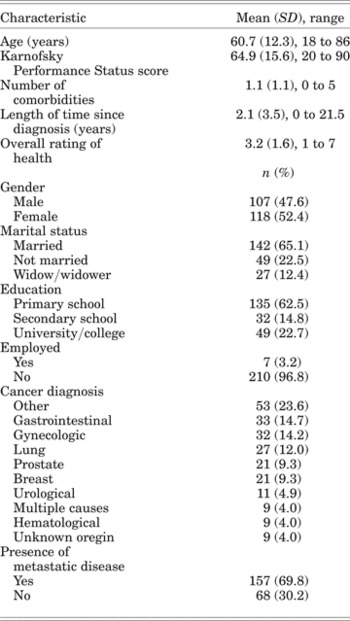
As shown in Table 1, the majority of the sample were women (52%), with a mean age of 60.7 years (SD = 12.3). Almost two thirds of the sample (65.1%) were married and 96.8% were not working. Only 22.7% had a college or university education.
Demographic and clinical characteristics of the oncology inpatients with paina

a Responses do not always total 225 because some questions were not answered by all respondents.
Clinical Characteristics
As shown in Table 1, the mean length of time since the cancer diagnosis was 2.1 years (SD = 3.5 years) and the mean number of comorbidities was 1.1 (SD = 1.1). The most prevalent type of cancer was gastrointestinal (14.7%), and 69.8% of the patients had metastatic disease. The patients reported their own mean health status as 3.2 (SD = 1.6) and their mean KPS score was 64.9 (SD = 15.6).
HHI Scores
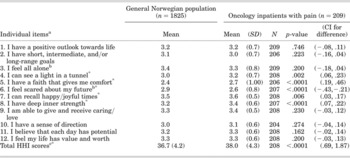
As shown in Table 2, the mean HHI total score was 38.0 (SD = 4.3). Mean scores for each of the individual items on the HHI ranged from 2.6 (SD = 0.8) on the item “I feel scared about my future” to 3.6 (SD = 0.5) on the item “I can recall happy/joyful times.”
Individual item and total scores for the Herth Hope Index (HHI) in oncology inpatients with pain compared to the general Norwegian population

aScores can range from 1 (strongly disagree) to 4 (strongly agree) with higher scores indicating higher levels of hope.
bScores are reversed coded.
cScores can range from 12 to 48 with higher scores indicating higher levels of hope.
*Mean scores significantly different between samples.
The differences between the HHI scores for the oncology inpatients with pain compared to the general Norwegian population are listed in Table 2. Oncology inpatients with pain had a significantly higher total HHI score than the general Norwegian population. For 4 of the 12 individual HHI items, oncology inpatients in pain reported significantly higher scores compared to the general Norwegian population. However, the oncology inpatients reported significantly lower scores on the item “I feel scared about my future.”
Relationships between Hope and Demographic and Clinical Characteristics
No significant correlations were found between total HHI scores and any of the demographic (i.e., age, gender, education, employment status) or clinical (i.e., cancer diagnosis, number of comorbidities, functional status presence of metastatic disease, length of time since diagnosis, overall rating of health) characteristics.
Relationships between Hope and Pain Characteristics
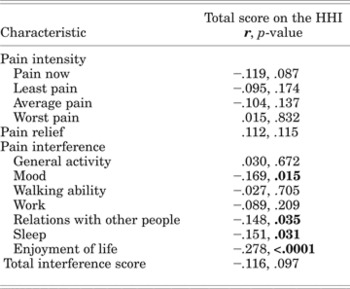
No significant correlations were found between total HHI scores and any of the pain intensity or pain relief scores (Table 3). Total HHI score was negatively correlated with ratings of pain interference with mood (r = −.17, p < .05), relations with other people (r = −.15, p < .05), sleep (r = −.15, p < .05), and enjoyment of life (r = −.28, p < .01).
Relationships between pain characteristics and Herth Hope Index (HHI) total scores

DISCUSSION
This study is the first to examine the relationships between hope and pain in oncology inpatients from a Western culture, as well as to compare hope scores in these patients to the general population in Norway. It is interesting to note that the total HHI score in these oncology patients (i.e., 38.0 ± 4.3) was comparable to that reported by Chen (Reference Chen2003). In this Taiwanese study, inpatients with a variety of cancer diagnoses reported total HHI scores of 37.0 (±5.3).
Although several authors have suggested that the concept of hope is culture specific (Hsu et al., Reference Hsu, Lu, Tsou and Lin2003; Lin et al., Reference Lin, Lai and Ward2003a; Rustoen et al., Reference Rustoen, Wahl and Hanestad2003; Averill & Sundarajan, Reference Averill, Sundarajan and Eliott2004), findings from this study suggest that oncology inpatients in Eastern and Western societies report similar levels of hope using the HHI. However, because the Taiwanese studies did not report individual item scores for the HHI, additional research is warranted across a variety of cultures to determine whether specific aspects of hope are more relevant to different cultural groups or have different meaning across cultural groups.
An important contribution of this study is the ability to compare the responses of oncology inpatients with those from the general Norwegian population. Of note, oncology inpatients with pain reported significantly higher hope scores than the general Norwegian population (Table 2). The difference between this sample's mean HHI total score and that of the general Norwegian population equates with a small effect size (i.e., d = .30, where d is the difference between the two means in standard deviation units; Cohen, Reference Cohen1994). Although relatively small, this effect size may represent a clinically meaningful difference. In a recent study of the effects of a psychosocial hope intervention for older palliative home care patients (Duggleby et al., Reference Duggleby, Degner and Williams2007), the treatment group reported a significantly higher total HHI score than the control group that equated with an effect size of d = .34. Qualitative data from the same study confirmed that this increase in hope in the intervention group represented a clinically meaningful change. Therefore, it is possible that the difference in hope between the oncology patients with pain and the general Norwegian population is clinically important and requires verification perhaps through a qualitative study.
The finding that oncology inpatients with pain reported higher levels of hope than the general Norwegian population is consistent with a previous study of patients with heart failure. These patients reported higher HHI total scores (i.e., 37.7) than the general Norwegian population (Rustoen et al., Reference Rustoen, Howie and Eidsmo2005). In fact, the HHI scores for the patients with cancer pain and heart failure were quite similar.
Although having a serious or chronic illness can undermine hope, the changes that can occur in an individual's life, with a redefining of priorities, may result in higher levels of hope and an increased awareness of hope despite negative circumstances. The higher level of hope may also reflect the oncology patients' adaptation to a life-threatening chronic disease, or a “response shift” in their evaluation of hope. A “response shift” is defined as a change in the meaning of one's self-evaluation as a result of changes in values or internal standards (Schwartz & Sprangers, Reference Schwartz and Sprangers1999). This concept is used to explain higher levels of quality of life reported by individuals even in the setting of disease progression (Schwartz & Sprangers, Reference Schwartz and Sprangers1999; Schwartz et al., Reference Schwartz, Bode and Repucci2006; Westerman et al., Reference Westerman, The and Sprangers2007). The concept of a response shift in hope was described initially by Rustoen et al. (Reference Rustoen, Howie and Eidsmo2005) in patients with heart failure. In addition, in the first longitudinal study of changes in hope in oncology patients (Sanatani et al., Reference Sanatani, Schreier and Stitt2008), overall hope was maintained or increased even in the presence of a trend toward fewer patients hoping for a cure. Additional longitudinal studies are needed to determine how hope changes over the course of a patient's illness.
A comparison of the oncology patients' ratings of the individual items on the HHI to those of the general Norwegian population reveals several important differences. The largest difference was on the item “I feel scared about my future” (Table 2). The oncology patients with pain were more scared for their future than the general Norwegian population (i.e., medium effect d = .40). This finding is consistent with previous studies that explored oncology patients' concerns about the future. For example, in a study that investigated the problems that cancer patients experienced and their unmet needs (Osse et al., Reference Osse, Vernooij-Dassen and Schade2005), one of the most prevalent problems was coping with the unpredictability of the future. In a more recent study of palliative care patients (McPherson et al., Reference McPherson, Wilson and Murray2007), one of their major concerns was their concern about the future and the likely effect that their death would have on those around them. While concerns about the future are appropriate for persons with advanced cancer, another reason for concern may be related to a fear of inadequate pain management. This idea is supported by findings from a study that demonstrated that unrelieved cancer pain increases patients' fear about the future (Strang, Reference Strang1997).
Interestingly, on the other four HHI items where differences were found, the oncology patients scored higher than the general Norwegian population. These items represent all three factors of hope (i.e., temporality and future, positive readiness and expectancy, and interconnectedness) that are measured by the HHI (Herth, Reference Herth1992). Higher scores on two of these items (i.e., “I have a faith that gives me comfort” and “I can recall happy/joyful times”) were also reported by patients with heart failure (Rustoen et al., Reference Rustoen, Howie and Eidsmo2005).
Surprisingly no relationships were found between hope and any of the pain intensity scores. However, small but significant correlations were found between the total HHI score and the more psychosocial interference scores on the BPI (i.e, mood, relations with other people, enjoyment of life) and sleep. The lack of significant correlations between hope and the functional interference items (i.e., general activity, walking, work) may be due to the fact that these patients were hospitalized and not working. Although not consistent with two studies from Taiwan that reported significant correlations between total interference and level of hope (Hsu et al., Reference Hsu, Lu, Tsou and Lin2003; Lin et al., Reference Lin, Lai and Ward2003a), the findings from this study suggest that hope may be more related to the psychosocial effects on pain. This hypothesis is supported by a Taiwanese study (Lin et al., Reference Lin, Lai and Ward2003a) that found significant positive correlations between pain interference and mood disturbance. Additional research is warranted on how pain effects hope in oncology patients.
Limitations of this study must be noted. First, the entire sample was inpatients and all were regular opioid users. Therefore, the findings may not be generalizable to all oncology patients with pain. Second, because the patients in this study were fairly ill, only a limited number of pain characteristics were evaluated. Further studies need to include additional pain characteristics (e.g., distress associated with pain, self-efficacy, coping) and other psychosocial variables that may mediate or moderate the relationships between hope and pain.
In summary, this study is the first to examine the relationships between hope and a variety of pain characteristics in oncology inpatients from a Western culture. Findings from this study suggest that, like patients with other chronic illnesses, oncology patients with pain may experience a response shift in the level of hope. Longitudinal studies are needed that examine oncology patients' level of hope across their disease and treatment trajectories as well as in terms of changes in their pain experience.
ACKNOWLEDGMENTS
The research was funded by Oslo University College, Norway, and also supported by the Fulbright Foundation in Norway. The authors express their deep appreciation to the staff and patients at the Norwegian Radium Hospital. Special thanks to the nurses Anne Berit Murstad and Anne Skogli for their help with the data collection. Finally the authors gratefully acknowledge the EPOS steering committee, in particular Pål Klepstad, M.D., Ph.D., Pain and Palliative Research Group, Norwegian University of Science and Technology, Trondheim, Norway, for their support of this study.