In 2005, the United Nations Security Council (UNSC) adopted Resolution 1617, extending the council's financial and travel sanctions against al-Qaeda and affiliated terrorist groups.Footnote 1 The resolution provided an opportunity for the council to articulate a set of legally binding rules regarding state efforts to combat terrorist financing, an increasingly important component of global counterterrorism efforts.Footnote 2 Suprisingly, Security Council members passed on this opportunity. Instead of designing its own rules for counterterrorism finance, the UNSC opted to defer to another international organization, instructing member states “to implement the comprehensive, international standards [of] the Financial Action Task Force (FATF).”Footnote 3
The FATF is a relatively weak, informal organization with no founding treaty or formal authority in international law.Footnote 4 The UN Security Council, by contrast, is a legally empowered institution with abundant administrative and technical resources. By deferring to the FATF, the Security Council obligated all UN member states to comply with a set of nonbinding rules crafted in an informal institution. Why did council members choose to elevate FATF rules for terrorism finance instead of articulating their own—in effect, accepting the authority of a weaker institution? More broadly, why would any international organization accept the authority of another IO, rather than extending its own?
In this article, I explore the practice of institutional deference: one IO's acceptance of another organization's exercise of authority.Footnote 5 Deference is a frequent practice conducted by international organizations that operate in the same policy domain. In its most common form, member states of one organization formally adopt a set of rules established by a different institution, as exemplified by the Security Council's deference to the FATF. Other cases of deference are less formal, with member states altering an IO's operational routines, technical assistance programs, or monitoring systems to support the rules of another organization.
Deference is a tool used by IO member states to manage jurisdictional overlap among international institutions. In many issue areas, contemporary global governance is fragmented among multiple IOs that simultaneously attempt to regulate state behavior. The presence of multiple institutions governing a single issue, deemed an “international regime complex” in the literature, often leads to inefficient overlap and inconsistencies in international rules. To avoid these problems, international organizations coordinate rule making via institutional deference. Just as the UN Security Council recognized the authority of the FATF to regulate counterterrorism finance, IO member states often selectively accept other institutions’ authority over particular subissues. This allows institutions to avoid the adoption of conflicting rules and to capture efficiency gains through division of labor.
Institutional deference is vital to effective multilateral cooperation. Without a mechanism for coordination, the proliferation of overlapping governance institutions endangers cooperation on a range of important issues, including the regulation of financial flows, trade, human rights, and counterterrorism. The literature on regime complexes underscores these deleterious effects. As Abbott and colleagues state, “typically, regime complex theory treats the co-existence of multiple governance actors with overlapping mandates as a pathology (‘overlap’ or ‘fragmentation’) that threatens governance effectiveness through redundancy, inconsistency, and conflict.”Footnote 6 Left unresolved, these effects not only erode the hard-fought gains states have achieved through multilateral cooperation, but also undermine public confidence in international institutions at a time when their utility is increasingly under assault from nationalist leaders. I challenge the pessimistic view of regime complexity by demonstrating how institutions can coordinate rule making via deference.Footnote 7
The use of institutional deference also has broader implications than the relationship between international organizations. It sheds light on whether governing institutions can successfully resolve jurisdictional conflicts in the absence of a clear legal hierarchy. This is a highly salient question at the international level where states confront an increasingly dense and complex set of bilateral and multilateral rules. But it is also important at other levels of government as the movement of goods, people, and information obscure traditional administrative boundaries. Jurisdictional conflicts between states and international institutions or between subnational authorities may require similar decentralized coordination strategies.
The paper has three closely related goals. First, I define the practice of institutional deference and explain why it is an attractive strategy for member states of international organizations. I develop a theory of deference as a solution to inefficient overlap and inconsistent rules across IOs. The decision to defer is rooted in the preferences of IO member states. When coordination problems undermine cooperation in a regime complex, member states face a tradeoff. They can resolve jurisdictional conflicts by instructing an IO to defer to another organization, but in doing so they surrender the ability to formulate their own rules. As this tradeoff implies, we are more likely to observe deference when the gains from coordinated rule making exceed states’ desire to maximize control over global governance.
Second, I demonstrate that deference is a common practice that has a significant effect on IO behavior. I leverage a novel data set of over 2,000 IO policy documents to examine deference in three issue areas: counterterrorism, intellectual property, and election monitoring. In addition to describing patterns of deference, I use a structural topic model to show how deference shapes IO rule making by facilitating a division of regulatory labor among IOs. This is particularly important given the central focus in the regime complexity literature on the harmful effects of discordant rules and standards.
Finally, I explore the political determinants of institutional deference. If deference represents a bargain to manage overlapping IO jurisdictions and divide labor, on whose terms is this bargain constructed? Why are some IOs privileged over others in the acceptance of regulatory authority? The direction and intensity of deference reflect two broad processes. First, deference is used to overcome cooperation problems by pooling resources among different types of organizations. For example, member states strategically distribute deference to link IOs with issue-specific technical expertise to IOs with binding legal authority, as in the UNSC-FATF example. Second, deference is shaped by state power: IOs with weaker member states tend to defer to organizations with more powerful members.
Why Defer? Jurisdictional Conflict Among IOs
The last several decades have seen a rapid growth in the number of international organizations that seek to regulate state behavior. This proliferation of IOs has altered the structure of interstate cooperation in many issue areas. Issues such as trade and global health, which were once regulated by relatively integrated regimes, are now governed by a complex network of distinct institutions with partially overlapping mandates and memberships.Footnote 8
The IOs that govern an issue area do not always act in concert. Raustiala and Victor claim that, “the rules in these elemental regimes functionally overlap, yet there is no agreed upon hierarchy for resolving conflicts between rules.”Footnote 9 Independent rule making by multiple IOs often results in a fragmented and potentially conflicting set of international rules and standards.Footnote 10 In other words, a common feature of regime complexes is inconsistency in law or regulatory practice.
Much of the literature on regime complexity focuses on the potential for rule conflict to undermine international cooperation. Inconsistent rules among IOs can raise a number of potential barriers to cooperation, including increasing uncertainty and raising transaction costs. I briefly highlight two problems associated with inconsistent rules that have received significant attention: reduced compliance via regulatory arbitrage and inefficient duplication.
Regulatory Arbitrage and Inefficient Duplication
Inconsistent rules may reduce compliance when the same actors are subject to multiple regulatory jurisdictions. States can leverage loopholes and incongruencies in regulatory systems to circumvent costly rules—a process known as regulatory arbitrage.Footnote 11 If the compliance costs of conflicting regulations differ, states will prefer to recognize the authority of the lowest-cost regulator. In some cases, this dynamic can create a “race to the bottom” effect that empowers the weakest regulatory authorities.Footnote 12 States may also leverage inconsistencies to escape compliance with burdensome requirements—for example, by exploiting gaps in regulatory authority, or by claiming the absence of a clear global standard on a particular issue.Footnote 13 The net effect is a reduction in compliance with international rules, norms, and standards.
Chinese and Russian use of the Shanghai Cooperation Organization (SCO) provides a useful example of arbitrage in the counterterrorism regime complex. Several IOs, including the United Nations (UN) and the Organization for Security and Co-operation in Europe (OSCE), require member states to ensure that national counterterrorism policies protect basic human rights, such as freedom of expression and the right to seek asylum.Footnote 14 In 2004, the SCO, a regional organization made up of Russia, China, and the Central Asian states, adopted a set of counterterrorism rules that conflict with these principles. The SCO employs an expansive definition of terrorism, explicitly conflating terrorist acts with the “co-equal evils” of separatism and extremism. It has also adopted controversial policies regarding extradition and denial of asylum for individuals suspected of participating in these activities.Footnote 15 In practice, SCO members have leveraged these rules to escape compliance with international human rights obligations.Footnote 16 This behavior is far from unique in international regime complexes. States and other targets of regulation often opportunistically select among multiple regulatory authorities (“forum-shopping”) to avoid complying with international rules they do not like.Footnote 17
The second major problem associated with overlapping institutions is inefficient duplication of effort. Duplication occurs through the promulgation of redundant rules, as well as IO technical assistance or information-exchange initiatives designed to implement rules. In many cases, the development of rules within an IO involves the expenditure of significant material and human resources. In the regime complex for intellectual property rights, for example, the development of rules can require lengthy negotiations and a high level of legal expertise. Duplication among multiple institutions, such as the World Intellectual Property Organization (WIPO), the World Trade Organization (WTO), and the World Health Organization (WHO), generates inefficiency costs and constrains the productivity of IOs in a regime complex.
These barriers to cooperation in regime complexes are acknowledged by both scholars and policymakers.Footnote 18 Yet existing theories of international institutions suggest that member states should take action if cooperation is undermined by regulatory arbitrage and duplication. Rational institutionalist theory argues that states create international institutions to generate gains from cooperation.Footnote 19 This theory implies that states will recognize the costs associated with inconsistent rules and direct IOs to coordinate their rule-making efforts. In the regime complex for intellectual property, for example, the three institutions I referenced in the preceding paragraph have established a regular consultative process for “strengthening their cooperation and practical coordination on issues around public health, intellectual property and trade.”Footnote 20 These coordination efforts are common among IOs but have largely remained unexamined by scholars.Footnote 21
While institutional deference occurs between two international organizations, I emphasize the role of member states in pushing IOs to reconcile jurisdictional conflicts. Member states create international institutions and typically maintain close control over their activities. Bureaucratic actors within an IO may have some agency in shaping coordination, but the fundamental tradeoff involved in deference—the gains from coordination versus the loss of control—is reflected most clearly in the preferences of member states.
Institutional Deference: A Mechanism for Coordination
Faced with the potential for arbitrage and duplication, IO member states have incentives to prevent inconsistent rules. Two potential remedies are harmonization of IO rules or the formal unification of disparate institutions. If states face a single set of harmonized rules, the costs of compliance are constant across regulatory authorities, and regulatory arbitrage ceases to be an attractive strategy. Harmonization also alleviates transaction costs, since rules do not differ across regulatory jurisdictions. This strategy, however, is difficult if not completely infeasible.Footnote 22 IOs in a regime complex have different member states, mandates, and decision-making mechanisms. The likelihood of all states agreeing to a single, comprehensive set of rules is quite low.Footnote 23 Institutional unification is also prohibitively difficult once multiple IOs lay claim to governance of an issue area; the elimination of existing institutions is rare and often opposed by states and IO bureaucrats with vested interests.
When these options are infeasible, regulatory institutions in other contexts have turned to an alternative strategy: clarifying the scope of each body's regulatory authority to reduce jurisdictional overlap. Instead of adopting a single set of rules, this approach reduces rule conflict by establishing where “each regulatory authority extend[s], and what should be done when these overlap.”Footnote 24 In international law, this approach is known as the “Conflict of Laws” or “Private International Law.”Footnote 25 Its goal is to coordinate rules by assigning areas of contested jurisdiction to a single authority. This strategy is more feasible than unification, since each clarification of jurisdiction is limited in scope and does not eliminate any regulatory body.
The practice of institutional deference represents IO member states’ attempt to mimic this “Conflict of Laws” process. When the potential for rule conflict arises, IOs engage in deference, defined as the acceptance of another IO's exercise of authority. This definition is adapted from Efrat and Newman, who examine formal deference agreements among national courts.Footnote 26 Deference is a common form of coordination among IOs in a regime complex.
Examples of institutional deference are plentiful in international politics. I described earlier how UN Security Council members accepted the FATF's rules for terrorist finance rather than developing their own regulations. By doing so, the Council avoided setting multiple, potentially conflicting sets of rules. Other IOs, including the Asia Pacific Economic Cooperation (APEC) forum, have similarly deferred to the FATF.Footnote 27 Organizations involved in counterterrorism policy have also granted deference on the issue of aviation security, a key policy priority after the 9/11 attacks. In 2013, the Organization for American States (OAS) pledged to “help member states comply with the International Civil Aviation Organization (ICAO) standards and recommended practices.”Footnote 28 The Organization for Security and Cooperation in Europe (OSCE) also adopted ICAO's rules, deciding in 2003 “that all OSCE participating states should aim to comply fully with the recommended ICAO minimum security standards.”Footnote 29 These are instances in which one IO explicitly accepts an exercise of authority by another organization, despite the lack of a formal legal hierarchy to resolve jurisdictional conflicts.
Other examples of deference are less conspicuous, with one institution informally accepting the rules of another as it monitors state behavior. This is prominent among some institutions in the regime complex for election monitoring, where multiple IOs develop rules for fair and open elections and assess compliance via election monitoring missions. In a 2008 electoral observation report, for example, the European Union (EU) evaluated the election of Nepal's Constituent Assembly based on rules adopted by both the OSCE and the Council of Europe (COE).Footnote 30
Deference can target specific issues where conflicting rules are particularly damaging, and it can be reversed if circumstances change.Footnote 31 These characteristics make deference similar to other arrangements for sharing authority among global governance actors, such as delegation and orchestration.Footnote 32 Like deference, delegation and orchestration occur when one actor grants another authority to pursue governance goals. However, two key differences distinguish deference from these related concepts. First, deference emphasizes a different set of actors. In international relations, delegation has focused on how states (as principals) transfer authority to IOs (their agents). Orchestration theory focuses on how IOs mobilize third parties (primarily NGOs and rarely IOs) to aid their governance efforts. By contrast, deference occurs exclusively between IOs, as one organization accepts an exercise of authority by another.Footnote 33
Second, the temporal sequence of actions associated with deference differs from delegation and orchestration. In delegation and orchestration, the sharing of authority precedes an act of governance. Actors delegate or orchestrate ex ante with the expectation that the future behavior of the agent/intermediary will reflect their preferences. Accordingly, both orchestration and delegation emphasize mechanisms in which the actor conferring authority attempts to control or “steer” the recipient.Footnote 34 Deference reverses this sequence. An exercise of authority (e.g., the formulation of rules by an IO) occurs first, and then another IO decides whether to accept the exercise of authority by validating those rules. Lacking control over organizations’ future behavior, IOs defer ex post after observing an act of governance.
The fact that member states of one IO lack the ability to steer another organization after deference has occurred is consequential. It suggests that member states face a tradeoff when attempting to resolve jurisdictional conflicts among IOs. Deferring to another organization helps mitigate duplication and opportunities for regulatory arbitrage but it also requires member states to surrender the opportunity to formulate their own rules.Footnote 35 The use of deference should therefore increase as the gains from coordinated rule making rise and decrease as states seek to maximize control over global governance. These impulses produce competing expectations regarding the frequency of deference in international regime complexes. One one hand, the overlapping mandates of IOs in regime complexes produce an abundance of jurisdictional conflicts that may be resolved through the frequent use of deference. On the other hand, the fact that multiple institutions were constructed in a particular issue area suggests states have competing preferences over global governance, limiting their willingness to defer.Footnote 36 The empirical investigation of deference patterns in the next section helps adjudicate between these expectations.
A final conceptual question raised by deference is its potential to redistribute authority among IOs. Deference occurs whenever one IO accepts another organization's exercise of authority. In some cases, this acceptance simply reinforces existing authority relations among IOs. When a regional organization defers to the UN Security Council, for example, it does not imbue the Council with added authority since UNSC rules are already binding for all UN member states. In cases without a clear pre-existing authority structure, however, deference may generate meaningful shifts in authority from one IO to another. When deference flows are asymmetric, certain IOs expand their jurisdiction while others contract. Deference can thus help construct hierarchies of authority among international institutions.
As the examples illustrate, cooperation in international regime complexes is not condemned to suffer from arbitrage, noncompliance, and inefficient duplication. In some instances, IO member states succesfully coordinate to reduce or eliminate overlaps in governing authority. In other cases, states are unable to reach agreement regarding whose authority should be privileged when IO jurisdictions overlap. But the challenges involved in institutional deference do not justify the assumption that regime complexity is pathological for cooperation. Instead, assessments of cooperation in regime complexes should be informed by how successfully its constituent institutions are able to coordinate their rules and standards.
Patterns of Deference
To measure the use of deference by international organizations, I examine whether organizations explicitly accept an exercise of authority by another IO regulating the same policy domain. I look for cases of deference that are formally documented in the written record of rules, norms, and standards adopted by international organizations. If deference occurs between two IOs, the act should be reflected in the official corpus of documents that chronicle an institution's exercise of authority.
Examining cases of deference that are formally documented facilitates measurement but also entails a cost. It excludes potential instances of “deference by abstention,” in which members states of one IO implicitly recognize the authority of another organization by declining to assert their own jurisdiction. Instead, this measurement strategy prioritizes “deference by validation” where one IO explicitly accepts an exercise of authority by another organization.Footnote 37 This is a stronger form of institutional deference, and is more likely to mitigate jurisdictional frictions and facilitate a division of labor.
Measuring deference requires identifying the set of rules and regulations adopted by international organizations in a given issue area. Unlike states, however, most IOs do not maintain a single authoritative and comprehensive collection of rules. Instead, the record of rule making in international organizations is spread across a variety of documents that articulate obligations for member states. The type and nature of these documents varies by institution. The adoption of rules often begins when member states negotiate a broad set of principles that are codified in a treaty or resolution. Afterward, secretariat officials or issue-specific subsidiary bodies develop a set of more precise implementing rules that translate broad principles into specific obligations for states. These rules are organized into codes of conduct, best practices, policy statements, or monitoring guidelines and disseminated to member states. I examine this material, which I collectively refer to as IO policy documents, to explore deference among organizations.Footnote 38
Data Collection
The IO policy document is the basic unit of measurement used to assess patterns of institutional deference. I define a policy document as a written record of rules or obligations member states are expected to follow. These documents take a variety of forms, including treaties, resolutions, policy guidelines, best practices, mission reports, codes of conduct, and agreements. While not all documents have the binding force of a formal treaty, they are useful vehicles for coordinating with other institutions on specific subissues.Footnote 39 Each time an IO articulates obligations for member state behavior, it has an opportunity to defer to the rules of another organization. As a result, the presence or absence of deference in IO policy documents reveals the extent to which institutions successfully coordinate rule making.
To measure institutional deference, I collect a large sample of policy documents adopted by IOs in three regime complexes: election monitoring, counterterrorism, and intellectual property rights. I selected these issue areas for two reasons. First, they represent a diverse range of topics, from human rights to security to economic issues. Each issue area has its own set of cooperation problems that complicate the task of coordinating global governance. Second, each regime complex has been the focus of previous scholarly attention. The existence of previous work helps to establish the boundaries of the policy domain and limits subjectivity in determining which international organizations should be considered participants in each regime complex.
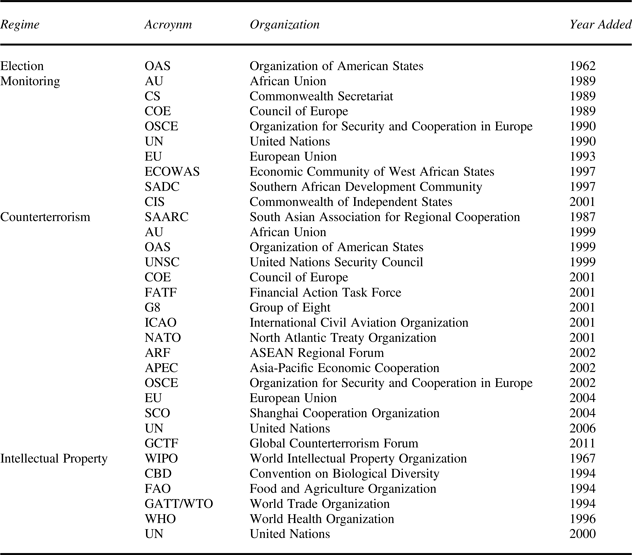
To find relevant policy documents in these regime complexes, I first identified the set of IOs that participate in global governance of each issue. To be considered part of the regime complex, an IO must formally include the relevant issue in its institutional mandate or actively regulate state behavior in the issue area.Footnote 40 Even with this criteria, there can be reasonable disagreement regarding which IOs participate in governance of a particular issue. A broad conception of intellectual property, for example, could encompass a wide range of related issues regulated by dozens of organizations. To narrow the field of candidate IOs, I drew on Kelley'sFootnote 41 and Hyde'sFootnote 42 extensive examination of the election-monitoring regime complex; Helfer's work on the intellectual property regime complex;Footnote 43 and Rosand's study of the counterterrorism regime complex.Footnote 44 Table 1 displays the IOs included in the regime complexes for election monitoring, counterterrorism, and intellectual property rights, as well as the year of entry for each IO.Footnote 45
International organizations in three regime complexes

For each year that a particular international organization participates in governance of the issue area, I collect all IO documents that articulate rules in the relevant policy domain and are publicly available from the IO's website.Footnote 46 For example, a 2010 resolution adopted by the European Parliament documents EU policy on human rights and democracy.Footnote 47 I include this resolution in the sample of policy documents used to assess deference among election-monitoring organizations. Overall, the search yields over 2,000 policy documents from IOs in the election-monitoring, counterterrorism, and intellectual property regime complexes.
I parse each document with statistical software to see whether it makes reference to any other IO in the same regime complex. These cross-institutional references are then hand coded on a five-point scale, with “1” denoting a passing or irrelevant reference and “5” (deference) representing a clear acceptance of another IO's authority. The EU resolution discussed earlier makes reference to the OSCE, another organization involved in regulating electoral procedures. Specifically, it calls on relevant EU bodies to ensure that OSCE recommendations are “fully and systematically integrated into all EU policy fields,”Footnote 48 which is coded as an instance of deference. Missing references—documents in which one IO does not refer to another—are coded as 0. Details of the coding scheme can be found in the appendix.
The reference scores are then used to create an aggregated measure of institutional deference for each directed IO dyad in a given year. Institutional deference from IO A to IO B in year t is calculated as the proportion of IO A's policy documents from year t that include at least one explicit case of deference (a score of 5) to IO B. The resulting data set of institutional deference includes 3,718 unique directed IO dyad-years.
Deference in Three Regime Complexes
A review of the deference data reveals three notable trends. First, deference is a common practice among IOs in the same regime complex. The thirty-two institutions in three regime complexes I examined engaged in over 1,250 unique instances of institutional deference in the period under study.Footnote 49 Even if each particular act of deference represents an acceptance of authority of limited scope, collectively they represent a significant narrowing of jurisdictional overlap in these regime complexes. Overall, approximately 14 percent of IOs defer to at least one other organization in a given year. This rate differs slightly across policy domains (16.8% in intellectual property versus 14.4% in counterterrorism and 11.9% in election monitoring) but is commonplace in all three regime complexes.
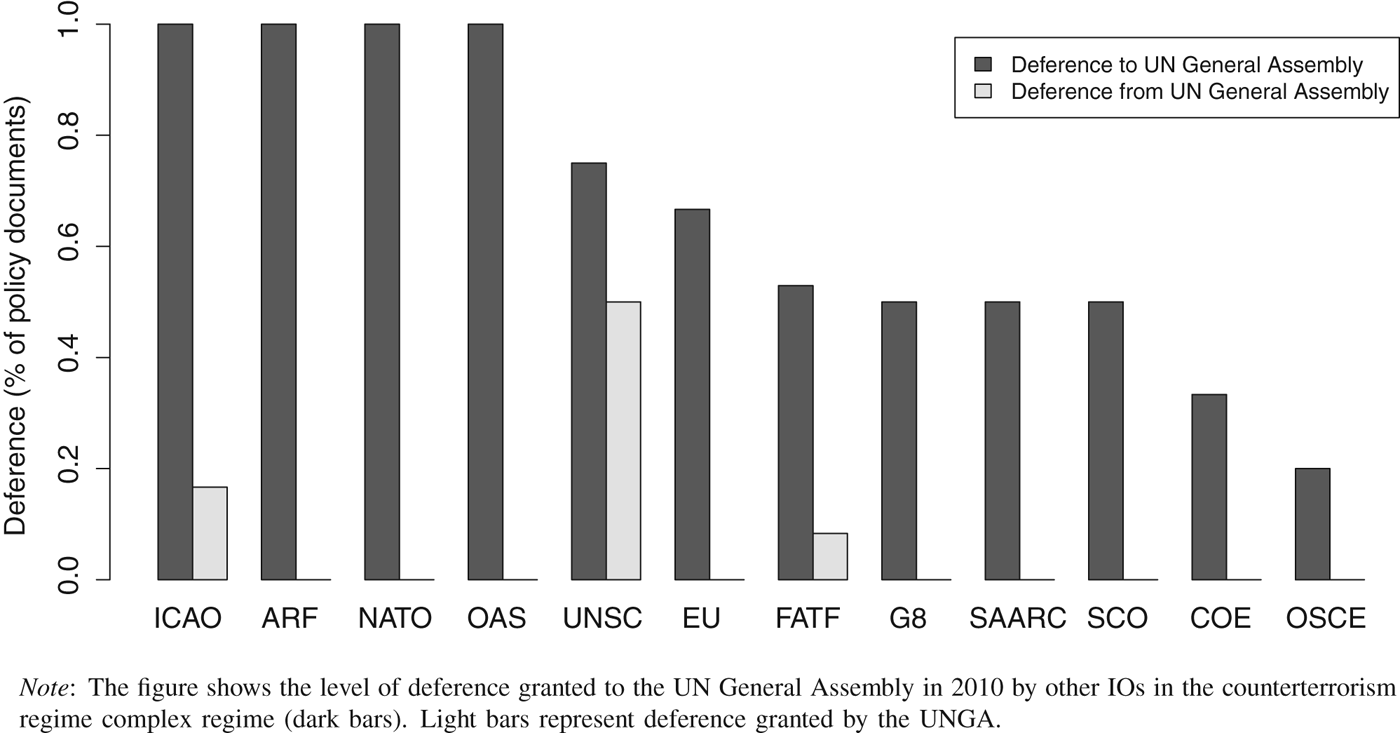
Second, deference flows are asymmetric, flowing predominantly in one direction within a given pair of IOs. This pattern is notable since we might expect member states of two IOs occupying the same regulatory space to strike a quid pro quo bargain, engaging in mutual deference to each other on separate subissues. Deference in one direction may also generate incentives for the recipient IO to reciprocate in the future, thereby enhancing the legitimacy of the deferring IO. While these incentives are incorporated in the empirical analysis, descriptive statistics suggest that among pairs of IOs, one tends to dominate in terms of the total flow of deference. Figure 1 displays asymmetric deference between the UN General Assembly and other institutions in the counterterrorism regime complex in the year 2010. As the graph illustrates, the UN is granted a high level of deference from many institutions but does little deferring in return. Only three IOs (ICAO, the UN Security Council, and the FATF) are recipients of institutional deference from the General Assembly.
Institutional deference with UN General Assembly

Third, these patterns of asymmetric deference reveal an informal hierarchy of authority among international institutions in a regime complex. Deference flows may either reinforce or restructure authority relations among IOs. If an informal IO grants deference to a formal, treaty-based organization, it reflects the pre-existing distribution of authority among institutions. If deference flows to less powerful IOs, or between institutions with similar levels of pre-existing authority, it can reshape governing authority in the regime complex. When uneven flows of deference persist over time, some IOs expand their jurisdiction while others contract.Footnote 50 The acceptance of another IO's authority can therefore reposition organizations with no formal chain of authority into a clear hierarchical relationship. The hierarchy arising from institutional deference is more ad hoc and less absolute than the practice of legally nesting a new IO within an existing institution. Each instance of deference may be a relatively small acceptance of authority on a specific subissue; it is only in the aggregate that a clear hierarchy becomes visible.
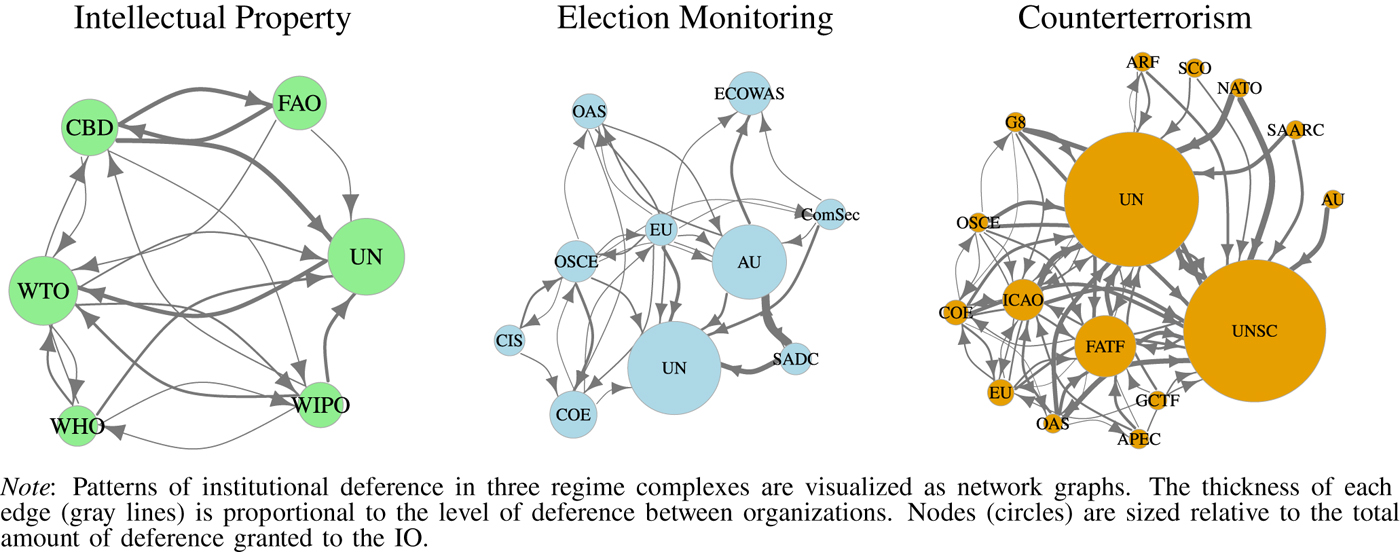
Figure 2 demonstrates this hierarchy in each of the three regime complexes using a network graph. IOs are represented as nodes (circles) in the network. They are connected to each other via directed flows of institutional deference (lines). The size of each IO is proportional to the total amount of deference granted to the institution by other IOs in the regime complex. Line thickness represents the amount of deference granted from one IO to another.
Networks of institutional deference

The figure underscores how the degree of hierarchy differs across each regime complex. Counterterrorism institutions display a clear hierarchical structure, with deference flowing overwhelmingly to the UN General Assembly and UN Security Council. The election-monitoring regime complex is less hierarchical, with at least some deference granted to each IO but clear asymmetry in the aggregate flow of deference. Intellectual property has the flattest structure, with deference distributed horizontally among institutions.
A few broad trends are evident in the figure. First, it appears that IOs with the power to set universal, binding rules receive more deference than regionally defined IOs or those that lack the force of international law. In particular, the UN and UN Security Council loom large in each regime complex. Second, the observed hierarchy in deference flows differs dramatically across policy domains. This suggests that deference is shaped by the structure of the specific cooperation problem that states confront in each issue area. In counterterrorism, for example, divergent rules are particularly costly; noncompliance by a subset of states threatens the viability of the entire regime.Footnote 51 States also largely agree on the basic goals of the counterterrorism regime. These features facilitate the emergence of a few authoritative institutions as focal points for coordination in the regime. In both election monitoring and intellectual property, however, clubs of states can sustain cooperative outcomes even if others follow a different set of rules. As a result, the pressure for coordination—and thus the structure of institutional deference patterns—are attenuated.Footnote 52
Division of Labor
Now that deference has been established as a practice that generates systematic patterns of relations among IOs, an important question remains: does it matter for how IOs actually govern? To demonstrate that deference is a tool to manage overlapping jurisdiction, I examine the division of labor among counterterrorism institutions. This issue area is well-suited for examining whether deference is associated with a division of labor among IOs. Cooperation on counterterrorism encompasses a range of subissues, including transportation security, terrorist financing, criminal justice, and immigration. Global governance of counterterrorism policy reflects these divisions, with IOs developing separate rules for each subissue. This governance structure allows us to examine how counterterrorism IOs divide regulatory effort. Do IOs tend to duplicate effort, with each institution separately articulating rules for aviation security, criminal justice, and other issues? Or do some IOs, as hypothesized, use institutional deference to resolve jurisdictional overlaps and focus their rule making on separate topics?
To measure division of labor among counterterrorism institutions, I estimate the attention IOs devote to particular subissues each year using a structural topic model. A topic model is a statistical tool for estimating latent themes, or topics, in a body of text.Footnote 53 Given a large number of documents, a topic model can inductively recover the topics discussed in the text, identify the words most closely associated with each topic, and estimate the proportion of each document devoted to each topic.Footnote 54
I estimate a ten-topic structural topic model on the 677 policy documents produced by IOs in the counterterrorism regime complex from 1999 to 2013.Footnote 55 Many of the ten topics identified by the model are closely associated with functional subissues related to counterterrorism policies. For example, one topic features the terms money, launder, and fund among its most frequent words, clearly signaling the topic of terrorism finance. Other topics focus on preventing nuclear terrorism (signified by words such as nuclear, materi [al], and safe [ty]), criminalizing terrorist acts (crime, investig [ate], court), and protecting human rights (right, human, protect). Figure A1 in the appendix displays the words that appear most frequently in each topic.
The results of the topic model provide a measure of how each IO allocates regulatory effort in each year. This can be used to estimate division of labor among IOs. Deference generates a division of labor only if IOs subsequently differ in their rule-making activity: member states of IO A choose to accept the authority of IO B to govern a particular subissue and instead focus their attention on separate matters. If this occurs, we should see the regulatory effort (and thus the topical focus) of two IOs diverge as they engage in deference with each other.
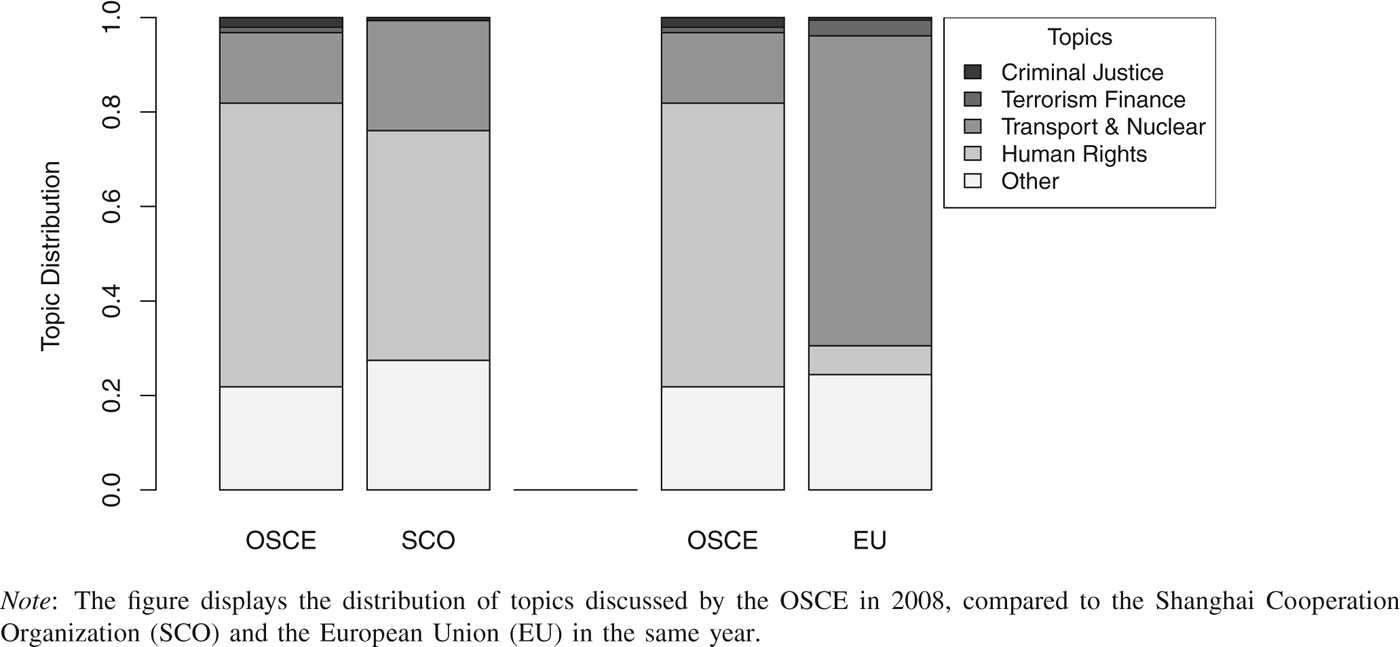
Figure 3 shows how the topic model results can provide evidence of a division of labor. It compares the OSCE's regulatory efforts in 2008 with two other IOs, the EU and the SCO. There are several instances of deference between the OSCE and EU in the years preceding 2008 and none between the OSCE and SCO. We should therefore expect the OSCE and EU to divide labor by focusing their rule-making efforts on separate issues, while the OSCE and SCO will have more overlap in their regulatory focus. The figure confirms this expectation. The topics discussed by the OSCE and SCO are very similar (left panel). By contrast, the OSCE and the EU (right panel) have taken a more complementary approach to counterterrorism governance: the OSCE tends to emphasize human rights, while the EU focuses on transportation and nuclear security.
Division of labor with Organization for Security and Cooperation in Europe (OSCE), 2008

To examine this process systematically, I construct an annual measure of division of labor between each pair of counterterrorism IOs. The measure calculates the total absolute difference between two IOs’ topic distributions in a given year. As two IOs prioritize different subissues, the division-of-labor measure increases; it decreases as IOs devote regulatory effort to the same subissues. The measure is bounded between 0 and 2, and the sample average is 1.00. In the figure, the OSCE and SCO have a division-of-labor score of 0.30, while the OSCE and EU score is 1.17.
Data in the counterterrorism regime complex are consistent with the use of deference as a tool to divide labor. Pairs of IOs that engage in institutional deference have, on average, a division-of-labor score of 1.06; the corresponding score for IO pairs that do not defer to each other is 0.96. The difference is statistically significant (p-value < 0.01), suggesting that IOs that coordinate via institutional deference devote their governance efforts to different subissues.
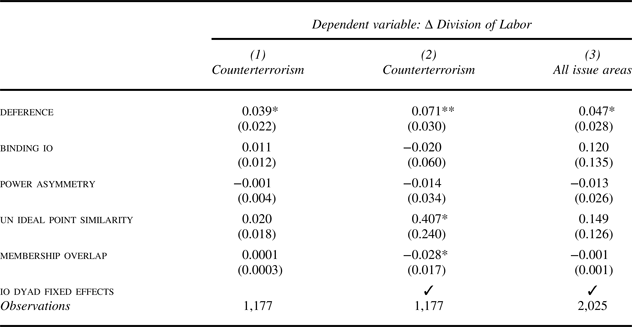
In addition to comparing levels of division of labor, we can examine how division of labor changes over time once deference occurs. Table 2 displays the results of a linear regression model estimating the effect of institutional deference on the subsequent change in division of labor between two IOs. The unit of observation is the directed IO dyad-year. Deference, the independent variable, is measured as the proportion of IO A’s policy documents that contain at least one instance of institutional deference to IO B. The model controls for several potential confounders: the number of overlapping member states, similarity in the foreign policy preferences of member states,Footnote 56 and whether the IO pair includes an institution with binding legal authority. I also control for member state power asymmetries among IOs, since Gehring and Faude argue that a balanced distribution of power should generate greater division of labor.Footnote 57 The construction of the dependent variable—the change in division of labor from the previous year—mitigates confounding variables that remain constant within each IO pair. Standard errors are clustered by directed IO dyad.
Effect of deference on division of labor

Notes: Results of linear models estimating the effect of deference on division of regulatory labor. Coefficient estimates are displayed with standard errors in parentheses. *p < .10; **p < .05; ***p < .01.
The results indicate that IO pairs that engage in institutional deference are significantly more likely to divide labor. In the baseline model (Model 1), deference is the only variable with a statistically significant association with division of labor. In Model 2, which adds fixed effects to account for unobserved heterogeneity among IO dyads, the effect is even stronger: when an IO defers to another institution in all of its policy documents, the two organizations subsequently increase their division of labor by 0.071 (compared to an average change of 0.01).
The counterterroism issue was selected because of its measurement advantages: governance is differentiated into distinct subissues, making it an ideal fit for the topic-modeling approach. It is possible, however, that this issue area represents an “easy” test for the effect of deference given the uniquely hierarchical structure of deference flows among counterterrorism institutions portrayed in Figure 2. To ensure the results are not limited to counterterrorism, Model 3 expands the test to include IOs in the election-monitoring and intellectual property rights issue areas. Deference remains a significant predictor of increasing division of labor across all three issue areas.
The Determinants of Institutional Deference
Coordination via deference represents a cooperative bargain between IO member states over the acceptance of regulatory authority, and like most bargaining scenarios it generates important distributional effects. Member states must decide which institution will be privileged and which will cede jurisdiction. What are the sources of power that allow one organization to “win” deference from another? In other words, how do states decide who will defer to whom?
I consider two distinct models of institutional deference. Both models are rooted in the preferences of IO member states. The first is a “functional efficiency” model in which member states grant deference to overcome obstacles to global governance and maximize cooperative gains. This model recognizes that IOs differ in expertise, decision-making structure, and legal authority. When the need for coordination arises, states consider the relative strength of each IO in the regime complex and target deference to capitalize on specific institutional complementarities. The functional efficiency model is a natural extension of the functional theory of institutions that Keohane articulated.Footnote 58 If states construct institutions in order to reduce transaction costs and generate welfare-enhancing cooperative gains, it is reasonable to expect them to have similar goals when setting the terms of coordination among multiple institutions. In this conception, deference is a tool used to gather expertise and solve coordination problems.Footnote 59
I test three observable implications of the functional model of institutional deference. First, patterns of deference will empower IOs with the greatest expertise in the issue area. IOs should therefore be more likely to defer to technical, issue-specific institutions compared to political organizations with no specific issue mandate. Second, states will use deference to help overcome difficult bargaining problems within IOs. Regulatory action is often blocked in organizations where decision-making procedures require a consensus or supermajority of votes. In these cases, the organization is likely to defer to another IO with fewer veto points—in effect, using another institution as a means to overcome bargaining sclerosis. Third, deference will help pool institutional expertise, which is needed to formulate effective rules, with legal obligation, which is needed to bind state behavior. Deference should therefore be more common between IOs that adopt binding rules and technical, information-rich institutions.
The functional model of deference is consistent with a rational division of labor in the regime complex, where enlightened member states use deference to efficiently resolve cooperation problems. However, deference also has distributional effects that weigh on member states’ decisions. When an IO engages in deference, the power to govern is often shifted from one set of IO member states to another. Instead of a tool to maximize cooperation, states may view deference as a means to enhance their own rule-making authority.
The “Member State Power” model assumes states seek to maximize their own governing authority in the regime complex. This model emphasizes the fact that deference represents an agreement over the scope of regulatory authority—a bargain over whose rules will prevail when jurisdictions overlap. Unless two IOs have perfectly identical memberships, this generates a conflict of interest between the IOs’ member states; each state would prefer to have their own rules privileged. As in other bargaining environments with conflicting interests, states’ material power is an important driver of outcomes. In this case, power imbalances imply that IOs with relatively weak members are more likely to defer to organizations with powerful member states.
Two mechanisms translate member state power into institutional deference. First, states with high material capability tend to enjoy more influence in international organizations.Footnote 60 As diplomats meet in IOs to discuss the ideal distribution of regulatory authority, powerful states are better equipped to steer deference toward their preferred institutions. Second, powerful states may simply coerce or buy off weak members of an opposing IO. Since member states ultimately control the budgets and authority of international organizations, weak states can then instruct their IO to defer to the more powerful IO. If this pattern persists, the effective regulatory authority of “powerful” IOs grows, the authority of “weak” IOs contracts, and a power-based hierarchy may emerge in the regime complex.
In the empirical tests that follow, I consider two observable implications of the Member State Power model. First, when power imbalances exist among members of two IOs, we should expect deference to flow toward institutions with more powerful members. Since states prefer to maintain governing authority in the regime complex, each set of members draws on their diplomatic or coercive capacity to ensure its own organization is granted deference. The second way that state power can shape deference is via the decision-making rules of each institution. Some IOs grant augmented decision-making ability to their more powerful member states. Weighted decision-making rules tend to emphasize sources of national power, such as population or size of the domestic economy. IOs that use weighted voting therefore give powerful countries additional sway. When the regulatory jurisdictions of two IOs overlap, powerful states will favor the organization where they have the most influence over outcomes. As a result, a power-based model expects powerful states to steer deference toward IOs with weighted voting procedures.
The contrasting expectations of the Functional Efficiency and Member State Power models mirror a long-standing debate among strands of rational institutionalist (RI) theory. RI theory conceptualizes IOs as performing functions that are valuable to states, but scholars have differed in their emphasis on power and distributional concerns. One strand, represented by the “rational design” literature, argues that states are very good at optimizing the design of institutions to perform their functions effectively.Footnote 61 This view is consistent with the Functional Efficiency Model because governing power in a regime complex is distributed to the most capable organizations. Another strand of RI theory emphasizes the significance of distributional issues and power disparities, therefore expecting institutions to deviate from a straightforward functionalist design.Footnote 62 The Member State Power model similarly prioritizes power concerns and suggests regime complexes have a broad tendency to allocate governing power to the strong at the expense of the weak.Footnote 63 The empirical analysis that follows offers a unique opportunity to test these conceptions of rational institutionalism in a new domain: the use of deference in international regime complexes.
Data and Measurement
The dependent variable for this analysis is the intensity of institutional deference between directed pairs of IOs. Institutional deference is measured from IO policy documents described earlier; it ranges from 0 to 1. The unit of analysis is the directed IO dyad-year. Data from all three regime complexes provide approximately 3,700 unique observations. The analysis examines whether differences in member state power or functional complementarities drive institutional deference between IOs.
The independent variables represent the two models of deference. Member state power is measured as the difference in the number of “great powers” in each IO, as determined by the Correlates of War Project.Footnote 64 To make the variable suitable for the directed-dyad format of the data, I calculate the difference in great powers between the recipient of deference and the granter. As we examine the level of institutional deference from IO A to IO B, great power difference measures how many more great power states are members of IO B compared to IO A. A positive coefficient on this variable indicates deference tends to flow toward IOs with more great power members. I also include a dichotomous variable (weighted voting) that takes a value of 1 if the recipient of deference employs weighted decision-making procedures, and 0 otherwise.Footnote 65
Three variables represent the functional efficiency model. The first, technical io, is a dummy variable equal to 1 if the recipient of deference is an issue-specific, technical organization. Second, the variable binding-technical pair equals 1 when an IO dyad features one IO with binding legal authority and one technical institution. Finally, the variable decision-making difference measures the relative ease of decision making among two IOs. To construct this variable, I first score each IO according to the ease of its decision-making process. Organizations requiring a simple majority to adopt policy rules receive a 3; those requiring a supermajority receive a 2, and those that demand consensus receive a 1. I then subtract the score for the granter of deference from the score for the recipient of deference. The resulting variable ranges from −2 to 2. It achieves its highest value when an IO with onerous decision-making procedures considers deferring to an IO with the lowest threshold for rule adoption. The functional efficiency model expects a positive and statistically significant coefficient on this variable.
In addition to these primary variables, other factors likely influence the direction and intensity of institutional deference among IOs. If these factors are also correlated with the key independent variables, omitting them can introduce bias. As before, I control for membership overlap and the similarity of foreign policy preferences among member states of the two institutions. In addition, I include controls for the budget of the potential recipient of deference,Footnote 66 as well as an indicator variable equal to 1 when one IO in the pair is legally nested in another. To control for the propensity of regional organizations to defer to IOs with more universal membership, I create a dummy variable for “regional to global” IO pairs. I address the potential for deference in one direction to generate reciprocal deference by including an indicator equal to 1 if deference previously occurred in the opposite direction for each IO pair. Finally, I include fixed effects for each issue area and a cubic polynomial to address temporal dependencies. Further details regarding the construction of all variables can be found in the appendix.
Regression Analysis
The dependent variable requires a regression model appropriate for proportional outcome data. In the results presented here, I use a generalized linear model with a logistic link function. This specification allows the response variable to take any value in the range [0,1].Footnote 67 Directed institutional deference is modeled as follows:
 $$\displaylines{Deference_{a \to b,t} = logit^{ - 1} (\alpha + \beta _1 {\rm Great \,\, Power \,\, Difference}_{a \to b,t} + \beta _2 {\rm Weighted \, Voting}_b \cr \quad + \beta _3 {\rm Technical \,\, IO}_b + \beta _4 {\rm Binding - Technical \,\, Pair}_{a,b} \cr \quad + \beta _5 {\rm Decision - Making \,\, Difference}_{a \to b} + \beta _5 D_{a \to b,t} )} $$
Institutional deference from organization a to organization b in year t is assumed to be a function of the two member state power variables (great power difference and weighted voting), the three functional efficiency variables (technical io, binding-technical pair, and decision-making difference), and a vector of control variables D.
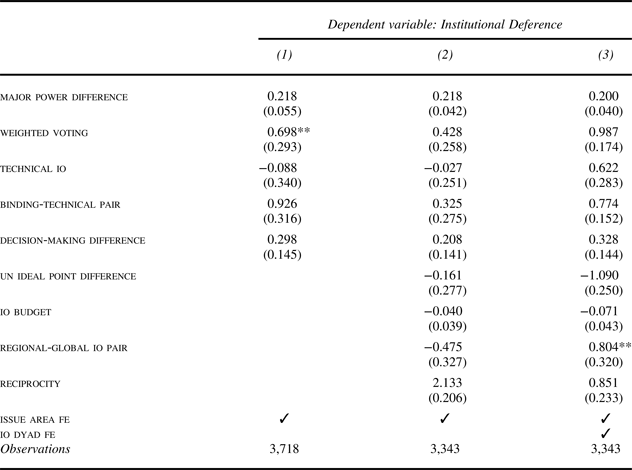
Results appear in Table 3. Model 1 is a simple baseline specification with only the key independent variables; the second model incorporates control variables to address potential confounders. Model 3 further incorporates fixed effects for each pair of IOs; this model estimates the effect of our key variables while controlling for the underlying propensity of each specific pair of international organizations to engage in institutional deference.Footnote 68 In all models, standard errors are clustered by directed IO dyad.
Effect of state power and functional efficiency variables on institutional deference

Notes: Results of generalized linear models estimating the effect of member state power and IO characteristics on directed institutional deference. All models include controls for membership overlap, an indicator for nested IOs, and a cubic polynomial for time (not shown). Statistical significance is denoted by: *p < 0.1; **p < 0.05; ***p < 0.01. 1.5
The two Member State Power variables (major power difference and weighted voting) have a consistent, positive association with deference across all models. Each additional major power member state in an IO predicts a statistically significant increase in the amount of deference it is granted by peer institutions. Similarly, IOs that employ weighted voting schemes receive substantially more deference than those with egalitarian decision-making rules. These results provide strong support for the Member State Power hypothesis: states’ material power appears to be an important driver of institutional deference among IOs.
The results also provide compelling evidence for the Functional Efficiency model. IO dyads that pair a technical body with an institution that has binding legal authority are significantly more likely to engage in deference. Deference also tends to flow toward IOs with more permissive decision-making structures, suggesting states may strategically use deference to resolve intractable bargaining problems. The coefficients on these variables are significant and positive in Models 1 (the baseline model) and 3 (with IO dyad fixed effects). They fail to achieve statistical significance in Model 2, potentially because of correlation with other IO design features like global orientation and budget size. The third functional variable, technical io, has a significant effect on deference only in Model 3.
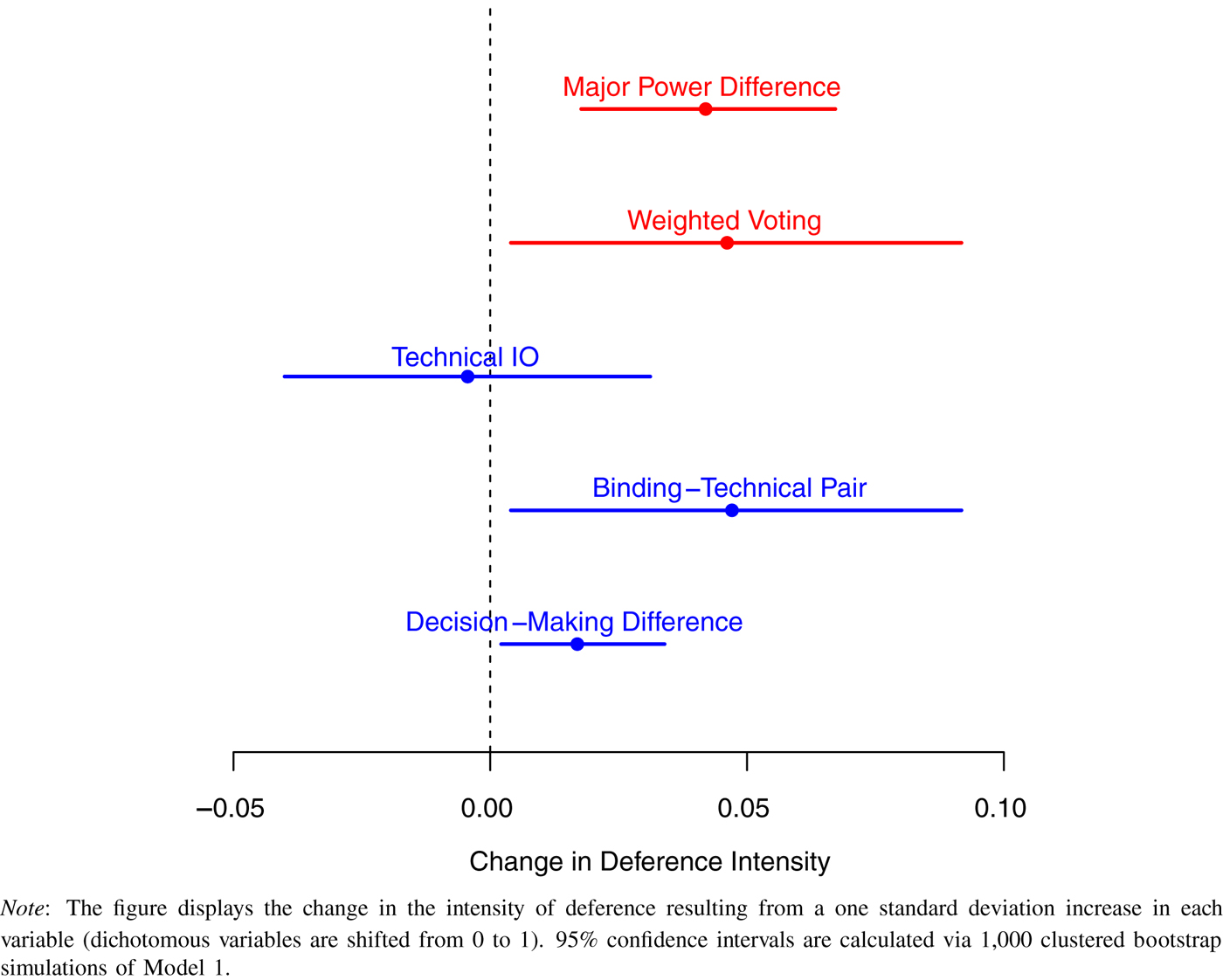
Substantive effect size is difficult to infer from the logit coefficients. Figure 4 shows the average marginal effect on institutional deference when each continuous variable is increased by one standard deviation (dichotomous variables move from 0 to 1), while other variables are held at their observed values.Footnote 69 An increase in the major power difference variable by one standard deviation (three additional major power member states) produces a 0.042 increase in institutional deference. This effect represents a 69 percent increase over the average deference score of .061. Weighted voting has a slightly larger effect; moving from an egalitarian to a weighted decision-making procedure induces an average increase of 0.046 in the amount of deference granted to an institution. The effect of binding-technical pair is similar in magnitude, representing an increase in deference of 0.047 when an IO dyad features one legally empowered IO and one technical institution. The marginal effect of decision-making difference is smaller (0.017) but remains statistically significant, while the technical io indicator has no discernible effect on deference flows.
Substantive effects of power, efficiency variables on institutional deference

Taken together, the analysis suggests deference is a strategic act that is shaped both by efficiency concerns and power politics. The strong effect of two of the functional efficiency variables suggests states use deference to efficiently pool resources among disparate organizations. At the same time, there is robust evidence that the distributional consequences of institutional deference also shape coordination among IOs. Powerful states tend to drive deference toward their preferred IOs, expanding their governing authority at the expense of the weak.
Empirical findings are robust to a range of alternative measures and model specifications. Alternative regression models, including a linear model, a probit link function, and a binomial regression model at the policy-document level produce substantively identical results. To ensure the results do not depend on a specific operationalization of the outcome variable, I recode deference using the full 1–5 scale discussed earlier and rerun the analysis with consistent results. Finally, to address the possibility that the “Major Power” variable is too crude a measure to capture subtle differences in member state capacity, I re-estimate the models with different measures of member state power, including the Correlates of War National Material Capabilities (NMC) index and the average gross domestic product (GDP) of an IO's member states. Separately, I also test the member state power variables after removing institutional design variables, such as decision-making procedures, that may be influenced by the presence of powerful states. Results are robust to these changes.
Two final issues influence the interpretation of these results. The first is potential endogeneity associated with regime complex formation. Overlapping institutions are constructed by states, so each IO's membership and its specific design features are strategically selected rather than randomly assigned. Deference patterns are likely to be influenced by the process of constructing new IOs. For example, suppose a group of states is dissatisfied with bargaining gridlock in a particular institution. These states may strategically create a new IO with fewer members and a more permissive decision-making procedure, adopt a new set of rules, and then lobby the original IO to defer to those rules. This sequence of events is observationally equivalent to “functional” deference among pre-existing IOs. Nonetheless, this behavior still conforms to the underlying logic of the functional efficiency model: states pool resources across IOs to overcome cooperation problems. The process of regime complex formation could also operate in a manner consistent with the member state power model if states design new institutions to maximize their control over global governance. Since the incentives for institutional proliferation mirror the two models examined here, and would produce the same patterns of deference if present, the processes driving regime complex formation are compatible with the empirical results.
A second issue is the role of IO legitimacy in driving patterns of deference. Member states are more likely to accept an act of rule making by another IO if they view the organization as legitimate. Buchanan and Keohane draw a distinction between normative and sociological legitimacy.Footnote 70 Normative legitimacy concerns whether an institution has the right to rule. States may have a variety of standards for assessing the normative legitimacy of IOs. While these are not explicitly modeled in the preceding analysis, several of the independent variables can be viewed as proxies for legitimacy standards. For example, global IOs with universal membership may enjoy a right to rule through the consent of all states. Technical IOs have superior information that may make them normatively preferable to more political bodies.Footnote 71 The fact that both global and technical organizations receive more deference from other IOs suggests they may be normatively preferable institutions.
Sociological legitimacy concerns whether an institution is widely believed to have the right to rule. Deference flows are thus a signal of legitimacy in the sociological sense. When member states of one IO accept the authority of another, they are conferring legitimacy on the latter institution. The empirical tests therefore shed light on how sociological legitimacy is constituted among IOs.
Discussion and Future Research
In this paper I identify two fundamental problems associated with global governance in international regime complexes—inefficient duplication and regulatory arbitrage—and argue that states address these problem through the practice of institutional deference. Deference is a common form of coordination among IOs. Its goal is to minimize areas of overlapping jurisdiction by assigning authority to a single organization. Evidence of institutional deference in the counterterrorism, election-monitoring, and intellectual property regime complexes are consistent with this purpose. IOs that engage in deference with each other tend to have less jurisdictional overlap, focusing their regulatory efforts on separate subissues.
Deference can be used to facilitate efficient governance of a policy area, and there is evidence that member states are more likely to engage in deference when two IOs share functional complementarities. This finding sheds light on the motivating example I presented at the start of the paper. The UN Security Council defers to the Financial Action Task Force (FATF), at least in part, because the FATF is an information-rich, technical body that is uniquely well placed to articulate and monitor rules on terrorist finance. This makes it an attractive partner for the Security Council, which enjoys binding legal authority but lacks the technical expertise of the FATF.
Deference also has distributional effects. Acts of deference confer legitimacy on specific institutions. They also shape or reinforce the distribution of governing authority among IOs. Because patterns of deference are correlated with member state power, attempts to coordinate rule making may generate an informal hierarchy of regulatory bodies that benefits the strong at the expense of the weak.
The paper offers the first systematic account of institutional deference in international regime complexes. The empirical analysis shows that states have been able to reduce jurisdictional overlap using the practice of institutional deference. This serves as a rebuttal to more pessimistic assessments of cooperation in regime complexes. These results suggest scholars should update their standards for assessing the effectiveness of international institutions. In a unified regime, effectiveness is usually judged on the basis of depth of cooperation, defined as “the extent to which [the institution] requires states to depart from what they would have done in its absence.”Footnote 72 In regime complexes, however, effective cooperation demands not only depth but also inter-institutional coordination. In other words, assessing cooperation in regime complexes requires investigating how institutions interact with each other in addition to the obligations they place on member states.
The paper has implications that extend beyond the three regime complexes examined here. Regulatory arbitrage and the attendant pressure for coordination is a feature inherent to regime complexes, and to other environments featuring multiple, overlapping regulatory authorities. This analysis suggests that when regulatory bodies—including IOs, courts, or subnational authorities—attempt to address legal inconsistencies, they may generate unseen but important shifts in governing authority.
The analysis also highlights the need for more scholarship on how regulatory institutions handle overlaps in authority. Institutional deference is one observable strategy employed by regulatory institutions, but there are others (e.g., avoiding inconsistencies by dividing labor geographically among institutions). Alternative strategies may have different effects on the distribution of governing power. In addition, future scholarship should more directly tackle the question of how the constituent institutions in regime complexes emerge and evolve. In this paper I take regime complex structure as given, and ask what impact regulatory coordination among institutions has on the distribution of governing authority. But regime complex structure and the institutional features of IOs are themselves determined by states. The factors that drive this process—those that lead states to join institutions, create new IOs, or shift the design of existing ones—are important additional areas of inquiry.
Supplementary Material
Supplementary material for this article is available at <https://doi.org/10.1017/S0020818318000164>.