Introduction
Creating a culture of personal preparedness for disaster has been one of the major goals of the Ready campaign of the Federal Emergency Management Association (FEMA).1 Begun in February 2003, the Ready campaign is “designed to educate and empower Americans to prepare for and respond to emergencies including natural and man-made disasters. The goal of the campaign is to get the public involved and ultimately to increase the level of basic preparedness across the nation.” The Ready campaign seeks to have Americans: 1) create an emergency supply kit; 2) make a family emergency plan; and 3) know the appropriate response to different types of disaster (shelter in place versus evacuate).1
Despite recent disasters such as 9/11 and Hurricane Katrina, the available research indicates that Americans remain unprepared for disasters.2–4 Wingate has suggested that public health preparedness efforts should define vulnerable populations and focus on their needs.Reference Wingate5 A large percentage of the population seeking care in an emergency department as their means of primary health care are sicker, more disabled, and more chronically ill.6 Vulnerable populations and those who use the emergency department as their primary source of health care have the potential to strain disaster resources and potentially shift care from those in critical need.
Several studies have investigated the disaster preparedness of specific vulnerable populations. Baker et al reported on the preparedness level of families with children having special health care needs compared to those in the general population and found that those families with special needs children actually had a lower level of preparedness than the general population.Reference Baker and Baker7 Barata et al studied 1272 patients presenting to a New York emergency department and found that most did not have a household disaster plan, nor did they know of disaster plans at their work or school.Reference Barata and Llovera8 Zils et al studied patients in a Milwaukee emergency department and showed that those patients were less prepared than the general population.Reference Zils, Lerner and Pirrallo9 In both the New York and Milwaukee studies, households with children tended to be better prepared for disaster.Reference Barata and Llovera8, Reference Zils, Lerner and Pirrallo9
The Civilian Assessment of Readiness for Disaster (CARD) Survey was developed to determine the disaster preparedness of emergency department patients and to identify predictors of low levels of preparedness. This study further focused on two vulnerable populations, families with special health care needs and single parents. It was hypothesized that these vulnerable groups would be better prepared for disaster.
Methods
Research Design
Utilizing a cross-sectional study design over a one-year period, subjects who had completed their initial physician evaluation in the emergency department were surveyed. Subjects were approached by trained research assistants who provided the subject with information regarding participation in the CARD survey. If the subject expressed interest, the research assistant provided the subject with verbal information about the study using a standardized script and obtained the subject's verbal consent. Subjects willing to participate were provided with the survey and asked to complete and return it to the research assistant. The survey was designed to either be filled out by the participant or read to them by a research assistant depending on participant preference. This study was approved by the Institutional Review Board of the University of North Carolina.
Setting
This study was conducted in the Emergency Department of the University of North Carolina Hospitals in Chapel Hill, North Carolina (USA). The University of North Carolina Hospitals is a suburban, public, tertiary-care academic medical center that serves the greater Raleigh-Durham-Chapel Hill metropolitan area and is also a regional referral center for patients throughout North Carolina and the surrounding states. The hospital has a full complement of specialists, services, and clinics. The ED is staffed by board-certified emergency medicine attending physicians and supports an emergency medicine residency. The ED serves approximately 65,000 patients annually.
Participants
Subjects were all adult (≥18 years old) emergency department patients seeking care in the University of North Carolina Hospitals Emergency Department from July 2007 through August 2008. Exclusion criteria were mentally impaired, institutionalized (ie, a prison or nursing home), or non-English speaking subjects as determined by the nurse caring for the patient.
Measures
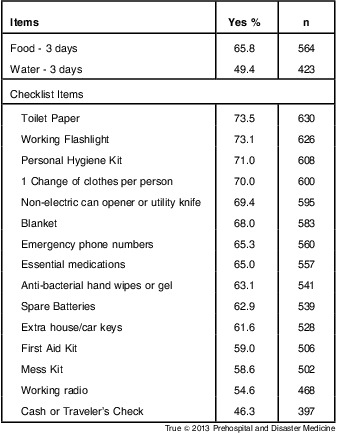
The survey consisted of two sections: 1) general disaster preparedness; and 2) participant demographics. For section 1, the CARD survey consisted of 22 questions assessing personal disaster preparedness, including the 15 items on a readiness checklist derived from FEMA's Ready campaign, as well as knowledge of work and school emergency plans, and creation of a family meeting place (Table 1).10 The demographic section collected information including age, gender, education, race, income, and living environment.
FEMA 15-Item Checklist Plus Food and Water

Data Analysis
For general preparedness, “prepared” was defined as having food and water for all members of the household for a minimum of three days and at least 75% of the additional items included on the FEMA readiness checklist. To determine if preparedness differed by gender, age, socioeconomic status, race, education, or living environment, chi-square or Fisher's exact test was used. Data are presented as frequencies with percentages. Ninety-five percent confidence intervals (CIs) were calculated where appropriate. A P value of <.05 was considered statistically significant. All analyses were performed using SAS statistical software (Version 9.2, SAS Institute, Cary, North Carolina USA).
Results
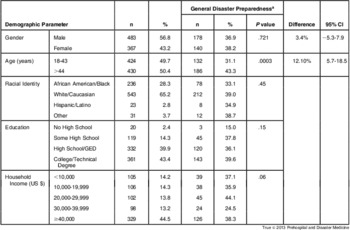
Of 1000 subjects approached, 965 (96.5%) agreed to participate. Of these, 96 surveys were excluded due to incompleteness, and an additional 12 participants were excluded when subsequently found to live in a nursing home. Final sample size was 857. Most participants were white (65.2%), middle-aged (mean 45 years) males (56.8%) who had graduated high school (83.2%) and had an annual income < US $40,000 (44.5%) (Table 2).
Demographics

ahaving food and water for all members of the household for a minimum of three days and at least 75% of the additional items included on the FEMA readiness checklist.
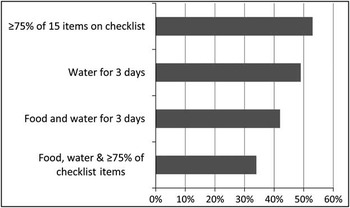
General disaster preparedness was inadequate. Only 451 (52.6%) had >75% of checklist items, 393 (45.9%) subjects had food and water for three days, and 318 (37.1%) had both food, water, and >75% of items (Figure 1). Most subjects (69.0%) did not have a gathering location in case of emergency, and 65.0% (n = 555) did not have a family emergency preparedness plan.
General Preparedness

Level of preparedness was associated with age. Participants 44 and older were more likely to have food, water, and >75% of checklist items when compared to younger age respondents (43.3% vs 31.1%, difference = 12.1%, 95% CI: 5.7%-18.5%, P = .0002) Level of preparedness was not associated with gender, education, race or income (P > .05 for all, Table 2).
Subjects with Special Needs and Single Parents
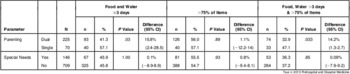
One hundred and forty-six (17.1%) respondents reported having people in their homes with special needs. Of these, 55.5% had >75% of items on checklist, 45.9% reported having food and water for three days, and 36.3% had food, water, and >75% of items on the list. Subjects with special needs were no more prepared than subjects without special needs (P > .05 for all, Table 3).
Preparedness Based on Parenting and Special Needs

Two hundred and ninety-five respondents (34.4%) had children living at home. Of these, 70 (23.7%) reported being a single parent. Compared to two-parent homes, single parents were more likely to have food and water for ≥ 3 days (57.1% vs 41.3%, P = .03), and more likely to have food, water, and >75% of items on the list (47.1% vs 32.9%, P = .03, Table 3).
Discussion
The emergency department patient population surveyed was not prepared for disaster. Those over the age of 44 were more likely to be prepared, presumably because they had more personal experience with disasters. Single-parent households were also more prepared, while persons caring for people with special needs did not demonstrate an increased level of disaster preparedness. Nevertheless, while some populations were better prepared than others, no population was well prepared for disaster.
Clearly, the current method of disaster preparedness education is ineffective. While there are excellent Web sites and helpful information available, this information is not reaching the general public. Since many of this patient population may not have regular access to the Internet, incorporating disaster preparedness into the school-age curriculum may help families overall prepare for disaster. Incorporating education into parent-teacher conferences or other school-wide events could broaden the audience even further. Specifically targeting families with single parents and special needs children through the school system could assure that these vulnerable populations receive this valuable information. For those without children, partnering with local businesses to provide education to employees about disaster preparedness could be an effective solution. The current methods are, in the authors’ opinion, too generic, and perhaps a more personal and targeted message would be more effective.
Making disaster preparedness education part of the discharge process from the hospital or emergency department would potentially increase awareness for this clearly underprepared patient population. Additionally, making education materials entertaining and accessible would catch the interest of a wider audience. The Centers for Disease Control have an online blog for public health matters titled “Preparedness 101: Zombie Apocalypse,” which outlines the ways in which one would prepare for an invasion of zombies.11 While this is clearly an implausible scenario, the article goes on to liken the zombie apocalypse to other natural disasters and subsequently gives valuable information about disaster preparation. Campaigns like this that use popular culture to present this information may be more effective in reaching the intended audience.
Limitations
There were some limitations to this study. The stress of requiring care in the ED may impact the ability to accurately answer survey questions. Additionally, the portion of the population that is non-English speaking was excluded, and the survey was limited to those receiving care at the University of North Carolina. Non-English speaking patients are another vulnerable population that may have changed the outcomes of the survey or added to the ability to identify predictors of low levels of preparedness. Though subjects were asked about items on the checklist, it was not ascertained whether they had packed a bag should evacuation be required. This may have caused overestimation of the number of survey responders who were truly prepared for disaster.
Conclusion
This study and others have found that only the minority of any group is actually prepared for disaster. Future research should focus on ways to implement disaster preparedness education, specifically targeting vulnerable populations, then measuring the effects of educational programs to demonstrate that preparedness has increased as a result.
Abbreviations
- CARD:
Civilian Assessment of Readiness for Disaster
- ED:
Emergency Department
- FEMA:
Federal Emergency Management Association