Capital owners are often thought to be especially supportive of right-of-center, market-oriented economic policies and political parties, to prefer restrained fiscal and monetary policiesFootnote 1 and, if they own corporate securities, to prefer policies that are ‘pro-business and against state regulation’.Footnote 2 More broadly put, capital owners are often thought (and found) to be especially supportive of right-of-center, market-oriented economic policies and political parties.Footnote 3 Many politicians – most memorably George W. Bush and Margaret Thatcher – have taken those preferences as motivation for public policies that expand capital ownership and, thus, create an ‘ownership society’ of capital-owning citizens sympathetic to right-of-center, neoliberal politics.Footnote 4
Whether and how an ‘ownership society’ manifests in practice is an open question, and one that is particularly important to the study of Latin American mass politics.Footnote 5 Pension reforms in Latin America during the 1980s and 1990s massively expanded the reach of defined contribution pension systems, which considerably increased popular capital ownership: 91.6 million Latin Americans had an active account in a reformed pension system as of mid-2015, roughly 37 per cent of whom were active contributors.Footnote 6 Conventional understandings of ‘ownership society’ politics predicts that this expansion of popular capital ownership should have shifted Latin American politics – or at least the political preferences of participants in reformed pension systems – towards acceptance of market-oriented, neoliberal politics. Jose Piñera, one of the chief architects of Latin American pension reform, seems to have been aware of this potential, and indeed considered pension reform’s social engineering potential as a selling point. As he recounts describing it to then-Governor George W. Bush, ‘social security reform could be used both to provide a decent retirement and to create a world of worker-capitalists, an ownership society’.Footnote 7
These expectations do not bear out. Latin Americans have not en masse become ‘worker-capitalists’. Post-pension reform Latin America has, if anything, moved leftward.Footnote 8 To take one particularly striking illustration, union-led street protests against Piñera’s pension system broke out in 2017, pushing Socialist President Bachelet to pursue reforms that reduce, if not eliminate, the pension system’s market-based elements.Footnote 9 Whatever Piñera had in mind by a ‘world of worker-capitalists’, it is hard to imagine a scenario that is less likely to qualify. The empirical section of this article shows that theses macro trends and anecdotes are not hiding subtler dynamics: Latin American participants in defined contribution pension systems are not more supportive of neoliberalism than their non-participating peers; Latin American societies with many such participants in defined contribution pension systems are not more supportive of neoliberalism than those with few participants.
None of that will surprise observers of Latin American politics; the region’s leftward turn in the 2000s is clear and well documented, as is discontent with many of the neoliberal reforms of the 1990s.Footnote 10 But from a broader theoretical perspective it is puzzling. Given the primacy of capital endowments to much political economy theorizing, is it really plausible that 90 million capital owners could be created without affecting preferences over policies with clear implications for the returns to capital? Why has pension reform failed to create a Latin American ownership society?
I argue that Latin American pension reform has generated an ownership society of sorts, but it has done so in ways that differ from conventional accounts of ‘ownership society’ politics. Pension reform has not directly affected Latin American attitudes towards neoliberalism, but has done so indirectly by shaping the criteria that participants use to make performance-based judgments about neoliberalism’s track record. I call this the retrospective ownership society. The retrospective ownership society argument builds on past findings on the importance of performance-based judgments to Latin American politicsFootnote 11 and on popular support for Latin American neoliberalism in particular.Footnote 12 In this version of that argument, pension reform affects participants’ attitudes towards the market by exposing them to the returns on pension capital. Making those returns a central and visible consequence of participants’ exposure to neoliberalism induces them to incorporate pension returns into their beliefs about its performance and, thus, its desirability. High-returning pension assets signal to pension participants that neoliberalism ‘works’ and should be supported; low pension returns signal the opposite.Footnote 13 At the national level, the more people who participate in a defined contribution pension system, the more neoliberalism’s popularity should vary with pension returns.
The empirical portion of this article evaluates my theory’s predictions, primarily by analyzing the 2010 Latin American Public Opinion (LAPOP) survey. This survey is unique (even among LAPOP iterations) since it asked respondents whether and how often they contribute to a (pension reform-created) defined contribution pension. I ask whether participants in a defined contribution pension system hold systematically different views of the market’s role in policy making, and whether any such differences vary with pension returns. These analyses show substantial support for the retrospective ownership society’s predictions. They do not support more conventional notions of ownership society politics. I buttress these findings by analyzing a time-series cross sectional dataset of Latino Barometer surveys. These surveys did not ask about individuals’ pensions, but they do ask questions about the appropriate balance of state and market repeatedly over time. I use country-year aggregates of these data to ask whether survey respondents in countries with higher rates of participation in a defined contribution pension system hold systematically different views of neoliberalism, and whether any such distinctions vary with pension returns. These data and their analysis are subject to a variety of caveats, but they also tend to support the retrospective ownership society.
This article makes a number of contributions. It most directly supplements the literature on economic drivers of support for Latin American neoliberalism,Footnote 14 and in particular work that emphasizes cross-individual variation in retrospective, performance-based judgments. While the recognition that heterogeneous capital endowments beget heterogeneous patterns of performance-based judgments is not new,Footnote 15 its exposition here underlines its relevance to Latin American mass politics. Borrowing Lewis-Beck and Nadeau’sFootnote 16 nomenclature, focusing on patrimony rather than valence issues illuminates otherwise obscured nuances in the drivers of Latin American political attitudes.
This article makes a second contribution to our understanding of the nexus of neoliberal policy making and popular support for its continuation. It extends work by Korpi and Palme,Footnote 17 Campbell,Footnote 18 PiersonFootnote 19 and others who argue that public pension systems create ‘policy feedback’ through which their adoption creates a class of beneficiaries that supports those policies’ perpetuation in the future. Defined contribution systems operate differently, and are only as able to generate such feedback as they are able to generate high returns for their participants. The contingent nature of this feedback is important. Governments, especially in small, open economies, have limited influence over the returns on pension fund investments, and therefore have limited influence on pension reform’s eventual political implications. Many Latin American pension systems have experienced sustained losses and low returns. The neoliberal welfare state does not generate support for its perpetuation in the same way that more traditional welfare policies do. And in that, the neoliberal welfare state is a less useful vehicle for social engineering.
Thirdly, the article also resonates with works – notably including Gingrich and AnsellFootnote 20 and Zhu and LipsmeyerFootnote 21 – that consider how individuals’ attitudes towards welfare state expansion are determined by their position within the existing welfare state. The retrospective ownership society similarly suggests that the welfare state (in this case, the neoliberal version) defines the context in which attitudes are formed, but does not dictate those attitudes directly. There are, however, substantial divergences between these theories. In Gingrich and Ansell and Zhu and Lipsmeyer, individuals maximize their material interests in light of status quo policies; in the retrospective ownership society they question the desirability of the status quo itself. To illustrate, consider that in Zhu and Lipsmeyer, individuals facing employment precarity and employment-based healthcare provision resist social spending because they are unlikely to benefit from it and because the additional taxation undermines their capacity to self-insure. However while Zhu and Lipsmeyer consider preferences given the status quo, we can also consider preferences about the status quo. In this case, the combination of employment precarity and an employment-based healthcare system might also provoke preferences for an alternative form of healthcare provision. This possibility is closer to what the retrospective ownership society theorizes, and what the empirical tests appear to be capturing in the Latin American data. Latin American participants in a defined contribution pension system do not ask ‘What will serve my interests as a capital owner?’ but rather, ‘Are my interests being served by the neoliberal policies that led me to capital ownership?’
LATIN AMERICAN PENSION REFORM AND THE RETROSPECTIVE OWNERSHIP SOCIETY
Latin American pension systems traditionally operated on a defined benefit, pay-as-you-go (henceforth: DB-PAYGO) basis. PAYGO-financed pension systems are transfer systems in which pension benefits are paid from contemporaneously collected taxes. Tax-contributing workers receive a claim on the income of future workers in exchange. The ‘defined benefit’ nature of the system is that the correspondence between tax contributions paid and pension benefits received is defined by law, and knowable to the worker ex ante. The primary alternative to a DB-PAYGO system is a funded, defined contribution system (henceforth: FDC). In a ‘funded’ system, workers’ tax contributions are set aside and invested in financial assets, rather than transferred to current retirees. When they retire, workers’ pension benefits are paid out of the capital that accumulates in their personal accounts, usually by converting it into an annuity. The mapping of contributions to benefits is left undefined, and is thus unknowable to the worker ex ante. Higher-retuning investments generate larger pension benefits, and vice versa. Among the more important differences between the two systems is the reallocation of risk from the sponsor to the worker. DB-PAYGO systems accrue liabilities independently of the revenue needed to meet them, and it falls to the plan sponsor to ensure the system’s solvency. FDC systems accrue liabilities in lockstep with the funds available to service them. Solvency risk is largely eliminated, but workers bear the risk of insufficient returns leading to lower-than-expected pension benefits.
Chile was the first Latin American country to adopt an FDC system in 1981. The Chilean reform reflected practical concerns over the solvency of the prior system, as well as Pinochet’s ideological commitments to market-driven, neoliberal policy making.Footnote 22 The new Chilean system rechanneled worker contributions out of the transfer system and invested them into personal accounts managed by private pension fund administrators (administradoras de fondos de pensiones, or AFPs).Footnote 23 Retiring workers convert their amassed investments into an inflation-indexed annuity (or set up a programmed withdrawal), the value of which depends on workers’ lifetime contributions and the returns that the resulting investments have generated.Footnote 24 Following a lag, the Chilean system spread to other Latin American countries.Footnote 25 Peru adopted an FDC pension system in 1993, Argentina and Colombia in 1994, Uruguay in 1996, Bolivia and Mexico in 1997, El Salvador in 1998, Costa Rica, the Dominican Republic and Nicaragua (never enacted) in 2001, and Panama in 2008. While distinct from each other in a variety of ways (these differences are described in more detail below), each of these reforms expanded the number of Latin Americans with an interest in the returns on financial capital. As noted in the introduction, over 90 million Latin Americans currently hold a balance in a reformed, FDC pension system. All are capital owners, and all hold political attitudes that are potentially shaped by that fact.
The Ownership Society
How does the increase in capital ownership created by pension reform affect mass politics? A natural starting point for that question is to consider pension participants’ newfound (or newly amplified) material interest in the returns on financial capital. To the extent that participants in an FDC pension system connect their political interests to their identity as capital owners, they should favor policies that they believe are most likely to support higher returns on their pension assets. The essence of the ‘ownership society’ is that perceived-to-be-beneficial policies are those that prioritize low inflation, corporate profits and the returns on capital over other plausible policy targets. Such policies include balanced budgets, labor market liberalization, privatization, and decreased corporate taxation and regulatory burdens.Footnote 26 Some of those preferences are specific to investments in corporate securities, but any investment in financial assets should, all else equal, generate an affinity for policies that emphasize budget control and price stability.Footnote 27 The conventional articulation of the ownership society narrative is that participants in a defined contribution pension system (or perhaps the subset of them that is invested in corporate securities) recognize themselves as capital owners, and come to prefer neoliberal policies out of a belief that those policies will benefit them as such.
This vision of the ownership society is consistent with the political ethos associated with Thatcher’s enterprise society and Bush’s ownership society, and perhaps more importantly with rigorous theoreticalFootnote 28 and empirical work in political science and economics.Footnote 29 As a political theory of welfare state politics, this version of ownership society politics resembles Gingrich and AnsellFootnote 30 and Zhu and LipsmeyerFootnote 31 insofar as individuals take the status quo for granted – in this case a neoliberal welfare system that ties pension benefits to the returns on financial capital – and adopt preferences that maximize welfare within it.
If (some version of) the conventional version of the ownership society narrative accurately describes Latin America’s experience with pension reform, we should expect to observe support for the following hypothesis.
Hypothesis 1: Participants in Latin American FDC pension systems will be more supportive of neoliberalism.
If ownership dynamics were relevant only to investments in corporate securities, we would expect that:
Hypothesis 1a : Participants in Latin American FDC pension systems invested in corporate securities will be more supportive of neoliberalism.
To put hypothesis 1A in perspective, Table 1 shows the portion of pension investments across four asset classes: domestically issued government debt (including bonds issued by the central bank), domestically issued corporate securities (debt or equity), foreign investment and domestic financial institutions.Footnote 32 These data are shown separately for December 2000, 2009 (the most important year for my analyses) and 2014. Investments in corporate securities have been substantial in Peru, Colombia, Chile and, recently, Mexico, but small elsewhere. Allocations to government debt are universally substantial, but still vary across countries.Footnote 33
Portfolio Allocations across Latin American AFPs in 2000, 2009 and 2014

Source: Asociación Internacional De Organismos De Supervisión De Fondos De Pensiones.
* 2009 and 2014 Bolivian data from Federacion Internacional de Adminstradoras de Fondos de Pensioniones (FIAP).
The Retrospective Ownership Society
The retrospective ownership society describes post-pension reform politics in entirely different terms than the conventional ownership society. Whereas the latter posits that pension participants adopt policy preferences that maximize income within the neoliberal status quo, the former has them consider the utility of that neoliberal status quo. Capital ownership through pension reform shapes policy preferences over neoliberalism by offering pension returns as an indicator of its desirability. High recent pension returns suggest to the participants that pension reform – and by extension the broader neoliberal project – is beneficial and should be supported. Low returns suggest the opposite. Thus, rather than moving participants towards an embrace of neoliberal politics, the retrospective ownership society argues that defined contribution pension systems can move participants towards neoliberalism or away from it, depending on the performance of pension investments.
There are several reasons to suspect the retrospective ownership society’s plausibility. For one, extant evidence suggests that recent economic performance commonly informs political judgments, in generalFootnote 34 and specifically in Latin America, where retrospective evaluations of macroeconomic performance have been linked to popular attitudes towards incumbent politiciansFootnote 35 and towards neoliberalism.Footnote 36 Evidence further suggests that differences in capital endowments lead individuals to prioritize different performance metrics that are relevant to them.Footnote 37 The retrospective ownership argument reapplies these dynamics to understand post-pension reform politics. Pension reform divides individuals according to whether or not they participate in an FDC pension. Those that do should prioritize pension returns as an indicator of neoliberalism’s success, while those that do not should not.
Secondly, for a variety of reasons pension returns serve as a plausible heuristic for neoliberalism’s performance more broadly. They are exceptionally clear: the value of pension assets either goes up or down, by a lot or by a little. They are also trustworthy. Whereas many official statistics come from governments that have incentives to misrepresent the data in their favor,Footnote 38 pension returns reflect market movements that are reported without government intermediation. Third, information about recent pension returns is easily available and periodically reported to participants directly by the AFPs. Even where such direct reporting is unavailable, out of date or ignored, participants can reasonably infer their pension account’s performance by observing the performance of local financial markets, which are widely reported and can be tracked on a minute-by-minute basis.Footnote 39 These qualities contrast sharply with information associated with the performance of other areas of neoliberal reform, such as healthcare, education or utilities provision. Performance metrics in these areas are necessarily more complex, less accessible, less regularly updated, and less likely to generate clear-cut indications of a policy’s success or failure.Footnote 40 That is not to say that pension returns would be an especially good heuristic with which to assess neoliberalism’s performance. Neoliberalism’s performance in one policy area does not necessarily inform its potential in others,Footnote 41 and the recent return that participants are most likely to focus onFootnote 42 may not even be an especially good indicator of the long-term performance of the pension system. But the literature shows that easily accessible indicators of government performance often have an outsized influence on popular opinion.Footnote 43 And for all its limitations, pension returns are arguably a better indicator of neoliberalism’s performance than the broader measures of macroeconomic performance that have previously been shown to play that role.
If the retrospective ownership society accurately characterizes post-pension reform attitudes towards neoliberalism, we should expect support for the following hypothesis.
Hypothesis 2: Participants in FDC pension systems will be more likely to support neoliberalism when pension returns are high, and less likely to do so when recent pension returns are low.
EMPIRICAL TESTS
Individual-Level Tests
The first set of empirical tests uses individual-level survey data from the 2010 iteration of the LAPOP survey.Footnote 44 This survey was administered to 134,185 respondents across twenty Latin American countries. This survey is particularly useful for current purposes because it asks respondents whether they participate in a publically operated defined contribution pension system and, if so, the frequency of their contributions to it. The 2010 wave is the only publically available survey to ask these questions.
Dependent Variables
I form my dependent variables for these tests using the extent to which respondents agreed with the following statements:
The (Country) government, more than the private sector, should be primarily responsible for providing retirement pensions.
The (Country) government, more than the private sector, should be primarily responsible for providing health care services.
The (Country) government, more than individuals, should be the most responsible for ensuring the well being of the people.
The (Country) government, instead of the private sector, should own the most important enterprises and industries of the country.
The (Country) government, more than the private sector, should be primarily responsible for creating jobs.
The (Country) government, instead of the private sector, should implement strong policies to reduce inequality between rich and poor.
Answers range from 1–7, with 7 indicating complete agreement that the state should take more responsibility relative to the market, or to the individual. These questions get to the heart of public support for neoliberalism. For expositional clarity I have reversed the scale of the variable such that high values indicate support for market-based, neoliberal policies.
I analyze responses to these questions individually and in the aggregate by creating an index that averages across them. Ansolobehere, Rodden and SnyderFootnote 45 suggest that simple averages of conceptually related responses provide more reliable indicators of preferences than the individual responses themselves. I used factor analysis to identify which responses are conceptually similar enough to be included in an index. That analysis indicates that responses to whether or not the government should provide pensions, provide healthcare, ensure wellbeing, create jobs and reduce inequality all load on a single factor (with rotated factor loadings over 0.5), while responses to whether or not the government should own the most important enterprises and industries appears to reflect a separate and unique set of political beliefs.Footnote 46 The ‘State–Market Index’ averages across the responses that load onto the single factor.
Independent Variables
I measure pension system participation using responses to LAPOP questions asking whether the respondent has a pension, which pension system they use and how often they have contributed to it in the last year (options include: monthly, at least once or twice, and never). I use a dichotomous measure of pension participation equal to 1 if the respondent contributes monthly to an FDC pension, and 0 otherwise.Footnote 47 Roughly 14 per cent of respondents in countries that have undergone pension reform are coded as contributors. The participation rate implied by the LAPOP survey is similar, but slightly lower, than what would be expected on the basis of data provided by the pension fund administrators, which suggest that the participation rate should be closer to 19 per cent. While impossible to know definitively, some participants may have been unaware of their participation, or aware of their affiliation with the pension system but unaware of the frequency of their tax contributions to it.Footnote 48 My focus on self-reported participation likely misses some actual participants, but to the extent that a respondent is unaware of their enrollment in an FDC pension system, I would not expect enrollment to affect their political preferences.
I measure pension returns as the year-on-year, real (net of inflation) returns on pension assets, as recorded in the International Association of Pension Fund Supervisors’ (Asociación Internacional de Organismos de Supervisión de Fondos de Pension, or AIOS) biannual report. Because the LAOP surveys were administered early in 2010, I use the year-on-year return for 31 December 2009. While the substitution of national returns for AFP-specific returns is sub-optimal (but necessary because the LAPOP survey does not ask which pension manager respondents contribute to), the limited variation in pension returns across AFPs suggests that it comes at minimal cost.Footnote 49
The year-end 2009 pension returns are roughly bimodal and universally high: AFPs in Chile (22.5 per cent), Colombia (26.8 per cent), Peru (32.9 per cent) and Uruguay (30 per cent) posted extremely high returns; AFPs in Mexico (10.2 per cent), El Salvador (5.6 per cent), the Dominican Republic (7.8 per cent) and Costa Rica (9.2 per cent) did relatively worse, but still well. These abnormally high returns reflect the depth of the crisis the year prior, as high 2009 returns typically offset low 2008 returns. Only AFPs in Colombia and the Dominican Republic posted sizable two-year cumulative returns during this period; every other country saw cumulative real returns between −3 per cent and 3 per cent. Therefore models using the 2009 returns data test whether recent exposure to very high returns disproportionately affects the preferences of those who directly benefitted from them.Footnote 50
My focus on the 2009 returns reflects the substantial evidence of recency bias in the political salience that individuals place on economic phenomena.Footnote 51 However, while individuals might tend towards myopia under ‘normal’ circumstances, we should not obviously expect pension participants to have lost sight of the depths of the 2008 market crash just two years prior. A longer history of returns may better indicate popular perceptions of recent pension performance. For that reason, I also report estimates using a weighted average of real pension returns over the prior two- and three-year periods, with geometrically declining weights attached to more distant observations.
My regressions also include a battery of control variables including individual attributes gleaned from the LAPOP survey – age, gender, years of education, income and employment type (dummy variables indicating whether the respondent is a public sector employee, a private sector employee, a private sector employer, an informal sector worker, a volunteer or not working) – as well as country-level variables measuring macroeconomic outcomes – the inflation rate, the unemployment rate, GDP per capita, and the GDP per capita growth rate – and structural features of the pension system – the percentages of the national aggregate portfolio allocated to foreign investment and domestic government bonds, and the national participation rate. The individual-level controls are meant to alleviate biases that might otherwise arise from non-random selection into pension participation; the country-level controls are meant to more precisely characterize the influence of pension returns and pension participation, separately from other correlated phenomena. For a more detailed discussion of the control variable set see the online appendix.
The sample used in these estimates is limited to countries for which survey data is available that operated an FDC pension pillar as part of their national pension system in 2009: Colombia, Chile, Costa Rica, The Dominican Republic, El Salvador, Mexico, Peru and Uruguay.Footnote 52
Does Latin America Have a Conventional Ownership Society?
The first set of tests asks whether participation in a Latin American FDC pension system correlates with support for neoliberal policies, as predicted by conventional understandings of ownership society politics. The first, and simplest, model that I estimate to test this prediction is:
 $$Attitudes_{i} {\equals}\beta 1{\asterisk}Participation_{i} {\plus}individual\,controls_{i} {\plus}country\,controls_{j} {\plus}e_{i} ,$$
where the i subscript indicates the individual, and the j subscript indicates the country. ‘Individual controls’ and ‘country controls’ refer to the variables noted above. I also estimate a version of this model that includes country fixed effects rather than the individually specified country-level controls.
The model of ownership society politics tested in Equation 1 suggests that the mere fact of owning financial assets through the pension system generates support for market-based approaches to policy making. This is consistent with much political rhetoric and with more fully developed political economy theories based on financial asset owners’ preferences for tighter fiscal policies. It would also be consistent with the idea that participants adopt an ‘investor class’ social identity, perhaps independently of specific beliefs about specific investments and their relationships to policy making.Footnote 53 If any of these are accurate, β1 should be positive, indicating that participants in a defined contribution pension system are more likely to support market-based policies.Footnote 54
I also test for the possibility that the ownership society is limited to pension reforms that lead individuals to own corporate securities. In addition to a preference for fiscal restraint that plausibly accompanies any form of financial asset ownership, owning corporate securities generates an interest in corporate profits and, plausibly, a preference for limited public sector involvement in the economy. It is also possible that whatever social identification with ‘investor class’ politics accompanies financial asset ownership is especially pronounced when those financial assets are issued by the private sector. If any of those possibilities are accurate, participation in an FDC pension system should increase acceptance of neoliberalism only to the extent that AFP portfolios include corporate securities. I test this possibility using Equation 2 below:
 $$\openup -6pt \eqalignno{ Attitudes_{i} {\equals} & \beta 1{\asterisk}Participation_{i} {\plus}\beta 2{\asterisk}Corporate\,Securities_{j} {\plus}\beta 3{\asterisk}Participation_{i} \cr {\asterisk}Corporate\,Securities_{j} {\plus}individual\,controls_{i} {\plus}country\,controls_{j} {\plus}e_{i} $$
where corporate securities measures the percentage of assets invested in either corporate stocks or bonds. If this version of the ownership society describes Latin American pension reform’s political effects, we should expect a positive and statistically significant β3, a statistically insignificant β1 (suggesting no effect of pension participation in the absence of investments in corporate securities), and a positive and statistically significant coefficient on the linear combination of β1 + β3*corporate securities, when corporate securities takes on sufficiently high values.
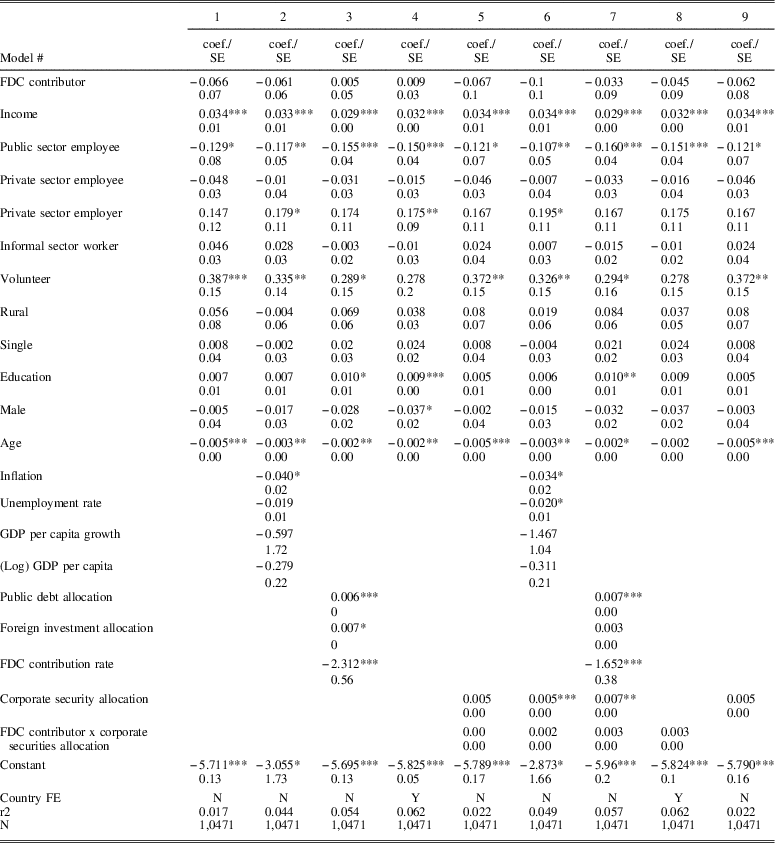
The results of these models are noted in Table 2. The dependent variable in each regression in Table 2 is the ‘State–Market Index’. Models 1–4 show estimates of (different versions of) Equation 1, which includes participation in an FDC pension system but does not interact it with the portion of the pension portfolio invested in corporate securities. Model 1 includes just the individual-level control variables, and is estimated with country-level random effects and robust standard errors. The coefficient estimate of β1 (which refers to the FDC pension participation variable) is negative, extremely small and statistically insignificant. There is no evidence from this model that participants in an FDC pension are more supportive of market-based policies than their non-participating peers. Model 2 adds the country-level macroeconomic controls, with little effect on the estimates. β1 remains negative, statistically insignificant and small. Model 3 replaces the macroeconomic variables with control variables specific to the AFP. The coefficient is now in the expected, positive direction, but remains small and statistically insignificant. Model 4 introduces country fixed effects (and thus drops all of the country-level controls) and produces nearly identical results.
Effect of Pension Participation on Individuals’ Attitudes toward Neo-Liberalism

Source: LAPOP data.
Columns 5–8 report estimates of Equation 2, which interacts participation in an FDC pension system with the percentage of pension assets that are invested in corporate securities, as described above in Equation 2. As before, I estimate specifications that include just individual-level controls (Model 5), country-level macroeconomic controls (Model 6), pension system-related controls (Model 7) and country fixed effects (Model 8). None of the resulting estimates support the corporate securities-specific version of the conventional ownership society hypothesis. The coefficient on the interaction between FDC pension participation and the allocation to domestic corporate securities is always in the expected, positive direction, but is never statistically significant. The relevant conditional coefficients (not shown, but available on request) never attain statistical significance. As a final estimate, Model 9 replicates Model 5 (the simplest specification) but includes corporate securities without the interaction with participation. The coefficient on corporate securities is positive, which is consistent with countries with AFPs that are more heavily invested in corporate securities having more market-acceptant participants, but small and statistically insignificant.Footnote 55
In unreported tests I explored other plausible conditional relationships between attitudes towards the market, participation in an FDC pension system and the types of assets the associated AFPs invest in. These unreported estimates include testing for the possibility that only investments in corporate equity (and not corporate debt) create an ownership society, and that any investment other than in government debt could create an ownership society. The evidence supports none of those possibilities.Footnote 56
Does Latin America Have a Retrospective Ownership Society?
The next set of models tests the ‘retrospective ownership society’, in which participation in an FDC pension system conditionally affects individual attitudes towards neoliberalism, depending on recent pension returns. To do so I estimate several versions of Equation 3, which is given below.
 $$\openup -6pt\eqalignno{ Attitudes_{i} {\equals} & \beta 1{\asterisk}Participation_{i} {\plus}\beta 2{\asterisk}Pension\,Returns_{j} {\plus}\beta 3{\asterisk}Participation_{i} {\asterisk}Pension\,Returns_{j} \cr {\plus}individual\,controls_{i} {\plus}country\,controls_{j} {\plus}e_{i} $$
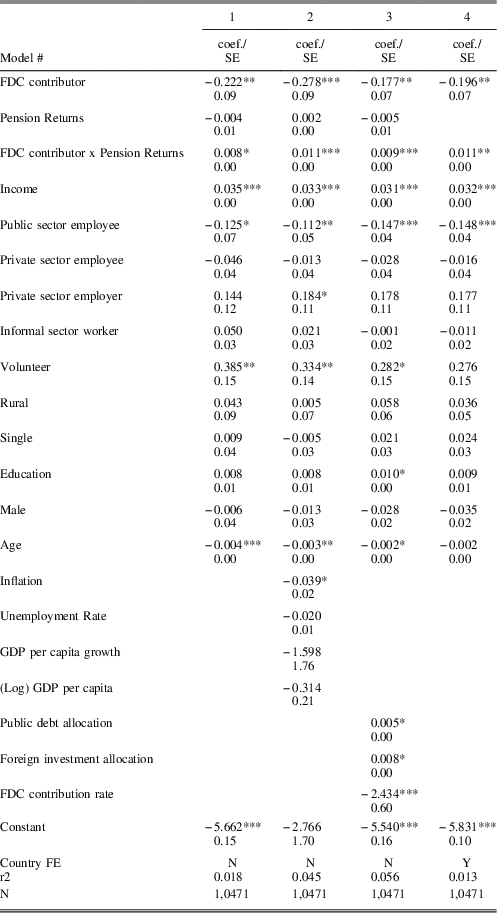
If the data support the retrospective version of the ownership society, the coefficient on the interaction term – β3 – should be positive, indicating that participation in an FDC pension pushes contributors to favor a larger role for the state in the economy when returns are low, and a larger role for the market when returns are high.Footnote 57
The estimates listed in Table 3 follow the same progression as in Table 2: Model 1 includes only individual-level control variables, Model 2 introduces country-level macroeconomic control variables, Model 3 replaces those with control variables related to the pension system, and Model 4 replaces all country-level variables with country fixed effects. These models consistently support the predictions of the retrospective ownership society. The coefficient on the interaction term is positive across all four specifications and is always statistically significant. Moreover, its magnitude is remarkably stable across specifications. The coefficients on the constituent term indicating participation in an FDC pension system are statistically significant and negative across all four models, which indicates that participants in FDC pension systems are more critical of market-based approaches to policy making than non-participants when returns are equal to zero. That is consistent with the retrospective ownership society theory, but refers to a condition (0 per cent real returns) that is below the observed lower bound in this sample.
Effect of Pension Participation, Pension Returns on Individuals’ Attitudes toward Neo-liberalism

Source: LAPOP data.
Conditional coefficient plots provide a better sense of these results. Figure 1 plots the estimated effect of being a contributor to an FDC pension system across observed values of real pension returns. I use Model 3 as the basis for these estimates, though other models give similar results. The histogram in Figure 1’s background shows the distribution of observations in the sample; the dotted line indicates a 95 per cent confidence interval around the estimates. The conditional coefficient estimates are negative and statistically significant when pension returns are low (or in the more specific case of these data, when pension returns following a crisis are insufficiently high). When returns are low, contributors to an FDC pension system are less favorable towards a market-based approach to public policy than their non-contributing peers, and more favorable towards a state-led alternative. The conditional coefficient estimates are positive and statistically significant when pension returns are high, indicating that under these conditions contributors to an FDC pension system are more likely than their non-contributing peers to prefer market-based approaches to public policy. These findings are consistent with the retrospective ownership society theory. The substantive effects are such that at the highest observed returns, the estimated effect of being a contributor is to have views that are roughly 15 per cent of a standard deviation more market acceptant than a non-contributor. At the lowest end of the spectrum of observed return, the substantive effect of being a contributor is to have views that are roughly 10 per cent of a standard deviation more accepting of a state role in the economy than a non-contributor.Footnote 58
Conditional effect of pension participation on attitudes towards neoliberalism

The control variables provide an interesting, and generally intuitive, picture of who supports market-based approaches to policy making. Higher-income respondents support market-based approaches more than lower-income respondents, as do younger respondents and those who work outside the public sector. High inflation and, less consistently, higher unemployment rates appear to drive demand for state involvement in the economy. Also notable is that the R2 in these regressions are very low, which is also the case for the regressions noted in Table 2. As such, while these models clarify the relationship between capital ownership via pension reform and attitudes towards neoliberalism, they still leave much of that variation left unexplained.
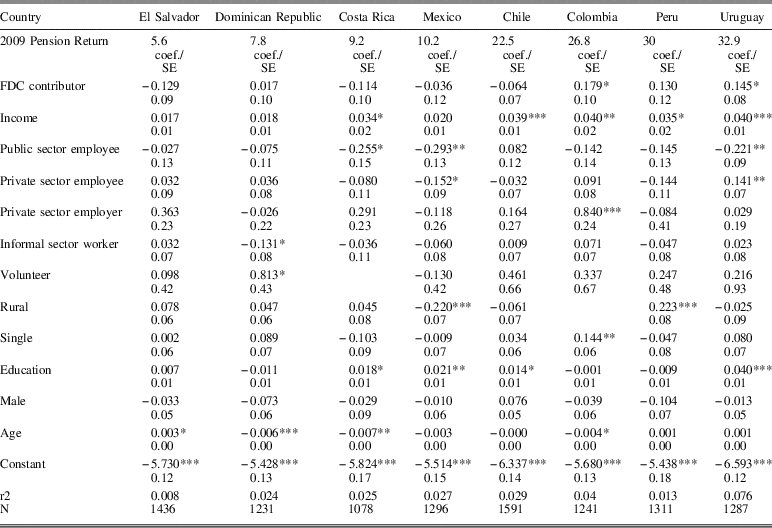
Tables 4–6 show the results of several robustness checks. Table 4 reports models that estimate the relationship between being a contributor to an FDC pension system and support for neoliberalism using separate regressions for each country. Doing so sacrifices efficiency relative to the pooled regressions noted in Table 3 (and prevents the inclusion of control variables that only vary at the country level), but more clearly indicates whether these patterns are broadly present or driven by dynamics in one or a small number of countries. If the patterns are broadly present, participation in an FDC pension system should correlate negatively with support for the state over markets in countries with the lowest 2009 pension returns, and positively in countries with the highest 2009 pension returns.
Effect of Pension Participation on Individuals’ Attitudes toward Neo-liberalism, by Country and Arranged by 2009 Pension Returns

Source: LAPOP data.
Effect of Pension Participation, Pension Returns on Individually Held Attitudes toward Neo-liberalism, Robustness Checks

Source: LAPOP data.
Effect of Pension Participation, Pension Returns on Individuals’ Attitudes toward Neo-liberalism

Source: LAPOP data.
The results in Table 4 are arranged from left to right according to their 2009 pension returns. The country with the lowest 2009 pension returns (El Salvador: 5.6 per cent) is on the far left, and the country with the highest 2009 returns (Peru: 32.9 per cent) is on the far right. The results of these regressions suggest that the above-noted patterns are broadly applicable. The three countries with the highest-returning pension systems (Colombia, Uruguay and Peru) are also those with the highest positive correlations between participation in an FDC pension system and support for market-based policies. In Colombia and Uruguay this coefficient is statistically significant at the 0.1 level. Data from countries with the lowest-returning pensions also conform to expectations. The only two countries whose data produce substantively large negative coefficients (El Salvador and Costa Rica) are two of the three lowest-returning pension systems (the Dominican Republic is the third). While neither coefficient estimate is statistically significant, the coefficient from the El Salvador regression is relatively close (p = 0.164). The general trend in these models strongly suggests that the retrospective ownership society describes general, continent-wide trends.
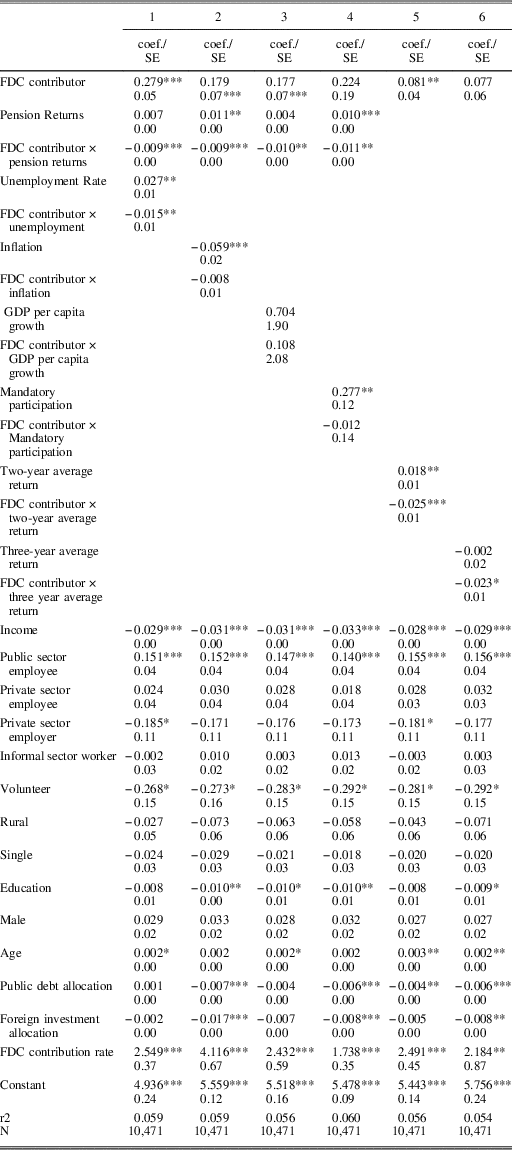
Models 1–3 in Table 5 explore more deeply whether the conditional relationships noted in Table 3 and Figure 1 reflect the political salience of macroeconomic phenomena, but not returns specifically. To do so I estimate several ‘horse race’ models in which FDC pension participation is interacted with both pension returns and the other, potentially confounding, variable.Footnote 59 The estimates presented in Table 5 use Model 3 in Table 3 as the baseline (that is, they include controls for individual and pension system-related characteristics). Model 1 considers the interaction between FDC pension participation and the unemployment rate; Model 2 considers the inflation rate; and Model 3 considers the GDP per capita growth rate.
The first thing to note from these results is that the coefficient on the interaction between being a contributor to an FDC pension system and pension returns remains positive, statistically significant and virtually unchanged across all four specifications. There is no evidence from these data that omitting these interactions from previous models meaningfully affected the results. Secondly, these estimates do not suggest that FDC pension participants’ attitudes towards neoliberalism are more sensitive to inflation or to GDP per capita growth than non-participants. The exceptional finding in this regard is Model 1, which suggests that FDC pension participants’ attitudes towards neoliberalism are insensitive to the unemployment rate, while non-participants tend to support neoliberalism more when unemployment is low, and vice versa. This may be a causal consequence of pension participation, or it could be that employment precarity – which is not well captured in my control variables – is negatively correlated with participation in an FDC pension system. The important point, however, is that this model leaves the article’s central findings unchanged.Footnote 60
It is also possible that different reactions to participating in an FDC pension system are better attributed to whether or not that participation is mandatory. 2009 returns are, in practice, higher in countries with voluntary participation. I test this possibility in Model 4, which interacts the indicator of participation in an FDC pension system with a dummy variable indicating whether participation is mandatory in the respondent’s country. That interaction is statistically insignificant. There is no evidence in this regression that pension participation’s effect on attitudes towards neoliberalism is sensitive to whether or not participation is mandatory.
Models 5 and 6 in Table 5 replace the one-year return with weighted averages of the previous two and three years’ returns, respectively.Footnote 61 Notwithstanding the literature’s focus on the enhanced salience of recent events, the depths of the 2008 crash in pension returns very likely remained salient to Latin American pension participants in 2010, and that memory might have informed their translation of pension returns to beliefs about the wisdom of market-based policy making. If so, a two- or three-year weighted average return might better reflect the financial information that informs LAPOP respondents’ political preferences. Moreover, the 2009 returns are atypical and include some outliers, and it is possible that the results reported above are artifacts of that quirkiness. To the extent that the two- and three-year returns variables produce similar patterns, it suggests that these findings are not quirks of any extreme value. Estimates of Model 5 (which uses the two-year weighted average return) and Model 6 (which uses the three-year weighted average return) produce coefficients on the interaction between participation in an FDC pension system and pension returns that are statistically significant and positive, and stable across specifications.Footnote 62
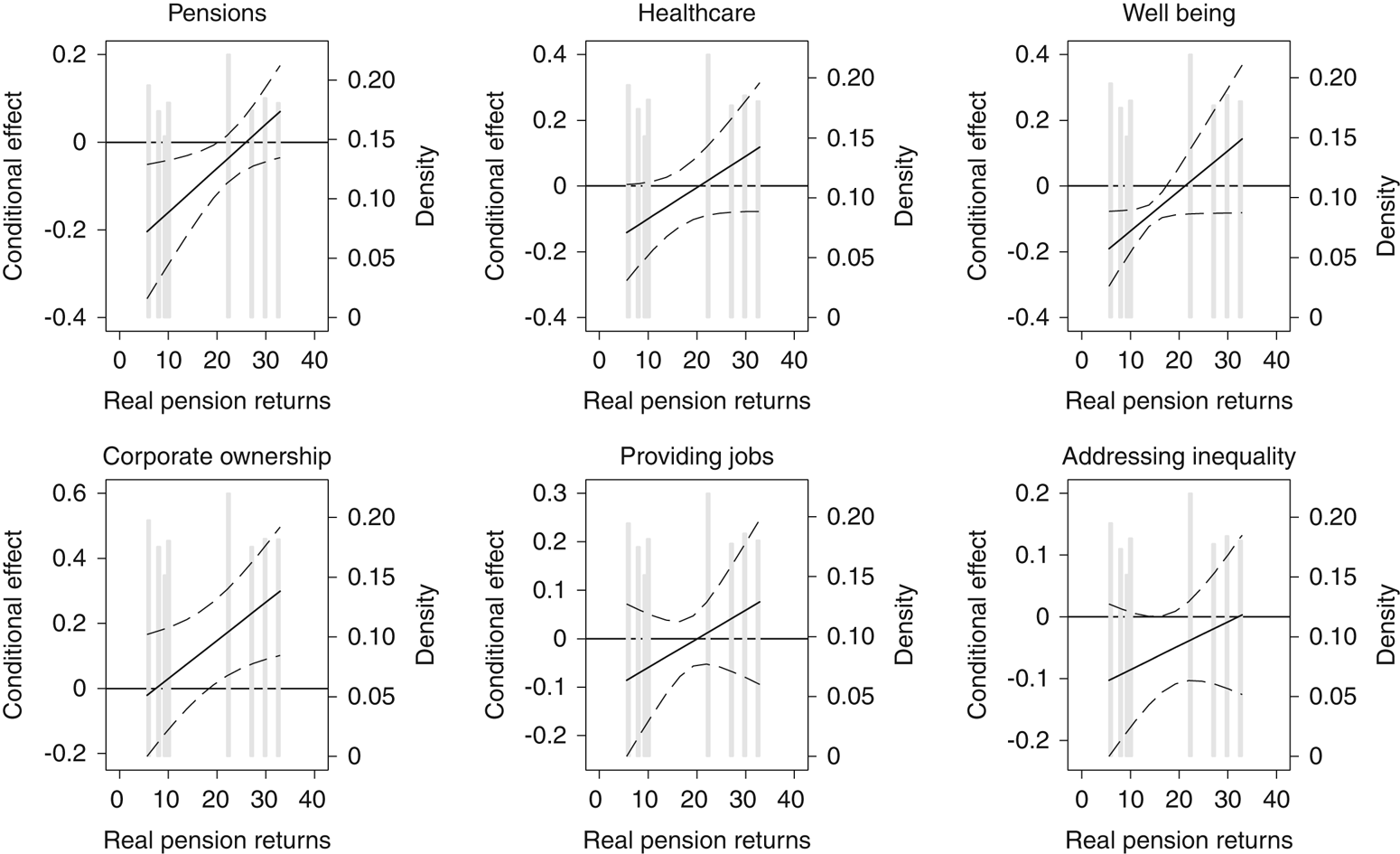
As a final robustness check, Table 6 re-estimates the main model (Model 3 in Table 3), but uses the components of the State–Market Index as separate dependent variables. These components measure respondents’ desired balance of state and market in: (1) the provision of pensions, (2) healthcare, (3) well being, (4) corporate ownership, (5) job creation and (6) addressing inequality. The coefficient on the interaction between participation in an FDC pension system and pension returns is in the expected, positive direction in all models, and statistically significant at the 0.1 level or higher in every model except Models 5 and 6, which model attitudes towards the state’s role in providing jobs and addressing inequality, respectively.
As before, a better sense of the results can be gleaned from plots of the conditional coefficients. Figure 2 plots for each model in Table 6 the estimated conditional coefficients (and a 95 per cent confidence interval), evaluated across the observed range of real pension returns. The top row of plots in Figure 3 shows the results relating to three areas – pensions, health care and ‘well being’ – that can be broadly understood as related to social insurance. The results of these models are fairly consistent: when the returns on pension assets are relatively low, participants in FDC pension systems favor a larger state role in the provision of pensions, healthcare and wellbeing than non-participants, ceteris paribus. The substantive effects are also reasonably consistent: when returns are at the lowest observed values, contributors are 10–15 per cent of a standard deviation more favorable than non-contributors towards state involvement in social insurance provision. The coefficient estimate flips in countries with high levels of pension returns in all three models, indicating more support for the market (rather than the government) in social insurance provision, though the conditional effects at the higher end of the pension returns spectrum are never statistically significant at the 0.05 level.
Conditional effect of pension participation of attitude towards limiting government’s role in…

Conditional effects of pension participation rates on belief that markets are best for country model numbers Note: see Table 7.

The lower three plots in Figure 3 show the estimated conditional relationship between participating in an FDC pension system and attitudes towards state control over industry, state provision of jobs and the state’s role in reducing inequality. Pension participation’s conditional correlation with beliefs about the state’s role as a provider of jobs and in addressing inequality are generally similar to estimates in other areas, but are less precisely estimated and statistically insignificant across the entire range of observed pension returns. These estimates do, however, suggest that contributors to an FDC pension system are more likely to favor private ownership when pension returns are high, but are indistinguishable from non-participants on this issue when returns are low. In general, then, the relationship between FDC pension participation, pension returns and attitudes towards neoliberalism appears in these data to be strongest with respect to social insurance programs, but is to varying degrees evident across issue areas.
Societal Level Tests Using Latinobarometer Data
The next set of tests uses data from the Latinobarometer.Footnote 63 These data constitute the richest and most comprehensive available information on Latin American public opinion. Unfortunately for the present purposes, however, Latinobarometer surveys do not ask whether respondents participate in an FDC pension system. Therefore these data cannot evaluate the validity of the retrospective ownership society at the individual level. They can, however, be used to examine whether there are analogous relationships at the country-year level – that is, the extent to which survey respondents in countries with high levels of participation in an FDC pension system profess attitudes towards market-based policy making that differ from respondents in countries with low participation in an FDC pension system, and whether these differences vary according to pension returns. To answer these questions I average across individual responses in the Latinobarometer dataset, and collapse it into a time-series cross-sectional format organized at the country-year.
Discerning the validity of a causal model set at the individual level using data aggregated to the country-year level runs afoul of the ecological fallacy, with potentially significant consequences. If, for example, pension reform increased market acceptance among pension participants but also generated offsetting market skepticism among non-participants – perhaps because they infer from their non-participation that neoliberal social policies do not serve their interests – the aggregate data might erroneously suggest that pension reform is politically innocuous. If non-participants outnumber participants, or if their reaction is stronger or more consistently observed, a particular misreading could suggest that participation in an FDC pension has precisely the opposite of its actual effects. It is therefore important to underscore that this section examines aggregate-level data in order to discern aggregate-level patterns, and not as an alternative approach to identifying individual-level causal mechanisms. This is still an important exercise. The ‘society’ part of the ownership society is not accidental; its promise is its potential to shape politics on a wide scale, and the existence of individual-level effects does not necessarily mean that corollary effects will be observable at the national level.Footnote 64
Dependent Variable
I use country-year averages of responses to the following question as the dependent variable in these analyses:
Do you strongly agree, somewhat agree, somewhat disagree, or strongly disagree with each of the following phrases that I am going to read:…
Market economy is best for the country
Responses range from 1 (strongly agree) to four (strongly disagree). As before, for ease of interpretation I reverse the sign of the measure such that it yields an indicator of market support rather than market skepticism. High values suggest greater support for markets over states as an organizing principle for the economy; low values indicate the opposite. This question was asked in 1998, 2000, 2002, 2007 and 2009.
Independent Variables
I measure FDC pension participation at the country-year level with the number of active contributors as a percentage of the over-fifteen population. Data on active contributors is taken from year-end reports issued by AIOS, and supplemented when missing with data from FIAP. Population data comes from the World Bank’s World Development Indicators (WDI). Variation in participation rates is substantial, and driven by a combination of factors, including the staggered nature of the Latin American reforms (older reforms typically enroll higher portions of the working population), and the fact that participation in FDC systems is mandatory in some countriesFootnote 65 and voluntary in others.Footnote 66 The limitation of these systems to formal sector workers also generates different degrees of coverage according to the size of the informal sector.Footnote 67 As of year-end 2016, participation rates were highest in Chile, where virtually the entire economically active populations were affiliated with a reformed pension system, and almost two-thirds of those were active contributors.Footnote 68 In contrast, only 36.7 per cent of economically active Peruvians participated in an FDC system, and only 15.9 per cent actively contributed.
Pension returns are measured in the same way as before, using the same data sources. Because the Latinobarometer surveys were conducted late in the year I use the contemporaneous values of the real year-end return. I also include control variables meant to isolate the effects of pension returns from other macroeconomic indicators. These include macroeconomic controls – (the log of) GDP per capita, the GDP per capita growth rate, the unemployment rate and the inflation rate, all of which were taken from WDI – as wells as controls for allocations made to foreign investment and to government debt, and whether participation in the pension system is mandatory.
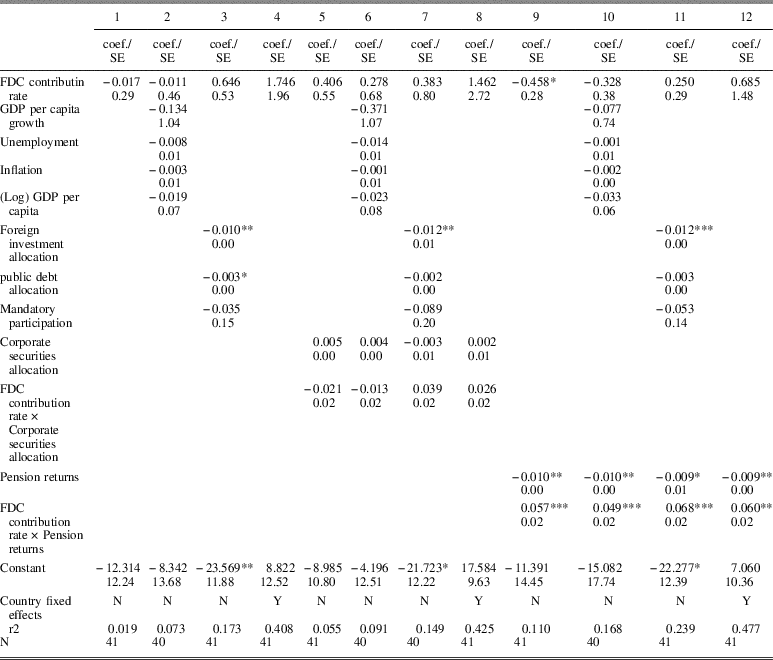
My initial tests ask whether the average citizen in country-years with higher rates of participation in an FDC pension system views markets more favorably than those in country-years with less participation, without reference to pension returns. The conventional ownership society hypothesis implies that they should, which should in turn generate a positive correlation between support for the market and the portion of the over-fifteen population that contributes to an FDC pension system. The sample for these models is again limited to countries that operated a reformed pension system at the time, so the comparison is between country-years with expansive participation in an FDC pension system and country-years with lower, but non-zero, levels of participation. The included countries are: Argentina, Bolivia, Chile, Colombia, Costa Rica, El Salvador, Mexico, Peru and Uruguay.Footnote 69 As before, I also estimate models that allow for the possibility that participation in an FDC pension system only generates pro-market sentiment to the extent that pension assets are invested in corporate securities. Unless otherwise noted, all models are estimated using a random-effects ordinary least squares method with robust standard errors, and include a linear time trend. These results are listed in Table 7.
Effect of Pension Participation Rates, Pension Returns on Belief in Markets as ‘Being Best for Country’

Model 1 in Table 7 models national preferences towards the market as a function of the portion of the over-fifteen population that contributes to an FDC pension system, with no additional controls or interactions. The coefficient estimate for the contribution rate variable is negative, which is contrary to the expectations of the conventional ownership society hypothesis, and does not approach statistical significance. Model 2 adds controls for GDP per capita, GDP per capita growth rate, unemployment rate and inflation rate; Model 3 substitutes those controls for measures of portfolio allocations, and whether participation is mandatory; Model 4 replaces those control variables with country fixed effects. The coefficient on the percentage of the population that contributes to an FDC pension never approaches statistical significance in any of these models, and is inconsistently signed across them. Models 5–8 replicate Models 1–4, but interact the portion of the over-fifteen population that contributes to an FDC pension with the portion of pension assets that are invested in domestic corporate securities. If owning corporate securities through the pension system led to pro-market attitudes, we would expect the interaction term to have a positive coefficient. Instead, the coefficients on the interaction term are inconsistently signed and never statistically significant. These non-findings are consistent with similar non-findings in the LAPOP data. There is no evidence in these data to support the conventional understanding of ownership society politics.
Models 9–12 in Table 7 test the implications of the retrospective ownership society hypothesis. These models replicate Models 1–4, but interact FDC pension participation rates with pension returns. Model 9 includes no controls other than the time trend, Model 10 adds macroeconomic controls, Model 11 includes the pension system-specific controls, and Model 12 adds country fixed effects. If the retrospective ownership society account accurately characterizes the data, we should expect the coefficient estimate on the interaction term to be positive. As shown in Table 7, all four models do produce positive and statistically significant coefficient estimates for the interaction term.
Figure 3 plots conditional coefficients for the portion of the over-fifteen population that contributes to an FDC pension (and a 95 per cent confidence interval), estimated across the observed range of pension returns. Those conditional coefficients vary enough over the four models listed in Table 7 that Figure 3 shows estimates from each of them separately. The conditional coefficients associated with Models 9 and 10 both suggest that FDC participation rates correspond to support for markets when returns are high and antipathy towards them when returns are low, though only the former effects are consistently statistically significant, and even then only when the returns are exceptionally high. In slight contrast, the results from Model 11 suggest that higher FDC participation rates nearly always correlate with more pro-market attitudes, that the magnitude of the correlation grows as pension returns increase, and that this relationship is statistically significant for returns that are (roughly) in the top half of the observed range of distributions. Model 12, which includes the country fixed effects, suggests coefficient estimates similar to those from Model 11, but with substantially larger standard errors, which is to be expected given the small number of observations per country.
Table 8 presents re-estimates of the robustness checks in Table 4, this time applied to the Latinobarometer data. Models 1–3 test the possibility that the conditional correlations noted above are better understood as FDC pension participants’ greater interest in the unemployment rate (Model 1), the inflation rate (Model 2) or the GDP per capita growth rate (Model 3). Model 4 includes the interaction between the FDC pension participation rate and an indicator of whether participation in the FDC system is mandatory. The results of these models support this article’s main findings. The coefficient on the interaction between the pension participation rate and pension returns remains positive and statistically significant across all three models, through it does reduce slightly in magnitude in Model 3. These models also fail to provide any evidence that pension participants’ political attitudes are especially sensitive to non-pension-related macroeconomic indicators, or that pension reform’s effects on mass politics are conditional on whether that participation is voluntary or mandatory.
Effect of Pension Participation Rates, Pension Returns on National Popularity of Markets, Robustness Checks

Models 5 and 6 replace the one-year return with the two- and three-year weighted average returns, respectively. Estimates using a two-year return provide no evidence of a retrospective ownership society, suggesting that long memories in 2009 were an aberration, and that under ‘normal’ conditions Latin Americans react more to very recent events. The negative coefficient on the interaction between the FDC pension participation rate and the three-year returns is puzzling. It suggests that higher levels of participation in an FDC pension system correlate with pro-market attitudes when pension returns are low, and with anti-market attitudes when pension returns are high. This result seems almost certainly spurious: it is not clear why wide participation in high-returning pension systems should turn people off of the market, and even less clear why the three-year weighted average returns should be politically salient in this way when the two-year returns are not. The clearer takeaway from Models 5 and 6 is the lack of evidence that participants in an FDC pension system respond to longer-term trends in a way that accords with the retrospective ownership society.
CONCLUSION
What happens to mass politics when public policies are used to expand capital ownership? Conventional wisdom suggests that capital owners’ well-documented preferences for right-of-center approaches to policy makingFootnote 70 should transfer to policy-induced capital owners. According to this view, expanding the capital-owning class through public policy should move society to the right and towards acceptance of neoliberal, market-based approaches to policy. Such a dynamic is commonly known, at least in the American context, as an ‘ownership society’, where it had substantial currency during the twentieth century and continues to today.Footnote 71 This article assesses that conventional wisdom about ownership society politics in the context of Latin American pension reform, and finds it lacking. There is no evidence in post-pension reform Latin America of a shift towards support for neoliberalism in the region.
At least in retrospect, the Latin American ownership society’s failure to develop may seem obvious. Regional politics experienced a ‘left turn’ following the neoliberal 1990s and early 2000s, and the pension reforms, themselves a hallmark of neoliberal policy making, have in several countries come under popular fire and been subject to ‘re-reforms’.Footnote 72 Pension reform has clearly not been a reliable vehicle for promoting neoliberal politics. But if not the ownership society, then what? ArzaFootnote 73 suggests that the backlash against defined contribution pension systems reflects their inability to ‘take root’ in Latin American politics. That is certainly consistent with observed outcomes, but it is an extraordinary (and not at all obvious) statement about the irrelevance of capital endowments to mass politics. Can 90,000,000 capital owners really be created without affecting political attitudes?
The central argument of this article is that the reforms did ‘take root’, just not in ways that conform to traditional understandings of ownership society politics. Latin American pension reform shaped policy preferences indirectly, by influencing the criteria that pension participants use to judge the neoliberal approach to policy making. Pension reform changes beliefs about what will work in the future by shaping perceptions of what has worked in the past. I refer to this dynamic as the retrospective ownership society, according to which high pension returns in the recent past signal that neoliberalism ‘works’ and should be supported; low returns indicate that it has not worked, and therefore should not be supported.
The retrospective ownership society theory of post-pension reform politics in Latin America characterizes public opinion data from the past fairly well. It also provides an important context for understanding current developments in the re-reform movement. This is most notably the case in Chile, where popular protests, in conjunction with the 2016 Bravo Commission report on pension system reform, appeared to have set the stage for a potentially substantial reform of the pension system.Footnote 74 Candidates in the 2017 presidential elections unanimously held that the pension systems needed reform, ranging from Beatriz Sánchez’s call for the AFP system’s elimination, to Guillier’s commitment to pursue Bachelet’s proposal to keep the basic structure of the pension system intact, but enhance its non-market and redistributive elements, to the eventual winner, Sebastian Piñera (Jose’s brother, and formerly Chilean president from 2010–14), who has called for a comparatively modest reform plan to increase public and employer contributions and discourage early retirement.Footnote 75
More notable than elite dissatisfaction with the private sector, market-based aspects of the Chilean pension system – Former President Bachelet has long held that preference, as have other left-leaning actors in Chilean politicsFootnote 76 – is the strengthening of a popular dissatisfaction following low real returns on pension assets in 2015 (2.16 per cent) and 2016 (1.74 per cent) and the apparent softening of that dissatisfaction as pension returns improved substantially in 2017 to 7.51 per cent, which is similar to the system’s historic real return of 8.17 per cent.Footnote 77 The retrospective ownership society hypothesis helps explain the timing of these protests’ emergence in late 2016 and early 2017, and then also the embrace of a (relative) non-reformer in the November 2017 election. To the extent that this popular dissatisfaction with the market-based pension system is necessary for reform, the retrospective ownership society theory shows that the window of opportunity for reform may be narrow, particularly if returns improve and memories remain short.