Introduction
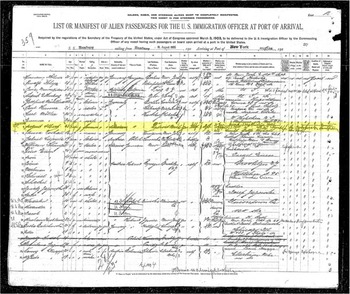
When August Albert, a 63-year-old, unmarried farmer from Michigan, arrived at Ellis Island on August 28, 1905, after visiting his childhood home in Germany, the physician told him he was too old to emigrate to the United States.Footnote 1 Despite proving to the Board of Examiners that he spoke English, Albert was told that he would not be allowed to reenter the country. Shocked, Albert informed the immigration officials that he had lived in Michigan for 32 years and was a state citizen.Footnote 2 He told them he had voted for multiple presidents, including President Theodore Roosevelt.Footnote 3 To prove he was not likely to become a public charge, Albert produced $1,168.20 and asserted he could still work as a farmer.Footnote 4 Albert explained that he took out first papers over two and a half years before November 8, 1892, when white, male residents who declared their intent to become American citizens could be granted Michigan citizenship. However, because Albert did not follow through and did not receive his naturalization certificate, the immigration officials refused to investigate his Michigan citizenship and classified him as an illegal alien.Footnote 5 Subject to deportation, Albert’s case was forwarded to the Department of Labor and Commerce.Footnote 6
Two days after Albert arrived at Ellis Island on the SS Hamburg,Footnote 7 newspapers across the United States broke the story that federal immigration officials refused to let him return home to Michigan. Headlines read, “Man Without a Country.”Footnote 8 “Voter Here, but Can’t Get In.”Footnote 9 “Had Voted, but Is Held as Immigrant.”Footnote 10 Albert’s plight drew attention from all quarters—the 1905 equivalent of a viral news story—after the Associated Press syndicated the story. News editors weighed in on Albert’s status as a Michigan citizen and longtime voter, questioning why Albert had been held at the port of entry. The Providence Telegram asked how one could be a citizen of a state but not the United States. Asked the New York World, “Is not the man from Kalamazoo as much a member of Uncle Sam’s fold as Father Knickerbocker himself?” The Washington Post, which opposed the practice then known as alien suffrage, claimed that Albert was “one of many thousands” of noncitizen voters, as many states granted suffrage when residents declared intent to become citizens.Footnote 11 A letter writer argued that Albert’s voting history was irrelevant, calling it “a great mistake, though not an uncommon one, to confound suffrage with citizenship” (Figure 1).Footnote 12
Manifest for the S.S. Hamburg of August 28, 1905, including August Albert.
Source: “S.S. Hamburg: List or Manifest of Alien Passengers,” August 28, 1905.

The “weighty problem” of the citizenship and suffrage of Albert, who left for Germany under the misconception that Michigan state citizenship and suffrage made his failure to finalize his naturalization inconsequential, alerted millions of newspaper readers to noncitizen voting.Footnote 13 Newspaper editors lashed out at “red tape” and “absurdities of administration” that jeopardized Albert’s efforts to return home.Footnote 14 Some even suggested that Albert evade immigration officials by landing in Michigan or enlisting the Michigan governor’s help. In the end, evasion of Ellis Island immigration officials proved unnecessary because Albert won the right to return to his farm in Michigan after being “held for special inquiry.”Footnote 15 Although not representative of the experiences of immigrants or noncitizen voters, Albert’s story suggests that we take a closer look at contested connotations of suffrage and citizenship in a land where alien suffrage had existed since 1704.
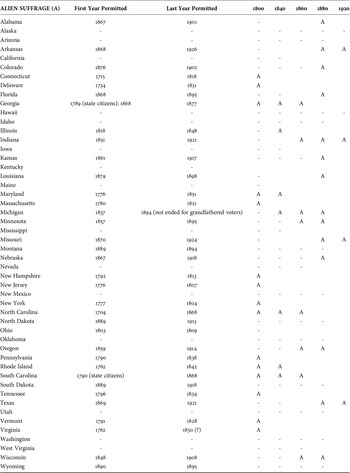
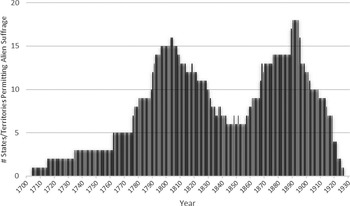
This article delves into the hidden history of noncitizen voting in the United States from 1704 to 1926 and argues that conferral of suffrage without citizenship in different regions during different periods of history is linked with economic expansion as well as racial, gender, and class bigotry. Having introduced the practice through Albert, the article traces origins of alien suffrage in the eighteenth century and rise and fall in the earliest states. Next discussed is the westward expansion of alien suffrage and state citizenship in the mid-to-late nineteenth century. After tracing the rise of alien suffrage, the article traces its decline in the 1890s and early 1900s and demise by 1926. Fluctuation in number of colonies, states, or territories allowing alien suffrage between 1704 and 1926 is represented by Figure 2, which highlights what a historian a century ago called a “spasmodic” history.Footnote 16 Given that the actual extent of noncitizen voting is unknown, as proof of citizenship was not recorded at the polls, this article relies on state constitutions as a proxy (Table 1). The article concludes by discussing some of the implications of U.S. noncitizen voting history, along with recent, renewed interest in noncitizen voting and potential relevance to future policy.
U.S. States/Territories Permitting Alien Suffrage, 1704–1926

Source: State Constitutions (Keyssar 2009).
U.S. States/Territories Permitting Alien Suffrage, 1704-1926.
Source: State Constitutions (Keyssar 2009).

Birth of a Nation of Immigrants
Thomas Jefferson wrote into the Declaration of Independence the grievance that King George III “endeavoured to prevent the population of these States; for that purpose obstructing the Laws for Naturalization of Foreigners; refusing to pass others to encourage their migrations hither, and raising the conditions of new Appropriations of Land.”Footnote 17 With this accusation, Jefferson highlighted the desire to populate the nascent nation. He made it clear that the government would employ immigration incentives, not emigration bans, to encourage those willing to work.Footnote 18 And he implicitly claimed for the nation control over its borders, a doctrine spelled out later in the constitutional power “to establish an uniform Rule of Naturalization.”Footnote 19 Left ambiguous was whether national policy precluded state citizenship and alien suffrage.
George Washington echoed Jefferson’s sentiment, telling Irish immigrants in 1783 that “the bosom of America is open to receive not only the opulent & respectable Stranger, but the oppressed & persecuted of all Nations & Religions; whom we shall wellcome to a participation of all our rights & previleges.”Footnote 20 Washington’s statement is also an example of early melting-pot rhetoric.Footnote 21 By specifically mentioning the oppressed and persecuted, Washington asserted a moral imperative for both emigration from Europe and immigration into a vast land offering safety from monarchs and political participation. Although Washington did not delineate the rights and privileges afforded to new immigrants, the word “all” suggests a broad interpretation.
Historians disagree about how to interpret cited parts of the Declaration of Independence and Washington’s letter but generally agree that the nation is defined by immigration. Immigrants did not arrive in massive waves accidentally but were incentivized by economic opportunity, conflict, famine, and other reasons.Footnote 22 During Washington’s lifetime, unnaturalized immigrants voted in local, state, and national elections. All thirteen original states offered noncitizens some form of suffrage by 1800. For instance, Delaware emphasized in 1776 that “every Freeman, having sufficient Evidence of a permanent common Interest with, and Attachment to the Community, hath a Right of Suffrage.”Footnote 23 In 1792, New Hampshire offered a ballot to “every [white] male inhabitant … of twenty-one years of age and upwards, excepting paupers.”Footnote 24
Because British law had allowed local naturalization alongside national citizenship, there was precedent for the states to determine citizenship and suffrage.Footnote 25 According to early suffrage historian Kirk Porter, “the underlying idea was that a man’s property entitled him to vote—not his character, his nationality, beliefs, or residence, but his property.”Footnote 26 Concepts of national and state citizenship often blurred.Footnote 27 By 1800, voting by landed, white, male noncitizens was legal in many states. Yet noncitizen voting did not develop from democratic ideals, nor did the practice lead to voting rights for women or people of color. According to historian Alexander Keyssar, states “shied away from making citizenship the key criterion for suffrage rights, in part because many feared it would also justify the enfranchisement of women and blacks.”Footnote 28 Officials allowed bigotry to dictate whom to include.Footnote 29 States made room for male strangers of European ancestry but not others. For a century after the nation’s founding, most nonwhite men could not vote. For 150 years, most women could not vote.Footnote 30 Only New Jersey specifically enfranchised women prior to 1800 (1776–1807).Footnote 31 Alien women faced restrictions on suffrage and citizenship, especially if they did not marry a citizen.Footnote 32 Because states set the rules, suffrage and citizenship policies varied by political and labor demand, racism, and xenophobia.Footnote 33
The shift from colony to new nation brought radical changes in immigration. No longer subject to the whims of the British monarch and plans for the North American colonies to serve as a dumping ground for paupers, convicted felons, and others thought unworthy, the new states began to pick and choose whom they admitted and to whom they granted political and civil rights. “The postwar surge of immigration filled republican harbors with an abundant supply of the free workers Americans had always preferred,”Footnote 34 posited historian Marilyn Baseler. Captive labor ideology gave way to free labor ideology that was racial and patriarchal,Footnote 35 fueled by economic expansion.Footnote 36 States rolled back citizenship, residency, and religious qualifications in favor of property and tax qualifications. Newly independent governing bodies tried to facilitate migration of workers and landowners, while keeping out the “poverty-stricken” and the “rowdy.”Footnote 37
Massachusetts’s 1780 constitution, similar to other eighteenth-century state constitutions, focused not on citizenship or nationality but on property and income. It stated that “every male inhabitant of twenty-one years of age and upwards, having a freehold estate … of the annual income of three pounds, or any estate of the value of sixty pounds, shall have a right to give in his vote for the senators for the district of which he is an inhabitant.”Footnote 38 Requiring net worth of 60 pounds or income of three pounds restricted ballot box access by economic status. Notably, the 1780 state constitution used the word “inhabitant,” not citizen, to describe the white, male voter.
By contrast, Massachusetts’s 1821 constitution defined a state voter as a “male citizen of twenty-one years of age and upwards, excepting paupers and persons under guardianship, who shall have resided within the commonwealth one year, and within the town or district, in which he may claim a right to vote, six calendar months next preceding any election of governor, senators or representatives, and who shall have paid, by himself or his parent, master or guardian, any state or county tax, which shall, within two years next preceding such election, have been assessed upon him, in any town or district of this commonwealth.”Footnote 39 The 1821 suffrage clause is twice as long as the 1780 version, reflecting desire to restrict the franchise. The change from inhabitant to citizen, along with new residency and poll tax requirements, reveal legislative efforts that arose throughout New England to exclude immigrants from suffrage.
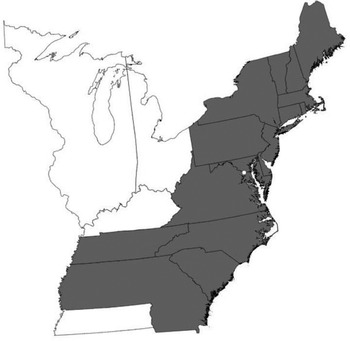
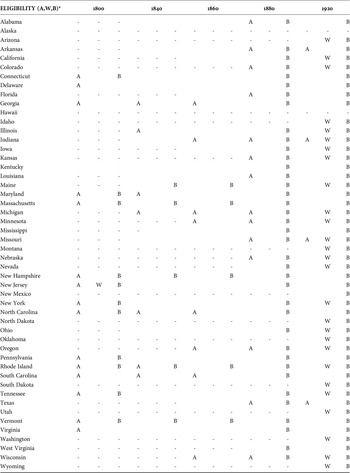
Before discussing backlash toward immigration, generally, and opposition to noncitizen voting, specifically,Footnote 40 that culminated in the wholesale insertion of citizenship requirements into eastern state constitutions by the mid-nineteenth century, it is worth considering how pervasive alien suffrage was, at least on paper, at the end of the eighteenth century. Figure 3, a map of states and territories permitting alien suffrage in 1800, reveals states where unnaturalized immigrants could legally vote that November. Except for Kentucky, all other states in existence in 1800 permitted at least some noncitizens to vote. This is significant as only a fraction of the populace could vote. Nearly all states that allowed noncitizens to vote denied suffrage to Black Americans, women, and many white men, reflecting entrenched racial, gender, and class biases that still exist today (Table 2).Footnote 41
U.S. States/Territories Permitting Alien Suffrage, 1800.
Source: State Constitutions (Keyssar 2009); HistoricalMapChart.net.
Note: Alien suffrage legal in shaded areas.

Comparison of Voting Eligibility in U.S. States, 1800-1920

Source: State Constitutions and U.S. Constitution (Keyssar 2009).
* Legally Eligible to Vote: A = Aliens; W = Women; B = Black Men (limited by poll taxes, literacy tests, grandfather clauses).
Early Opposition to Alien Suffrage
More than 250,000 people immigrated to the new nation from 1776 to 1819, comprising the dominant labor force in the Northeast but not the South.Footnote 42 Partly in response to the Federalist enactment of Alien and Sedition Acts of 1798, the Democratic-Republican party became known in the 1800 elections as the party of immigrants.Footnote 43 A year later, John Adams complained that “a group of foreign liars, encouraged by a few ambitious native gentlemen, have discomfited the education, the talents, the virtues, and the property of the country.”Footnote 44 Hinting that Jefferson had stolen the 1800 election with immigrant aid, Adams’ bigotry hastened the demise of his party.Footnote 45
Increasing involvement of immigrants in civic governance led anti-immigrant politicians and newspaper editors to condemn Jefferson for easing the path to suffrage. “One of the People” likened immigrant voting to a “terrible machine,” writing in 1803 that “pathetical appeal … which Mr. Jefferson used as an enforcement to his recommendation of a speedy and almost immediate admission of foreigners to the rights of suffrage, is worthy of particular notice.”Footnote 46 A century later, Ambassador William L. Scruggs attacked alien suffrage and state citizenship, attributing them to those who “worship at the political shrine which Thomas Jefferson erected in 1798.”Footnote 47
Vociferous opponents of the shift in the center of American political power from rural to urban areas blamed immigrants who could vote in many states after waiting a year or two.Footnote 48 The rising perception of alien suffrage unleashed the tongues of opponents of expanding suffrage to women and Black men. The War of 1812 further engendered nationalism and spurred states to require citizenship for suffrage.Footnote 49 Most early states rescinded alien suffrage out of fear of foreign enemies or immigrant opposition to slavery.Footnote 50 An 1814 Freeman’s Journal editorial epitomized racialized and gendered opposition. Unless changes were made to prevent alien suffrage, “every citizen in the state, without discrimination, would have been entitled to vote; a female also could have been an elector, and a black man [could] have voted.”Footnote 51 Contrary to popular conceptions of “civic racialism”Footnote 52 as a product of the Progressive era, the nation had debated the politics of race and urbanization long before Madison Grant railed against “native American aristocrac[ies] resting upon layer after layer of immigrants of lower races.”Footnote 53 In an era when noncitizens could legally vote in the oldest states, racialized and gendered xenophobia sowed seeds of nativism.
The states where noncitizen voting was lawful dwindled until midcentury, when rising demand for workers, particularly cheap white immigrants from Europe, combined with racism toward nonwhite Americans prompted territories to use declarant alien suffrage to encourage resettlement. Noncitizen voting proved an alluring incentive for interstate migration. To allay fears about foreign election intervention, Wisconsin and other states allowing noncitizen voting after 1848 generally required immigrants to declare their intent to become citizens. In so doing, declarant alien suffrage was recast as a pathway to formal citizenship, not a substitute for it.Footnote 54
By the 1840s, millions of displaced Western Europeans had two choices for settlement: cities and rural farms.Footnote 55 Frontier territories with statehood inclinations lured immigrants with promises of state citizenship and voting rights. Albert is one example. Although there were no specific population targets, Congress wanted territories populated before granting statehood. Rep. Galusha Grow of Pennsylvania recommended conditioning admission upon “sufficient population to support a State Government without imposing excessive burdens and taxes upon the people.” Footnote 56 In practice, territorial leaders attempted to boost population as much as possible. With land cheap and demand for bodies high, German immigrants formed entire communities in Milwaukee and rural Wisconsin. Eventually, those communities gained political representation.Footnote 57
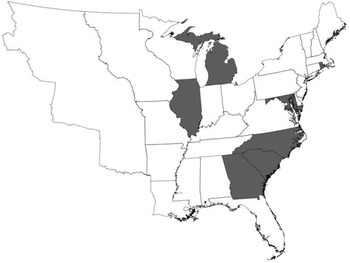
Once colonies and territories gained statehood and no longer needed to woo immigrants with suffrage and state citizenship, many stopped granting suffrage to new immigrants. Figure 4, showing states and territories where alien suffrage was legal in 1840, for instance, contrasts with the 1800 map. Northwest Territory and Illinois Territory needed migration to become a state and then curtailed alien suffrage. Michigan came within one vote of requiring citizenship in 1836, but lawmakers relented, grandfathering in “aliens who were residents previous to the adoption of that constitution.”Footnote 58 Wisconsin, which granted aliens suffrage in 1848, restricted it by intent.Footnote 59 Like Indiana, Michigan, and Oregon, Wisconsin eschewed property and income requirements but required immigrants to declare their “intention to become citizens” before they could vote.Footnote 60
U.S. States/Territories Permitting Alien Suffrage, 1840.
Source: State Constitutions (Keyssar 2009); HistoricalMapChart.net.
Note: Alien suffrage legal in shaded areas.

Alien suffrage thrived on the American political scene in the mid-nineteenth century in spite of nativist antagonism, which manifested in animosity toward Irish Catholic immigrants, the Pope, and the Democratic Party.Footnote 61 “Popery!” “Democracy!”Footnote 62 After a Pennsylvania Supreme Court ruling located legal justification for alien suffrage within principles of “natural justice,” anti-immigrant forces coalesced around shared opposition to the “prophetic eye of Jefferson” and ramped up racialized criticisms.Footnote 63 Despite tenuous connections between Irish immigrants, the Pope, and the Democratic Party, the nativist American Party enjoyed early success. Combining racialized, anti-Catholic language with brooding language of conspiracy theorists, Americanists, also known as Know Nothings, made protesting voting by the new immigrants a cause célèbre.
Whereas Whigs such as New York Senator Joshua A. Spencer had “no fear of the foreign vote” and sought immigration compromises, the American Party preferred xenophobic rhetoric to rationality.Footnote 64 Xenophobia surged along with immigration, making Catholic immigrants targets of nativist hostility.Footnote 65 Conflicts between members of the American Party, on one side, and Whig and Democratic party members, on the other side, led into name-calling. Critics of the American Party, its rituals, and its secret order, bitingly called Americanism “Whiggery in disguise.”Footnote 66 The critics portrayed the American Party as a fringe party of anti-immigrant demagogues, pointing to unanimous support of Senate slaveholders for disenfranchisement of noncitizens in the Nebraska Bill.Footnote 67 They called the Know Nothings’ “noisy discussion of the question of alien suffrage in the Territories [a] trick”:
A prejudice is first aroused against the foreigner, and then it is represented to the people as a fact involving the existence of the confederacy that unnaturalized foreigners are permitted to vote in the Territories… . In the hands of rabble rousing politicians, this fact is swelled to monstrous proportions.Footnote 68
Pragmatic defenses of immigrant citizens and noncitizens as “tend[ing] to multiply free laborers and free States, and circumscribe the system of slave labor”Footnote 69 could not match the Know Nothings’ xenophobia. The Herald of Freedom’s defense of alien suffrage on the grounds that “wages of labor are now, and have been, in Oregon, double what they are on the Atlantic coast”Footnote 70 was too neutral to compete with the Easton Gazette’s rant that in Minnesota, “Republicans and Democrats joined hands [and] will in the course of time be allied openly together under the banner of the ‘Alien Party’ against the conservative, national and Americanized principles of the American Party.”Footnote 71 In response to a broadly anti-immigrant screed by Senator A. G. Brown of Mississippi that he “never would vote to place the offscourings of the earth, upon equality with American born citizens,” all the Ripley Bee could do was urge Brown’s party to “drive him out of its ranks.”Footnote 72 There was no response when the New York Times complimented Justice Benjamin Curtis for disenfranchising “two thousand alien voters in Massachusetts” and denounced a Kentucky legislator who the newspaper alleged won election due to “alien suffrages on the Railroads.”Footnote 73 Yet alien suffrage survived.
Alien Suffrage Goes West
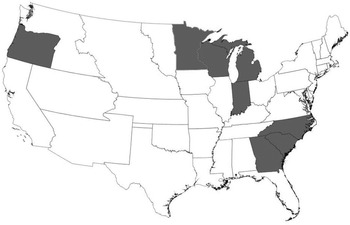
As territories in the Midwest and Northwest moved toward statehood before and after the Civil War, a new wave of jurisdictions let noncitizen immigrants vote, calculating that benefits of attracting cheap labor outweighed fears associated with enfranchising white, male immigrants. Figure 5, a map of states and territories allowing alien suffrage in 1860, reflects initial expansion westward, coupled with lingering southern alien suffrage. As territories sought statehood, they shared an “insatiable appetite for cheap labor.”Footnote 74 Immigration boosted state populations and attracted workers. Southern states also sought white migrants, for racist reasons. A white official from Alabama predicted that emancipation would reverse anti-immigrant policy: “We want no Chinese wall around us to hold the Negroes, or prevent the white man from entering the state.”Footnote 75
U.S. States/Territories Permitting Alien Suffrage, 1860.
Source: State Constitutions (Keyssar 2009); HistoricalMapChart.net.
Note: Alien suffrage legal in shaded areas.

Unlike the Confederate States of America, which outlawed alien suffrage by declaring that “no person of foreign birth, not a citizen of the Confederate States, shall be allowed to vote for any officer, civil or political, State or Federal,”Footnote 76 Reconstruction-era state constitutions in Alabama, Arkansas, Louisiana, and Texas restored alien suffrage at the same time Black men temporarily won civil rights long denied to them.Footnote 77 Representative of postwar constitutions, the 1868 Arkansas constitution granted a vote to any 21-year-old resident alien who “has legally declared his intention to become a citizen of the United States.”Footnote 78 The Alabama convention of 1875 even stated its intent that “immigration shall be encouraged.”Footnote 79 But voting rights for Black Americans were rolled back by poll taxes, literacy tests, grandfather clauses, and other racially discriminatory means designed to suppress the vote that lasted well into the twentieth century.Footnote 80
Although reformers and judges grew concerned toward the end of nineteenth century about political machines and loosening voting restrictions, courts generally held state-granted rights constitutional.Footnote 81 One after another, frontier state high courts, and then the U.S. Supreme Court, found alien suffrage constitutional and separable from U.S. citizenship. The Supreme Court of Illinois found it “wholly unnecessary to enquire whether the [allegedly illegal] elector was a citizen of the United States.”Footnote 82 Indiana’s high court noted that “states may confer privileges on those who are not citizens. [Declarant aliens] are not citizens of the United States; nor can they become so till after five years’ residence therein.”Footnote 83 Similarly, the Wisconsin Supreme Court ruled, in two 1863 cases involving noncitizen voters, that “it may be possible for the state to confer the right of voting on certain persons without making them citizens,”Footnote 84 and “in all cases where the state confers the right of state citizenship on aliens who have declared their intentions to become citizens of the United States, the act of voting is conclusive proof of an acceptance of such state citizenship by them.”Footnote 85 Just as in Michigan, where August Albert earned suffrage and state citizenship without naturalization, “a resident alien, who has declared his intention to become a citizen of the United States … becomes thereby a citizen of the State of Wisconsin.”Footnote 86
Even the U.S. Supreme Court recognized the existence and constitutionality of alien suffrage, noting in its otherwise infamously annulled Dred Scott decision that “a person may be entitled to vote by the law of the State, who is not a citizen even of the State itself. And in some of the States of the Union foreigners not naturalized are allowed to vote.”Footnote 87 In 1874, in Minor v. Happersett, a case brought by suffragist Virginia Minor with the goal of nationalizing women’s suffrage by linking it with U.S. citizenship, the Court instead judicially separated suffrage from citizenship. The Court acknowledged the historical distinction between suffrage and citizenship:
Citizenship has not in all cases been made a condition precedent to the enjoyment of the right of suffrage. Thus, in Missouri, persons of foreign birth, who have declared their intention to become citizens of the United States, may under certain circumstances vote. The same provision is to be found in the constitutions of Alabama, Arkansas, Florida, Georgia, Indiana, Kansas, Minnesota, and Texas.Footnote 88
Expanding westward with late-nineteenth-century waves of Eastern and Southern European immigrants, alien suffrage regained its position by 1880 as a democratic norm. Figure 6, a map of states and territories whose state constitutions permitted noncitizens to vote in 1880, shows how alien suffrage swept westward and peaked with territorial expansion and industrialization.
U.S. States/Territories Permitting Alien Suffrage, 1880.
Source: State Constitutions (Keyssar 2009); HistoricalMapChart.net.
Note: Alien suffrage legal in shaded areas.

Alien suffrage and expedited naturalization procedures, perfected by Boss Tweed and his ilk, also sustained political machines.Footnote 89 The suffrage provided working-class immigrants with political power.Footnote 90 Although “many native-born Americans [saw immigrants as] a threat to the ‘American’ race and to democracy,” with foreign-born citizens and noncitizens lumped together, many immigrants appreciated political organizations for providing social services without asking too many questions: “I think there’s got to be in every ward a guy that any bloke can go to when he’s in trouble and get help.”Footnote 91 Historians of Jewish immigration have observed the importance of community solidarity.Footnote 92 Ethnic group voting occurred in places as remote as southwest Texas, where a community of “immigrant Southern Republicans” sent a German refugee to Congress.Footnote 93
However, noncitizen eligibility to vote did not necessarily translate into access to voting. The first state constitution of Minnesota, for example, specifically permitted declarant aliens to vote but only if they were male and white, and the word “white” was not defined.Footnote 94 Similarly, legal ineligibility did not necessarily prevent voting. For instance, some western states required declarant aliens to show “first papers,” affirming intent to become a citizen, only upon request, whereas others did not require proof. During the Civil War, the Union army controversially drafted over a thousand noncitizens, including declarant aliens and other noncitizens who had voted.Footnote 95 In short, election practice deviated from suffrage eligibility throughout the nineteenth century.Footnote 96
With more than one-third of the states allowing white, male, declarant aliens to vote in 1880, and the practice found constitutional, alien suffrage began to come under scrutiny in the national press, statehouses, and old union halls, often in the context of broader anti-immigrant sentiment.Footnote 97 A Tennessee legislator introduced a bill in 1868 to bar alien suffrage because the “newly enfranchised foreigners, almost to a man, voted the Conservative ticket.”Footnote 98 In 1884, prominent poet Joaquin Miller suggested giving people different numbers of votes because “the ignorant and lazy negro, the newly landed immigrant, the worthless tramp of whatever race or place … ought not to be permitted to put in a ballot that will stand equal to and cancel the vote of a Calhoun, a Cleveland or a Blaine.”Footnote 99 A civics magazine viewed extending the naturalization waiting period from 5 to 15 years as a “much-needed reform.”Footnote 100 The New York Times opined that alien suffrage posed “a menace to the perpetuity of our free institutions.”Footnote 101 The Washington Post editorialized that “in many of the States the door is almost wide open to a class of foreign and ignorant voters, who have barely settled in the country and who know next to nothing of its institutions, laws, or even language.”Footnote 102 The same editorial page protested that “in some of the States there are thousands of voters who are as unfit for suffrage as machines or cattle.”Footnote 103
Yet even as expansion of alien suffrage prompted calls for reform, labor demand grew, boosting immigration to record highs after 1880.Footnote 104 But xenophobia dominated the press, and editors called for curtailment of both immigration and alien suffrage. Fears about alien suffrage influenced congressional debates, particularly about immigrants from Asia or Eastern Europe. Racism surged during debate on the 1882 Chinese Exclusion Act, which prohibited “immigration of Chinese laborers for 10 years, except for those who were in the country on November 17, 1880.”Footnote 105 George Lawyer observed in an 1895 law review article that suffrage had always been racialized: “The only way to the franchise left open to the unfortunate alien, whose color or race or tribe is a bar, is a special enactment or privilege granted by congress.”Footnote 106 The only bright spot was Senator Oliver Morton’s minority report, which astutely observed that the Chinese “could only be protected from persecution and outrage by our giving them suffrage and citizenship.”Footnote 107
Decline and Demise of Alien Suffrage
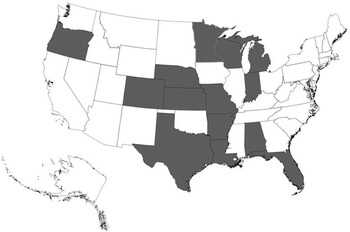
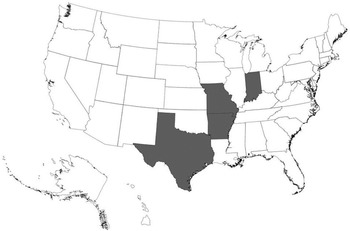
Spurred by resurgent nativism and the Ku Klux Klan, efforts to antagonize the latest, darker-skinned waves of immigrants and prevent them from having a voice reached fruition at the end of the nineteenth century and during the first two decades of twentieth century.Footnote 108 After 1890, no new state promised voting rights to noncitizens and state after state did away with it. “Corruption of the elective franchise and a distrust of alien suffrage have been bringing in for some years an era of ballot legislation,” the Morning Oregonian reported in June of 1895.Footnote 109 The Portland newspaper’s assessment rang true. Figure 7, a map of states and territories where alien suffrage was legal in 1920, reveals the ultimate decline of alien suffrage between 1890 and 1920.
U.S. States/Territories Permitting Alien Suffrage, 1920.
Source: State Constitutions (Keyssar 2009); HistoricalMapChart.net.
Note: Alien suffrage legal in shaded areas.

Alien suffrage frequently drew anti-immigrant ire. The Youth’s Companion editorialized in 1903 against alien suffrage by alleging that “thousands of unnaturalized aliens … vote at every election.”Footnote 110 A minister from Indiana pointed to “twelve or thirteen states in which an alien may vote.”Footnote 111 The Washington Post crusaded against alien suffrage as part of a broader crusade for naturalization restrictions, publishing no less than seven editorials decrying noncitizen voting. In November 1901, the Post condemned alien suffrage as “anomalous and undesirable,”Footnote 112 asserting a need to “annul” state alien suffrage laws.Footnote 113 In April 1902, the paper turned a story on rejection of a naturalization applicant for language reasons into a broadside against immigrants and alien suffrage, concluding that “thousands of men whom our government regards as aliens take part in controlling our government.”Footnote 114 Three months later, the Post asked: “If there is anything more absurd … in any government under the sun, what and where is it?”Footnote 115 In 1906 and 1907, the Post feared aliens could decide close presidential elections,Footnote 116 calling it “a glaring inconsistency.”Footnote 117 Lawmakers would not likely have missed all seven editorials.
World War I brought further animosity. In 1918, Rep. Henry Flood, foreign affairs committee chair, drafted a bill to bar noncitizens from voting if the United States was at war with their nation of origin.Footnote 118 But Congress did not pass Flood’s bill; instead, the end of noncitizen voting coincided with postwar passage of women’s suffrage and dramatically expanded immigration restrictions. For example, Texas tacked an “alien suffrage provision,” ending alien suffrage, onto resolutions to add women’s suffrage to the state’s constitution.Footnote 119 The Arkansas legislature put a constitutional amendment to end alien suffrage on the 1920 ballot. The amendment “to deny the right of suffrage to aliens” passed with “87,237 in the affirmative and 49,757 in the negative.”Footnote 120 However, because a 1915 court decision required “a majority of the electors voting,” the amendment did not become law until the court reversed itself in 1925 and 1926.Footnote 121 The Arkansas secretary of state made the change retroactive to November 2, 1920, an extraordinary action given the prohibitions on ex post facto laws in article I, section 9, and article I, section 10, of the U.S. Constitution.Footnote 122
In summary, scholars have not paid enough attention to racialized and gendered motives for expansion of noncitizen voting in colonial and frontier periods and restriction during antebellum and post-Reconstruction periods. “What mattered most for suffrage,” noted political theorist Lisa Garcia Bedolla, “was a person’s race and gender, rather than their citizenship status.”Footnote 123 Bedolla is right. But age and economic desperation also mattered.Footnote 124 The checkered past of noncitizen voting was shaped by racism, sexism, labor demand, and xenophobia. Racial animosity toward darker-skinned and non-Protestant immigrants from eastern and southern Europe and Asia also motivated racialized restrictions on immigration, as exemplified by the Chinese Exclusion Act of 1882 and Johnson-Reed Immigration Act of 1924.Footnote 125 Immigrants were up against the resurgent Ku Klux Klan’s brand of “Americanism”; Jews, for instance, were often not considered white.Footnote 126 Some European immigrants returned to Europe, but many ethnicities also faced racism there.Footnote 127 Xenophobia ended noncitizen voting. As political scientist Leon Aylsworth noted in 1931, “For the first time in over a hundred years, a national election was held in 1928 in which no alien in any state had the right to cast a vote for a candidate for any office—national, state, or local.”Footnote 128
Conclusion
The history of noncitizen voting in the United States from 1704 to 1926, hidden in plain sight by the myth that citizenship rights are immutable, highlights fluctuations in citizenship and suffrage. At the founding, many white men came from England. Once the colonies declared independence from England, constitutional drafters made alien suffrage a part of most new state constitutions. Early states permitted alien suffrage until nativism swept the nation in the nineteenth century. Some descendants of early English immigrants opposed new immigrants “not of English stock and who were thought incapable of ready assimilation.”Footnote 129 However, when legal noncitizen voting nearly vanished in the mid-1800s, political and labor demands made declarant alien suffrage critical to territorial expansion. Territories dangled state citizenship and voting to entice white, male, European migration. Bypassing waiting periods for naturalization, territories made voting contingent not on citizenship but on intent. Alien suffrage became widespread again by the late 1800s. But from the 1890s until noncitizen voting ended in 1926, no new states legalized alien suffrage. Yet the time line tells only part of the story. Alien suffrage origins lie in economic and racialized motivations for suffrage and state citizenship to be offered as a migration incentive. However, despite claims of noncitizen influence on elections by alien suffrage opponents, it is unknown how many noncitizens voted because citizenship status was not recorded at the polls.
Alien suffrage challenges the misconception that suffrage history is linear. The trajectory of a practice long considered a “contradiction”Footnote 130 reveals expansion and restriction. Suffragist opponents called it “unseemly, if not unjust, to enfranchise alien males while women remained voteless.” Racist supporters argued that not permitting alien suffrage would suggest that white noncitizens “were inferior to recently enfranchised blacks.”Footnote 131 Neither state-specific legalization nor the long history of alien suffrage fully explain why public opinion fluctuated. The meanings of citizenship and suffrage changed depending on views toward immigrants, women, and people of color. The right to vote conferred a form of citizenship on unnaturalized immigrants, though citizenship did not confer suffrage. When political and industrial leaders desired to grow state populations, they conferred suffrage without requiring citizenship. When racist nativists depicted unnaturalized immigrants as enemies, those in power redefined suffrage to require citizenship.
Although no state allows noncitizens to vote in state or federal elections, the practice has reemerged as a subject of debate. After nearly a century of citizenship being a legal prerequisite for suffrage, noncitizen voting is drawing renewed attention. With more than 10 million lawful, permanent residents in the United States, elected officials and community groups in New York City have long advocated for noncitizen voting.Footnote 132 On January 9, 2022, Mayor Eric Adams allowed a bill to become law that will let an estimated 808,000 noncitizens vote in city elections starting in 2023.Footnote 133 Notably, the city has recent experience with noncitizen voting, as noncitizen parents voted in community school board elections for decades. New York and other large cities have also emerged as leaders in offering licenses and other identification to noncitizens and expanding access to public services to undocumented immigrants. After Takoma Park, Maryland, allowed noncitizens to vote in local elections in 1992, ten Maryland municipalities followed suit.Footnote 134 In 2016, voters in San Francisco, California, passed a ballot proposition that allowed noncitizen parents to vote in school board elections.Footnote 135 Member of Congress Jamin Raskin called the push for noncitizen voting a “suffrage movement.”Footnote 136 By contrast, former President Donald Trump falsely claimed that hundreds of thousands of noncitizens voted in the 2020 presidential elections as part of his unsuccessful legal challenges to President Joe Biden’s victory.Footnote 137 Two years earlier, Trump made similar unproven claims that “58,000 non-citizens voted in Texas, with 95,000 non-citizens registered to vote.”Footnote 138
In short, the history of noncitizen voting, coupled with modern debates about citizenship and suffrage, favors the notion that noncitizen voting warrants renewed consideration. Its history connects immigration policy, economic history, and racial and gender discrimination, revealing how American suffrage and citizenship evolved. The curious case of August Albert should be recalled by policy makers in the future when debating immigration, citizenship, and suffrage.