Introduction
The Galapagos Martin Progne modesta is the smallest of the nine species of the Progne genus present in the Neotropics (Del Hoyo et al. Reference Del Hoyo, Elliott and Christie2004). In the past, the Galapagos Martin was considered conspecific with Peruvian Martin Progne murphyi and Southern Martin Progne elegans (Zimmer Reference Zimmer1955, Eisenmann Reference Eisenmann1959), but DNA studies showed that these two species are not closely related to each other. The lack of genetic samples from the Galapagos Martin makes it difficult to know its closest ancestor but it is likely that this species branched off from an errant migratory Progne from the continent (Moyle et al. Reference Moyle, Slikas, Whittingham, Winkler and Sheldon2008).
The Galapagos Martin is one of the least studied avian species in the Galapagos Islands due to its high mobility and the inaccessibility of its nesting sites. A brief study estimated probably fewer than 500 individuals (Wiedenfeld and Jiménez-Uzcátegui Reference Wiedenfeld and Jiménez-Uzcátegui2008). In addition to its small population size, a supposed decrease during the last decades caused the uplisting of its Red List status to ‘Endangered’ in 2012 (IUCN 2019).
The present paper aims to collate all available data about the conservation status of the Galapagos Martin. Information was compiled on its historical distribution from several old sources and recent observations collected by citizen science (eBird and observations from naturalist guides), visiting scientists, and data collected by the Galapagos Landbird Conservation Program (Cunninghame et al. Reference Cunninghame, Ortiz-Catedral and Fessl2012, Fessl et al. Reference Fessl, Anchundia, Carrion, Cimadom, Cotín, Cunninghame, Dvorak, Mosquera, Nemeth, Sevilla, Tebbich and Causton2017).
Methods
Historical status
Available data from old expeditions to Galapagos in the last 200 years was compiled to understand the distribution and abundance of the species in the past. These data come entirely from scientific publications and information published on museum websites about specimens stored in their collections. We consider historical information from the oldest known record of this species in Galapagos until the early 1970s.
Recent surveys
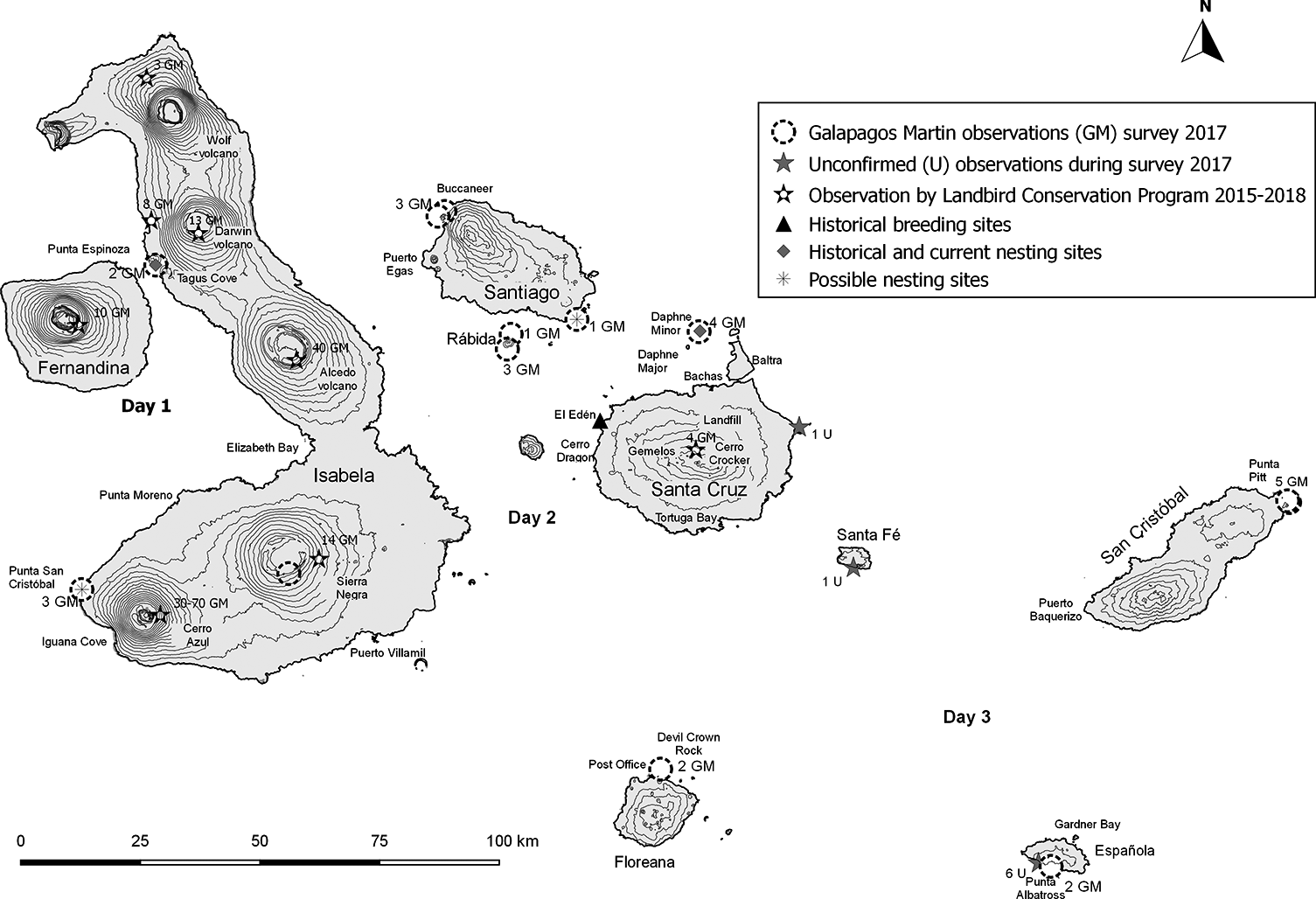
Although Galapagos Martins frequent many areas in Galapagos, most repeated sightings are from the coastlines. From 21 to 23 July 2017, coastline counts were conducted simultaneously using five boats to discover possible colonies and collect data on distribution and population size. Each boat followed the coast very closely, covering approximately 1,100 km along 14 islands and 23 islets. The islands to the north of the equator without recent records of Galapagos Martin (Wiedenfeld Reference Wiedenfeld2006), namely Genovesa, Marchena, Pinta, Darwin and Wolf, were not covered (Figure 1). Birds that could not be positively identified but with similar flight pattern and colour as the Galapagos Martin were categorised as unconfirmed observations.
Results of the Galapagos Martin survey in 2017 and observations by the Landbird Conservation Program during 2015-2018. Further, historical, confirmed and possible nesting sites.
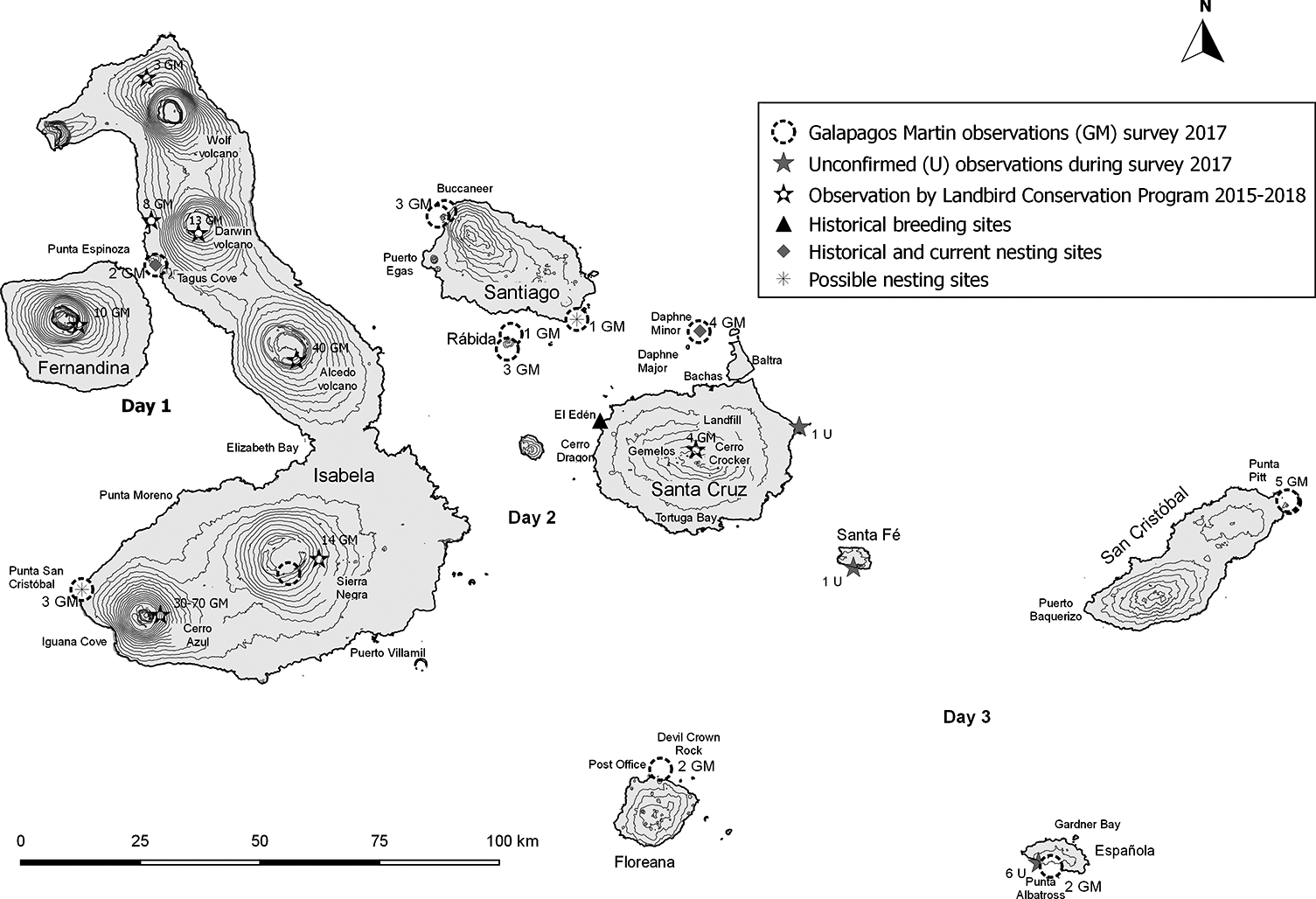
During the first day, two observers on separate boats counted birds along the coasts of Fernandina Island and western Isabela Island simultaneously to reduce the possibility of double counting. On the second day, five boats with one observer each surveyed the coasts i) of southern Isabela Island and of the islets “Cuatro Hermanos”; ii) along eastern Isabela Island; iii) around the islands Pinzón, Rábida, Daphne Major, Daphne Minor, North Seymour and Baltra; iv) of Santiago Island and its islets and v) along Santa Cruz and its islets as well as Santa Fé Island. On the third day, three boats with one observer each counted separately around the islands of Floreana, Española and San Cristóbal. Counts started between 06h00 and 07h30 depending on the weather, visibility, and travel distance from the starting point (Figure 1).
Galapagos Martins are frequently observed at the top of volcanoes, especially on Isabela Island. Due to the inaccessibility and remoteness of these sites, it was only possible to obtain data from the Sierra Negra volcano on Isabela Island with help from naturalist guides on the third day of the survey.
Current distribution and abundance
We used sightings from the last 15 years (2003–2018) reported on eBird, by naturalist guides, and by scientific expeditions to delimit the current distribution range. Information collected by tourists was restricted to tourist sites, which represent a small area of Galapagos. Data collected by visiting scientists were reported from both tourist sites and remote areas of the Galapagos National Park.
Since 2015, the Landbird Conservation Program has recorded sightings of Galapagos Martins in more detail. In 2017 and 2018, nest material of two accessible used nests in Tagus Cove, Isabela Island, were examined for the presence of the parasitic fly Philornis downsi, one of the main threats to small birds in the Galapagos Islands (Causton et al. Reference Causton, Peck, Sinclair, Roque-Albelo, Hodgson and Landry2006). Prior monitoring of these nests was not consistent due to the remoteness of the site and the limited transportation available.
Results
Historical distribution
The first records of the Galapagos Martin were from buccaneers who remembered Europe when they saw these birds (Beebe Reference Beebe1924). Before 1897, there were several scientific expeditions to the Galapagos Islands and the Galapagos Martin was either collected or observed in low numbers on several islands. In 1835, Darwin mentioned that this bird was only present in Santiago Island and “it was very far from common”. Darwin spent several days in San Cristóbal, Floreana and Tagus Cove on Isabela, but did not report other sightings of the Galapagos Martin (Owen and Gould Reference Owen and Gould1838). The first report of this species on Floreana was in 1838 (Neboux Reference Neboux1840). In 1852, Kinberg, who observed the Galapagos Martin in Santiago, did not report it from San Cristóbal, Floreana and Santa Cruz where he collected other bird species (Sundevall Reference Sundevall1871). In 1868, Habel made the first record on Santa Cruz stating, "The most noticeable birds of this island which I did not collect were two species of swallows. One, a large kind, kept to the perpendicular rocks which lined the estuary, and did not fly inland, the other, smaller, flew about the island, but too rapidly to be shot by me”. He even identified one of these as a Galapagos Martin (Salvin Reference Salvin1876, Sharpe and Wyatt Reference Sharpe and Wyatt1894). In 1888, the Galapagos Martin was collected in Santa Cruz Island by Lee during the Albatross expedition (Ridgway Reference Ridgway1890). In 1891, Baur recorded sightings at the islands Santa Fé and Pinzón (Baur Reference Baur1891, Reference Baur1897, Ridgway Reference Ridgway1897) without mentioning numbers.
Most of the Galapagos Martin specimens now available in museum collections were collected during three different expeditions. In 1897, the Webster-Harris expedition collected 32 birds (five on Floreana Island, 19 on Isabela Island, and eight on San Cristóbal Island). On San Cristóbal Island, Harris caught six Galapagos Martins close to Punta Pitt and two at the Hacienda Cobos and added the note “Progne were numerous about the house”. Harris observed Galapagos Martins as well on the islands of Santa Fé, Española and Santa Cruz (Rothschild and Hartert Reference Rothschild and Hartert1899).
The Hopkins-Standford Expedition in 1898–1899 obtained nine Galapagos Martins from Isabela and Baltra Islands. Snodgrass and Heller stated: “This swallow is very abundant at some places in the archipelago. We found it most numerous near Elizabeth Bay, on the north shore of the southern half of Albemarle (Isabela Island). We obtained it also at Tagus Cove and southern Seymour Island (Baltra)” (Snodgrass and Heller Reference Snodgrass and Heller1904).
During the expedition of the California Academy of Sciences (CAS) in 1905–1906, 56 Galapagos Martin were collected; 46 of these were collected on western Isabela Island (Swarth Reference Swarth1931). Gifford stated: “It seemed to be commonest on Albemarle, but was not particularly abundant everywhere…fairly abundant on Villamil (several on salt lagoons and hunting over houses and ground)….quite common on Iguana Cove hunting insects and the true center of abundance of this specie is Tagus Cove” (Gifford Reference Gifford1919).
More observations were reported by Beebe in 1923 on Baltra, Daphne Major and Santa Cruz Island (Beebe and William Reference Beebe and Williams1923). On the Pinchot expedition in 1929, Fisher stated that: “Martins were seen almost daily ashore on open stretches of Santa Cruz and Seymour islands (Baltra and North Seymour)….At Daphne numbers were observed about the cliff where they nest in close association with Galapagos shearwaters, noddies, and terns. At Eden in Santa Cruz numbers were seen entering or leaving their nesting crevice in the cliff” (Fisher and Wetmore Reference Fisher and Wetmore1931). Later collections were made by Garth and Elliot in the Velero III in 1933–1934 (four specimens are stored in LACM, USNM), and 10 specimens collected in 1935 by Puleston and an unknown collector are stored in AMNH. Four sightings in 1937 were recorded on Tagus Cove Isabela (recorded by ANSP). For abbreviations and more historical details about collections and sightings, see Table S1 in the online supplementary material.
Survey in 2017
In the simultaneous boat survey in 2017, we counted 26 Galapagos Martins and had eight unconfirmed observations (Figure 1). Inland, five individuals were counted in the tourist area on the Sierra Negra volcano (Table S2).
Surveys from 2015 to 2018
During expeditions to the Isabela volcanoes from 2015 to 2018, more Galapagos Martins were observed at once than in the counts around the coast (Table S2). On Wolf volcano, three Galapagos Martins were observed (23 November 2015, 0.07309°S, 91.36942°W) with sporadic sightings in the crater (Gabrielle Gentile pers. comm.). On the slope of Darwin volcano, 13 martins were seen flying together (20 February 2018, 0.24655°S, 91.33087°W), chattering and heading towards the coast. From Alcedo volcano, data were collected in 2016 (9–16 April), 2017 (26 January) and 2018 (12 March–2 April). In 2016, several individuals were observed daily on the crater rim flying and hunting insects over the vegetation. The maximum number of Galapagos Martins seen at one time was 40 individuals (10 April, 0.44349°S, 91.09216W°). This group flew very slowly, chattering, and then flew north-east into the crater. In 2017 another group of 35 individuals was observed flying together over the crater rim, chased by two Galapagos Hawks Buteo galapagoensis. In 2018, Galapagos Martins were observed every day flying along the edge of the crater during the 22-day visit to this volcano (Tui de Roy pers. comm.). These observations indicate a resident population around the crater, which may also be a nesting site. On Sierra Negra volcano, 2–14 individuals were frequently observed during 2015–2018 (Table S2). On the south-western slope and rim of the Cerro Azul volcano, group size varies between 30 and 70 individuals, which were observed flying on 20 and 21 December 2016 (Tui de Roy pers. comm.). Galapagos Martins were also seen in the highlands of Fernandina Island, with 10 martins reported at the rim of the volcano (July 2018, Tui de Roy pers. comm.).
Current distribution
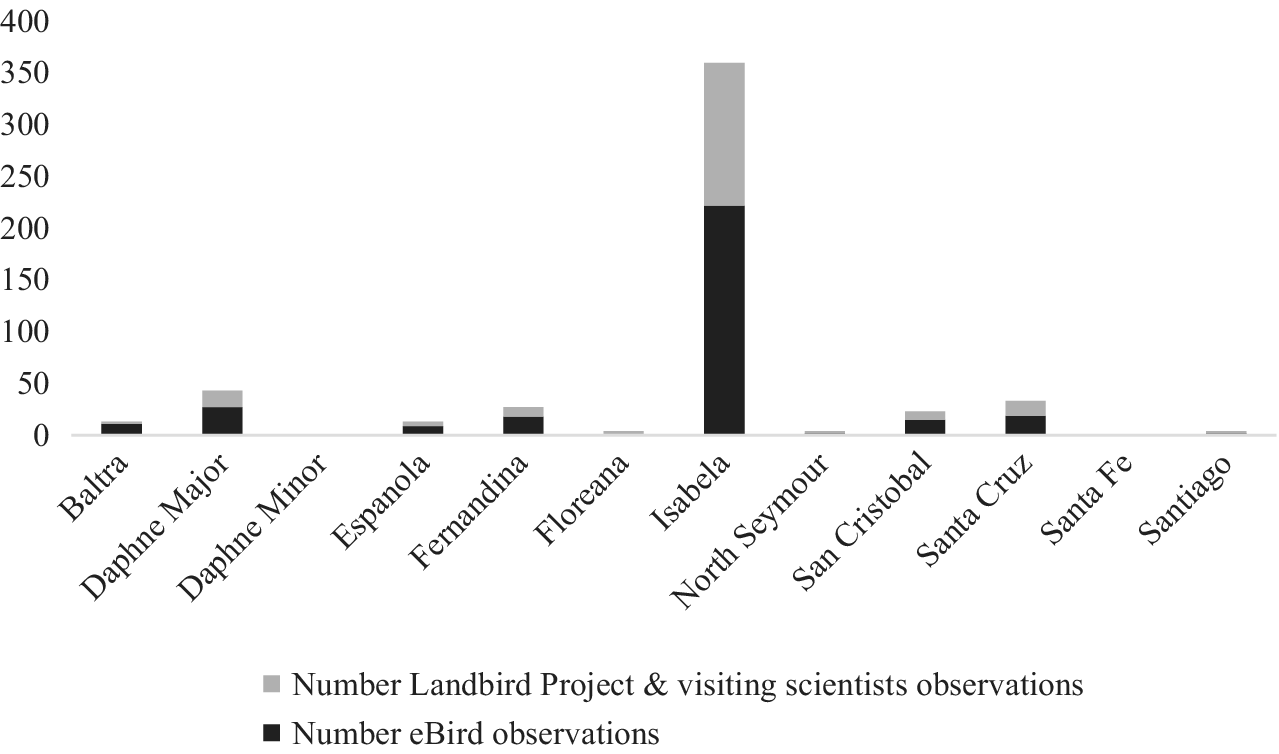
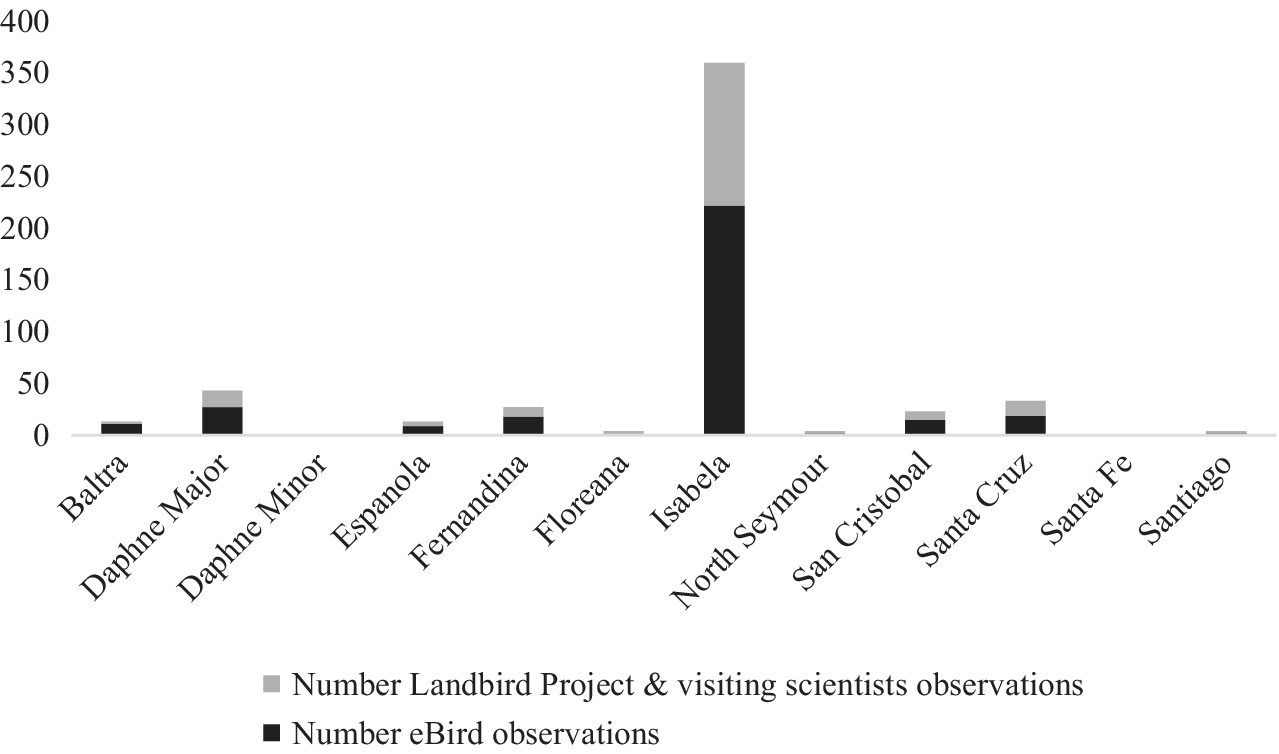
The islands with over 20 observations in the last 15 years (2003–2018, including data from eBird, naturalist guides, visiting scientists and the Landbird Conservation Program) include Isabela (360 observations), Daphne Major (43), Santa Cruz (33), Fernandina (27) and San Cristóbal (23) (Figure 2). These five islands also have the largest group sizes per single observation (Table S2).
Number of observations of Galapagos Martins from 2003 to 2018 data compiled from eBird, naturalist guides, visiting scientists and data from the Landbird Conservation Program.
Nesting sites and nesting season
During the coastline surveys, three possible nesting sites were identified (Figure 1). On the south-east coast of Santiago, a Galapagos Martin was observed entering a cavity in the cliff (0.37051°S, 90.58042°W). On Daphne Minor, four Galapagos Martins were observed flying and perching on the cliff (0.39353°S, 90.35098°W). On western Isabela Island, three individuals were observed flying near Punta San Cristóbal and one flew into a small crater and then exited (0.87766°S, 91.50980°W). Additionally, on Daphne Major, a report in 2008 from eBird noted a bird entering a cavity in the cliff, which was confirmed as a nesting site.
Tagus Cove hosts the largest known breeding colony of Galapagos Martin. In recent years, at least eight cavities have been found occupied along the cliff, with Galapagos Martins entering and carrying nesting material. The nesting area is divided into two sections: the southern part (0.26840°S, 91.37125°W) had six used cavities and the northern part (0.26581°S, 91.38291°W) had two occupied cavities in a stone wall of 35-40 m in height. In 2015, three active nests were recorded in July (John Garate, naturalist guide, “The Beagle” and Tui de Roy pers. comm.) and in April 2016, a juvenile was reported in the same area (“Lindblad Expeditions” naturalist guide, Cindy Manning pers. comm.). On 23 March 2017, four nests were reported by Nicolas Andrade (“The Beagle” naturalist guide), one of which had three large chicks. The same nest was confirmed to still have chicks on April 11 (Tui de Roy pers. comm; Luis Die Dejean pers. comm.). On 29 April, this nest site was found with an adult incubating one egg and thus was not collected at that time (David Anchundia). Two more nests of Galapagos Martins were also found in construction in the same area. No other active nests were reported during the rest of 2017. On 23 February 2018, the colony was revisited but no breeding activity was observed. The forest in the surrounding area was very dry and there was likely not enough food available to trigger breeding. On 23 March 2018, breeding activity was reported at the colony (eBird). At that time, the forest was very green, and more food was available to encourage the birds to breed. On 8 May 2018, one active nest with two large chicks was observed, along with an adult male feeding two fledglings on a ledge of the cliff (Tui de Roy pers. comm.). On 29 May 2018, seven fledglings and 18 adults were observed (David Anchundia pers. obs.).
Philornis downsi found in Galapagos Martins
During the visit to Tagus Cove in February 2018, the old nest observed active in April 2017 was collected and 13 pupal cases of P. downsi were discovered. This was the first record of P. downsi parasitising Galapagos Martin nests, although there was a long time-lapse between the nest observation and nest collection. On 29 May 2018, the nest observed at the beginning of May was empty with no signs of dead chicks in the nest. The nest material was collected and seven pupal cases and 17 closed pupae of P. downsi were found; 15 flies emerged the next day. This finding confirms that the invasive fly P. downsi also parasitises the Galapagos Martin.
Discussion
Distribution and status
Most of the historical sightings reported Galapagos Martins close to the coast. However, we believe that the survey of more than 1,000 km of coastline in 2017 did not bring the expected results of a snapshot picture of its distribution. Strong ocean currents, wind, and shallow water made it difficult to navigate and get close enough to a cliff to identify the species of some birds seen. Further, Galapagos Martins are difficult to see, especially when perched on a cliff. A complete survey in the future needs to incorporate a simultaneous survey on all mountain tops in addition to the coastal survey and should aim to be conducted during favourable weather conditions. A double observer technique would be a more effective method to estimate the probability of detection and its variance (Nichols et al. Reference Nichols, Hines, Sauer, Fallon, Fallon and Heglund2000). However, such a survey would be logistically demanding and costly and might provide little new information for an assessment of the conservation status of this species. Other techniques including mark/recapture techniques and assessment of breeding success might be more beneficial.
Regarding our data, we can only confirm the statement of Wiedenfeld and Jimenez-Uzcátegui (Reference Wiedenfeld and Jiménez-Uzcátegui2008) that there are probably much fewer than 500 birds on the Galapagos islands. Moreover, there are indications that the Galapagos Martin populations have declined in number or at least shifted their distribution. Isabela Island has always been the most important island for observing and collecting Galapagos Martins, with almost 90 birds collected and over 300 sightings in the last 15 years (eBird 2017, visiting scientists and own data). Gifford (Reference Gifford1919) mentioned Tagus Cove as the “true center of abundance”. In 1906, 29 Galapagos Martin individuals were collected by the CAS alone (Swarth Reference Swarth1931). Collectors mentioned that shooting this species was difficult because the birds moved very fast, so it is likely that there were more individuals in that area. Currently, Tagus Cove is a tourist site and one of the main known breeding sites of the Galapagos Martin, with a maximum of 25 individuals seen at one time; however, this species is not observed throughout the year (“The Beagle naturalist guides” pers. comm.). Furthermore, observed group sizes at a single site (e.g. Alcedo crater rim) vary considerably even within a couple of days (pers. obs.).
In certain places where the Galapagos Martin was more common a century ago, the species is no longer seen. This is especially true for the town of El Progreso in the highlands of San Cristóbal Island, in the highlands of Floreana Island, in the coastal town of Puerto Villamil, Isabela Island at its salt lagoons, and on the El Eden islet in front of Santa Cruz, a past breeding site, but without recent reports of breeding.
Threats
Potential threats for this species include introduced parasites, diseases, rats, bad weather events and food availability (Wiedenfeld and Jiménez-Uzcátegui, Reference Wiedenfeld and Jiménez-Uzcátegui2008, Jiménez-Uzcátegui et al. Reference Jiménez-Uzcátegui, Wiedenfeld, Valle, Vargas, Piedrahita and Alava2019). We report P. downsi parasitism in two Galapagos Martin nests for the first time, but the impact this parasite might have on the populations is unclear. P. downsi has been identified as one of the main threats to small landbirds of the Galapagos (Causton et al. Reference Causton, Peck, Sinclair, Roque-Albelo, Hodgson and Landry2006). Larvae feed on the blood of the nestlings, causing weakness and sometimes death (reviewed in Fessl et al. Reference Fessl, Heimpel, Causton and Parker2018). Martins and swallows have a slow nestling growth compared to other passerines, which are probable adaptations to food requirements and difficulty to obtain food (Ricklefs Reference Ricklefs1983, Lack Reference Lack1968). There is a lack of information on the length of the feeding phase of the Galapagos Martins, but in other martin species this phase is around 25–30 days (Del Hoyo et al. Reference Del Hoyo, Elliott and Christie2004). For Darwin´s Finches Geospiza spp., Galapagos Flycatcher Myiarchus magnirostris and Galapagos Mockingbirds Mimus spp., the feeding phase is between 13 and 15 days (Grant and Grant Reference Grant and Grant1980, Knutie et al. Reference Knutie, Owen, McNew, Bartlow, Arriero, Herman, DiBlasi, Thompson, Koop and Clayton2016, D. Anchundia unpubl. data). The longer feeding phase may expose Galapagos Martin nestlings for an extended amount of time to P. downsi larvae parasitism and potentially increase mortality risk.
Studies on tree finches in Galapagos have shown that species with a smaller clutch size are more affected by P. downsi in their reproductive success than species with larger clutch size (Fessl and Tebbich Reference Fessl and Tebbich2002). The Galapagos Martin has a small clutch size (1–3 eggs) compared to other martin species with 3–6 eggs (Del Hoyo et al. Reference Del Hoyo, Elliott and Christie2004). On the other hand, larger bodied species like Galapagos Mockingbird Mimus parvulus (~50 g) and Vegetarian Finch Platyspiza crassirostris (~31 g) tolerate P. downsi parasitism better than smaller sized birds (Heimpel et al. Reference Heimpel, Hillstrom, Freund, Knutie and Clayton2017, Knutie et al. Reference Knutie, Owen, McNew, Bartlow, Arriero, Herman, DiBlasi, Thompson, Koop and Clayton2016). Thus, the Galapagos Martin with an average weight of ~30 g may better tolerate the parasitism of P. downsi. A detailed study about the impacts of P. downsi parasitism on the Galapagos Martin is urgently needed.
Other parasites with unknown effects on Galapagos Martin include lice and mites. A review of feathers from specimens collected in 1898–1899 and 1901 found seven species of lice from the order Phithiraptera: Docophorus domesticus, D. breviformis, Colpocephalum heterosoma, Myrsidea incerta, M. rustica, Quadraceps gloriousus, and Q. separatus (Kellogg and Kuwana Reference Kellogg and Kuwana1902, Kellogg Reference Kellogg1906). There is no information about mite or lice load on Galapagos Martin, but a correlation of higher number of lice with decreasing body condition was reported for the Galapagos Hawk Buteo galapagoensis (Parker et al. Reference Parker, Whiteman and Miller2006). Research on the most studied species of the Progne genus, the Purple Martin Progne subis, has shown that it is severely affected by a hematophagous ectoparasite, the martin mite Dermanyssus prognephilus. This mite species attacks nestlings and adults, which reduces reproductive success by causing adults to abandon their nests when they are excessively disturbed (Moss and Camin Reference Moss and Camin1970). This genus of mites was reported in Galapagos (O’Connor et al. Reference O’Connor, Foufopoulos, Lipton and Lindström2005), but there are no studies on their presence or impact on the Galapagos Martin or any other species.
The introduction of new avian pathogens to Galapagos also increases the risk and stress on land birds, especially on small populations, and could act as an obstacle for populations to recover in a catastrophic event. For example, Haemoproteus has been reported in Progne subis (Davidar and Morton Reference Davidar and Morton1993) and this and other parasites such as Toxoplasma and Plasmodium are already present in Galapagos and could affect the Galapagos Martin (Bataille et al. Reference Bataille, Levin, Sari and Parker2018).
There is no knowledge about predation of rats or cats on Galapagos Martin, a bird species adapted to nest in holes in cliffs or inaccessible sites, potentially for better security of their nests due to the inaccessibility of the sites (Gill Reference Gill1995).
Inclement weather can cause high mortality in martin and swallow populations due to the sharp decline of food sources, especially insects (Del Hoyo et al. Reference Del Hoyo, Elliott and Christie2004). There is a high variance in climate in Galapagos between years, which could affect the food sources and increase the vulnerability of the entirely insectivorous species. Diet records of the Galapagos Martin reported individuals foraging on butterflies Callidryas eubele, Agraulis vanillae, and moths Deilephila lineata, Melipotis harrisoni (Gifford Reference Gifford1919, Beebe and Williams Reference Beebe and Williams1923) and a review of stomach contents from a fledgling and its father found only small moths in the diet (Beebe Reference Beebe1924). In general, the insectivores are the most affected group in Galapagos, especially on inhabited islands, probably due to change in prey availability (Dvorak et al. Reference Dvorak, Fessl, Nemeth, Kleindorfer and Tebbich2012, Reference Dvorak, Nemeth, Wendelin, Herrera, Mosquera, Anchundia, Sevilla, Tebbich and Fessl2017). Another purely insectivorous bird, the Little Vermillion Flycatcher Pyrocephalus nanus, has declined and disappeared on inhabited islands due to a combination of P. downsi parasitism, habitat reduction, and decreased food abundance (Dvorak et al. Reference Dvorak, Nemeth, Wendelin, Herrera, Mosquera, Anchundia, Sevilla, Tebbich and Fessl2017, Fessl et al. Reference Fessl, Anchundia, Carrion, Cimadom, Cotín, Cunninghame, Dvorak, Mosquera, Nemeth, Sevilla, Tebbich and Causton2017). The Galapagos Martin could be affected by the same threats, given its current absence in inhabited zones of Floreana, Isabela, and San Cristóbal islands.
Future studies
We are beginning a study using artificial bird houses located in areas with high frequency of Galapagos Martin observations. If the martins colonise the houses, this will allow us to mark birds; collect samples for phylogenetic studies; collect baseline data on their health; and to investigate the importance of ectoparasites, including lice and P. downsi; such data are urgently needed for a better assessment of the status of this species and to inform future conservation efforts.
Supplementary Materials
To view supplementary material for this article, please visit http://dx.doi.org/10.1017/S095927092000009X.
Acknowledgements
This study was conducted through the Landbird Conservation Program with the research permits PC 33-16, PC 07-17 and PC 01-18 approved by the Directorate of the Galapagos National Park. We thank David Anderson from Wake Forest University, who allowed the martin observers to join boats that conducted a census of blue-footed boobies. We are grateful to Andrea Coloma, Agustín Gutiérrez, Wilson Iñiguez, Andreinna Moran, and Courtney Pike for their assistance in the coastal census, and Jairo Torres for his assistance in the Sierra Negra volcano census. We want to thank the team of the tourist ship “The Beagle” which looked for Galapagos Martins throughout their itinerary and specifically to the naturalist guides, Nicolás Andrade and John Garate for their sightings while on the ship. Also, thanks to Cindy Manning of the ship “Lindblad Expeditions,” and Luis Die Dejean and Tui de Roy for sharing their sightings. We thank the company Lindblad Expeditions for helping us with transportation in the field and logistics in the monitoring of nests. A special thank you as well for the counting team of the Galapagos Landbird Project and the team that worked in Isabela: Javier Cotín, Michael Dvorak, Celina Leuba, Denis Mosquera, Erwin Nemeth, Lorena Rojas and Beate Wendelin. We thank Michael Dvorak for sharing his comments and helping to improve the version of the manuscript and Courtney Pike and Dana Lind for help in reviewing the English language and comments. The work was funded by Galapagos Conservancy, and International Community Foundation with a grant awarded by The Leona M. and Harry B. Helmsley Charitable Trust, the Lindblad Expeditions National Geographic Fund and support from Swiss Friends of Galapagos. This is contribution number 2256 of the Charles Darwin Foundation of the Galapagos Islands.