Introduction
Inputs of organic matter (OM) such as allochthonous leaf litter from riparian systems are important energy sources for many aquatic organisms and biogeochemical processes in headwater streams (Boyero et al. Reference Boyero, Pearson, Gessner, Dudgeon, Ramírez, Yule, Callisto, Pringle, Encalada, Arunachalam, Mathooko, Helson, Rincón, Bruder, Cornejo, Flecker, Mathuriau, M’Erimba, Gonçalves, Moretti and Jinggut2015; Vannote et al. Reference Vannote, Minshall, Cummins, Sedell and Cushing1980; Wallace et al. Reference Wallace, Eggert, Meyer and Webster2015). Forest cover along the riparian zone affects the quantity and quality of OM inputs (Gregory et al. Reference Gregory, Swanson, McKee and Cummins1991; Pozo et al. Reference Pozo, González, Díez, Molinero and Elósegui1997), the structure of stream banks and benthic substrata (Covich Reference Covich1988; Gregory et al. Reference Gregory, Swanson, McKee and Cummins1991; Oelbermann and Raimbault Reference Oelbermann and Raimbault2015), temperature and light conditions in the stream (Covich Reference Covich1988; Gregory et al. Reference Gregory, Swanson, McKee and Cummins1991; Hawkins et al. Reference Hawkins, Murphy and Anderson1982, and aquatic food webs and ecosystem processes (Fisher and Likens Reference Fisher and Likens1973; Johnson and CovichReference Johnson and Covich1997; Vannote et al. Reference Vannote, Minshall, Cummins, Sedell and Cushing1980). Therefore, riparian vegetation along streams contributes to important structural and functional processes linking terrestrial and aquatic ecosystems (Gonçalves and Callisto Reference Gonçalves and Callisto2013; Gregory et al. Reference Gregory, Swanson, McKee and Cummins1991; Vannote et al. Reference Vannote, Minshall, Cummins, Sedell and Cushing1980). Allochthonous leaf litter inputs to forested headwater streams arrive from different riparian forest sources (Figure 1), which correspond to OM that may come from different plant species, time since abscission, elemental composition, and or residence time in the soil surface or aquatic ecosystem. Once leaves reach the stream, they are broken down due to physical abrasion, leaching, or biological degradation (Follstad Shah et al. Reference Follstad Shah, Kominoski, Ardón, Dodds, Gessner, Griffiths, Hawkins, Johnson, Lecerf, LeRoy, Manning, Rosemond, Sinsabaugh, Swan, Webster and Zeglin2017; Gessner et al. Reference Gessner, Chauvet and Dobson1999; Tank et al. Reference Tank, Rosi-Marshall, Griffiths, Entrekin and Stephen2010) and transformed into coarse particulate organic matter (CPOM, Figure 1). The exported CPOM provides a heterogeneous energy source for detritivore-dominated aquatic food webs. In headwater streams of the Luquillo Experimental Forest, a large portion of CPOM (40–60%) is consumed in-situ (Cross et al. Reference Cross, Covich, Crowl, Benstead and Raḿrez2008), and the rest is transported down river, where it continues to be processed and transformed into particulate, fine, and dissolved pools of organic matter (Boyero et al. Reference Boyero, Pearson, Gessner, Dudgeon, Ramírez, Yule, Callisto, Pringle, Encalada, Arunachalam, Mathooko, Helson, Rincón, Bruder, Cornejo, Flecker, Mathuriau, M’Erimba, Gonçalves, Moretti and Jinggut2015) serving as energy sources along the aquatic continuum (Cross et al. Reference Cross, Covich, Crowl, Benstead and Raḿrez2008; Crowl et al. Reference Crowl, McDowell, Covich and Johnson2001; Vannote et al. Reference Vannote, Minshall, Cummins, Sedell and Cushing1980; Webster et al. Reference Webster, Benfield, Ehrman, Schaeffer, Tank, Hutchens and D’Angelo1999).
Conceptual diagram of organic matter in the form of leaf litter inputs across the three sources as vertical or canopy inputs in the green arrow, lateral or riparian inputs as the orange arrow, and leaf litter from submerged traps or from upstream with flow in the blue arrow. The sum or combination of the different sources across the landscape entering the stream makes up the total coarse particulate organic matter (CPOM) that is exported downriver.

Streams in temperate forests usually receive large pulses of leaf litter in autumn. In many tropical forested regions, an almost constant photoperiod throughout the year (Chave et al. Reference Chave, Navarrete, Almeida, Álvarez, Aragão, Bonal, Châtelet, Silva-Espejo, Goret, von Hildebrand, Jiménez, Patiño, Peñuela, Phillips, Stevenson and Malhi2010; Zalamea and González Reference Zalamea and González2008) supports greater forest productivity (Huston and Wolverton Reference Huston and Wolverton2009). Therefore, leaf litter inputs can occur year-round rather than in seasonal pulses (Brandão et al. Reference Brandão, Moraes, Silva, Gonçalves, de Souza Rezende and da Silva2022; Sales et al. Reference Sales, Gonçalves, Dahora and Medeiros2015; Tonin et al. Reference Ferreira, Pérez, Petrucio, Reis, Rezende, Roque, Santos, Siegloch, Tonello, Tonin, Gonçalves, Bambi, Couceiro, Feitoza, Fontana, Hamada, Hepp, Lezan-Kowalczuk, Leite, Lemes-Silva, Lisboa, Loureiro, Martins, Medeiros, Morais, Moretto, Oliveria, Pereira and Boyero2017; Zalamea and González Reference Zalamea and González2008). Consequently, tropical streams can receive greater amounts of leaf litter than streams in temperate regions (Benson and Pearson Reference Benson and Pearson1993; Datry et al. Reference Datry, Foulquier, Corti, von Schiller, Tockner, Mendoza-Lera, Clément, Gessner, Moleón, Stubbington, Gücker, Albarinõ, Allen, Altermatt, Arce, Arnon, Banas, Banegas-Medina, Beller, Blanchette, Blanco-Libreros, Blessing, Boëchat, Boersma, Bogan, Bonada, Bond, Brintrup Barría, Bruder, Burrows, Cancellario, Canhoto, Carlson, Cauvy-Fraunié, Cid, Danger, Bianca de Freitas, De Girolamo, Evans de La, del Campo, Dias-Villanueva, Dyer, Elosegi, Faye, Febria, Four, Gafny, Ghate, Gómez, Gómez-Gener, Graça, Guareschi, Hoppeler, Hwan, Jones, Kubheka, Laini, Langhans, Leigh, Little, Lorenz, Marshall, Martín, McIntosh, Meyer, Miliša, Mlambo, Morais, Moya, Negus, Niyogi, Papatheodoulou, Pardo, Pařil, Pauls, Pešić, Pláśek, Robinson, Rodríguez-Lozano, Rolls, Sánchez-Montoya, Savić, Shumilova, Sridhar, Steward, Storey, Taleb, Uzan, Ross Vander, Watham, Woelfle-Erskine, Zak, Zarfl and Zoppini2018).
The delivery of leaf litter can be driven by various environmental and climatic factors. Wind can increase inputs of litter to streams (Gonçalves et al. Reference Gonçalves, de Souza Rezende, Gregório and Valentin2014), especially during drier seasons or during periods of increased winds when trees can easily loose leaves and accumulate on the forest ground (Colón-Gaud et al. Reference Colón-Gaud, Peterson, Whiles, Kilham, Lips and Pringle2008). Rain is also an important driver, as seasonal patterns and storm events can dislodge leaves from trees, and stream discharge increases the transport and inputs of leaves on the ground into streams (Colón-Gaud et al. Reference Colón-Gaud, Peterson, Whiles, Kilham, Lips and Pringle2008; Fritz et al. Reference Fritz, Pond, Johnson and Barton2019; Gonçalves et al. Reference Gonçalves, de Souza Rezende, Gregório and Valentin2014; Heartsill-Scalley et al. Reference Heartsill Scalley, Scatena, Moya and Lugo2012; Wallace et al. Reference Wallace, Eggert, Meyer and Webster1997). In the Bisley Experimental Watersheds of the Luquillo Experimental Forest, soils can be easily saturated promoting greater runoff during rain or storm events (Schellekens et al. Reference Schellekens, Scatena, Bruijnzeel, Van Dijk, Groen and Van Hogezand2004). Leaf fall in a tropical forest has been correlated with solar radiation where peaks in leaf fall occurred with the greatest solar radiation (Zalamea and González Reference Zalamea and González2008). Others have found that the El Niño Southern Oscillation had strong effects on patterns of wet forest reproduction and fruiting bodies rather than rainfall, temperature, or solar radiation (Zimmerman et al. Reference Zimmerman, Hogan, Nytch and Bithorn2018). Collectively, this suggests that for tropical montane streams the inputs of allochthonous OM may be driven by a combination of climatic and regional factors. The timing and magnitude of leaf litter inputs to streams can be magnified or altered by extreme climatic or weather events that are common in tropical regions.
Natural disturbance such as hurricanes and droughts can be important factors that influence the structure and functioning of tropical montane forests (Beard et al. Reference Beard, Vogt, Vogt, Scatena, Covich, Sigurdardottir, Siccama and Crowl2005; Gutiérrez-Fonseca et al. Reference Gutiérrez-Fonseca, Ramírez, Pringle, Torres, McDowell, Covich, Crowl and Pérez-Reyes2020; Gutiérrez-Fonseca et al. Reference Gutiérrez-Fonseca, Ramírez, Vega Gómez, Gómez, Pringle, McDowell and Crowl2025; Smith-Martin et al. Reference Smith-Martin, Muscarella, Ankori-Karlinsky, Delzon, Farrar, Salva-Sauri, Thompson, Zimmerman and Uriarte2022; Zimmerman et al. Reference Zimmerman, Wood, González, Ramirez, Silver, Uriarte, Willig, Waide and Lugo2021) and reshape the riparian zone with direct implications for allochthonous OM inputs (Heartsill-Scalley et al. Reference Heartsill Scalley, Scatena, Moya and Lugo2012; Wohl et al. Reference Wohl, Hinshaw, Scamardo and Gutiérrez-Fonseca2019). For example, Hurricanes Irma and María completely defoliated the Luquillo Experimental Forest (Liu et al. Reference Liu, Zeng, Zou, González, Wang and Yang2018) and increased leaf litter inputs to streams 5-fold (Gutiérrez-Fonseca et al. Reference Gutiérrez-Fonseca, Ramírez, Vega Gómez, Gómez, Pringle, McDowell and Crowl2025). During hurricanes or intense storms, winds can defoliate, break stems and branches, which dramatically change physical channel structure, light, temperature, and energy sources in aquatic ecosystems. High wind speeds from hurricanes correlated positively with litterfall (Beard et al. Reference Beard, Vogt, Vogt, Scatena, Covich, Sigurdardottir, Siccama and Crowl2005) in streams of Luquillo and trees in low elevations along riparian corridors have been found to receive the most damage and leaf loss with hurricanes (Heartsill-Scalley et al. Reference Heartsill Scalley, Scatena, Lugo, Moya and Estrada Ruiz2010; Reilly Reference Reilly1991). Intense rain events that trigger increased stream discharge can facilitate the transport of OM to streams (Wymore et al. Reference Wymore, Brereton, Ibarra, Maher and McDowell2017). On the other hand, droughts can also have large-scale impacts on the landscape and consequently on the delivery of OM to adjacent streams. Droughts can lead to reduced CPOM exports from streams as leaf litter is retained in the landscape due to lacking surface flows (Heartsill-Scalley et al. Reference Heartsill Scalley, Scatena, Moya and Lugo2012; Larned Reference Larned2000). The effects of droughts can damage or change soil and tree root properties that lead to leaf litter accumulation on the forest floor that are later transported into streams as pulses of litter with large rain events (Beard et al. Reference Beard, Vogt, Vogt, Scatena, Covich, Sigurdardottir, Siccama and Crowl2005; Crowl et al. Reference Crowl, Welsh, Heartsill-Scalley and Covich2006; Yu and Gao Reference Yu and Gao2020). Drought-induced water stress in riparian vegetation can lead to greater inputs of leaf litter into steams (Colón-Gaud et al. Reference Colón-Gaud, Peterson, Whiles, Kilham, Lips and Pringle2008; Gutiérrez-Fonseca et al. Reference Gutiérrez-Fonseca, Ramírez, Pringle, Torres, McDowell, Covich, Crowl and Pérez-Reyes2020; Heartsill-Scalley et al. Reference Heartsill Scalley, Scatena, Moya and Lugo2012; Larned et al. Reference Larned2000) and promote pulses of CPOM exports. Therefore, long-term studies are important for capturing the range of unpredictable large-scale disturbances that occur in tropical forested regions. Despite what we have learned of tropical forests, the temporal dynamics and magnitudes of leaf litter inputs in tropical montane streams and the environmental factors that modulate this energy source to streams have received less attention (Tonin et al. Reference Ferreira, Pérez, Petrucio, Reis, Rezende, Roque, Santos, Siegloch, Tonello, Tonin, Gonçalves, Bambi, Couceiro, Feitoza, Fontana, Hamada, Hepp, Lezan-Kowalczuk, Leite, Lemes-Silva, Lisboa, Loureiro, Martins, Medeiros, Morais, Moretto, Oliveria, Pereira and Boyero2017). Long-term studies of leaf litter inputs are often based on short-term observations, less than 4 years, (Bambi et al. Reference Bambi, de Souza Rezende, Feio, Leite, Alvin, Quintão, Araújo and Gonçalves Júnior2017; Benson and Pearson Reference Benson and Pearson1993; Brandão et al. Reference Brandão, Moraes, Silva, Gonçalves, de Souza Rezende and da Silva2022; Gonçalves Júnior et al. Reference Gonçalves Júnior, Silva França and Callisto2006; Larned Reference Larned2000) and do not capture the effects and recovery of the landscape after major disturbances or patterns at a finer scale.
Here we present an eight-year study of leaf litter inputs from different landscape sources (vertical, lateral, and upstream, Figure 1) in two tropical montane streams of the Luquillo Experimental Forest. We present our data in two forms: leaf litter inputs across the different sources and total CPOM exports as an estimate of all the combined materials from the different sources reaching the stream and exported downstream (Figure 1). This study includes hurricanes, multiple intense rain events, and prolonged dry periods. We pose three main questions: (1) What are the temporal patterns and magnitudes of leaf litter inputs into tropical streams? (2) Which environmental factors are potential drivers or modulators of leaf litter inputs and CPOM exports? and (3) How do disturbances in the form of hurricanes and dry periods influence leaf litter inputs and CPOM exports over time? We hypothesized that extreme weather conditions (i.e. prolonged rain events, hurricanes, and droughts) lead to increased leaf litter inputs into headwater streams due to accumulations of leaves and subsequent transport or facilitated inputs from rain. We also expect that leaf litter from the canopy and riparian zones will be the greatest contributors as they are proximal sources to streams, and they will be positively related to increases in rain, temperature, wind, and solar radiation as the main factors that can directly control productivity of the forest and therefore leaf litter inputs.
Methods
Study site
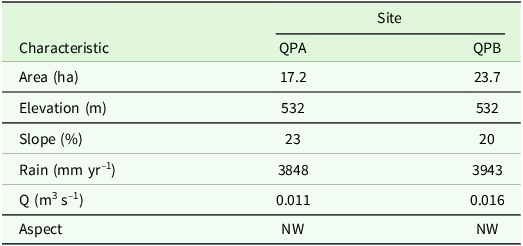
This study took place within the Río Espiritu Santo Watershed in the Luquillo Experimental Forest (LEF) in northeastern Puerto Rico (Figure 2a). We focused on two headwater streams, Quebrada Prieta A (QPA, 18.323N, −65.814W) and Quebrada Prieta B (QPB, 18.322N, −65.814W) (Table 1), which are part of the long-term streams studied in the LEF as part of the Luquillo Long-term Ecological Research (LTER) (McDowell et al. Reference McDowell, Leon, Shattuck, Potter, Heartsill-Scalley, González, Shanley and Wymore2021). Both streams are highly shaded 1st order with large rocks and boulders in the streambed, have steep hillslopes between 8% and 16% with a series of pools and steps, and are underlain by volcaniclastic lithology of andesite and mudstone (McDowell and Asbury Reference McDowell and Asbury1994; McDowell et al. Reference McDowell, Leon, Shattuck, Potter, Heartsill-Scalley, González, Shanley and Wymore2021). The streams are 532 m in elevation, and QPA has an area of 17 ha and QPB 23 ha (Table 1). The watershed is located in the ‘subtropical wet forest life zone’ sensu Holdridge (Ewel and Whitmore Reference Ewel and Whitmore1973) and is covered with mature tabonuco-sloanea forest type, which is characterized by the presence of tabonuco (Dacryodes excelsa Vahl), motillo (Sloanea berteroana Choisy ex DC), sierra palm (Prestoea acuminata, var. montana (R. Graham) Nichols), and various types of hydrophytic vegetation along riparian areas (Harris et al. Reference Harris, Lugo, Brown and Heartsill Scalley2012; Heartsill-Scalley Reference Heartsill Scalley, Harris, Lugo, Brown and Heartsill Scalley2012; Hudspeth et al. Reference Hudspeth, Pastor and Heartsill-Scalley2023; Thompson et al. Reference Thompson, Brokaw, Zimmerman, Waide, Everham, Lodge, Taylor, García-Montiel and Fluet2002). Precipitation is about 3500 mm annually with rain falling all year with periods of less rain generally between January and April (Gutiérrez-Fonseca et al. Reference Gutiérrez-Fonseca, Ramírez, Pringle, Torres, McDowell, Covich, Crowl and Pérez-Reyes2020; Heartsill-Scalley et al. Reference Heartsill Scalley, Scatena, Moya and Lugo2012). Mean annual temperature ranges between 20°C and 25°C, with an annual mean of 23°C (Harris et al. Reference Harris, Lugo, Brown and Heartsill Scalley2012; Zalamea and González Reference Zalamea and González2008). For descriptions of forest soil, above ground biomass, and disturbance history, see Scatena and Lugo Reference Scatena and Lugo1995; Heartsill-Scalley et al. Reference Heartsill Scalley, Scatena, Lugo, Moya and Estrada Ruiz2010; Heartsill-Scalley et al. Reference Heartsill Scalley, Scatena, Moya and Lugo2012; McDowell et al. Reference McDowell, Leon, Shattuck, Potter, Heartsill-Scalley, González, Shanley and Wymore2021; Leon et al. Reference Leon, Heartsill-Scalley, Santiago and McDowell2021.
Map of a) Quebrada Prieta A (QPA) and Quebrada Prieta B (QPB) which are headwaters of Quebrada Prieta sub-watershed within the Río Espíritu Santo (RES) Watershed in the Luquillo Experimental Forest (LEF) also known as El Yunque National Forest (EYNF) in the northeast region of Puerto Rico. A conceptual diagram b) of the three different baskets/traps across sources (vertical, lateral, and submerged) installed in both streams, c) image of a vertical basket, d) image of a lateral trap, and e) image of a submerged trap.

Watershed characteristics for study streams Quebrada Prieta A (QPA) and Quebrada Prieta B (QPB) in the Luquillo Experimental Forest, Puerto Rico, obtained from Leon et al. (Reference Leon, Heartsill-Scalley, Santiago and McDowell2021). Rain represents the mean annual values from January 2017 up to July 2024 and discharge (Q) from January 2017 up to December 2023

Leaf litter collection
The collection of leaf litter started in January 2017 and ended in July 2024. During this time frame, LEF was impacted by Hurricanes Fiona, Irma, and María as well as other tropical storms, rain events, and periods of prolonged dryness. Leaf litter was collected every 2 weeks from baskets or taps across three different sources: vertical for canopy inputs, lateral for riparian hillslope inputs, and partially submerged for upstream inputs (Figures 1, 2b, Table 2). Basket/traps were placed along a 150 m study reach in each stream. Vertical baskets were suspended 1 m above the streams to capture leaf litter falling into the stream directly from the canopy above (Gutiérrez-Fonseca et al. Reference Gutiérrez-Fonseca, Ramírez, Pringle, Torres, McDowell, Covich, Crowl and Pérez-Reyes2020) with 10 baskets (0.21 m2, mesh 2 mm) installed above each stream for a total of 20. On the banks of both streams, 6 lateral traps (0.21 m2, mesh 6 mm) were placed on the hillslopes to capture leaf litter inputs from the riparian zone that would reach the stream by wind or runoff, for a total of 12. Three partially submerged traps (0.15 m2, mesh 6 mm) were anchored longitudinally in each stream bottom to capture litter transported from upstream, for a total of six traps. These three trap/basket locations reflect the various sources and conditions of leaf litter derived from the forest landscape (Bambi et al. Reference Bambi, de Souza Rezende, Feio, Leite, Alvin, Quintão, Araújo and Gonçalves Júnior2017; Bärlocher et al. Reference Bärlocher, Gessner and Graça2020). All leaf litter collected was dried at 65°C for a minimum of two weeks and weighed.
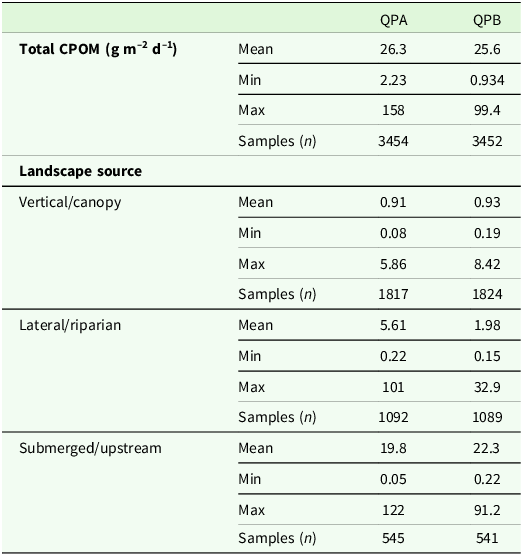
Mean, minimum (Min), and maximum (Max) values of bi-weekly coarse particulate organic matter (CPOM, g m–2 d–1) for total CPOM and by landscape source for study streams Quebrada Prieta A (QPA) and Quebrada Prieta B (QPB), from January 2017 up to July 2024 in the Luquillo Experimental Forest, Puerto Rico

The combined effects of hurricanes Irma and María destroyed almost all basket/traps (vertical, lateral, and submerged) so data are not available for the collection weeks of Sept. 29 and Oct. 3 of 2017, for both streams. On occasions, storms and high flows damaged different traps but were repaired within a few days of the storm, and collection days per sample were adjusted accordingly. For additional details on the data set, see the EDI Data Portal (Ramírez et al. Reference Ramirez, Gomez and Leon2024).
Flow reduction experiment
Both streams are part of the Stream Flow Reduction Experiment (FRE), with the goal to simulate a reduction in stream discharge over several months by diverting 30–50% of the water 130 m downstream. The flow reduction dates were April through August 2022 and March through July in 2023 and 2024. QPA is the reference site with no flow reduction or any water-level manipulations while QPB is the experimental stream that undergoes flow reduction.
Environmental data
Stream discharge (Q, m3 s–1) was derived from stage height continuously monitored in both streams every 15 min with a HOBO water-level data logger (model U20L-04, Onset Computers, Bourne, MA). Discharge was estimated from water-level rating curves (Ramírez Reference Ramírez2024a ). Environmental parameters such as precipitation (PPT, mm), wind (m s–1), air temperature (Temp., °C), and solar radiation (Solar Rad., watts m–2) were obtained from the meteorological station at El Verde Field Station at 350 m asl, part of the LUQ-LTER, and are all available through the EDI Data Portal (Ramírez Reference Ramírez2024b ). Precipitation, wind, and solar radiation data are missing between September and November 2017 due to Hurricanes Irma and María damaging the meteorological station. For more details on meteorological tower data, see Ramírez (Reference Ramírez2024b ). Environmental data (including discharge) were averaged for the corresponding dates between basket/trap sampling as a representation of conditions in the forest prior to leaf litter collection.
Within the time frame of our study, dry conditions tended to occur from December to June and wet seasons from July to November (Figure S1). Average daily rain over the 8-year time series was estimated as 8 mm day-1 in El Verde (Figure S1), and baseline discharge was estimated at 0.010 m3 s–1 for QPA and 0.018 for QPB (Figure S2), also over the same 8-year period. The 8 mm rain per day was used as a threshold for wet and dry conditions.
Statistical analysis
Weekly leaf litter inputs by sources are reported as the average of the n number of baskets/traps for the corresponding date per source per site. We also report the total CPOM export, as the sum of all sources (vertical, lateral, and upstream) for each collection date. Leaf litter inputs and total CPOM exports were averaged per month per site and reported as mass per area per day (g m–2 d–1).
Synchrony between monthly total CPOM across QPA and QPB was determined by mutual information (MI) with the muti R-package (Scheuerell Reference Scheuerell2017). MI characterizes the mutual dependence of two time series in a non-parametric approach (Ardón et al. Reference Ardón, Helton, Scheuerell and Bernhardt2017; Cazelles Reference Cazelles2004) and provides values between 0 and 1 where values closer to 1 indicate a strong synchrony between QPA and QPB, and MI values near 0 describe little covariance between the CPOM of both streams.
Linear regressions were based on bi-weekly leaf litter inputs from the three different sources and total CPOM exports; inputs from the three sources and total CPOM exports were related to precipitation, wind, solar radiation, and air temperature for the corresponding dates as described above. Differences were determined with non-parametric ANOVA using the Kruskal-Wallis rank sum test (KW) and pairwise Wilcox test to determine differences between sources across sites, months, between sources or sites during wet or dry periods with an alpha set at 0.05. All data and statistical analyses were conducted in R (R Core Team Reference Core Team2024) using RStudio (version RStudio 2024.04.2).
Results
Leaf litter inputs by sources
Leaf litter sources for both streams are predominantly from inputs flowing from upstream with vertical inputs being the lowest (Figure 3, Figure S3, Figure S4). There was no clear temporal pattern across sources of leaf litter inputs (Figure S3) but the greatest leaf litter from vertical inputs occurred in April–May and August (KW H = 48.7, df = 11, p = 0.000001), from lateral inputs occurred May–August (KW H = 24.8, df = 11, p = 0.01), and flowing from upstream occurred in April–May and July–August (KW H = 28.2, df = 11, p = 0.003) over the 8 years (Figure 3), where the months of April and May tend to have less rain (Figure S1). The greatest peaks in monthly mean leaf litter occurred after Hurricanes Irma and María where vertical inputs reached values of 5.86 and 8.42 g m–2 d–1 for QPA and QPB, respectively (Table 2, Figure S3) but declined in the following collection dates and remained lower. Lateral or riparian inputs after the hurricane reached values of 67.3 and 32.9 g m–2 d–1 for QPA and QPB, respectively (Figure S3), and such peaks were not observed again. Peaks in upstream leaf litter inputs were not necessarily related to hurricanes and occurred much more sporadically with values as high as 79.6 and 59.1 g m–2 d–1 for QPA and QPB, respectively, which are higher than the mean upstream inputs of 19 g m–2 d–1 and 22 g m–2 d–1 in QPA and QPB, respectively (Table 2, Figure S3). During large rain events or hurricanes, leaf litter sources can shift to vertical or lateral sources to become the most abundant leaf litter sources, where OM from overland flows can dominate (Figure S3). In both streams, differences in leaf litter contributions across all three sources were statistically significant (Figure S4, KW H = 1315.1, df = 2, p = 2.2e–16). The effects of the FRE on leaf litter inputs were not clear as frequent rain events occurred during this experimental period, and a reduced flow was not possible to maintain (Figure S3).
Monthly medians of leaf litter sources from Quebrada Prieta A (QPA) and Quebrada Prieta B (QPB) with green points as vertical inputs, orange points as lateral inputs, and blue points as upstream inputs with errors bars representing standard error. Lowercase letters denote statistically significant differences across months per source from an ANOVA (α = 0.05).

Total CPOM exports
On average over the eight years, QPA and QPB total CPOM exports (sum of all three sources) were 26 g m–2 d–1 and 25 g m–2 d–1 (Table 2), respectively. Total CPOM exports had no statistically significant difference between stream sites (KW H = 0.45, df = 1, p = 0.5). Both streams behaved similarly in their temporal patterns over the study period (Figure 4a) with a mutual dependence of 0.70 suggesting that downstream exports of organic matter from both streams are similar in terms of timing and magnitude. The greatest peaks in CPOM exports were observed right after hurricanes Irma and María with values of 158 ± 34.1 g m–2 d–1 and 99.4 ± 215.7 g m–2 d–1, for QPA and QPB, respectively (Figure 4). These post-hurricane peaks represent about 5 times the average CPOM exports for QPA and 4 times the average CPOM exports in QPB within the time frame of our study. Other peaks in total CPOM exports tended to coincide with shifts from prolonged dry (<8 mm PPT per day over several continuous months) to wet conditions or within periods of prolonged dry conditions (Figure 4). Elevated total CPOM exports tended to occur in April–May and July–August over the 8 years (Figure S5, KW H = 42.3 df = 11, p = 0.00001). Total CPOM exports tended to be greater during wet periods compared to dry periods (Figure S6, KW H = 15.6, df = 1, p = 0.00007). The unusually excessive rains during the FRE obscured clear patterns in total CPOM exports from QPB as both streams behaved similarly in terms of elevated quantities of CPOM exports although QPA had slightly greater CPOM export values during the FRE (Figure 4).
Mean monthly total CPOM for Quebrada Prieta A (QPA, yellow points) and Quebrada Prieta B (QPB, purple points) with black vertical lines as standard error. Precipitation (PPT) is presented as monthly sums and discharge (Q) are monthly means for QPA (yellow points) and QPB (purple points) with black vertical lines as standard error. Orange vertical lines denote hurricanes or major storms that had a direct impact while pink vertical lines mark hurricanes or tropical storms that passed near the island but not a direct impact. Green and brown horizontal segments mark wet (green) or dry (brown) periods where the threshold was 8 mm of rain per day, and the gap is due to lack of data after Hurricane María. Grey vertical boxes are the dates of the flow reduction experiments (FRE) in QPB. There are no data available from Sept 29 and Oct 3, 2017, due to Hurricane María, so respective monthly averages are only based on 1 date and therefore no error bars for total CPOM. Discharge data are available until December 2023.

Potential drivers of leaf litter inputs and total CPOM exports
Environmental factors varied little across our study period (Figure 5). Average wind was 0.95 m s–1 and varied between 0.001 and 3.46 m s–1. Average daily precipitation was 12.35 mm and varied between 0.1 and 433 mm. Temperature was on average 23.9°C and varied between 17°C and 30.7°C. The average solar radiation was 354 watts m–2 and varied between 0.02 watts m–2 and 1391 watts m–2.
Bi-weekly mean CPOM by leaf litter sources such as vertical leaf litter inputs (green), lateral leaf litter inputs (orange), and upstream leaf litter inputs (blue) from both sites combined related to a) average precipitation (PPT, mm), b) average solar radiation (watts m–2), c) average wind (m s–1), and d) average temperature (°C) between leaf litter collection dates. Lines are linear regressions and only included for statistically significant relationships where p < 0.05. Meteorological tower data are missing between September and November 2017 due to damages from Hurricane María.

Environmental factors related differently between the sources of leaf litter inputs and total CPOM exports. Lateral and upstream inputs related positively with increasing precipitation while vertical inputs showed no clear relationship with rain (Figure 5a). Vertical leaf litter inputs were the only source that related positively with increasing solar radiation (Figure 5b). None of the sources showed clear relationships with wind (Figure 5c). Vertical and upstream leaf litter showed a positive relationship with increasing temperature while lateral inputs showed no clear pattern with temperature (Figure 5d). Across sources, there were only statistically significant differences between wet and dry periods for upstream leaf litter inputs (KW H = 15.6, df=1, p = 0.00008) while there were no differences between wet and dry periods for vertical or lateral inputs (Figure S7; vertical: KW H = 2.14, df = 1, p = 0.14; lateral: KW H = 1.56, df = 1, p = 0.21). Total CPOM exports from both streams related positively to precipitation (Figure S8a) but there were no clear relationships between total CPOM exports and solar radiation, wind or temperature (Figure S8b–d).
Discussion
The temporal patterns and magnitudes of leaf litter inputs, whether by inputs or total CPOM exports, are dynamic and variable over time in tropical montane streams. Leaf litter reaching the streams is mostly derived from upstream or a combination of sources that deliver processed detritus downstream. Upstream inputs can be magnified at times, especially during transition periods from dry to wet conditions that lead to pulses of CPOM exports. The various sources of leaf litter inputs quantified in this study are affected by the same environmental drivers as forest productivity. In turn, changes in leaf litter inputs modulate exports of CPOM and streams ecosystem processes where changes to forest leaf litter dynamics have both direct and indirect influences on stream carbon processing and transport converging terrestrial and aquatic ecosystem processes.
Temporal patterns and Leaf litter sources
Temporal patterns in leaf litter across sources were variable with peaks driven by seasonal patterns in rain and temperature. In streams at similar elevation and forest type, but on the windward side of the Luquillo Mountains, leaf litter seasonal patterns also followed those of rain rather than phenological patterns of riparian zone leaf fall (Heartsill-Scalley et al. Reference Heartsill Scalley, Scatena, Moya and Lugo2012). Across tropical forests in South America, and similar to our study, litterfall was found to have a mild seasonality (Chave et al. Reference Chave, Navarrete, Almeida, Álvarez, Aragão, Bonal, Châtelet, Silva-Espejo, Goret, von Hildebrand, Jiménez, Patiño, Peñuela, Phillips, Stevenson and Malhi2010; Erickson et al. Reference Erickson, González, McDowell and Potter2025). The type of forest can have an influence on the timing and magnitude of inputs where certain vegetation can dominate the number of leaves or even the timing of leaf fall (Pozo et al. Reference Pozo, González, Díez, Molinero and Elósegui1997). Forests with high tree diversity may differ in timing where phenology patterns and consequently leaf litter peaks are asynchronous, leading to continuous leaf litter inputs, whereas forests dominated by deciduous species could be more consistent in temporal patterns and magnitude of inputs.
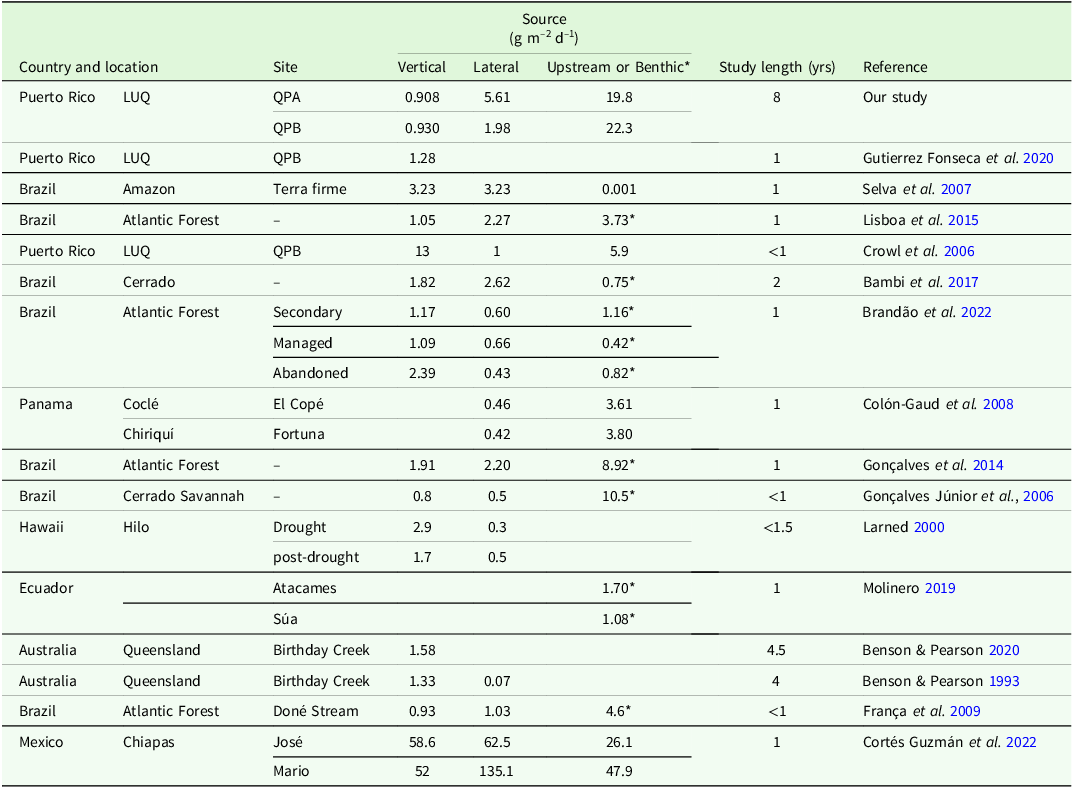
In the tropical montane forest of LEF, all three leaf litter sources had different timing and magnitudes, but the greatest contributor of OM in the streams was consistently leaf litter derived from upstream. In tropical montane streams of Panama, Hawai’i, and other sites in Puerto Rico, leaf litter sourced from upstream as a combination of leaf litter from further upstream was also identified as the greatest contributor of OM (Colón-Gaud et al. Reference Colón-Gaud, Peterson, Whiles, Kilham, Lips and Pringle2008; Crowl et al. Reference Crowl, Welsh, Heartsill-Scalley and Covich2006; Larned Reference Larned2000). Further, benthic sources have been found to be the greatest contributors of OM potentially due to the streams having a greater capacity to accumulate materials during low flows or dry periods (Gonçalves et al. Reference Gonçalves, de Souza Rezende, Gregório and Valentin2014; Gonçalves Júnior et al. Reference Gonçalves Júnior, Silva França and Callisto2006; Molinero Reference Molinero2019). In this study, the inputs to both streams from vertical, lateral or flowing from upstream sources contributed different quantities of leaf litter. In contrast, no differences were found between the allochthonous vertical and lateral inputs to streams in the Cerrado biome of Brazil (Gonçalves Júnior et al. Reference Gonçalves Júnior, Silva França and Callisto2006). In tropical streams of Australia, lateral inputs were found to be negligible (Benson and Pearson Reference Benson and Pearson1993, Reference Benson and Pearson2020) suggesting that magnitude of inputs can vary with forest type among other factors.
This study is one of the few to continuously monitor leaf litter across different sources in a tropical forest for an extended period of time (Table 3). Several other studies in tropical regions have collected leaf litter from various sources but span time scales of only two years or less (Table 3). Having our study within a long-term ecological studies framework (McDowell et al. Reference McDowell, Leon, Shattuck, Potter, Heartsill-Scalley, González, Shanley and Wymore2021) is a large benefit that allows for long-term monitoring to better constrain inputs and exports while also capturing environmental changes and climate variables that are difficult to anticipate such as droughts (McDowell et al. Reference McDowell, Leon, Shattuck, Potter, Heartsill-Scalley, González, Shanley and Wymore2021) and controlled environments limiting anthropogenic effects. We note here, and across other studies, that it is important to differentiate that leaf litter derived from upstream and from benthic stocks is not necessarily the same. Benthic leaf litter has had a longer residence time retained in the benthos, whether in riffles, runs, or pools, whereas leaf litter from upstream is actively spiralling, as it flows downstream, and their implications for biotic uptake and downriver transport are different.
Literature values of leaf litter inputs by source from different tropical regions. Upstream and benthic-derived leaf litter are combined in one column but values pertaining to benthic collection are denoted by an asterisk

Potential drivers of leaf litter inputs and CPOM exports
Precipitation was a positive driver of increased total CPOM exports as well as inputs from upstream and lateral or riparian zones. Similarly, CPOM exports in a different study in the Bisley Experimental Watersheds of LEF were positively correlated with precipitation (Heartsill-Scalley et al. Reference Heartsill Scalley, Scatena, Moya and Lugo2012) as well as in other tropical regions (Gonçalves Júnior et al. Reference Gonçalves Júnior, Silva França and Callisto2006; Lisboa et al. Reference Lisboa, Lemes da Silva, Siegloch, Gonçalves Júnior and Mello Petrucio2015). Although the relationships we observed were significant but weak, across other tropical rainforests, litterfall productivity has been found to be poorly correlated with precipitation (Chave et al. Reference Chave, Navarrete, Almeida, Álvarez, Aragão, Bonal, Châtelet, Silva-Espejo, Goret, von Hildebrand, Jiménez, Patiño, Peñuela, Phillips, Stevenson and Malhi2010). While rain itself did not have strong effects on leaf litter inputs or total CPOM exports, the seasonality of rain could have a strong influence, as was observed in other tropical sites (Benson and Pearson Reference Benson and Pearson2020; Chave et al. Reference Chave, Navarrete, Almeida, Álvarez, Aragão, Bonal, Châtelet, Silva-Espejo, Goret, von Hildebrand, Jiménez, Patiño, Peñuela, Phillips, Stevenson and Malhi2010). In contrast, studies in tropical regions have found leaf litter inputs declined with rain (Gonçalves et al. Reference Gonçalves, de Souza Rezende, Gregório and Valentin2014; Tonin et al. Reference Ferreira, Pérez, Petrucio, Reis, Rezende, Roque, Santos, Siegloch, Tonello, Tonin, Gonçalves, Bambi, Couceiro, Feitoza, Fontana, Hamada, Hepp, Lezan-Kowalczuk, Leite, Lemes-Silva, Lisboa, Loureiro, Martins, Medeiros, Morais, Moretto, Oliveria, Pereira and Boyero2017). Depending on the forest type, topographic characteristics, and bank slopes, rain can have varying intensity and different influences on the transport of leaf litter into streams and eventual export of CPOM (Benson and Pearson Reference Benson and Pearson1993).
Across sources, only vertical leaf litter related to solar radiation which was found to be an important driver of leaf fall in the Luquillo mountain (Angulo-Sandoval and Aide Reference Angulo-Sandoval and Aide2000; Zalamea and González Reference Zalamea and González2008) as well as across multiple tropical rain forests especially in the dry season (Chave et al. Reference Chave, Navarrete, Almeida, Álvarez, Aragão, Bonal, Châtelet, Silva-Espejo, Goret, von Hildebrand, Jiménez, Patiño, Peñuela, Phillips, Stevenson and Malhi2010; Lisboa et al. Reference Lisboa, Lemes da Silva, Siegloch, Gonçalves Júnior and Mello Petrucio2015). In certain tropical regions where water stress is low, the photoperiod may be a key driver in patterns of leaf litter inputs as it is less variable throughout the year compared to precipitation and can promote greater productivity (Bambi et al. Reference Bambi, de Souza Rezende, Feio, Leite, Alvin, Quintão, Araújo and Gonçalves Júnior2017) which can influence leaf litter inputs and therefore CPOM exports. We found the greatest total CPOM exports overlapped with periods of greatest solar radiation, similar to the findings of Zalamea and González (Reference Zalamea and González2008) for leaf fall in the same forest, which suggests that increased productivity due to greater solar radiation can lead to greater leaf fall. While we expected wind to be a strong driver in leaf litter inputs, we did not find such patterns with total CPOM exports or the different leaf litter sources. In our headwater streams, the continuous forest canopy could create a protective cover shielding wind effects across the different litter sources obscuring patterns in wind on a daily to weekly basis. In other tropical forests, no clear relationships between CPOM exports or leaf litter inputs with wind have been found (Bambi et al. Reference Bambi, de Souza Rezende, Feio, Leite, Alvin, Quintão, Araújo and Gonçalves Júnior2017; Tonin et al. Reference Ferreira, Pérez, Petrucio, Reis, Rezende, Roque, Santos, Siegloch, Tonello, Tonin, Gonçalves, Bambi, Couceiro, Feitoza, Fontana, Hamada, Hepp, Lezan-Kowalczuk, Leite, Lemes-Silva, Lisboa, Loureiro, Martins, Medeiros, Morais, Moretto, Oliveria, Pereira and Boyero2017). In contrast, different leaf litter sources were positively related to wind in streams of the Atlantic rain forest (Gonçalves et al. Reference Gonçalves, de Souza Rezende, Gregório and Valentin2014; Lisboa et al. Reference Lisboa, Lemes da Silva, Siegloch, Gonçalves Júnior and Mello Petrucio2015) and in rainforests of islands in the Indian Ocean (Green Reference Green1998). Influences by wind may be location specific as it might depend on slope, orientation and frequency of windy events.
Changes in temperature may be an important factor modulating inputs of leaf litter to streams. We found that total CPOM exports, vertical and upstream inputs increased with warmer temperatures, although weakly. In a cross-tropical synthesis, CPOM exports also related poorly with temperature (Chave et al. Reference Chave, Navarrete, Almeida, Álvarez, Aragão, Bonal, Châtelet, Silva-Espejo, Goret, von Hildebrand, Jiménez, Patiño, Peñuela, Phillips, Stevenson and Malhi2010). However, temperature could be an important factor in leaf fall where most species leaf fall correlated positively with temperature while a subset related negatively (Lisboa et al. Reference Lisboa, Lemes da Silva, Siegloch, Gonçalves Júnior and Mello Petrucio2015). Negative relationships are consistent with other studies in the streams of the Cerrado savannah that also found leaf litter declined with increasing temperatures (Bambi et al. Reference Bambi, de Souza Rezende, Feio, Leite, Alvin, Quintão, Araújo and Gonçalves Júnior2017). The inconsistent relationships found with temperature in tropical regions suggest that temperature might not be a key factor influencing leaf litter inputs (Tonin et al. Reference Ferreira, Pérez, Petrucio, Reis, Rezende, Roque, Santos, Siegloch, Tonello, Tonin, Gonçalves, Bambi, Couceiro, Feitoza, Fontana, Hamada, Hepp, Lezan-Kowalczuk, Leite, Lemes-Silva, Lisboa, Loureiro, Martins, Medeiros, Morais, Moretto, Oliveria, Pereira and Boyero2017) as it can be relatively constant throughout the year. The exception would be the cases of extreme temperatures such as those with drought conditions.
Influence of disturbances
We found a clear influence of both hurricanes and droughts in our sites, which led to peaks in total CPOM exports and leaf litter inputs from the different sources. Storms and hurricanes greatly influenced OM inputs to streams and can be a strong influence on interannual variability and patterns (Benson and Pearson Reference Benson and Pearson2020; Gutiérrez-Fonseca et al. Reference Gutiérrez-Fonseca, Ramírez, Vega Gómez, Gómez, Pringle, McDowell and Crowl2025; Heartsill-Scalley et al. Reference Heartsill Scalley, Scatena, Moya and Lugo2012). The strong winds and intense rain during hurricanes and storms led to mostly upstream leaf litter inputs. Hurricanes Irma and María caused the forest canopy to open 7 times greater and increased leaf fall by 5 times (Gutiérrez-Fonseca et al. Reference Gutiérrez-Fonseca, Ramírez, Vega Gómez, Gómez, Pringle, McDowell and Crowl2025). Leaf litter sources near the streams have shown to have stronger responses to hurricanes than those in the hillslopes (Beard et al. Reference Beard, Vogt, Vogt, Scatena, Covich, Sigurdardottir, Siccama and Crowl2005) suggesting that near-stream regions are more susceptible to disturbances.
Droughts and dry conditions have also had clear effects resulting in increased leaf litter inputs to the streams. High rates of litterfall associated with dry periods were probably caused by increased abscission as a response to the drier conditions, rather than seasonal senescence. Hydric stress in trees can be a strong driver that leads to greater leaf litterfall in tropical forests (Green Reference Green1998; Gonçalves and Callisto Reference Gonçalves and Callisto2013; França et al. Reference França, Gregório, D’Arc De Paula, Gonçalves Júnior, Ferreira and Callisto2009), especially for vegetation near streams that are adapted to conditions of increased water availability (Beard et al. Reference Beard, Vogt, Vogt, Scatena, Covich, Sigurdardottir, Siccama and Crowl2005). Increased litterfall and litter standing crops have been observed during droughts in other tropical forest of Australia, Mexico, and Puerto Rico (Benson and Pearson Reference Benson and Pearson2020; Cortés Guzmán et al. Reference Cortés Guzmán, Alcocer, Cuevas Lara, Soria Reinoso, Oseguera and Merino-Ibarra2022; Heartsill-Scalley et al. Reference Heartsill Scalley, Scatena, Moya and Lugo2012; Spain Reference Spain1984). We observed that the transition from dry to wet conditions led to increased inputs, which is similar to findings in various tropical sites (Benson and Pearson Reference Benson and Pearson2020; Brandão et al. Reference Brandão, Moraes, Silva, Gonçalves, de Souza Rezende and da Silva2022; del Cid et al. Reference del Cid, Rezende, Calor, Dahora, De Aragão, Guedes, Caiafa and Medeiros2019). The increases in inputs can be attributed in part to leaf abscission resulting from increased temperature and solar radiation leading to leaf litter accumulating in riparian zones. When rain breaks the dry periods, all the accumulated leaf litters in the riparian zones enter streams either from wind or from overland flows after large rain events. During droughts, low flow conditions in streams facilitate leaf litter accumulation in stream eddies, pools, around rocks, log jams, and other channel substrates that are subsequently released with high flows resulting in CPOM export pulses (Larragaña et al. Reference Larrañaga, Díez, Elosegi and Pozo2003). This has been observed in Hawai’i, where leaf inputs from upstream were higher after droughts compared to during the drought period (Larned Reference Larned2000). Greater leaf litter inputs have also been observed in dry seasons of the Atlantic rain forest of Brazil (Gonçalves et al. Reference Gonçalves, de Souza Rezende, Gregório and Valentin2014; Selva et al. Reference Selva, Couto, Johnson and Lehmann2007) where wind also influenced inputs, especially those of lateral leaf litter (Gonçalves et al. Reference Gonçalves, de Souza Rezende, Gregório and Valentin2014). The patterns of OM quantity in dry, wet, and transition seasons that we have documented might not be prevalent across all tropical regions. In the Cerrado savannah of Brazil, differences in inputs between wet and dry seasons were not found (Bambi et al. Reference Bambi, de Souza Rezende, Feio, Leite, Alvin, Quintão, Araújo and Gonçalves Júnior2017). In the pre-montane moist rainforest of Panama, although total inputs were generally higher during the longer wet season, input rates were greater during the dry season (Colón-Gaud et al. Reference Colón-Gaud, Peterson, Whiles, Kilham, Lips and Pringle2008).
In the Caribbean, the frequency and intensity of hurricanes and storms (Erickson et al. Reference Erickson, González, McDowell and Potter2025; Kossin et al. Reference Kossin, Knapp, Olander and Velden2020) as well as an increased prevalence of droughts (Dai Reference Dai2013; Konnings et al. Reference Konings, Saatchi, Frankenberg, Keller, Leshyk, Anderegg, Humphrey, Matheny, Trugman, Sack, Agee, Barnes, Binks, Cawse-Nicholson, Christoffersen, Entekhabi, Gentine, Holtzman, Katul, Liu, Longo, Martinez-Vilalta, McDowell, Meir, Mencuccini, Mrad, Novick, Oliveira, Siqueira, Steele-Dunne, Thompson, Wang, Wehr, Wood, Xu and Zuidema2021) and dryer conditions (Taylor et al. Reference Taylor, Stephenson, Owino, Chen and Campbell2011) have been documented to affect quantity of leaf litter inputs to ecosystems (Heartsill-Scalley et al. Reference Heartsill Scalley, Scatena, Moya and Lugo2012). Therefore, changes in frequency and intensity of droughts and cyclonic activities (Dai Reference Dai2013, Konning et al. Reference Konings, Saatchi, Frankenberg, Keller, Leshyk, Anderegg, Humphrey, Matheny, Trugman, Sack, Agee, Barnes, Binks, Cawse-Nicholson, Christoffersen, Entekhabi, Gentine, Holtzman, Katul, Liu, Longo, Martinez-Vilalta, McDowell, Meir, Mencuccini, Mrad, Novick, Oliveira, Siqueira, Steele-Dunne, Thompson, Wang, Wehr, Wood, Xu and Zuidema2021) may lead to cumulative changes to the timing and magnitude of leaf litter inputs. Ultimately, this understanding of leaf litter inputs with the combined and consecutive effects of environmental disturbances is needed to document stream ecosystem thresholds that can alter carbon processing and exports, and their associated aquatic communities.
Conclusion
Within headwater streams of a tropical watershed, hurricanes and transitions from dry to wet conditions lead to pulses of CPOM exports. However, these patterns may be due to the mature forest cover present along the studied streams and their watersheds. Therefore, this may not be applicable across all tropical regions as it depends on environmental conditions and landscape land cover and land use characteristics. Synergy of the same environmental factors that influence forest productivity such as rain, solar radiation, and temperature may be important to modulate leaf litter inputs and CPOM exports. Considering the forest as a whole, especially forest cover conditions in the landscape upstream serves to enhance conservation of aquatic ecosystems, especially those that rely heavily on allochthonous inputs of OM. Forest cover is a fundamental contributor to maintaining environmental conditions and leaf litter as the basal energy source in headwater streams. The factors controlling leaf litter inputs may directly influence aquatic food webs and keystone species such as the freshwater shrimp that are common and important contributors in the breakdown of leaf litter (Crowl et al. Reference Crowl, Welsh, Heartsill-Scalley and Covich2006; England and Rosemond Reference England and Rosemond2004; Pettit et al. Reference Pettit, Davies, Fellman, Grierson, Warfe and Davies2012; Pringle et al. Reference Pringle, Hemphill, McDowell, Bednarek and March1999) in streams. Forest management that affects riparian zones may have a strong and direct influence on leaf litter inputs to streams (Brandão et al. Reference Brandão, Moraes, Silva, Gonçalves, de Souza Rezende and da Silva2022), especially in headwater streams that can have important implications for OM exports downriver (Benson and Pearson Reference Benson and Pearson2020). To fully understand the terrestrial and aquatic connections that influence OM dynamics in streams, maintaining long-term records of leaf litter inputs and their sources, stream chemistry, and food web dynamics may provide a holistic view of the landscape and the terrestrial-aquatic connections that drive many of the biogeochemical processes in streams.
Supplementary material
The supplementary material for this article can be found at https://doi.org/10.1017/S0266467426100455
Acknowledgements
We would like to thank all the past and present volunteers and staff of StreamFRE project that helped build and install all the equipment and infrastructure, performing baskey and trap maintenance and replacements, and collecting and processing all samples. We thank the LUQ-LTER and USDA Forest Service International Institute of Tropical Forestry (IITF) staff that conduct meteorological tower maintenance and data organization. This research was conducted with logistical support from the USDA Forest Service IITF and the LUQ-LTER program, in cooperation with the University of Puerto Rico. This work was part of the USDA Forest Service Resource Assistant Program in partnership with Minorities in Natural Resources and Related Sciences.
Financial support
Support for this work was provided by grants DEB-1546686 and DEB-1831952 from the National Science Foundation to the University of Puerto Rico as part of the Luquillo Long-Term Ecological Research Program. Additional support was provided by the USDA Forest Service International Institute of Tropical Forestry and the University of Puerto Rico.
Competing interests
Authors declare no conflicts of interest.