Introduction
Life history theory proposes that growing up in unpredictable environments with higher mortality risks makes it adaptive for an individual to accelerate reproductive timing ensuring at least some offspring will survive and continue the genetic lineage (Chisholm et al., Reference Chisholm, Ellison, Evans, Lee, Lieberman and Pavlik1993). For females reproductive viability begins with menarche. As such, acceleration in menarcheal timing has been studied extensively from a life history perspective with a plethora of factors identified as potential antecedents. Belsky et al. (Reference Belsky, Steinberg and Draper1991) theorized that early family environment provides a template for future expectations of reproductive opportunities, mate choice and ultimately resource availability. Specifically they proposed that stressful family environments would lead to early puberty, early reproduction, unstable pair bonds and low parental investment in offspring.
This theory has received much empirical support, particularly in respect to menarcheal and reproductive timing. Parental absence, stepfather co-residence, sibling presence, stressful intra-family relationships, poor child–parent bonds, maternal harshness and lower socioeconomic position have all been associated with early menarche (Moffitt et al., Reference Moffitt, Caspi, Belsky and Silva1992; Graber et al., Reference Graber, Brooks-Gunn and Warren1995; Kim et al., Reference Kim, Smith and Palermiti1997; Ellis & Garber, Reference Ellis and Garber2000; Hoier, Reference Hoier2003; Padez, Reference Padez2003; Quinlan, Reference Quinlan2003; Romans et al., Reference Romans, Martin, Gendall and Herbison2003; Matchock & Susman, Reference Matchock and Susman2006; Belsky et al., Reference Belsky, Steinberg, Houts, Friedman, DeHart and Cauffman2007; Alvergne et al., Reference Alvergne, Faurie and Raymond2008; Bogaert, Reference Bogaert2008). Likewise there is evidence for relationships between low parental investment, parental absence (Wellings & Kane Reference Wellings and Kane1999; Ellis et al. Reference Ellis, Bates, Dodge, Fergusson, Horwood, Pettit and Woodward2003; Nettle et al., Reference Nettle, Coall and Dickins2010), poverty (Barber, Reference Barber2001), reduced feelings of family support (Nettle & Cockerill, Reference Nettle and Cockerill2010), early familial stress (Chisholm et al., Reference Chisholm, Quinlivan, Petersen and Coall2005) and frequent residential relocations (Nettle et al., Reference Nettle, Coall and Dickins2011) with early reproduction, or, in the case of Nettle & Cockerill (Reference Nettle and Cockerill2010), with early intended reproduction.
Although relationships between family-level adversity and both menarcheal and reproductive timing have been extensively studied, the same is not true for neighbourhood-level adversity. In terms of menarche, neighbourhood-level adversity has been largely ignored. However, there is compelling evidence that these factors play a role in reproductive timing. Women living in neighbourhoods with higher levels of disadvantage (McCulloch, Reference McCulloch2001; Nettle, Reference Nettle2010) and mortality rates (Wilson & Daly, Reference Wilson and Daly1997), decreased life expectancies, fewer healthy years (Nettle, Reference Nettle2011) and lower perceptions of safety (Johns, Reference Johns2011) tend to have younger ages at first birth. Geronimus (Reference Geronimus1987), and more recently Johns et al. (Reference Johns, Dickins and Clegg2011), argued that these types of harsh environmental cues accelerate reproductive trajectories in females by signalling a threat to future reproductive opportunity. If one considers that associations between early menarche and early childbearing in females have been directly (Dunbar et al., Reference Dunbar, Sheeder, Lezotte, Dabelea and Stevens-Simon2008) and indirectly (Udry, Reference Udry1979; Helm & Lidegaard, Reference Helm and Lidegaard1990; Andersson-Ellström et al., Reference Andersson-Ellström, Forssman and Milsom1996; Deardorff et al., Reference Deardorff, Gonzales, Christopher, Roosa and Millsap2005; Savolainen et al., Reference Savolainen, Mason, Hughes, Ebeling, Hurtig and Taanila2012) found in the literature, it is plausible that neighbourhood-level factors could also play a role in menarche.
The primary aim of this study was to explore the relationships between menarcheal timing and a wide set of measures of childhood adversity, including both family-level and neighbourhood-level factors, in a cohort of adolescent girls from an English urban area. Data on childhood adversity, intended reproductive timing and interest in infants in this cohort have been reported elsewhere (Clutterbuck et al., Reference Clutterbuck, Adams and Nettle2014), but the correlates of age at menarche have not previously been examined. Because Clutterbuck et al. (Reference Clutterbuck, Adams and Nettle2014) found that increased family- and neighbourhood-level adversity in this sample was associated with a desire to have children at a younger age the secondary aim of this study was to investigate the relationship between menarche and intended reproductive timing.
Methods
Overview
The data were obtained from a large cross-sectional study investigating the effect of childhood adversity on intended reproductive timing and interest in infants in English adolescent females, described in detail elsewhere (Clutterbuck et al., Reference Clutterbuck, Adams and Nettle2014). The data were collected from March to June 2012. To obtain a copy of the raw data please contact the corresponding author. Ethical approval was obtained from Newcastle University's Faculty of Medical Sciences Ethics Committee.
Sample
Girls aged 9–14 years were recruited from schools in the Metropolitan Borough of North Tyneside in the North East of England. Information letters and consent forms were sent to parents. Parental written consent was mandatory for participation in the study. In total, 357 girls took part in the study. However, three participants were omitted from the analysis because one did not meet the age criteria; and two had previously taken part in a similar study by the same research group.
Materials
Participants completed a written questionnaire containing a number of measures relating to childhood adversity, menarcheal timing and intended reproductive timing.
Neighbourhood deprivation
Participants' postcodes were used to identify the Index of Multiple Deprivation (IMD) score of their area of residence. The IMD scores are small-area-based markers of deprivation calculated from a range of measures in seven domains (income; employment; health and disability; education, skills and training; barriers to housing and services; crime; and the living environment) (McLennan et al., Reference McLennan, Barnes, Noble, Davies, Garratt and Dibben2011). These scores are ranked from 1 (most deprived) to 32,482 (least deprived).
Residential relocations
Participants reported the number of times they had moved house.
Family structure
Co-residence of mother, father and stepparents was reported. If applicable, participants reported the age at which the mother and/or father no longer resided in the same house. Stepfather presence was recorded for those participants reporting father absence as well as stepparent co-residence. Participants also reported the number of biological and half/stepbrothers and sisters.
Family support
This scale measured participants' feelings of parental care and concern for well-being. This was a modified version of the Family Stress Scale (Mikach, Reference Mikach1999) used by Nettle & Cockerill (Reference Nettle and Cockerill2010) and has scale reliability of a=0.78. It included five questions (e.g. ‘My father is always there when I need him’) measured on a seven-point scale (‘1 Strongly Disagree’ to ‘7 Strongly Agree’). Scores were summed for analysis and higher scores indicated stronger feelings of family support.
Perceived neighbourhood safety and quality
The Perceived Neighbourhood Safety and Quality (PNSQ) scale measured feelings of safety and exposure to delinquent behaviours in the neighbourhood (e.g. ‘Most adults in my neighbourhood respect the law’). This was a modified version of the Neighbourhood Environment Scale (Elliott et al., Reference Elliott, Huizinga and Ageton1985). Participants indicated how true each of eight statements was for them (e.g. ‘1 Not at all true’ to ‘4 Very true’). Responses were summed, with higher scores indicative of better neighbourhood perceptions.
Ideal age at parenthood
Participants reported if they would like to have a child one day. If ‘yes’, participants reported how old they would like to be when they have their first child. Reported ideal age at parenthood has been shown to be an accurate prospective measure of actual age at parenthood in a sample of 16-year-old females (OR 5.39; 95% CI 3.71–7.83) (Nettle et al., Reference Nettle, Coall and Dickins2010).
Menarche
Participants reported if they had begun menstruating. If so they reported either the month and year or their age in years and months at first menstruation.
Procedure
Participants took part in groups of two to four during school hours in a quiet room and were given verbal and written instructions on completing the questionnaire.
Data analysis
Any answers on the questionnaire that were left blank were imputed using the mid-point. If participants put an age range for ideal age at parenthood the mid-point was also imputed. However, if multiple ages for ideal age at parenthood were given the mean was taken. Bivariate correlations were used to explore the relationships between the childhood adversity measures. Because of the age range in this sample only a quarter of the participants (n=98) had reached menarche. However, excluding pre-menarcheal participants from the analysis ignores useful information regarding potential effects of the predictor variables on menarcheal timing. In order to circumvent this issue Cox regressions were used to analyse relationships between childhood adversity, ideal age at parenthood and menarche. Data were censored at the reported date of menarche or the date of data collection if menarche had not yet occurred. Relationships between childhood adversity and ideal age at parenthood have been analysed in detail elsewhere (Clutterbuck et al., Reference Clutterbuck, Adams and Nettle2014) but are discussed briefly in the results. All analysis was conducted in SPSS v19.0. All tests were two-tailed with p<0.05 deemed statistically significant.
Results
Descriptive statistics
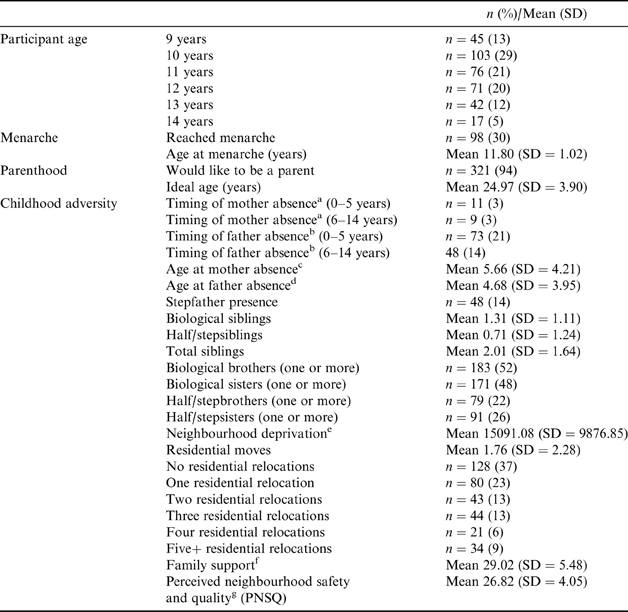
Descriptive statistics for all questionnaire measures are shown in Table 1. For those who had reached menarche, age at menarche ranged from 8.92 years to 13.58 years. Participants who wished to have children one day reported an ideal age at parenthood from 14 to 36 years. The IMD rankings for participant's residence ranged from 507 to 31,911. Half of the sample lived in the 39% most deprived areas in England and Wales with a quarter residing in areas categorized as the 20% most deprived. Another quarter of the participants lived in the 27% least deprived areas in England and Wales. Participants reported moving house anywhere from zero to eighteen times. The majority (91%) of participants had at least one or more biological (81%) or half/stepsibling (35%). Because only around 5% of participants had experienced mother absence from the home at some point in their life the ‘Timing of mother absence’ variable was excluded from subsequent analysis.
Descriptive statistics of all questionnaire measures

a Timing of mother absence: age group of participant when mother stopped living in the same residence. Percentage includes those with continual mother presence.
b Timing of father absence: age group of participant when father stopped living in the same residence. Percentage includes those with continual father presence.
c Age at mother absence: age at which mother stopped living in the same residence as participant (n=20).
d Age at father absence: age at which father stopped living in the same residence as participant (n=121).
e LSOA (Lower Super Output Area), an Index of Multiple Deprivation ranking small areas in England and Wales on a scale from 1 (most deprived) to 32,482 (least deprived).
f Family support: the minimum possible score was 5 and the maximum was 35; higher scores indicate more positive feelings of family support.
g PNSQ: the minimum possible score was 8 and the maximum was 32; higher scores indicate more positive perceptions of neighbourhood.
Childhood adversity, menarche and intended reproductive timing
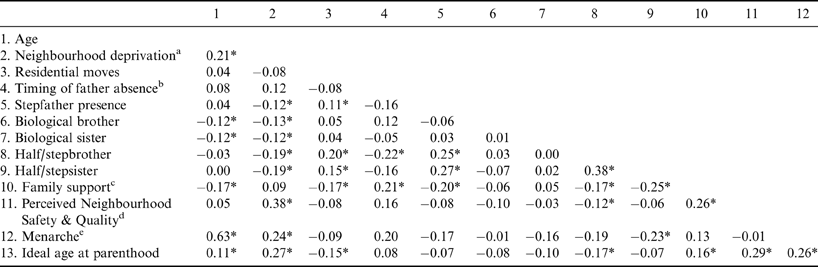
Table 2 shows correlations among the measures of childhood adversity, menarche and intended reproductive timing as well as age. Although most were correlated in the expected directions, many associations were weak and not all achieved statistical significance. Father absence in later childhood was associated with higher feelings of family support and fewer numbers of half/stepbrothers. Conversely, stepfather co-residence was associated with decreased feelings of family support and increased numbers of half/stepsiblings. Girls from more deprived neighbourhoods were more likely to have a stepfather living in the home, more biological and half/stepsiblings as well as a poorer perception of their neighbourhoods. Moving house more times was related to disruption within the home such as stepfather presence, more half/stepsiblings and lower feelings of family support. Having more half/stepsiblings was associated with reduced feelings of family support, but only half/stepbrothers was related to poorer neighbourhood perceptions. Girls with poor neighbourhood perception tended to also report lower feelings of family support.
Correlations between age, childhood adversity, menarche and ideal age at parenthood
a LSOA (Lower Super Output Area), an Index of Multiple Deprivation ranking for small areas of England and Wales on a scale from 1 (most deprived) to 32,482 (least deprived).
b Timing of father absence: a categorical variable of the age group of the participant (1=0–5 years, 2=6–14 years) when father stopped living in the same residence. For the purposes of this correlation table those with continual father presence were removed from this variable.
c Family support: the minimum possible score was 5 and the maximum was 35; a higher scores indicates more positive feelings of family support.
d Perceived Neighbourhood Safety and Quality: the minimum possible score was 8 and the maximum was 32; higher scores indicate more positive perceptions of neighbourhood.
e Menarche: a continuous variable of age at menarche.
*p<0.05.
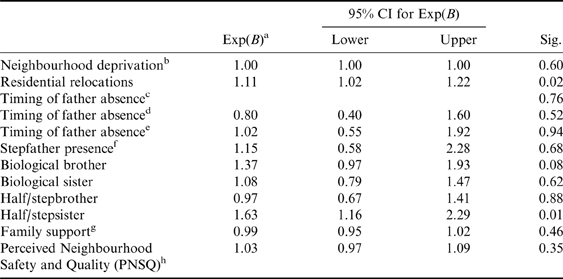
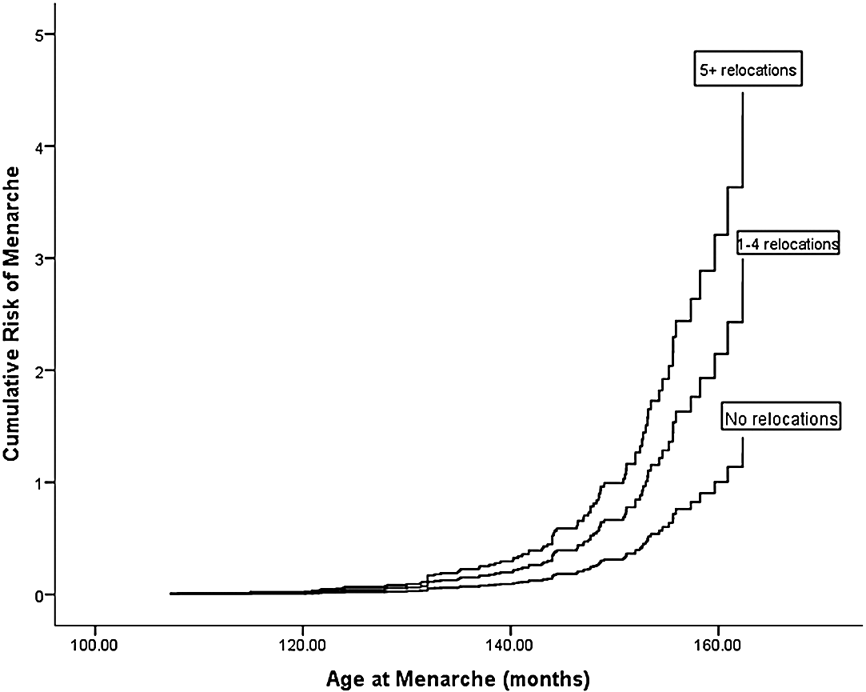
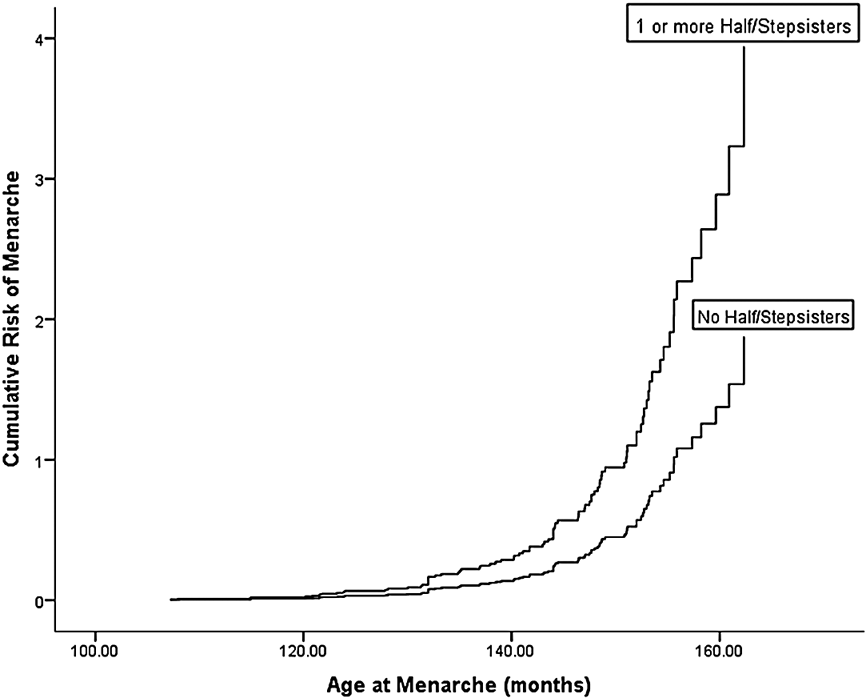
All ten childhood adversity variables were entered into a Cox regression with menarche as the outcome. In total 87 (25%) participants were included as events (having reached menarche) and 217 (61%) participants were censored (having not yet reached menarche). The remainder were treated as missing due to missing values in either the outcome or predictor variables. As Table 3 shows, only residential relocations (HR 1.11; 95%CI 1.02–1.22) and number of half/stepsisters (HR 1.63; 95%CI 1.16–2.29) were significantly associated with timing of menarche such that moving house more often, and having more half/stepsisters was associated with accelerated menarcheal timing. The effect of moving house was cumulative in nature, even when controlling for the other nine childhood adversity variables. Compared with never moving house, moving house one to four times more than doubled the likelihood of reaching menarche at a given time point (HR 2.14; 95%CI 1.23–3.73) and moving house five or more times more than tripled the likelihood of the event occurring (HR 3.20; 95%CI 1.44–7.10; see Fig. 1). After controlling for the other nine childhood adversity variables, participants who had one or more half/stepsisters compared with those who had none were twice as likely to reach menarche at a given time point (HR 2.10; 95%CI 1.16–3.79; see Fig. 2).
Results from a Cox regression of menarcheal timing on the ten measures of childhood adversity
a Exp(B) represents the relative risk of reaching menarche at a given age for each additional unit of predictor variable. In total 87 (25%) participants were included in the analysis as having reached menarche with 217 (61%) participants censored.
b LSOA (Lower Super Output Area), an Index of Multiple Deprivation ranking small areas in England and Wales on a scale from 1 (most deprived) to 32,482 (least deprived).
c Timing of father absence: this variable had three categories: 1=father absence during 0–5 years; 2=father absence during 6–14 years; 3=father present.
d Timing of father absence: father absence during 0–5 years of age compared with reference category (‘father present’).
e Timing of father absence: father absence during 6–14 years of age compared with reference category (‘father present’).
f Stepfather presence: stepfather presence compared with the reference category of ‘no stepfather present’.
g Family support: the minimum possible score was 5 and the maximum was 35; higher scores indicate more positive feelings of family support.
h Perceived Neighbourhood Safety and Quality: the minimum possible score was 8 and the maximum was 32; higher scores indicate more positive perceptions of neighbourhood.
The cumulative risk of menarche at a given age for each one unit increase in residential relocations, adjusted for all other childhood adversity variables.
The cumulative risk of menarche at a given age for each one unit increase in number of half/stepsisters, adjusted for all other childhood adversity variables.
Previous analysis of this sample revealed that increased levels of both family-level and neighbourhood-level childhood adversity were related to earlier ideal age at parenthood (Clutterbuck et al., Reference Clutterbuck, Adams and Nettle2014). Ideal age at parenthood and the ten childhood adversity variables were entered into a Cox regression with menarche as the outcome, but there was no relationship between these two variables (HR 1.00; 95%CI 0.94–1.07).
Discussion
The relationship between multiple measures of childhood adversity and menarcheal timing, as well as the relationship between menarcheal timing and intended age of reproduction, was investigated in a cohort of urban English adolescent girls. Of the ten childhood adversity measures, only frequency of residential relocations and number of half/stepsisters was associated with accelerated menarche. Girls who had moved house more times were more likely to experience menarche at a given age than those who had never moved. The effect of residential relocations on menarcheal timing was cumulative. Compared with those who had never moved, relocating one to four or five or more times doubled or tripled the chance of reaching menarche, respectively. In addition, the more half/stepsisters a participant had the more likely she was to have reached menarche. This accelerating effect of half/stepsisters on menarche was present even when comparing those participants with no half/stepsisters with those with one or more. There was no association between intended reproductive timing and menarcheal timing.
The family- and neighbourhood-level childhood adversity factors that have previously been associated with menarcheal and reproductive timing were not associated with menarcheal age in this sample (see Introduction for references). However, the sample size in this study was smaller than in previous studies investigating antecedents of these reproductive life events (Moffitt et al., Reference Moffitt, Caspi, Belsky and Silva1992; Wilson & Daly, Reference Wilson and Daly1997; McCulloch, Reference McCulloch2001; Hoier, Reference Hoier2003; Padez, Reference Padez2003; Quinlan, Reference Quinlan2003; Romans et al., Reference Romans, Martin, Gendall and Herbison2003; Matchock & Susman, Reference Matchock and Susman2006; Belsky et al., Reference Belsky, Steinberg, Houts, Friedman, DeHart and Cauffman2007; Alvergne et al., Reference Alvergne, Faurie and Raymond2008; Blell et al., Reference Blell, Pollard and Pearce2008; Bogaert, Reference Bogaert2008; Johns, Reference Johns2011). Furthermore, some studies have found that it is the duration of father absence or stepfather presence that matters most (Moffitt et al., Reference Moffitt, Caspi, Belsky and Silva1992; Ellis & Garber, Reference Ellis and Garber2000; Hoier, Reference Hoier2003; Quinlan, Reference Quinlan2003; Alvergne et al., Reference Alvergne, Faurie and Raymond2008). To determine if duration of father absence had an effect on menarche in this sample a Cox regression was run including the ten childhood adversity variables but replacing the ‘Timing of father absence’ variable with a ‘Duration of father absence’ variable (duration of stepfather presence was not collected in this sample). However, the substitution of father duration made no difference to the model (details not shown).
Surprisingly, the only family structure variable that had a significant accelerating effect on menarche was the number of half/stepsisters. In this sample 57 (63%) of the participants with half/stepsister(s) (n=91) also had a half/stepbrother(s), a stepfather or both. These three variables were significantly positively correlated with each other. Thus it is possible the presence of half/stepsister(s) was acting as a proxy for exposure to unrelated males, a phenomenon observed by others to be related to early menarche (Ellis & Garber, Reference Ellis and Garber2000; Matchock & Susman, Reference Matchock and Susman2006). It is important to bear in mind that although participants were asked explicitly if a stepparent co-resided with them this was not the case for siblings, where in the interest of brevity participants were only asked about the number and type of sibling. Alternatively it is possible that having genetically dissimilar females present, such as half/stepsisters, increases intrasexual competition activating early reproductive development. Recently intrasexual competition between females has garnered attention in the animal literature for the role it plays in reproductive success (Clutton-Brock & Huchard, Reference Clutton-Brock and Huchard2013). The result observed here, that is an acceleration of menarche in the presence of half/stepsisters, is in contrast to a previous finding in this sample of a decrease in ideal age at parenthood in the presence of half/stepbrothers (Clutterbuck et al., Reference Clutterbuck, Adams and Nettle2014). It should be noted that birth order was not collected in this sample. However, it is unclear how useful this information would have been as there is little consensus within the literature on the effect of birth order on menarcheal timing (Hoier, Reference Hoier2003; Bogaert, Reference Bogaert2008, as reviewed in Matchock & Susman, Reference Matchock and Susman2006; Padez, Reference Padez2003)
To the authors' knowledge no previous studies investigating childhood adversity factors on menarcheal timing have explored the role of frequency of residential relocations. However, associations have been reported between residential relocations and both early sexual initiation and early childbearing (Crowder & Teachman Reference Crowder and Teachman2004; South et al. Reference South, Haynie and Bose2005; Ellis et al. Reference Ellis, Figueredo, Brumbach and Schlomer2009; Nettle et al. 2010b). Relocating indicates instability within the family and is likely to cause disruption to a child's social networks, which are essential in buffering against life's stressors (Cohen & Wills, Reference Cohen and Wills1985). The social networks of mothers and/or fathers are likewise potentially disrupted when relocating, increasing parental stress levels and potentially decreasing support available for the child. Certainly, in this sample, frequent residential relocation was associated with presence of a stepfather (indicating absence of at least one biological parent), increased number of half/stepsiblings and reduced feelings of family support. What is more, the effects of residential relocations on children are far reaching, including negative health outcomes, higher adult mortality rates, increased substance abuse, internalizing and externalizing symptoms and poor educational performance (Astone & McLanahan, Reference Astone and McLanahan1994; Tucker et al., Reference Tucker, Marx and Long1998; Jelleyman & Spencer, Reference Jelleyman and Spencer2008; Oishi & Schimmack, Reference Oishi and Schimmack2010). Many of these outcomes, it should be noted, are also associated with outcomes of early puberty and menarche (Van Jaarsveld et al., Reference Van Jaarsveld, Fidler, Simon and Wardle2007; Copeland et al., Reference Copeland, Shanahan, Miller, Costello, Angold and Maughan2010; Prentice & Viner, Reference Prentice and Viner2013).
The absence of an association between menarche and intended reproductive timing in this sample is perhaps not surprising given that this relationship tends to be indirect and mediated by sexual initiation (Udry, Reference Udry1979; Andersson-Ellström et al., Reference Andersson-Ellström, Forssman and Milsom1996; Deardorff et al., Reference Deardorff, Gonzales, Christopher, Roosa and Millsap2005; Dunbar et al., Reference Dunbar, Sheeder, Lezotte, Dabelea and Stevens-Simon2008; Savolainen et al., Reference Savolainen, Mason, Hughes, Ebeling, Hurtig and Taanila2012). Although it is possible that some of the sample were sexually active it is likely to be only a small proportion. In addition, although intended age at reproduction has been found to be well correlated with actual age at first birth (Nettle et al., Reference Nettle, Coall and Dickins2010), these variables are not interchangeable and intended age at reproduction tends to change with age and maturity. This was the case in this sample, where older participants tended to state an older ideal age at first birth.
To the authors' knowledge this study is the first to explore relationships between family-level and neighbourhood-level child adversity, as well as intended reproductive timing on menarcheal age. In addition, the study is unique in using a cohort of peri-pubescent participants rather than adults. Compared with study designs using retrospective recall with adults, participants in this study were reporting on current, or relatively recent, life events and circumstances allowing for potentially more reliable recall.
This study was part of a larger study that focused on recruiting girls within a specific age range and not by pubertal stage (Clutterbuck et al., Reference Clutterbuck, Adams and Nettle2014). Thus the proportion of post-menarcheal participants was small. The larger study included two ‘interest in infants’ tasks as well as the questionnaire. As such the authors were conscious to limit the number of questionnaire items to ensure participation did not prove too onerous for the young participants. Unfortunately, this meant the omission of possibly useful family structure information such as duration of stepfather presence, sibling co-residence and birth order, as discussed above. Other factors known to correlate with menarcheal timing, such as body mass index or maternal age at menarche, might also have explained some of the variation in menarcheal timing in this sample (Posner, Reference Posner2006). However, obtaining these measures was beyond the scope of this study. Additionally, it is not clear how much mother's menarcheal age would add to the overall picture of adversity and menarcheal timing because it is difficult to determine if the mother–daughter menarcheal relationship is truly genetic or due instead to intergenerational similarities in developmental environments.
Due to the age of the cohort, socioeconomic position was also omitted from the questionnaire because the authors could not be confident in the reliability of responses to questions about parental income, educational attainment or employment. However, there is support for the utility of neighbourhood socioeconomic position as a proxy for individual socioeconomic position (Adams et al., Reference Adams, Ryan and White2004). Furthermore, investigating relationships between neighbourhood environment and physical development could have positive implications for real life. Lessons on pubertal development could be brought forward in schools where early development might be more likely in female pupils. As well, because early menarche is often associated with early childbearing (see Introduction for references) it could add valuable information to the emerging debate (Johns et al., Reference Johns, Dickins and Clegg2011) that the route to reducing teenage pregnancy rates is through reducing disadvantage and inequality.
Future research should explore the circumstances that strengthen the relationship between residential relocations and menarche. Two possible avenues are critical age of exposure, outlined as important in Belsky et al.'s theory (Reference Belsky, Steinberg and Draper1991), and type of relocation such as just home, just school or both. For a child or adolescent, moving house can come with a host of uncertainty and stress. It requires the establishment of new social networks and adjustment to a new environment with all its potential risks. It often indicates disruption to home life, possibly through the break up and/or the merging of families. Rather than a benign event in a young female's life, residential relocation, in this sample, appears to be an important factor in menarche exhibiting a cumulative impact on its timing.
Acknowledgments
The authors would like to thank North Tyneside Council and The Birth Control Trust Galton Institute for funding this study, and all the participants and the schools for taking part in this research.