Introduction
The longnose stingray Hypanus guttatus (Block & Schneider, 1801) is a demersal ray belonging to the Dasyatidae (stingray) family, which comprises 81 species (Last et al., Reference Last, Naylor and Manjaji-Matsumoto2016). It is a marine and brackish-water stingray distributed along the western coast of the Atlantic Ocean, from the southern Gulf of Mexico to south-eastern Brazil (Bigelow & Schroeder, Reference Bigelow and Schroeder1953; McEachran & Carvalho, Reference McEachran, Carvalho and Carpenter2002; Rosa & Furtado, Reference Rosa and Furtado2016), attaining 180–200 cm disc width (DW; Stehmann et al., Reference Stehmann, McEachran, Vergara and Fischer1978; Cervigón & Alcalá, Reference Cervigón and Alcalá1999; Tagliafico et al., Reference Tagliafico, Rago and Rangel2013). This is the most common ray in artisanal and industrial fisheries along the northern (Lessa, Reference Lessa1997; Frédou & Asano-Filho, Reference Frédou, Asano-Filho, Jablonski, Rossi-Wongtschowski, Haimovici, Lessa, Martins, Ávila and Frédou2006) and north-eastern Brazilian coasts (Gadig et al., Reference Gadig, Bezerra, Feitosa and Furtado-Neto2000; Silva et al., Reference Silva, Basílio and Nascimento2007; Lessa et al., Reference Lessa, Rodrigues, Barreto, Nunes, Camargo and Santana2015), and has traditionally been a by-catch in shrimp trawl, bottom longline and gillnet fisheries. However, the species can be a frequent by-catch species in some areas (Frédou & Asano-Filho, Reference Frédou, Asano-Filho, Jablonski, Rossi-Wongtschowski, Haimovici, Lessa, Martins, Ávila and Frédou2006; Silva et al., Reference Silva, Basílio and Nascimento2007; Paiva et al., Reference Paiva, Lima, Souza and Araújo2009) and, over the last decade, has become a target species for some artisanal fisheries in Pernambuco, Sergipe and Bahia states, where it is taken in large mesh ray-nets (Melo, Reference Melo2016).
Throughout the species' distribution range in Brazil over the last decades, there has been a higher fishing pressure due to: (a) an increase in the number of fishing gears; (b) an increase in length of nets (ICMBio, 2011; Lessa et al., Reference Lessa, Batista and Santana2016); (c) the specific targeting of rays; and (d) a recent uncontrolled increase in bottom longlines by fishers, the latter two by artisanal fleets in the study area. In addition, throughout the species' habitat there has been environmental degradation due to mangrove deforestation and the release of sewage to an extent which is hard to ascertain (Instituto Trata Brasil, 2013).
Most of the published information on H. guttatus is from occurrence records, limited data on catch rates, mass–length relationships (Teixeira et al., Reference Teixeira, Silva, Fabré and Batista2017) and aspects of their diet and reproduction (Menni & Lessa, Reference Menni and Lessa1998; Silva et al., Reference Silva, Basílio and Nascimento2007) with age and growth parameters estimated using multi-model inference (Gianeti et al., Reference Gianeti, Santana, Yokota, Vasconcelos, Dias and Lessa2019). Typical of Myliobatiformes, the species displays matrotrophic viviparity (with lipidic histotrophy) and gives birth to 2–4 embryos each year, with the young 14–17 cm disc width. Males are known to mature at 41–46 cm DW, females at 50–56 cm DW (Menni & Lessa, Reference Menni and Lessa1998; Yokota & Lessa, Reference Yokota and Lessa2007; Gianeti, Reference Gianeti2011). The age-at-maturity in males and females is 5 years and 7 years, respectively (Gianeti et al., Reference Gianeti, Santana, Yokota, Vasconcelos, Dias and Lessa2019). The most recent IUCN Red List Assessment for H. guttatus was Data Deficient (Rosa & Furtado, Reference Rosa and Furtado2016).
Hypanus guttatus uses the coastal waters of north-east Brazil for parturition and for the development of young, and these waters provide similar nursery ground habitats for a range of other elasmobranchs, including Rhizoprionodon porosus (Poey, 1861), Carcharhinus acronotus (Poey, 1860), Carcharhinus limbatus (Valenciennes, 1839), Carcharhinus falciformis (Müller & Henle, 1839), Pseudobatos percellens (Walbaum 1792), Narcine brasiliensis (Olfers, 1831), Aetobatus narinari (Euphrasen, 1890), Rhinoptera bonasus (Mitchill 1815), Hypanus marianae (Gomes, Rosa & Gadig, 2000) and Hypanus americanus (Hildebrand & Schroeder, 1928). The area is part of an ecologically and biologically significant area (EBSA; Convention on Biological Diversity, 2018), benefitting from micro-scale enrichment (Vital et al., Reference Vital, Stattegger, Amaro, Schwarzer, Frazão, Tabosa and Silveira2008), which provides environmental conditions that contribute to the high fishery production (Aragão, Reference Aragão2008) by the artisanal fleet, considered the largest in the north-east region of Brazil (Yokota & Lessa, Reference Yokota and Lessa2006).
The few studies on the diet of H. guttatus from tropical Brazilian waters did not provide detailed identification of the prey composition, and the diet was either described by major taxonomic groups (Carvalho-Neta & Almeida, Reference Carvalho-Neta and Almeida2001; Silva et al., Reference Silva, Viana and Furtado-Neto2001) or from studies on a specific prey taxon (Carqueija et al., Reference Carqueija, Souza-Filho, Gouvêa and Queiroz1995).
The aim of the current study was to characterize the diet composition of H. guttatus, providing a detailed description of the food items found in the stomach contents, with the feeding habits analysed in relation to sex, size class and season.
Materials and methods
Specimens were obtained from monthly sampling of the by-catch of Hypanus guttatus landed by artisanal fisheries in Caiçara do Norte – RN (05°04′S 36°03′W), from August 2007 to July 2008. These fisheries employ beach seines (25 mm mesh size: <3 m water depth), shrimp otter trawls (30 mm mesh size: 8–10 m water depth, from January to April), hand lines (about 6 m deep) and bottom longlines (100 hooks, 3–4 m deep). The bottom sediment of this inner shelf fishing area is mainly composed of sand and clay, with the presence of carbonate enriched sands and mud increasing with depth (Tabosa, Reference Tabosa2006; Vital et al., Reference Vital, Gomes, Tabosa, Frazão, Santos and Plácido2010).
After collection the sex, disc width (DW cm) and total weight (TW g) were recorded for each specimen. The stomach of each stingray was removed, fixed in a 10% buffered formalin seawater solution and then preserved in 70% ethanol 72 h after fixation. The pieces of the fish used as bait, when found in the stomach, were removed and discarded before fixation, so as not to bias stomach content analysis or indices of vacuity. The percentage of empty stomachs was calculated and the weight of the stomach contents from each specimen was recorded after fixation. Prey types were identified to the lowest possible taxonomic level.
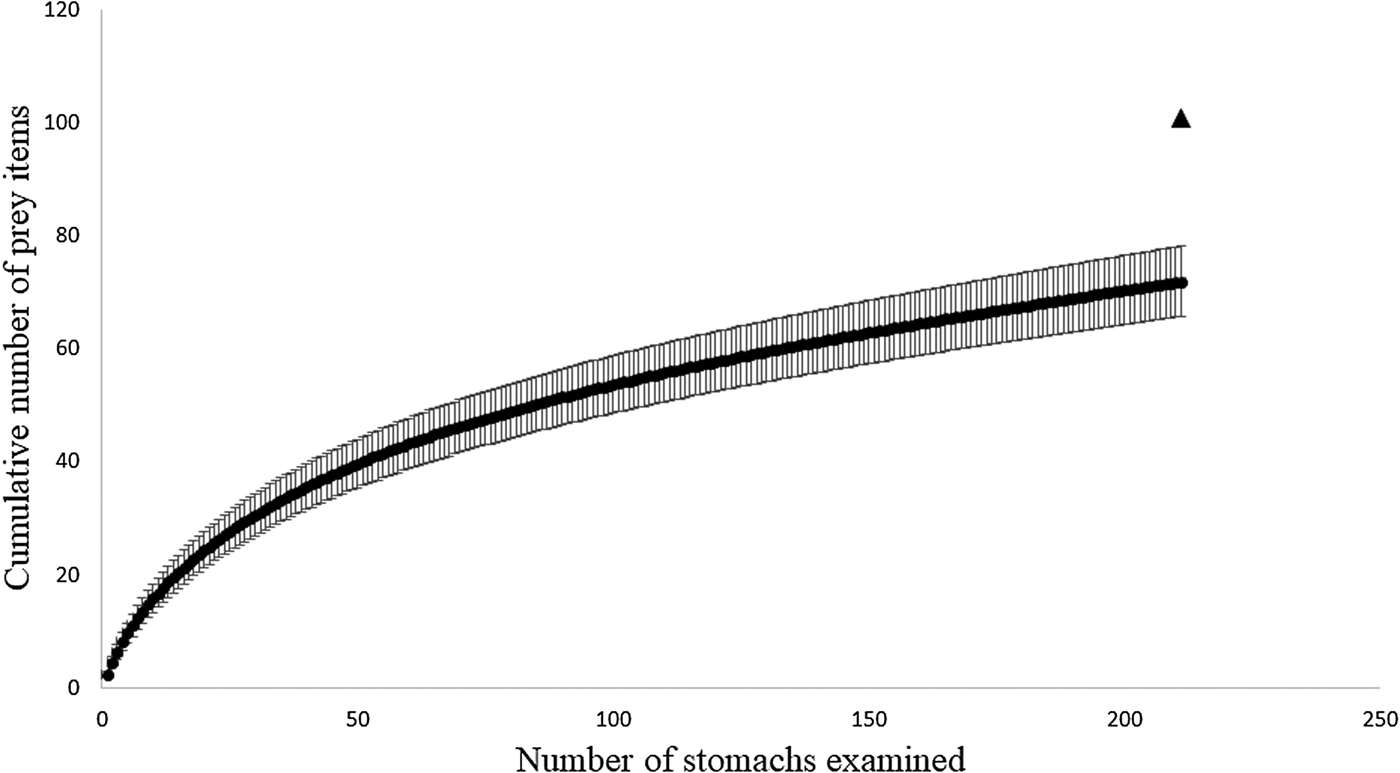
A randomized cumulative prey curve was plotted to assess if the sample size was satisfactory to describe the diet of H. guttatus in the sampled period (Ferry & Cailliet, Reference Ferry, Cailliet, MacKinlay and Shearer1996). The order in which stomach contents were analysed was randomized through a rarefaction of the sample using the PAST 3.24 statistical software (Hammer et al., Reference Hammer, Harper and Ryan2001) and the mean (± standard deviation) number of new prey observed was plotted for each consecutive stomach. To estimate the maximum number of prey that would have to be sampled to ideally describe the diet, we calculated the Jackknife1 estimator (Colwell & Coddigton, Reference Colwell and Coddington1994; Colwell, Reference Colwell2004).
The frequency of occurrence (FO%), numerical frequency (N%) and percentage of weight (W%) of each prey type was calculated according to Hyslop (Reference Hyslop1980). To identify the most important prey species in the diet, the per cent index of relative importance (IRI%) (Pinkas et al., Reference Pinkas, Oliphnat and Iverson1971) was calculated, using the following formula: %IRI = FO% × (N% + W%). To examine the ontogenetic variation in diet, rays were divided into two size-classes (<40 cm DW; ≥40 cm DW). Because the Caiçara do Norte region has no clearly defined seasons based on temperature, seasonal variation was examined in terms of precipitation using two periods: a dry season (September–February) and a rainy season (March to August), based on Rao et al. (Reference Rao, Lima and Franchito1993) and INMET (2010).
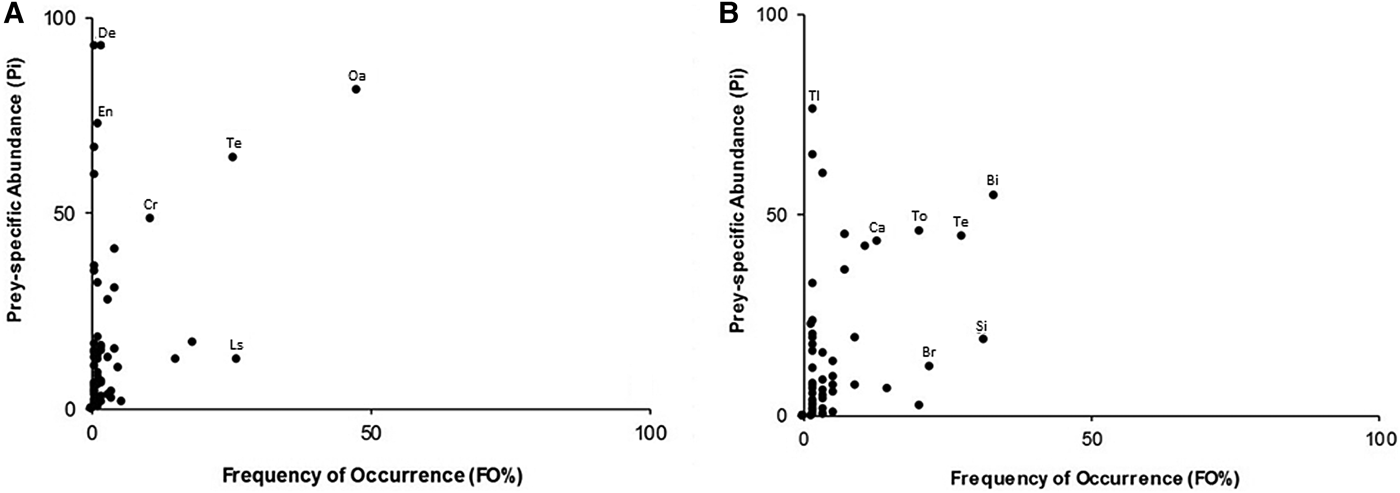
For evaluation of the feeding strategy (generalist or specialist), niche breadth and the importance of prey to the diet (dominant or rare), the graphical method proposed by Amundsen et al. (Reference Amundsen1996) was used, which consists of plotting a prey-specific abundance graph (Pi%) (which is defined as the frequency calculated for a prey taxon from only the stomachs in which that prey taxon occurs) in relation to the prey item's FO%. The abundance percentage – relationship between prey-specific abundance and FO% that increases along a diagonal line from the lower left to the upper right side – illustrates the importance of prey items. Thus, the most important prey items are positioned on the upper right, while rare or non-important prey items are situated on the lower left side. The vertical axis represents the feeding strategy of the predator – generalist (lower part) or specialist (upper part). Prey plots situated near the upper left corner indicate the specialization of individual predators and plots situated in the upper right corner (restricted to one or just a few points) indicate population specialization (narrow feeding niche).
As a measure of the feeding niche breadth, the Levins Index (Bp) was used: Bp = (B−1) / (n−1), where Bp is the Levins Index standardized by the number of prey item categories (n) and B is equal to 1/Σ p i2, with p i being the percentage weight of each prey category i in the sample (Krebs, Reference Krebs2014). Feeding niche breadth values range from 0 (a narrow niche) to 1 (a broad niche). To calculate p i%, Bp and the similarity in the diet, only the percentage weight (W%) of each taxon was considered due to the difficulty in counting the exact number of certain stomach prey types, such as bivalve molluscs, which are often found in pieces, as it was only possible to measure the weight of these items.
Similarities in diet composition (as a function of W%) between the groups defined by season (dry and rainy) and size class (<40 cm, ≥40 cm DW) were evaluated using multivariate statistical analysis according to Clarke & Warwick (Reference Clarke and Warwick2001) (PRIMER-E). Similarity matrixes were obtained using the Bray–Curtis similarity coefficient after square root transformation. A one-way analysis of similarity test (ANOSIM), using the seasons as factors, was used for the two size classes to evaluate whether diet composition was significantly influenced by season. To test for possible significant differences in diet composition between the two size classes, the same ANOSIM analysis was used, with size classes as the factor. To identify prey categories that contributed the most to the dissimilarity between groups SIMPER (similarity percentages) was performed. The Chi-square test was used to verify differences in W% of each item consumed by males and females in the sample (StatSoft, 2007).
Results
Stomachs were examined from 258 Hypanus guttatus specimens (127 females, 12.7–88.5 cm DW, 62.2–22,000 g TW; and 131 males, 12.7–57.0 cm DW, 23.1–5750 g TW). The sex ratio was not significantly different from 1:1 (χ2 = 0.031, P > 0.05). From these stomachs, 49 (19%) were empty. The non-stabilization of the randomized cumulative prey curve in an asymptote (Figure 1) indicates that, despite the significant number of analysed stomachs, this was not sufficient to characterize the H. guttatus diet in its fullness in the sampled region. The Jackknife1 estimator was calculated as 100.86 (Figure 1), suggesting that about 30 items could still be found in the H. guttatus diet.
Randomized cumulative prey curve for stomachs of Hypanus guttatus collected in Caiçara do Norte (north-eastern Brazil). Error bars represent standard deviations. Jackknife 1 estimator = black triangle.

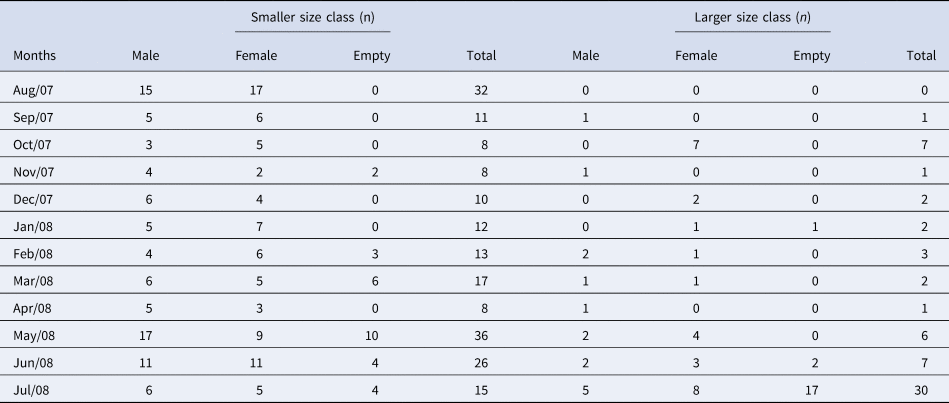
Overall, 209 individuals had stomachs containing food (n = 79 females <40 cm; n = 27 females ≥40 cm; n = 87 males <40 cm and n = 16 males ≥40 cm DW); (Table 1). The percentage of empty stomachs varied significantly throughout the months (χ2 = 207.48, P < 0.05), with the highest observed value in July 2008. During the months of August, September, October and December 2007 and April 2008, none of the examined stomachs were empty (Table 1). The proportion of empty stomachs did not differ between males and females (χ2 = 2.47, P = 0.12). No significant difference was found in the proportions of empty stomachs between fish <40 cm or ≥40 cm DW (χ2 = 1.65, P = 0.20). However, there were months where the occurrence of empty stomachs coincided with the number (n) of neonates (assumed to be individuals of 12.7–17 cm DW with internal yolk reserves still present; November 2007, n = 2; February 2008, n = 2; March 2008, n = 8; May 2008, n = 12 and June 2008, n = 5) and adults that were reproductively active (males with sperm in the seminal vesicle and females presenting full-term embryos and/or mature ovarian follicles) (January 2008, n = 5; June 2008, n = 8 and July 2008, n = 30).
Number of sampled stomachs (n) of H. guttatus size classes in Caiçara do Norte between August 2007 and July 2008

Smaller size class is <40 cm disc width and larger size class is ≥40 cm disc width.
Diet composition
Seventy-two prey categories from five major groups (Polychaeta, Crustacea, Mollusca, Sipuncula and Teleostei) were identified in the diet of H. guttatus (Table 2). The caridean shrimp Ogyrides alphaerostris was the dominant prey type in terms of FO% (37%), N% (56%), W% (32%) and IRI% (32.51). Molluscs, mainly represented by Tellinidae bivalves (IRI% = 4.69), were the second main prey type, followed in order of importance by the opossum shrimp Bowmaniella sp. (IRI% = 2.69), the caridean shrimp Leptochela serratorbita (IRI% = 2.26) and Sipuncula (IRI% = 0.37). Polychaetes exhibited relatively high FO% values (FO% = 15.17), but the W% and N% were low. As there was no significant difference in W% of the items identified between males and females (χ2 = 0.34, P = 1), the genders were grouped to test seasonal and ontogenetic differences in diet composition.
Composition of H. guttatus diet in terms of frequency of occurrence (FO%), percentage weight (W%), numeric frequency (N%) and per cent index of relative importance (IRI%) (n.i. = not identified), evaluated in Caiçara do Norte between August 2007 and July 2008

Feeding strategy
As there were significant ontogenetic differences in the diet for H. guttatus of <40 cm and ≥40 cm DW, the graphical method for understanding the feeding strategy was performed separately for the two groups (Figure 2). According to the feeding strategy plots, most prey items consumed by both size classes of H. guttatus had low frequency of occurrence and low prey-specific abundance indicating these prey types were of low importance and were only eaten occasionally, indicating a generalist diet and thus a broad niche width. However, the caridean shrimp O. alphaerostris and bivalves (including Tellinidae) were located more superiorly and right on the graph, which would indicate a certain specialization on these items by H. guttatus <40 cm DW and H. guttatus ≥40 cm DW, respectively. Items as Dendrobranchiata and Engraulidae (Figure 2A), and Trichiurus lepturus (Figure 2B) were located in the upper left corner on the graph, which would suggest the specialization of a few individuals of the population on these items. The Levins Index was low for both size-classes (<40 cm DW, Bp = 0.07; ≥40 cm DW, Bp = 0.2).
Representation of the diet pattern of H. guttatus using all identified stomach content items for smaller size class (<40 cm disc width) (A) and larger size class (≥40 cm disc width) (B). Oa, Ogyrides alphaerostris; Te, Tellinidae n.i.; De, Dendrobranchiata; Ti, Trichiurus lepturus; En, Engraulidae; Cr, Crustacea n.i.; Ls, Leptochela serratorbita; Bi, Bivalvia n.i.; To, Teleostei n.i.; Si, Sipuncula n.i.; Br, Brachyura n.i.; Ca, Callinectes sp.

Diet comparisons
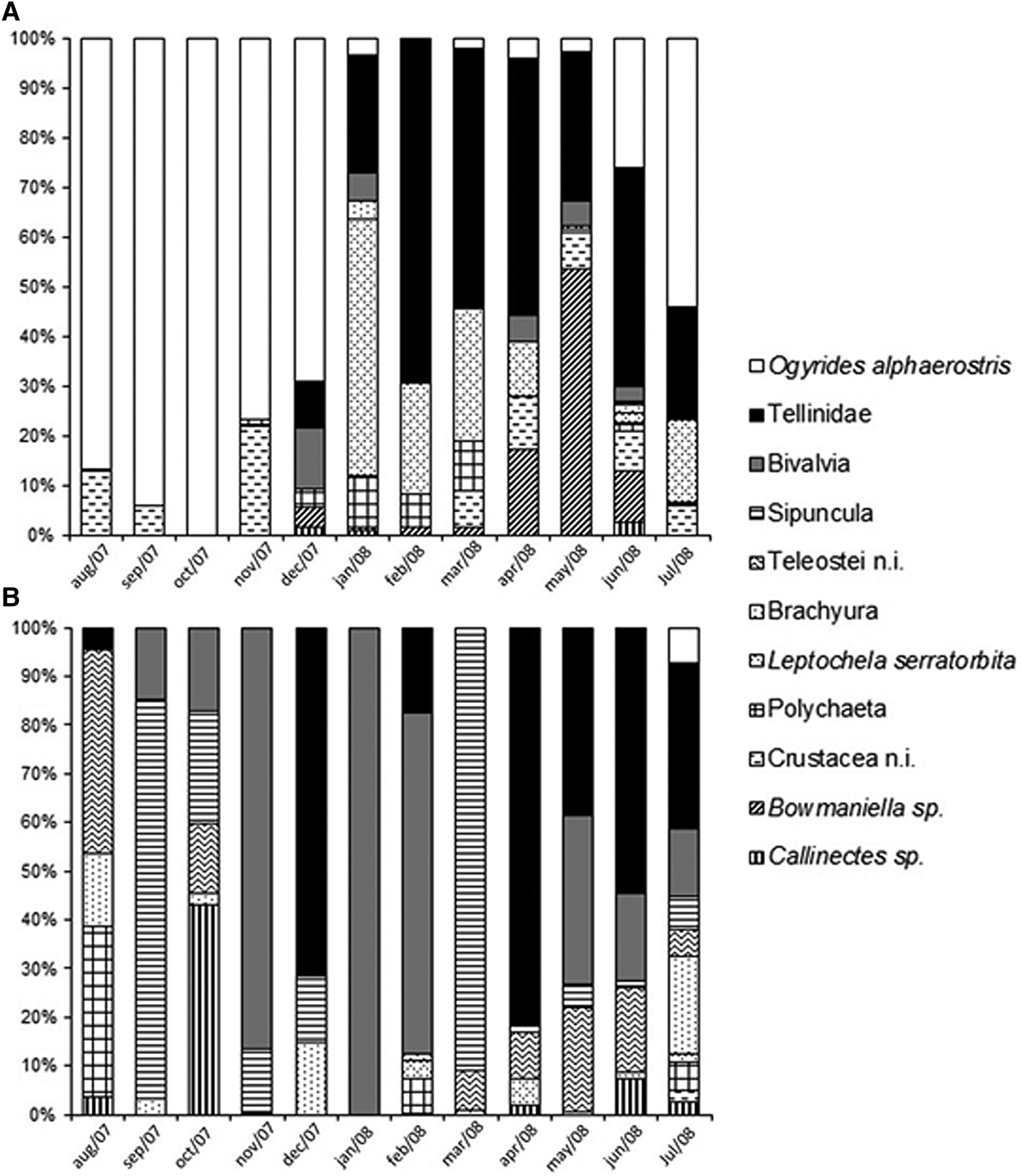
There were no significant differences in the diet composition (categorized by W%) between the dry and the rainy season for either the smaller size class (ANOSIM % W: global R = −0.004, P = 0.49) or larger size class (ANOSIM W%: global R = 0.095, P = 0.097) of H. guttatus. However, it was observed that the items consumed by the smaller size class from August to December 2007 were mostly crustaceans (O. alphaerostris and unidentified Crustacea) and from January to March 2018 the most consumed items were Tellinidae (Bivalvia) and the caridean shrimp L. serratorbita (Figure 3). In April 2008, there was an increase in the percentage of mysids Bowmaniella sp., alongside Tellinidae, until June 2008, when the marked presence of O. alphaerostris in the stomach contents was once again evident (Figure 3).
Diet composition in terms of per cent weight (W%) of smaller size-class (A) and larger size-class (B) of Hypanus guttatus from the Caiçara do Norte region (north-eastern Brazil) between August 2007 and July 2008, by month.

Unidentified bivalves and Tellinidae were the most consumed prey types by the larger size class in the sampled months, except in September 2007 and March 2008, when sipunculids became the most consumed prey taxon. In August 2007, teleost fish and polychaetes were more evident and in October 2007, there was an increased presence of brachyuran crabs Callinectes sp. together with sipunculids and teleosts (Figure 3).
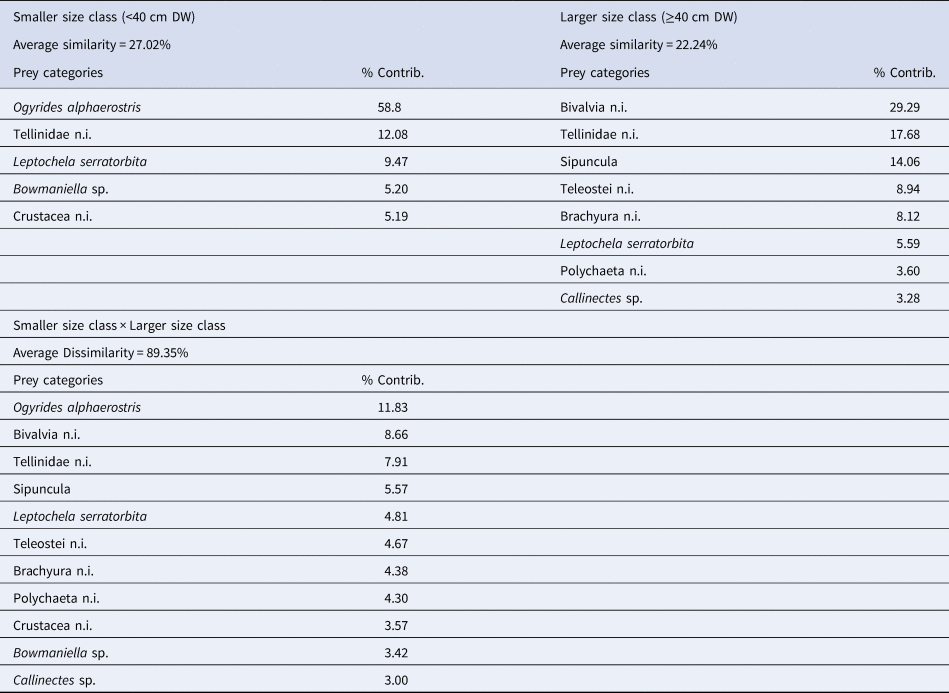
Although some overlap was found, a significant difference was observed between the diet composition of the two size classes of H. guttatus (ANOSIM W%: global R = 0.427, P = 0.001). Through the SIMPER analysis it was estimated that the average dissimilarity in diet composition between the two size classes was 89.4% (Table 3). The prey types with a high contribution to the dissimilarity between these groups were O. alphaerostris, unidentified bivalves, tellinid bivalves, sipunculids, L. serratorbita, unidentified teleosts and unidentified brachyurans. The caridean shrimp O. alphaerostris was the prey item that contributed most to the similarity of diet composition of the smaller size class, while bivalves (mainly Tellinidae) were the prey items that contributed most to the similarity in the diet of the larger size class (Table 3). The prey types of the categories Sipuncula, unidentified teleosts, Brachyura and Polychaeta, were not recorded in the diet of the smaller size class, but they were important to the diet of the larger size class, and therefore contributed to the dissimilarity between these two groups (Table 3).
Per cent contribution of the most common prey in diet composition for the smaller size class and larger size class of H. guttatus, from Caiçara do Norte (north-eastern Brazil), captured between August 2007 and July 2008, and the most discriminant ones between these two groups

%Contrib, per cent contribution; DW, disc width.
Discussion
The months with the highest proportion of empty stomachs coincided with the months in which neonates and reproductive adults were observed. Neonates still being nourished by the internal yolk reserves had no food content in their stomachs. Reproductive adults were also found with no stomach contents. In mating and/or parturition periods some elasmobranch species are known to cease feeding (Springer, Reference Springer1960; Capapé, Reference Capapé1975; Olsen, Reference Olsen1984).
The diet of H. guttatus includes a varied range of benthic and benthopelagic organisms. A wide variety of prey items was also found in other studies on the diet of H. guttatus. Silva et al. (Reference Silva, Viana and Furtado-Neto2001) found Echinodermata (Holothuroidae), Mollusca (Bivalvia and Gastropoda), various crustaceans (Pennaeidae, Portunidae, Stomatopoda, Isopoda and Amphipoda), Polychaeta, Sipuncula and Teleostei in the diet of H. guttatus from Ceará State, north-eastern Brazil. Carvalho-Neta & Almeida (Reference Carvalho-Neta and Almeida2001) studying the species in Maranhão State coast found the following prey items in order of frequency of occurrence: brachyuran crustaceans (54%; mainly Callinectes sp.), polychaetes (11%), teleosts (5%), decapod larvae (4%) and priapulids (4%). Both studies characterized the species as a generalist and opportunistic predator feeding on the most available prey items. Differences in the order of preference of food items between studies probably reflect differences in prey availability between sampling areas. Carqueija et al. (Reference Carqueija, Souza-Filho, Gouvêa and Queiroz1995) focused their study only on crustacean decapods, but found nine different families of this group in the diet of H. guttatus from Bahia State coast.
The prey categories found, especially Bivalvia, Teleostei, Caridea, Brachyura, Polychaeta and Sipuncula, have also been found in the diet of other stingrays, such as Hypanus say (Snelson & Williams, Reference Snelson and Williams1981), N. kuhlii (Compagno et al., Reference Compagno, Ebert and Smale1989), Dasyatis marmorata (Capapé & Zaouali, Reference Capapé and Zaouali1992), Hypanus americanus (Gilliam & Sullivan, Reference Gilliam and Sullivan1993), Hemitrygon akajei (Taniuchi & Shimizu, Reference Taniuchi and Shimizu1993), Dasyatis chrysonota (Ebert & Cowley, Reference Ebert and Cowley2003), Dasyatis pastinaca (Ismen, Reference Ismen2003; Yeldan et al., Reference Yeldan, Avsar and Manasirli2009), Himantura uarnak, Pastinachus sephen (Raje, Reference Raje2003) and Urogymnus asperrimus (Elston et al., Reference Elston, von Brandis and Cowley2017).
The wide range of prey items found in the stomachs of H. guttatus, indicates this species to be a generalist and opportunist predator. Although the graphic method for feeding strategy suggests some specialization of the smaller size class on O. alphaerostris and of the larger size class on bivalves, this is probably more related to the greater availability of these prey in the environment in the sampling period, than to a preference for these prey. The same would apply to individuals of H. guttatus that presented the high p i% value for the prey items Dendrobranchiata, Engraulidae and Trichiurus lepturus (points located in the upper left corner of the graph); these individuals probably encountered a greater abundance or large specimens of these prey, rather than being specialized predators on such prey species.
The alternation and variation of prey items between the months sampled reinforce the idea that the species takes advantage of the prey availability in the environment at that moment. The substrate where the rays were captured, consisting mostly of clay, mud and sandy-mud, is the type of soft-bottom where crustaceans (one of the most important prey groups in the diet of H. guttatus) dominate the biomass of benthic macroinvertebrates (Abele, Reference Abele1974; Virnstein, Reference Virnstein, Durake, Phillips and Lewis1987). Tellinidae bivalves (another frequent prey) are also commonly found in this type of substrate (Simone & Wilkinson, Reference Simone and Wilkinson2008). Despite the wide variety of food items found, the randomized cumulative prey curve and Jackknife1 estimator indicated that at least 30 more items could still be found in the diet of H. guttatus, also supporting the hypothesis of a generalist diet.
The higher frequency of some prey in the stomachs may lead to a low calculated Levins Index value, suggesting narrow niche, when the width of the niche is more likely to be broad. The resource items in the stomach content of an individual should be counted only to provide an estimate of the dietary proportions for that individual (Krebs, Reference Krebs2014), which was done in the present study. On the other hand, the usage and importance of the resource ought to be scaled to their availability, because some resources are very abundant and common and other resources are uncommon or rare (Hurlbert, Reference Hurlbert1978), however, Levins' measure of niche width does not address the possibility that resources vary in abundance (Krebs, Reference Krebs2014).
The observed difference in the diet between size classes is probably related to the greater physical capacity and experience of the larger stingrays to catch prey that smaller ones are not able to capture yet (e.g. Teleostei, Brachyura and Sipuncula). Silva et al. (Reference Silva, Viana and Furtado-Neto2001) also found ontogenetic changes in the diet of this species and observed, as in the present study, an increase in the consumption of fish and molluscs among adults. Thorson (Reference Thorson1983) analysed eight stomachs of H. guttatus from the Caribbean Sea and found only bony fishes and molluscs, but all stomachs analysed were from larger specimens (>581 mm DW).
In studies of D. pastinaca in Mediterranean waters, a similar diet shift to that observed for H. guttatus in the present study was also reported, with the preference for caridean shrimps decreasing, and teleosts and brachyuran crustaceans becoming dominant with increasing size (Capapé, Reference Capapé1975; Ismen, Reference Ismen2003; Yeldan et al., Reference Yeldan, Avsar and Manasirli2009). The same pattern was observed for D. marmorata in Tunisian waters (Capapé & Zaouali, Reference Capapé and Zaouali1992), Dasyatis chrysonota in South Africa (Ebert & Cowley, Reference Ebert and Cowley2003), M. californica in the northern coast of California (Gray et al., Reference Gray, Mulligan and Hanna1997) and other batoids in coastal waters of Australia (Platell et al., Reference Platell, Potter and Clarke1998).
There were no differences between the diets of H. guttatus males and females, probably because both sexes occupy the same habitat year-round and have access to the same prey types (Yokota & Lessa, Reference Yokota and Lessa2006, Reference Yokota and Lessa2007). Similar results were obtained for H. guttatus from the Maranhão State coast in north-eastern Brazil (Carvalho-Neta & Almeida, Reference Carvalho-Neta and Almeida2001) and for urolophid species off the coast of south-west Australia (Platell et al., Reference Platell, Potter and Clarke1998). Sex differences in diet are more likely to occur in species that segregate sexually, such as the bat ray Myliobatis californica (Gray et al., Reference Gray, Mulligan and Hanna1997). In the present study there were also no differences in the diet of H. guttatus in relation to dry and rainy seasons, a fact that is common in tropical coastal regions due to typical species richness and stability of the environmental conditions (Rohde, Reference Rohde1992; Willig et al., Reference Willig, Kaufman and Stevens2003).
In conclusion, H. guttatus plays an important role as consumer of the benthonic and benthopelagic coastal communities from north-eastern Brazil, feeding on a wide range of most available prey on the environment. The species presents an ontogenetic change in the diet that is probably related to the greater physical capacity of larger individuals to catch different prey types.
Acknowledgements
The authors thank the local fishermen for collection.
Financial support
The authors thank the Graduate Program of Oceanography (IOUSP), CAPES (Coordenação de Aperfeiçoamento de Pessoal de Nível Superior) for a PhD scholarship to M.D. Gianeti and the CNPq (Conselho Nacional de Desenvolvimento Científico e Tecnológico) for a research grant to R.P.T. Lessa. This study was financed in part by the Coordenação de Aperfeiçoamento de Pessoal de Nível Superior – Brasil (CAPES) – Finance Code 001.