Introduction
Grain sorghum is the sixth most common crop in the United States, being grown on 1.2 million ha in 2016 (NASS 2018a). As with all crop production, competition with weeds is among the top yield reducers for grain sorghum (Thompson et al. Reference Thompson, Dille and Peterson2017). Palmer amaranth was rated as the most troublesome weed by the Weed Science Society of America in a 2015 survey (Van Wychen Reference Van Wychen2016) and is a problem weed in grain sorghum production in Kansas (Peterson Reference Peterson1999).
Palmer amaranth has extended emergence throughout the summer growing season (Norsworthy et al. Reference Norsworthy, Griffith, Griffin, Bagavathiannan and Gbur2014). Because double-crop grain sorghum is typically planted in late June to early July after winter wheat harvest in Kansas (Shroyer et al. Reference Shroyer, Thompson, Brown, Ohlenbusch, Fjell, Staggenborg, Duncan and Kilgore1996), Palmer amaranth is usually established or emerging with the double-crop grain sorghum. Competition with weeds in such situations often results in substantial grain yield losses (Dieleman et al. Reference Dieleman, Hamill, Fox and Swanton1996). Tillage prior to double-crop planting to destroy emerged weeds is not an option in most double-crop systems, because soil moisture is often limited following a winter wheat crop, and growers want to conserve soil moisture for the double-crop grain sorghum crop. Therefore, an herbicide must be applied to control emerged Palmer amaranth. Additional PRE-applied residual herbicides are commonly used in no-till systems with the goal of controlling weeds that would emerge during the first few weeks after crop emergence (Mueller et al. Reference Mueller, Mitchell, Young and Culpepper2005). Producers have limited chemical options, as grain sorghum is associated with fewer registered herbicides than are other major crops (e.g., corn, soybean, and cotton) in the United States (Thompson et al. Reference Thompson, Dille and Peterson2017). If Palmer amaranth was not controlled in grain sorghum, yield reductions as high as 57% compared to the weed-free control were observed when 1.6 Palmer amaranth plants m–2 were transplanted into grain sorghum at the five-leaf developmental stage (Moore et al. Reference Moore, Murray and Westerman2004).
Palmer amaranth has been documented to be resistant to at least four different herbicide sites of action in Kansas (Heap Reference Heap2018; Peterson Reference Peterson1999). Palmer amaranth was first confirmed resistant to atrazine in Texas in 1993 and Kansas in 1995 (Heap Reference Heap2018). Historically, the mechanism of atrazine resistance in weeds has been based on target site; the resistance trait was transferred through maternal inheritance, with subsequent fitness costs in the atrazine-resistant progeny. However, a non-target site, metabolism-based mechanism through glutathione S-transferase conjugation has been identified to facilitate atrazine resistance in Palmer amaranth (Nakka et al. Reference Nakka, Godar, Thompson, Peterson and Jugulam2017). This mechanism involves paternal inheritance and little to no fitness cost. Populations with resistance to atrazine are not controlled in either PRE or POST applications of atrazine alone (Kohrt et al. Reference Kohrt, Sprague, Nadakuduti and Douches2017), although Palmer amaranth control was enhanced when atrazine was combined with 4-hydroxyphenylpyruvate dioxygenase (HPPD)–inhibiting herbicides (e.g., mesotrione or isoxaflutole) PRE on a population of Palmer amaranth resistant to both HPPD-inhibiting herbicides and atrazine. This indicates continued utility for atrazine when combined with HPPD-inhibiting herbicides even on populations resistant to both atrazine and HPPD-inhibiting herbicides (Gundy et al. Reference Gundy, Hay, Thompson and Dille2018).
Records from 1991 through 2011 indicate that atrazine use in grain sorghum as a percentage of planted acres has been relatively constant (71% to 82%) in Kansas. During this time, the use of VLCFA-inhibiting herbicides increased from 34% to 70% (NASS 2018b). Although multiple variables probably drove the increased use of VLCFA-inhibiting herbicides, one plausible cause was the slow onset of atrazine-resistant Palmer amaranth, and the subsequent poor control that was being observed with atrazine applied alone in grain sorghum.
Little to no research has been conducted for weed control in double-crop grain sorghum with modern herbicide options. In recent years, additional herbicides have been labeled for use in grain sorghum, making no-till grain sorghum more feasible and widely accepted. The objective of this research was to compare various herbicide treatments for the control of atrazine-resistant and susceptible populations of Palmer amaranth in double-crop grain sorghum.
Materials and Methods
Field experiments were conducted near Manhattan (39.12567 N, 96.613488 W) and Hutchinson (37.931114 N, 98.029392 W), Kansas in 2016 and 2017. Within 24 h after winter wheat harvest, glyphosate (1,540 g ae ha–1) (RoundUp PowerMax®, Monsanto Company, St. Louis, MO) was applied over the entire plot area for control of emerged grasses and glyphosate-susceptible broadleaf weeds. Four hours after glyphosate application, grain sorghum hybrid HG 48-B (Heartland Genetics, Beloit, KS) was no-till planted at 123,500 seeds ha–1 into winter wheat stubble in rows spaced 76 cm apart with four rows per plot. The site near Hutchinson was planted on June 29, 2016 and June 22, 2017. The site near Manhattan was planted on June 30, 2016 and June 21, 2017. Treatments were arranged as a randomized complete block design with plot dimensions of 7.6 m long by 3 m wide and four replications.
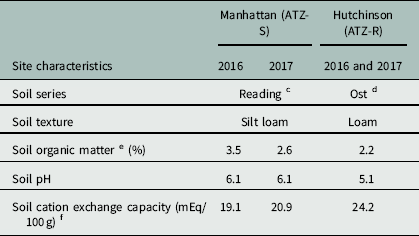
Fourteen herbicide treatments were evaluated, consisting of eight PRE-only and six PRE followed by (fb) POST applications and one nontreated check, with multiple herbicide products from several herbicide manufacturing companies (Table 1). An indigenous population of atrazine-resistant Palmer amaranth was present at the Hutchinson site (ATZ-R), and an indigenous population of atrazine-susceptible Palmer amaranth was present at the Manhattan site (ATZ-S) (data not shown). Soils information for each site-year is listed in Table 2. Immediately after planting, paraquat (841 g ai ha–1) (Gramoxone SL 2.0®, Syngenta Crop Protection, Greensboro, NC) was applied over all plots to control emerged glyphosate-resistant Palmer amaranth. POST treatments were applied 3 wk after planting (WAP) to standardize applications across different environments, ensure all herbicides were applied within label guidelines for crop developmental stage, and represent current management recommendations for POST herbicide timings in Kansas (Anonymous 2010; Reddy et al. Reference Reddy, Stahlman, Geier, Thompson, Currie, Schlegel, Olson and Lally2013). All treatments were applied with a CO2 backpack sprayer and a 1.9-m handheld boom equipped with AIXR 110015 nozzles (TeeJet Technologies, Wheaton, IL) at a volume of 140 L ha–1 at 220 kPa and a speed of 4.8 km h–1. Adjuvants used for the POST application timing are listed in Table 1.
Treatment, trade name, herbicide rate, application timing, POST adjuvant, and herbicide registrant. a

a Abbreviations: fb, followed by.
b Adjuvant abbreviations and manufacturers: AMS, ammonium sulfate (N-Pak® AMS Liquid, Winfield Solutions, LLC, St. Paul, MN); COC, crop oil concentrate (Prime Oil®, Winfield Solutions, LLC, St. Paul, MN); NIS, nonionic surfactant (Activate PlusTM, Winfield Solutions, LLC, St. Paul, MN).
c Adjuvant rates: COC, 1% vol/vol; AMS, 2.7 L ha–1; NIS, 0.25% vol/vol.
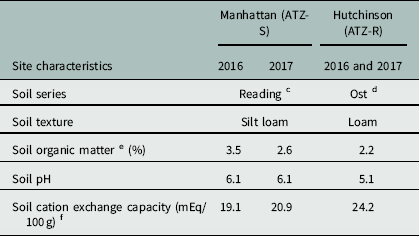
a Abbreviations: mEq, milliequivalents.
b All soil characteristics assessed from a 0- to 7.6-cm soil sampling depth.
c Fine-silty, mixed superactive, mesic Pachic Argiudolls.
d Fine-loamy, mixed superactive, mesic Udic Argiustolls.
e Loss-on-ignition (Ball Reference Ball1964).
f Adjusted to pH 7 (Rich Reference Rich1969).
Precipitation was measured and recorded by weather stations located within 2.5 km of all experiment locations. Palmer amaranth control was visually evaluated 3 and 8 WAP and recorded as percent control relative to the nontreated plots, with 0% being no control and 100% complete control. Palmer amaranth aboveground biomass and density were recorded from 0.25-m2 quadrats for each plot when grain sorghum reached physiological maturity in both 2016 and 2017. Palmer amaranth biomass was bagged and dried at 65 C for 1 wk, and dry weights recorded.
Palmer amaranth control at 3 and 8 WAP, biomass, and density were subjected to ANOVA using JMP Pro 12 (SAS Institute, Cary, NC) and means separated using Fisher’s protected LSD at α=0.05. Sites were analyzed separately because of the presence of atrazine-resistant Palmer amaranth at ATZ-R and atrazine-susceptible Palmer amaranth at ATZ-S. Data were pooled across years for each site after no year-by-treatment interactions were observed (data not shown). Treatment was considered as a fixed effect and replication nested within year as a random effect. All data were assessed for assumptions of equal variance, with density data being log transformed; transformed density means were back-transformed for discussion. Differences among groups of treatments were compared using contrasts.
Results and Discussion
Environmental Conditions and Crop Injury
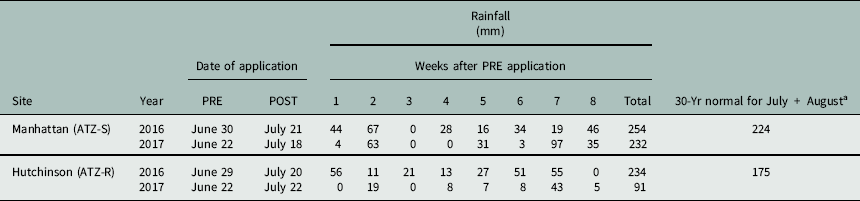
All sites received 19 mm or more precipitation within 2 WAP and 15 mm or more precipitation 2wk after POST application (Table 3). Precipitation for July and August was greater than the 30-yr average at all site-years and provided adequate moisture for production of double-crop grain sorghum, except for ATZ-R in 2017, which received less than the 30-yr normal precipitation (Table 3). Although the grain sorghum exhibited stress, it was still able to produce grain; Palmer amaranth control and growth did not seem to be affected (personal observation). Little to no crop response was observed from PRE treatments at 3 WAP, and no discernible effect from crop injury was detected at 8 WAP in any of the site-years (data not shown).
Rainfall by week after PRE application date at sites near Manhattan (ATZ-S) and Hutchinson (ATZ-R) in 2016 and 2017 and 30 yr precipitation normals for the months of July and August for ATZ-S and ATZ-R. a , b
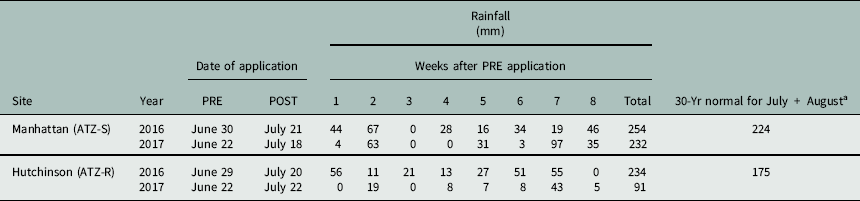
a Cumulative rainfall for the months of July and August as referenced from the 30-yr normal from 1980 to 2010 for each respective location as recorded by the National Oceanic and Atmospheric Administration (Arguez et al. 2010).
b POST herbicide applications were made 3 wk after PRE application in all site-years.
ATZ-S Palmer Amaranth Control
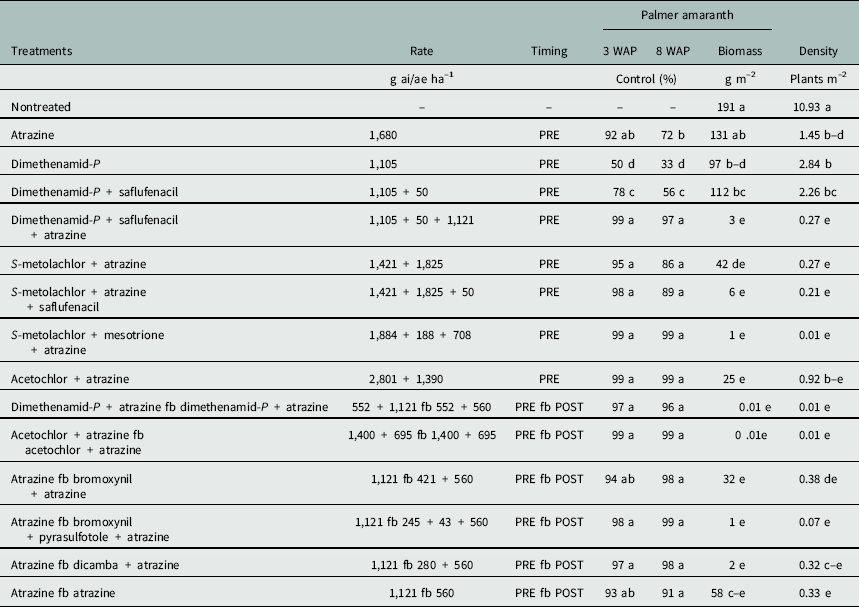
Treatments that included atrazine PRE resulted in excellent control (> 90%) 3 WAP, and treatments that included other herbicides (i.e., a VLCFA or HPPD-inhibiting herbicide) with atrazine did not improve control compared to atrazine alone. Dimethenamid-P when applied alone (Table 4) provided the least control (50%) of Palmer amaranth 3 WAP. When saflufenacil was added to dimethenamid-P, the control of Palmer amaranth was increased to 78%; however, control was still less than other treatments. The high level of control provided by atrazine 3 WAP demonstrates the utility of this herbicide on susceptible populations of Palmer amaranth.
Herbicide treatments, rates, and timing of application with Palmer amaranth control, biomass, and density at Manhattan (ATZ-S) during 2016 and 2017. a , b

a Abbreviations: fb, followed by; WAP, weeks after planting.
b Means followed by the same letter within a column are not statistically different according to Fisher’s Protected LSD (α=0.05).
At 8 WAP, the best control (≥ 86%) was observed with treatments that included PRE applications of atrazine with another residual herbicide(s) or PRE fb POST treatments. Atrazine alone provided only 72% control. Within the PRE fb POST treatments, various types of programs were assessed, all of which contained atrazine in the PRE and POST timing. However, it is clear that atrazine heavily contributed to the efficacy of these treatments through the control of emerged Palmer amaranth at the time of application at 3 WAP as well as through residual activity of atrazine at 8 WAP; this is substantiated by the control provided by the atrazine fb atrazine treatment at 8 WAP (91%). The foliar activity of POST atrazine-containing treatments was probably enhanced with the addition of an oil activator adjuvant (Nalewaja and Adamczewski Reference Nalewaja and Adamczewski1976) (Table 1). When atrazine was applied as a PRE-alone without a POST, control was decreased to 72% at 8 WAP, probably because of late-season Palmer amaranth emergence, as the concentration of atrazine declined in the soil through microbial degradation (Mueller et al. Reference Mueller, Steckel and Radosevich2010). The least control was observed with PRE dimethenamid-P (33% at 8 WAP). Control was increased to 56% when saflufenacil was added to dimethenamid-P, although control was still less than all other treatments; however, control was increased when atrazine was included with either of these two treatments (Table 4).
Palmer amaranth density was less in all treatments compared to the nontreated check, whereas all treatments reduced Palmer amaranth biomass compared to the nontreated check except for atrazine PRE-alone. Dimethenamid-P, dimethenamid-P plus saflufenacil, and atrazine PRE-alone resulted in greater biomass compared to all other treatments. Treatments that included a PRE fb POST or atrazine plus another residual herbicide PRE tended to result in lower densities than other treatments. POST treatments including bromoxynil, pyrasulfotole, or dicamba did not provide additional control at ATZ-S because of the high efficacy of atrazine.
ATZ-R Palmer Amaranth Control
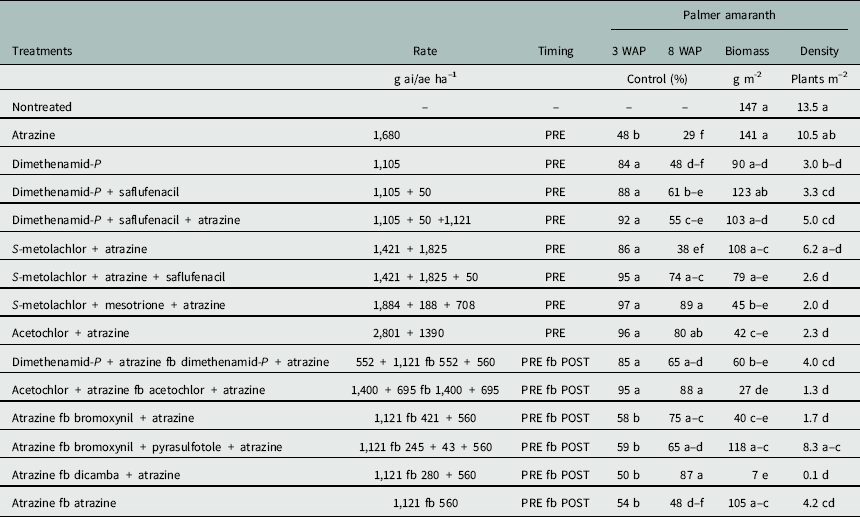
Treatments that included a VLCFA-inhibiting herbicide provided better Palmer amaranth control (≥ 84%) than treatments that had received only atrazine PRE (≤ 59%) at 3 WAP (Table 5). At 8 WAP, atrazine PRE-alone resulted in poor Palmer amaranth control (29%), whereas dimethenamid-P, S-metolachlor plus atrazine, and atrazine fb atrazine provided similar poor control (≤ 48%). The addition of saflufenacil to S-metolachlor plus atrazine resulted in better control (74%) than S-metolachlor plus atrazine alone (38%). Adding mesotrione to S-metolachlor plus atrazine also provided better control (89%) than S-metolachlor plus atrazine (38%). The increase in control with the S-metolachlor plus mesotrione plus atrazine treatment could be due in part to the rate increase with S-metolachlor (1,421 to 1,884 g ai ha–1), as well as the addition of mesotrione. Furthermore, because S-metolachlor, mesotrione, and saflufenacil have varying levels of chemical availability in the soil and different rates of microbial degradation, they could help to increase weed control by being available for uptake by weeds for different periods of time after application (Beestman and Deming Reference Beestman and Deming1974; Mueller et al. Reference Mueller, Boswell, Mueller and Steckel2014; Pallet et al. Reference Pallet, Cramp, Little, Veerasekarean, Crudace and Slater2001).
Herbicide treatments, rates, and timing of application with Palmer amaranth control, biomass, and density at Hutchinson (ATZ-R) during 2016 and 2017. a , b

a Abbreviations: WAP, weeks after planting; fb, followed by.
b Means followed by the same letter within a column are not statistically different according to Fisher’s Protected LSD (α=0.05).
At 8 WAP, atrazine fb atrazine resulted in only 48% control–a result that indicates limited efficacy was achieved with atrazine in terms of residual or foliar activity in the POST application at ATZ-R. When dicamba or bromoxynil was included with atrazine in the POST application, control increased to ≥ 75%; however, when pyrasulfotole was added to the bromoxynil plus atrazine POST application, Palmer amaranth control, biomass, or density did not differ from atrazine applied POST-alone. The premix containing pyrasulfotole and bromoxynil is labeled for the control of Palmer amaranth up to 10 cm tall in grain sorghum (Anonymous 2016), whereas Palmer amaranth control by bromoxynil alone is not labeled (Anonymous 1999). In contrast, atrazine fb bromoxynil plus atrazine resulted in a reduction in Palmer amaranth density compared to atrazine fb bromoxynil (lower rate) plus pyrasulfotole plus atrazine (Table 5). Because the Palmer amaranth at ATZ-R is susceptible to HPPD-inhibiting herbicides (data not shown), decreased control with pyrasulfotole on emerged Palmer amaranth could be due to warm temperatures. High temperatures have been demonstrated to reduce the efficacy of HPPD-inhibiting herbicides (e.g., pyrasulfotole) when applied to Palmer amaranth (Godar et al. Reference Godar, Varanasi, Nakka, Prasad, Thompson and Mithila2015, Thompson and Jugulam Reference Thompson and Jugulam2015). Because most POST applications to double-crop grain sorghum in Kansas tend to take place in July during periods of high temperatures, this would potentially reduce the utility of pyrasulfotole, and effective Palmer amaranth control would require a more robust overlapping residual herbicide program or other strategies.
Of the PRE fb POST treatments, several included a layered-residuals approach, with a VLCFA-inhibiting herbicide applied in both PRE and POST applications. The two treatments that included acetochlor provided some of the best Palmer amaranth control 8 WAP (≥ 80%). In both of these treatments, the same total amount of acetochlor was applied; however, one received the total amount of acetochlor in the PRE application, whereas the other received the total distributed equally across the PRE fb POST applications in a layered approach. Dimethenamid-P plus atrazine fb dimethenamid-P plus atrazine resulted in a similar level of control (65%) compared to the same amount of total dimethenamid-P applied PRE (48%). In both cases, similar levels of Palmer amaranth control, biomass, and density were achieved for the corresponding herbicide regardless of the allotment of active ingredient per application (Table 5). This indicates that split applications of VLCFA-inhibiting herbicides could be used as part of a planned herbicide program and may be advantageous when adverse environmental conditions (e.g., lack of rainfall for herbicide incorporation, excessive rainfall for leaching) occur. This approach has been demonstrated as an effective approach to manage Palmer amaranth in a season-long, layered-residual strategy (Steckel et al. Reference Steckel, Sprague and Hager2002).
Palmer amaranth biomass was less than the nontreated check in two PRE-only treatments (S-metolachlor plus mesotrione plus atrazine and acetochlor plus atrazine), and all PRE fb POST treatments with the exception of two treatments (atrazine fb bromoxynil plus pyrasulfotole plus atrazine and atrazine fb atrazine). All treatments except S-metolachlor plus atrazine, atrazine PRE-alone, and atrazine fb bromoxynil plus pyrasulfotole plus atrazine resulted in a reduction in Palmer amaranth density.
Palmer amaranth control was generally lower at ATZ-R than at ATZ-S because of the high level of efficacy of residual and foliar activity observed with atrazine-containing treatments at ATR-S. Treatments that contained multiple residual herbicides, effective POST applications, and VLCFA-inhibiting herbicides applied PRE fb POST tended to result in the best overall Palmer amaranth control.
Contrasts of Various Herbicide Treatments
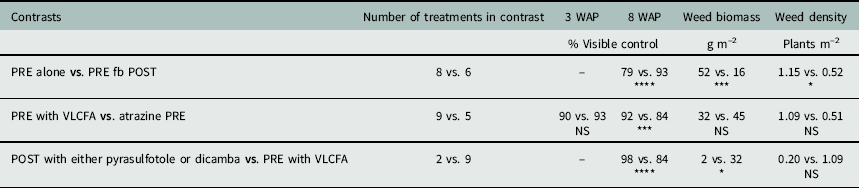
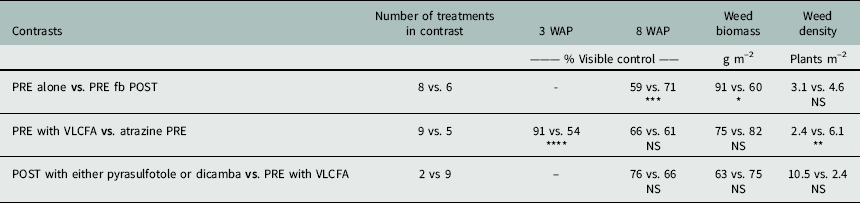
Herbicide treatments that combined a PRE fb POST provided greater Palmer amaranth control and reduction in biomass and density at 8 WAP than PRE-only treatments at ATZ-S (Table 6). Similar trends were observed at ATZ-R; however, no differences were observed in density reductions (Table 7). This demonstrates the effectiveness of PRE fb POST weed control systems with multiple effective modes of action to control Palmer amaranth.
Contrasts of treatments on Palmer amaranth control, biomass, and density at Manhattan (ATZ-S) during 2016 and 2017. a , b

a Abbreviations: fb, followed by; NS, not significant; VLCFA, very-long-chain fatty acid–inhibiting herbicides; WAP, weeks after planting.
b Significance of contrast means difference: *P=0.1 to 0.05, **P=0.05 to 0.01, ***P=0.01 to 0.0001, ****P<0.0001 levels.
Contrasts of treatments on Palmer amaranth control, biomass, and density at Hutchinson (ATZ-R) during 2016 and 2017. a , b

a Abbreviations: fb, followed by; NS, not significant; VLCFA, very-long-chain fatty acid–inhibiting herbicides; WAP, weeks after planting.
b Significance of contrast means difference: *P=0.1 to 0.05, **P=0.05 to 0.01, ***P=0.01 to 0.0001, ****P<0.0001 levels.
PRE treatments containing VLCFA-inhibiting herbicides (with and without other herbicides) provided greater Palmer amaranth control 3 WAP compared to atrazine-only PRE treatments at ATZ-R (Table 7). This demonstrated the effectiveness of a PRE application of VLCFA-inhibiting herbicide on atrazine-resistant Palmer amaranth. Contrasts did not reveal a benefit from the addition of a VLCFA-inhibiting herbicide 3 WAP at ATZ-S (Table 6). This indicates that atrazine alone in a PRE application would probably provide sufficient control during the early developmental stages if the Palmer amaranth were susceptible but not if it was a resistant population. When the same contrast was considered at 8 WAP, the addition of a VLCFA-inhibiting herbicide improved Palmer amaranth control as compared to atrazine-only PRE treatments at ATZ-S (Table 6). At ATZ-R, the addition of a VLCFA-inhibiting herbicide did not result in increased weed control 8 WAP, albeit reductions in weed density were observed. (Table 7). This contrast indicates that PRE applications of VLCFA-inhibiting herbicide were beneficial for early- and late-season control of atrazine-resistant Palmer amaranth and late-season control of atrazine-susceptible Palmer amaranth.
Treatments with a POST that contained pyrasulfotole or dicamba improved Palmer amaranth control 8 WAP compared to treatments that contained a VLCFA-inhibiting herbicide at ATZ-S (Table 6). Differences in control 8 WAP were not observed at ATZ-R for this contrast, possibly because of the overall lower level of control from the lack of atrazine activity observed at ATZ-R (Table 7). This result reveals the importance of maintaining the effectiveness of atrazine, even when other herbicides are used in tank mix with atrazine. Palmer amaranth biomass was decreased at ATZ-S but not at ATZ-R; differences in density were not observed at either location (Tables 6 and 7). Results in this contrast could be further confounded by the emergence and growth of atrazine-resistant Palmer amaranth at the time of POST application at ATZ-R. Treatments that utilized dicamba or pyrasulfotole in the POST application were preceded with a PRE application of atrazine that provided<60% control 3 WAP (Table 5). Dense weed populations have been shown to decrease the efficacy of POST herbicide control by limiting weed coverage (Legleiter et al. Reference Legleiter, Bradley and Massey2009). Schultz et al. (Reference Schultz, Myers and Bradley2015) found PRE fb POST herbicide programs provided greater control of water hemp (Amaranthus rudis J.D. Sauer) compared to POST only.
Practical Implications for Management
Herbicides are the primary means of controlling Palmer amaranth in double-crop grain sorghum. Double-crop sorghum is grown in the absence of tillage to conserve soil moisture, so tillage is not a usual weed control option. The treatments in this study included both residual and foliar-applied herbicides, and the number of effective sites of action differed across sites because of the presence of atrazine-resistant Palmer amaranth at ATZ-R and atrazine-susceptible Palmer amaranth at ATZ-S. Previous research has shown that the use of at least 2.5 effective sites of action delayed the evolution of glyphosate resistance (Evans et al. Reference Evans, Tranel, Hager, Schutte, Wu, Chatham and Davis2016), and using multiple effective sites of action is described as a best management practice to reduce the risk of herbicide resistance (Norsworthy et al. Reference Norsworthy, Ward, Shaw, Llewellyn, Nichols, Webster, Bradley, Frisvold, Powles, Burgos, Witt and Barrett2012). Consultants and producers should strive to understand which sites of action are effective on each specific weed population and therefore use multiple effective sites of action in each herbicide application to conserve the utility of the limited herbicide options in grain sorghum. The results of this study demonstrate the high efficacy of atrazine in controlling susceptible populations of Palmer amaranth both PRE and POST in double-crop grain sorghum and suggest that an integrated approach should be implemented to preserve the future efficacy of atrazine in those populations.
At ATZ-R, atrazine was ineffective at managing Palmer amaranth both PRE and POST; thus, atrazine may only be useful to enhance the activity of HPPD-inhibiting herbicides (Gundy et al. Reference Gundy, Hay, Thompson and Dille2018) or to control other weed species that may be present. As a result of this study, producers and consultants must achieve control of atrazine-resistant Palmer amaranth by using PRE-residual herbicides (e.g., VLCFA- or HPPD-inhibiting herbicides), an effective POST herbicide application, and layering VLCFA-inhibiting herbicides in both PRE fb POST applications in addition to integrated weed management strategies in double-crop grain sorghum.
Acknowledgments
The research received no specific grant from any funding agency, commercial, or not-for-profit sectors. No conflicts of interest have been declared. The authors appreciate the help of Dr. Curtis R. Thompson, Mrs. Cathy Minihan, fellow graduate students, and the experiment field staff for their assistance with this project.