Do constitutional reforms offer an appropriate vehicle for the development of the judiciary, or do they offer an opportunity for unscrupulous politicians to reshape the courts? Extant empirical research reveals that constitutional arrangements such as the tenure system influence judicial independence and the stability of justices on the bench.Footnote 1 Scholarly proponents of judicial reform normally rely on these findings to advocate major constitutional amendments, without noticing that constitutional change also offers an opportunity for incumbent politicians to restructure the judiciary for their own benefit. History suggests that well-intentioned attempts to ‘upgrade’ constitutional designs often backfire by exposing judges to partisan manipulation. Thus, an important question remains unanswered: Can constitutional reforms, no matter their stated goals, pose a threat for the stability of judicial institutions?
We address this question using a large historical dataset for eighteen Latin American countries between 1904 and 2010. Latin America has had a long history of constitutional innovation, which produced one of the most diverse legal environments in the world. Latin American judicial systems combine native institutions (such as the amparo procedure), the US tradition of decentralized judicial review, and European influences (the civil law tradition, Kelsenian Constitutional Courts) into complex arrangements. Constitutional reforms have often addressed judicial modernization, tackling deficits in the legal system.Footnote 2 Yet, despite this history of legal reforms (or perhaps because of it), judicial instability remains a persistent problem well into the twenty-first century. The purge of the Bolivian Constitutional Court in 2009 and the removal of seven Venezuelan justices in 2013 represent two recent examples of recurrent judicial turnover in the region.
Even though the instability of Latin American judiciaries is a problem widely acknowledged by the literature, existing research focuses on its political roots rather than on the mechanisms employed to reshuffle the courts.Footnote 3 The most common explanations for judicial turnover emphasize the strategic behavior of justices and the political context in which they are immersed, and typically treat institutional rules regulating the high courts as fixed. In this article, by contrast, we specifically acknowledge the consequences of an unstable constitutional environment. We argue that the alteration of institutional arrangements undermines the stability of justices because, irrespective of their stated goals, constitutional amendments and replacements offer a window of opportunity to reorganize the composition of the judiciary.
Assessing the impact of constitutional change on judicial instability is no simple task because changes in institutional design may be driven endogenously.Footnote 4 Although institutional studies typically treat constitutions as exogenous, this assumption is problematic for our topic because the same unobserved factors that make politicians willing to dismiss judges may also encourage them to alter the legal system. This point has important implications for scholars advocating reform. If constitutional change drives judicial turnover exogenously, legal reform will correlate with turnover not because an underlying force occasionally causes both events, but because the reform process creates systematic opportunities for the replacement of judges. Sincere reformers, therefore, may want to gauge the risk of promoting legal transformations that, irrespective of their content, could ultimately serve the purposes of scheming politicians.
We address this analytical problem by using a two-stage discrete-time survival model. The first-stage model predicts institutional change, while the second stage explains the judges’ duration in office. In doing so, we integrate two major literatures: studies of constitution-making and studies of judicial politics. We focus on three endogenous outcomes: the adoption of new constitutions, which typically involve the creation of a powerful constituent assembly with authority over the high courts; the adoption of constitutional amendments referring to the judiciary; and changes in the size of the Supreme Court or the Constitutional Tribunal, which in some countries are introduced by the legislature without altering the constitution. Our analysis shows the extent to which changes in the legal framework undermine the stability of judges in office.
The next two sections of the article summarize the main lessons from the literatures on the causes of judicial instability and the determinants of constitutional change. We connect the two literatures and reconstruct a causal sequence in the empirical sections. After a discussion of the estimation technique, we present the results of the first-stage and the second-stage models. The conclusions address the theoretical and normative implications of our findings.
EXPLAINING JUDICIAL TURNOVER
Research about judicial independence acknowledges that judicial tenure is rarely protected in developing countries, but it seldom examines the roots of this problem. This work typically assumes that justices can protect their jobs by ruling in favor of the government, even though there is limited evidence to support this assumption.Footnote 5 To fill in this gap, recent studies have sought to identify the causes of judicial turnover.Footnote 6
This nascent research underscores that governments want to craft supportive majorities in the high courts in order to protect their policies and to exercise influence over lower judges. But revamping the judiciary demands actions that can be politically risky and legally questionable. Thus, leaders must have strong incentives and command strong political leverage to undertake a purge of the judicial hierarchy.
Incentives to reshuffle the courts vary with the political alignment of judges and with the role of the judiciary. Government leaders pursue the replacement of judges nominated by previous administrations, particularly administrations led by opposition parties, and they seek to replace judges appointed by past political regimes, especially in the aftermath of a democratic transition or a democratic breakdown.Footnote 7
Institutional designs empowering the judiciary are also important in this regard because, paradoxically, they create incentives for politicians to capture the high courts. Tsebelis notes that courts become powerful veto players when they have authority over constitutional adjudication and when legislators cannot easily overrule their interpretations. As a result, Lara Borges et al. argue that constitutional judges are more exposed to political attacks than other members of the judiciary.Footnote 8
Because replacing constitutional judges is a difficult endeavor, politicians must also command enough political leverage to pursue this goal. Constitutional rules that grant life terms or long terms in office to court members restrict the frequency of opportunities to nominate replacements. However, several studies have shown that the professional lifespan of Latin American justices is consistently shorter than the duration of their formal terms of office.Footnote 9
Even if they lack formal authority to dismiss judges – for example, if court members enjoy life tenure – rulers have multiple resources at their disposal to ‘induce’ exits from the bench. Such informal resources – which include offering side-benefits in exchange for retirement, promoting embarrassing media exposés, and threatening judges with impeachment – are more easily deployed when governments are very popular or command extraordinary power. Presidents are more capable of crafting loyal courts early in their terms, when they enjoy high approval rates, and this power is reinforced when a new party gains office invoking a popular mandate for change. Rulers may also justify extraordinary measures against the judiciary during economic crises, and their attacks on high courts are presumably more likely to succeed in authoritarian regimes and in less developed countries, where legal institutions are weaker.Footnote 10
Consequences of Constitutional Change
In line with those arguments, we claim that episodes of constitutional change offer an exceptional window of opportunity to recast the judiciary. Constitutional reforms create distinct incentives for the dismissal of justices. When crafting new institutions under incomplete information, constitutional designers may not be able to predict the effects of those institutions accurately.Footnote 11 Although this reality lessens many concerns about endogenous effects in institutional analysis, it compounds the problem analyzed in this article: because politicians are uncertain about the ex ante effects of new rules, they need to secure control over their ex post interpretation by an allied judiciary. Thus, when multiple parties negotiate the terms of a new constitution, the allocation of seats in the Supreme Court or Constitutional Tribunal often becomes part of the agreement. And when a single party imposes constitutional change unilaterally, its leaders often revamp the courts to secure a loyal interpretation of the new charter.Footnote 12
Episodes of constitutional change also augment the leverage of political leaders over the courts. Popularly elected assemblies exercising constituent powers can place themselves above any form of judicial review and, even when the Supreme Court is able to negotiate the terms of a reform with political leaders, its bargaining power may be stymied by popular mobilization in support of the constitutional process.Footnote 13
Mechanisms promoting judicial turnover operate at three different levels: constitutional replacement, partial amendments, and court-packing. At the most encompassing level, majorities invoke constituent powers to replace the existing constitution with a new one. Although motives for constitutional replacement normally transcend judicial politics, the adoption of new constitutions consistently promotes the departure of justices. The reason for this outcome is not simply that many constitutional replacements take place during periods of regime change, when incumbent elites – including top judges – are vulnerable. Only about a quarter of all new constitutions in our sample were adopted in the aftermath of a democratic transition or breakdown. The main reason for the destabilizing effect of constitutional replacement is that constituent assemblies are in most cases above any form of judicial review. Thus, the coalition that dominates the constitutional process may alter the structure or jurisdiction of high courts to compel a renewal of the judicial hierarchy. For instance, as part of significant changes introduced to Ecuador’s political system in 2008, the Constituent Assembly disbanded the Supreme Court and the Constitutional Tribunal and replaced them with a National Court of Justice and a Constitutional Court. In response, most members of the Ecuadorian Supreme Court resigned in protest.Footnote 14 Thus, we hypothesize that:
HYPOTHESIS 1. Constitutional replacements increase the risk of judicial instability in the high courts.
At a second level, legislators may introduce specific constitutional amendments to alter the design of judicial institutions, without adopting a new charter. During periods of major political realignment, constitutional amendments often serve as legal instruments to reorient the judiciary. Amendments to the Mexican Constitution adopted in 1934 and 1994, as well as to the Guatemalan Constitution adopted in 1993, for instance, explicitly stipulated the departure of all justices from the bench.Footnote 15 During periods of ordinary politics, amendments are less callous but politicians may still use them to gain leverage on the judiciary. Pozas-Loyo and Ríos-Figueroa show that, in a fragmented political context, high courts can negotiate the content of amendments to protect their standing.Footnote 16 But if cohesive majorities control the amendment process, political leaders cannot credibly commit to such agreements.Footnote 17
Although limited in scope, amendments can affect the jurisdiction or the administrative powers of high courts, modify the criteria for the nomination of justices, shorten their terms in office, or alter the institutional standing of the judiciary. Confronted with such changes, justices often retire to express opposition or to protect their reputations. But even when amendments appear to benefit the judiciary, the mobilization of public and legislative majorities in support of reforms signals the strength of the government and encourages the resignation of hostile judges. Thus, the process leading to constitutional amendments, more than their content, has the potential to affect the composition of courts. Although constitutional amendments presumably have a less decisive impact than constitutional replacements on the structure of the judiciary, we hypothesize that:
HYPOTHESIS 2. Amendments affecting the judiciary increase the risk of judicial instability in the high courts.
At a third level, legislators may also expand the size of high courts and appoint new members. Unless the constitution fixes the maximum number of justices, such changes can be done by statute: the number of Supreme Court seats was raised by a new Bolivian constitution in 1967, by a Honduran constitutional amendment in 2001, and by an Argentine law in 1990. Historically, expansions of court size have been driven by the growing complexity of the law, which encouraged the division of supreme courts into specialized chambers, but they have also resulted from ‘packing’ schemes intended to alter the location of the median justice.Footnote 18 Even when such changes are politically motivated, the effect of court enlargement on judicial turnover differs from the consequences of other institutional amendments. An increase in the number of seats allows politicians to pack the court with friendly judges instead of removing unfriendly ones. Thus, we claim that:
HYPOTHESIS 3. An expansion in the number of seats reduces the risk of judicial instability in the high courts.
In sum, we do not contend that all constitutional changes undermine the judiciary, but we argue that reforms often create the means and the motive for judicial purges. In transitional contexts involving accommodation among multiple parties, constitutional reforms designed to strengthen the judiciary are sometimes accompanied by the removal of politicized judges in order to ‘reset’ the legal system. This strategy has proven successful, as illustrated by the Mexican reform of 1994.Footnote 19 However, if ensuing appointments are politicized by the new majority, formal rules designed to strengthen the judiciary are ultimately thwarted. This risk is particularly high when countries engage in ‘serial’ constitutional replacement, recasting the fundamental law – as well as the courts in charge of interpreting it – with every political realignment.Footnote 20
Constitutional change can, therefore, undermine the integrity of the judiciary even when legal reforms are formally intended to empower judges and protect their autonomy. As noted by Finkel, ‘despite professed goals of empowering the judiciary, for the greater part of the twentieth century Latin American judicial reforms did little to reduce the dominance of presidents over the courts.’Footnote 21 Finkel shows that ruling parties often initiate judicial reforms by altering the constitution, but block the implementation of such reforms through ordinary legislation. In line with other scholars, she claims that rulers implement those reforms only when elections are highly competitive, as a form of insurance in case they lose power.Footnote 22 We expand on this view by claiming that the process of constitutional reform by itself creates conditions for judicial turnover.
Evidence in support of our argument, however, is confounded by potential endogeneity. The problem is not that politicians will modify the constitution simply as a result of their desire to reshuffle the courts (although this may be true in few circumstances), but that the same unobservable factors that encourage some leaders to tamper with the constitution also motivate them to purge the judiciary. Thus, it is hard to establish whether constitutional change causes judicial turnover or whether both forms of institutional instability are driven by a third omitted factor, such as leaders’ commitment to democracy.Footnote 23
EXPLAINING CONSTITUTIONAL ENDURANCE
If institutional change is a potentially endogenous source of judicial turnover, it becomes necessary to step back and identify the exogenous causes of constitutional change. There is strong consensus in the literature that the durability of a constitution depends on the constitutional design itself, which can facilitate or obstruct the charter’s amendment, as well as on the political and economic environment. Even though scholars have traditionally focused on one of those factors, in recent years they have started to examine their combined effects.Footnote 24 We build on the insights of those recent studies.
Constitutional Design
Conventional studies have shown that constitutional rigidity is determined by the number of veto players and by the degree of consensus required for the initiation and approval of reforms. A greater number of actors involved in the amendment process makes negotiations more difficult, while the requirement of super-majorities makes the approval of reforms less likely.Footnote 25
Along similar lines, other scholars claim that constitutions are more likely to endure under pluralistic and participatory institutions. Some stress the importance of social and political inclusion during the drafting of the constitution, claiming that constitutions subject to public debate are more likely to generate self-enforcement and endurance.Footnote 26 Others emphasize the positive effect of pluralistic institutions, which produce uncertainty about the outcomes of political competition and thus encourage support for shared rules among political actors.Footnote 27 A third group highlights the benefits of institutions that diffuse power – such as bicameralism, executive veto, and federalism – since they adapt more easily to changing historical circumstances and thus survive in time.Footnote 28 The underlying argument among those scholars is that constitutional designs that decentralize power are likely to produce a stable political context and thus a durable constitution.
However, institutional change is expected to reflect a path-dependent process: the age of the constitution matters because older constitutions are more legitimate and thus likely to survive, particularly if they are amended in a timely manner.Footnote 29
More relevant for our argument, scholars have also argued that legal systems with judicial review are likely to have enduring constitutions because judges can update the interpretation of the charter without changing its text. However, if our hypothesis is correct, judicial review might also encourage frequent constitutional reforms, as politicians have greater incentives to restructure the judiciary.Footnote 30
The Political and Economic Environment
Many scholars have acknowledged the importance of exogenous shocks for the stability of constitutions. Among the list of political factors undermining constitutions, the collapse of the political regime appears to be one of the most common explanations.Footnote 31 Transitions to democracy or the establishment of dictatorships often involve a change in the constitution because new rulers require a legal framework to advance the goals of the regime. Other scholars, however, claim that a change of administration or ruling party, even without a change of regime, can promote revisions in constitutional rules. New administrations pursuing ideological renewal may promote the adoption of new policies and legal frameworks.Footnote 32
Economic crises are also relevant for the endurance of the constitution. Przeworski et al. showed that economic development has a positive effect on the stability of the political regime. Extrapolating from this finding, other scholars anticipated a positive relationship between economic development and constitutional stability, arguing that countries with strong economies will be likely to retain the same constitution.Footnote 33
Finally, diffusion effects may shape the stability of constitutions. Changes in the constitution of a given country may encourage subsequent changes in the constitutional design of neighboring countries. For instance, the Spanish Constitutional Tribunal and the Colombian Constitutional Court inspired the creation of the Bolivian Constitutional Tribunal in 1994. Therefore, constitutional trends are likely to induce changes in local constitutions throughout the region.Footnote 34
A TWO-STAGE SURVIVAL MODEL
Our normative concern ultimately boils down to a concise empirical question: Do constitutional reforms increase the risk of judicial turnover? To answer this question we model the duration of justices in office using a multi-level, two-stage discrete-time survival estimator. The first-stage models instrument the endogenous predictors (institutional changes), while the second-stage model estimates the impact of those factors on the duration of judicial tenures.
Our analysis covers information for eighteen Latin American countries (Argentina, Bolivia, Brazil, Chile, Colombia, Costa Rica, the Dominican Republic, Ecuador, El Salvador, Guatemala, Honduras, Mexico, Nicaragua, Panama, Paraguay, Peru, Uruguay, and Venezuela) between 1904 – the year when the constitution of the newly founded Republic of Panama went into effect – and 2010. Information was gathered from multiple historical sources, including the courts’ archives. The database contains information for the universe of justices serving in those countries during this period: a total of 3,192 Supreme Court and 302 Constitutional Tribunal justices, equivalent to 24,763 justice-years in office. Judges were not included in the sample when they served as alternates (suplentes or conjueces), or when they were members of other institutions (such as congress members) integrating ad hoc constitutional courts.Footnote 35
The primary unit of analysis is justice-years, that is, justices observed every year serving in the court. The dependent variable acquires a value of 1 on the year a justice leaves the court and 0 on all previous years. Thus, the expected tenure for a judge observed in a given year equals π–1, where π is the predicted probability of the justice leaving office during the discrete time interval.
To define the estimator, consider the discrete-time survival model:
 $$Y_{{jcit}} \,{\rm =}\,{\rm \alpha }\,{\rm {\plus}}\,{\rm \beta }_{{\rm 1}} X1_{{jcit}} \,{\rm {\plus}}\,{\rm \beta }_{{\rm 2}} X2_{{cit}} \,{\rm {\plus}}\,{\rm \gamma }_{{\rm 1}} E1_{{cit}} \,{\rm {\plus}}\,{\rm \beta }_{{\rm 3}} X3_{{it}} \,{\rm {\plus}}\,{\rm \gamma }_{{\rm 2}} E2_{{it}} \,{\rm {\plus}}\,{\rm \tau }_{t} \,{\rm {\plus}}\,{\rm {\varepsilon},}$$
where Y jcit reflects whether justice j serving in court c leaves office in country i during year t. The risk of departure is a function of a baseline hazard α, a set of predictors (denoted with X and E), a hazard function that changes over time τ t , and a residual component ε. The stability of the judge may depend on predictors (X1 jcit ) that vary across individuals and over time (such as the age of the judge), on legal conditions (X2 cit , E1 cit ) that vary across courts (for example, members of constitutional tribunals and supreme courts may serve for different terms), and on national factors (X3 it , E2 it ) that vary across countries (such as political events).
This structure poses additional challenges to statistical inference because some of the predictors are potentially endogenous. As an example, let E1 cit represent the number of judges serving in the court. If powerful politicians consider j a hostile judge, they may decide to ‘pack’ the court – i.e., increase its size by appointing additional members – instead of forcing j to retire. Thus, unobserved factors that help explain an increase in the collective size of the body may also account for the (lower) probability of the individual’s exit. To the extent that such unobserved factors are captured by the error term in Equation 1, the resulting correlation between E1 and the residual will violate the assumptions of the model and prevent proper estimation of the causal effect γ1.
We address this problem by instrumenting the endogenous variable, using a court-year level equation:
 $$E1_{{cit}} \,{\rm =}\,{\rm \alpha }_{{\rm 2}} \,{\rm {\plus}}\,{\rm \beta }_{{{\rm 21}}} X2_{{cit}} \,{\rm {\plus}}\,{\rm \beta }_{{{\rm 22}}} X3_{{it}} \,{\rm {\plus}}\,\varphi _{{{\rm 21}}} Z1_{{cit}} \,{\rm {\plus}}\,{\rm u}_{{\rm 1}} ,$$
where E1 is modeled as a function of exogenous predictors that operate at the court-year (X2) or country-year (X3) levels, plus instruments such as Z1 cit , which are uncorrelated with the error term in the first equation.Footnote 36 The conventional treatment of endogeneity, known as two-stage predictor substitution (2SPS), replaces the observed size of the court in Equation 1 with the predicted value from Equation 2.Footnote 37
As a second example, consider E2 it , a dichotomous indicator reflecting constitutional change (for example, the adoption of a new constitution or amendment) in country i during year t. A similar instrumental-variable approach would employ a logistic estimator to model the probability of constitutional change in any given country-year. The 2SPS procedure would then replace the values of E2 it in Equation 1 with the predicted log-odds of constitutional change resulting from this model. To address some estimation concerns, we also employ an alternative control-function approach (or two-stage residual inclusion, 2SRI), discussed below.Footnote 38
MODEL SPECIFICATION
Following the previous literature review, we organize our discussion of numerous predictors of judicial instability and constitutional change into political and institutional factors. Among the institutional factors, constitutional change and the size of courts present the greatest potential for endogeneity. Political shocks such as partisan changes in the composition of government and regime transitions are likely exogenous causes of both judicial instability and constitutional change. Thus, the distinction between political and institutional explanations is relevant for the specification of first-stage and second-stage models.
Judicial Survival (Second Stage)
Our main model includes three endogenous predictors measuring institutional change. Two dichotomous variables, New constitution and Targeted amendment, capture the adoption of a new charter and the adoption of a constitutional amendment affecting the judiciary, respectively. Because constitutional changes take place nationwide, these predictors operate at the country-year level. The third endogenous variable, Size of the court, is a continuous measure reflecting the number of seats in the court (irrespective of whether all seats are filled at a given point in time). As mentioned in previous sections, the latter variable is analytically distinct from the other endogenous predictors in two important ways. Because many charters do not set the size of judicial bodies, the number of seats is sometimes altered by legislatures without changing the constitution. In addition, countries may host more than one high court (for example, a supreme court and a constitutional tribunal); therefore, the size of the court varies across court-years (as opposed to country-years) and thus involves a different level of analysis. We discuss the first-stage models employed to instrument the three endogenous variables in the next section.
Political factors
Because political realignments can affect the stability of judges, we predict that new administrations will coincide with a greater probability of judicial turnover: Change of president is a dichotomous indicator capturing whether a new administration has taken office over the past twenty-four months, while Change of ruling party indicates that a new party has gained control of the executive branch.Footnote 39 The model includes two additional predictors to reflect transformations in the political regime: Democratic transition is a dummy indicating whether an authoritarian regime had been transformed into a democracy or semi-democracy during the past three years, and Democratic breakdown reflects whether a democratic (or semi-democratic) regime had become authoritarian over the same time span. To capture ‘insurance’ incentives created by Competitive elections, which should reduce the risk of turnover, we include a dichotomous indicator based on the historical classification developed by Mainwaring et al. We distinguish the effects of the latter variable from the overall level of democracy by including the Polity score, which ranges between −10 for autocracies and +10 for democracies.Footnote 40
The model also includes two variables to control for ideological alignments at the justice level because, as the literature predicts, justices not aligned with the administration are more likely to suffer pressure to depart from the bench.Footnote 41 Two dichotomous indicators capture whether a justice was Appointed by the president (i.e., during the tenure of the incumbent) or Appointed by the same party (irrespective of whether the party controlled the nomination during the current administration or in the past). Judges nominated by the same president or party are expected to face a lower risk of removal.
Institutional factors
To measure standard institutional determinants of judicial turnover, we include three justice-level dummies reflecting the End of the judge’s term (a dummy coded as 1 if the judge is scheduled to complete his or her term in any given year, irrespective of whether reappointment is allowed),Footnote 42 Judicial review (coded 1 when the constitution explicitly grants review powers to the court), and Constitutional tribunal (a sub-set of the latter, captures whether the judge sits in a constitutional tribunal). Those predictors do not present major endogeneity concerns because any change in their structure would require a constitutional replacement or amendment. Expectations for those coefficients, moreover, are clear: judges completing their terms will leave unless reappointed, and those with powers of judicial review will be likely targets of political pressures. To distinguish the short-term effect of constitutional change from the destabilizing legacies of a prior history of constitutional instability, our models also include the Age of the constitution and the Time elapsed since the last amendment, both measured in years.Footnote 43
Controls
National levels of modernization are measured through Per capita GDP (lagged by one year, in thousands of constant year-2000 dollars) and macro-economic conditions through the annual rate of Economic growth (as a proportion of per capita income). Moreover, we model duration-dependence (i.e., parameter τ t in Equation 1) using a cubic transformation of the Number of years each justice has served in the Court.Footnote 44 Because personal information for all justices is not available – particularly in the early twentieth century – this time-counter allows us to control, albeit crudely, for general individual characteristics that map into years of service (such as age, health) while the cubic transformation permits considerable flexibility in the functional form.
Endogenous Predictors (First Stage)
Instrumentation of endogenous predictors requires the estimation of three models using New constitution, Targeted amendment, and Size of the court as dependent variables. The first two models involve dichotomous outcomes and are estimated using logistic regression; the third model involves a continuous variable estimated through ordinary least squares (an alternative count estimator is discussed below).
Political factors
All first-stage models incorporate a common set of exogenous variables, including indicators of a Change of president, Change of ruling party, Democratic transitions, Democratic breakdowns, Competitive elections, and the Polity index, already described in the previous section. It is expected that changes in the political system will trigger changes in constitutional rules. To avoid bias in the second-stage estimates, the models also include measures of the proportion of incumbent judges appointed by the president and by the ruling party. A large number of judges aligned with the ruling party will presumably reduce incentives to pack the court.
Institutional factors
Models of constitutional change also control for the Age of the constitution, since charters legitimized by tradition are less likely to be replaced, and for the Time elapsed since the last amendment, because dated legal texts become easy targets for replacement.Footnote 45 They also include the indicators capturing whether courts have constitutionally enshrined powers of judicial review and the presence of a Constitutional Tribunal.Footnote 46 Theories discussed previously suggest that strong powers of judicial review should reduce the likelihood of constitutional change. A third included instrument measures the proportion of judges reaching the end of their terms in any given year: opportunities to nominate new judges should reduce incentives to expand the size of the court.
Controls
The list of independent variables was augmented with three additional items: Per capita GDP, Economic growth, and the Number of years in office for the average justice. Theories of constitution-making anticipate that successful economic environments will discourage constitutional reform, while an aging court with many members close to retirement might discourage costly political attempts to pack the body.
Excluded instruments
The remaining variables are expected to influence constitutional change, but they are theoretically unrelated to the tenure of justices and thus excluded from the second-stage model. We determined exclusion restrictions based on theoretical criteria grounded in the literature. For instance, a dichotomous variable accounts for the rigidity of the amendment process by capturing whether the constitution demands a Super-majority in the legislature to enact reforms. It is expected that countries with a rigid amendment procedure will have enduring constitutions, but not that they will remove judges more often. Two other variables, Federalism and Bicameralism, reflect power-sharing norms embedded in the charter. The consensus nature of these constitutional features is expected to make constitutions and the size of the courts more stable, but not to affect the tenure of judges.Footnote 47
To improve estimates for the size of the court, first-stage models incorporate a dummy reflecting whether the constitution sets a Fixed size for the court. Ríos-Figueroa noted that in such cases politicians will need to reform the constitution in order to expand the number of seats. In addition, a court-level variable measures the Original size of the court at the time of its founding (or in 1900, if the court was created in the nineteenth century) to account for the fact that some courts simply had more members at their inception.Footnote 48
Four additional instruments control for the impact of the international diffusion on constitutional change. The first variable reflects the proportion of Latin American countries adopting new constitutions and the second one captures the proportion of Countries adopting amendments over the past three years. A third item tallies the number of years elapsed since the last Constitutional replacement in Spain, to capture trans-Atlantic diffusion in the 1930s and particularly after 1978.Footnote 49 The fourth variable reflects the Average size of high courts in other Latin American countries at the time. Legal reforms in neighboring countries or in Spain are expected to encourage similar reforms, but not to disturb the stability of justices in other countries.
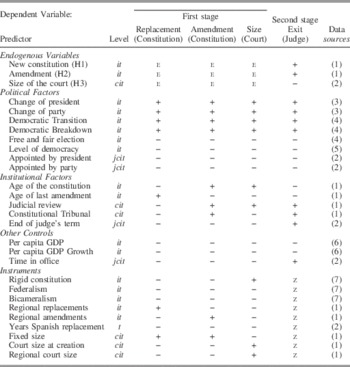
Table 1 presents the list of independent variables, the expected sign for their coefficients at each stage of the estimation, and the sources for the data.Footnote 50 The probability of exit for the average judge in our sample is 0.15, which represents an expected survival time of about seven years in a typical year of service.
Predictors and Anticipated Effects

Notes: Anticipated effects: +β>0; −β<0; e Endogenous (dependent variable); z Not applicable (excluded instruments). Levels of measurement: t Year, it Country-year, cit Country-court-year, jcit Country-court-justice-year. Data sources: (1) Lara Borges, Castagnola, and Pérez-Liñán (Reference Lara Borges, Castagnola and Pérez-Liñán2012); (2) database on constitutional justices developed for this project; (3) Goemans, Skrede Gleditsch, and Chiozza (2009) plus country sources; (4) Mainwaring, Brinks, and Pérez-Liñán (Reference Mainwaring, Brinks and Pérez-Liñán2007); Mainwaring and Pérez-Liñán (Reference Mainwaring and Pérez-Liñán2013); (5) Polity IV (Marshall Reference Marshall2013); (6) World Development Indicators and Maddison (Reference Maddison2003); (7) Comparative Constitutions Project (Elkins, Ginsburg and Melton Reference Elkins, Ginsburg and Melton2009).
RESULTS
In this section we present our empirical results for eighteen countries between 1904 and 2010. In order to facilitate the interpretation of the causal sequence, we report the results of first-stage equations in Table 2, followed by second-stage survival models in Table 3.
First Stage: Institutional Change
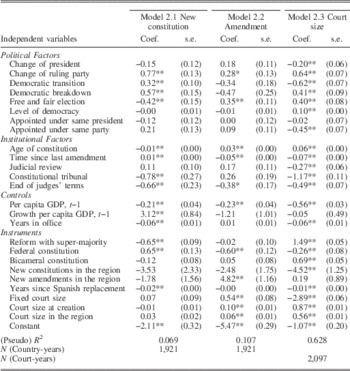
All first-stage models are reported in Table 2. Equation 2.1 models the probability of a full constitutional replacement, Equation 2.2 models the probability of a constitutional amendment targeting the judiciary, and Equation 2.3 models the number of court seats, which expands with court-packing. Even though the three endogenous predictors are estimated for panel data (units of analysis are country-years in the first two models and court-years in the third one), our estimates do not include fixed effects. The instruments are robust to the inclusion of fixed effects, but because unit effects capture unexplained cross-panel variance, those parameters may also be endogenous (i.e., correlated to the residual in Equation 1).Footnote 51
First-Stage Models of Constitutional Change and Court Packing, 1904–2010

Notes: Entries are regression coefficients (logistic in 2.1–2.2 and OLS in 2.3). Unweighted N=24,763. *p<0.05 **p<0.01
The evidence suggests that constitutions are more likely to be replaced (2.1) and amended (2.2) when a new party comes to power. Changes in the ruling party also incite an expansion in the number of court seats (2.3), a pattern consistent with packing schemes. Democratic transitions and breakdowns trigger replacements but not targeted amendments, in alignment with the findings of Elkins et al. using a broader sample.Footnote 52 The size of the court is slightly smaller in countries making a transition from authoritarian rule, but it increases subsequently under competitive politics. The presence of a greater proportion of justices nominated by the ruling party, not surprisingly, reduces government incentives to expand the size of the court.
The age of the charter and the time elapsed since the last amendment have significant but opposite effects for the likelihood of constitutional replacements (2.1). The risk of replacement declines with the age of the charter, and increases when no amendments are introduced. By contrast, the probability of a targeted amendment (2.2) increases with the age of the document but declines if there is no prior tradition of amending the charter. Those results confirm the presence of a substitution effect, also detected by previous studies.Footnote 53
In line with the findings of Elkins et al. we find that judicial review per se does not extend the life of constitutions. However, Model 2.1 indicates that the odds of constitutional replacement decline when a separate constitutional tribunal exercises this role (p<0.05). By contrast, Model 2.2 shows that the rate of constitutional amendments expands with a constitutional tribunal (p<0.05). Both results are consistent with Negretto’s findings. Courts with powers of judicial review also tend to be smaller in size.Footnote 54
The evidence suggests that more developed countries are less likely to replace their constitutions, to introduce amendments, or to expand high courts. Annual growth in per capita income, by contrast, seems to facilitate replacements but has no effect on the other endogenous variables. These findings partially contrast with Negretto’s regional study of Latin America and the worldwide study of Elkins et al., where variables accounting for development and economic crises appear unrelated to constitutional stability.Footnote 55
Turning to the excluded instruments, the analysis shows that constitutions requiring a super-majority to enact reforms reduce the probability of constitutional replacement (surprisingly, this effect is not significant for amendments), but they also encourage legislatures to expand the number of court seats. Concurrently, constitutions fixing the number of justices keep the size of high courts in check, but they encourage the adoption of constitutional amendments addressing the judiciary. Together, these findings reveal another substitution strategy: politicians pack the courts when they are less able to revamp their constitutional structure (and vice-versa). Constitutional design is hardly effective to protect high courts when legislators craft agreements to overcome formal barriers, especially if the allocation of court seats facilitates the formation of partisan coalitions.
Table 2 suggests that Latin American countries replace federal constitutions at critical junctures rather than amending them progressively through the layering or displacement of specific clauses.Footnote 56 The table also provides mixed results with regards to diffusion effects. The adoption of new constitutions throughout the region does not promote constitutional replacement in other countries, but it signals that legal overhaul is possible and reduces demands for court packing.Footnote 57 The adoption of new amendments dealing with the judiciary, by contrast, triggers imitation elsewhere. In addition, a recent constitutional replacement in Spain promotes the adoption of new constitutions in Latin America and eases pressures for court packing in the short run. Model 2.3 reflects a secular trend toward the expansion of courts: the original size of the collegiate body is an important predictor of its current size, but courts tend to grow in size as the constitution ages and when other courts in the region increase their size.
Second Stage: Judicial Turnover
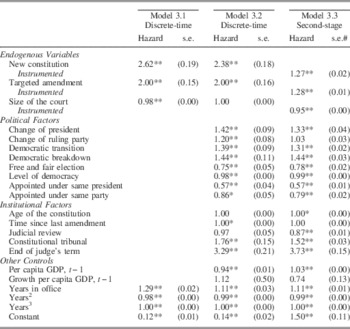
Does institutional change affect the stability of justices on the bench? Table 3 presents the results of the discrete-time survival models accounting for the duration of justices in office. Model 3.1 includes the original (non-instrumental) measures of institutional change with no controls, Model 3.2 incorporates the remaining predictors, and Model 3.3 reports the results of our second-stage estimation.Footnote 58 Entries are expressed as odds ratios: values greater (smaller) than one indicate that the risk of exit is increasing (decreasing) on the predictor. The results offer strong evidence in favor of the argument that institutional change is a major source of judicial turnover.
Survival Models for Latin American Justices, 1904–2010

Notes: Entries are odds ratios (standard errors). Number of observations in each model, 24,763. Number of subjects in each model, 3,494. *p<0.05 **p<0.01. # Bootstrapped for 100 replications.
The coefficients for the endogenous predictors in Models 3.2 and 3.3 support our main hypotheses. The adoption of a new constitution raises the odds of judicial turnover 2.4 times and the adoption of amendments targeting the judiciary makes the odds of turnover twice as high. The hazard ratios for dichotomous endogenous predictors are not directly comparable across Models 3.2 and 3.3, thus the apparent reduction in coefficients for the first two instrumental items.Footnote 59 Although no significant effect is observed in Model 3.2, Model 3.3 indicates that the odds of judicial instability decline by about 5 per cent with every new seat in the court.
These findings remain consistent when we estimate the two-stage model for separate sub-samples covering 2,384 judges who ruled under democracy and 1,902 judges who did so under dictatorships.Footnote 60 Authoritarian rulers may have greater leverage over the judiciary, but democratic rulers have stronger incentives to control judges because they are effectively subject to their jurisdiction. As a result, leaders in both regimes employ constitutional reforms as an opportunity to revamp the courts.
The results also hold when we control for the direction of constitutional reforms. Our database has nineteen constitutional events instituting the courts’ power of judicial review and fourteen removing that power from a court (for example, transferring judicial review from the supreme court to a constitutional tribunal), ten reforms fixing the number of justices in the court and fourteen eliminating this constraint, ten granting life tenure and nine eliminating it, thirty-three extending the duration of judges’ terms and twenty-nine reducing their terms, seventeen making the appointment of judges multilateral and nine concentrating the appointment process in a smaller number of actors. The ancillary analysis in Table S3 (see Supplementary Materials) shows that constitutional replacements and amendments undermine judicial stability irrespective of whether they nominally weaken or strengthen the judiciary, indicating that the political process driving the reforms, more than their formal content, underpins the causal mechanism.
Table 3 confirms that the political environment is crucial for judicial survival. Justices are more likely to leave office when the administration changes and less likely to do so when they were nominated by the incumbent president. In line with this finding, judges nominated by the ruling party tend to enjoy safer seats. More generally, the evidence shows that democratic transitions and breakdowns represent an important source of judicial instability.Footnote 61 Consistent with ‘insurance’ theories, judicial tenures are longer when competitive elections allow for alternation in power and in more democratic countries. Institutional factors also shape the endurance of justices on the bench. Predictably, the end of the term marks a peak in the likelihood of exiting office. Moreover, constitutional tribunal members are more exposed to the risk of removal than Supreme Court justices (p<0.01).
Alternative Estimators
For these conclusions to be meaningful, our excluded instruments must be relevant (related to the endogenous predictors) and exogenous (uncorrelated with the residual of the second-stage equation). Relevance can be assessed in Table 2: in all models, at least three instruments are strong predictors of the endogenous variable. The quality of the instrumental variable, however, varies for each outcome. Our analysis of constitutional change does not differ considerably from the findings of other studies, but because constitutional change – either replacements or amendments – is rare, the predictive power of Models 2.1 and 2.2 is more limited than the predictive power of Model 2.3. Exogeneity of excluded instruments is hard to assess given the complex structure of the model, but we note that in a regression of the second-stage residual against all instruments, R 2=0.01. Bivariate correlations of the second-stage residual with the excluded instruments are also trivial, ranging between −0.04, for federalism and +0.03 for the average court size in the region.Footnote 62
To assure the consistency of our findings, we analyzed the data using three alternative estimators. First, we included a frailty parameter in the second stage, reflecting the assumption that the baseline hazard varies randomly across individuals.Footnote 63 Second, we re-estimated the size of the high courts (first-stage Model 2.3) using a negative-binomial count model instead of ordinary least squares. Third, we replaced the two-stage prediction substitution estimator for a two-stage residual inclusion (2SRI) procedure.Footnote 64 The results for all the tests, presented in supplementary Table S4, unfailingly support the findings in Table 3.Footnote 65
DISCUSSION AND CONCLUSIONS
Scholars often advocate major legal reforms to strengthen the rule of law and judicial independence, without realizing that constitutional events offer politicians a unique window of opportunity to recast the judiciary to their advantage. The analysis of judicial tenure in eighteen Latin American countries between 1904 and 2010 proves that constitutional change is a powerful source of judicial turnover. Judicial instability is triggered not only by the adoption of new constitutions, but also by the adoption of specific amendments affecting the judiciary. This effect is not an artifact of confounding factors and it is significant even after we account for potential endogeneity. Moreover, our findings indicate that court ‘packing’ is a feasible substitute for court ‘reshuffling’: an expansion in the size of the court is consistently related to a parallel reduction in the risk of judicial turnover.
Our findings have substantive implications for theories of institutional change and of judicial politics. Canonical works in all variants of the neo-institutional tradition take for granted that constitutional rules are exogenous and constrain the power of political actors.Footnote 66 However, scholars have acknowledged the theoretical problem posed by the endogenous nature of institutions.Footnote 67 Because political elites who are subject to constitutional rules are also designers of such rules, it is unclear whether institutions constrain their behavior or simply reflect their initial willingness to abide by such norms. In response to this puzzle, some scholars have explored the causes for constitutional change, while others have analyzed subtler ways in which institutions are reshaped, distorted, or abandoned.Footnote 68 This line of reflection has been augmented by the study of informal institutions, which reinforce or undermine the effectiveness of formal norms.Footnote 69
Our study contributes to this line of inquiry in two ways. First, because the enforcement of normative frameworks requires legal interpretation, we claim that courts – especially, constitutional courts – represent the first layer of analysis to understand the endogenous nature of institutions. If high courts are unwilling to enforce unfavorable norms, governments will circumvent legal constraints. Moreover, if high courts are willing to advance a favorable interpretation of the law, governments will expand their prerogatives without pursuing legal reform. Thus, political battles to control the meaning of the law quite often turn into political battles to control the composition of high courts. Our analysis showed that political realignments – at the government level as well as the regime level – are strong predictors for judicial turnover in Latin America.
A second conclusion of this article is that institutional instability matters for judicial integrity, irrespective of the content of the rules. Neo-institutional studies have conventionally focused on the consequences of institutional design for political life, yet we claim that the process of change, more than its direction, is critical for judicial independence. We do not argue that constitutional change is just a façade to reshuffle the high courts, but the crafting of new constitutions often allows political leaders to overhaul the judiciary – a powerful temptation even as the constitutional assembly seeks to strengthen the legal system. Nor do we argue that the renewal of justices is always detrimental to the performance of the judiciary, but frequent attempts to replace the constitution and its interpreters will set a pattern in which ‘change is both radical and recurrent.’Footnote 70
The findings presented in the previous pages prove that constitutional change can be a persistent source of judicial instability. Those findings hold for a large number of countries, across dictatorships and democracies, and over a very long historical period. The practical lesson offered by Latin America is not that scholarly advocates should abandon any project of reform in favor of a conservative view of the law, but that they should be fully aware of the potential consequences of institutional change for the integrity of the judiciary they intend to protect.