“It's not just about Lubbock, but any small hypocritical town.”
—Natalie Maines on “Lubbock or Leave It”Footnote 1
The May 2006 release of the Dixie Chicks’ fourth studio album, Taking the Long Way, was a much-anticipated event for country music. Following the backlash against lead singer Natalie Maines for her denunciation of President George W. Bush from a London concert stage, many were eager to see how the trio would respond to the industry, the media, and former fans. Instead of placating the country music audience, however, the group released a boldly unapologetic album that confronted their critics head on. They were, according to the title of their lead single, “Not Ready to Make Nice” over the political controversy that had surrounded their career for more than three years.Footnote 2 Although the single and its video attracted national media attention, it was the album's seventh track, “Lubbock or Leave it,” that was most heatedly discussed in Maines's Texas hometown—even before the album was released. Co-written by Maines, her bandmates Emily Robison and Martie Maguire, and Mike Campbell (of Tom Petty and the Heartbreakers), the song responded to Lubbock's participation in the 2003 boycott of the Dixie Chicks’ music. When local entertainment journalist William Kerns published the song's lyrics in May 2006, Lubbock residents soon began expressing their objections to the portrayal of their hometown as small and narrow-minded.Footnote 3 The Lubbock Avalanche-Journal's website received a barrage of comments, and local musician Billy Briggs even co-authored a response song (“Trouble in the Henhouse”) with his wife Katherine. Their song defended Lubbock, criticized the trio, and called for a continued boycott.Footnote 4 Lubbock's angry response was not surprising: the song was viewed as an insult to the West Texas community that “raised” Maines.
The lyrics of “Lubbock or Leave it” appear to reject the lead singer's hometown outright; the song's musical setting, however, draws on conventions deeply associated with the West Texas region against which Maines rails.Footnote 5 The country-rock musical setting suggests a deeper layer of meaning, revealing that Lubbock's culture and traditions have permanently marked Maines's artistic identity.Footnote 6 This simultaneous rejection and embrace offers a rich example of how songwriters use music as a means to define their relationship with place, and in turn articulate their role within sociopolitical and cultural structures.
In his seminal work in cultural studies, Raymond Williams argued that country and city are constructions of the imagination; the country represents the past and old ways, whereas the city represents the future and modernization.Footnote 7 Such ideas are complicated by the myriad ways in which individuals perceive and relate to open spaces and urban development; what may provide a sense of freedom for one individual may cause feelings of isolation for another. What makes Lubbock such a fascinating case study for considering the relationship between artist and place are the tensions between these constructions of country and city and the contradictory narratives that emerge in many of the songs about the West Texas city. Although the surrounding area is indeed rural, known for cattle and cotton farming, Lubbock is a prosperous city with nearly 230,000 residents and a major university, Texas Tech.Footnote 8 Local songwriters, however, tend to describe Lubbock through a rural or small-town lens, creating an image of an expansive countryside while describing the city as limiting, constricting, and isolated.
The concepts of “place,” “space,” and “home” are integral to country music. Indeed, place-based song narratives not only describe and define place—both specific and archetypal—but also articulate the relationship between individuals and their environment and community. Within country music, this tradition finds its roots in early hillbilly recordings, songs of the singing cowboy, Kentucky bluegrass, and western swing.Footnote 9 Many of the genre's most prominent artists have reflected on place in their music: the Carter Family's “My Clinch Mountain Home” (1937; Clinch Mountain, Virginia); Loretta Lynn's “Coal Miner's Daughter” (1969; Butcher Holler, Kentucky); and Dolly Parton's My Tennessee Mountain Home (1973; Sevierville, Tennessee) are just a few examples. Contemporary country artists continue to communicate life experiences and lessons learned in small-town America (Little Big Town's “Boondocks” [2005]), to juxtapose the simplicity of life in their hometown against the greed of the city (Carrie Underwood's “Ain't in Checotah Anymore” [2005]), or to explore issues of regional or national identity (Rodney Atkins's “It's America” [2009]).Footnote 10 Such songs do not simply describe home; rather, they use place as a way to define core elements of the artists’ identities and to articulate an element of rusticity, which, as Pamela Fox notes, allows country artists to maintain their humble origins and their connection to a predominantly working-class culture.Footnote 11
Country artists often explore their relation to place through the juxtaposition of city and country (as with Underwood's reflection on Checotah, OK) and through narratives that express the tensions between sin and salvation, urban and rural life, liberal and conservative values, and resistance and conformity.Footnote 12 Country scholar Joli Jensen has observed that cities are often represented as dehumanizing places full of greed and temptation, whereas the country is characterized by green landscapes and associated with family values (sometimes represented by a waiting mother or girlfriend).Footnote 13 The relationship between country and city, however, is not so easily generalized as one of salvation versus sin: just as home can represent security and belonging, it can also represent a place from which artists struggle to escape the confines of family, community, politics, and religion.Footnote 14 Such narratives enable us to see vital parts of individual, regional, or national identity that would otherwise be hidden, obscured or overshadowed.
The fields of cultural geography and musicology both offer models for exploring the ways in which popular music serves to express regional and national identity. Since the early 1990s cultural geographers have been demonstrating how songs can be used to construct regional and national identity, or even to impart emotion and personality to place.Footnote 15 The work of Blake Gumprecht, for example, has explored the ways in which West Texas artists have captured the region's soundscape in their music.Footnote 16 Following the lead of cultural geography, musicologists have in the past decade turned their attention to geography in both classical and popular music.Footnote 17 Adam Krims and Travis Stimeling in particular have demonstrated how musical codes and stylistic conventions contribute to the image or identity of place. Krims's groundbreaking 2007 book, Music and Urban Geography, was the first significant musicological project to draw from the fields of music theory and urban geography in order to understand the social, political, and cultural messages communicated in popular music. Integral to Krims's study is the idea that musical codes and stylistic conventions can represent or characterize geographic space. His work emphasizes the role that the musical setting (harmony, melody, instrumentation, etc.) plays in highlighting, embracing, and/or critiquing aspects of environment described in a song's lyrical narrative.Footnote 18 Stimeling's 2012 study of country music responses to Central Appalachian mountaintop removal mining considers, among other things, the ways in which musical styles are used to evoke a sense or regional identity and, by extension, establish a sense of community among artists.Footnote 19 Collectively, these studies, arising from the fields of cultural geography and musicology, provide a framework for understanding the language and music used to characterize Lubbock in the songs of contemporary country artists, and for understanding how these artists—whether of mainstream or local renown—negotiate their place within the town's musical culture.
Dixie Chicks and Lubbock, TX
At the beginning of 2003, the Dixie Chicks were riding high on the success of their third studio album, Home (2002), a largely acoustic album featuring folk-inspired lyrics, bluegrass instrumentation, and even classical orchestration.Footnote 20 Recorded with Lloyd Maines— Natalie Maines's father—in Austin's Cedar Creek Studios, the album received rave reviews and sold six million units in its first seven months on store shelves.Footnote 21 But everything changed dramatically after 10 March 2003 when, from the concert stage at Shepherd's Bush Empire in London, Natalie Maines proclaimed that the trio was “ashamed the President of the United States was from Texas.”Footnote 22 Many viewed this statement, made on foreign soil and on the eve of war, as un-American and un-patriotic. The ensuing denunciation hurt the musicians’ careers and private lives; Maines even received a death threat.Footnote 23 Instead of apologizing or recanting, the Dixie Chicks fought back against those who wished to silence them. They joined the “Vote for a Change” tour alongside James Taylor, Bruce Springsteen, Pearl Jam, and Bonnie Raitt, becoming advocates for free speech at a time when radio conglomerates were shutting out any artist who displayed the slightest opposition to President Bush.Footnote 24 After taking a two-year break from recording and writing following the “incident” (which, one might argue, was ongoing), Taking the Long Way became a vehicle for the trio to respond to critics. They embarked upon their musical journey under the guidance of celebrated heavy metal and rap producer Rick Rubin and, for the first time, participated in the writing of every song on an album.Footnote 25Taking the Long Way introduced a new sound for the trio, one that embraced the Southern California vibe of the Eagles and the intensity of 1970s rock and roll, while retaining the banjo rolls and fiddle licks for which they are known.Footnote 26 Although many critics applauded the album's maturity, Taking the Long Way also reignited anger among many Republican organizations, the country music industry, and former fans, and sparked new controversy for Maines in her hometown of Lubbock, TX.
“Lubbock or Leave it”
In a VH1 special, the Dixie Chicks revealed that “Lubbock or Leave it” was inspired by the 2005 documentary The Education of Shelby Knox, which follows a fifteen-year-old girl's political activism as she fights to establish a gay-straight alliance in Lubbock and comprehensive sex education in a public school system that preaches abstinence.Footnote 27 The film captures Knox's transformation from conservative Baptist to liberal Christian and her personal struggles with her parish and parents. Having grown up in Lubbock, Maines sympathized with Knox and admitted in the VH1 interview that the documentary reminded her of what it was like to be a teenager in the city.Footnote 28 But at the time that the trio began writing the song with Mike Campbell, Maines was still unwelcome in Lubbock: the town that had fostered her talent had turned its back on her. Following the “incident,” the Lubbock Avalanche-Journal received an overwhelming number of angry letters about Maines and her bandmates, and Lubbock radio stations refused to play the trio's music.Footnote 29 Although the song does not delve into the issues raised in Knox's documentary, the lyrical narrative addresses the larger issue that affected both Knox and Maines: an individual's struggle with the parochialism and conservative thinking of her hometown.
The city's name is mentioned only in the song's title, which is an obvious play on the slogan “love it or leave it.” The popularity of the phrase coincided with a surge of patriotism in the late 1960s and early 1970s during the Nixon presidency. It became a popular bumper sticker and was even used in two popular country releases: Merle Haggard's “Fightin’ Side of Me” (1969), and Ernest Tubb's “It's America (Love It Or Leave It)” (1970). In these songs, Haggard and Tubb responded to rising anti-war sentiments during the Vietnam War; Haggard's jingoistic anthem explicitly warns those who criticize the American way of life that if they don't love it, they can leave it. Both songs were in keeping with Lubbock's religious-political platform of the time, as the town's ministries preached loyalty and patriotism as part of a religious crusade against Communism (see below). Around the same time, “Lubbock or leave it” became an unofficial city slogan, appearing on bumper stickers.Footnote 30 The slogan was later used to name an Austin-based art gallery, performance space, and gift shop dedicated to preserving Lubbock culture; a chapter about Lubbock's musical culture in Nicholas Dawidoff's In the Country of Country (1995); and Lubbock native Lizzy McGlynn's short video documentary of her hometown.Footnote 31 In these uses the slogan conveys an affection and respect for Lubbock and all its oddities. Maines and her co-writers, on the other hand, use it to criticize Lubbock's narrow-mindedness, and to sarcastically question her place within the town.
The Dixie Chicks do not name Lubbock in the song's lyrics, but instead use geographic descriptors and landmarks in each of the verses.Footnote 32 The first verse criticizes Lubbock's weather (“dust bowl”), location (“Bible Belt”), overabundance of churches (“got more churches than trees”), and inability to persuade Maines to remain true to her religious upbringing (“couldn't save me, couldn't keep me on my knees”). The third and fourth lines of the verse contain the first reference to a Lubbock landmark, Loop 289 (the highway that encircles the city), and expertly weave the titles of four famous tunes by Lubbock native Buddy Holly (underlined): “Oh Boy, Rave On down Loop 289, That'll Be the Day you see me back in this Fool's Paradise.” These carefully chosen titles not only insult Lubbock (the “Fool's Paradise”), but also begin constructing Maines's relationship to Holly, which emerges in the bridge. The second verse further describes Lubbock as intolerant of progress, change, and liberalism, and chides the city for trying to hide the high incidence of drug and alcohol use among its youth (“On the strip, the kids get lit”), referencing the Las Vegas–style area just south of the city. The third verse mocks Lubbock's “International” Airport, with its flights to Paris and Athens, that is, Paris, Texas and Athens, Georgia, and ends with Maines laughing to herself as she sees the portrait of Buddy Holly that hangs in the airport.
Whereas the verses define Lubbock's character, the bridge and chorus establish Maines's relationship with her hometown, and her place within its musical heritage. In the bridge, Maines directly addresses Buddy Holly: “I hear they hate me now just like they hated you, maybe when I'm dead and gone I'm gonna get a statue too!” Although Lubbock now reveres Holly (and capitalizes on his image through a park, museum, and music festival), the song suggests that the town has conveniently forgotten its criticism of the rockabilly star during his lifetime. Maines, who felt ostracized by her hometown, uses the song's climax to draw parallels between Lubbock's poor treatment of Holly and her own experience.Footnote 33 The chorus is infused with sarcasm, asking how she will “ever get to heaven” without her hometown's moral and religious grounding.Footnote 34 The song closes with a repetition of this question, a final jab at her community's inability to “save” her. What emerges throughout the narrative is a clear rejection of Lubbock's values, and the overriding sense that Maines perceives herself as an outsider to this community.
Several Lubbock musicians and residents supported the Dixie Chicks’ lead singer, including Holly's widow.Footnote 35 One resident identified the root of the problem when he wrote, in defense of Maines,
I know why Natalie wanted to leave. Why Natalie had to leave. Lubbock is a safe place to raise kids. But it's a narrow place, a protected place, a limited place that doesn't respond well to questions, provocation, or change.
It's not a city, in the sense that we define cities. It's a small town of 200,000 people, with all the virtues and vices of a small town. The people of Lubbock are good people, but they are good in a very narrow way.
They are good in a very narrow context, and they react poorly when that context is threatened. They are quick to offer their hospitality, and even quicker to turn when that hospitality is abused.Footnote 36
Another supportive Lubbock native described the track as a “rousing musical fuck you that drove critics into a whole new spasm of blood-flecked red state rage.”Footnote 37
Those who chose to respond most publicly to the lyrics, however, interpreted the song as a rejection of the town, its values, and its traditions. The Lubbock Avalanche-Journal's website received a barrage of letters and comments about Maines and the song from Lubbock citizens who viewed the lyrics as disrespectful of the town that raised her and were appalled by her self-comparison to rockabilly icon Buddy Holly.Footnote 38 One critic claimed that the song lyrics revealed more about Maines than Lubbock:
I see a young Lubbock girl, raised by fine parents and taught in Lubbock schools, who found fame and fortune, and in the process lost her loyalty, her patriotism and her genteelness. Saddest of all, she seems to have lost her faith. Her repetitive chorus of “Salvation's gone, I'm on my way to hell's half acre” is a chilling example of what her life after Lubbock has done for her.Footnote 39
One of the most critical responses came from Lubbock country musician Billy Briggs and his wife Katherine in their song, “Trouble in the Henhouse.”Footnote 40 Reacting to “Lubbock or Leave it,” the Briggs’ song followed the Dixie Chicks example and drew on titles of Dixie Chicks and Buddy Holly song titles to defend Lubbock's honor and criticize the trio. Where the Dixie Chicks called Lubbock a “Fool's Paradise,” the Briggs returned the criticism in their song's chorus, calling the trio a bunch of “Fools” for not realizing that Lubbock is a “Paradise.” The second verse draws on Dixie Chicks song titles to let the band know that Lubbock is better off without them by quoting “Without You” (1999). Ultimately, “Trouble in the Henhouse” sends the message that Lubbock should stop buying Dixie Chicks songs, the trio is no longer welcome in Lubbock, and Maines should not expect a statue any time soon “because Buddy is a legend, and [she's] not even second best.” As the song fades out, Briggs again uses Dixie Chicks song titles to make fun of Maines, noting the “Wide Open Space” (1998) between her ears and suggesting that she should stop listening to the “Voice[s] Inside [her] Head” (2006).
Maines proved to be a destabilizing figure in her hometown. Her liberal, anti-war politics and open criticism of Lubbock's hypocrisy and narrow-mindedness offended many. The song provoked a heated reaction from Lubbock citizens, and demonstrated not only their fierce loyalty, but also their intolerance for individuals who threaten the status quo of the town. Those who did not sympathize with Maines were unable to comprehend how the singer could so openly reject her hometown; they blamed fame, fortune and, most importantly, life outside of Lubbock, for what they perceived as her loss of manners, faith, and patriotism.
Lubbock, Texas
Standing out there on your front lawn you can look down the street all the way through town to the horizon. You realize there isn't much difference between over there at the horizon and over here, where you're standing. In effect, you're standing on the horizon; you're on the edge of the planet. It's a real bizarre thing. I think it's unconsciously affected people in ways they don't suspect.Footnote 41
Located in the Texas panhandle, Lubbock County sits in the middle of the Southern High Plains of West Texas, 125 miles south of Amarillo and 345 miles west of Dallas. Lubbock County is flat and treeless (see Figure 1).Footnote 42 Elevated 2341 feet above sea level, the region's climate is hot and dry, with summer temperatures reaching highs of 105°F, and an average of only eighteen inches of rain per year.Footnote 43 Lubbock's climate is characterized by extreme weather conditions, and has the highest incidences of severe thunderstorms, dust storms, hail, and tornadoes in the world.Footnote 44 Once believed to be uninhabitable, Lubbock County transformed from empty terrain into a prosperous city, surrounded by sprawling farming land due to the postwar development of new irrigation technologies that allowed farmers to tap deep into the Ogallala Aquifer.Footnote 45 Although the main industries of the region today are cattle, cotton, and oil, Lubbock is also home of Texas Tech University, established in 1923, as well as many manufacturing and technology companies.Footnote 46
Lubbock County landscape. Photograph by Christopher J. Oglesby. Used with permission.

Religion and politics have been closely bound together throughout Lubbock's history. The early settlers endured danger, hardship, grinding work, and deprivation; the asceticism of their lives has left a mark on Lubbock throughout the twentieth and twenty-first centuries, most notably with regard to conservative views on sexual abstinence and alcohol sales.Footnote 47 In the 1880s, the first religious denominational tradition to organize services in the region was the Church of Christ, followed shortly after by Baptist and Methodist faiths in 1892.Footnote 48 By 2001, there were 574 churches in Lubbock, and the first three ministries to assemble in the region remain the largest congregations.Footnote 49 Lubbock natives have long turned to religion as a guiding force through periods of heightened national and international tensions. During the Cold War, the rise of communism led Lubbock's religious communities to increase activity in an effort to maintain the town's high moral standards. Church ministries employed teachers to enter into public schools to teach Biblical faith and ward off, in H. Paul Chalfant's words, “alien ideas which might be brought into the area.”Footnote 50 As Butch Hancock recounts about his youth, “in Lubbock, we grew up with two main things, God loves you and he's gonna send you to hell, and that sex is bad and dirty and nasty and awful and you should save it for the one you love.”Footnote 51 Abstinence continues to be the main message of sexual education in Lubbock's public schools; as a result, conservatively oriented patriotism and religious beliefs have been the foundation of ideological thought in Lubbock.
This conservatism also led to a strict control over the sale of alcohol in the region. Between 1901 and 1972, thirteen elections were held concerning the sale and consumption of alcohol in Lubbock city and its surrounding county, with results ranging from prohibition to severe restrictions, although liquor could be purchased fairly easily through bootleggers, hotel bellmen, and even at the courthouse.Footnote 52 A 1972 Lubbock city election made “liquor by the drink” legal, while package liquor sales remained illegal inside city lines. According to Lawrence Graves, “many people were appalled by this apparent abandonment of the strict moral standards by which the city had lived for so many years.”Footnote 53 Lubbock had previously held the distinction as the largest “dry” city in the country, but following this election, a privately owned conglomerate of liquor stores called “The Strip” opened on Highway 87.Footnote 54 With its flashing neon lights, the stretch of highway resembled the Las Vegas strip, and was the only place where one could buy alcohol by the package (see Figure 2). In 2006, the Lubbock City Council voted to annex “The Strip” and make package alcohol sales legal within Lubbock city limits—albeit with strict zoning restrictions.Footnote 55
“The Strip,” Lubbock, Texas. Photograph by Christopher J. Oglesby. Used with permission.
Lubbock's rigid conservatism, deep religious values, and geographic isolation proved to be an environment conducive to a rich and diverse musical heritage. As Lloyd Maines recounts,
Lubbock was pretty much nothing but cotton fields and high school football. When you were growing up, you were expected to play sports, which we did . . . But as far as entertainment went, you had to kind of create your own. So a lot of music came out of there. It was the exact same thing with [Lubbock residents] Joe Ely, Butch Hancock, Jimmie Gilmore, all those guys, and I'm sure if you went back and asked Buddy Holly or Mac Davis or Waylon Jennings, it would be the same.Footnote 56
Lubbock has always been a country-western dominated region, thanks to the West Texas swing music of Bob Wills and Tommy X. Hancock. But the city also holds a prominent place in the rock canon, as the birthplace of Buddy Holly and The Crickets. As one of the pioneers of rock ‘n’ roll along with artists such as Elvis Presley, Carl Perkins, Jerry Lee Lewis, and Johnny Cash, Holly was a dominant figure in the “rockabilly” subgenre. According to Lubbock historian Christopher J. Oglesby, most of Holly's classmates in Lubbock “remember him, if at all, as ‘that crazy boy who always carried around a guitar.’”Footnote 57 Perhaps due to his rapid rise to fame, Lubbockites seemed oblivious to Holly's rock status in the rest of the country (and Europe) until well after his death.Footnote 58 In fact, during the 1950s, Lubbock—like many religiously centered towns of the time—had a love-hate relationship with rock ‘n’ roll in general. Many viewed the music as deviant and lacking moral decency. The media, religious and political organizations, and schools systems acted as cultural guardians, protecting their community against the decadence of rock music. After a Holly concert in the late 1950s, the Lubbock Avalanche-Journal printed a picture of the concert under the headline “Teen-Age ‘Bop’ Clubs Worry City Officers,” with the faces of dancing teenagers blocked out so as not to embarrass parents by their children's deviant behavior. For many Lubbockites, rock music represented the loose morals of society's underbelly, and many believed that the genre had a negative effect on youth.
Music Culture in Lubbock
Since Holly's premature death in 1959, the Lubbock region has been a fertile breeding ground of talented and radical musicians. Waylon Jennings, born in nearby Amarillo, started his career as a radio DJ in Lubbock before playing bass guitar in Holly's band in 1959, and later achieved his own success as one of country music's most prominent “outlaw” artists.Footnote 59 Roy Orbison lived south of Lubbock before moving to Nashville; the 1970s TV star and singer-songwriter Mac Davis hails from Lubbock County as well. The city of Lubbock is also home to a group of musical mavericks who have continually rebelled against Lubbock's conservative values. These artists include singer-songwriters Joe Ely, Jimmie Dale Gilmore, Butch Hancock, and Terry Allen; psychobilly musician The Legendary Stardust Cowboy; and pedal steel player and producer Lloyd Maines.Footnote 60 Ely, perhaps the most famous of the group, is known for his more progressive country-rock fusion. Ely, Hancock, and Gilmore play together as The Flatlanders, an alternative country group that fuses the musicians’ respective styles of rock, country, and folk.
Although Holly's rockabilly sound has remained a seminal influence on Lubbock musicians, the 1970s radio station XERF—based out of Del Rio and featuring the talents of radio personality Wolfman Jack—had perhaps the greatest impact on Lubbock's young musicians. In the film Lubbock Lights, Ely, Hancock, and Allen recall spending nights out in the middle of the cotton fields listening to XERF on car radios, receiving an education on music that exposed them to Muddy Waters, Bo Diddley, Jimmy Reed, and Little Richard. This music inspired Lubbock's youth to explore new instrumental sounds and techniques, and has led to distinctive sound now associated with the region.Footnote 61 Gumprecht has defined this sound as uniquely West Texan, falling “somewhere between country, rock, and folk,” and which includes the rockabilly style of Holly, progressive country-rock fusion of Ely, and stripped down country-folk of Hancock, Gilmore, and Allen.Footnote 62
The Maines family has maintained a prominent place in Lubbock's musical culture.Footnote 63 Lloyd Maines is a legendary pedal steel guitarist and important sound engineer and record producer, and has appeared on and produced more than 150 albums.Footnote 64 Introduced to music as a young boy, Lloyd grew up watching his father perform in the Maines Brothers Band in the 1950s (a band he and his brother inherited in the 1970s). In the late 1970s, he performed with Ely's band and was an integral component to their progressive country-rock sound. Like her father, Natalie Maines was surrounded by Lubbock's musical culture throughout her youth, and has credited Joe Ely as a major influence on her stage performance.Footnote 65
The Musical Tradition of Addressing Lubbock
Lubbock singer-songwriters have long explored their relationship with the region in and through their music. This tradition dates to the turn of the twentieth century and the singing cowboys, who sang about the places they lived while moving cattle up to the western markets.Footnote 66 Since then, Lubbock musicians have written a variety of place-conscious songs about the town. Some artists have even created musical portraits of Lubbock's geography, as in Butch Hancock's 1978 album West Texas Waltzes and Dust Blown Tractor Tunes. Hancock wrote the album from the seat of his John Deere tractor, and even tuned his guitar to the tractor's second gear (which produced a G drone); the changing tone of the tractor's hum while moving through hard and loose soil provided the accompaniment.Footnote 67 His hoarse, warbly vocals on songs like “Dry Land Farm” capture the area's hot, dusty landscape, while his forcefully played harmonica produces a piercing “doubled” pitch that sounds like the whistle tones of harsh wind. Although Hancock's performance paints a picture of the harsh realities of dry land farming in a region known for its dust storms, he also finds peace and appreciation in Lubbock's environment. In “Texas Air,” an ode to West Texas land, the piercing quality of the harmonica subsides and Hancock produces more focused, clean sound that evokes a sense of a gentle breeze. Terry Allen incorporates a wind machine, tornado siren, and violin in “Lubbock Tornado (I Don't Know)” (1980) to simulate the F5 tornado that devastated Lubbock in 1970.Footnote 68 And in “South Winds of Summer” (2002), The Flatlanders combine the long pitch bends of a musical saw and pedal steel, as well as the tremolo of a mandolin, to evoke the Lubbock wind and, as in the other songs mentioned here, capture the artists’ intimate relationships with land and environment.Footnote 69
Many Lubbock musicians spent their youth in a battle with the conservative views, religious structures, unstable climate, geographic location, and extreme isolation of their hometown. In Lubbock Lights, Terry Allen states that the “town was so conservative and so isolated. . . it's about the largest town in nearly 300 miles in every direction. So it was a center in that sense, but it was also a prison in that sense, too.”Footnote 70 Despite the fact that Lubbock is indeed a city, these artists remain preoccupied with the contradictory notions of freedom and isolation created by what Ely calls the “vast nothingness” of the landscape, stating that Lubbock's landscape can make one feel both insignificant and limitless. Allen, on the other hand, believes that these extremes can make a person paranoid. In the documentary, several artists note that cars provided freedom; most artists fled from Lubbock at an early age by bus, car, hitchhiking, or train-hopping to other (often larger) cities, notably Austin. Yet within the country music tradition, distance from home often creates nostalgia for the security and comfort of family and community, and a desire for an eventual return (whether physical or metaphorical). Many of the musicians in the documentary reflect nostalgically on the town, its people, and attest that its rigid confines actually led them to create progressive and experimental music.
Terry Allen's concept album Lubbock (On Everything) (1979), recorded by Lloyd Maines, touches comically on a variety of themes including the town, its people, industry, agriculture, the weather, and the land. In Lubbock Lights, Allen shares strong opinions about Lubbock, describing his isolation in his youth, and his desire to flee as soon as he could; but he also admits that when he really looked at the songs that he wrote more than twenty years earlier for Lubbock (On Everything), he realized he actually loved his hometown. His songs may poke fun at some of the cultural oddities of the town, but none are mean-spirited; they instead reveal compassion for the community that raised him and inspired his artistic voice.
In 1981, Mac Davis explored a more traditional country music narrative in his hit “Texas in My Rear View Mirror,” a song about a teen's desire to escape his hometown that he had written after living in Los Angeles for a dozen years. The song's verses chronicle a young man's journey from restless Lubbock teen to struggling Hollywood musician; at the song's bridge, the young man realizes that Hollywood had deceived him; the moon in his new home was not even the same as the one he knew in Lubbock. Too proud to admit his mistakes, he remains in Hollywood and gives in to the temptations of alcohol. After each verse, or stage in his journey, Davis sings that he “thought happiness was Lubbock, Texas in [his] rear view mirror.”Footnote 71 In the final verse, however, he explains that God helped him realize that happiness was actually “Lubbock, Texas growing nearer and dearer.”
Davis's lyrics ascribe qualities to the two locations in a way that corresponds with scholar Joli Jensen's observation about the ways in which country songs distinguish the urban from the rural. Hollywood appears to young Davis in his dreams as a seductive, but increasingly unfriendly, “lady in red,” whereas home, although not necessarily rural, is initially portrayed as limiting, associated with his (smothering) mother and religious upbringing. This contrast is further developed in the musical setting, which draws on specific sounds to characterize Lubbock and Hollywood. The introduction deploys harmonica, acoustic guitar, and pillowy strings, a combination often used to signify rural spaces, and which later represent “home” in the lyrics. At the bridge, the acoustic guitar and harmonica drop out, with the comping Rhodes, bass guitar, and drum kit creating a dream-like atmosphere; the shift from “ooohs” to “aaahs” in the background vocals marks the moment of realization that Hollywood had deceived him. With this realization, the original instruments slowly re-enter as the young man comes out from under Hollywood's magnetic spell. A pedal steel guitar joins in as Davis finds spiritual redemption, and further emphasizes the narrative shift toward “home.” The musical setting of the verses and choruses and dream-like bridge represents the tension of the traditional home versus urban Hollywood, or the security of family versus the seductive lady in red. Ultimately, this song is about the struggle to find one's place within the community to which one was born: the further Davis's character got from home, the more he realized that home was an integral part of who he was as an individual.
Whereas Mac Davis characterized Lubbock as a faithful wife, Andy Eppler's 2006 song “Lubbock, Texas” presents the town as a tease who tortures the songwriter with her hurtful behavior and continual rejection. The son of a preacher, Eppler had a religious upbringing and sang worship music in his father's church before turning to secular music in his mid-teens. At the age of twenty-one, after a few years of playing his music in Lubbock bars with little success, he penned “Lubbock, Texas.”Footnote 72 Eppler's Lubbock emerges in the song narrative as a tease or an unfaithful lover (first verse) and an unaccepting authority figure (fourth verse); the choruses ask Lubbock why she won't “kiss” or “love” him despite his fidelity. Eppler concludes the chorus (and song) by questioning why Lubbock insists on making a fool out of him. The image of Lubbock-as-tease is positioned against the welcoming arms of Boulder, Colorado—a town that he continually threatens to leave Lubbock for (and eventually did, in 2008). Eppler's performance and recording strategies capture an intimate message from the singer to his hometown. “Lubbock, Texas” was recorded directly into Eppler's laptop microphone, capturing audible unintentional, non-verbal sounds including the click that turned the recording software on and off. These strategies pull the listener into Eppler's personal space, as though we were observing him compose a letter to Lubbock.
In interview with Oglesby, Eppler noted that every time he plays this song in Lubbock, “the crowd goes nuts . . . Every time I say the words, ‘Lubbock, Texas’ you see a wave through the crowd with everyone yelling.” “Apparently they weren't listening to the rest of the song,” Eppler jokes—the song itself is an obvious criticism of intolerant Lubbock audiences.Footnote 73 Eppler explored his relationship with Lubbock yet again on Disease in the Heartland, his 2009 concept album about life on the West Texas Plains, in which he further defines his estranged relationship with his hometown and displays not nostalgia for Lubbock, but a strong desire to escape from it.
These musical responses to Lubbock capture different aspects of the region's identity. For some, like Hancock, the region has a particularly rural identity; his songs about the region address the effect of the environment on dry land farming and the plight of the farmer who struggles with the harsh climate. He portrays West Texas's climate as inhospitable yet tranquil, and conveys a deep appreciation for the region, while offering powerful social commentary on the conflicts between rural and urban values. For others, notably Allen, Davis, and Eppler, Lubbock has a small-town identity. With the exception of Eppler, the artists express nostalgia for a town that they spent their youth battling against. Time and distance seems to have provided Allen and Davis with a new understanding of the role that West Texas played in fostering their musical talent and artistic identity. Whether or not Natalie Maines is willing to admit it, Lubbock has likewise shaped her musical development and identity. As revealed in the musical setting of “Lubbock or Leave it,” to which I will now return, her roots remain firmly tied to the musical culture of Lubbock.
Musical Influences on “Lubbock or Leave it”
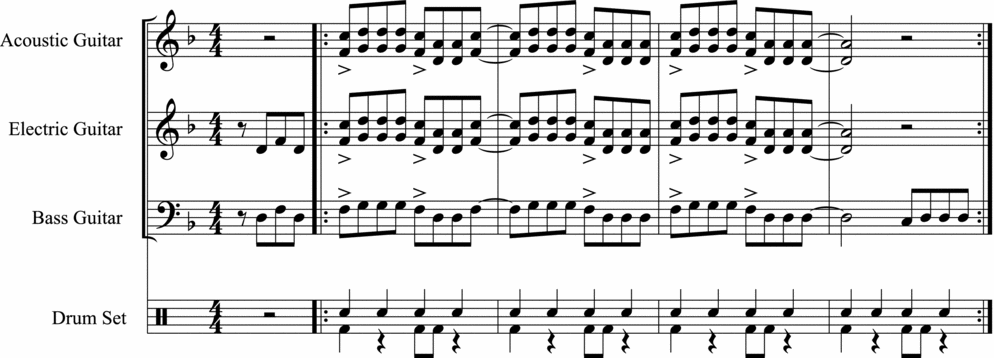
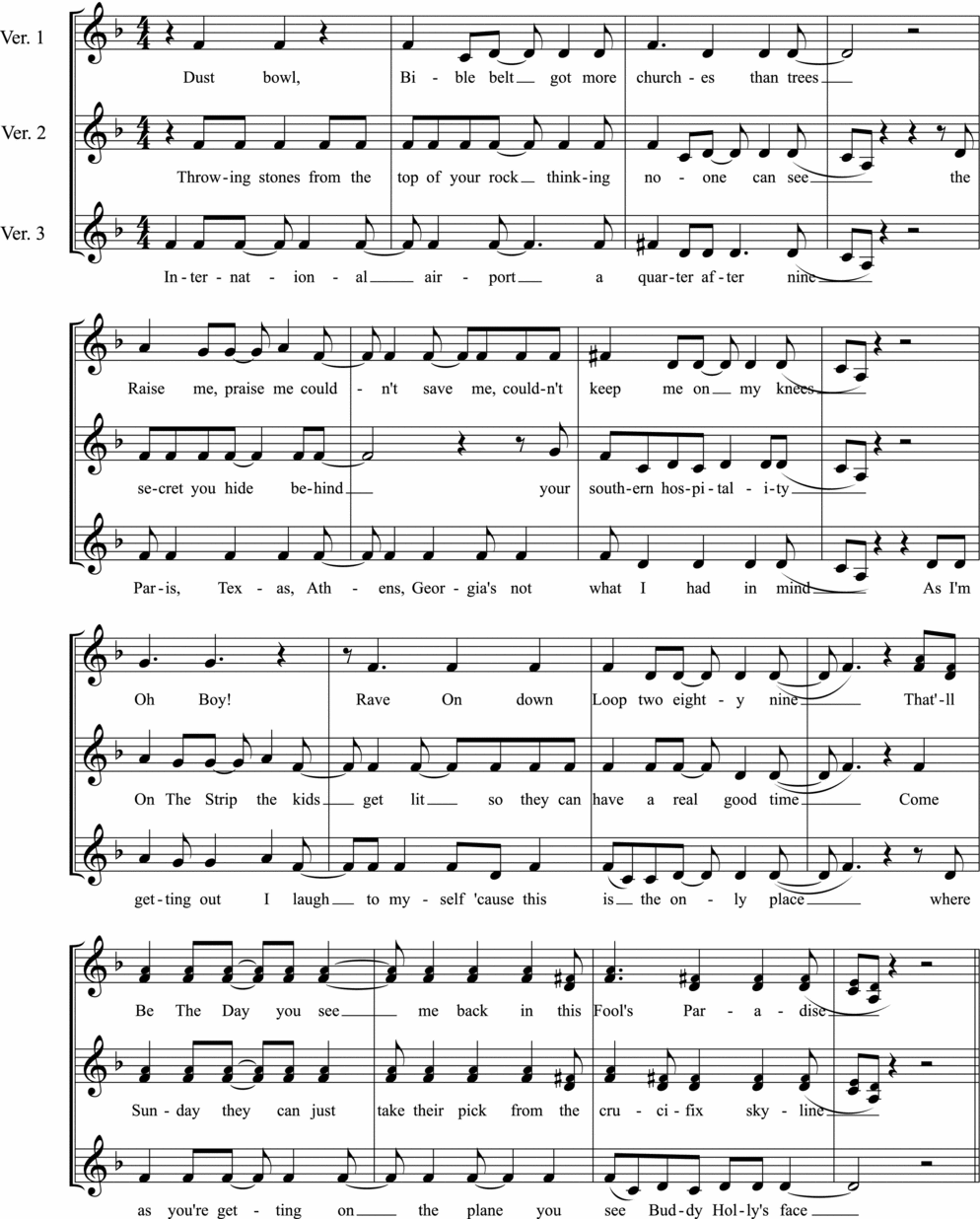
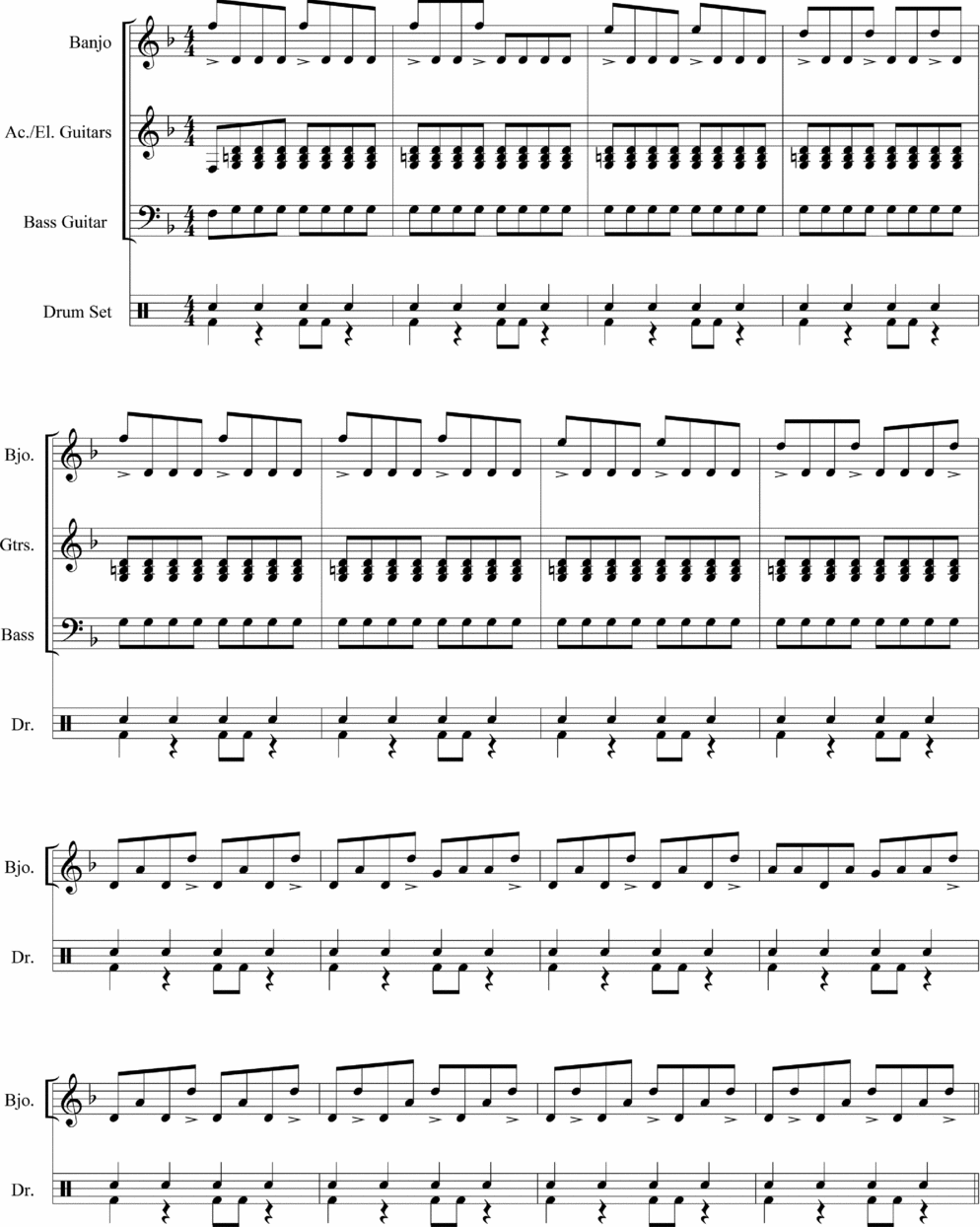
The Dixie Chicks drew on a combination of rock and country idioms to support the lyrical message of “Lubbock or Leave It.” Indeed, the musical setting establishes an additional layer of meaning not found in the lyrics. The composition of the song started with a repeated four-chord, power-chord riff on electric and acoustic guitars (III–IV–III–I) over an electric bass picking the roots of the chords (F–G–F–D) in D minor (see Example 1).Footnote 74 Maines's declamatory singing also enhances the rock-like feel. Like the vocals of “Sin Wagon” (on Fly [1999]) and “White Trash Wedding” (on Home [2002]), Maines's vocal line in “Lubbock or Leave It” consists of shorter note values and an aggressive, punchy delivery. The song's melody echoes the rise and fall of speech in the first verse, but becomes increasingly static through the second and third verses as the melody increasingly emphasizes F-natural, creating a sense of accumulating anger (see Example 2). In the third verse, Maines's vocal line is doubled subtly to create a slightly delayed echo-effect. While this may have been used to provide an angrier and more aggressive vocal quality at the song's climax, one might speculate that it simulates announcement over a loudspeaker at an airport—the place where Maines encounters Holly's painting. The aggressive, declamatory singing and the power-chord riff evoke the passion of an angry rock anthem, and given that this combination is unique within the Dixie Chicks oeuvre, the adoption of a rock sound is both potent and significant.
Dixie Chicks, “Lubbock or Leave It,” introduction (power-chord riff). LUBBOCK OR LEAVE IT. Words and Music by EMILY ROBISON, MARTIE MAGUIRE, NATALIE MAINES and MIKE CAMPBELL. Copyright © 2005 WOOLLY PUDDIN’ MUSIC, SCRAPIN’ TOAST MUSIC, and WILD GATOR MUSIC. All Rights for WOOLLY PUDDIN’ MUSIC and SCRAPIN’ TOAST MUSIC. Administered by Words & Music Copyright Administration. All Rights Reserved.
Dixie Chicks, “Lubbock or Leave It,” Maines vocal line (verses 1–3). LUBBOCK OR LEAVE IT. Words and Music by EMILY ROBISON, MARTIE MAGUIRE, NATALIE MAINES and MIKE CAMPBELL. Copyright © 2005 WOOLLY PUDDIN’ MUSIC, SCRAPIN’ TOAST MUSIC, and WILD GATOR MUSIC. All Rights for WOOLLY PUDDIN’ MUSIC and SCRAPIN’ TOAST MUSIC. Administered by Words & Music Copyright Administration. All Rights Reserved.
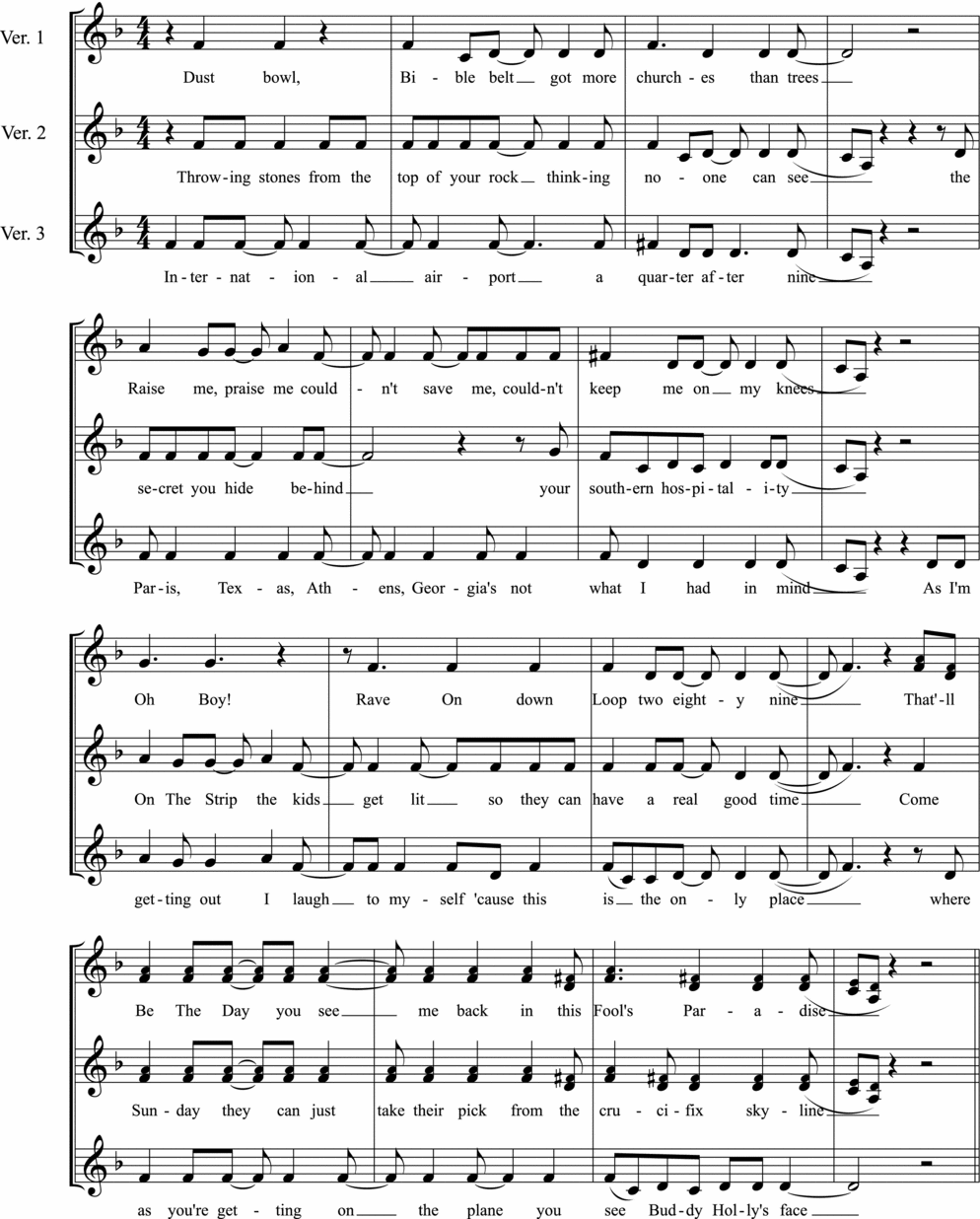
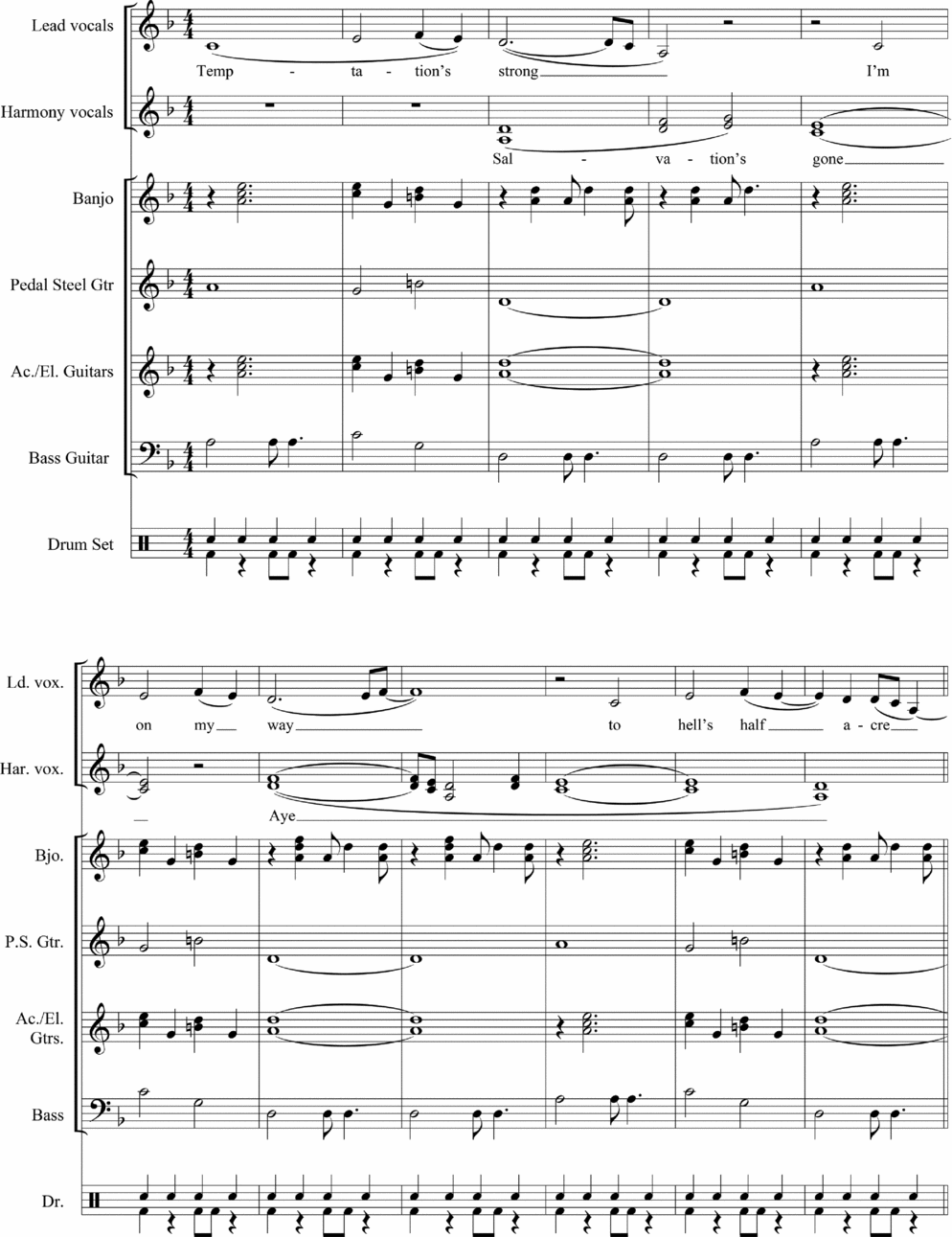
Despite the prominent rock sound, elements of country and bluegrass permeate the song's musical setting. The blunt vocal declamation of the verses softens into a legato line, accompanied by the country-like harmony vocals of Maguire and Robison, as Maines begins to reflect on her lack of religious salvation. The chorus sets up a traditional call-and-response as her bandmates respond in harmony to Maines's “temptation's gone” with the line “salvation's gone” in longer, held note values (see Example 3). The accompaniment also relaxes from aggressive power-chords into a western swing feel. After Maines sings the first statement of “How Will I Ever,” the guitars transition back into the power-chord riff for the final, cheeky lines of the chorus as she questions how she will ever get to heaven without the help of her hometown.
Dixie Chicks, “Lubbock or Leave It,” chorus (11 bars). LUBBOCK OR LEAVE IT. Words and Music by EMILY ROBISON, MARTIE MAGUIRE, NATALIE MAINES and MIKE CAMPBELL. Copyright © 2005 WOOLLY PUDDIN’ MUSIC, SCRAPIN’ TOAST MUSIC, and WILD GATOR MUSIC. All Rights for WOOLLY PUDDIN’ MUSIC and SCRAPIN’ TOAST MUSIC. Administered by Words & Music Copyright Administration. All Rights Reserved.
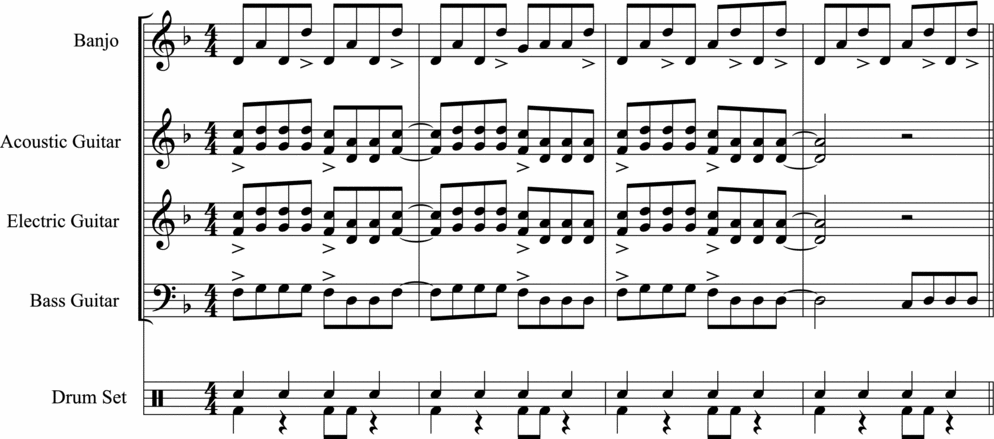
The trio incorporates several genre conventions to contribute to the country coloring of the song: Emily Robison plays a rollicking banjo roll throughout the song; Maguire fiddles alongside the guitar riff in the song's instrumental intro, third verse, and outro; and Lloyd Maines plays pitch bends and slides on the pedal steel in the chorus. The banjo plays a crucial role in the instrumental ensemble and song narrative. In the song's instrumental introduction, Robison fingerpicks the roots of the power chords (with the bass guitar), but transitions into a roll in the first verse (see Example 4). This roll opposes the forceful rhythm and timbre of the power-chord riff, a clash of musical idioms that generate a tension that grows through the first two verses until Robison's instrumental solo (see Example 5). Although the banjo remains present through the entire song, it slowly moves from background accompaniment in the introduction to the surface as soloist and maintains this prominence in the recording mix to the end of the song.
Dixie Chicks, “Lubbock or Leave It,” juxtaposition of power-chord riff and banjo roll. LUBBOCK OR LEAVE IT. Words and Music by EMILY ROBISON, MARTIE MAGUIRE, NATALIE MAINES and MIKE CAMPBELL. Copyright © 2005 WOOLLY PUDDIN’ MUSIC, SCRAPIN’ TOAST MUSIC, and WILD GATOR MUSIC. All Rights for WOOLLY PUDDIN’ MUSIC and SCRAPIN’ TOAST MUSIC. Administered by Words & Music Copyright Administration. All Rights Reserved.
Dixie Chicks, “Lubbock or Leave It,” banjo solo. LUBBOCK OR LEAVE IT. Words and Music by EMILY ROBISON, MARTIE MAGUIRE, NATALIE MAINES and MIKE CAMPBELL. Copyright © 2005 WOOLLY PUDDIN’ MUSIC, SCRAPIN’ TOAST MUSIC, and WILD GATOR MUSIC. All Rights for WOOLLY PUDDIN’ MUSIC and SCRAPIN’ TOAST MUSIC. Administered by Words & Music Copyright Administration. All Rights Reserved.
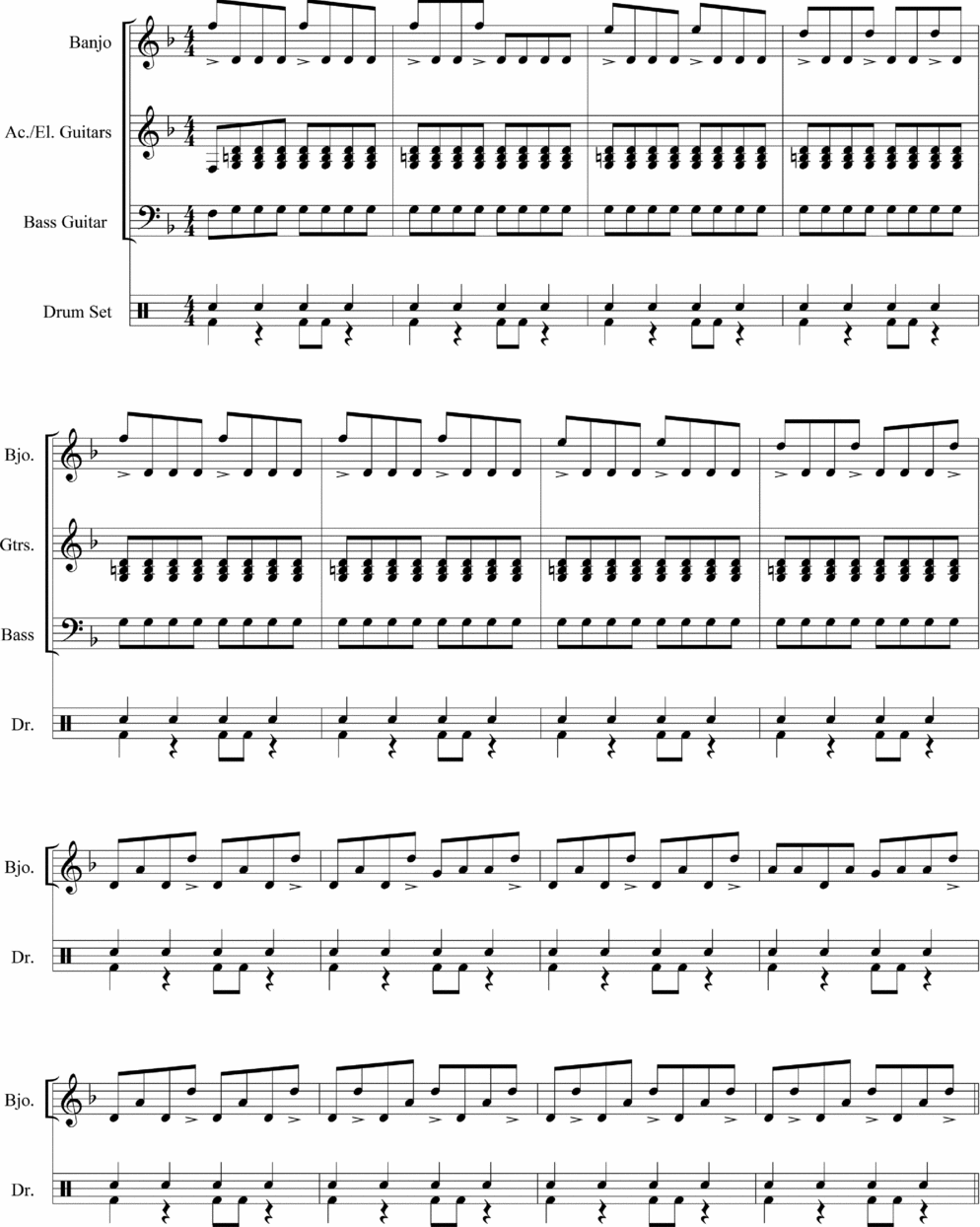
The interaction between the power-chord riff and the banjo illuminates an internal tension not only between the opposing rhythms and timbres of the instruments, but also between Maines and Lubbock, and, by extension, the rock and country genres. This clash also emerges in the shift from the aggressive and declamatory tone of the verses to the softer country swing of the reflective chorus. One might also interpret the banjo solo, especially as it supports Maines's mocking of Lubbock's international airport, as a deeper characterization of the city's backwardness.Footnote 75 These tensions increase through the song to its climax, where the bridge links these two genres: Lubbock's once-rejected rockabilly icon becomes a crucial link between Maines and her hometown, between clashing musical idioms, and between opposing worlds. The interplay of country and rock idioms not only complicates the genre's conventions, boundaries, and values, and thus allows the group to renegotiate its place within country music. But this country-rock fusion bears striking resemblance to the musical sound so deeply associated with Maines's hometown; as such, the trio actually criticizes Lubbock's conservative and religious values through a progressive musical sound that has come to be identified with Lubbock. Indeed, the song implies just such a double message: the Dixie Chicks draw on musical conventions associated with Lubbock in an act of defiance toward the city, while also finding a musical language that allows Maines to claim her place within the community and musical culture. Although these genres seem to represent the clash of a conservative social structure (country) with a desire for a more progressive and liberal-minded environment (rock), the very use of a musical style tied to the region suggests instead that Lubbock has left an indelible mark on the lead singer. Maines may have physically left Lubbock—she now lives in Los Angeles—and may not share its politics and values, but she is tied musically to the region; through this song, she firmly establishes her continuing connection to West Texas.
Conclusions: Lubbock? . . . Or Leave it?
On their 2006 Accidents and Accusations world tour, the Dixie Chicks opened their set with “Lubbock or Leave it”—but not before they gave another middle-finger salute to the American commander-and-chief. The Dixie Chicks heralded their arrival on stage with the Presidential march “Hail to the Chief.” The combination of the march and “Lubbock or Leave it” created a powerful political platform on which the trio began its concert each night. Beyond functioning as an act of dissent and mockery, the pairing of songs demonstrated the trio's continued frustrations with U.S. politics and the conservative values of West Texas.
On the surface, “Lubbock or Leave It” exposes Maines's struggles with her hometown. What is striking here is how the Dixie Chicks document this struggle: through a fusion of country and rock often associated with the Lubbock or West Texas sound. In doing so the musicians present a subversive response to Lubbock and, by extension, the hypocrisy of all parochial small towns—as Maines herself noted, “It's not just about Lubbock, but any small hypocritical town.”Footnote 76 Yet Maines's adoption of the Lubbock sound—the musical voice through which she established her identity on the national stage—reveals the lead singer's nostalgia for and indebtedness to her birthplace. Following in the tradition of her musical forebears, Maines deconstructs the image of her hometown and challenges its boundaries, constructing her own place in Lubbock. Although the power chords might seem to express Maines's frustrations, their fusion with banjo rolls, fiddle licks, and pedal steel pitch bends and slides asserts an affinity with Lubbock's musical heritage. The aggressive rock sound in the verses harkens back to the progressive country-rock stylings of Ely and Lloyd Maines (and even the rockabilly of Holly), while the softer chorus invokes the western swing influence of the region, and the resonating banjo and fiddle licks maintain the trio's country roots.
The landmarks chosen to ridicule Lubbock in the lyrics suggest another layer of identification. While Loop 289, “The Strip” (Highway 87), and the Lubbock International Airport have provided musicians with routes out of Lubbock, they also allow them to return. Indeed, many of Lubbock's musicians have returned—whether permanently or on annual visits. (Even Holly planned on returning to his hometown before his life was cut short by the fatal plane crash.Footnote 77) The isolation and limitations these artists felt in their youth proved to be a catalyst for seeking change through creative means, which, in turn, led them to reconnect to and identify themselves with the music of the region. The same can be said for Maines. She may not wish to return physically to Lubbock, but she has metaphorically come home. “Lubbock or Leave It” thus functions not only as an obvious platform for criticism, but also as a means for artistic and personal growth, and, if we listen carefully, reconciliation.