1. Introduction
In both education in general and languages learningFootnote 1 in particular, there is an increasing recognition of the need to develop students' intercultural capability. While this capability is named and understood in very different ways, it is recognised as one of the implications of globalisation and its resulting transformation of economies, technologies, societies and education. For example, the most recent national statement on education in Australia prepared by the Council for the Australian Federation (that is, the conference of Ministers of Education of all states and territories of Australia) recognises the importance of relating our own values and traditions to the experience of others, in promoting and reconciling global and local citizenship. It emphasises intercultural engagement, communication and understanding as skills for future participation in society (Council for the Australian Federation 2007: 17). Similarly, reflecting critically on the impact of globalisation on contemporary curriculum development, Lovat & Smith (Reference Lovat and Smith2003: 46) refer to a ‘sharing of the horizons of understanding’.
In languages education in recent times, there has been a move towards intercultural language learning (Byram Reference Byram1997; Kramsch Reference Kramsch, Byram and Fleming1999; Liddicoat et al. Reference Liddicoat, Papademetre, Scarino and Kohler2003). This orientation builds on a recognition that, in the context of learning languages, communication is at least potentially intercultural, in that it entails students learning to move between two languages and cultures – the students' own language(s) and culture(s), and the languages and culture(s) they are learning.
Making claims about developing this intercultural capability in learning languages raises questions of how it is evidenced for students, parents, teachers and others, and therefore how this capability is to be assessed. This assessment poses a range of theoretical and practical challenges. While some initial work has been undertaken in seeking to assess intercultural competence (Byram & Zarate Reference Byram and Zarate1994; Byram Reference Byram1997; Byram, Gribkova & Starkey Reference Byram, Gribkova and Starkey2002; Sercu Reference Sercu2004; Liddicoat & Scarino forthcoming), the focus has tended to be on developing tasks for assessing cultural knowledge and behaviour that require students to enact particular roles (Sercu Reference Sercu2004) or on attitudes in attitudinal tests (Cadd Reference Cadd1994) or on cultural awareness tests (Byram, Morgan & Colleagues Reference Byram, Morgan and Colleagues1994). However, none of these tasks captures both the students' participation in communication, understood as the interchange of meaning, and their reflective analysis of what is at play in particular instances of communication across cultures.
My discussion in this paper is based on the experience of two ongoing studies that form part of the program of research at the Research Centre for Languages and Cultures (RCLC) at the University of South Australia. One involves working with teachers to investigate assessing intercultural capability in learning languages; the other involves working with university lecturers to investigate the assessment of an intercultural capability in diverse disciplines in the context of the internationalisation of their particular courses. In both studies the participants have been working collaboratively with the researchers in a continuous dialogue. The process of investigation has involved iterative cycles of development, analysis and reflection in line with the assessment cycle, which I will describe. There are limitations of such an approach but I see this kind of experimental work as a necessary stage at this point of the profession's engagement with intercultural language learning.
But before considering how to assess this intercultural capability, it is necessary to characterise language learning within an intercultural orientation and the assessment process that has informed the studies. It is also necessary to acknowledge the fundamental paradigm debate in assessment (McNamara Reference McNamara2003), for it shapes participants' conceptions of what is and is not feasible in assessment.
2. Learning languages within an intercultural orientation
There have been numerous contributions towards understanding ‘what the nature of intercultural communication might be and how it might be taught’ (Kramsch Reference Kramsch2002: 277; see also Alred, Byram & Fleming Reference Alred, Byram and Fleming2003; Liddicoat et al. Reference Liddicoat, Papademetre, Scarino and Kohler2003). The major characteristic of intercultural language learning is that it engages with the process of understanding and interpreting human communication and interaction – not only with observation, description, analysis and interpretation of phenomena shared when communicating and interacting, but also with active engagement in interpreting self (intra-culturality) and ‘other’ (inter-culturality) in diverse contexts of social and cultural exchange (Papademetre & Scarino forthcoming). Intercultural language learning is fundamentally about how language and culture come into play in creating and exchanging meaning. It develops in students the capability to recognise and integrate into their communication an understanding of themselves as already situated in their own language(s) and culture(s) when they communicate with others, and to recognise that others also approach communication from the background of their own experiences within their own language(s) and culture(s). It also recognises that people interpret communication and relationships through the frame of reference of their cumulative experience within their own language and culture. This cumulative experience is constantly reconsidered and re-articulated, and re-shapes the frame of reference that people draw upon in creating and interpreting meaning. Learning an additional language and culture, especially through experiences that invite students to move between the two linguistic and cultural systems, contributes to re-shaping this frame of reference.
The goal of intercultural language learning is to develop, extend and elaborate upon students' interpretive frames of reference through experiencing and reflecting upon communication in increasingly complex intercultural contexts. This means extending students' repertoires of communication and their meta-awareness of the relationship between language, culture, meaning and learning. Students therefore have dual roles. As participant users of the target language they use language to communicate meanings and experience different ways of making meaning between languages and cultures. They are also learners/analysers of the target language, constantly reflecting critically on the exchange of meanings from multiple perspectives; reflecting on their own values and those of others. In the dual process of experience and analysis of communication between languages and cultures, students are invited to de-centre from their own linguistic and cultural situation to consider that of others. They become participants in diversity. Through these experiences, students come to understand over time that in intercultural interaction the ethical consequences of communication are always amplified, because intercultural interaction involves negotiating difference as well as experiencing new and at times challenging ways of ‘reading’ the world.
Assessing intercultural capability therefore involves assessing students' performances in experiencing and analysing communication, a dual process that requires moving between the students' own languages and cultures and the language and culture being learned.
3. Understanding the assessment process
3.1 The assessment cycle
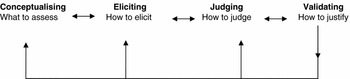
In the ongoing studies on intercultural capability at the RCLC that provide the basis for this paper, assessment is conceptualised as a cycle involving a set of four interrelated processes (see Figure 1).
The assessment cycle.

The starting point for the assessment cycle is the conceptualisation of what is to be assessed, that is, the construct. In languages education within an intercultural orientation, this means conceptualising what it means ‘to know’ an additional language in the context of diversity. This process drives all the other processes in the cycle. It is also a reminder that, more than being a technical issue, assessment is a profoundly conceptual one. The way the construct is conceptualised influences the process of elicitation; that is, the nature of the tasks that are provided influences the type of evidence of the construct that the task can generate. The conceptualisation of the construct influences the criteria for judging performance; these in turn influence the construction of the tasks. The judgments made of students' performance must be justified as accounts of the construct being assessed. Inferences that are made about students' performances are warranted through the process of validation. This involves matching the construct with the evidence-eliciting processes and interpreting and justifying the inferences made, based on the evidence. These four processes, operating in a mutually informing cycle, provide a framework through which to consider conceptual and practical issues in assessing intercultural capability.
3.2 Assessment paradigms
The assessment process in education is located in a tension between two contrasting epistemological cultures that influence views of learning on the one hand, and views of assessment (Shepard Reference Shepard2000) on the other. These are traditional psychometric perspectives set within a positivistic paradigm, and more recent qualitative sociocultural perspectives set within an interpretive paradigm (Gipps Reference Gipps, Pearson and Nejad1999; Delandshere Reference Delandshere2002).
In her highly influential paper, Sfard (Reference Sfard1998) draws a distinction between the ‘acquisition metaphor’ (i.e. having knowledge) and the ‘participation metaphor’ (i.e. knowing through doing with others). These metaphors can be connected to assessment paradigms. Within the acquisition metaphor, learning is understood as a process of acquiring factual knowledge that is then abstracted and generalised. This view of learning fits best within the traditional psychometric paradigm, which focuses on testing content through objective procedures. In the psychometric paradigm, student learning is referenced to either the performance of other students (norm-referencing) or a predetermined standard (criterion-referencing). Within the participation metaphor, learning is understood as a process of constructing understanding by interacting with more knowledgeable others in diverse contexts. This view of learning aligns with the qualitative, sociocultural, interpretive paradigm, which provides a contextual and personalised view of assessment. Curriculum-related, authentic content is assessed using both objective and subjective procedures. It is designed to show in the best way possible what it is that students know. Sfard highlights the need for both metaphors to be taken into account.
The assessment of intercultural capability is set within these contrasting paradigms. The challenge is to reconcile the two perspectives in practice. In working with the teacher-assessors in our two studies, it is clear that the views they hold about the assessment process (specifically, where they situate themselves in this paradigm debate) influences what they see as possibilities and constraints in assessing intercultural capability.
4. Conceptualising
4.1 Defining the construct
Considering the assessment of intercultural capability must begin with defining the construct. This is by no means straightforward as it has been conceptualised in diverse ways (Crichton & Scarino Reference Crichton and Scarino2007). Furthermore, with regard to intercultural capability in languages education, two additional matters need to be taken into account. First, learning languages necessarily involves the movement between at least two languages. In other words, the construct is per force plurilingual and pluricultural: the students' first or home languages and cultures are an integral part of and not separate from learning an additional language. Second, intercultural capability needs to be considered both in particular instances or episodes and developmentally.
4.2 Diverse conceptualisations of intercultural capability
Intercultural capability has been conceptualised in a number of different ways. Risager (Reference Risager2007) describes two models of intercultural competence, one of which adopts an anthropological point of departure while the other has a linguistic point of departure. The anthropological models describe intercultural competence as allied to but separate from communicative competence (language-in-culture). The linguistic models frame cultural competence within communicative competence (culture-in-language).
One of the most elaborated of the anthropological models is that of Byram & Zarate (Reference Byram and Zarate1994). It includes four sets of skills, attitudes and knowledge which they call ‘savoirs’: savoirs, savoir comprendre, savoir apprendre/faire, savoir être. To these four Byram (Reference Byram1997) has added a fifth: savoir s'engager. This view of intercultural does not specifically deal with the interrelationship between these savoirs and linguistic competence. Byram (Reference Byram1997) also developed a model of intercultural communicative competence that includes: linguistic competence, sociolinguistic competence, discourse competence and intercultural competence, defined as the savoirs. Byram sees these dimensions as interrelated but also separable. There is therefore a lack of clarity about the level of integration within the model.
Risager (Reference Risager2007) extends Byram & Zarate's model by foregrounding the plurilingual nature of intercultural communicative competence within a transnational perspective. She foregrounds the centrality of resources, creating two additional categories beyond structural, semantic and pragmatic competence (Byram's linguistic and sociolinguistic dimensions), namely, languacultural competences and resources (linguistic identity) and transnational cooperation. While Risager's model captures additional important dimensions of intercultural communicative competence, an issue remains that is inherent in all models, and that is how the dimensions interrelate, in particular for the purposes of assessment.
Sercu (Reference Sercu2004) has also extended the construct, but in a different direction. She includes a ‘meta-cognitive dimension’ to enable learners to plan, monitor and evaluate their own learning processes. The monitoring of one's learning processes, however, does not necessarily include meta-awareness of the play of language and culture in the process of communication itself in variable contexts, or in the dynamic process of negotiating meaning across cultures or, indeed, in working towards the fundamental goal of the learning process that is the development of self-knowledge-and-awareness as the basis of all human understanding.
Through these models we gain an elaborated and valuable understanding of the range of dimensions that might be included in conceptualising intercultural capability. How these various dimensions and combinations are operationalised for assessment remains an issue. For example, values classification, while an important dimension, is insufficient on its own as a model of intercultural capability in the context of learning languages. As such, assessment of intercultural capability through attitudinal tests (Cadd Reference Cadd1994), culture assimilator tests (Brislin et al. Reference Brislin, Cushner, Cherrie and Yong1986) or cultural awareness tests (Byram, Morgan & colleagues Reference Byram, Morgan and Colleagues1994) would be too limited.
My own interest is in the models that have a linguistic point of departure; that is, examining assessment in the context of communicative language ability and communicative language use.
Van Ek (Reference Van Ek1986) describes communicative ability as comprising six competences as well as the non-linguistic dimensions of autonomy and social responsibility. This is the only model that includes sociocultural competence (understood as familiarity with the frame of reference used by the target culture). The remaining competences in this model are linguistic competence, sociolinguistic competence, discourse competence, strategic competence and social competence.
By far the most elaborated model of communicative language ability for the purposes of assessment is that developed by Bachman (Reference Bachman1990) and Bachman & Palmer (Reference Bachman and Palmer1996). Like the Van Ek model, the Bachman & Palmer model is a psycholinguistic one that takes as its starting point the native-speaker as the communicative norm and assumes that communicative ability is developed as an individual accomplishment. The psycholinguistic models do not capture the social–interactive dimensions of communication (McNamara Reference McNamara1996, Reference McNamara2001; Chalhoub-Deville Reference Chalhoub-Deville2003; McNamara & Roever Reference McNamara and Roever2006). Communication is mediated socially and culturally in interaction. This is a defining feature of intercultural capability. It is interactive.
It is the social–interactional perspective that is of particular interest to the construct of intercultural capability. Claire Kramsch, one of the most important researchers in language, culture and learning, used the term ‘interactional competence’ to capture the nature of communication as human interaction in a cross-cultural perspective. She states that successful interaction entails ‘not only a shared common knowledge of the world, the reference to a common external context of communication, but also the construction of a shared internal context or “sphere of inter-subjectivity”’ (Kramsch Reference Kramsch1986: 367). For Kramsch, learning an additional language ‘entails not only language but also metalanguage skills in the foreign language, such as the ability to reflect on interactional processes, manipulate and control contexts and see oneself from an outsider's point of view’ (p. 369). This points to inter-subjectivity (i.e. the movement between subjective life-worlds of the interactants) and a particular kind of meta-awareness about the context of communication as distinctive dimensions of communicative language ability. By engaging in both of these in communication a person comes to understand the self and the other.
The interactional approach to defining the construct extends the dimensions that need to be taken into account in assessment. Chalhoub-Deville (Reference Chalhoub-Deville2003) describes the construct to be assessed as the ability-in-individual-in-context. She presents this as a way of rendering the social–interactional perspective, arguing that there is a reciprocal influence between the abilities of the individual language user and the context. She notes that the interactional perspective presents two challenges to assessment: (1) ‘amending the construct of individual ability to accommodate the notion that language use is . . . co-constructed among participants’, and (2) the notion that language ability is local, and the ‘conundrum of reconciling that with the need for assessments to yield scores that generalize across contextual boundaries’ (p. 373).
Kramsch (Reference Kramsch2006) recently extended the notion of interactional competence to include the likely interaction of language learners not only with monolingual native speakers but also with multilingual users with diverse values and ideologies. She suggests students ‘might need more subtle semiotic practices that draw on a multiplicity of perceptual clues to make and convey meaning’ (p. 250). She highlights the need to understand the practice of meaning-making itself (p. 251), describing it as ‘symbolic competence’:
Language learners are not just communicators and problem-solvers, but whole persons with hearts, bodies, and minds, with memories, fantasies, loyalties, identities. Symbolic forms are not just items of vocabulary or communication strategies, but embodied experiences, emotional resonances, and moral imaginings. We could call the competence . . . symbolic competence. Symbolic competence does not do away with the ability to express, interpret and negotiate meanings in dialogue with others, but enriches it and embeds it into the ability to produce and exchange symbolic goods in the complex global context in which we live today. (Kramsch Reference Kramsch2006: 251)
When diverse languages and cultures are at play in communication this capability extends beyond interaction as a social practice to the interpretation of symbolic systems. This qualitative meta-layer ‘makes language variation, choice and style central to the language learning enterprise’ (Kramsch Reference Kramsch2006: 251). An important concern in learning languages, then, is understanding meaning and meaning-making. Intercultural capability requires both interactional competence and symbolic competence. Thus intercultural capability includes the experience of interpreting and constructing meaning in communicative interaction in diverse contexts and the capability to analyse the process of meaning-making itself in the context of diverse cultures. The relationship between the experiential and analytic dimensions remains a complex issue for assessment because it raises the question of whether they can be assessed in an integrated or separate manner.
4.3 The development dimension
The assessment process needs to take into account the dynamic nature of the construct. We do not have an adequate theory of language development from an intercultural perspective. Attempts to depict development have tended to address what is learned, employing categories that capture the increasing complexification of language and content. Development, however, is ‘not just a question of knowledge (content and skills or changing mental representations) but of the relationship between learners and knowledge, which entails questions of identity and agency as they participate in practice where the knowledge has meaning’ (Moss Reference Moss and Moss2008: 233).
Bennett, Bennett & Allen (Reference Bennett, Bennett, Allen, Paige, Lange and Yershova1999) have proposed a model for the acquisition of what they call ‘intercultural sensitivity’: the Developmental Model of Intercultural Sensitivity (DMIS). The model describes a progressive series of stages from ethnocentrism to ethno-relativism. The descriptions are highly generalised and do not recognise that intercultural sensitivity may well be context- or task-specific. The linear progression that is assumed does not accord with the complexity of development. Overall, the model does not address the important relationship between language and intercultural sensitivity. The authors have grafted their proposed stages of development onto the language proficiency scale of the American Council for the Teaching of Foreign Languages (1985). This grafting process, however, assumes that students have had no exposure to intercultural experiences within their development before commencing their learning of the additional language.
When assessing students' developing intercultural capability we need to expand our conception of what it means to know a language, to include notions such as:
• the experience in situ of interaction among people with diverse cultural and language backgrounds and reflection on the social and cultural construction of meaning, and the variability of context;
• the appreciation of multiple perspectives, and responses to different perspectives, in deciding, comparing, etc. and explaining how they ‘make sense’ or interpret reflexively;
• the ability to de-centre, to question assumptions;
• growing increasingly aware of the processes of interpretation and meaning-making.
5. Eliciting: operationalising the construct
5.1 An expanded view of assessment processes
When eliciting an intercultural capability in learning languages, the conceptual challenges I have already discussed transfer to the process of eliciting. At the same time, insights from sociocultural theories of learning and assessment in general education help us to reconceptualise how we might assess an intercultural capability in the learning of languages.
Theories of assessment from general education emphasise (1) the participation and interaction of the learners as social beings, within communities of practice and within the culture of the learning environments; (2) experience and meaning; and (3) a constant critical reflection on language, culture, positioning and identities (Haertel et al. Reference Haertel, Moss, Pullin, Gee and Moss2008: 8). Experiencing and critical reflection are ongoing dynamic processes in the context of students' developmental trajectories as they learn ways of being, acting, communicating, thinking and valuing.
A sociocultural orientation to learning and assessment implies two things. First, it implies that assessment is evolving and dynamic, as the individual learner interacts within a learning environment consisting of people (with their own particular histories, home and peer cultures, and previous learning experiences) and resources (Moss Reference Moss and Moss2008: 228). In this dynamic view of assessment, learning and assessment are no longer separate but integrated. Second, it means expanding the instruments of assessment to include evidence-based evaluations and judgments from the classroom, both formal and informal, and both tacit and explicit (Moss Reference Moss and Moss2008: 223).
Thus, elicitation can include individual tasks, sets of tasks that shape learners' experiences over time, analyses of moment-to-moment action and interaction, and conversations that probe students' meanings, focusing not only on ‘knowledge and skill but also on embodied experience, meaning, language, culture, participation, positioning and identities enacted’ (Moss Reference Moss and Moss2008: 238). This means eliciting the meanings that students themselves make of experiences, texts and images, and their participation in or engagement with them. This expanded view of elicitation opens useful possibilities for assessing the intercultural capability, not only at designated assessment moments but also as an integral part of the continuous process of teaching and learning. However, our experience in the two studies on assessing intercultural capability indicates that teachers who operate within a traditional view of assessment find this expanded view of assessment challenging.
5.2 Eliciting an intercultural capability
All processes designed to elicit intercultural capability need to include assessment of communication in intercultural interaction that is elicited in ‘critical moments’ (moments where the exchange matters to the student/participant) and to probe students' meta-awareness of processes of interpretation or making sense, as evidenced in analysis and reflection elicited in commentaries (where students are asked to reflect upon their experience of participation or engagement). There may be different foci in different tasks. For example, students may be invited to analyse and reflect on spoken or written performance in critical moments. The critical moment in an intercultural interaction may be when students realise that the way they will be perceived by their interlocutor or reader is vital. The task would also invite students to analyse and reflect upon their own participation, choices, language, culture and meaning. Other tasks could invite students to analyse and reflect on a concept or idea. The concept or idea could emerge from exploring personal, cultural or intercultural experiences through texts (print, visual, etc.) based on themes from social life and how they are played out in different ways in different contexts; for example, stereotypes, alternative cultures, or respect for the elderly. Further experiences provided for students could invite students to analyse and reflect on language itself; for example, a comparative consideration of naming, greeting, forms of address, politeness, or apology in the diverse languages. Given the developmental dimension of intercultural capability, elicitation processes also need to provide for assessment over time. This might include processes such as ongoing observation; the use of portfolios; the use of journals for recording intercultural experiences in the target language and reflections on these experiences; and extended projects strengthened by analysis, cumulative commentary, summation, explanation, and elaboration. Some questions that might be addressed cumulatively across the various experiences are:
• What connections can you draw within and across texts, sources, tasks, experiences, interactions? (Invites de-centring, abstracting, comparing, moving between languages and cultures.)
• What connections can you draw between your response and those of others? (Invites engaging with multiple perspectives.)
• How have you come up with these connections? (Invites decentring from one's own experience, to develop self-awareness.)
• Does your engagement with these questions and your own/others' responses to them provide you with variable ways of understanding social life worlds in the language and culture you are learning and any other languages and cultures and their diverse communities? How? (Invites respecting multiple perspectives on the social, cultural and linguistic construction of human action in all spheres of human communication/interaction.)
From the spoken, written, and interpretive performances of intercultural interaction we assess students' ways of managing interaction in the target language, their openness to the expectations of others, their actual communicative exchanges, responding to others, and their processes of interpreting, comparing, connecting, relating and valuing while taking multiple perspectives into account.
From analysing and reflecting tasks we assess students' meta-awareness of variability; interpreting contexts, roles, relationships, purposes, choices, perspectives and change; the social, cultural, linguistic and historical construction of meaning; and ultimately, critical and ethical awareness of language(s), culture(s) and their relationship.
When communicating, people routinely accomplish these two roles; that is, the role of communicator and the role of analyser, reflecting constantly on the nature, process, substance and impact of communication. In eliciting intercultural capability, it is necessary to tap both roles. Nevertheless, finding ways of holding both roles in play simultaneously in the assessment process remains a challenge.
Examples of assessment procedures developed by teachers working on the studies being undertaken by the RCLC are available from the author.
6. Judging and validating
Like conceptualising and eliciting, so too the judging and validating processes are situated in the tension between the two contrasting paradigms. Within traditional approaches, judging involves a system of evidence, criteria standards and rules of aggregation applied to student performances. Within qualitative, sociocultural approaches, judging is seen as inherently social (McNamara & Roever Reference McNamara and Roever2006), involving an act of interpretation; criteria and standards are understood as constructs that are not formulated through definition but through interpretation and meaning-making in multi-criterion qualitative judgments (Sadler Reference Sadler1987, forthcoming).
Validation is the quality assurance process of assessment as a whole: conceptualising, eliciting and judging in relation to the particular purpose and use of assessment. In current conceptualisations there has been a meaningful shift from validating tests and scoring to validating the inferences made and their social consequences (Messick Reference Messick and Linn1989; McNamara Reference McNamara2003). This shift highlights both the importance of the process of inferencing and its bases in the assessment process and the need to consider the consequences of assessment.
Teachers and lecturers involved in the two studies on assessing intercultural capability report that they are able to identify important features of the construct and incorporate them in some way in experiences designed to elicit this developing capability. The process of judging, however, presents challenges.
One of the participants in the study on assessing intercultural capability in international education (see Crichton et al. Reference Crichton, Scarino, Papademetre, Barker, Lushington and Woods2006) comments on the issue from his perspective as a psychologist, not a specialist in language and linguistics. When asked in an interview to reflect on the judging process, he states:
Well, I can talk about sensibilities but not specifics because I don't actually know enough to know what to carve out there. But the story would be a demonstration how, you know, language is used and how it mediates meaning and how it's in research from a linguistic [pause] someone who is doing an analysis from a linguistic standpoint – how they would actually deconstruct and construct things . . . and this is the way you can see the world. So you could compare and contrast the particular world view to another world view about how we can interpret things . . .
This lecturer captures the themes of: (1) the relationship between language and the mediation of meaning, (2) judging as a process of analysis that might be undertaken from diverse points of view, (3) the importance of comparison and standpoints or world views, and (4) the centrality of interpretation. He sees need for a language for judging the intercultural capability.
While the complexity of making judgments about intercultural capabilities can be partly explained by acquiring the vocabulary to talk about the ways in which multiple meanings are socially mediated through language and culture, this issue of language can also be seen as the surface manifestation of a deeper issue. What appears to be absent is a larger frame of reference or fore-understanding that educators necessarily bring to making judgments. All the lecturers involved in the study were able to identify instances of intercultural experience, interaction and understanding, and to analyse evidence of students' engagement and understanding. In order to judge any one instance of performance, however, it is necessary to reference it against a map of other possible, relevant instances representing the scope of the discipline as a whole, and against a likely trajectory of language learning and development in studies on assessing an intercultural capability in learning languages. It is these inter-connected maps of possible instances and development that are not available as frames of reference for making and justifying judgments. These frames of reference are available, albeit tacitly, for skills such as writing in the target language. This is not to say that there is or should be a single agreed frame but rather, based on their own experience and/or the literature in the field, experienced teachers have been able to develop an integrated framework for judging writing. They have also been able to develop a sense of what constitutes evidence of learning, and a common language for talking about the assessments they make. Such a map of possible instances and evidence, and a common language that would facilitate the dialogue necessary for making and justifying judgments about intercultural capability has not yet been developed (or begun). The current focus on understanding the processes of judging is particularly promising because it invites exploration of processes of interpretation (Moss Reference Moss1996). Understanding these processes is critical to the assessment of intercultural capability in language learning; that is, it is important to examine the fore-understanding that students bring to communication and language learning, and to expand their interpretive frames. Similarly, the goal for teachers as assessors is to interpret students' meaning-making both episodically and longitudinally, because a consideration of peoples' continuously developing interpretive frames is integral to human understanding in general, and to the understanding of self and other.
Research continues in both studies using the four interrelated processes of the assessment cycle. The process of assessment, because of its very nature, sharpens the focus of thinking towards addressing what it is that we are assessing (and teaching), what it is that students are learning, how we assess it and why. An issue, however, is the resilience of traditional views of assessment, which may interfere with the need for further inquiry and experimentation. We need to keep recognising both the challenges and opportunities in assessment.
7. Conclusion
Much more research is needed towards understanding the intercultural capability in learning and using languages in diversity. The role of assessment is important both because it sharpens the conceptual focus on the nature of learning and using languages within an intercultural orientation and because it provides valuable information about students' actual learning. It is also important because assessment has the power to shape what language learning is; who the learners are and their understanding of what it is that is important to learn. The challenge is not to look for easy ways to assess but to expand the repertoire of assessment to accommodate a more complex view of languages learning that includes the development of intercultural capability. Grounded research with teachers and lecturers, as in the studies-in-progress reported here, begins to provide a fine-grained picture of the nature of this intercultural capability. It generates ways of eliciting it and ways of understanding and evidencing it, while always foregrounding the intimate relationship between language, culture and meaning, which is the core work of teachers of languages.
Acknowledgements
I thank Leslie Harbon for the invitation to the TESOL Research Network. I am grateful to the lecturers and teachers who are participating in the research studies reported here and to the anonymous reviewers for thoughtful comments.
Angela Scarino is Associate Professor of Applied Linguistics and Director of the Research Centre for Languages and Cultures at the University of South Australia. She is the President of the Applied Linguistics Association of Australia and a former President of the Australian Federation of Modern Language Teachers Associations. Her research interests include language curriculum development, language assessment, language and culture teaching and learning, and teacher education.