The power of the Mongol army lay in its vast numbers of mounted archers, their swift and skilled manoeuvers on the battlefield and their ability to cover great distances in a way that very few contemporary armies were capable of matching.Footnote 2 The military skills needed to conduct a successful siege were not to be found in the army gathered on the steppe by Chinggis Khan. Planning and building dams, ramps and siege-machines required engineers, carpenters and trained troops.Footnote 3 Siege warfare called for expertise and knowledge that were both practically foreign to the nature of the Mongol army.
Throughout the Mongol Empire's existence and the various stages of its army's development, the open battlefield was always favoured over engaging an enemy fighting from strongholds and fortified cities. Embarking on a long siege could delay the army for a considerable length of time and disrupt a campaign that had been carefully planned according to a strict schedule.Footnote 4 Siege warfare forced the army to halt, to set up a camp, to procure sufficient pasture and water for thousands of horses and the large herds that were an integral part of Mongol armies.Footnote 5
The aim of this paper is to present the abilities and shortcomings of the siege units employed by the Mongol army prior to Hulegu's invasion of Syria (1259), and their gradual decline during the Mamluk-Ilkhanid war (1260–1323). Part of the discussion will be dedicated to the question of gunpowder. Did the Mongol army under Hulegu's command employ gunpowder in siege warfare? Were they equipped with a superior weapon that was unknown to the Frankish, Ayyubid and Mamluk armies?
Though the use and transmission of gunpowder by the Mongol army has been widely studied the subject is still debated among scholars.
The establishment of siege units by Chinggis Khan
Chinggis Khan quickly learned and acknowledged the faults of the Mongol army and it was he who initiated the recruitment of foreign soldiers and artisans. This became a well-established policy amongst his successors.Footnote 6 The status, religion or origin of these people was of no significance to the Mongols, and their recruitment was determined only by their skill, knowledge and experience.
The need for siege units first arose when Chinggis Khan moved across the steppe into northern China (1211–1234) and faced the walled cities of the Jin Empire.Footnote 7 From this time onwards siege units were to be regularly recruited among the conquered states of northern China, and were to serve the Mongol army until the late thirteenth century. In 1211 a Chinese officer by the name of Chang Ba-tu supervised the Mongol army's siege machines. After him came Xue Ta-la-hai who commanded both the siege machines and the navy.Footnote 8
When Chinggis Khan invaded central Asia he was said to have had with him ten thousand soldiers who could work siege machines.Footnote 9 The recruitment of siege units among the northern Chinese continued during the reign of the great Khan Mongke (r.1253–1259), who conscripted blacksmiths, carpenters and gunpowder makers.Footnote 10 Hulegu followed suit and in 1253 when the campaign to the west was being organised he recruited a thousand households from North China that specialised in building and operating siege engines, and giant crossbows, and hurling naft.Footnote 11
From the year that Chinggis Khan began to besiege the cities of northern China and up to the time Hulegu set out on his campaign, the Mongols were constantly engaged in warfare. During those forty years the army besieged tens of strongholds and cities possessing larger, stronger and more advanced fortifications than those found in Syria. Complex siege operations were carried out, some demanding the building of dams, the diversion of rivers and the raising of large earth ramparts. Apart from the necessary engineering knowledge, the scale of these operations required hundreds if not thousands of labourers.Footnote 12 Prisoners taken from the local populations around the besieged city were often the source of manpower.Footnote 13 One of the most detailed accounts of Mongolian methods of siege warfare is given by John of Plano Carpini, an emissary of Pope Innocent IV, who travelled to the court of the Great Khan in 1245–1247.
They [The Mongols] reduce fortresses in the following manner. If the position of the fortress allows it, they surround it, sometime even fencing it round so that no one can enter or leave. They make a strong attack with engines and arrows and they do not leave off fighting by day or night, so that those inside the fortress get no sleep; the Tartars however have some rest, for they divide up their forces and they take it in turns to fight so that they do not get too tired. If they cannot capture it in this way they throw Greek fire . . . If they are still unsuccessful and the city or fort has a river, they dam it or alter its course and submerge the fortress if possible. Should they not be able to do this, they undermine the city and armed men enter it from underground; once inside, some of them start fires to burn the fortress while the rest fight the inhabitants. If they are not able to conquer it even in this way, they establish a fort or fortification of their own facing the city, so as not to suffer any injury from the missiles of the enemy; and they stay for a long time over against the city, unless by chance it has outside help from an army which fights against the Tartars and removes them by force. While they are pitched before the fortification they speak enticing words to the inhabitants making them many promises to induce them to surrender into their hands”.Footnote 14
By the time Hulegu set out for the West, Mongol siege warfare had come to rely on the northern Chinese contingents. It seems that they did not train their own men in this field. It is plausible, however, that some of the central Asian armies that joined Hulegu had their own siege teams.
Hulegu's campaign was the last of its kind under the united Mongol Empire.Footnote 15 Although the sources say that Hulegu recruited soldiers from among the northern Chinese who specialised in siege warfare, it is not clear whether the Ilkhanid state established by the Mongols in 1260 maintained this custom and continued to recruit northern Chinese siege experts.
Chinese Siege Warfare
In view of the fact that Hulegu besieged cities and fortresses in the Middle East by employing Chinese units and technology, a brief survey of the siege methods in use in northern China until the mid-thirteenth century, is in order.
The most common feature of Chinese siege machines during this period is that they were propelled by manual power. Their greatest drawback was the large number of people required to work them. Simple siege machines needed forty men, the larger ones demanded a force of two hundred and fifty. This made the teams an easy target for the enemy.Footnote 16
Chinese siege machines can be divided roughly into three main categories:
1. Pao (to hurl or to throw), catapults that fired round clay balls.Footnote 17
2. Containers holding inflammable materials.
3. Large and powerful crossbows.
An interesting aspect of Chinese siege machines is the use of clay balls as projectiles. This was recommended by Chen Gui (ca.1130 ad), author of the twelfth-century war manual Shou-cheng lu.Footnote 18
The counterweight siege machines operated in the late twelfth century by the Frankish and Ayyubid armies first appeared in China during Qubilai's reign (1260–1294). We have no written evidence of Ilkhanid use of counterweight siege machines other than an illustration in a copy of the Jami al-tawarikh (1306–1314) at the Edinburgh University Library.Footnote 19 The most convincing evidence of the penetration of Islamic siege technology from Syria into the Ilkhanid state and further into the Chinese Empire is dated 1272. During Qubilai's wars against the Song state he sought the advice and help of his nephew, the Ilkhan Abagha (r. 1265–1282), asking for two Muslim siege engineers to be sent to his court.Footnote 20 This request would seem to indicate that siege technology in the eastern Mediterranean was more advanced than that of the Ilkhanid state and of the Chinese units employed by Qubilai. We may also conclude that the Ilkhanid army had begun to use the counterweight trebuchet soon after the state was established. Two Muslim engineers who travelled to China, Ala al-Din from Mayyafariqin and Ismail from Aleppo, built what is known in the Mamluk sources as “the large Frankish manjaniq”; in China it received the title “the Muslim pao”. A description of this siege machine is given in the Yuanshi. Its main advantages were that it did not require a large team; the projectiles were considerably heavier than the Chinese types and could cover a greater distance. The stones could reach 90 kg. and more in weight.Footnote 21 According to the source, when the projectiles hit the ground they made craters that measured two metres in diameter. The sound tore through the sky and the earth and the damage was considerable.Footnote 22 This appears to be the first Chinese description, if somewhat exaggerated, of the counter weight trebuchet.
Inflammable materials
In addition to stone and clay projectiles, vessels containing inflammable materials were a favourite type of ammunition in Chinese siege warfare.Footnote 23 Certain machines had names such as: ‘Huo Pao’ i.e. a fire hurling siege machine. Pots with wicks of flax or cotton were used, containing a combination of sulphur, saltpeter (potassium nitrate), Aconitine,Footnote 24 oil, resin, ground charcoal and wax. This recipe contains all the basic ingredients for making gunpowder, but its particular emphasis was on producing toxic fumes; it was called ‘tu-yao yen-chiu’, literally a ball of smoke and fire.Footnote 25
The frequent use of inflammable materials in Chinese siege warfare was probably due to the fact that a large percentage of both public and private buildings were constructed of wood and bamboo. Even houses made of mud bricks had a wooden frame. In addition to clay roof tiles, thatched roofs could be found in both northern and southern China. Thatching materials included straw from wheat or rice, canes and various types of wild grass.Footnote 26
It is not surprising then that the main dread of the besieged was of fire inside the city. Pots containing inflammable materials were hurled into a densely populated city where many structures were of wood.Footnote 27 Occasionally, even the city towers along the curtain walls were a combination of bricks and wood;Footnote 28 this can be seen in the walls of the city of Shaoxing, dating to the thirteenth and fourteenth centuries. A few examples of wooden gate towers date to the fourteenth and sixteenth centuries.Footnote 29 In some cases a high wooden palisade was erected parallel to the stone or brick curtain wall.Footnote 30
The immense destruction caused to the city of Bukhara when it was besieged by Chinggis Khan illustrates the effectiveness of inflammable materials in siege warfare.
He [Chinggis-Khan] now gave orders for all quarters of the town to be set on fire; and since the houses were built entirely of wood, within several days the greater part of the town had been consumed, with the exception of the Friday mosque and some of the palaces, which were built with baked bricks. . . mangonels were erected, bows bent and stones and arrows discharged. . . . For days they fought in this manner.Footnote 31
In contrast to the widespread custom in large parts of China and some parts of Central Asia, of using wood and cane, in the Eastern Mediterranean public, private and military buildings were constructed mainly of stone.Footnote 32 This was both plentiful and relatively cheap when compared to the price of wood. It seems therefore that, although inflammable materials were used in siege warfare by the Ayyubids, the Franks and the Mamluks, their effect was considerably less disastrous.
The question of gunpowder
The differences of opinion concerning the use and efficiency of gunpowder during the twelfth and thirteenth centuries call for a short survey. The majority opinion is that gunpowder was used by Chinese armies in the mid thirteenth century and even earlier. This group includes the following scholars: Goodrich, Chia-Sheng, Allsen, Khan, Martin, Chase, DeVries and Needham. Needham conducted the most extensive archaeological and historical research on the subject of the development of gunpowder and firearms in China,Footnote 33 arguing that by the mid-thirteenth century the Chinese could destroy city gates and walls using gunpowder.Footnote 34 He cites four sieges in which gunpowder was used: Gaifeng (Kaifeng) (1232), Merw, Samarqand,Footnote 35 and probably also during the siege of Baghdad (1258).Footnote 36 Martin, who carried out a thorough study of the Mongol army, holds a similar opinion. Khan, who surveyed the sources that cover the Mongol invasion of the Delhi Sultanate, agrees with Needham and Martin.Footnote 37 Allsen also believes that gunpowder began to be utilised around the same time, but presents his opinion with some caution. Among the one thousand teams Hulegu brought with him on his campaign to the West, he thinks there were men who knew how to produce gunpowder. Allsen says that at the battle near the Amu Darya (1220) the Mongol army fired rockets launched with the help of gunpowder.Footnote 38 Like Needham, Allsen claims that during the siege of Baghdad the Mongols used some form of gunpowder. Many scholars rely to a great extent on the studies published by Needham. Franke is currently one of the few who maintain that even at the end of the Yuan Dynasty (1271–1368) gunpowder was not a weapon that could determine the outcome of a battle.Footnote 39 His conclusions are based on a survey of the archaeological finds and the historical sources, all of which show that the number of casualties as a result of the use of gunpowder was very low. Ayalon demonstrated the problems of terminology in the Mamluk sources. His conclusion was that there is no definite evidence that firearms were in use during the thirteenth and the first half of the fourteenth century, and that gunpowder was no more than an incendiary.Footnote 40
Returning to the question of whether the northern Chinese contingents employed gunpowder technology in siege warfare requires an examination of the three sources that give an account of Hulegu's army on the eve of his journey westward.
a) The earliest source was written by Ala al-Din Ata Malik, Juwayni, a Persian official who served the Mongols (d. 681/1283). His Tarikh -i jahan-gusha (‘History of the world-conqueror’) is an encyclopaedic account of Chinggis Khan and his times that documents events until 1288.
b) The second source was written by the Persian historian Rashid al-Din Fadl Allah Abu l-Khayr (d. 718/1318). The Jami al-tawarikh (‘Collection of chronicles’), compiled ca. 1317, is the first universal history. It records in detail the establishment of the Ilkhanid state by Hulegu soon after the fall of Baghdad and the execution of the Abbasid Caliph (1258).
c) The latest source is the Yuanshi, a Chinese official history of the dynasty founded by the Mongols, compiled ca. 1370.
Neither Juwayni nor Rashid al-Din, both of whom describe Hulegu's campaign, mention the use of gunpowder by the siege units of the Mongol army. It is perhaps possible that they were not familiar with this new weapon and described it by the terminology often used for various incendiary weapons that were known among Middle Eastern armies. However, this does not seem to be the case. Both works contain only a short paragraph on the whole subject of the northern Chinese siege units and neither notes anything unusual or new concerning the arsenal of Hulegu's army. Thus it seems more than likely that Mongol methods and weapons did not appear strange or unknown.
A close examination of the Persian and Chinese texts yields some more detailed results. Juwayni says that among the siege units there were soldiers specialising in hurling naft. He terms them naft andazan (
 ).Footnote 41 Rashid al-Din mentions these same units, using the same terminology to describe the men who hurl naft. In addition, he writes that among those siege units were teams he calls the charck andaz (
 ). The Persian word charck means literally “a round object”, while andaz means “to throw” or hurl.Footnote 42 Thus it seems that Rashid al-Din is in fact referring to the teams operating the siege machines that hurled round catapult stones. The Chinese source is more complex than the two Persian ones.Footnote 43 The Yuanshi describes the recruitment of artisans for the siege units in the armies of Chinggis Khan and Ogedei.Footnote 44 In 1252 Hulegu's siege units were drawn from the same source of manpower.
The term used for a particular artisan in Chinese is in fact a combination of two words. The first describes the raw material utilised by a specific craft. The second is jiang which can be best translated as ‘smith’. The list in the Yuanshi includes blacksmiths who work with iron, smiths who work with wood, i.e. carpenters, and smiths who work with gold, i.e. goldsmiths. The last raw material mentioned in the list is huo – fire. In contrast to the first three combinations which use the word jiang, huo appears on its own. It is therefore difficult to translate and to reach a definite conclusion concerning its exact meaning in this context. The notion that it refers to craftsmen who specialised in the production of gunpowder is somewhat farfetched. The term hou jiang does not appear at all in the Hanyu Dacidian (the Chinese 12 volume dictionary) or in the Ciyuan (a dictionary orientated towards classical Chinese). The term hou jiang appears once more in the Yuanshi and there too it comes directly after a mention of goldsmiths. Further, the combination hou jiang never seems to appear in any of the other earlier or later official Chinese histories such as the Mingshi, Jinshi, or Songshi. It is therefore difficult to conclude that the Mongols used gunpowder in siege warfare or to assume that they had men in their siege units who knew how to produce gunpowder. The fact that other contemporary and later Persian chroniclers such as Nasir al-Din al-Tusi (d. 672/1274) and Wassaf, Abd Allah b. Fadl Allah (fl. 698–723/1299–1323) are silent and do not mention a dramatic debut of a new technology, further supports the view that gunpowder did not arrive in the Middle East with Hulegu's army.Footnote 45
Contemporary and later Arabic sources that describe the Mongol invasion and the siege of Baghdad do not mention any unique weapons used by the Mongols. Ibn Tiqtaqa (d. 1281) gives only a brief account of the Mongol invasion and capture of Baghdad. Ibn al-Furat (b. 735/1335) focuses on the execution of the last Caliph. Adh Dhahabi (d. 748/1348) in his Tarikh al-islam describes the Mongol archers, their swords and horses. In his account of the destruction of Baghdad he does not mention the use of unusual or powerful siege weapons; neither do al-Yunini (d. 726/1326), al-Nuwayri (d. 732/1332) nor al-Maqrizi (d. 845/1442).Footnote 46
One of the most impressive characteristics of siege warfare under the Mongol commanders is the way siege units exploited the topography and natural surroundings of the area around a besieged city. Rivers were diverted, dams built and mud ramparts or brick walls constructed in order to seal the city and cut it off from its surroundings. Those earthen works show an outstanding degree of thought and initiative on the part of well trained engineering teams and skilled craftsmen, capable of planning and operating such large scale projects. At this point of the discussion we should note that the most common material for the construction of curtain walls in China and Central Asia was rammed earth, sometimes faced with stone and/or sun dried mud bricks.Footnote 47 In contrast to Middle Eastern and European strongholds that were built on prominent sites (hills, mountains, cliffs and the like) “no such preference for an elevated, easily defensible site, however, seems to have nourished city site selection in China”.Footnote 48
The Frankish, Ayyubid and Mamluk siege teams dug sapping tunnels and worked a variety of siege machines, but they never attempted to change the course of rivers and/or the terrain near the besieged city. The main reason seems to have been lack of human resources; without a huge labour force such ideas could not be carried out.
The strength of the siege units employed by the Mongols apparently did not depend on superior siege technology or on changing the topography round the besieged city or fortress, but rather on the ability to recruit and position great numbers of siege machines and teams that could run the entire siege operation day and night without halting. During the siege of Nishapur (1221) the Mongols placed three thousand giant cross bows, three thousand stone hurling siege machines, seven hundred machines that hurled pots of naft, four thousand ladders and two thousand five hundred piles of stones brought from the nearby mountains. The assault continued day and night.Footnote 49 Even if the figures are exaggerated they give an idea of the immense strength of the siege contingents in the service of the Mongol armies.
The sources of manpower available to the Ilkhanid state differed from those of the Mongol empire.Footnote 50 It is rather doubtful that Hulegu's heirs continued to recruit men from northern China for their siege contingents. This raises a number of questions concerning the composition, number and origin of the men in the Ilkhanid siege units, as well as their fighting skills in the field of siege warfare. The chroniclers provide very little information on the source of the manpower that served in those units. Any assumption is bound to remain such for lack of firm evidence. However, it is possible to overcome this obstacle by analysing the sieges conducted under Hulegu's command and comparing them to those carried out in later years by his successors. This may enable us to draw some conclusions concerning the development and changes of siege warfare that occurred in the Ilkhanid army.
Sieges conducted during Hulegu's campaign
Before beginning a siege, an emissary was sent with a clear message to the ruler of the city or the fortress; the message conveyed a simple and straightforward offer – surrender and avoid a military confrontation.Footnote 51 The next stage was determined according to the answer. But in fact, the only reply that would prevent a siege was surrender, complete submission and acknowledgment of Mongol sovereignty.
Once it was decided to proceed and besiege the site, time was devoted to organising camp. Before the siege of Maymundiz (a fortress of the Ismailis, south of the Caspian Sea) began, Hulegu surveyed the area and examined the fortress gates.Footnote 52 He then ordered his best men, chosen from his personal guard, to carry logs for the construction of siege machines to the nearby summits that surrounded the fortress. In some sieges the Mongols dug a moat or built a wall or an earth rampart around the besieged city at quite an early stage. During the entire period of organisation the army was exposed to the enemy's attacks and was in a highly vulnerable position. Assaults were launched by the besieged, using both machines and small contingents of mounted men who raided the Mongol camp and quickly returned to the safety of the walled city. An example of such behaviour can be seen during the siege of Mayyafarqin (656/1258–657/1259).Footnote 53 The siege of Gird Koh (spring 651/1253), carried out by the Mongol vanguard commanded by Ketbugha, began by digging a deep moat and building a high wall round the siege camp. This provided sufficient protection from enemy raids.Footnote 54 Meanwhile Ketbugha organised his men round his camp in a pattern known as jarga,Footnote 55 a formation borrowed from the hunting methods used on the plains. But to no avail; the army eventually retreated and Gird Koh was taken only eighteen years later during the reign of Abagha.
At the siege of Baghdad (1258), the Mongols decided on a change of tactics after a few weeks. This entailed a great investment of time and labour, since it included the building of towers that rose above the city walls; once these were completed siege machines were mounted on them, thus gaining the advantage of height. In addition, the water tunnels leading into the city were blocked so that no one could escape.Footnote 56 Another example of this tactic of surrounding a besieged city can be seen in the siege of Aleppo in 657/1259. At the outset of the siege, a large earthen rampart known as a chappar was built around the city.Footnote 57
The impression one is left with is that the majority of the siege teams remained with the core of the Mongolian army under Hulegu's command, and that they were reserved for cities and strongholds that were strategically important or of great symbolic significance, such as the Assassin fortresses, Baghdad, the seat of the Caliph,Footnote 58 or the fortress of al-Bira at the ford on the upper Euphrates. Cities and strongholds of secondary importance were besieged by forces recruited from the local population and a small force sent from the main Mongol army.
After Hulegu's son Yoshmut encountered difficulties during the siege of Mayyafarqin he was assisted by the two sons of Badr al-Din Lulu, the governor of Mosul. An experienced siege-engineer accompanied them. The town eventually fell once its food supplies were exhausted.Footnote 59 The same combination of local forces and a Mongol contingent besieged Arbela and Mardin.
Those examples suggest that shortly after the Mongols arrival in the Middle East they were exposed to siege machines such as the counter weight trebuchet that was in use throughout the region. On one occasion Hulegu recruited local siege experts, as Mongol rulers had done since the reign of Chinggis Khan.
The Ilkhanid sieges of the border fortresses of al-Bira and al-Rahba
The sieges conducted after the establishment of the Ilkhanid state (1260) were mainly carried out against the two frontier fortresses on the Euphrates, al-Bira and al-Rahba (Map 1).Footnote 60 The obvious Ilkhanid targets and the constant Mamluk state of alert left little room for surprise attacks. During Hulegu's reign al-Bira was besieged twice. While the first attempt was certainly a success the second failed rather miserably. This raises some questions as to the siege units and the conduct of the whole affair; the more so since the area and the immediate surroundings of the fortress must have been well known by then to the Ilkhanid army.

Al-Bira is situated on one of the fords along the northern section of the Euphrates. The Mongols considered it as the gate to the area now known as Syria, and for the same reason it became a key stronghold in Mamluk defense. The first Mongol siege of al-Bira was carried out in Dhu al-Hijja 657/December 1259. The garrison fought as best it could but the Mongol army outnumbered it and the fortress fell within two weeks.Footnote 61
Three years later (659/1262) al-Bira was recaptured and Baybars rebuilt it. Although the fortress was strengthened, consistently maintained and the garrison reinforced, its capacity to withstand the enemy depended on the ability of the Mamluk field army to arrive within days or a couple of weeks at the most.Footnote 62
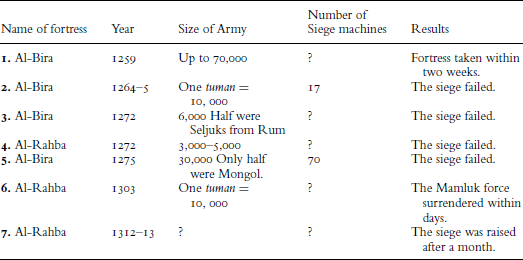
Al-Bira was besieged for the second time approximately a month before Hulegu's death. By the winter of 663/1264–1265 the military balance in the region had changed considerably. The Mongol defeat at Ayn Jalut did not change Mamluk perceptions of the Mongols, but it no doubt broke the image of an invincible army. The stability achieved within the sultanate during the 1260s allowed Baybars to organise the Mamluk frontier and prepare it for the next Mongol move. The strengthened Mamluk garrison and the well organised relief forces from the Syrian cities considerably reduced the Ilkhanids’ chances of recapturing the fortress. Between December 1264 and January 1265 the Ilkhanid army erected seventeen siege machines around the fortress of al-Bira. In addition a section of the moat was filled with wood.Footnote 63 The Mamluk garrison was quick to react and the Mongol operation was foiled by the wood being set on fire. The Ilkhanids’ attempt to scale the walls failed and in mid-February they abandoned the site after hearing that a Mamluk relief force was on its way from Cairo. Baybars ordered repairs to be taken care of by his own troops.Footnote 64 Weapons and food supplies were renewed and the garrison reinforced; thus the fortress was made ready for the next Ilkhanid assault.
The methods of siege warfare conducted under Hulegu's command and those of his successor seem much the same. The main difference between the two sieges, separated by five years, was in the size of the army, a difference of considerable importance since both fortress and garrison had been strengthened and reinforcements could reach al-Bira at relatively short notice. During the first siege Hulegu came with the greater part of the Mongol army. Assuming that at the siege of Baghdad (January 1258) the army numbered approximately two hundred thousand men, it seems likely that in December 1259 the force that besieged al-Bira was still fairly large. In 1264–5 the besieging Ilkhanid force under Durbai's command had only one tumen, i.e. ten thousand men, at the most. An Armenian contingent was supposed to join them,Footnote 65 but when they heard that the Ilkhanids were retreating they decided to turn back, and did not participate in the battle at all.Footnote 66
The third and fourth sieges of al-Bira and al-Rahba occurred simultaneously in the winter of 671/1272 during Abagha's reign. While half the force marched towards al-Rahba the other half besieged al-Bira. The Mamluks followed suit. The Syrian force led by Fakhr al-Din al-Himsi and Ala al-Din al-Hajj was sent to al-Bira while Baybars himself hurried to al-Rahba. The Ilkhanid army encamped in front of al-Bira was composed of three thousand Mongols and approximately three thousand Seljuks from Rum. Siege machines of different types were positioned at the foot of the fortress. According to Wassaf, Baybars had promised the garrison at al-Bira that reinforcements would arrive within a week. He added that if they were delayed the besieged might surrender and abandon the fortress.Footnote 67 There was no need for this alternative plan, since the Ilkhanid army was defeated after engaging the Mamluk relief force. Although we lack information concerning the number and type of siege machines, we know the strength of the Ilkhanid force. The size of the army had dropped significantly, once again, and of its six thousand men only half were Mongols. The siege of al-Rahba, was carried on by an Ilkhanid army of similar size.Footnote 68 With the arrival of Baybars the siege was abandoned, and the Ilkhanids retreated to the eastern bank of the river where they built a fortified camp. This turned out to be a grave mistake, mainly due to the superior numbers of the Mamluk army. Baybars was determined to attack. The Mamluks began to cross the river; the Ilkhanids soon discovered them and began to attack while the Mamluks were still crossing. The Ilkhanid army was defeated, suffering heavy losses. Thus all four attempts to take al-Rahba and al-Bira with a relatively small force failed. This may have taught the Ilkhanids an important lesson, since future sieges were conducted with a considerably larger army.
The fifth attempt to take al-Bira dates to the winter of 674/1275. The Ilkhanid army led by Abtai numbered thirty thousand; half are said to have been Seljuks and soldiers recruited from the nearby cities of what is now Iraq. The siege units must have been well manned and organised, as we are informed that seventy siege engines were built. Yunini mentions only twenty three siege machines of the Frankish type, while Ibn al-Furat states there were only eleven. Although the force was considerably larger, the number of siege machines possibly higher than ever before, and Mamluk reinforcement were delayed, the Ilkhanid army lifted the siege within nine days. The garrison at al-Bira stood fast and managed to hold their ground without help.Footnote 69 The fierce cold and signs of treason in the Seljuk force are among the main reasons given for the Ilkhanid failure. The siege machines were set on fire and the army retreated.Footnote 70
After the fifth Ilkhanid debacle a noticeable change took place in their strategy. From this point on invasion routes bypassed the two Mamluk fortresses on the Euphrates. In addition, once the Ilkhanid forces entered Syria they manoeuvered around the strongholds and fortified cities of Aleppo, Hama and Homs, making great efforts to avoid siege warfare. The routes they chose speak for themselves. Whether because their siege technology and methods ceased to advance or because they were less experienced and numerically fewer than Hulegu's siege contingents, there was a clear attempt to move the fighting to the battlefield and lure the Mamluks into close combat.
In the two attempts to invade Syria (679/1280, 680/1281) during Abagha's reign the Ilkhanid force came from the north through the territories of the Armenian Kingdom of Cilicia. The Mamluk garrisons in the region and the urban populations withdrew before the Ilkhanid army and if it encountered any resistance this was nominal. The retreating Mamluk forces halted at Damascus where they reorganised their lines and returned to fight the Ilkhanid army, pursuing it back across the river and further north to Ayn-Tab.Footnote 71
The vast army sent by Abagha in 680/1281 (estimated between forty to eighty thousand men) under the command of Mengu-Temur,Footnote 72 suffered a crushing defeat at the battle of Homs.Footnote 73
Ghazan (r. 1295–1304) invaded Syria three times within the space of four years, and if not for his death there would have been a fourth attempt. In his renewed efforts he chose a new crossing point for his army. In 699/1299–1300 the Ilkhanid forces crossed the Euphrates near Qalat Jabar, and from there marched for five days to reach Aleppo.Footnote 74 The army manoeuvered around the city, avoiding a siege, and continued south, bypassing Hama and luring the Mamluk army into an open battlefield near Wadi Khaznadar, where it was defeated.Footnote 75 The city of Hama surrendered immediately after the battle and the Ilkhanid army marched south into Damascus. Within a few weeks the entire army left with Ghazan, a small contingent remaining behind in the city. The only siege conducted during this campaign was that against the citadel of Damascus, which refused to capitulate. Although an Ilkhanid garrison remained in the city it appears to have been busy looting. The Mamluks took advantage of the chaos and sent out small units from the citadel to attack the pillaging Ilkhanid forces. A few weeks later the Ilkhanids retreated, as it became increasingly difficult to fight the citadel garrison, continue the siege and hold on to the city.Footnote 76
A year later, in 700/1300–1301, Ghazan invaded Syria for the second time. The campaign came to an end due to severe rains.Footnote 77
For his third campaign (702/1303) Ghazan chose a very different course. An army that numbered one tumen crossed the Euphrates at al-Hila, east of Karbala. It is easy to justify this choice of a ford as it was not defended by the Mamluks and was far from any of their possible sources of intelligence. Though there was no danger of the army suffering from lack of water, since it would march along the river, the time and distance this journey consumed were considerable.Footnote 78 Once the army had crossed the Euphrates, Ghazan marched north to al-Rahba which capitulated within a few days. According to Rashid al-Din, Ghazan sent an embassy, headed by Rashid al-Din himself, to conduct most of the negotiations with the local population, which eventually decided to surrender.Footnote 79 Ghazan's next step is rather surprising for he decided to end the campaign at this point. The move is difficult to explain. Rashid al-Din says that the hot weather and the danger of seasonal floods caused Ghazan to abandon the original plan. The Armenian historian Hetum gives a different account. He claims that Qaidu (the ruler of Central Asia, a member of the house of Ogedei. [d. 1301])Footnote 80 threatened to invade the eastern frontier of the Ilkhanid state; this caused a quick change of plans. A second Ilkhanid force, that was moving parallel to that of Ghazan, entered Syria from the north, reached Homs and continued to Damascus, where it was defeated by the Mamluk army at Marj al-Suffar in Ramadan 702/April 1303.Footnote 81
The last Ilkhanid attempt to invade Syria took place in 712/1313–1312, during the reign of Oljeitu. The army under the command of the Ilkhan left the new capital of Sultaniyya, crossed the Euphrates at Qirqsiya (ancient Carchemish) and marched south to al-Rahba.Footnote 82 Oljeitu, influenced by Qara-Sanqur and Aqqush al-Afram (Mamluk amirs who had defected to the Ilkhanid side shortly before the campaign) was convinced that al-Rahba would surrender without a siege. This notion soon proved mistaken. The town put up a fierce defence, the Ilkhanid army set siege machines and hurled “Greek Fire” but its losses were severe. Ilkhanid supplies were far from adequate and after three weeks a shortage of food began to be felt.Footnote 83 Rashid al-Din, who was present, advised the Ilkhan to answer the request of the besieged and provide them with an aman (guarantee of safety). The whole event looks like an effort to avoid humiliation. It is more than likely that the attempt to persuade the Mamluks to surrender was made to save face and to enable the Ilkhanid army to retreat without appearing to have suffered a severe defeat. Approximately a month after the siege had begun, Ramadan 712/January 1313, the Ilkhanid force crossed the Euphrates and headed back east.Footnote 84
The following table sums up the attempts to take the Mamluk fortresses on the Euphrates. The most striking point that emerges from it is the decrease in the size of the army in comparison with the force under Hulegu before the establishment of the Ilkhanid state. At first it seems that the cause of the failures was the small size of the forces deployed, yet even when the numbers were considerably increased, the Ilkhanid army could not subdue the fortresses. The claim that the Ilkhanid army was occupied on the frontiers with Chaghatai and the Golden Horde is hardly persuasive and does not fully explain the matter. Although we do not have all the details, and the historical accounts are lacking, it seems that part of the reason was the deterioration of the Ilkhanid siege units. None of the large scale engineering works that were carried out during the campaigns of Chinggis Khan or on Hulegu's journey to the Middle East were attempted by the Ilkhanid army. While both fortresses were modest in size, their location made it impossible to flood or mine their walls and towers. Even if an original engineering idea had been implemented, such projects demanded a great deal of labour and suitable teams of artisans. The number of men allocated to the campaigns was small and hardly sufficient for carrying out large scale projects that would have included shifting quantities of earth. Even when the army was larger there is no sign of any new initiative in the conduct of siege, no new ideas or techniques.
The sieges of al-Rahba and al-Bira

None of the Mamluk sources that describe Ilkhanid siege warfare along the Euphrates mention the use of gunpowder or of unusual types of incendiaries causing severe damage to the fortifications, incredible noise or a high death rate among the besieged. If gunpowder was brought in by Hulegu's army, as has been suggested by a number of scholars, it is difficult to explain its absence in the last decades of the thirteenth century. The descriptions provided by Mamluk, Persian and Chinese sources all seem to agree that neither the Mongol army under Hulegu's command nor the Ilkhanid army had any superior knowledge in the field of siege warfare.
The ability of the Mamluks to provide a relief force within days, or a couple of weeks at most, prevented the Ilkhanids from carrying out complicated engineering projects. Even the simplest method of siege warfare – surrounding the site and starving its inhabitants until they surrendered – was not possible due to the short time that passed until the arrival of Mamluk reinforcements. The lack of time was a problem that the Ilkhanid army could not solve. The changes in strategy during the reign of Abaka, the decision to avoid siege warfare and encounter the Mamluks in the open field, are a silent recognition of the limitations and flaws of its siege units.