Introduction
The beginning of the industrial era has been described as a transition of major significance in Earth's history, as shifts in human resource use fundamentally altered the environment, landscapes and society. This process of industrialization began in Britain from around 1700 (Steffen et al. Reference Steffen, Crutzen and McNeill2007). The direct effects of industrial pollution on lichens are well known, and dramatic declines in diversity have been noted since the mid-19th century (e.g. Grindon Reference Grindon1859; Crombie Reference Crombie1885). By the time the British Lichen Society Mapping Scheme was begun in 1964, numerous zones devoid or nearly devoid of lichens had developed in urban areas across Britain (Hawksworth & Rose Reference Hawksworth and Rose1970), and individual species had experienced greatly reduced ranges (Hawksworth et al. Reference Hawksworth, Rose, Coppins, Ferry, Baddeley and Hawksworth1973). However, detailed knowledge of the losses of lichen diversity remains unquantified for most areas, especially with respect to ‘baseline’ distributions from before the industrial era, which pre-date systematic recording.
Lichens play an important role as bioindicators, and their composition and diversity at a site reflect environmental aspects of the landscape, including not only the pollution regime, but also the climate setting, and woodland spatial-temporal structure and habitat quality. This role of lichens as proxy-indicators has been applied especially to lichen epiphytes. Of the approximately 1900 lichen fungi in Britain (Smith et al. Reference Smith, Aptroot, Coppins, Fletcher, Gilbert, James and Wolseley2009), c. 40% occur as epiphytes, growing on trees. Here, a growing body of literature highlights the role of individual and interacting factors which are known to control epiphyte community composition (the types of species which occur on a given tree). For example, lichens demonstrate well-differentiated biogeographical patterns in response to climatic variation (Werth et al. Reference Werth, Tommervik and Elvebakk2005; Ellis & Coppins Reference Ellis and Coppins2006), and bioclimatic models can be used to describe the distribution of lichens with high predictability (Coppins Reference Coppins, Brown, Hawksworth and Bailey1976; Ellis et al. Reference Ellis, Coppins and Dawson2007). Lichen epiphytes also demonstrate sensitivity to the extent and temporal continuity of woodland stands (Selva Reference Selva1994; Gignac & Dale Reference Gignac and Dale2005) and have been applied as bioindicators for woodland ecological continuity (Rose Reference Rose, Brown, Hawksworth and Bailey1976; Coppins & Coppins Reference Coppins and Coppins2002). Of particular interest recently is the sensitivity of lichens to their substratum, with an important suite of lichens found particularly on nutrient-rich bark. Historically, Ulmus would have been an important tree in supporting a distinct epiphyte community (Watson et al. Reference Watson, Hawksworth and Rose1988), with certain component species persisting on sub-neutral bark such as that of Fraxinus, a species which is now under threat itself (Ellis et al. Reference Ellis, Coppins and Hollingsworth2012, Reference Ellis, Coppins, Eaton and Simkin2013).
From the perspectives of both biodiversity change over time, and reconstructing environmental drivers of this change, it is significant that epiphytic lichens can be found inside historical buildings (Coppins et al. Reference Coppins, Rose and Tittensor1985; Yahr et al. Reference Yahr, Coppins and Ellis2011), preserved from the time a wooden building component was harvested from the landscape. For the majority of low-status houses and barns, the style of construction and materials used were locally derived and intimately connected, creating distinctive ‘vernacular’ local styles (Brunskill Reference Brunskill2000; Iredale & Barrett Reference Iredale and Barrett2002). Although other studies have documented epiphytes in vernacular buildings (Coppins et al. Reference Coppins, Rose and Tittensor1985; Bates Reference Bates1993), our group has recently demonstrated the utility of this resource to describe biodiversity from a point prior to the industrial era, and to pinpoint forces responsible for changes observed through to the post-industrial period by relating lichen records to factors known to shape their distributions (Yahr & Ellis Reference Yahr and Ellis2009; Ellis et al. Reference Ellis, Yahr and Coppins2011; Yahr et al. Reference Yahr, Coppins and Ellis2011). Here, we use the well-researched epiphytic lichen community as a tool to estimate lichen biodiversity losses in an area which was thought to have experienced only a relatively minor impact from industrialization, Exmoor National Park in Somerset, south-west England. We compare two methods to estimate these losses and discuss the relevance of the distributional changes observed.
Methods
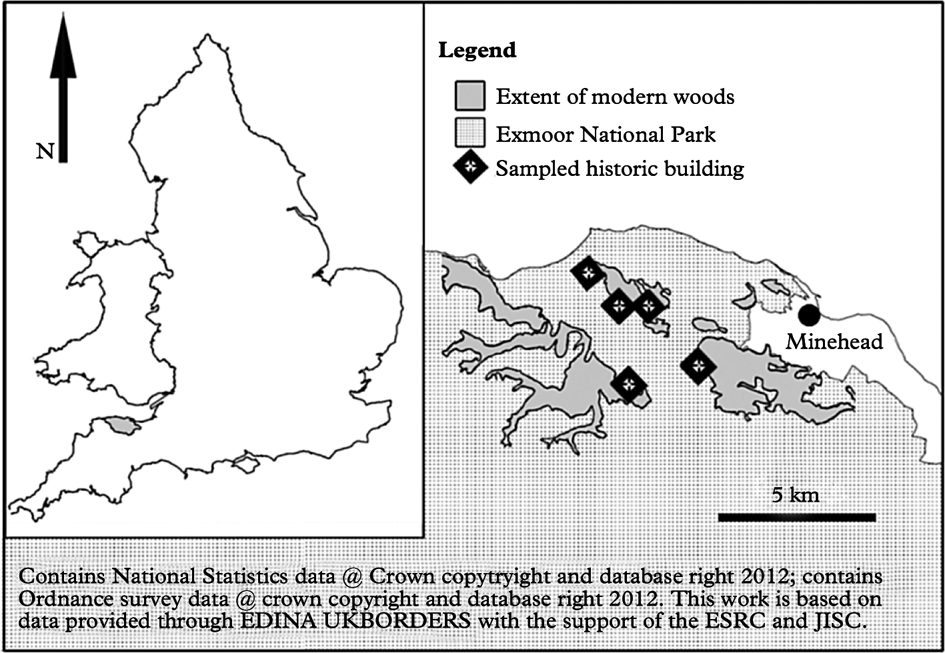
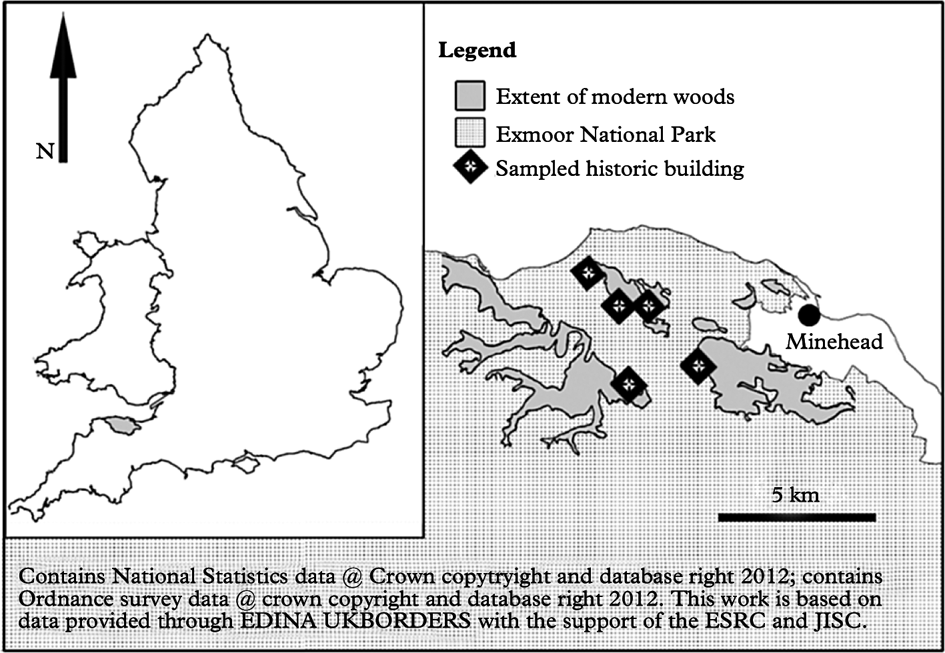
Sampling sites (villages with vernacular buildings) were located on the Holnicote Estate near Minehead, in Exmoor National Park, south-west England (51°13′N, 3°32–35′W; Fig. 1), a well-wooded landscape of long ecological continuity, recognized for high lichen diversity (Rose Reference Rose, Brown, Hawksworth and Bailey1976; Wolseley & O'Dare Reference Wolseley and O'Dare1989; Coppins & Coppins Reference Coppins and Coppins1998). We surveyed six vernacular buildings, all of which were residences and had original roof elements remaining from the 18th century or earlier. Dating of timber structures was estimated to century based on archaeological survey reports (Holincote Estate, National Trust), on style of construction (e.g. Hewett Reference Hewett1980), and in consultation with local building specialists (e.g. Penoyre Reference Penoyre2005).
Study site with location of individual houses marked and extent of modern woods shown. Inset: Exmoor National Park (shaded) in SW England.
All visible and untreated timber elements were examined for the presence of bark and preserved epiphytes. Where necessary, bark samples were returned to the laboratory at the Royal Botanic Garden Edinburgh for identification of preserved epiphytes using standard microscopic and chemical methods. The species of tree for each bark sample was recorded. The presence of an epiphyte species on sampled pre-industrial bark constitutes a ‘historical presence’ for the purposes of analysis. Sampled buildings are scattered across several villages, and each species presence is attributed to the 10 km square in which the building is found. We recorded lichen and bryophyte epiphytes on timbers and roundwood such as wattles and pole rafters, but our analysis below is limited to lichens on timbers.
Quantifying species extirpation
In contrast to the relatively straightforward observation that epiphytes preserved inside historical buildings result in historical records, it is a challenge to identify cases where a species is recorded historically, but is not expected to occur at the same site in the present-day landscape, indicating species loss over time. We used two methods to estimate this loss. First, direct observations compared a species record from historical material with an equivalent 10 km grid-square using the British Lichen Society (BLS) mapping data, (held at the University of Bradford) for the period since c. 1960 (hereafter termed ‘modern’), allowing direct inference of a species' extirpation between the pre- and post-industrial eras.
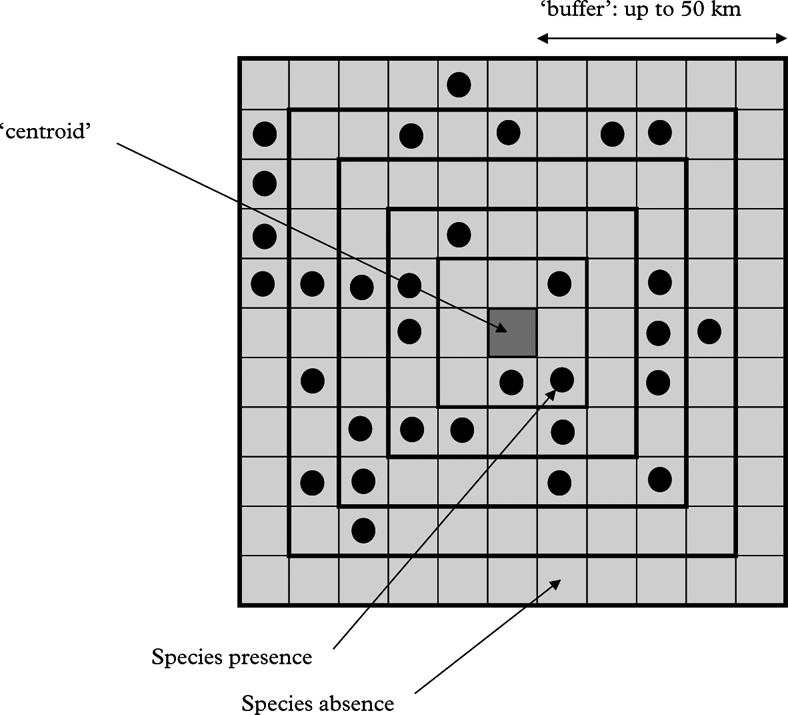
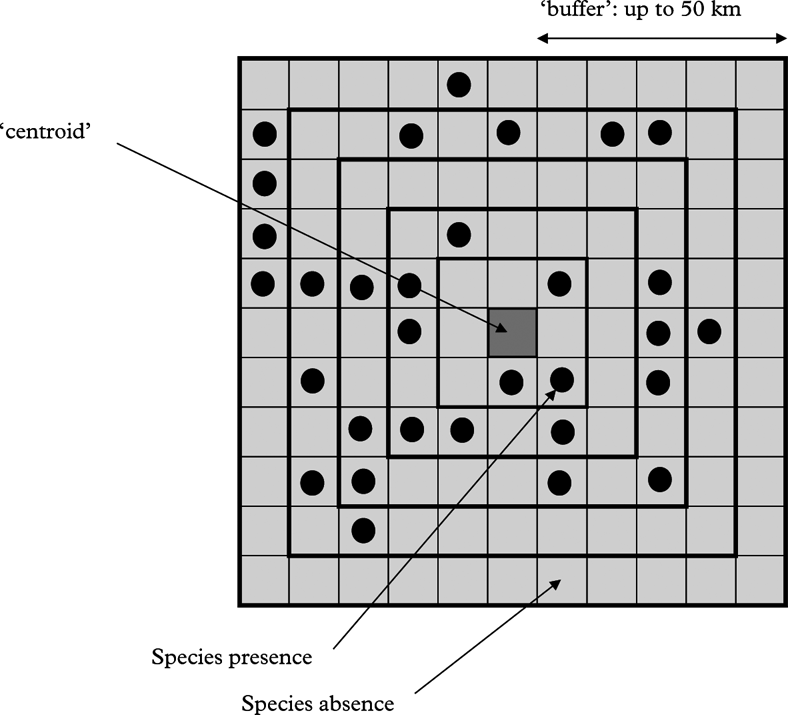
However, even with intense recording effort, it is very difficult to definitely confirm a species' absence, particularly for diminutive lichens. This problem may be mitigated by statistical estimates of a species' likelihood of occurrence based on a wider sample of the species' confirmed presences across the landscape, which greatly reduces the dependency of the result (extirpation or not) on the accuracy of a single data point (the 10 km grid-square containing the sampled village). Therefore, we also compared each historical record (an epiphyte on a historical timber) with a statistical estimate for its presence-absence in the modern landscape following Ellis et al. (Reference Ellis, Yahr and Coppins2011). In short, we began by scoring modern presence-absence (BLS mapping data) for each epiphyte in the 10 km grid-square within which the historical timber was located (Fig. 2). This data point, referred to as the ‘centroid’, was accompanied by a measure of the lichen species' occurrence in consecutively sized buffers, positioned at 10 km intervals, up to a maximum buffer of 50 km (Fig. 2). Next, we determined the optimal spatial scale (buffer size) at which species abundance predicts presence-absence in the centroid, by building a generalized linear model (GLM) using the base package in R (2013). This model describes the likelihood of modern presence-absence in the centroid for each buffer size averaged across all species together. Predictive capacity of each buffer size-based model was measured as the area under the receiver operating characteristic curve (AUC) (Swets Reference Swets1988; Fielding & Bell Reference Fielding and Bell1997). Comparing models for buffers with different dimensions (10–50 km), the one with the highest cross-validated AUC value (x-AUC) was selected for estimating species likelihoods in the centroid grid-square.
The process of spatial inference, in which a species' presence-absence in a target ‘centroid’ grid-square is estimated based on its landscape-scale spatial density, measured for surrounding grid squares grouped into buffer zones.
Having determined the optimal size to model likelihood of occurrence in the centroid, we used two methods to identify the threshold at which to determine a species' presence or absence in the target grid-square (centroid). First, we applied an AUC threshold, positioned at the model likelihood value which maximizes the sum of sensitivity (proportion of true positive predictions) and specificity (proportion of true negative predictions). However, this is possibly a conservative estimate of extirpation, being skewed towards false presences for rare taxa (Manel et al. Reference Manel, Williams and Ormerod2001). To accommodate these possible anomalies with AUC thresholds, we secondly applied as an alternative the Cohen's Kappa threshold.
Using these different methods, we can determine: 1) where a species occurs in the historical landscape and 2) if the same species is not expected to occur within an equivalent location (‘centroid’ square) in the modern landscape (likelihood values<AUC or Kappa thresholds). Robust estimates of both of these conditions then allow us to infer species extirpation, representing an inferred shift in species' landscape-scale spatial distributions and abundances, between the pre- and post-industrial eras. However, as an additional precaution, we performed a sensitivity analysis to test the robustness of our thresholds, comparing the estimated magnitude of species extirpations for a range of contrasting decision threshold values. If the optimum selected threshold is robust, we would expect little change in the extirpation value across a range of thresholds on either side of the optimum.
Results
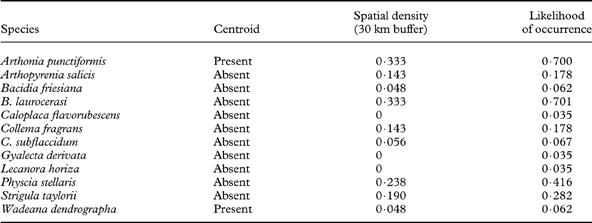
Sixteen timbers in six different buildings supported historical epiphytes. On the bark of these, 33 lichen epiphytes which could be named to species and an additional seven bryophyte species were recorded, for a total of 77 individual observations (Appendix 1). Twelve of the building timbers with bark were identified with very high confidence as Ulmus (based on wood anatomy) and one was identified as Ulmus with medium confidence, based on its bark and epiphytes. There were also individual timbers of Aesculus, Quercus, and one timber that could not be identified. Based on a direct comparison with observed lichen species presence-absence in the 10 km target grid-square, c. 31% of lichen epiphytes recorded from the pre-industrial timbers had disappeared from the post-1960 landscape (Table 1). Additionally, 119 records of epiphytes from roundwood poles less than 10 cm in diameter were observed but not analyzed here. They are found on a wider variety of tree species including Ilex, Salix, Fraxinus, and Corylus (Appendix 2).
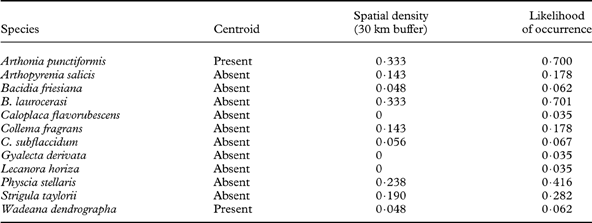
Species which were recorded from timbers sampled in vernacular buildings from the historical landscape (pre-industrial era), but which are not expected to occur at the same site during the present-day (post-industrial era), based on statistical inference, i.e. with likelihood values<0·71 (cf. Table 2).
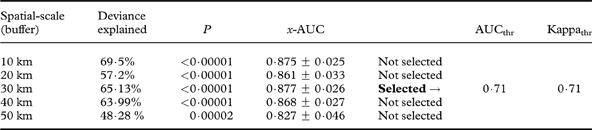
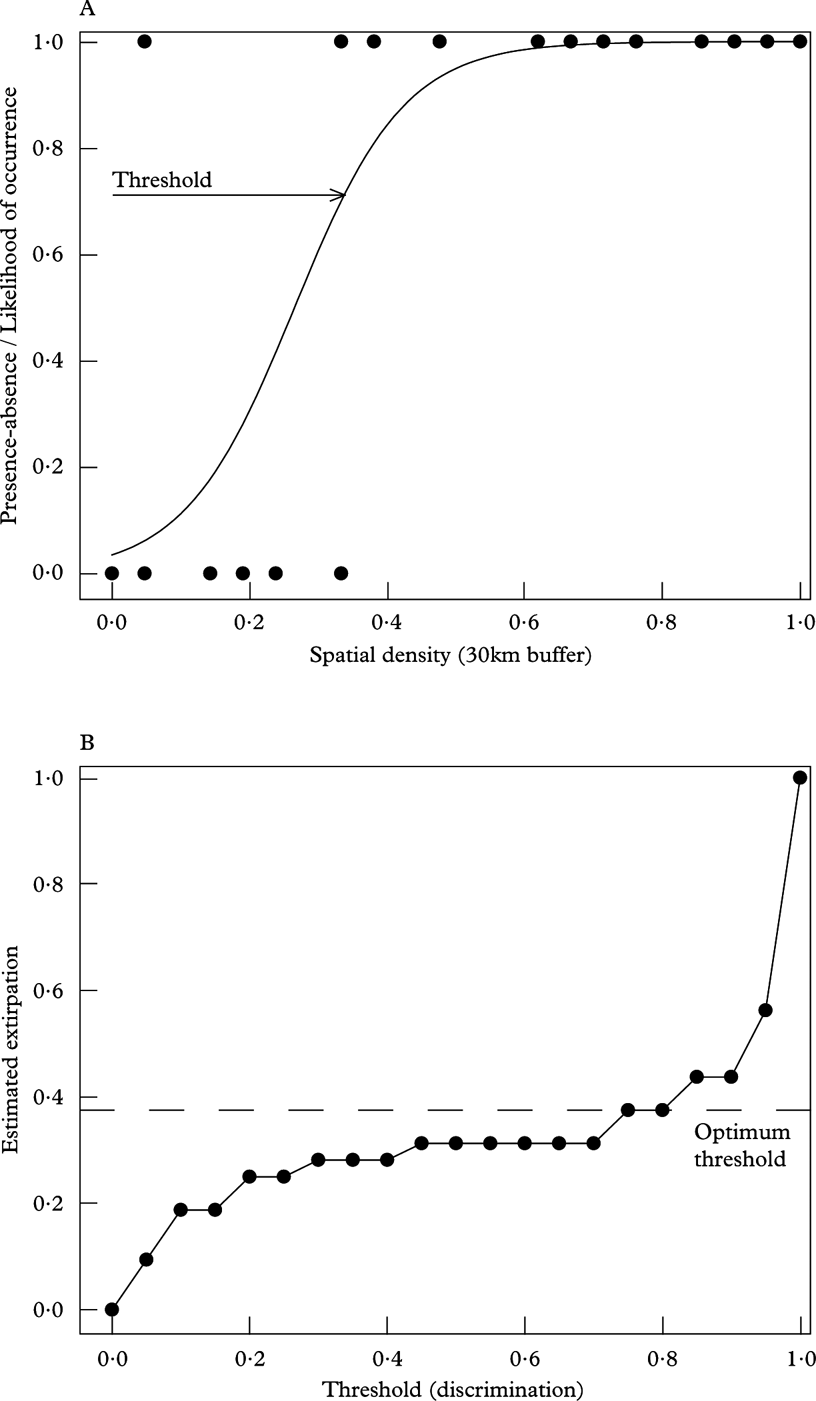
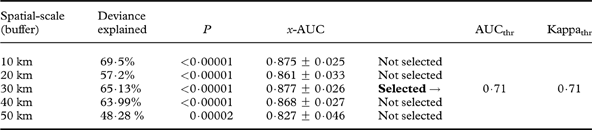
The GLM to compare species occurrences in the centroid grid-square with spatial density for different buffers was highly significant across all scales, though was optimized using n−1 cross-validation at a buffer size of 30 km (Table 2; Fig. 3A). Decision thresholds to estimate species' presence-absence were set at model likelihood values of 0·71 for both AUC and Kappa determined thresholds (Table 2); this led to an inferred species loss of c. 38%, based on the comparison with each lichen species' landscape-scale density.
Diagnostics for general linear models, used to describe presence-absence of lichen species in a centroid grid-square, compared to the spatial density of records in contrasting sized buffer zones (cf. Fig. 2) and decision thresholds (AUC/Kappa) for the statistical inference of extirpation (expected absence).
A, the optimum GLM, in which the likelihood of occurrence for lichen species in a centroid grid-square (Fig. 2) was explained by the surrounding spatial density of records using a 30 km buffer zone. The decision threshold for inferring a species' presence-absence is shown; B, the effect of changing the decision threshold (x-axis) on the proportion of species which are estimated to have been extirpated (y-axis), compared to the estimated level of extirpation based on an optimized decision threshold (dashed line).
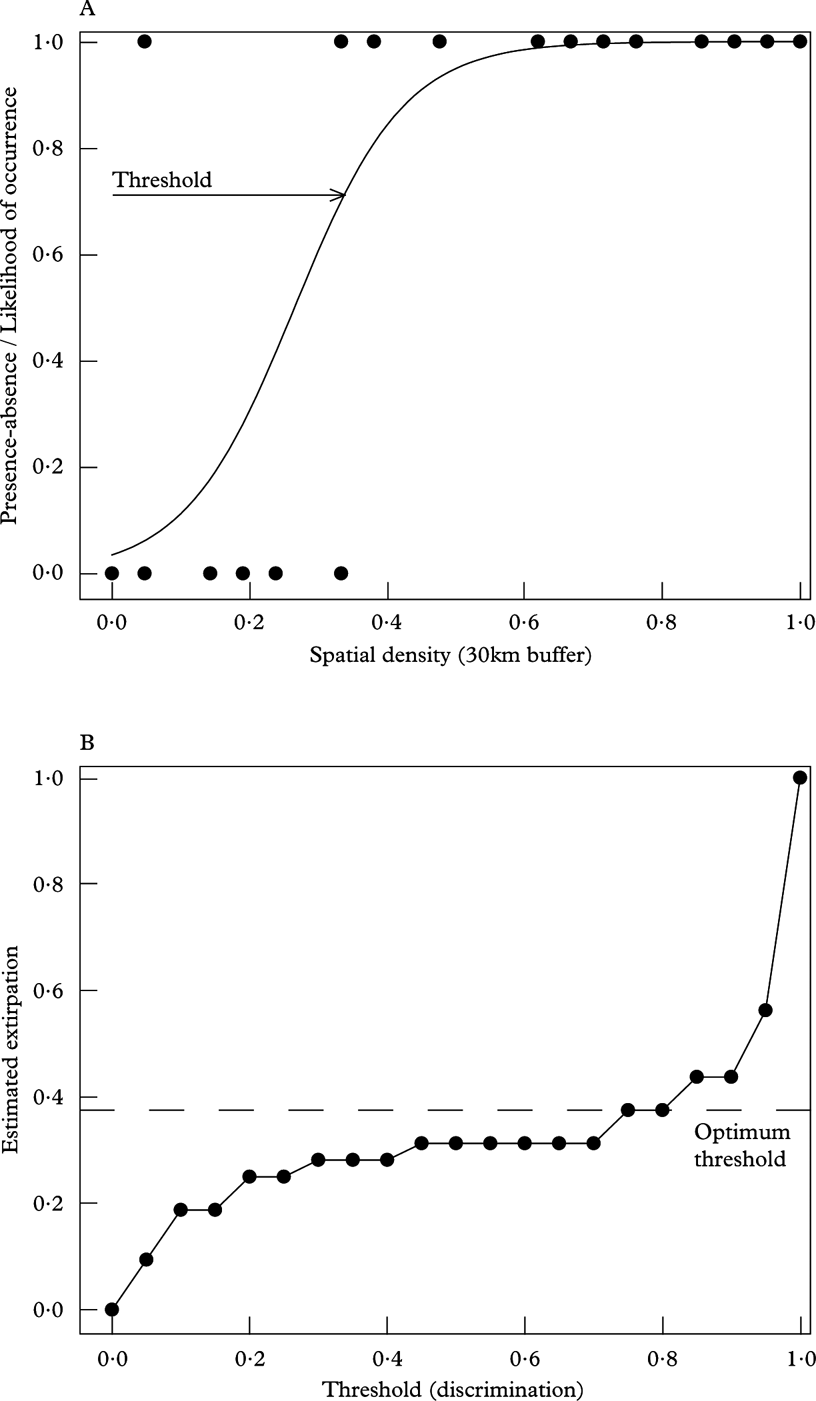
The slight discrepancy in estimated species extirpation (31% compared to 38%), when comparing observed occurrence and statistical inference, was accounted for by two species. These species had been recorded for the centroid grid-square (the 10 km square containing the sampling site), but have below threshold densities (<AUC/Kappa thresholds) in the surrounding landscape using the 30 km buffer: Arthonia punctiformis, and Wadeana dendrographa. Notwithstanding these anomalies, the values for inferred extirpation varied only slightly around the optimum decision threshold (Fig. 3B), suggesting that the AUC/Kappa thresholds used for estimating species loss was broadly reliable across a wide range of statistical likelihood values.
Discussion
We demonstrate the potential role of preserved lichen epiphytes on the internal structures of vernacular buildings in order to reconstruct pre-industrial biodiversity patterns. This is an important development because although lichen sensitivity to industrial pollution is well established (Hawksworth & Rose Reference Hawksworth and Rose1970; van Herk Reference van Herk1999), and the history of change in British lichen diversity during a period of severe pollution has been well documented (Laundon Reference Laundon1967; Larsen et al. Reference Larsen, Bell, James, Chimonides, Rumsey, Tremper and Purvis2007), our knowledge of the pre-industrial period is scanty. This period from before industrial pollution corresponds to an unknown set of baseline conditions. We suggest here that the archaeological record provides a hitherto unexplored sample of post-medieval, pre-industrial structural timbers, which represents a geographically widespread and abundant sample of epiphytic habitat and associated species from this period.
In making a comparison of species occurrence from the pre- and post-industrial eras, we assume that timbers studied in vernacular buildings were ‘sampled’ from the local environment, within a small geographical distance of their present-day location. There is a general assumption in the archaeological and historical literature that the timber for local unspecialized uses would have been sourced from nearby, heavily managed woodlands (Rackham Reference Rackham1972; Haneca et al. Reference Haneca, Wazny, Van Acker and Beeckman2005; Miles Reference Miles2006), although transport from more distant sources has been documented for outsize timber or crown construction projects (Rackham Reference Rackham and McGrail1982). In a heavily wooded area such as Exmoor, this assumption seems fair; in addition, the distance from major transport routes along coasts or rivers makes the use of local woodland resources even more likely. The dating of material to the pre-industrial era is based on distinctive styles of carpentry (e.g. Hall Reference Hall1981), which have themselves often been carefully dated using dendrochronology to cross-reference material with a master chronology (e.g. Penoyre Reference Penoyre1998; McDermott Reference McDermott2006; Miles Reference Miles2006).
Furthermore, we assume that modern distributions of the epiphytes we studied are completely, or at least accurately, known. If we assume species distributions are completely known, we can compare the historical occurrence of a species with its presence or absence in the same location for the industrial and post-industrial era. This yielded the estimated loss of 31% of species for the preserved historical lichen diversity. However, assuming incomplete but accurate knowledge of species distributions, and defaulting to statistical inference, we find an estimated loss of 38% of species. The total estimate of species loss across the industrial threshold, for Exmoor, is therefore in the region of 31–38%. This is similar to an estimate of 35% for Wiltshire, though less than an estimate of 65% for a nearby village in Somerset (Ellis et al. Reference Ellis, Yahr and Coppins2011), and therefore supports the growing evidence for local-scale patterns in biodiversity impacts.
Two species presented a discrepancy because they occur in the centroid post-1960, but are rare enough in the surrounding landscape to have generated an expected absence, and help to scrutinize our methods. For Arthonia punctiformis, the discrepancy may be a case of incomplete recording for this easily overlooked but probably widespread species. Recent unpublished field records in the vicinity of our sites suggest the problem of ‘false-absences’ may apply more widely to diminutive species such as Arthopyrenia salicis and Strigula taylorii. On the other hand, Wadeana dendrographa and several other species (see below) were found on historical timbers and are genuinely extremely rare in the vicinity of the sampling sites today. In the case of W. dendrographa, detailed cross-checking of mapping scheme records by one of the authors (BJC) confirms this rarity, and indicates that the species has not been recorded in the centroid grid-square since the 1970s. This is consistent with the ‘expected absence’ inferred from the species' wider distribution using statistical inference, and which draws on a generalization which suggests that species tend to be more locally abundant where they are frequent (e.g. at range centres) than where they are infrequent (Brown et al. Reference Brown, Mehlman and Stevens1995; Gaston et al. Reference Gaston, Blackburn, Greenwood, Gregory, Quinn and Lawton2000). The expected absence highlights the ecological significance of occurrence on a historical artefact, which represents a small and declining sample of the available epiphytic habitat within the pre-industrial landscape.
The inferred loss of lichen species highlights the ecological importance of elm in the historical landscape. More than three-quarters of the nearly 100 historical lichen records from timbers in the Exmoor area were from elm, and 13 of 16 timbers with bark in this study were elm. The prevalence of elm in our Exmoor sample is similar to the all-elm sample from the nearby village of Stogursey, an observation which contrasts with samples in other parts of England, where oak figures more prominently (see fig. 4 in Yahr et al. Reference Yahr, Coppins and Ellis2011). The dominance of elm as the main building material in this area has also been noted by regional building specialists (McDermott Reference McDermott2006).
Of the species found on historical timbers, Caloplaca flavorubescens, Collema fragrans, Lecanora horiza, and Wadeana dendrographa are all now Nationally Scarce (occurring in between 16–100 10 km grid-squares) and meet IUCN criteria for red-listing, either as near threatened (L. horiza, W. dendrographa) or endangered (Caloplaca flavorubescens and Collema fragrans). The archaeological records of these and three other now Nationally Scarce species (Bacidia friesiana, Gyalecta derivata, and Strigula taylorii) are from elm. In England, this suite of species is restricted to nutrient-rich bark, especially of Fraxinus, and sometimes also Fagus (C. fragrans), Quercus (L. horiza, G. derivata), Acer (G. derivata, S. taylorii) or Sambucus (B. friesiana); the severe risk to C. fragrans has already been highlighted in relation to the loss of Ulmus (Watson et al. Reference Watson, Hawksworth and Rose1988) The current importance of Fraxinus for several of these species is a worrying observation in light of the new threat from ash dieback, Chalara fraxinea (Ellis et al. Reference Ellis, Coppins and Hollingsworth2012, Reference Ellis, Coppins, Eaton and Simkin2013). Field observation also indicates that several of the elm-associated species, such as Caloplaca flavorubescens and Collema fragrans, are characteristic of relatively open habitats, as may be provided by wayside or hedgerow trees.
Despite notable species which seem to have disappeared as a consequence of elm decline (see above; Watson et al. Reference Watson, Hawksworth and Rose1988), the Exmoor lichens seem to have been well buffered against the impact of industrial biodiversity, which occurred widely across lowland England. For example, in the London area, of 159 species recorded since the late 16th century, only 62 were recorded between 1950–1967 despite intensive searches (Laundon Reference Laundon1967), a loss of well over half the known species. Similar reductions were noted for Mendlesham, Suffolk (Coppins & Lambley Reference Coppins and Lambley1974) and even more dramatic losses for the Epping Forest in Essex (Hawksworth & McManus Reference Hawksworth, McManus and Hanson1992), despite their apparently rural settings. Losses in these and other sites have been attributed especially to the loss of old trees, but also to the effects of pollution, particularly in sites which lie downwind of London in the prevailing winds. In contrast, although Exmoor is relatively distant from large urban areas, surveys of lichens during the 1970s suggested that it was still subject to the effects of pollution, though these were relatively mild (Hawksworth & Rose Reference Hawksworth and Rose1970).
Likewise, although late-19th and 20th century declines in ancient woodland extent and continuity (Rose Reference Rose, Bates and Farmer1992; Pryor & Smith Reference Pryor and Smith2002; Rackham Reference Rackham2010) are perhaps important across southern and western England in accounting for losses in lichen diversity (Ellis et al. Reference Ellis, Yahr and Coppins2011), the low-intensity land management and well-wooded countryside of Exmoor may have provided refugia for epiphytes. Few published studies of the lichens of Somerset exist, but some areas are known to have exceptionally diverse epiphytic communities, probably as a function of habitat diversity (e.g. tree composition) and long ecological continuity (Wolseley & O'Dare Reference Wolseley and O'Dare1989; Coppins & Coppins Reference Coppins and Coppins1998). We conclude that one of the key factors behind the loss of biodiversity in the Exmoor landscape may be the changes in woodland composition, marked by the relatively recent loss of Ulmus due to Dutch elm disease. This is significant given the potential for further major tree disease outbreaks which loom large in British conservation.
We thank Nigel Hester for making the archaeological survey reports available for inspection at the National Trust, Holnicote Estate Records Office, and Ann Lund for arranging access to the properties. Individual tenants are also warmly thanked for permitting access and offering information about the properties. David Chamberlain kindly identified all bryophyte material. John Dallimore, David Martin, Dorothy Treasure, and Brenda Watkin provided useful discussions about dating buildings in southern England.
Appendix 1. Epiphytic lichens and bryophytes sampled from pre-industrial building timbers on the Holnicote Estate, Exmoor.
Numbers in parentheses are the number of different timbers on which a given species was found. All species were found on Ulmus in addition to other species unless indicated otherwise below. A ‘?’ symbol before a phorophyte name indicates that it is assigned with medium confidence to that genus.
-
Acrocordia gemmata (4)
-
Arthonia punctiformis (1, Aesculus)
-
A. radiata (2, ?Ulmus, Aesculus)
-
Arthopyrenia salicis (1, ?Ulmus)
-
Bacidia friesiana (1, ?Ulmus)
-
B. laurocerasi (2)
-
B. rubella (4)
-
Caloplaca flavorubescens (1, ?Ulmus)
-
C. holocarpa (1, unknown)
-
Collema fragrans (1)
-
C. subflaccidum (1)
-
Graphis scripta (1)
-
Gyalecta derivata (1)
-
Gyalecta sp. (1)
-
G. truncigena (1)
-
Lecania naegelii (1)
-
Lecanora chlarotera (3, ?Ulmus, Aesculus)
-
L. horiza (4)
-
Lecanora sp. (1, Quercus)
-
Lecidella elaeochroma f. elaeochroma (4, ?Ulmus, Aesculus)
-
Opegrapha atra (2)
-
O. herbarum (1)
-
O. varia (4)
-
Parmelia sulcata (1, ?Ulmus)
-
Pertusaria albescens var. albescens (1, unknown)
-
Phaeophyscia orbicularis (2, ?Ulmus)
-
Physcia adscendens (1)
-
P. aipolia (2, ?Ulmus)
-
P. stellaris (1)
-
P. tenella subsp. tenella (1)
-
Physconia distorta (1, ?Ulmus)
-
Physconia sp. (2)
-
Pyrenula chlorospila (2)
-
Strigula taylorii (1, unknown)
-
Unknown sp. (1)
-
Wadeana dendrographa (1)
-
Xanthoria parietina (4, ?Ulmus)
Lichens
-
Frullania dilatata (4)
-
Homalothecium sericeum (2)
-
Leskeaceae? (2)
-
Orthotrichum cf. stramineum (1)
-
Orthotrichum diaphanum (1)
-
Syntrichia laevipila (1, unknown)
-
Zygodon sp. (2)
Bryophytes
Appendix 2. Epiphytic lichens and bryophytes sampled from pre-industrial roundwood on the Holnicote Estate, Exmoor.
Numbers in parentheses are the number of times a given species was observed.
-
Anisomeridium biforme (3, Quercus)
-
A. viridescens (1, ?Salix)
-
Arthonia didyma (1, Ilex)
-
A. punctiformis (8, unknown, Fraxinus, Ilex)
-
A. radiata (17, unknown, ?Salix, Corylus)
-
A. spadicea (1, ?Salix)
-
Arthopyrenia analepta group (1, Ilex)
-
A. punctiformis (5, Fraxinus, Corylus)
-
Arthopyrenia sp. (1, unknown)
-
Caloplaca cerinella (1, ?Salix)
-
Graphis scripta (3, Ilex, Quercus)
-
Lecania naegelii (1, ?Salix)
-
Lecanora carpinea (13, Fraxinus)
-
L. chlarotera (15, Fraxinus, Corylus, Ilex, Quercus, Salix)
-
L. chlarotera/subfusca group (1, Ilex)
-
L. sambuci (1, ?Salix)
-
Lecidella elaeochroma f. elaeochroma (21, Fraxinus, Corylus, Ilex, Quercus)
-
Leptorhaphis maggiana (3, Corylus)
-
Opegrapha atra (8, Fraxinus, Ilex, Quercus)
-
O. herbarum (3, Quercus)
-
Opegrapha sp. (1, Ilex)
-
O. varia (1, Ilex)
-
Parmelia sulcata (2, Ilex)
-
Pertusaria albescens var. albescens (1, Ilex)
-
P. amara f. amara (1, Ilex)
-
P. pertusa (1, Quercus)
-
Pyrenula macrospora (1, Ilex)
-
Xanthoria parietina (1, ?Salix)
Lichens
-
Frullania dilatata (2, Quercus)