





Functional bowel disorders (FBDs) are highly prevalent gastrointestinal conditions, encompassing irritable bowel syndrome (IBS), functional bloating, functional constipation, functional diarrhoea and unspecified functional bowel disorders. Reference Wiley and Chang1 Epidemiological studies indicate that the prevalence of FBDs in adults ranges from 28.6 to 31.7%, Reference Palsson, Whitehead, Törnblom, Sperber and Simren2 suggesting that more than 1 in 4 individuals may be affected. Owing to their high prevalence, chronic and recurrent symptoms and substantial subjective distress, FBDs severely impair patients’ quality of life and place a considerable burden on healthcare systems. Reference Chang, Di Lorenzo, Farrugia, Hamilton, Mawe and Pasricha3 The pathogenesis of FBDs is complex and multifactorial, involving but not limited to motility disorders, visceral hypersensitivity, intestinal barrier dysfunction, abnormal gut–brain interactions, dysbiosis of the gut microbiota and psychological disorders such as depression and anxiety. Reference Wiley and Chang1,Reference Drossman4 In recent years, increasing attention has been directed towards the potential influence of social and psychological factors on gastrointestinal health, given the intricate interplay among social behaviours, mental well-being and gastrointestinal function.
Social connection plays a pivotal role in maintaining both physical and mental health. Reference Holt-Lunstad5 In contrast, social disconnection, particularly in the forms of social isolation and loneliness, has emerged as an important yet underrecognised public health concern. Social isolation refers to an objective deficiency in social interactions with family, friends and the broader community, whereas loneliness reflects a subjective feeling of distress resulting from a discrepancy between desired and actual social relationships. Reference Donovan and Blazer6,Reference Holt-Lunstad and Perissinotto7 Both conditions have been linked to a wide spectrum of adverse health outcomes, including infections, cardiovascular disease, stroke, Parkinson’s disease and dementia, Reference Liang, Zhou, He, Zhang, Wu and Luo8–Reference Shen, Rolls, Cheng, Kang, Dong and Xie13 highlighting the fact that their adverse effects on health should not be overlooked.
Given the established role of psychosocial factors in the pathophysiology of FBDs, Reference Yan, Zhang, Li, Liu, Yang and Yang14,Reference Qin, Cheng, Tang and Bian15 and the close association of anxiety and depression with FBDs, Reference Eijsbouts, Zheng, Kennedy, Bonfiglio, Anderson and Moutsianas16 it is plausible that social isolation and loneliness may also influence the risk of developing FBDs. Emerging research suggests that social isolation and loneliness can influence gastrointestinal function through several biological mechanisms, including activation of the hypothalamic–pituitary–adrenal (HPA) axis, increased inflammatory responses and impaired immune function. Reference Cacioppo, Cacioppo, Capitanio and Cole17–Reference Sidik20 These pathways have been implicated in the development and exacerbation of gastrointestinal dysfunction. However, whether social isolation and loneliness are associated with the risk of FBDs remains largely unexplored. To date, there is a lack of large-scale and prospective cohort studies specifically examining the associations between social disconnection and FBDs, which undermines substantial efforts to understand potential risk factors of gastrointestinal health and inform preventive strategies.
To address these gaps, we leveraged a large-scale prospective cohort to evaluate the associations of social isolation and loneliness with the risk of FBDs. We further conducted mediation and subgroup analyses to explore potential pathways and effect modification. Our findings may help clarify the role of social disconnection in the development of FBDs, and provide epidemiological evidence to inform future research and preventive strategies.
Method
Study design and participants
This study is based on a large population-based cohort study including over 0.5 million participants aged 37–73 years from 22 assessment centres across England, Wales and Scotland between 2006 and 2010. Reference Sudlow, Gallacher, Allen, Beral, Burton and Danesh21 A wide range of variables, including demographic information, lifestyle factors, biomarkers, imaging data and genetic data, were collected through touchscreen questionnaires, verbal interviews and physical measurements. The UK Biobank cohort study was approved by the North West Multicentre Research Ethics Committee, and all participants gave written informed consent before data collection. Our research is an observational study based on the approved project (application ID: 99732) from UK Biobank.
Among a total of 501 926 participants in UK Biobank (excluding those who withdrew from UK Biobank), we excluded those who (a) had the FBDs diagnosis at baseline; (b) had a cancer diagnosis at baseline; or (c) had missing data on social isolation or loneliness. A flowchart of participant inclusion is presented in Supplementary Fig. 1.
Assessment of social isolation and loneliness
Social isolation was assessed with three questions through touchscreen questionnaires: (a) ‘How often do you visit friends or family or have them visit you?’; (b) ‘Which of the following (leisure/social activities) do you attend once a week or more often?’; and (c) ‘Including yourself, how many people are living together in your household?’. Each question was scored 0 or 1, with the total social isolation score ranging from 0 to 3. Participants were classified as either least isolated (0 points), moderately isolated (1 point) or most isolated (2 or 3 points). This composite index has been widely applied in previous UK Biobank studies and has been associated with adverse health outcomes in prior research. Reference Liang, Chen, Feng, Liu, Ai and Xue10,Reference Smith, Barnes, Green, Reeves, Beral and Floud11
Loneliness was evaluated with two questions: (a) ‘Do you often feel lonely?’ and (b) ‘How often are you able to confide in someone close to you?’. Each question was scored 0 or 1, with the total loneliness score ranging from 0 to 2. Participants were classified into either no loneliness (0 or 1 point) or loneliness (2 points) groups. The scoring and classification method for loneliness has been widely used in UK Biobank studies. Reference Liang, Zhou, He, Zhang, Wu and Luo8,Reference Liang, Chen, Feng, Liu, Ai and Xue10 Detailed scoring and classification methods are provided in Supplementary Table 1.
Ascertainment of outcome
The primary outcome was the first incidence of FBDs (including IBS and other FBDs), which was coded as K58 and K59 according to the International Classification of Diseases, 10th revision (ICD-10). All of the sources of FBDs diagnosis were based on primary care, hospital admissions data, self-report and other sources. The end-point was defined as the date of the first occurrence of FBDs for individuals who developed FBDs. The follow-up period was calculated from baseline, defined as the date of enrolment into UK Biobank, until the earliest occurrence of FBDs, death, loss to follow-up or the end of follow-up (1 July 2025), whichever came first.
Covariates
We considered several variables related to social isolation/loneliness and FBDs as potential covariates, including gender, age, body mass index (BMI), ethnicity, assessment centre, educational level, employment status, Townsend Deprivation Index (TDI), smoking status, drinking status, diet, physical activity and history of depression/anxiety. The definitions of these covariates are as follows: gender (male/female); age (continuous); BMI (continuous); ethnicity (White/other); assessment centre (England/Scotland/Wales); educational level (college or university degree/others degree); employment status (employed/unemployed); smoking status (never/previous/current); and drinking status (never/previous/current). TDI is a composite measure of the socioeconomic level, where a higher index indicates a poorer socioeconomic status. Physical activity was categorised as either low, moderate or high as assessed by the International Physical Activity Questionnaire. Reference Cao, Xu, Zhang and Wang22 Diet was evaluated by the healthy diet score, calculated based on the following criteria: vegetable intake ≥4 tablespoons per day; fruit intake ≥3 pieces per day; fish intake at least twice per week; processed meat intake no more than twice per week; and red meat intake no more than twice per week. Each favourable dietary factor was assigned one point, with a total score ranging from 0 to 5. Reference Wang, Zhou, Song, Ma, Hu and Heianza23 Participants were classified into either the healthy diet or unhealthy diet group (further details are provided in Supplementary Table 2). History of depression and anxiety was defined as any diagnosis recorded before the baseline, based on ICD-10 codes F32–3 (depression) and F40–1 (anxiety).
Statistical analysis
Baseline characteristics are presented as mean ± s.d. for continuous variables, and as frequency (percentages) for categorical variables. To determine which of these potential covariates should be adjusted for as confounders, we used a graphical tool called directed acyclic graphs (DAGs). Reference Tennant, Murray, Arnold, Berrie, Fox and Gadd24 According to the DAG (Supplementary Fig. 2), we adjusted for gender, age, BMI, ethnicity, education level, employment status, assessment centre, TDI and history of depression/anxiety in the main model.
We applied Cox proportional hazards regression models to calculate hazard ratios, and 95% CIs to estimate the associations between social isolation or loneliness and the incidence of FBDs. The proportional hazard assumption was tested using the Schoenfeld residuals method before conducting Cox regression analysis. The test confirmed that both social isolation (P = 0.63) and loneliness (P = 0.43) models were consistent with the proportional hazard assumption. To explore both the separate and joint effects of social isolation and loneliness on the risk of FBDs, we performed two approaches: (a) separate effect analyses, evaluating the association of social isolation and loneliness with FBDs risk separately; and (b) joint effect analyses, assessing the combined impact of social isolation and loneliness by creating composite exposure groups, with individuals with the least social isolation and no loneliness serving as the reference.
We further performed mediation analysis to estimate the mediation effects of various factors in the associations among social isolation, loneliness and risk of FBDs, including smoking, drinking, diet, physical activity, depression and anxiety (only incident depression and anxiety diagnosed after baseline and before FBDs diagnosis were considered mediators). For each potential mediator, two regression models were fit: a mediator model, where the mediator was regressed on the exposure and confounders; and an outcome model, where the outcome was regressed on the exposure, the mediator and the confounders. The indirect and direct effects were calculated from the two regression models, and the proportion mediated was calculated accordingly. The estimated mediation proportion and its 95% CI were reported. Detailed methodology has been described previously. Reference Li, Mathur, Solomon, Ridker, Glynn and Yoshida25,Reference Yoshida, Mathur and Glynn26
Subgroup analyses were conducted by gender (female versus male), age (<65 v. ≥65 years), BMI (<25 v. ≥25 kg/m2), ethnicity (White versus other), education level (college or university degree versus non-college or university degree), employment status (employed versus unemployed), TDI (TDI <−2.18 v. ≥−2.18; the median value of TDI in our study was −2.18) and assessment centre (England/Scotland/Wales) to identify the vulnerable populations. The statistical significance of the difference between strata was assessed using a two-sample z-test, applied according to the following formula:
 $Z = \;{{{Q_1} - {Q_2}} \over {\sqrt {\rm{{S}}{{{E}}_1}^2 + {{S}}{{{E}}_2}^2} }}$
where Q 1 and Q 2 are the strata-specific regression coefficients and SE1 and SE2 are the corresponding standard errors. Reference Chen, Kan, Chen, Huang, Bai and Song27
Moreover, we further conducted a series of sensitivity analyses to identify the robustness and reliability of our findings. First, we added further covariates (including smoking status, drinking status, diet and physical activity) to the primary model. Second, to minimise potential errors related to delayed diagnosis at baseline, we excluded participants whose FBDs diagnosis occurred in the first 3 years of follow-up. Third, to reduce diagnostic bias, we excluded FBDs cases sourced from self-report or other sources.
Statistical analyses were conducted with R software version 4.3.2 for Windows (R Foundation for Statistical Computing, Vienna, Austria; https://www.r-project.org/) in this study. Cox proportional hazards regression and mediation analysis were conducted using the survival and regmedint packages in R, respectively. A two-sided P < 0.05 was considered statistically significant.
Results
Baseline characteristics of the study population
A total of 396 009 participants were included in the study, with a mean age of 56.2 ± 8.1 years, and 52.2% were female. Baseline characteristics are presented in Table 1. Among these participants, 14.4% were classified as the most isolated, 40.3% as moderately isolated and 4.7% as the loneliness group. Individuals with higher levels of social isolation or loneliness were more likely to be slightly younger, be male, have lower socioeconomic status, have unhealthy lifestyle behaviours (including current smoking, lower healthy diet scores and less physical activity) and have a history of depression or anxiety.
Baseline characteristics of UK Biobank participants, by social isolation and loneliness

Table 1 Long description
The table presents baseline characteristics of 396009 UK Biobank participants, categorized by levels of social isolation and loneliness. It includes data on follow-up years, age, gender, body mass index, ethnicity, assessment center, education level, employment status, smoking status, drinking status, healthy diet score, physical activity, history of depression, and history of anxiety. The table is divided into columns for total participants, levels of social isolation (least, moderately, most), and levels of loneliness (no loneliness, loneliness). Each row provides specific data points for these categories. For example, the mean follow-up years are 15.2 plus or minus 3.4, with age ranging from 55.8 to 56.5 years across different groups. The gender distribution shows a higher percentage of females (52.2%) overall. Body mass index averages around 27.4 plus or minus 4.8 kg/m². The ethnicity breakdown includes White, Other, and Missing categories. Assessment centers are listed as England, Scotland, and Wales. Education levels range from college or university degree to no qualifications. Employment status includes employed, unemployed, and missing data. Smoking and drinking statuses are categorized as never, previous, current, and missing. Healthy diet scores and physical activity levels are also detailed. History of depression and anxiety is noted as yes or no. The table highlights variations in these characteristics across different levels of social isolation and loneliness.
Separate associations of social isolation and loneliness with the risk of FBDs
During a mean follow-up period of 15.2 ± 3.4 years, a total of 31 877 (8.0%) incident cases of FBDs were recorded. Compared with those without FBDs, participants with FBDs tended to be female, have lower socioeconomic status, be unemployed, be smokers (previous/current) and have a history of depression or anxiety (Supplementary Table 3). After adjusting for confounders (including gender, age, BMI, ethnicity, education level, employment status, assessment centre, TDI and history of depression/anxiety), we observed that individuals in the moderately isolated and most isolated groups had a significantly increased risk of FBDs (moderately isolated: hazard ratio 1.07, 95% CI 1.04–1.10, P < 0.001; most isolated: hazard ratio 1.15, 95% CI 1.11–1.20, P < 0.001) compared with the least isolated group. Similarly, in comparison with the no-loneliness group, individuals in the loneliness group had a higher risk of FBDs (hazard ratio 1.28, 95% CI 1.21–1.35, P < 0.001) (Fig. 1).
Associations of social isolation and loneliness with the risk of functional bowel disorders. Hazard ratios and 95% CIs were estimated using Cox proportional hazards models. Dots represent hazard ratios and horizontal lines indicate 95% CIs. The main model was adjusted for gender, age, body mass index, ethnicity, education level, employment status, assessment centre, Townsend Deprivation Index and history of depression/anxiety.

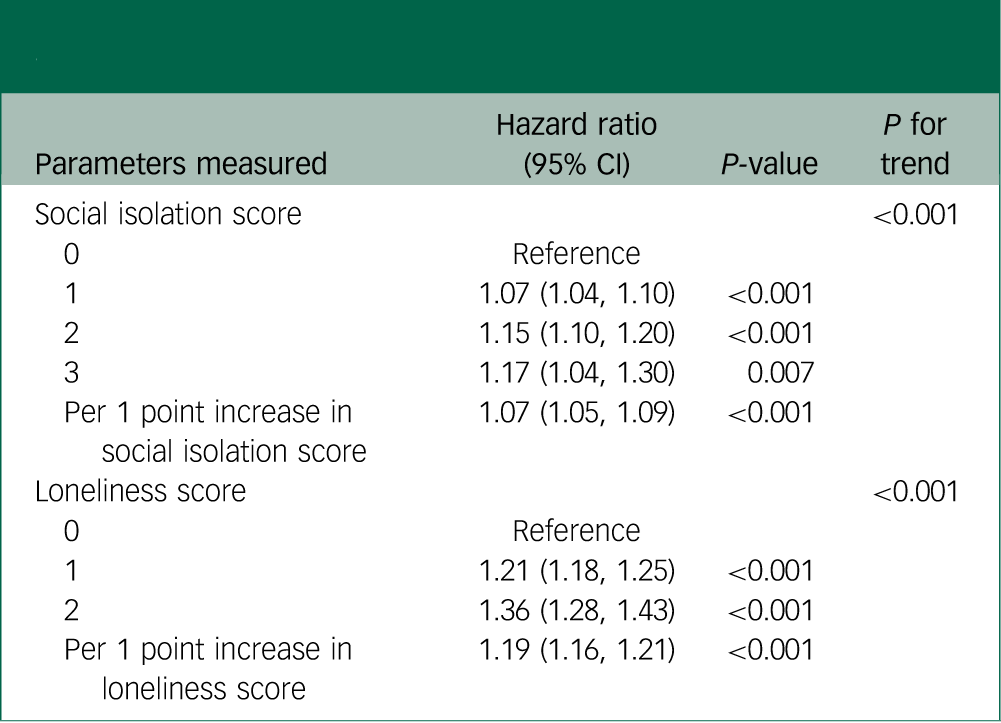
As shown in Table 2, there was a significant dose–response relationship between the scores of social isolation and loneliness and the risk of FBDs (for trend, P < 0.001). With each one-point increase in social isolation and loneliness scores, the risk of FBDs increased by 7% (hazard ratio 1.07, 95% CI 1.05–1.09, P < 0.001) and 19% (hazard ratio 1.19, 95% CI 1.16–1.21, P < 0.001), respectively.
Trend analysis of social isolation and loneliness levels with the risk of functional bowel disorders

Table 2 Long description
A table comparing the hazard ratios and P-values for the relationship between social isolation and loneliness scores and the risk of functional bowel disorders. The table has 10 rows and 4 columns. The columns are labeled Parameters measured, Hazard ratio (95% CI), P-value, and P for trend. The rows are labeled with different scores for social isolation and loneliness. For social isolation score, the hazard ratios increase from 1.07 to 1.17 as the score increases from 1 to 3. For loneliness score, the hazard ratios increase from 1.21 to 1.36 as the score increases from 1 to 2. The P-values for all scores are less than 0.001, indicating a significant relationship. The P for trend values are also less than 0.001, indicating a significant dose-response relationship.
The model was adjusted for gender, age, body mass index, ethnicity, education level, employment status, assessment centre, Townsend Deprivation Index and history of depression/anxiety. Detailed scoring methods of social isolation and loneliness are provided in Supplementary Table 1.
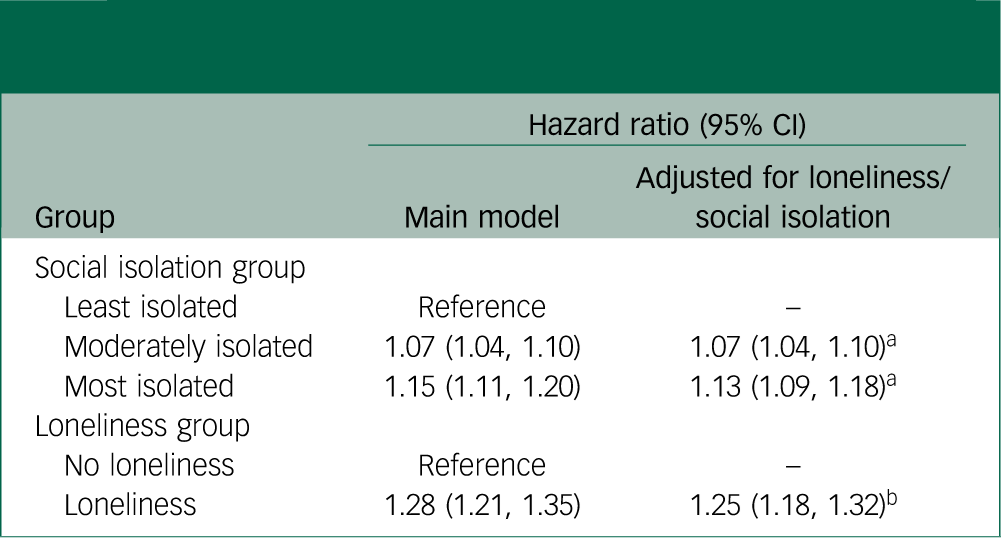
In the main model, social isolation and loneliness were both associated with increased risk of FBDs; following mutual adjustment, the associations were only slightly attenuated (Table 3). Compared with the least isolated group, the hazard ratios for FBDs were 1.07 (95% CI 1.04–1.10) for moderately isolated and 1.13 (95% CI 1.09–1.18) for the most isolated group. Loneliness was also associated with FBDs risk following adjustment for social isolation (hazard ratio 1.25, 95% CI 1.18–1.32). This minimal change in effect estimates suggests that social isolation and loneliness capture related, but not identical, aspects of social disconnection.
Associations of social isolation and loneliness with the risk of functional bowel disorders following mutual adjustment

Table 3 Long description
A table comparing hazard ratios for functional bowel disorders based on social isolation and loneliness. The table has 4 rows and 3 columns. The columns are labeled ‘Group‘, ‘Main model’, and ‘Adjusted for loneliness/social isolation’. The ‘Group’ column is further divided into ‘Social isolation group’ and ‘Loneliness group’. Under ‘Social isolation group’, the rows are labeled ‘Least isolated’, ‘Moderately isolated’, and ‘Most isolated’. Under ‘Loneliness group’, the rows are labeled ‘No loneliness’ and ‘Loneliness’. The ‘Main model’ column shows hazard ratios with 95% confidence intervals for each group. For the ‘Social isolation group’, the hazard ratios are 1.07 (1.04, 1.10) for moderately isolated and 1.15 (1.11, 1.20) for most isolated, with the least isolated group as the reference. For the ‘Loneliness group’, the hazard ratio is 1.28 (1.21, 1.35) for loneliness, with no loneliness as the reference. The ‘Adjusted for loneliness/social isolation’ column shows adjusted hazard ratios with 95% confidence intervals. For the ‘Social isolation group’, the adjusted hazard ratios are 1.07 (1.04, 1.10) for moderately isolated and 1.13 (1.09, 1.18) for most isolated. For the ‘Loneliness group’, the adjusted hazard ratio is 1.25 (1.18, 1.32).
The main model was adjusted for gender, age, body mass index, ethnicity, education level, employment status, assessment centre, Townsend Deprivation Index and history of depression/anxiety.
a. Adjusted for loneliness.
b. Adjusted for social isolation.
Joint association of social isolation and loneliness with the risk of FBDs
Figure 2 shows the joint association of social isolation and loneliness with incident FBDs, using participants who were least isolated and no loneliness as the reference group. In both the loneliness and no loneliness groups, the risk of FBDs increased progressively with higher levels of social isolation. Furthermore, within each level of social isolation the loneliness group exhibited a higher risk compared with those without loneliness. The most isolated and loneliness group had a 46% higher risk of FBDs (hazard ratio 1.46, 95% CI 1.33–1.60, P < 0.001) compared with the reference group. These findings indicate that social isolation and loneliness jointly contribute to an increased risk of FBDs.
The joint association of social isolation and loneliness with the risk of functional bowel disorders. Hazard ratios and 95% CIs were estimated using Cox proportional hazards models. Dots represent hazard ratios and horizontal lines indicate 95% CIs. The main model was adjusted for gender, age, body mass index, ethnicity, education level, employment status, assessment centre, Townsend Deprivation Index and history of depression/anxiety.

Mediation analyses
Mediation analyses showed that several psychological and behavioural factors partially explained the associations between social isolation/loneliness and FBDs risk (Supplementary Table 4). For social isolation, low physical activity (16.19%, 95% CI 10.26–22.12%) represented the largest mediator, followed by anxiety (8.81%, 95% CI 6.22–11.41%) and depression (5.48%, 95% CI 3.52–7.44%). For loneliness, depression showed the greatest mediation proportion (10.20%, 95% CI 7.58–12.82%) followed by low physical activity (5.08%, 95% CI 3.40–6.76%) and anxiety (3.15%, 95% CI 2.11–4.18%). Smoking and drinking had small but significant mediation effects, with unhealthy diet not showing a significant mediation effect.
Subgroup and sensitivity analyses
Subgroup analyses suggested that the association between social isolation and incident FBDs appeared to be stronger among males and overweight and unemployed individuals. In addition, middle-aged participants (<65 years) showed a stronger association between loneliness and FBDs risk. No clear evidence of effect heterogeneity was observed for other covariates (Supplementary Fig. 3).
Sensitivity analyses supported the robustness of our findings. The association between social isolation/loneliness and the risk of FBDs remained materially unchanged following further adjustment for covariates, exclusion of cases occurring within the first 3 years of follow-up and removal of diagnoses based on self-reports and other sources (Supplementary Table 5).
Discussion
This large prospective cohort study provides evidence that both social isolation and loneliness are associated with an increased risk of FBDs, with a stronger association observed for loneliness. We further identified dose–response relationships for both exposures. A joint association was also observed, whereby individuals experiencing both social isolation and loneliness had the highest risk of FBDs. Mediation analyses suggested that depression, anxiety and low physical activity may partly explain these associations. Subgroup analyses indicated that the associations with social isolation appeared stronger among males and overweight and unemployed individuals, whereas middle-aged participants (<65 years) showed a stronger association between loneliness and FBDs risk. Together, these findings highlight the potential importance of social isolation and loneliness in the development of FBDs.
The underlying mechanisms through which social isolation and loneliness increase the risk of FBDs are plausible and involve biological, psychological and behavioural pathways. Reference Xia and Li28,Reference Shankar, McMunn, Banks and Steptoe29 From a biological perspective, several studies have indicated that chronic stress induced by social isolation and loneliness has been linked to activation of the HPA axis and sympathetic nervous system, Reference Cacioppo, Cacioppo, Capitanio and Cole17,Reference Xia and Li28 which may lead to alterations in stress hormone levels, immune dysregulation and chronic low-grade inflammation. Reference Cacioppo, Cacioppo, Capitanio and Cole17–Reference Sidik20 These stress-related responses have been proposed to influence the gut−brain axis, Reference Qin, Cheng, Tang and Bian15,Reference Moloney, Johnson, OMahony, Dinan, Greenwood-Van Meerveld and Cryan30,Reference Konturek, Brzozowski and Konturek31 potentially contributing to changes in gastrointestinal motility, visceral sensitivity, intestinal permeability and inflammatory responses − all of which are considered central to the pathophysiology of FBDs. From a psychological perspective, social isolation and loneliness are closely linked to depression and anxiety, Reference Santini, Jose, York Cornwell, Koyanagi, Nielsen and Hinrichsen32 which are well-established risk factors for FBDs. Reference Liu, Wang, Kang, Wang, Ren and Lv33 Consistent with this framework, our mediation analyses suggest that depression and anxiety partially mediated the associations between social isolation or loneliness and the risk of FBDs. Together, these findings support a potential psychosocial pathway linking social disconnection to gastrointestinal dysfunction. Furthermore, behavioural mechanisms may provide an additional explanation. Socially isolated or lonely individuals are more likely to engage in unhealthy lifestyle behaviours, Reference Shankar, McMunn, Banks and Steptoe29,Reference Kobayashi and Steptoe34 including low physical activity and smoking, which have been associated with a higher risk of IBS. Reference Ho, Sun, Zheng, Wong, Gao and Mao35 Consistently, our results showed that low physical activity, smoking and drinking contributed modestly to the observed associations, suggesting that lifestyle behaviours may partially explain the effects of social disconnection on FBDs risk. Taken together, these biological, psychological and behavioural mechanisms provide plausible explanations for the observed associations between social disconnection and the increased risk of FBDs, highlighting the critical role of psychosocial well-being in maintaining gastrointestinal health. It is also noteworthy that social isolation and loneliness have been associated with a broad range of adverse health outcomes, including infections, cardiovascular disease, stroke, Parkinson’s disease and dementia, Reference Liang, Zhou, He, Zhang, Wu and Luo8–Reference Shen, Rolls, Cheng, Kang, Dong and Xie13 suggesting that their impact may be wide-ranging and not limited to FBDs. Within this context, the present findings add to this evidence by demonstrating their relevance to FBDs, for which the aforementioned biological, psychological and behavioural mechanisms may help explain the observed associations.
Social isolation and loneliness are closely related constructs, and their frequent co-occurrence may partly explain why individuals exposed to both conditions exhibited the highest risk of FBDs in our study. At the same time, they capture different dimensions of social disconnection: social isolation reflects the objective absence of social connections, whereas loneliness represents the subjective experience of perceived social disconnection. Reference Donovan and Blazer6,Reference Holt-Lunstad and Perissinotto7 This distinction may help explain why loneliness showed a stronger association with FBDs risk in our study. Loneliness can exist regardless of one’s objective social connections or the duration of social isolation from others. Reference Liang, Chen, Feng, Liu, Ai and Xue10 Subjective social experiences are more closely linked to emotional stress responses and neuroendocrine activation, which are central components of the stress−gut interaction.
Our subgroup analyses provided further insights into the heterogeneity of the observed associations. Specifically, the relationship between social isolation and the risk of FBDs appeared to be stronger in males and overweight and unemployed individuals, whereas middle-aged individuals (<65 years) were more vulnerable to the adverse effects of loneliness. Several plausible mechanisms may underlie these patterns. Males may experience social isolation due to weaker social network structures and limited emotional expression, Reference Umberson, Lin and Cha36 which are further reinforced by social norms that encourage physical and emotional strength, self-reliance and stoicism. Overweight individuals may be at greater risk of social isolation as a result of weight-related stigma, reduced self-esteem and physical limitations, Reference Zhou, Tang, Wang, Li, Heianza and Qi37 all of which restrict social connections and contribute to shrinking social networks. Unemployment may represent a state of reduced social engagement and financial stress, which have been linked to psychological distress. In our study population aged 37−73 years, individuals <65 years, representing the middle-aged group, appeared more vulnerable to the adverse effects of loneliness than the elderly. Middle-aged adults are often exposed to multiple social role transitions, strained family relationships and the intertwined burden of occupational stress and health concerns, Reference Luhmann and Hawkley38 which may intensify social disconnection and psychological distress. These findings underscore the need to consider population heterogeneity and the necessity of preventive strategies for vulnerable groups.
Given the increasing global prevalence of social isolation and loneliness, our findings have important public health implications. Social disconnection, including both social isolation and loneliness, is associated with an elevated risk of FBDs. Early identification of individuals experiencing social disconnection may provide opportunities for timely psychosocial and behavioural interventions to reduce the risk of FBDs. Potential strategies to reduce social disconnection include strengthening social networks, enhancing social support, providing psychological interventions such as cognitive–behavioural therapy and promoting the use of digital platforms for meaningful interactions. Reference Cotterell, Buffel and Phillipson39,Reference Morr, Liu, Hurlemann, Becker and Scheele40 However, further research is needed to determine whether interventions targeting social disconnection can effectively reduce the health burden of FBDs.
This study has several notable strengths. First, to our knowledge, this is among the first large-scale prospective studies to investigate the associations of social isolation and loneliness with the risk of FBDs, providing new epidemiological evidence in this field. Second, the prospective design, large sample size and comprehensive adjustment for a broad range of potential confounders strengthen the validity of our findings. Third, by simultaneously assessing both social isolation and loneliness, we were able to evaluate their separate and joint associations with the risk of FBDs, providing additional insight into the complex role of social disconnection in gastrointestinal health.
Several limitations should be acknowledged. First, our study population comprised middle-aged and older adults from the UK, which may limit the generalisability of our findings to other age groups or populations in different countries. Second, social isolation and loneliness were assessed using self-reported questionnaires, which may have introduced measurement error and potential misclassification. However, these items have been widely used in UK Biobank studies and have demonstrated acceptable construct validity in capturing social disconnection. Third, as an observational study, causal inferences cannot be established although the observed associations remained consistent across multiple sensitivity analyses. Finally, the biological mechanisms discussed in this study were inferred from prior research rather than directly examined. Future longitudinal and interventional studies are warranted to further elucidate causal pathways, and to determine whether interventions targeting social disconnection may influence the risk of FBDs.
Our study suggests that social isolation and loneliness are associated with an increased risk of FBDs, with loneliness showing the stronger association. Individuals exposed to both conditions exhibited an even greater risk. Males, overweight or unemployed individuals and middle-aged adults appeared to be more vulnerable to these associations. These findings underscore the potential relevance of social disconnection as a psychosocial factor linked to FBDs. Addressing social isolation and loneliness may represent a promising avenue for risk reduction, although further research is required to clarify causal pathways and evaluate the effectiveness of interventions.
Supplementary material
The supplementary material is available online at https://doi.org/10.1192/bjo.2026.12065
Data availability
The data-set used in this study can be accessed from UK Biobank (https://www.ukbiobank.ac.uk/).
Acknowledgements
This research has been conducted using the UK Biobank Resource under application number 99732.
Author contributions
Y.R. and J.L. contributed equally as joint first authors. Y.R.: conceptualisation, methodology, formal analysis, data curation, writing – original draft, review and editing; J.L.: conceptualisation, methodology, formal analysis, software, visualisation, writing – review and editing; L.W. and Y.Z.: methodology, investigation, resources, writing – review and editing; L.L., J.C., Z.S. and L.M.: investigation, resources, writing – review and editing; F.D.: writing – review and editing, supervision, funding acquisition, project administration. All authors approved the final version of the manuscript.
Funding
The research was supported by Key Research and Development Projects of Shaanxi Province (no. S2023-YF-YBSF-1670), the China Postdoctoral Science Foundation (no. 2023TQ0260), the Postdoctoral Research Project of Shaanxi Province (no. 2023BSHYDZZ17) and the Basic Scientific Research Operating Funds of Xi’an Jiaotong University (no. 11913224000012).
Declaration of interest
None.
Ethical standards
The UK Biobank cohort study was approved by the North West Multicentre Research Ethics Committee, and all participants signed written informed consent before data collection. Our research is an observational study based on the approved project (application ID: 99732) from UK Biobank.




 Open access


eLetters
No eLetters have been published for this article.