Introduction
The number of older adults in Australia is increasing at unprecedented rates. By 2024, it is expected that 25% of the Australian population will be over 65 years, with a large proportion of that number being over 85 years (Australian Institute for Health and Welfare, 2015). The associated growth in older Australians living in aged care facilities is creating an increasing demand for aged care residential services. With approximately 200,000 older Australians currently living permanently in long-term aged care residential facilities (Australian Institute for Health and Welfare, 2015), the expectation is that services will expand and develop to best meet these growing needs.
Entry into a residential facility is often unexpected or unplanned, and can have profound implications on a resident's self-view and sense of identity. Mental health investigations indicate that 80% of aged care residents show symptoms of depression or anxiety (Seitz et al., Reference Seitz, Purandare and Conn2010). Depression identified in nursing home residents is unlikely to remit spontaneously (McSweeney and O'Connor, Reference McSweeney and O'Connor2008). Professional care staff may have low mental health literacy, and may not appreciate the resident's individuality sufficiently in order to provide tailored interventions or referrals to improve the wellbeing of residents.
Person-focused care in aged care settings has become an aspirational paradigm of contemporary aged care (Brownie and Nancarrow, Reference Brownie and Nancarrow2013) – a paradigm that emphasizes the individual needs at the center of the services they receive. The model of care has been found to improve quality of life in residents living in aged care settings (Sjögren et al., Reference Sjögren, Lindkvist, Sandman, Zingmark and Edvardsson2013). Person-centered care, such as that provided by the Eden Alternative Model, has been associated with significant reductions in residents’ boredom and helplessness (Bergman-Evans, Reference Bergman-Evans2004).
Yet, how can such care be provided when staff may not have sufficient knowledge of the resident – their history, values, likes and dislikes? With resident-staff communication in residential aged care settings being task-oriented, there may be limited opportunity to engage in meaningful conversation (Bennett et al., Reference Bennett, Ward and Scarinci2016). In addition, high job strain, demanding work, conflicting demands, and not enough time to accomplish work, was perceived to affect the caring climate in a residential care setting (Edvardsson et al., Reference Edvardsson, Sandman, Nay and Karlsson2009). Edvardsson et al., found that work satisfaction among staff is required to positively affect attitudes toward care and exhibiting a person-centered view. Staff satisfaction and resident well-being are associated, so preventing experiences of high job strain and fostering quality care was considered to be necessary in securing the quality of care provided to residents in the facility.
Life-stories about aged care residents may be a means by which to educate care staff about residents. Life-story work involves interviewing an individual about their life, recording such information, and arranging such information into a coherent narrative about an individual's experiences, values, interests and/or pursuits (McKeown et al., Reference McKeown, Clarke and Repper2006). Stories can offer narratives of people's life, extrapolating meaning from the content (McAdams and McLean, Reference McAdams and McLean2013). Hence, although a collection of facts and events, life stories extend beyond a chronological account of milestones, to offer a narrative account of the individual's lived experiences, that highlight an aspect of the individual's identity, worldview and meaningful experiences (McAdams and Pals, Reference McAdams and Pals2006). They may be stored on audio files, digitally or written.
Preliminary findings into the use of digital life stories indicated that care staff knowledge of residents improved and their attitudes became more positive after watching digital life stories (Bhar et al., Reference Bhar, Silver, Collins, Bhowmik, Dalziel and Stargatt2017). In that study, the material for the digital life stories was collected over a period of 9 months by university-based undergraduate psychology student volunteers, who were trained in video story production. The stories were then shown to aged care staff with the administration of pre- and post-measures.
While the research for digital stories appears promising, there is a dearth of studies exploring knowledge and attitudes of staff toward aged-care residents before and after reading written life stories. Research conducted in the UK using written life stories, with a focus on aged care residents with dementia, investigated how life story work was understood, developed in practice and affected the delivery and outcomes of care (McKeown et al., Reference McKeown, Clarke, Ingleton, Ryan and Repper2010). Semi-structured interviews, observation, and conversations were employed. Results indicate that life story work can enable care staff to “see the person behind the patient” (p. 155) and to enhance person-centered care for older people with dementia and their families. The limitations of the study included a small sample (n = 4), prompting the necessity to undertake research using more participants in the future.
Such research however, can be challenging. One study that initially used nursing and care staff to explore older adult's participation in written life story work found that practical constraints, including competing workload demands, impeded the study (Clarke et al., Reference Clarke, Hanson and Ross2003). To overcome the impediment, the researchers changed the methodology by introducing a care worker dedicated to the project. Qualitative data were collected from focus groups, semi-structured interviews, and observation - undertaken before and after the introduction of written life story work. The study highlighted the practical constraints on care staff and the value of introducing the services of a dedicated care worker, thereby removing the impediments to the study. Results indicated that life stories helped staff involved in the care of older adults to see patients as people, to understand the residents more fully and learn about their needs and behaviors, thus enabling staff to strengthen their relationships by gaining insight into the life they have lived.
Furthermore, while the literature above suggests that aged care residents’ written life-stories can impact on staff knowledge and attitudes toward residents, there is no evidence that life stories are more effective than usual file notes to provide staff with knowledge about a resident. No research has been published examining the impact of aged care resident's written life-stories on the knowledge and attitudes of professional care staff when compared to file notes. Usual intake information includes demographics, medical needs, as well as a psychosocial assessment. A life story may be a powerful tool to provide additional information for care staff to recognize the whole person, including the complex nature, and individuality of residents, their likes, dislikes, and values, thereby extending task-centered care to individualized person-centered care provision.
The current study examined the impact of written life-stories crafted by university journalism students on the knowledge and attitudes of care staff about the residents. The project examined if care staff showed a change in their knowledge and attitudes about a resident after reading a 2–4 page story written by the journalism students, about the resident, when compared to file notes.
Methods
Participants
Participants for the control and experimental conditions were recruited from Rathdowne Place, an aged care residential facility of Australian Unity Retirement Living in Melbourne, Australia. A total of 40 staff volunteers participated in the current study. Employees of Rathdowne Place were recruited via flyers posted throughout the residential facility and through electronic communications (email) with no financial or reward incentive offered. To participate, individuals were required to be aged 18 years or above, be employed by the residential facility, have a minimum Year 7 English literacy, and provide care to the resident featured in the life-story or file notes. The study was conducted in accordance with the National Statement on Ethical Conduct in Human Research (2007) and the Australian Code for the Responsible Conduct of Research, and was granted ethics approval by Swinburne University Human Ethics Research Committee: SHR Project 2016/146.
Measures
Demographics
Participants self-reported their gender, age, position held at the facility and length of employment.
Knowledge of resident scale (KRS)
Knowledge and attitudes about residents featured in a story was assessed before and after the intervention or control procedures for all participants using the KRS. The KRS is an attitudinal survey developed by Bhar et al. (Reference Bhar, Silver, Collins, Bhowmik, Dalziel and Stargatt2017) to measure attitudes of staff toward the aged residents. The scale was modified from its original version, to reference written life stories and case file notes instead of digital life stories. The survey comprised ten items that assessed for warmth toward the resident and knowledge of the residents’ history, preferences, and values. The participants rated the extent to which they had a positive feeling and high level of understanding about the resident, using a Likert scale, in order of 0 (Not at all) to 4 (Extremely). Example questions included, “How positive do you feel toward the resident?”, and “How well do you know the life history of this resident”? The KRS was found to be internally consistent at both the pre-test and post-test assessment points (α pre = 0.90, α post = 0.92).
Procedure
The focus of the study was on the impact of life-stories on knowledge and attitudes of aged care staff. In order to examine the impact of such stories, over and above the usual information that is provided to staff about the resident (e.g. file notes), the study employed a randomized controlled design. A total sample size of 32 staff participants was calculated as the minimum number to provide 80% power for the effect size for the intervention d=0.8 or higher at an alpha of 0.05.
Staff members of the facility were invited to participate in the study. They were asked to read the consent information statement and if interested in participating, to sign the consent form. Residents were also asked for their written consent to have their life-stories or file notes used in the study.
Staff participants completed a short demographic form and pre-test version of the KRS. Immediately following the pre-test survey, staff participants were randomly allocated to a control or experimental condition in a blinded way by the researcher. The researcher was blinded to the allocation sequence. A set of 40 opaque envelopes was pre-filled with a slip of paper by an individual not affiliated with the study indicating one of the conditions. Each envelope was marked serially from 1 to 40, and taken by the participants in sequential order. The researcher administered the control or intervention task, and by this stage was unblinded. Participants in the control condition were shown file notes, while those in the intervention condition were asked to read a life story. Participants were unblinded to task. Recruitment took place in August and September, 2016.
Experimental condition
Participants (n = 19) assigned to the experimental condition were asked to complete the pre-test questionnaire, read the resident's written life story, and then complete the post-test questionnaire. The life-story used in the experimental condition was two to four page story written by university journalism students, about the resident. Students met with residents three times over a six-week period to write the story. Such stories focused on individuals’ achievements, accomplishments, and interests, showcasing an aspect of the resident's life, such as, memorable experiences, and valued relationships. Nine residents (6 female and 3 male, mean age = 87, range = 20, SD = 6.89) allowed their stories to be used in the current study; hence nine stories were used in the experimental condition. Each participant read one life story, linked to residents they knew.
Control condition
Participants (n = 21) assigned to the control condition were asked to fill in the pre-test questionnaire, read the resident's file notes, then fill in the post-test questionnaire. Resident file notes were digital files collated into a Care Plan. The file notes, which varied in length from two to ten pages and consisted of question/answer format, were collected at intake by the facility's Care Plan Assessor and the Community Development Assistant from information provided by the resident, Medical Health Providers and family members. The file notes covered areas such as behaviors (physical, verbal, and wandering), medical diagnosis, medications, dietary requirements, personal hygiene, and social and human needs.
Data analysis
T-tests for independent samples and χ 2 tests were conducted to establish differences in demographic and KRS scores at baseline between conditions.
A series of mixed factorial Analysis of Variance (ANOVAs) was conducted to test if participants in the experimental condition showed a significantly larger increase in knowledge and attitudes toward residents than do participants in the control group.
Results
Participant flow
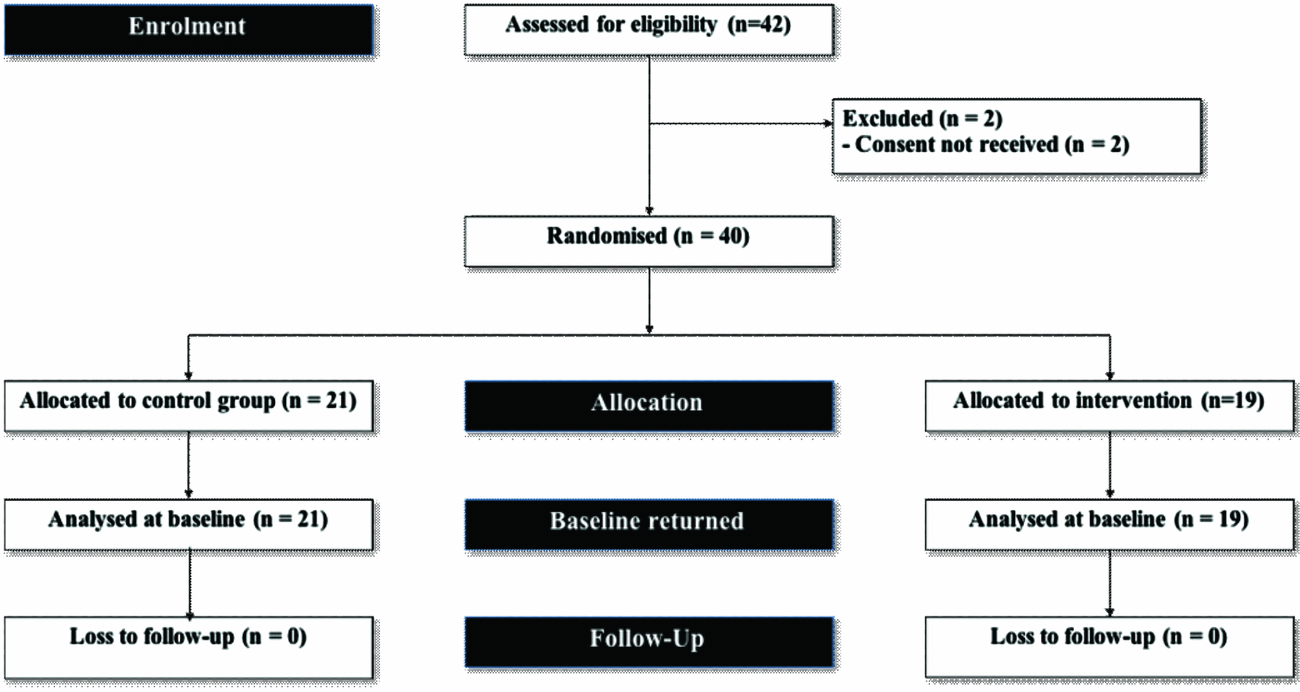
Figure 1 shows the flow chart of the recruitment process for the participants.
Flow chart outlining recruitment, enrolment, and participation at pre- and post-test.

Pre- and post-measures could be collected for 100% of the participants. Two staff members declined to participate.
Design and data analysis
Data were analyzed using SPSS version 24. A total of 40 participants were recruited and all were used in the final analysis. The data were screened for outliers and assumptions of normality, including skew and kurtosis. Series mean was used for one person on one item where data were missing. Mahalanobis distance value showed no outliers exceeded the critical value for 10 dependant variables (29.59) when p < 0.001. Assumptions of general linear model and homogeneity of variance were met. The skew and kurtosis statistics were within the range of –2 and +2 indicating the normality of the variables is within acceptable levels and therefore no transformations were necessary (George and Mallery, Reference George and Mallery2003).
Baseline data
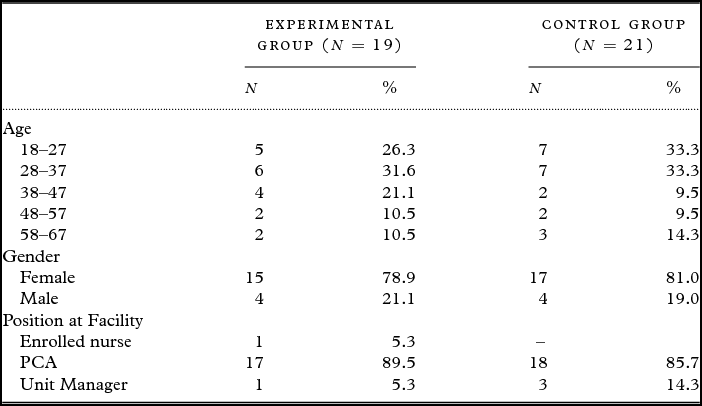
Demographic characteristics are included in Table 1. The participants were 8 male and 32 female with 30% in the 18–27 y/o group, 32.5% in the 28–37 y/o group, 15% in the 38–47 y/o group, 10% in the 48–57 y/o group, and 12.5% in the 58–67 y/o group. The participants were employed in the capacity of Personal Care Assistant (87.5%), Enrolled Nurses (2.5%), and Unit Manager (10%). The amount of time the staff members had been employed in the facility was between 0.5 and 30 months (M = 15.43, SD = 8.95), with time in months for the EG (M = 15.68, SD = 8.30) and CG (M = 15.19, SD = 9.70).
Demographic characteristics of participants

χ 2 tests showed that there was no significant difference between condition in age, gender, and position at the facility (p > 0.05), X2age (4, N = 40) = 1.18, p = 0.881), X2 gender (1, N = 40) = 0.25, p = 0.874, X2 position (2, N = 40) = 1.93, p = 0.380. No significant difference in duration of employment at the facility was found between conditions, t (38) = –0.171, p = 0.865.
Eleven-mixed factorial ANOVAs were run. The first ten focused on the ten items of the KRS, respectively, as outcome variables, while the 11th focused on the total score of the KRS.
The ANOVAs tested if participants in the experimental condition had a significantly larger increase in knowledge and attitudes toward residents than did participants in the control condition. The within-subjects variable was “time” and the between subject factors was “condition.”
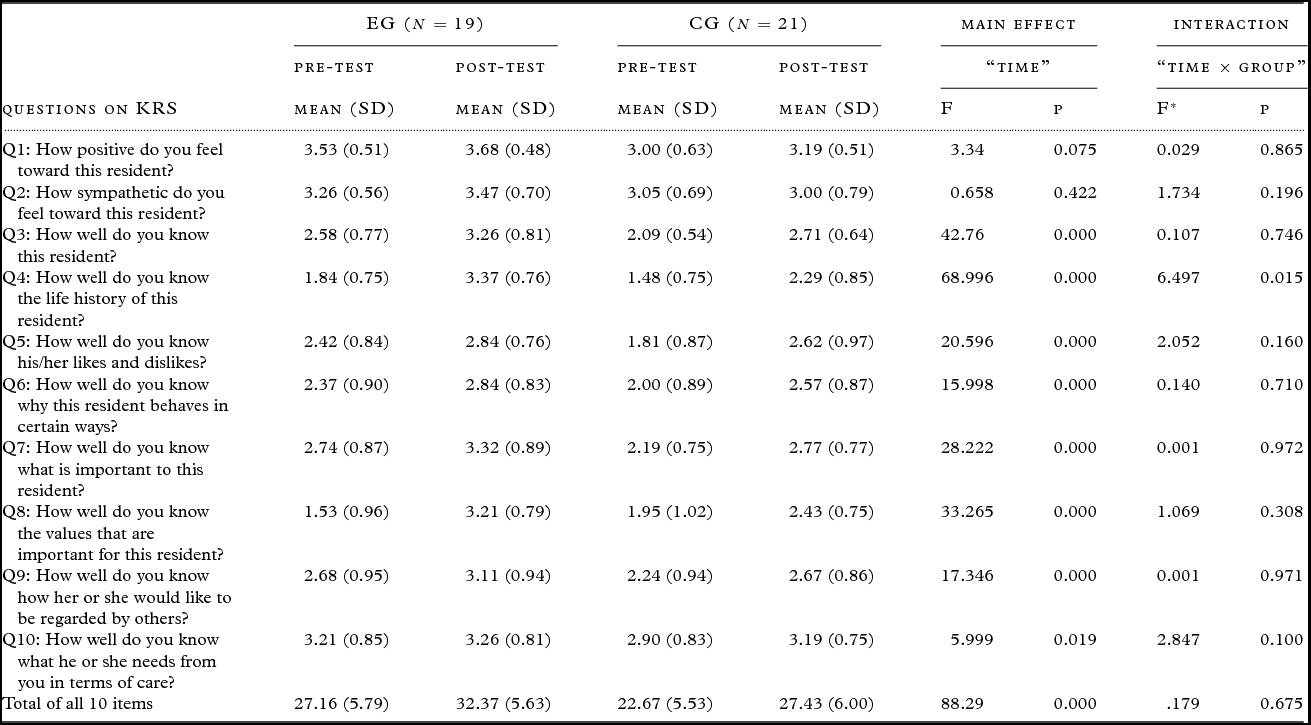
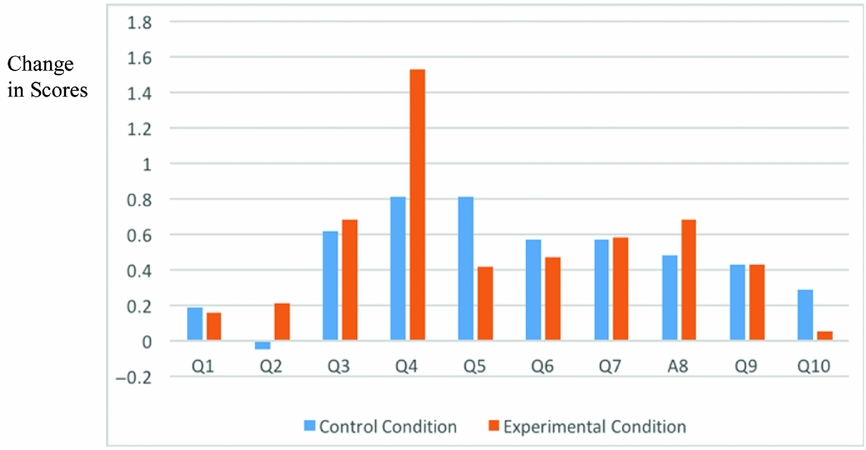
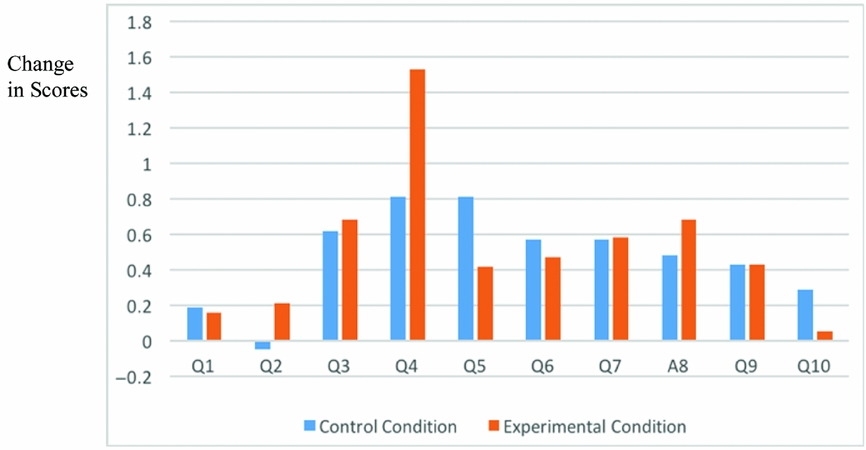
Results are shown in Table 2. A main effect for time was found for 8 of the 10 questions on the KRS, suggesting that irrespective of condition, scores on these items improved from pre- to post-test. No main effect for time and group interaction was found for the total KRS score. A significant interaction result was found for one item – question 4 “How well do you know the life history of this resident?” For this item only, significantly greater improvement was shown in the experimental condition than in the control condition, F (1,38) = 6.50, p = 0.02 (Figure 2).
Mean values and results of multivariate repeated measures analysis of variance

EG: experimental group; CG: control group; KRS: knowledge of resident scale.
*The df for all items was (1, 38) with the exception of item 2 which was (1, 37).
Change in scores on each item from the KRS from pre to post-test control and experimental conditions, respectively.
Discussion
Professional care staffs who are employed in the provision of aged care in residential settings are in a position to impact on the advancement of quality person-centered care in aged care residential facilities. Life-stories about aged care residents may be a means by which to educate care staff about residents. This study evaluated the impact of life-stories written by university journalism students compared to usual file notes on the knowledge and attitudes of aged care staff about the residents for whom they provide care.
Overview of findings
Results showed that reading information about aged care residents had a positive impact on staff knowledge and attitudes toward residents. This result was found regardless of whether the information was provided as usual file notes or life stories.
This study also supported findings from previous research suggesting that knowledge and attitudes change positively after reading life stories (McKeown et al., Reference McKeown, Clarke, Ingleton, Ryan and Repper2010). This is consistent with research using video recordings (Bhar et al., Reference Bhar, Silver, Collins, Bhowmik, Dalziel and Stargatt2017) capturing the uniqueness of older aged adults through stories of individuals. The current study overcame difficulties experienced by previous researchers which were practical constraints, including competing workload demands, that impeded the study. To overcome similar impediments, Clarke et al. (Reference Clarke, Hanson and Ross2003) changed their methodology by engaging a care worker dedicated to the project. This study overcame the constraint by using journalism students to write the life stories.
Overall, there did not appear to be a difference between the control condition or the experimental condition, as they are very similar in their amount of increase on staff knowledge and attitudes toward aged care residents. A possible explanation for this may be that there is an overlap of information across the two forms of material presented to the care staff in that a similar kind of information about the resident is available from both file notes and life stories. The staff may have already known the residents well prior to reading their life stories, either gained from the file notes or directly from the residents, their friends and family, therefore reducing the novelty of information presented. By reading the stories the staff may have felt that their knowledge of the resident did not change, or it could not increase further given their high level of knowledge prior to reading the stories, however a change was found.
Although no significant result was found, one item on the KRS, “How well do you know what he/she needs from you in terms of care?” showed a greater increase by the control group when compared to the experimental group (Figure 2). One explanation for this unexpected finding might be that staff unfamiliar with information about the resident may not have felt that reading the life story alone provided sufficient information to guide their care practices.
It was expected that differences would be found between the groups with regards to knowledge of life history. The findings of this study show that life-stories provided staff with unique information about the residents that they could not access from file notes alone. Life-stories contain vital information revealed by the resident, about the resident. Given that life stories commonly include the social context of a person's life, roles, values, relationships, loss and sense of self (Wills and Day, Reference Wills and Day2008), it is understandable that the historical and social context of a person's life was more potently communicated through life-stories than through file notes. Through written life stories, care staff can learn about the identity of the residents for whom they care, connect a person's past to their present, and to “see the person behind the patient” (McKeown et al., Reference McKeown, Clarke, Ingleton, Ryan and Repper2010, p.155).
It is worth noting that resident's responses to the first two questions relating to staff positive feelings and sympathy toward residents did not significantly change between pre- and post-measures. These items may be considered critical to person-centered care. These questions were scored most highly at baseline, and hence may indicate a participant social desirability effect.
This research provides evidence that the reading of file notes and life stories by care staff increase knowledge and improves attitudes toward residents and suggests that there is a difference in the kind of knowledge and attitudes that are impacted. This is important when person-centered care is provided to aged residents, as file notes may not provide the extra information about values, likes, and dislikes of the residents. Aged care staff can be assisted to gain information to understand the residents more fully. The richer information in the written life stories can provide staff with a historical background for the resident, including valuable insights into the resident's family, social, and personal life across the resident's lifespan.
Limitations
The study contained several limitations. First, a confounding variable is how a story was written. Some stories delved deeply into aspects such as a resident's likes and dislikes and offered insights into the resident that a staff member may never be able to know. Other stories presented more of a biographical perspective listing chronological events such as migration, and career achievements. There is no consensus among researchers regarding the superiority of one single approach to capturing an individual's life story above another (McKeown et al., Reference McKeown, Clarke and Repper2006). Heliker (Reference Heliker1997) suggests an unstructured approach asking patients to “Tell me about your life” and McKee et al. (Reference McKee, Wilson, Elford, Goudie, Chung and Bolton2002) describes the central idea to be more concerned with “listening to stories” as they are told. Research into life story work could be enhanced by developing guidelines for written life story production.
Second, the current study did not evaluate the detail provided in the file notes. It is expected that the content of file notes would vary between residential facilities. Therefore, future directions could be to conduct content analysis on both the life stories and file notes across numerous facilities in order to generalize these findings.
Third, there may have been bias in participants’ self-reports at pre-test and post-test as care workers may view themselves, or want to be seen as caring toward residents and therefore claim a greater level of understanding of residents and their needs than they actually have. Future studies could utilize an objective measure of staff knowledge and attitudes of residents, whereby staff bias could be measured and accounted for. The use of a comparison measure involving an assessment of staff knowledge and attitudes by residents at pre and post-test could be utilized.
Fourth, the present study did not include an intervention where the control group reviewed file notes as well as read life stories. Therefore, future research could utilize this methodology. Research of this nature could highlight the benefit of staff spending their valuable time learning more about the residents through reading their life stories.
Fifth, this study used stories written about residents who did not have dementia. Given the high percentage of older adults living in residential facilities who do have dementia, future research utilizing life stories with such residents is required. The capacity for staff to learn more about the residents may be more evident among residents with moderate to advanced dementia.
Finally, this study did not explore the resident's perspectives on how well staff knows them with a pre- and post-measure. Future research could include a measure of residents’ beliefs assessing staff changes in knowledge and attitudes toward them.
Implications
The research extends the existing body of research that life-stories provide residential aged care staff with different and valuable knowledge to that provided by file notes and hence be used more widely in Australia for fostering a person-centered care culture in such settings.
This study showed that reading file notes alone will increase staff knowledge and attitudes toward residents. When comparing life stories to reading file notes the difference is in the historical content.
Conclusion
The contribution of this research is that knowledge and attitudes of care staff toward aged residents for whom they provide care, can be improved by the use of file notes and life-stories. Furthermore, the history of residents can perhaps be better communicated through life-stories than file-notes. The stories provide the means by which aged care residents can communicate important facets of their past to impact their current relationships with staff involved with their care.
Conflict of interests
None.
Description of author's roles
M. Dennerstein and S. S. Bhar designed the study. M. Dennerstein recruited participants, executed study procedures, analyzed the data and wrote the paper under the supervision of S. S. Bhar. J. J. Castles assisted in participant recruitment for data collection.
Acknowledgments
This study was conducted at Rathdowne Place (Australian Unity), for which we are grateful for their enthusiasm and participation. We would like to thank the residents who agreed to participate and for sharing their stories. Special thanks to the journalism students from Swinburne University for writing the life stories.