Bilinguals outperform monolinguals in acquiring vocabulary in a foreign language (Bradley, King & Hernandez, Reference Bradley, King and Hernandez2013; Kaushanskaya & Marian, Reference Kaushanskaya and Marian2009a, Reference Kaushanskaya and Marian2009b; Nair, Biedermann & Nickels, Reference Nair, Biedermann and Nickels2016; Van Hell & Mahn, Reference Van Hell and Mahn1997). Past studies have attributed the word learning advantage to different sources, including enhanced phonological awareness (Kaushanskaya & Marian, Reference Kaushanskaya and Marian2009b), executive function (Bradley et al., Reference Bradley, King and Hernandez2013), or learning strategies (Nair et al., Reference Nair, Biedermann and Nickels2016). Research on bilingualism has focused primarily on the processing of two languages and its cognitive and neural consequences (e.g., Kroll, Dussias, Bice & Perrotti, Reference Kroll, Dussias, Bice and Perrotti2015); few studies relate aspects of bilingualism to learning and memory (but see Francis & Baca, Reference Francis and Baca2014; Healy & Bourne, 1998). Understanding the basis of learning differences between bilinguals and monolinguals is important not only for revealing the workings of the bilingual mind, but also for how bilingualism may reveal mechanisms of learning and memory more generally. The present study relates bilingual experience to research on desirable difficulties in learning (e.g., Bjork & Bjork, Reference Bjork, Bjork, Gernsbacher and Pomerantz2014). We examine the hypothesis that bilinguals may be advantaged learners because they have acquired specific knowledge about how to regulate their native or dominant language.
Past research on desirable difficulties in learning suggests that self-regulation may be a critical learning strategy associated with stable memory outcomes (e.g., Bjork, Dunlosky & Kornell, Reference Bjork, Dunlosky and Kornell2013). Desirable difficulties are conditions of learning that impose initial costs by inducing errors, requiring conceptual elaboration, or increasing the requirement to negotiate variation, but benefit learning and memory over time (Bjork et al., Reference Bjork, Dunlosky and Kornell2013). The evidence on the consequences of bilingualism suggests that experience in using two languages affects the ability to resolve competition efficiently and to regulate both cognitive and language control processes (Calabria, Hernández, Branzi & Costa, Reference Calabria, Hernández, Branzi and Costa2012; Prior & Gollan, Reference Prior and Gollan2013; Weissberger, Wierenga, Bondi & Gollan, Reference Weissberger, Wierenga, Bondi and Gollan2012). Here we examine the idea that these consequences may impose desirable difficulties (e.g., Bjork & Kroll, Reference Bjork and Kroll2015). We hypothesize that bilinguals regulate the native language, L1, in order to successfully activate and retrieve the second language, L2, making them better able to regulate the two languages more generally under conditions of new word learning.Footnote 1 Of interest given recent discussion about the consequences of bilingualism (e.g., Valian, Reference Valian2015), is that self-regulation may impose processing costs initially that enhance later learning outcomes.
The role of the L1 during novel word learning
Adult language learning is a difficult process that involves incorporating novel sounds, words, and structures into an established language system. Previous research suggests that the two languages utilize similar brain areas, even among late learners who achieve high proficiency (Abutalebi, Cappa & Perani, Reference Abutalebi, Cappa and Perani2001; Honey, Thompson, Lerner & Hasson, Reference Honey, Thompson, Lerner and Hasson2012; but see Xu, Baldauf, Chang, Desimone & Tan, Reference Xu, Baldauf, Chang, Desimone and Tan2017). The two languages are directly linked from the earliest stages as speakers learn L1 translations for L2 words (Kroll & Stewart, Reference Kroll and Stewart1994), and cross-language activation persists for highly proficient bilinguals and for those whose two languages take different form (e.g., Hoshino & Kroll, Reference Hoshino and Kroll2008; Thierry & Wu, Reference Thierry and Wu2007). A consequence is that bilingual speakers of all languages and proficiency levels are unable to simply “turn off” the non-target language (for review, see Kroll et al., Reference Kroll, Dussias, Bice and Perrotti2015; see Costa, Pannunzi, Deco & Pickering, Reference Costa, Pannunzi, Deco and Pickering2017, for alternative account). Cross-language competition produces slower or reduced lexical access (e.g., Baus, Costa & Carreiras, Reference Baus, Costa and Carreiras2013; Linck, Kroll & Sunderman, Reference Linck, Kroll and Sunderman2009) and more tip-of-tongue states (Sandoval, Gollan, Ferreira & Salmon, Reference Sandoval, Gollan, Ferreira and Salmon2010) in bilinguals, even when speaking the L1. A consequence of negotiating cross-language competition is that bilinguals become skilled at regulating the L1. Inhibition of the L1 (to a greater degree than the L2) has been demonstrated in studies of language switching (e.g., Meuter & Allport, Reference Meuter and Allport1999; Van Assche, Duyck & Gollan, Reference Van Assche, Duyck and Gollan2013), in which switching from the L2 into the L1 is more costly than the reverse; neural measures of inhibition reveal greater inhibitory control is recruited when speaking the L1 following the L2 than the reverse (Guo, Liu, Misra & Kroll, Reference Guo, Liu, Misra and Kroll2011; Misra, Guo, Bobb & Kroll, Reference Misra, Guo, Bobb and Kroll2012). Notably, bilinguals in many of these studies were highly proficient, suggesting that regulatory skill reflects a fundamental feature of dynamic bilingual language use. Even among studies that have attempted to show a differential reliance on L1 inhibition for learners who are less skilled (e.g., Costa & Santesteban, Reference Costa and Santesteban2004), there is evidence for global inhibition of L1 among all bilinguals (for discussion see Kroll & Gollan, Reference Kroll, Gollan, Ferreira, Goldrick and Miozzo2014). We hypothesize that the skill acquired by bilingual speakers in regulating the L1 may become a desirable difficulty when learning a new language.
Skill in regulating the L1 may account for the observed differences in vocabulary learning between bilinguals and monolinguals (for review, see Hirosh & Degani, Reference Hirosh and Degani2017). Previous studies reporting a bilingual advantage in word learning taught participants novel vocabulary through L1 translations (or through pictures, possibly leading to L1 translation; Bradley et al., Reference Bradley, King and Hernandez2013; Kaushanskaya & Marian, Reference Kaushanskaya and Marian2009b; Kaushanskaya & Rechtzigel, Reference Kaushanskaya and Rechtzigel2012; Nair et al., Reference Nair, Biedermann and Nickels2016; Papagno & Vallar, Reference Papagno and Vallar1995). Bilinguals have extensive practice in regulating the co-activation of L1 translations to a level that allows L2 words to be learned. Indeed, studies that manipulated availability of the L1 translation and semantic concept during learning found that bilinguals benefit from learning words that share sounds and semantic concepts with the L1 compared to those that do not (Kaushanskaya, Yoo & Van Hecke, Reference Kaushanskaya, Yoo and Van Hecke2013) and words whose semantic concepts are more readily available (Kaushanskaya & Rechtzigel, Reference Kaushanskaya and Rechtzigel2012). Studies manipulating semantic and translation ambiguity between languages have also shown patterns of learning consistent with desirable difficulties (Degani, Tseng & Tokowicz, Reference Degani, Tseng and Tokowicz2014). Kaushanskaya and Marian (Reference Kaushanskaya and Marian2009a) compared monolinguals and bilinguals in their ability to map non-native phonemes to letters by teaching vocabulary unimodally (auditory) or bimodally (auditory and written). In the bimodal condition, the strong association between L1 letters with particular sounds produced significant interference in learning. Bilinguals outperformed monolinguals in both the unimodal and bimodal condition, but revealed a larger advantage in the bimodal condition for the immediate and delayed test, suggesting that bilinguals better regulate L1 interference.
Schneider, Healy, and Bourne (Reference Schneider, Healy and Bourne2002) taught monolingual speakers new vocabulary by requiring them to produce forward (L1 to L2) or backward (L2 to L1) translations. Forward translations are more difficult because the L1 word activates phonological and semantic information in the L1 that may interfere in retrieving the weaker semantics and phonology in the L2 (e.g., Kroll & Stewart, Reference Kroll and Stewart1994). Schneider et al. found that participants who learned foreign vocabulary through forward translations performed poorly on the immediate test, but were better on the delayed test and remembered most of the vocabulary during the delay. By comparison, those who learned through easier backward translations performed well on the immediate test, but forgot much of what they learned and performed poorly on the delayed test.
Alternative accounts for the bilingual advantage in vocabulary learning
Here, we combine concepts from language learning, bilingualism, and learning and memory to explain why bilinguals may excel at new word learning. We propose that bilinguals are advantaged learners relative to monolinguals because the processing costs that they experience on a daily basis reflect the requirement to engage regulatory skill in their L1. That skill creates a foundation for new learning when words are learned through the L1. This l1 regulation hypothesis is the primary hypothesis we test in the present study.
We also consider several alternative explanations that have been considered in past studies: 1) the phonological awareness hypothesis (Kaushanskaya & Marian, Reference Kaushanskaya and Marian2009b); 2. transfer of learning context hypothesis (Nair et al., Reference Nair, Biedermann and Nickels2016), and 3. bilingual cognitive control advantage hypothesis (Bradley et al., Reference Bradley, King and Hernandez2013). 1) The phonological awareness hypothesis proposes that early experience with two languages maintains openness of the phonology that aids in acquiring novel words in unfamiliar languages, explaining the vocabulary learning advantage particularly for early bilinguals. 2) The transfer of learning context hypothesis states that late bilinguals are advantaged in vocabulary acquisition compared to monolinguals due to past experience with language learning, and predicts that bilinguals should reveal the advantage when the context of learning resembles the context in which they acquired their L2. Finally, 3) the bilingual cognitive control advantage hypothesis predicts that bilinguals who demonstrate superior cognitive control on executive function tasks should also be better at acquiring foreign vocabulary. According to this account, monolinguals with enhanced cognitive control should also reveal better learning.
It is important to clarify how the L1 regulation hypothesis differs from the bilingual cognitive control advantage hypothesis. Although bilingual language regulation relies on a network of cognitive control, it may not be engaged similarly for all language processes and speakers (Calabria et al., Reference Calabria, Hernández, Branzi and Costa2012; Prior & Gollan, Reference Prior and Gollan2013; Weissberger et al., Reference Weissberger, Wierenga, Bondi and Gollan2012). Language regulation refers to the management of spreading activation and potential competition within the language network. Bilinguals differ quantitatively and qualitatively from monolinguals due to the additional demands of managing activation both within and across languages. Language regulation necessarily recruits cognitive control mechanisms which encompass both reactive and proactive inhibitory control (Braver, Reference Braver2012), as well as task switching, goal maintenance, and conflict monitoring (Friedman & Miyake, Reference Friedman and Miyake2004). Critically, bilingualism takes various forms that require speakers to use and regulate their languages in different ways that have been hypothesized to engage cognitive control mechanisms and the neural networks that support them in different ways (e.g., see Green & Abutalebi, Reference Green and Abutalebi2013, for a model of bilingual adaptive control). Different aspects of bilingual language experience have been related to the presence and form of cognitive consequences (Bak, Vega-Mendoza & Sorace, Reference Bak, Vega-Mendoza and Sorace2014; Blumenfeld & Marian, Reference Blumenfeld and Marian2013; Emmorey, Luk, Pyers & Bialystok, Reference Emmorey, Luk, Pyers and Bialystok2008; Prior & Gollan, Reference Prior and Gollan2011; Vega-Mendoza, West, Sorace & Bak, Reference Vega-Mendoza, West, Sorace and Bak2015). Recent studies (e.g., Zirnstein, Van Hell & Kroll, Reference Zirnstein, Van Hell and Kroll2018) have shown that native language regulation and domain general control make separable contributions to patterns of bilingual language processing. While language regulation may draw on resources that are shared with the network that supports cognitive control, they are not the same. In the present study, we use language regulation to refer to how speakers manage relative levels of activation and resulting competition within or across languages, and cognitive control to refer to domain-general processes that are engaged to accomplish language regulation as well as many other non-linguistic tasks.
The present study
We compared English monolinguals with three different groups of bilinguals in their ability to learn novel Dutch vocabulary, a language equally unfamiliar to all participants, through English translations. One bilingual group learned vocabulary via the L1 while the other two groups learned via the L2. In Experiment 1, English monolinguals were compared to late, but highly proficient, English–Spanish bilinguals. For the monolinguals and English–Spanish bilinguals, the new words were learned via the native language. In Experiment 2, the same monolinguals were compared to Spanish–English bilinguals learning the Dutch words via their L2. These Spanish–English bilinguals were sequential but earlier bilinguals, with Spanish as the native language but immersed in the US. In Experiment 3, we tested Chinese–English bilinguals with Chinese as the native language, also immersed in the US. The Spanish–English and Chinese–English bilinguals learned the Dutch words via English, their L2. While the groups differed in a number of ways, including the age and context of initial L2 learning, the critical experimental manipulation was the language in which they learned Dutch. For the monolinguals and English–Spanish bilinguals, it was the native language. For the Spanish–English and Chinese–English bilinguals it was L2.
By comparing different bilingual groups learning vocabulary through the L1 or L2, and whose conditions and ages of L2 learning differ, we aim to examine to what extent learning via the L1 is critical for observing a bilingual advantage. Based on the L1 regulation hypothesis, we predicted that only English–Spanish bilinguals should demonstrate better foreign vocabulary learning. Only this group has extensive experience in regulating their L1 (English) during language use, and has the opportunity to apply this L1 regulatory skill during the learning task. The other two bilingual groups have significantly less skill in regulating their L2, English, since it does not compete as strongly when speaking their L1, and they are immersed in English. The monolinguals have little skill in regulating their L1 compared to bilinguals.
We test the L1 regulation hypothesis against a set of alternatives that are not mutually exclusive: 1) The phonological awareness hypothesis predicts that Spanish–English bilinguals might show the most pronounced learning advantage due to their relatively earlier age of acquisition; 2) The transfer of learning context hypothesis predicts that bilinguals who were more likely to have learned their L2 in classroom settings (the English–Spanish and Chinese–English bilinguals) may learn new words better than monolinguals because the context of the experiment more closely resembles explicit classroom settings, and therefore seems more familiar to them; despite the diversity of classroom experience, we note that the Spanish–English bilinguals were less likely than the other two bilingual groups to have first encountered their L2 in a classroom setting; 3) The bilingual cognitive control advantage hypothesis predicts that bilinguals should reveal an advantage in vocabulary learning to the extent that they outperform monolinguals on measures of cognitive control.
2. Experiment 1
2.1. Method
2.1.1. Participants
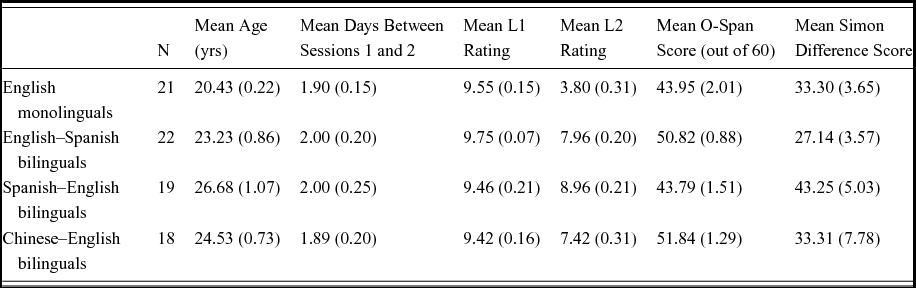
Twenty-four English-speaking monolinguals and 23 English–Spanish bilinguals participated in Experiment 1. Four participants were excluded for failing to return for Session 2 (1 monolingual), falling outside the target age range of 18–39 (2 monolinguals), or failure to reach a minimum working memory score of 25 out of a possible 60 working memory score (1 bilingual). This resulted in 21 English monolinguals and 22 English–Spanish bilinguals who participated in Sessions 1 and 2. The English–Spanish bilinguals were predominantly late learners of Spanish, with a mean age of exposure to Spanish of 11.05 years (SE = 1.01). Age of initial exposure to Spanish ranged from 0 to 16 years, but only 5 out of the 22 participants had been exposed to Spanish earlier than age 6; the remaining participants were exposed to Spanish after age 10 (See Table 1).
Language profile for each participant group. Means and standard errors (in parentheses) for age (in years), days between sessions, ratings on self-assessed proficiency in each language on a scale from 1 (not proficient) to 10 (highly proficient), Operation Span Scores, and Simon Scores (incongruent – congruent).

2.1.2. Materials
Sixty-four Dutch words were selected to be learned. These words and their English translations were matched on log frequencies (Baayen, Piepenbrock & Gulikers, Reference Baayen, Piepenbrock and Gulikers1995)Footnote 2. Sixty-four Dutch-like nonwords were matched for length, bigram, and trigram frequencies, and consonant-vowel structure with the target Dutch words to be used in the lexical decision task (Van Heuven, Reference Van Heuven2003). Two native Dutch speakers verified that they were not real Dutch words.
2.1.3. Procedure
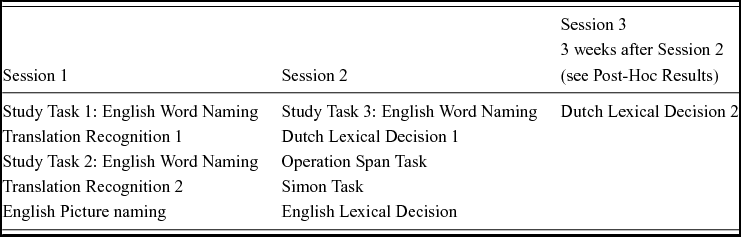
The tasks and materials described above were administered over the course of three sessions in the order shown in Table 2.
Design of Experiments 1–3.

Three presentations of a study task were presented across two sessions in order to provide multiple opportunities to learn the Dutch vocabulary. Two different methods of testing were utilized (translation recognition tasks and a Dutch lexical decision task) to assess not just the learning of the new vocabulary, but also to examine how encoded these new words were for the participants. Both presentations of the translation recognition tasks appeared first, to continue to engage English in the context of the experiment (e.g., De Groot, Delmaar & Lupker, Reference De Groot, Delmaar and Lupker2000), and to decrease task demands during early learning. The Dutch lexical decision task was administered at the end of the learning tasks to increase tasks demands by requiring participants to reject a high number of plausible Dutch-like lures.
Interspersed among the learning and test tasks were an Operation-span task to assess working memory (Turner & Engle, Reference Turner and Engle1989), the Simon task (Simon & Rudell, Reference Simon and Rudell1967) to assess executive function, and picture-naming tasks in English and a participant's other known language. Working memory and inhibitory control were examined in order to compare some well-known cognitive effects on bilingualism across groups who spoke different languages and were from very different cultural context. Picture-naming tasks were administered to assess proficiency and fluency in participants’ known languages.
In the study task, sixty-four Dutch words were taught individually, with a given trial presenting a Dutch word on the left side of the computer screen for two seconds, followed by the presentation of its English translation on the right side of the screen. The Dutch word and the English translation remained for a maximum of five seconds, or until a voice trigger was activated. Participants were asked to study the Dutch word and its English translation, and to read aloud the English translation when they were ready to proceed with the next trial. Critically, the study task was timed but not speeded to allow participants to elect how long (up to five seconds) to study each word pair while also requiring them to engage with the task by reading an English translation aloud, and to examine possible group differences in chosen study duration. The order of the Dutch words was randomized across study sessions and participants.
In the translation recognition tasks, a studied Dutch word appeared on the left side of the screen for two seconds, followed by an English word on the right side, similar to the study task. Participants had up to five seconds to press a yes or no button to indicate if the English word was the correct translation of the Dutch word; however, this task was both timed and speeded. Half the trials presented the correct English translation, and the other half presented an English word that was the translation of a different Dutch word previously learned.
In the Dutch and English lexical decision tasks, a fixation point was presented for 2 seconds, followed by a single letter string presented in the center of the screen. In the Dutch version, participants had to judge quickly and accurately whether the item was a real Dutch word that they had studied or not. Since the learned Dutch words included cognates and homographs with English, the no responses included Dutch-like nonwords, English-like nonwords, and other English words not learned at study to prevent all English words from being yes responses (as would be true if the only English words were cognates and homographs). In the English version, participants were asked to judge quickly and accurately whether the item was a real English word, and the no responses included English-like nonwords.
2.2. Results
2.2.1. Word naming at study
Both monolinguals and bilinguals correctly named the target (i.e., the English translations of the Dutch words) on over 99% of the trials.
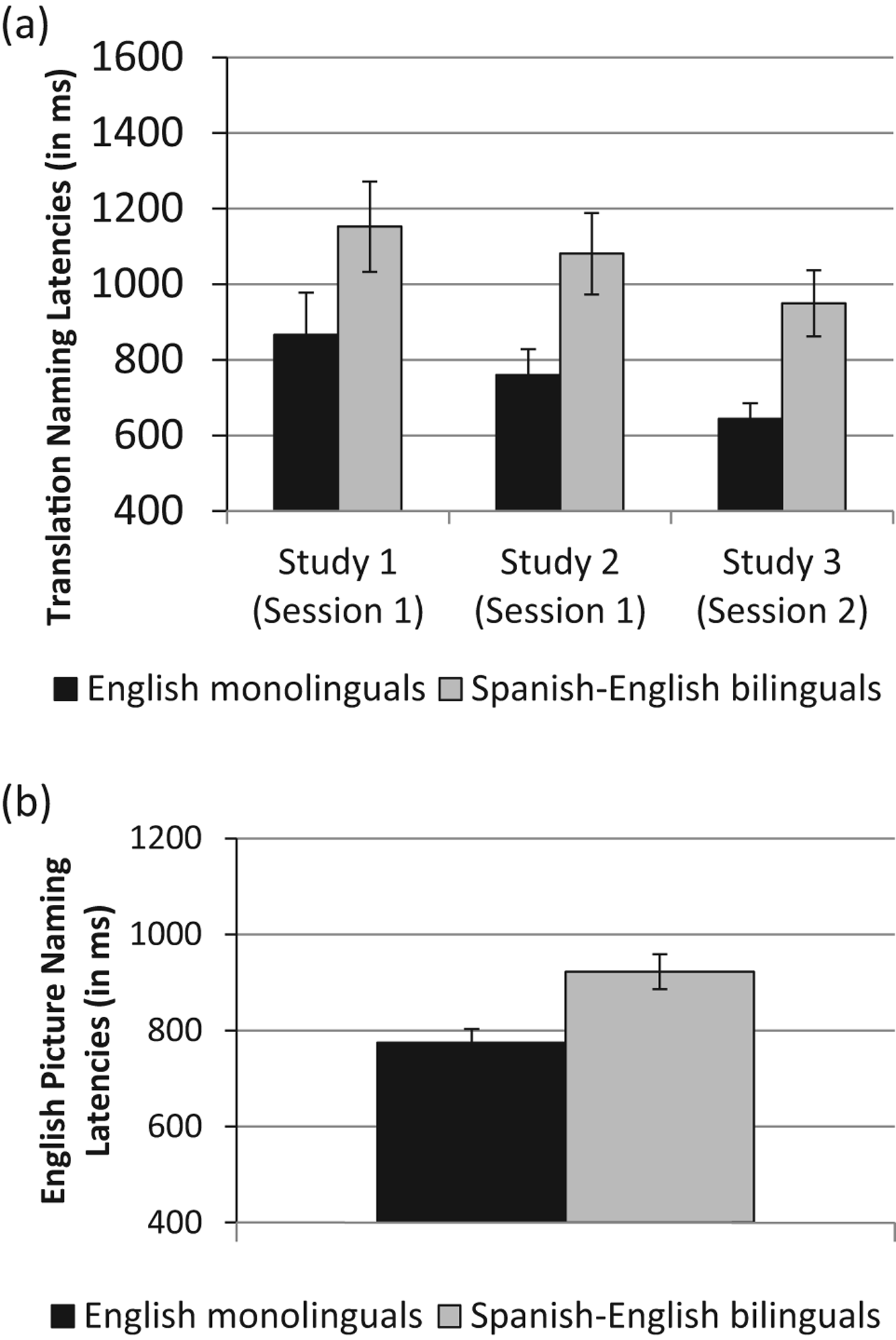
Naming latencies for all three presentations of the study task in which participants spoke the name of the English translation of the Dutch word are shown in Figure 1A. Note again that for the word naming task used at study, the task was timed but not speeded, up to five seconds. In contrast, the picture naming task was speeded, with naming responses generated as quickly as possible. The logic of examining these two tasks is to determine whether any observed differences in latencies during study reflect learning strategies or language processing costs. Language processing costs should produce longer latencies in both the study task and the picture naming task, since slower language processing should affect one's ability to retrieve the name for pictures and for words.
Error bars represent one standard error. (A) Translation naming latencies during study task and (B) picture naming latencies in English for English monolinguals and English-Spanish bilinguals in Experiment 1.

A 2 (language group: monolinguals, bilinguals) by 3 (study task presentation order: three presentations) mixed-factor ANOVA was conducted on the study latencies. A main effect of language group (F(1,39) = 10.49, p < .01, η2p = .19) revealed that bilinguals had longer naming latencies than monolinguals. There was also a main effect of task presentation order, (F(2,78) = 19.65, p < .001, η2p = .07), as naming latencies became faster over time. Bonferroni-corrected pairwise comparisons revealed that naming latencies at the second presentation were significantly faster than those at the first presentation (t(78) = 3.14, p < .05), and that naming latencies at the third presentation were significantly faster than those at the second presentation (t(78) = 4.58, p < .001).
An unexpectedly large difference in naming latencies was observed in the study task with longer study latencies for bilinguals than monolinguals although both groups were producing words in the native language (483 ms, 424 ms, and 352 ms, across respective presentations). This large effect of language group (0.19 η2p) is notable, as most language processing effects fall on the scale of approximately 50–100 ms. These substantially larger effects may reflect memory and explicit learning strategies in addition to language processing differences between groups.
2.2.2. English picture naming
To determine whether the differences shown in Figure 1 reflect a difference in memory and explicit learning strategies between the two groups, or simply slower language processing latencies for the bilinguals, we compared the performance on a simple picture naming task that assesses proficiency and lexical access in English. Both groups exhibited highly accurate performance on the picture naming task (monolinguals, 98.0%; bilinguals, 97.6%). An ANOVA on correct picture naming latencies showed that the two groups were not statistically different (F(1,40) < 1, p = .94). Hence, we can rule out group differences in lexical retrieval speed as the basis of the bilingual effect in the study task.
The picture naming data suggest that lexical retrieval in English for both groups was similarly fast, whereas the English translation naming during self-paced study shows that bilinguals were much slower. The next question was to assess the consequences of that difference for performance at test.
2.2.3. Translation recognition
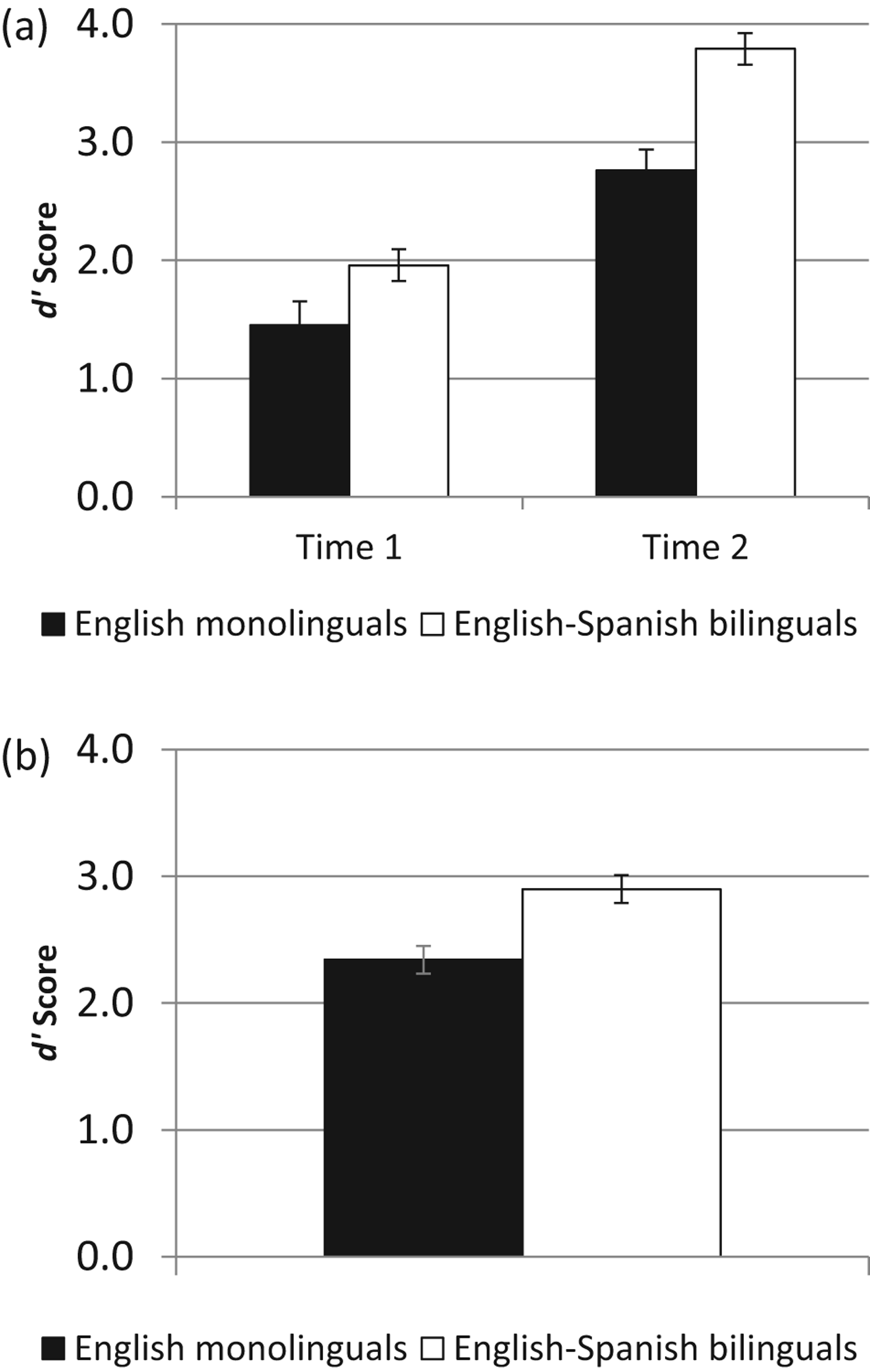
The translation recognition task was presented twice, once after the first two study opportunities in the first session. Given the immediacy of the translation recognition test after each study opportunity, performance on this task reveals the trajectory of learning after different amounts of study. These data are presented in Figure 2A.
Error bars represent one standard error. A) Translation recognition accuracy and B) Dutch lexical decision accuracy for English monolinguals and English-Spanish bilinguals in Experiment 1.

The accuracy data in this experiment and all following experiments from the translation recognition task and the Dutch lexical decision task were converted to d' scores to account for response bias. The d' scores were then submitted to a 2 (language group: monolinguals, bilinguals) × 2 (presentation order: time 1, time 2) mixed-factor ANOVA. A main effect of language group (F(1, 40) = 13.24, p < .01, η2p = .21) revealed that English–Spanish bilinguals (M = 2.87, SD = 1.14) outperformed the English monolinguals (M = 2.11, SD = 1.07). There was also a main effect of presentation order (F(1, 40) = 224.33, p < .01, η2p = .53), showing better performance after the second study opportunity (MT1 = 1.72, SDT1 = 0.84, MT2 = 3.30, SDT2 = 0.87). A significant interaction between language group and presentation order (F(1, 40) = 6.04, p = .02, η2p = .03) revealed that English–Spanish bilinguals’ improvement from the first to second test was greater than the English monolinguals’ improvement.
The data from the translation recognition task supported those from previous studies: the English–Spanish bilinguals outperformed the monolinguals, even after just one study opportunity, but that the advantage grew with more practice. Overall, these results suggest that the bilingual advantage in foreign language vocabulary learning can be observed very early in the learning process and reflects the trajectory of new learning as well as the final outcome.
2.2.4. Dutch lexical decision
The Dutch lexical decision task was presented twice, in Sessions 2 and 3. Due to attrition from Session 2 to 3, we report only the results from Session 2 here. These data appear in Figure 2B. For the results of Session 3 using the subset of participants who completed all three sessions, see the Post-Hoc Results section.
A t-test revealed that the English–Spanish bilinguals (M = 2.90, SD = 0.51) were more accurate than the English monolinguals (M = 2.34, SD = 0.50; t (41) = 3.62, p < .01, η2 = .23).
The Dutch lexical decision data provide converging evidence with the translation recognition data that the English–Spanish bilinguals learned the Dutch vocabulary better than the English monolinguals. The results from session 3 (see Post-hoc results) reveal that this pattern remains even after a longer period of time without additional study opportunities.
Data from the Operation-Span task and Simon task are reported in the Post-Hoc Results section to consider how working memory and cognitive control contributed to performance across all three experiments.
2.3. Discussion
There were two notable results in Experiment 1. First, the English–Spanish bilinguals were dramatically slower than the monolinguals to name words in English during study at all three task presentations. In contrast, the English-picture naming performance of the two groups of native English speakers did not yield latency differences. This suggests that the bilinguals’ slower naming latencies during study did not arise from language processing demands, but rather reflect a specific consequence of bilingualism for new learning. The study task results complement the second finding: the bilinguals were more accurate than the monolinguals in the translation recognition and Dutch lexical decision tasks.
Two explanations seem most likely to account for the pattern of cost at study yielding a benefit at test for the bilinguals. Perhaps most obvious is that the bilinguals elected to study for a longer time than the monolinguals due to previous language learning experience (transfer of learning context hypothesis). A second, not necessarily mutually exclusive explanation, is that, although both were learning via their native language, bilinguals in the context of this experiment engaged their L1 regulatory skill (L1 regulation hypothesis) during the presentation of foreign vocabulary. That regulatory skill is thought to arise from the experience of negotiating competition across the two languages.
The results of Experiment 1 do not permit these two possibilities to be teased apart. In theory, bilinguals have experience both as language learners overall and also as self-regulators. In Experiment 2, we tested Spanish–English bilinguals using the same protocol used in Experiment 1. For Spanish–English bilinguals, learning via English translations requires using their L2 to learn the new Dutch words. If bilinguals are advantaged in learning vocabulary because they are able to transfer a general, explicit learning strategy of studying new information longer, then the Spanish–English bilinguals should produce the same advantage. Indeed, they might even show a larger advantage than the English–Spanish bilinguals because they generally acquired the L2 earlier. If the advantage observed for the bilinguals in Experiment 1 occurred instead because they were learning via their L1, the language that they had learned specifically to regulate, then the Spanish–English bilinguals might not be expected to produce a similar advantage when they learn the new Dutch words via their L2.
3. Experiment 2
3.1. Method
3.1.1. Participants
Twenty-seven Spanish–English bilinguals participated in Experiment 2. Eight participants were excluded for failure to return for Session 2 (2 bilinguals), failure to reach a minimum working memory score of 25 out of a possible 60 (1 bilingual), or falling outside the target age range of 18–39 (5 bilinguals). This resulted in 19 Spanish–English bilinguals in Experiment 2. These bilinguals included both late L2 learners and early bilinguals, with a mean age of exposure to English of 6.58 years (SE = 1.32).
3.1.2. Materials
The materials were identical to those in Experiment 1.
3.1.3. Procedure
The procedure was identical to that of Experiment 1, except that the bilinguals in Experiment 2 were given the option to complete the Operation-Span task in the language they considered to be more dominant. As in Experiment 1, bilinguals learned the Dutch words via English, were instructed in English, and completed the picture naming task in English.
3.2. Results
3.2.1. Word naming at study
The Spanish–English bilinguals correctly produced the English translation on over 98% of trials presented during the study task.
The naming latency data for the Spanish–English bilinguals and the English monolinguals from Experiment 1 are presented in Figure 3. Data from one bilingual were excluded due to a recording malfunction. A 2 (language group: monolingual, bilingual) by 3 (study task presentation order: three presentations) mixed-factor ANOVA revealed a main effect of task presentation order, such that both groups were faster to name the English translations over the repeated study sessions (F(2, 74) = 8.53, p < .01, η2p = .04). Bonferroni-corrected pairwise comparisons revealed that naming latencies at the second presentation were not significantly faster than the first presentation. Naming latencies at the third presentation were significantly faster than the first presentation (t(37) = 3.20, p < .01). A main effect of language group revealed that the monolinguals were faster to name the English words during study than the Spanish–English bilinguals (F(1,37) = 6.11, p < .05, η2p = .12). No interaction between language group and study task presentation order was observed.
Error bars represent one standard error. (A) Translation naming latencies during study task and (B) picture naming latencies during the English picture naming task for English monolinguals and Spanish-English bilinguals in Experiment 2.

3.2.2. English picture naming
To assess differences in the speed of lexical access between the bilinguals and monolinguals in Experiment 2, we examined picture naming performance. The Spanish–English bilinguals performed the task quite accurately at 97.1%. When naming accuracies were submitted to a one-way ANOVA, monolinguals’ and bilinguals’ performance did not differ significantly. However, an analysis of the correct naming latencies revealed that the Spanish–English bilinguals named pictures in English more slowly than the English monolinguals (F(1, 37) = 11.16, p < .01, η2 = .23).
The slower picture naming latencies for the bilinguals suggests that their longer naming latencies in the study task may reflect the consequences of naming in the less proficient/dominant L2. If this is correct, then we might not expect to see a benefit at test that is comparable to the one reported for the English–Spanish bilinguals in Experiment 1.
3.2.3. Translation recognition
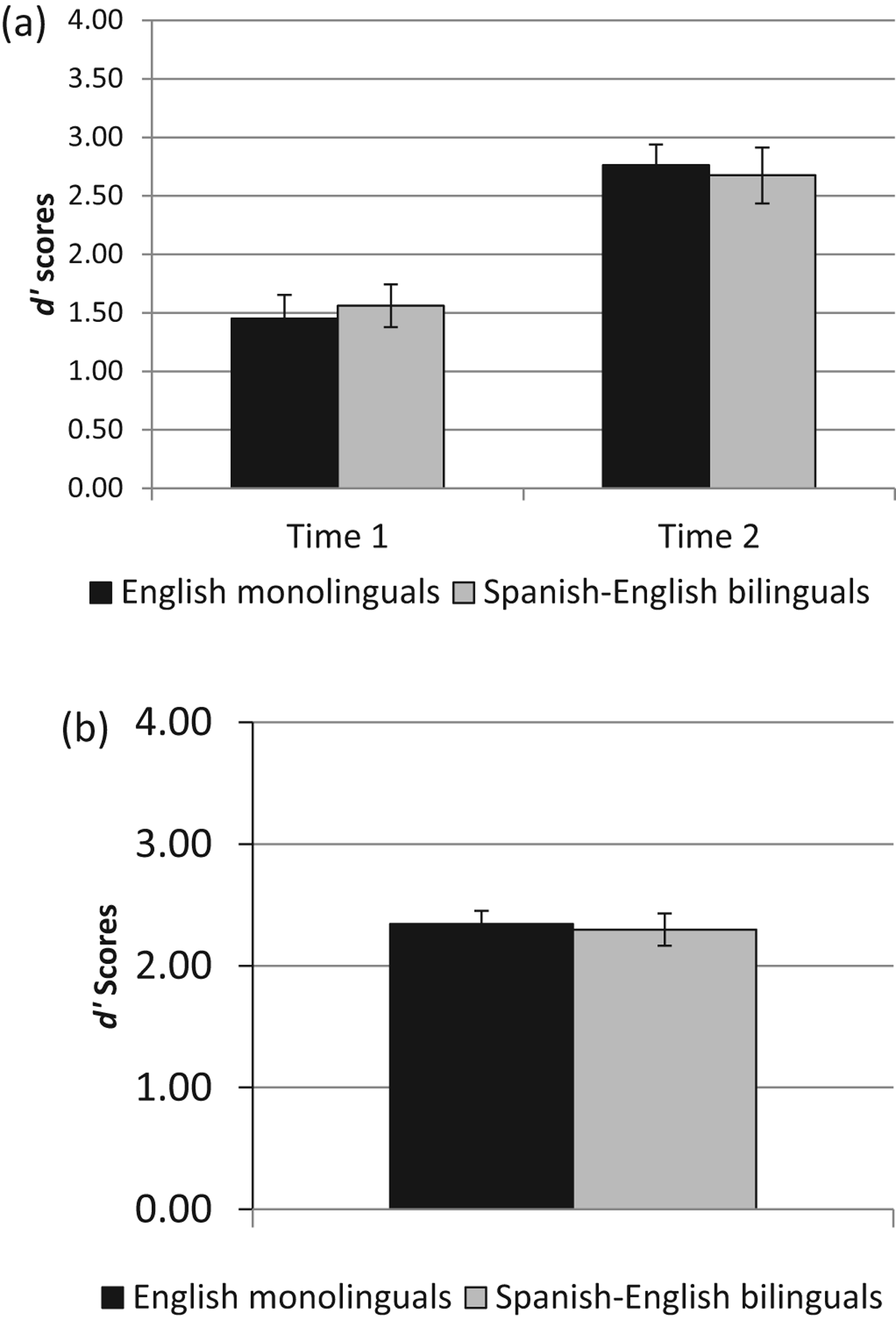
The d' scores were submitted to a 2 (language group: monolinguals, bilinguals) × 2 (presentation order: time 1, time 2) mixed-factor ANOVA. There was no main effect of language group (F(1, 37) = 0.01, p = .97, η2p < .01). A main effect of presentation order (F(1, 37) = 177.03, p < .01, η2p = .33) confirmed an increase in performance after the second study opportunity (MT1 = 1.50, SDT1 = 0.84, MT2 = 2.72, SDT2 = 0.91). The interaction between language group and presentation order was not significant (F(1,37) = 1.15, p = .29, η2p < .01). These data are presented in Figure 4A.
Error bars represent one standard error. A) Translation recognition accuracy and B) Dutch lexical decision accuracy for English monolinguals and Spanish-English bilinguals in Experiment 2.

3.2.4. Dutch lexical decision
A t-test on the d' scores revealed no difference: the Spanish–English bilinguals were no more accurate on the lexical decision task than the English monolinguals (t(1, 37) = .17, p = .86).
These results suggest that a bilingual advantage in foreign language vocabulary learning is not observed when learning foreign language vocabulary via L2 translations. In fact, the Spanish–English bilinguals in Experiment 2 performed similarly to the English monolinguals at test, despite being slower to name English translations at study.
3.3. Discussion
The Spanish–English bilinguals tested in Experiment 2 did not reveal an advantage in foreign vocabulary learning. These results fail to support the idea that this advantage is simply due to strategy, as these bilinguals were also skilled language learners who could have exercised such a strategy during study and indeed were slower at study. Likewise, these data also fail to support the phonological awareness hypothesis, which proposes that earlier bilinguals are more (or exclusively) advantaged in learning new languages, although these were not true simultaneous bilinguals. The bilinguals' self-paced study latencies were longer than the monolinguals’, but the bilinguals were also slower to name pictures in English (their L2). It is therefore impossible to tell whether the slower naming latencies during the study task were due to using the less skilled L2 or to a strategy to simply study longer.
The Spanish–English bilinguals tested in Experiment 2 differed in their relative balance of proficiency in English and Spanish; indeed, some of the participants had lived in the US for long enough that they reported being more dominant in English than Spanish. To examine the consequences of the relative dominance of the two languages, we performed an analysis by language dominance, reported in the Post-Hoc Analyses. However, the large variation in this group of Spanish–English bilinguals makes a comparison with the more homogenous English–Spanish bilinguals difficult. In Experiment 3, we examined a group of bilinguals learning via the L2 for whom there is no ambiguity about the dominant language and for whom the context of L2 acquisition is more similar to the English–Spanish bilinguals in Experiment 1.
4. Experiment 3
In Experiment 3 we tested Chinese–English bilinguals who were late bilinguals, having acquired English past early childhood. They were closely matched to the English–Spanish bilinguals in that their primary experience in L2 learning occurred in the classroom and they were more closely matched on measures of age and language proficiency (see Table 1). Unlike the Spanish–English bilinguals, there was no ambiguity about their language dominance. Although they were immersed in their English in the US, they were dominant in Chinese as the L1. If this group of bilinguals demonstrates an advantage in foreign language vocabulary learning, this would lend support for the transfer of learning context hypothesis: only bilinguals with extensive classroom L2 learning experience would utilize a more successful strategy in a laboratory vocabulary learning setting. However, if the Chinese–English bilinguals do not exhibit an advantage in foreign language vocabulary learning, this would support the l1 regulation hypothesis, that foreign language learning via a bilingual's dominant language underlies this advantage by providing bilinguals the opportunity to effectively utilize their language regulation skill.
4.1. Method
4.1.1. Participants
Nineteen Chinese–English bilinguals participated in Experiment 3. One participant was excluded due to reported English dominance; all remaining 18 bilinguals were Chinese dominant. The Chinese–English bilinguals were almost exclusively late learners of English, with a mean age of exposure to English of 11.71 years (SD = 1.57). Age of initial exposure to English ranged from 9 to 15.
4.1.2. Materials
The materials in Experiment 3 were identical to those in Experiments 1 and 2.
4.1.3. Procedure
The procedure in Experiment 3 was identical to that of Experiment 2. Like Experiment 2, the participants were given the option to complete the Operation-Span task in either Chinese or English. The Chinese–English bilinguals performed all other tasks in either English (their L2) or in Dutch (the target language being taught).
4.2. Results
4.2.1 Word naming at study
The Chinese–English bilinguals correctly produced the English target on over 97% of the study trials.
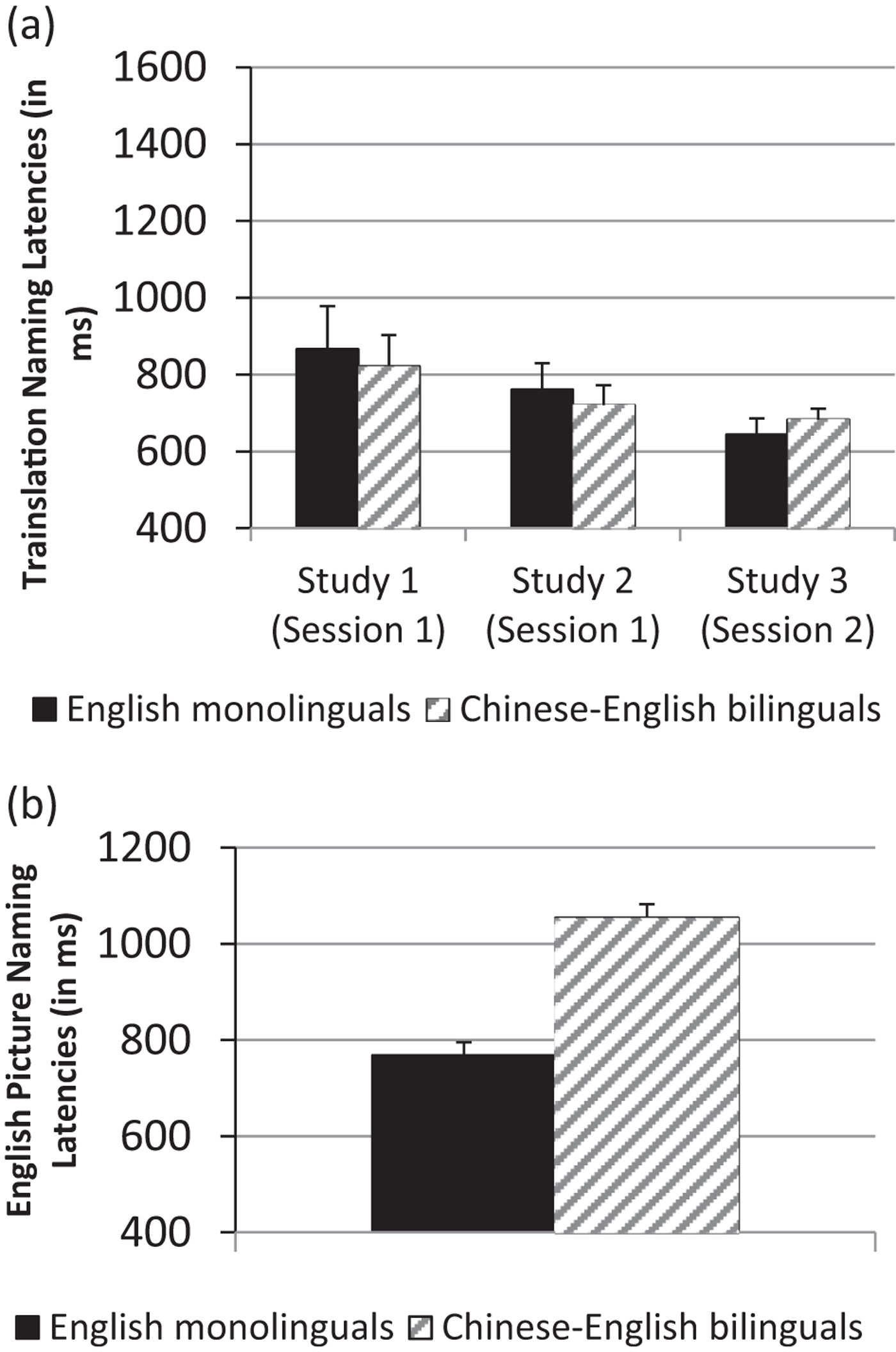
Data from the study and English picture naming tasks are presented in Figure 5. Combined with the English monolingual participants from Experiment 1, a 2 (language group: monolingual, bilingual) by 3 (study task presentation order: three presentations) mixed-factor ANOVA revealed a main effect of task presentation order, such that both groups were faster to name the English translation from one presentation of the task to the next (F(2, 72) = 11.74, p < .001, η2p = .07). Bonferroni-corrected pairwise comparisons revealed that naming latencies at the second presentation were marginally faster than the first (t(72) = 2.40, p = .07). Naming latencies at the third presentation were significantly faster than the second (t(72) = 4.05, p < .01). A main effect of language group was not found (F(1, 36) = 0.01, p = .92, η2p < .01). There was no language group by task presentation interaction (F(2, 72) = 0.17, p = .84, η2p < .01).
Error bars represent one standard error. (A) Translation naming latencies during study task and (B) picture naming latencies during the English picture naming task for English monolinguals and Chinese-English bilinguals in Experiment 3.

4.2.2. English-picture naming task
It is remarkable that the Chinese–English bilinguals performed the word naming task at study as quickly as they did, given that they were not only naming words in English (their L2), but also the bilingual group with the lowest self-reported proficiency in English (see Table 1).Footnote 3 To examine the possibility that these bilinguals, despite their low self-reported proficiency in English, were exceptionally quick to retrieve lexical information in English, we examined their performance on the English picture naming task. The Chinese–English bilinguals were significantly less accurate at naming pictures in English than the monolinguals (F(1, 37) = 27.43, p < .001, η2 = .43).
For the reaction time analyses, only correct trials were used. The Chinese–English bilinguals were indeed slower than the English monolinguals to name pictures in English (F(1, 37) = 55.08, p < .001, η2 = .6). These results seem likely to reflect the Chinese dominance of the Chinese–English bilinguals and suggest that the relatively fast self-paced study latencies are not due to fast lexical retrieval per se.
In light of the picture naming results, the results of the study task are more striking. If the transfer of learning context hypothesis were correct, we would have expected the Chinese–English bilinguals to have taken much longer than the English monolinguals – and perhaps also longer than the English–Spanish bilinguals – to name the English translations at study. However, the Chinese–English bilinguals were not only faster than the English–Spanish bilinguals at study, they were approximately as fast as the monolinguals. The fact that we find a dissociation between the picture naming latencies and English word naming latencies during study suggests that the study task is not simply word naming, in which case we would expect the pattern of results across tasks to be similar (e.g., see Kroll, Michael, Tokowicz & Dufour, Reference Kroll, Michael, Tokowicz and Dufour2002). Instead, the study task captures learning strategies adopted by the groups in the context of the task and instructions. Based on the results of Experiments 1 and 2, we might predict that, despite the similarity of the Chinese–English and English–Spanish groups, the Chinese–English bilingual groups should not exhibit an advantage in foreign vocabulary learning because they are learning via their L2.
4.2.3. Translation recognition
The d' scores were submitted to a 2 (language group: monolinguals, bilinguals) × 2 (presentation order: time 1, time 2) mixed-factor ANOVA. There was no main effect of language group (F(1, 37) = 1.95, p = .17, η2p = .04). A main effect of presentation order (F(1, 37) = 177.72, p < .01, η2p = .38) confirmed an increase in performance after the second study opportunity (MT1 = 1.28, SDT1 = 0.80, MT2 = 2.59, SDT2 = 0.92). The interaction between language group and presentation order was not significant (F(1,37) < 0.01, p = .98, η2p < .01). These data are presented in Figure 6A.
Error bars represent one standard error. A) Translation recognition accuracy and B) Dutch lexical decision accuracy for English monolinguals and Chinese-English bilinguals in Experiment 3.

4.2.4. Dutch lexical decision
A t-test revealed a marginal difference between groups, such that the monolinguals (M = 2.34, SD = 0.50) produced marginally better d' scores than the bilinguals (M = 2.01, SD = 0.55; t(35) = 1.94, p = 0.06). These data are presented in Figure 6B.
4.3. Discussion
If the bilingual advantage in vocabulary acquisition were due to transferring previous experience with learning languages into a new context, then we would have expected the Chinese–English bilinguals to reveal longer study latencies and better vocabulary learning at test, like the English–Spanish bilinguals (perhaps even longer study latencies due to their slower English lexical retrieval). Instead, the Chinese–English bilinguals were as fast as the monolinguals at study and did not reveal a learning advantage. The Chinese–English and English–Spanish bilinguals were well-matched on age of acquisition, classroom experience, and working memory. While foreign language classes differ vastly across cultures and countries, classroom learning entails explicit instruction and study strategies to learn the content, and the design of the study task should allow participants to engage those skills. One difference between the English–Spanish and Chinese–English bilinguals was that the Chinese–English bilinguals were immersed in their L2 (English). The Spanish–English bilinguals were also immersed in their L2, and many used English and Spanish jointly and switched dominance (see section 5.2). The Chinese–English bilinguals maintained strong dominance in their L1 and separated the contexts in which they used English and Chinese. This form of immersion may have different consequences for L1 regulation that does not allow them to engage this skill during new learning.
5. Post-hoc analyses
5.1. Participants who completed Dutch Lexical Decision Session 3 post-test
Given attrition between Sessions 2 and 3, we did not have a sufficient sample to report the results from the third session in the main analyses (monolinguals: 15, English–Spanish bilinguals: 13, Spanish–English bilinguals: 14, Chinese–English bilinguals: 12). However, analyses of the subset of participants who completed all three sessions reveal the same overall patterns. Combining across language groups from all three experiments, the results of a mixed-factor ANOVA on the English word naming latencies in the study task confirmed that study latencies became shorter over time (F(2, 52) = 3.53, p = .03), and revealed a main effect of language group (F(3, 51) = 7.3, p < .01). Pairwise t-tests were conducted for each study time. At Time 1, English monolinguals took significantly less time to study than the English–Spanish bilinguals (p = .04). At Time 2, English monolinguals took significantly less time to study than English–Spanish bilinguals (p = .02) and marginally less time than the Spanish–English bilinguals (p = .07). At Time 3, the English monolinguals took significantly less time than the English–Spanish bilinguals (p = .01) and Spanish–English bilinguals (p = .03).
Picture naming latencies revealed a main effect of language group (F(3, 49) = 13.59, p < .01) that confirmed the English monolinguals and English–Spanish bilinguals were equally fast at naming pictures, but the Spanish–English and Chinese–English bilinguals were significantly slower than the monolinguals (p < .01 for both).
Finally, d' scores from the Dutch lexical decision task from Session 2 and 3 were submitted to a mixed-factor ANOVA, revealing main effects of time (F(1, 50) = 283.57, p < .001) and language group (F(3, 50) = 4.47, p < .01), but no interaction. Follow-up pairwise t-tests revealed that, in Session 2, English–Spanish bilinguals significantly outperformed all other groups (all ps < .01), and, in Session 3, English–Spanish bilinguals significantly outperformed the English monolinguals and Chinese–English bilinguals (ps < .05) and marginally outperformed the Spanish–English bilinguals (p = .07).
Overall, the results from participants who returned for the third session confirm the pattern of results from the main analyses. The English–Spanish bilinguals took longer to name words at study, were as fast as monolinguals during English picture naming, and were the only group to reveal an advantage at test.
5.2. Experiment 2: Examining the role of language dominance
While not the primary focus of the current study, the mixed dominance of the Spanish–English bilinguals in Experiment 2 provided an opportunity to examine the effects of the effects of language dominance. Given the nature of language regulation and how it reflects the demands of current language use and context (Zirnstein et al., Reference Zirnstein, Van Hell and Kroll2018), bilinguals whose L1 and dominant language differ may allow us to better understand the relationship between language regulation and new vocabulary learning. The Spanish–English bilinguals differed in relative language proficiency; some retained their Spanish-dominance (n = 11) and others had become English-dominant (n = 8).Footnote 4 Language dominance was based on a ratio of the average self-reported proficiency in Spanish divided by English. Bilinguals with ratios greater than 1 were considered Spanish dominant, and less than or equal to 1 were considered English dominant. The Spanish-dominant group rated their overall Spanish proficiency as 9.96 (SD = 0.08, on a scale from 1 to 10), and the English-dominant group rated theirs as 8.6 (SD = 1.00). Although both groups rated their Spanish as highly proficient, the difference was significant (t(17) = 4.56, p < .01). Conversely, the Spanish-dominant group rated their English proficiency as 8.56 (SD = .79), and the English-dominant group rated theirs as 9.68 (SD = .69). A t-test revealed this difference was also significant (t(17) = 3.17, p < .01).
Naming latencies from the study task for the Spanish–English bilinguals were fitted in a linear regression with language dominance as a continuous predictor and study task order as a 3-level factor. A linear regression revealed a significant effect of dominance such that bilinguals who were more dominant in English were taking more time to study than bilinguals who were less dominant in English (ß = -156.61, SE = 58.35, t = 2.68, p < .01). Figure 7 depicts the mean naming latencies when groups are dichotomized by dominance. These data suggest that the more proficient the Spanish–English bilinguals were in English, the slower they were to name English words during study, resembling the English–Spanish bilinguals in Experiment 1.
Translation naming latencies during study task (error bars represent one standard error)

If slower study latencies reflect the engagement of language regulation skills for the more dominant language, then we might predict that the English-dominant bilinguals, although native speakers of Spanish, would behave much like the English–Spanish bilinguals in Experiment 1, with better performance on the translation recognition and Dutch lexical decision tasks than the Spanish-dominant bilinguals. The d' scores from the translation recognition task were submitted to a linear regression model with d' scores as the outcome variable and dominance and presentation order as predictor variables. The results revealed once again that dominance had a significant effect, such that bilinguals who were more English dominant outperformed bilinguals who were more Spanish-dominant on the translation recognition test (ß = -0.33, SE = 0.14, t = 2.31, p = .03).
The Dutch lexical decision task d' scores in Experiment 2 were also fitted with a linear model, with d' scores as the outcome variable and dominance as a predictor. Similar to the translation recognition results, bilinguals who were more dominant in English outperformed bilinguals who were more dominant in Spanish (ß = -0.31, SE = 0.14, t = 2.19, p = .04).
The post-hoc analysis of the Spanish–English bilinguals by language dominance is preliminary, but the pattern of results provides tentative support for the hypothesis that the bilingual advantage in vocabulary learning depends on learning through the dominant language. The findings reveal that with greater proficiency and dominance in English, the language of instruction, there were longer study latencies and better test performance, producing a pattern for the English-dominant bilinguals more similar to that of the native English speaking bilinguals.
5.3. Working memory
A strong predictor of language learning success that has also served as a proxy for cognitive control is working memory. The English–Spanish and Chinese–English bilinguals had higher working memory scores than the other two groups reported here (see Table 1). Not only has working memory been identified as a possible realm for bilingual advantages (Kroll et al., Reference Kroll, Michael, Tokowicz and Dufour2002; Grundy & Timmer, Reference Grundy and Timmer2016), more recent evidence suggests that working memory in L2 learners benefits vocabulary learning (Linck, Osthus, Koeth & Bunting, Reference Linck, Osthus, Koeth and Bunting2014; Tseng, Eddington, Phillips & Tokowicz, Reference Tseng, Eddington, Phillips and Tokowicz2012). To examine the influence of working memory on d' scores on the lexical decision task, a post-hoc analysis was conducted including using a linear model to control for working memory scores. This analysis revealed a marginal effect of working memory (F(1, 75) = 3.15, p = .08) whereby higher working memory was related to better performance on the lexical decision task. However, even when accounting for working memory scores, the group differences remained: compared to monolinguals, the English–Spanish bilinguals performed significantly better (ß = 0.51, SE = .22, t = 2.35, p = .02), the Spanish–English bilinguals performed no differently (ß = -0.04, SE = .21, t = 0.17, p = .86), and the Chinese–English bilinguals performed marginally worse (ß = -0.42, SE = .23, t = 1.84, p = .07).
The similarity of span for the English–Spanish and Chinese–English bilinguals, in contrast to the distinct patterns of performance in the vocabulary learning task, suggests that working memory alone is not responsible for an observed advantage in word learning. Rather, the advantage appears to depend on the way that the L1 is engaged during learning.
5.4. Simon Task
To examine the bilingual cognitive control hypothesis, Simon scores were calculated by subtracting the reaction times for congruent trials from incongruent trials for correct trials only. Since Simon scores were not normally distributed, they were transformed with a square root function before being submitted to statistical tests, but raw values are reported here.
A one-way ANOVA on the Simon scores comparing the four groups tested revealed no differences across groups (F(3, 72) = 1.13, p = .35, η2 = .04). Furthermore, there was no correlation between Simon scores and d' scores for the lexical decision task (t(74) = 0.54, p = 0.59, r = -0.06). This suggests that an individual's cognitive control ability, as measured by the Simon, did not influence their performance in the learning task, and did not differ as a function of being bilingual.
6. General Discussion
The purpose of the present study was to examine whether learning via the L1 or dominant language accounts for the patterns of costs and benefits observed in bilingual language processing and new learning, as a result of skill in L1 regulation. The results of the three experiments we report support this account by demonstrating that the bilingual advantage in foreign vocabulary learning is present only when novel words are taught via the L1 or dominant language. Two groups of bilinguals who learned vocabulary via the L2 (Experiments 2 and 3) did not differ from English monolinguals. In contrast, English–Spanish bilinguals revealed better vocabulary learning than the monolinguals, and took significantly longer to study the foreign vocabulary than the monolinguals (Experiment 1). Notably, they were no slower than the monolinguals when naming pictures in English, suggesting that their slow study performance reflected a strategy specific to learning.
The specificity of the observed bilingual advantage in vocabulary learning suggests that it is not attributable to general explicit language learning strategies or language experience (transfer of learning context hypothesis) per se. If longer naming latencies at study in Experiment 1 reflected a general explicit learning strategy, then we might have expected similar or even larger effects for the bilinguals in Experiments 2 and 3 who were naming in their L2. Contrary to this prediction, we found that the Chinese–English bilinguals were similarly fast to perform the study task as the monolinguals, but took much longer to name pictures in English, suggesting overall slower lexical access. While the Spanish–English bilinguals did take longer than monolinguals in the study task, the English picture naming results suggest that the slower naming performance was attributable to slower lexical retrieval in the L2. Indeed, what is notable about the results for the two bilingual groups learning via the L2 is that despite the differences between them, the overall outcome of learning was similar and not significantly different from monolingual performance. Hence, we conclude that the transfer of learning context hypothesis cannot account for why only the bilingual group who performed the study task via L1 translations demonstrated the bilingual advantage in foreign language vocabulary learning, and a matched bilingual group performing the task in the L2 did not.
The results also do not support the notion that the bilingual advantage in foreign vocabulary learning is due to more general advantages that have been reported for bilinguals in cognitive control tasks (e.g., Bialystok, Craik, Green & Gollan, Reference Bialystok, Craik, Green and Gollan2009). This account predicted that all bilinguals would outperform monolinguals in new vocabulary learning as well as on measures of cognitive control. None of the bilingual groups in this study revealed an advantage in cognitive control, nor were better cognitive control scores related to better performance on the vocabulary learning task. We also did not find support for the phonological awareness hypothesis in the present study, which would have predicted the Spanish–English bilinguals to reveal the greatest vocabulary learning advantage due to their relatively earlier age of acquisition. However, we acknowledge that the Spanish–English bilinguals in this study were not a strict test of this hypothesis. Further research should consider the role of language regulation and how the specificity of learning via the L1 or dominant language may differ for simultaneous bilinguals, whose languages develop in parallel and may become skilled in regulating both languages equally.
Based on the results of the present study, we propose that the specificity of the bilingual advantage can best be explained by the L1 regulation hypothesis. When the Spanish–English bilinguals were subdivided on the basis on language dominance, Spanish-dominant bilinguals exhibited a pattern of results similar to the Chinese–English bilinguals, whereas the English-dominant bilinguals' performance was similar to that demonstrated by the English–Spanish bilinguals. Hence, we conclude based on the preliminary post-hoc data that bilinguals’ foreign vocabulary learning advantage instead depends on learning via the dominant, rather than native language. For the English–Spanish bilinguals these were one and the same. In either case, the evidence supports the idea that congruency between the language of translation during study and the language that requires greater regulation plays a critical role in observing a bilingual advantage in foreign vocabulary learning.
The comparisons between these bilingual groups are imperfect, as is the nature of any research comparing groups with different language acquisition profiles. However, the English–Spanish bilinguals and Chinese–English bilinguals were closely matched in terms of age, age of L2 onset, self-ratings in L1 and L2, and working memory. Given these similarities, the fact that only the English–Spanish and English dominant Spanish–English bilinguals demonstrated an advantage in foreign language vocabulary learning suggests that what is critical is how the language of learning engages the regulation experience with the dominant language. In future research it will be important to examine this hypothesis within learners.
Another factor that may influence the pattern of observed results is the immersion context, since both of the groups learning via the L2 were also immersed in the L2. Research on desirable difficulties emphasizes the importance of self-regulation (Bjork et al., Reference Bjork, Dunlosky and Kornell2013), or internal regulation. The bilinguals who did not outperform the monolinguals may have been disadvantaged due to being immersed in the L2, potentially relying on external regulation cues and attempting to keep English active. In contrast, the mechanism of language regulation proposed to account for the bilingual advantage in new word learning requires that the language of translation be regulated skillfully to adjust the connections between a new word and its translation. A prediction for future studies is that the degree to which the native language is used under conditions of immersion may determine whether the language in which bilinguals are immersed can be used effectively for new learning.
The present results demonstrate that only bilinguals who are able to engage skilled language regulation processes during word learning reveal an advantage. The selectivity of this result is exciting because it points to a mechanism that may provide a causal explanation for the bilingual word learning advantage. These advantages in word learning appear to be distinct from domain general cognitive advantages that have been reported for bilinguals. The previous studies investigating bilingual word learning have only taught new words via the L1. Our findings restrict the generality of the previous findings, but also suggest a mechanism that links the consequences of language processing to the observed benefit. Together with an increasing body of research on bilinguals (e.g., Kroll, Dussias, Bogulski & Valdés Kroff, Reference Kroll, Dussias, Bogulski and Valdés Kroff2012), the present study illustrates the way in which bilingualism can provide a tool for revealing the mechanisms of language processing and learning that are otherwise obscured in users of one language alone.