Introduction
The number of studies aimed at analyzing anxiety in older adults has grown exponentially in the past two decades. Even though the prevalence rates for anxiety disorders are lower for this population group than for other age groups, the number of older persons suffering anxiety is far from negligible, and the available data demonstrate that these disorders are among the most prevalent psychiatric disorders in later life (Bryant et al., Reference Bryant, Jackson and Ames2008). Even when there is significant overlap between anxiety symptoms of younger and older adults, some important differences exist, such as older adults being more likely to focus on the somatic aspects of their experience of anxiety, presenting higher comorbidity between anxiety and other mental (e.g. depression) or physical problems, and higher rates of subthreshold anxiety (Bryant et al., Reference Bryant, Jackson and Ames2008; Wolitzky-Taylor et al., Reference Wolitzky-Taylor, Castriotta, Lenze, Stanley and Craske2010). It has been suggested that prevalence estimates of anxiety in late-life based on available assessment measures and diagnostic criteria (which have been developed with younger adult samples) are likely to be underestimated (Carmin et al., Reference Carmin, Wiegartz and Scher2000). Hence, limitations to the assessment of anxiety symptoms later in life may be related to the non-diagnosis or under-diagnosis of anxiety disorders among older adults (Wolitzky-Taylor et al., Reference Wolitzky-Taylor, Castriotta, Lenze, Stanley and Craske2010)
The need for diagnostic instruments specifically developed for older adults has been highlighted by both clinicians and researchers, and the need to develop and validate screening measures in the Spanish language has been pointed out as a necessary first step towards the improvement of the care provided to older Spanish speaking persons (Diefenbach et al., Reference Diefenbach, Robison, Tolina and Blank2004).
One of the measures developed specifically for assessing anxiety in later life is the Geriatric Anxiety Inventory (GAI; Pachana et al., Reference Pachana, Byrne, Siddle, Koloski, Harley and Arnold2007). Good to excellent psychometric properties were obtained for the GAI, such as internal consistency indexes (Cronbach's α) ranging from 0.91 to 0.93. A cut-off point of 10/11 was reported that allowed the correct classification of 83% of patients attending a psychogeriatric service who were diagnosed with Generalized Anxiety Disorder (GAD), with a specificity of 84% and a sensitivity of 75%. In support of its convergent validity, significant correlations with other measures assessing anxiety were also obtained. The GAI has been translated and validated in languages other than English. For example, Rozzini et al. (Reference Rozzini, Chilovi, Peli, Contil, Rozzini, Trabucchi and Padovani2008) validated an Italian version of the scale with an older sample diagnosed with mild cognitive impairment (MCI). This group reported good to excellent psychometric properties of the scale. In a study aimed at testing the psychometric properties of anxiety measures applied to older adults receiving home care services, the GAI showed the strongest psychometric properties (Diefenbach et al., Reference Diefenbach, Tolin, Meunier and Gilliam2009), including being the measure with the least frequently reported problems related to confusion and difficulty, and it was recommended as a screening measure. However, in the Diefenbach et al. study (Reference Diefenbach, Tolin, Meunier and Gilliam2009), the GAI showed a weak divergent validity score when correlated with a measure of depressive symptomatology.
With regard to GAI factorial structure, although Byrne and Pachana (Reference Byrne and Pachana2011) describe their scale as being unidimensional, they do not present any data on a factor analysis of the scale. The purported unidimensionality of this measure of anxiety contrasts with findings from previous studies using other measures of anxiety among older adults, which report on different dimensions of anxiety in this population (e.g. cognitive and somatic, in Kabacoff et al., Reference Kabacoff, Segal, Hersen and van Hassellt1997; cognitive, autonomic, neuromotor, and panic symptoms in Wetherell and Arean, Reference Wetherell and Arean1997). Given the contrast between these findings and the unidimensionality assumed for the GAI, it seems evident that the analysis of the factorial structure of the GAI would contribute to a great extent to establish its psychometric quality.
The already mentioned paucity in the available assessment measures for the study of anxiety in later life may partially explain the limited research conducted so far on psychological correlates of anxiety in older adults. With respect to this, there are some variables whose relationship with anxiety seem especially interesting, especially in light of their ability to improve our clinical understanding and treatment of anxiety disorders in older adults.
As mentioned above, empirical data clearly show that anxiety among older adults seems to be particularly related to depression. Also, there are data suggesting that anxiety may be associated, in the general population, with the use of specific emotion regulation strategies which seem to be particularly maladaptive, namely: rumination, experiential avoidance and emotion suppression. Although rumination has been analyzed for the most part in relation to depression, it also has been suggested to be characteristic of people with mixed anxiety and depressive symptoms (Nolen-Hoeksema, Reference Nolen-Hoeksema2000). With regard to experiential avoidance or the tendency to avoid contact with unpleasant or upsetting internal experiences (Hayes et al., Reference Hayes, Wilson, Gifford, Follette and Strosahl1996), it has been found to be a core mechanism in the development and maintenance of psychological distress in general, and anxiety disorders in particular, in the general population (Roemer et al., Reference Roemer, Salters, Raffa and Orsillo2005). Older people reporting higher scores on experiential avoidance report lower scores on quality of life (Butler and Ciarrochi, Reference Butler and Ciarrochi2007) and higher levels of anxiety (Andrew and Dulin, Reference Andrew and Dulin2007; Robertson and Hopko, Reference Robertson and Hopko2009). Emotion suppression, or the tendency to hide or inhibit the expression of positive and negative emotions, is highly related to experiential avoidance and is considered by some authors to be a component of this variable (e.g. Kashdan et al., Reference Kashdan, Barrios, Forsyth and Steger2006). This response-focused emotion regulation strategy has also been found to be significantly associated with higher levels of negative affect in the general population (John and Gross, Reference John and Gross2004). Available empirical evidence on age-differences in the use of emotion suppression is mixed, with some studies finding that older adults use this strategy less frequently than younger persons (John and Gross, Reference John and Gross2004) and other research revealing the opposite pattern (Márquez-González et al., Reference Márquez-González, Izal, Montorio and Losada2008). Considering all these variables together, very little is known regarding their role in the explanation of psychological distress in general, and of anxiety in particular, among older adults.
Returning to the GAI, to our knowledge, no translation into the Spanish language, nor any validation of the scale in Spain, has been completed so far. Nor has a factor analysis of the scale been attempted, which could provide useful information for researchers and clinicians using this measure. The main objective of this work is to analyze the psychometric properties of the Spanish version of the GAI, including its reliability (internal consistency) and factorial validity, through an exploratory factor analysis of the scale. A second objective of the study is to explore the associations between anxiety, as measured by the GAI, and other variables related to emotional distress (depression) and emotion regulation (rumination, experiential avoidance, and emotion suppression). These analyses will allow us to obtain relevant information on GAI criterion validity.
Methods
Sample
Three-hundred-and-two people (75.5% female) living in the community participated in this study. All the participants were 60 years of age or older, with a mean age of 71.68 years (SD = 6.85). The average number of years of formal education was 11.3 (SD = 7.14), and most of them were married (42.3%) or widowed (31.3%). All of them were recruited through cultural and social centers in Madrid, and freely agreed to participate in the study.
Measures
All the participants completed a questionnaire that covered the following set of variables, assessed by the scales described.
Anxiety – the Geriatric Anxiety Inventory (GAI; Pachana et al., Reference Pachana, Byrne, Siddle, Koloski, Harley and Arnold2007). The GAI consists of 20 dichotomous items measuring anxiety symptoms in older people (e.g. “I worry a lot of the time.”). Possible answers to these items are “agree” or “disagree”. This scale has displayed good to excellent psychometric properties in community and clinical populations, as well as with people with MCI (Pachana et al., Reference Pachana, Byrne, Siddle, Koloski, Harley and Arnold2007; Rozzini et al., Reference Rozzini, Chilovi, Peli, Contil, Rozzini, Trabucchi and Padovani2008). The Spanish version of the scale was developed in collaboration with the authors of the original version. Only one significant adaptation was considered necessary due to cultural differences in expressing anxiety symptoms. Specifically, regarding the item “I often feel like I have butterflies in my stomach”, the reference to butterflies not being common in Spain, a similar expression is used referring to ants (“A menudo siento hormigueo en mi estómago”).
Depression – the Center for Epidemiological Studies - Depression scale (CES-D; Radloff, Reference Radloff1977; Spanish validation by Losada et al., Reference Losada, Peñacoba, Márquez-González and Cigarán2008), a 20-item scale whose items assess depressive symptoms that participants might have felt during the past week (e.g. “I felt sad”). Responses can range from 0 “rarely or none of the time (less than 1 day)” to 3 “most or all of the time (5–7 days)”. The CES-D was found to be a good indicator of anxiety in the Longitudinal Aging Study – Amsterdam (Beekman et al., Reference Beekman, de Beurs, van Balkom, Deeg, van Dyck and van Tilburg2000). The internal consistency (Cronbach's α) found for this scale in this study was 0.87.
Rumination – the short version of the Ruminative Responses Scale (RRS-reduced version; Jackson and Nolen-Hoeksema, Reference Jackson and Nolen-Hoeksema1998; Spanish validation by Losada et al., Reference Losada, Peñacoba, Márquez-González and Cigarán2008). It is a ten-item scale that assesses self- and symptom-focused responses to sadness and distress (e.g. “I think about how sad I feel”). Scores range from 0 “never” to 3 “always”. The internal consistency found in this study was 0.91 (Cronbach's α).
Experiential avoidance – the Acceptance and Action Questionnaire (AAQ; Hayes et al., Reference Hayes, Bisset, Strosahl, Wilson, Pistorello and Dykstra2000; Spanish validation by Barraca, Reference Barraca2004). It has nine items (e.g. “When I feel depressed or anxious, I am unable to take care of my responsibilities”) that measure people's unwillingness to remain in contact with particular private experiences (e.g. emotions), taking steps to alter the form or frequency of these experiences or the contexts that occasion them (Hayes et al., Reference Hayes, Wilson, Gifford, Follette and Strosahl1996). Response options range from 1 “never true” to 7 “always true”. The internal consistency (Cronbach's α) found for this scale in this study was 0.62.
Suppression – the suppression factor of the Emotion Regulation Questionnaire (ERQ; Gross and John, Reference Gross and John2003; Spanish validation by Márquez-González et al., Reference Márquez-González, Izal, Montorio and Losada2008). It is composed of four items (e.g. “When I am feeling negative emotions, I make sure not to express them”) that measure a response that involves inhibiting ongoing emotion-expressive behavior (Gross and John, Reference Gross and John2003). Responses were rated on a scale from 1 “strongly disagree” to 7 “strongly agree”. The internal consistency (Cronbach's α) of this scale in this study was 0.77.
Procedure
The Department of Psychology of the Universidad Rey Juan Carlos (Madrid) has established collaboration agreements with cultural and social centers for older persons within the Red Cross organization. In these centers, the users participate in several courses focused on literature, painting, the internet, etc. One of the aims of these agreements is to develop screenings of the mental health of the users in order to develop psychoeducational programs directed to their observed needs. During the courses, users were requested to participate by completing the assessment protocol. Two trained psychologists were present during the assessments and answered all the possible questions by the participants. The average time for the assessments was 30 to 40 minutes.
Results
Confirmatory factor analysis of the GAI
A confirmatory factor analysis was applied to test the fit of the unidimensional model suggested by Byrne and Pachana (Reference Byrne and Pachana2011). Considering Hu and Bentler (Reference Hu and Bentler1999) criteria for good fit (Comparative Fit Index (CFI) and Tucker-Lewis Index (TLI) greater than 0.95, and the root mean square error of approximation (RMSEA) less than 0.06), the measurement model did not fit the data well (χ2 = 386.39; df = 170; p < 0.001; CFI = 0.89; TLI = 0.88; RMSEA = 0.07). With the aim of examining an alternative factor solution, an exploratory factor analysis was used.
Factorial validity of the GAI
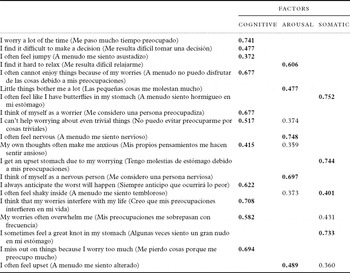
A principal components analysis of the 20 items of the scale was carried out using varimax rotation, in order to maximize the orthogonality of the factors. Three factors were obtained with eigenvalues higher than 1.0. These three factors explained 50.11% of the variance. Factor loadings are shown in Table 1. Most of the items that load on factor 1 refer to worry dimensions (e.g. frequency of worries, interference of worries on life, or identifying oneself as a worrier) or other cognitive dimensions of anxiety, such as anticipating bad things or having thoughts that contribute to anxiety feelings. Consequently, this first factor has been labeled “cognitive symptoms”. The second factor is composed of items referring mostly to symptoms associated with physiological activation (e.g. finding it hard to relax or feeling nervous). This factor has been labeled “arousal-related symptoms”. The third factor is composed of items referring to somatic symptoms of anxiety (e.g. feeling shaky inside or getting an upset stomach). This third factor has been labeled “somatic symptoms”.
Factor loadings of the GAI items

Note: Items in Spanish are shown between brackets. Numbers in bold in each column represent items clustered to the corresponding factor. Items <0.35 are not shown.
Reliability
The obtained internal consistency for the total scale, measured with Cronbach's α, has been 0.91. For the factors, acceptable to good internal consistency indexes have been obtained: a Cronbach's α of 0.89 for the cognitive symptoms factor, 0.71 for the arousal-related symptoms factor, and 0.72 for the somatic symptoms factor.
Criterion validity
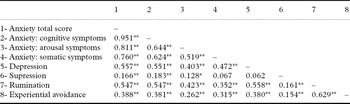
Significant associations between all the GAI factors and the GAI total score and depression, rumination, and experiential avoidance have been found (all p < 0.01; see Table 2). In all cases, higher scores for anxiety are associated with higher scores for depressive symptomatology, rumination and experiential avoidance. Regarding suppression, significant associations have been found between the GAI total score and all of the factors except for the somatic symptoms factor.
Correlations matrix

** p < 0.01; * p < 0.05
Relationship with sociodemographic variables
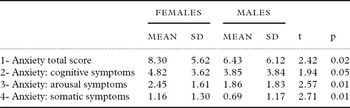
Women reported higher scores than men on both the GAI total score and all of the subscales (see Table 3). However, no significant gender differences were found between people with scores higher than the cut-off score for the GAI. A significant positive association was found between age and the score on the cognitive symptoms factor. Higher age was associated with higher scores on this factor (r = 0.13; p < 0.05). No differences in age were found between people scoring higher or lower than the cut-off score. Years of formal education were found to be inversely associated with the GAI total score (r = −0.15; p < 0.05), the cognitive symptoms factor (r = −0.14; p < 0.05), and the somatic symptoms factor (r = −0.20; p < 0.01). No significant association was found between years of education and arousal-related symptoms. People with scores above the cut-off score of the GAI reported significantly lower years of received formal education (mean = 9.61; SD = 5.78) than people with scores under the cut-off score (mean = 12.22; SD = 7.76).
GAI total and factor scores differences by gender

Discussion
The main aim of this study was to analyze the psychometric properties of the Spanish version of the Geriatric Anxiety Inventory (GAI). The internal consistency (Cronbach's α) obtained for the global scale is excellent and similar to that obtained with the English version of the scale (Pachana et al., Reference Pachana, Byrne, Siddle, Koloski, Harley and Arnold2007; Diefenbach et al., Reference Diefenbach, Tolin, Meunier and Gilliam2009), while acceptable to good indexes were found for the factors obtained. Regarding the GAI factorial validity, the results differ from the postulation put forward by Byrne and Pachana (Reference Byrne and Pachana2011) of the undimensional nature of the scale. A significant percentage of the variance of anxiety (50.11%) is explained by the three observed factors: cognitive symptoms, arousal-related symptoms, and somatic symptoms. Cognitive and somatic factors seem to be rather coincident with those reported by previous studies measuring anxiety in older persons with the GAI (e.g. Kabacoff et al., Reference Kabacoff, Segal, Hersen and van Hassellt1997), and autonomic arousal also has been identified by previous studies as an important dimension of anxiety (e.g. Schaub and Linden, Reference Schaub and Linden2000). It is relevant to note that most GAI items were found to load on the cognitive symptoms factor which, as has been mentioned in the results section, includes items referring to symptoms of worry and apprehension. Worry is a clinical feature of anxiety to which older persons seem especially susceptible and, in addition, is the main feature of generalized anxiety disorder (GAD), one of the most prevalent anxiety disorders later in life (Wolitzky-Taylor et al., Reference Wolitzky-Taylor, Castriotta, Lenze, Stanley and Craske2010). Diverse studies have been conducted to analyze the differential features of worry in GAD versus non-clinical older adults. In this sense, older adults with GAD have been found to report more concerns about health and to perceive greater distress and impairment due to their worries (higher frequency and uncontrollability of worry) (Wetherell et al., Reference Wetherell, Roux and Gatz2003).
Another interesting result is related to the finding that arousal and somatic aspects of anxiety seem to represent separate factors in older adults’ anxiety. This differentiation between arousal-related symptoms (more related to autonomic arousal and general nervousness) and somatic symptoms (more directly related to bodily sensations, especially in the stomach) suggests that somatic sensations may be experienced by Spanish older adults as clearly distinct from the feeling of general apprehension and nervousness. Another potential explanation for this finding is related to the fact that items related to somatic sensations (e.g. “I often feel like I have butterflies in my stomach”) were the most difficult to translate, and thus may present some limitations regarding its cross-cultural validity. Future cross-cultural studies are needed that confirm this factorial structure found for the GAI in older adults living in other countries.
With regard to the associations between anxiety as measured by the GAI and other relevant variables related to psychological distress and emotion regulation in the general population, significant relationships have been found, which lend support to the GAI's criterion validity. The obtained high association between the GAI and depression is similar to that reported by Diefenbach et al. (Reference Diefenbach, Tolin, Meunier and Gilliam2009), using the English version of the scale. This association adds to the literature supporting the significant comorbidity of anxiety and depression symptoms among older persons (Wolitzky-Taylor et al., Reference Wolitzky-Taylor, Castriotta, Lenze, Stanley and Craske2010). In addition, higher scores on the GAI have been linked to higher scores on rumination, experiential avoidance and emotion suppression. Thus, these variables may represent vulnerability factors which could facilitate the development of anxiety in old age, or they may be relevant factors involved in the maintenance of anxiety in this age group. These results are consistent with previous studies in the general population which find significant associations between anxiety and these variables using other instruments to assess anxiety. These data are particularly relevant if we take into account the data presented previously regarding significant associations between the use of rumination and suppression and objective health in the general population and among older adults.
The obtained findings regarding the association between anxiety and education and gender are also consistent with data in the literature on anxiety later in life. Higher scores on anxiety variables (worry and panic) were reported in the Berlin Aging Study for older persons with lower levels of education and, in addition, higher prevalence rates have been found for older women when compared with men (Schaub and Linden, Reference Schaub and Linden2000).
Several limitations of this study should be acknowledged. The sample is composed of non-clinical older persons living in the community and participating in cultural activities, and so the findings may not be generalizable to other groups of older adults, such as psychiatric samples or older adults who do not participate in such activities. In a similar way, the data presented are cross-sectional, and so no causal relationships may be inferred between anxiety and the other assessed variables. In addition, the internal consistency indicators found for the GAI factors are only acceptable, with some items being inconsistent within the factors (e.g. “Little things bother me a lot” in the Arousal factor). Finally, no assessment of discriminant validity nor other reliability indexes (e.g. test-retest reliability) has been done, so future studies should conduct further analyses on the psychometric properties of the Spanish version of the scale.
However, taken together, the results of this study suggest that the Spanish version of the GAI displays good psychometric properties. Further, our data suggest that the scale can be recommended for measuring anxiety in non-clinical older Spanish persons, and may be a useful instrument to be used in research studies aimed at analyzing anxiety and its correlates among older adults. Future studies should test the properties of the scale and explore the correlates of anxiety as measured by the GAI in clinical samples of older subjects in different settings, such as those residing in the community or in nursing homes.
Conflict of interest
None.
Description of authors' roles
María Márquez-González and Andrés Losada both worked on the design of the study and its implementation, the data analysis and the writing of the paper. Virginia Fernández-Fernández collaborated in the implementation of the study, data analysis and writing of the paper. Nancy Pachana collaborated in the adaptation of the scale and the writing of the paper.