In recent years there has been an increasing interest in testing experimentally to what extent emotions can influence moral judgments (e.g., Greene, Reference Greene2007; Greene, Nystrom, Engell, Darley, & Cohen, Reference Greene, Nystrom, Engell, Darley and Cohen2004; Strohminger, Lewis, & Meyer, Reference Strohminger, Lewis and Meyer2011; Ugazio, Lamm, & Singer, Reference Ugazio, Lamm and Singer2012; Valdesolo & DeSteno, Reference Valdesolo and DeSteno2006). A common means of investigating this issue has been to induce emotions experimentally and subsequently present people with moral dilemmas, asking them to decide whether a proposed action should be conducted or not. For instance, in the footbridge dilemma a train which is out of control is heading towards five people who are standing on the track, and who will be killed if nothing is done. One must judge whether a large person should be pushed off a footbridge in order to stop the train before it reaches the five people (Thomson, Reference Thomson1976). Recent studies have revealed that judgments concerning such dilemmas can vary as a function of the different emotions induced, including negatively valenced emotions such as anger or disgust (Ugazio et al., Reference Ugazio, Lamm and Singer2012), and positive ones such as mirth or elevation (Strohminger et al., Reference Strohminger, Lewis and Meyer2011; Valdesolo & DeSteno, Reference Valdesolo and DeSteno2006).
Another common means of investigating the effect of emotions on moral judgment has been to ask people to evaluate the wrongness of moral transgressions conducted by others (e.g., a person eating his dead dog for dinner), following the emotional induction. Due to the strong link documented in the literature between disgust and concerns about moral violations of purity (Rozin, Haidt, & McCauley, Reference Rozin, Haidt, McCauley, Lewis, Haviland-Jones and Barrett2008; see also Horberg, Oveis, & Keltner, Reference Horberg, Oveis and Keltner2011; Olivera & Roselló, Reference Olivera la Rosa and Roselló Mir2013), this emotion has received special attention in this kind of studies. People have been found to make more severe judgments (i.e., they more often judge actions as wrong) when they feel disgust induced through an hypnotic suggestion (Wheatley & Haidt, Reference Wheatley and Haidt2005), an odor with strong stink, the recall of a disgusting experience (Schnall, Haidt, Clore, & Jordan, Reference Schnall, Haidt, Clore and Jordan2008), taste (i.e., a bitter beverage; Eskine, Kacinik, & Prinz, Reference Eskine, Kacinik and Prinz2011), or even through the sound of an emetic event (i.e., a person vomiting; Seidel & Prinz, Reference Seidel and Prinz2013).
In contrast, fewer studies have examined the impact of positive emotions on judgments concerning moral transgressions, and those that examined this issue did not report clear effects. For instance, Seidel and Prinz (Reference Seidel and Prinz2012) used music to induce both a positive emotion (happiness) and a negative one (anger), and found that only the latter affected participants’ judgments by increasing their severity. Similarly, Eskine et al. (Reference Eskine, Kacinik and Prinz2011) found that participants who drank a bitter beverage (i.e., with negative valence) before rating moral vignettes exhibited more severe moral judgments than those who drank water, while judgments of participants who had a sweet beverage (i.e., with positive valence) did not differ significantly from those of participants who had water. Contrasting with these results, a popular study conducted by Valdesolo and DeSteno (Reference Valdesolo and DeSteno2006) found an effect of positive emotions on moral judgments. Specifically, these authors found that individuals who were induced to feel positive affect through a comedy clip were more likely to endorse utilitarian actions in the footbridge dilemma than those who viewed a neutral clip (i.e., participants who viewed the comedy clip were more likely to endorse the action of throwing a person from a bridge to save a larger number of people). However, this study focused on assessing participants’ decisions concerning moral dilemmas, and thus it is unclear whether the observed effects would generalize to evaluations of moral transgressions (for a discussion concerning the distinction between deciding in moral dilemmas and reacting to moral violations, see Monin, Pizarro, & Beer, Reference Monin, Pizarro and Beer2007).
In sum, past work suggests that judgments concerning moral transgressions can be affected by negative emotions, while evidence for an effect of positive emotions is limited. Moreover, the mechanisms underlying the effect of negative and positive emotions on judgments concerning moral transgressions (or lack thereof) are at present unclear. Previous studies often failed to control for the effect of arousal of the induced emotions (e.g., Valdesolo & DeSteno, Reference Valdesolo and DeSteno2006), leaving it unclear to what extent any differences observed for the effects of negative and positive emotions can be attributed to differences in stimulus valence or instead to differences in the associated arousal. Taking this into account, the main aim of the present research was to investigate how judgments concerning moral transgressions are affected by emotions with both negative and positive valence, while controlling for the effect of arousal.
Negative emotions can be associated with higher levels of arousal than positives ones, particularly among female (Lang, Bradley, & Cuthbert, Reference Lang, Bradley and Cuthbert2005; Mourão-Miranda et al., Reference Mourão-Miranda, Volchan, Moll, de Oliveira-Souza, Oliveira, Bramati and Pessoa2003). Higher levels of arousal, in turn, may draw people’s attention to the morally salient features of the environment to a larger extent (Huebner, Dwyer, & Hauser, Reference Huebner, Dwyer and Hauser2009). This would imply that previously observed effects of negative emotions such as disgust might have been driven to some extent by attentional and motivational processes Footnote 1 . A failure to elicit comparable levels of arousal for positive emotions might account, at least partially, for the failure to find a clear effect of such emotions in past work. Alternatively, it might be the case that negatively valenced emotions are more prone to affect moral judgments than positive ones, independently of arousal. As noted above, distinguishing between these alternative possibilities requires testing the effect of one emotion dimension (valence) while controlling for the other one (arousal). In the present work we aimed to disentangle the effects of valence and arousal on moral judgments by employing the International Affective Picture System (IAPS; Lang et al., Reference Lang, Bradley and Cuthbert2005). This instrument includes a wide range of normatively rated images, allowing the possibility of selecting those that differ in valence but elicit similar levels of arousal.
A secondary goal of the present work was to analyze systematically a set of moral transgressions with the aim of avoiding ceiling and floor effects which may overshadow the detection of any effect of affective images on people’s judgments. We reasoned that the effect of emotions on moral judgments might be modulated to some extent by the degree of agreement with the actions described in the vignettes to be evaluated. In line with this notion, some authors have analyzed people’s agreement with utilitarian solutions to dilemmas as a basis to classify dilemmas in terms of low vs. high conflict (Koenigs et al., Reference Koenigs, Young, Adolphs, Tranel, Cushman, Hauseret and Damasio2007), while others have excluded from their analyses those dilemmas where the majority of people either agreed or disagreed with the utilitarian solution (Suter & Hertwig, Reference Suter and Hertwig2011). Furthermore, some have adjusted the content of dilemmas of moral transgressions attempting to bring acceptability ratings closer to the mid-point of the scale (Paxton, Ungar, & Green, Reference Paxton, Ungar and Green2011; Seidel & Prinz, 2013). This suggests that past work has recognized that the degree of agreement with the actions can modulate the effect of different experimental manipulations. However, to the best of our knowledge no attempts were made to measure systematically the degree of agreement associated with different moral transgressions, prior to testing the effect of the experimental manipulations carried out in each case. Taking this into account, in Study 1 we developed a questionnaire of vignettes describing moral transgressions according to statistical criteria. In Study 2 we administered this questionnaire to participants, after they had been exposed to images inducing positive emotions, negative emotions, or no particular emotion.
STUDY 1
In this study we sought to develop a questionnaire including vignettes where: (a) people seldom responded near the extreme points of the response scale, and (b) there was a high degree of variability (variance) in participants’ evaluations of the described behavior. We also sought to include two vignettes with the opposite psychometrical features (i.e., where people often responded with ratings near the ends of the response scale and there was little variability in participants’ evaluations; in other words, vignettes where the great majority of people judged the action as either acceptable or unacceptable), in order to test the effect of emotions on this kind of vignettes as well in Study 2.
Materials and Method
Participants
One hundred and ten undergraduate students (85 females) were recruited from the Faculty of Psychology of the Universidad de Granada, and participated in exchange of course credit. Participants were informed that they could abandon the study at any time without any negative consequences. This and the following study were conducted in compliance with the regulations of the Ethics Committee of the University of Granada.
Procedure
Study 1 was comprised of three phases: (1) elaboration of a questionnaire of moral vignettes (in Spanish); (2) administration of the questionnaire to the student sample previously described; and (3) selection of the vignettes that should be included in the final version of the questionnaire to be used in Study 2.
Phase 1:
The selection of the vignettes to be included in the initial version of the questionnaire was carried out on the basis of four criteria established a priori to accommodate the aims of the present research. Specifically, we selected vignettes that: (1) were brief (with a maximum of 70 words), to ensure that the effects of the emotional induction applied in Study 2 would be present at the time of completion of the moral judgment task; (2) were written in third person, to constrain judgments to evaluations of other people’s behavior, where the participant is merely a passive witness (for evidence on differences between judging transgressions conducted by oneself vs. by others, see Valdesolo & DeSteno, Reference Valdesolo and DeSteno2008); (3) had varied moral content, to enhance the generalizability of our findings; and (4) mainly reflected real life scenarios, to preserve ecological validity.
We selected, translated, and adapted several moral vignettes. Some of them were gently provided by R. O’Hara, from the study conducted by O’Hara, Sinnott-Armstrong, and Sinnott-Armstrong (Reference O'Hara, Sinnott-Armstrong and Sinnott-Armstrong2010), and others were obtained from Knutson et al. (Reference Knutson, Krueger, Koenings, Hawley, Escobedo, Vasudeva and Grafman2010), and Schnall et al. (Reference Schnall, Haidt, Clore and Jordan2008). In most cases the vignettes were adapted to the cultural context of Spain Footnote 2 . The result of this process was a questionnaire including 32 items in which a character faces a situation and performs an act which is morally assessable.
Phase 2:
Participants were instructed to assess to which extent the behavior exhibited by the actor in each vignette was acceptable, using a 9-point Likert scale ranging from very unacceptable (1) to very acceptable (9). To avoid extended reasoning that could interfere with the effect of emotions in Study 2, participants were asked to provide their first impression concerning the characters’ behavior.
Phase 3:
The items were analyzed and ten moral vignettes were then selected according to statistical criteria. The rationale underlying the selection of a limited number of vignettes was the same as that for the word limit described above. That is, we sought to maximize the chances that the effect of the emotions induced in Study 2 would still be present at the time of judgment. The final questionnaire consisted of two sets of five brief vignettes.
Results
In order to identify the eight vignettes that better suited the criteria outlined above (i.e., where people seldom responded near the extreme points of the response scale, and with a high degree of variability in ratings), we submitted the 32 initial items to a descriptive analysis. As noted above, we also selected two vignettes with the opposite features (i.e., those which yielded the most extreme judgments). The first eight vignettes had means ranging from 4.75 to 6.34 (M = 5.57), and variances ranging from 5.04 to 6.98 (M = 5.69). The two additional vignettes had the lowest (M = 1.66) and the highest (M = 7.14) means, as well as the lowest variances (S Footnote 2 = 1.03 and S Footnote 2 = 2.64, respectively). That is, the first of these additional vignettes can be considered of high severity (as it received low acceptability ratings), while the other one can be considered of low severity (as it received high acceptability ratings). The full text of all the selected vignettes is included in the Appendix.
STUDY 2
The main aim of this study was to examine how induced emotions with different valence and similar arousal affect moral judgments. We used a design similar to that employed by Eskine et al. (Reference Eskine, Kacinik and Prinz2011) to study the impact of gustatory disgust on moral judgment, in which participants were assigned to a positive (sweet), a negative (bitter), or a neutral (water) emotional condition. Instead of flavors, we employed images as stimuli to induce positive and negative emotions, or no particular emotion. After the emotional induction phase, participants were instructed to rate the moral vignettes included in the questionnaire developed in Study 1.
For the first eight vignettes we expected to find differences in participants’ judgments related to the valence of the emotions induced. In line with previous research, we hypothesized that judgments would be more severe in the negative-valence group, as compared to both the positive-valence and the control groups (H1). Regarding the positive-valence group, if arousal affects moral reasoning, then judgments should also be affected in this group. In line with the studies that succeeded to find an effect of positive emotions (e.g., Valdesolo & DeSteno, Reference Valdesolo and DeSteno2006), we expected that the direction of the effect would be opposite to that of the negative emotion. That is, judgments should be less severe in the positive-valence group than in the negative and the control groups (H2a). In contrast, if arousal does not affect moral reasoning, then the positive emotion may show no effect (H2b). Predictions regarding the two extremely rated vignettes were less clear. In line with our hypothesis for the first eight vignettes, it is plausible to assume that the negative emotion might increase the severity of judgments for the vignette of low severity, whereas the positive emotion might decrease severity of judgments for the vignette of high severity. However, it might also be the case that moral transgressions which are judged more extremely are less sensitive to the effect of emotions. If this is the case, then no effect of emotions should be observed for these two vignettes.
Materials and Method
Participants
Seventy psychology undergraduate students (50 females; mean age 20 years) were recruited from the Universidad de Granada, and participated in exchange of course credit. Participants were informed that they could abandon the study at any time without any negative consequences. Three participants were excluded from the final analyses; two of them failed to complete all sections of the study and one guessed correctly the hypothesis of the study (see Procedure for a description of the specific questions participants had to answer). Thus, the final sample included 67 participants (positive condition, n = 22; negative condition, n = 23; neutral condition, n = 22).
Instruments
Moral vignettes:
To assess moral judgments we used the vignettes included in the questionnaire created in Study 1 (see Appendix). As in Study 1, participants were required to assess to which extent the behavior exhibited by the actor in each vignette was acceptable using a 9-point Likert scale ranging from very unacceptable (1) to very acceptable (9). Two forms of the questionnaire were used to counterbalance the order in which vignettes were presented. The first five items in form A were the last five items for form B and vice versa; each half contained one of the two items with extreme ratings and four items of the remaining eight.
Emotional Images:
As noted above, to induce emotions with different valence we used three categories of images (positive, negative, and neutral). Each category contained four images. Most of them were obtained from the IAPS database (Lang et al., Reference Lang, Bradley and Cuthbert2005) and were specifically selected according to their valence and arousal scores from the Spanish adaption of IAPS with the aim that the emotional groups differed in valence rating while were similar in arousal rating (Moltó et al., Reference Moltó, Montañés, Poy, Segarra, Pastor, Tormo and Vila1999; Vila et al., Reference Vila, Sánchez, Ramírez, Fernández, Cobos, Rodríguez and Moltó2001; the four positive ones, numbers 8496, 8461, 8186, and 2071, average valence and arousal ratings: 7.85 and 6.05, respectively; the four neutral ones, numbers 7025, 7041, 7175, and 7100, 5.13 and 2.97, respectively; and the 2nd and the 4th of the negative ones, numbers 9301 and 9405, 2.02 and 6.78, respectively). Additionally, two images were selected from the Internet using Google (1st and 3rd of the negative ones). Footnote 3
Manipulation check:
To assess the emotional effects of the presented images, and in order to check whether the average valence and arousal ratings showed the expected pattern according to the reported values in the Spanish adaptation of the IAPS, we used the Self-Assessment Manikin (SAM; Bradley & Lang, Reference Bradley and Lang1994). The SAM is a non-verbal pictorial assessment technique that measures different components of affective reactions. Here it was employed to measure the valence and arousal associated with the images. It is important to note that participants assessed the images after completing all moral judgment tasks, and consequently this assessment was memory-based rather than performed real-time.
Procedure
Participants were randomly assigned to one of the three experimental conditions described above. First, they were provided with an informed consent form stating that the aim of the study was to “test the effect of certain images in their emotional memory when performing linguistic interference tasks”. In the instructions we insisted on two issues: First, participants were requested to look carefully at the images as they would be asked about them at the end of the task. The aim of this instruction was to enhance the effect of the emotional induction. Second, as in Study 1, participants were instructed to answer according to their first impression of the behavior of the character in each vignette. As noted above, the aim of this instruction was to avoid extended reasoning that could potentially interfere with the effect of emotions.
Images were presented in group sessions using a 3-LCD Sony projector at an auditorium in the university. Participants were exposed to two 2-picture sets separated by a 3-min interval. First, two images were presented for 6 seconds each with no interval between them. Afterwards, participants evaluated five moral vignettes of the respective form of the questionnaire (A or B); then two more images were presented followed by the remaining five vignettes. The two sets of five vignettes were placed on different pages to prevent participants from seeing the second set of vignettes before being presented with the second set of images. Once participants finished the questionnaire they were asked to remember the images they had seen and to rate their valence and their arousal using the SAM. Finally, they answered one short question evaluating whether they had guessed the real purpose of the study (What do you think the hypothesis of the study was?) and another one evaluating whether that hypothesis had in fact affected their answers (Did the hypothesis that you indicated in the previous question affect your answers during the experiment?). The latter question aimed to distinguish the hypotheses that participants may have held during the experiment from those which they may have considered as a result of being asked the first question. Finally, participants were debriefed.
Results
Manipulation check
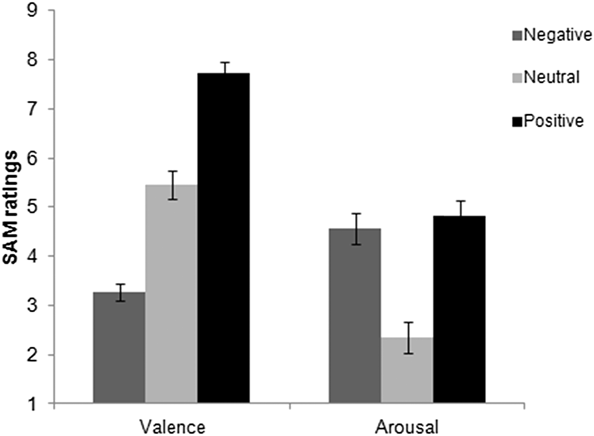
First, we performed two one-way ANOVAs to examine the effects of the emotional induction on valence and arousal ratings. The main effect of emotional condition was significant both for valence, F(2, 66) = 93.54, p < .001, η p Footnote 2 = 0.74, and for arousal, F(2, 66) = 17.33, p < .001, η p Footnote 2 = 0.35. Pairwise least significance difference (LSD) comparisons showed the expected pattern of results, with the positive group assigning higher valence ratings to images than both the control group, p < .001, d = 1.91, and the negative group, p < .001, d = 4.67. The two latter groups also differed between them, as ratings were lower in the negative group than in the control group, p < .001, d = 1.93 (see Figure 1). In addition, participants in both the negative and the positive groups rated the images as more arousing than participants in the control group, p < .001, d = 1.47 and p < .001, d = 1.58, respectively. However, no significant differences were found in arousal between the negative and the positive groups, p = .60; d = 0.16 These results indicate that participants in the positive and negative groups rated the images differently in terms of valence but not in terms of arousal, implying that the emotional induction may be considered effective.
Mean valence and arousal ratings for the images as a function of the emotion induced. Error bars represent ± standard error of the mean.

Effects of the emotional induction on moral judgments
In order to reduce variability, we computed the average rating across the eight vignettes of intermediate severity for each participant (see e.g., Amit & Greene, Reference Amit and Greene2012; Eskine et al., Reference Eskine, Kacinik and Prinz2011; Seidel & Prinz, Reference Seidel and Prinz2012, for a similar procedure) before conducting a mixed-design ANOVA with emotion as between-subject factor (positive, neutral, and negative), and kind of vignette (low, intermediate, and high severity) as within-subject factor. Mauchly’s test indicated that the assumption of sphericity had been violated, χ2(2) = 12.63, p = .002, therefore degrees of freedom were corrected using Greenhouse-Geisser estimates of sphericity (ε = .84). There was a significant main effect of vignette, F(1.69, 108.31) = 182.20, p < .0001, ηp Footnote 2 = 0.74, and an interaction between emotion and kind of vignette, F(3.38, 108.31) = 3.63, p = .008, ηp Footnote 2 = 0.10. The main effect of emotion was not significant, F < 1. In line with H1, pairwise LSD comparisons revealed that, for vignettes of intermediate severity, participants in the negative group were marginally more severe in their judgments than those in the control group p = .054, d = 0.60. Participants in the negative group were also more severe than those in the positive group, p = .002, d = 1.02, (see Table 1). However, differences between the positive and the control groups were not reliable, p = .196, d = 0.37, even though mean ratings in the positive group were higher at the descriptive level than in the control group (i.e., judgments were less severe in the former case). Therefore the data do not provide support for H2a, as judgments in the positive group differed significantly only from those in the negative group. Instead, the data are in line with H2b (i.e., they indicate that the positive emotion did not reliably affect judgments, for vignettes of intermediate severity).
Moral judgments of acceptability as a function of the emotion induced and type of vignette

Note: Minimum and maximum ratings for each item were 1 and 9. High ratings indicate moral acceptability (i.e., low severity); low ratings indicate moral condemnation (i.e., high severity).
Pairwise LSD comparisons also revealed that, for the vignette of high severity, the positive emotion was associated with an increase in the severity of judgments, as compared to the control group, p = .011, d = 0.75. No other statistically significant differences in judgments were observed as a function of emotional condition for the vignettes of high or low severity (ps > .1).
Overall, these results suggest that moral transgressions which are judged more extremely might be less sensitive to the effect of emotions. However, these findings should be interpreted with caution given the unexpected result that judgments were more severe in the positive group than in the control group, for the high severity vignette Footnote 4 .
General Discussion
In the present paper we examined the effect of emotions with both negative and positive valence on people’s judgments concerning a series of moral transgressions. Emotions were induced using positive and negative affective images specifically selected in an attempt to match their levels of arousal. In line with previous research (e.g., Eskine et al., Reference Eskine, Kacinik and Prinz2011; Schnall et al., Reference Schnall, Haidt, Clore and Jordan2008; Seidel & Prinz, Reference Seidel and Prinz2013), our results showed that the induction of an emotion with negative valence led to an increased severity in moral judgments, for vignettes that were not associated with extreme judgments. Additionally, our results indicated that an emotion with positive valence did not reliably affect judgments concerning such vignettes. Importantly, while the negative and positive images were rated differently in terms of their valence, they were matched in arousal as expected.
These findings contribute to shed light on previously documented differences in the effect of positive and negative emotions on judgments concerning moral transgressions. We reasoned that the effects of negative emotions documented in past work may have been determined, at least partly, by attentional and motivational processes linked to higher levels of arousal elicited by such emotions. However, our finding that moral judgments concerning vignettes of intermediate severity were not affected by positive images (that triggered levels of arousal similar to those triggered by negative images) suggests that this is likely not the case. Our findings also suggest that the failure to find a clear effect of positive emotions on moral judgments in past work is likely not linked to the specific methodology used to elicit emotions. It could be argued that visual stimuli may be more effective to induce emotions than tastes or sounds, or those images may increase the salience of some aspects of moral scenarios (Amit & Greene, Reference Amit and Greene2012). However, the use of arousing images as a means to induce both positive and negative emotions in our study yielded results in line with those observed in past work involving different induction methods. That is, our findings point to the notion that negatively valenced emotions are more prone to affect moral judgments than positive ones, regardless of the sensory modality employed for emotional induction.
In the present work we also conducted an a priori selection of vignettes based on psychometrical characteristics, as we reasoned that the degree of agreement with the actions described in the vignettes could potentially modulate the effect of emotions (i.e., vignettes which generally lead to extreme ratings might be less prone to be affected by emotions). Taking this into account, we selected vignettes for which moral ratings were near the mid-point of the scale and which led to a high variability in ratings. In addition, we included two vignettes where people often responded with ratings near the ends of the response scale and that were associated with little variability in participants’ evaluations. No reliable effects of induced emotions were detected for one of these vignettes, namely the vignette of low severity (i.e., that generally received high acceptability ratings). A possible interpretation of this finding is that moral transgressions which are judged more extremely are less sensitive to the effect of emotions. As an alternative explanation, the effect of emotions may simply be more difficult to observe in vignettes which are rated extremely, due to ceiling and floor effects. Unexpectedly, we also found that the positive emotion was associated with an increase in the severity of judgments concerning the vignette of high severity (i.e., that generally received low acceptability ratings). Firm conclusions cannot be established on the basis of this result, given that only one item with high severity was tested in our study. Future research testing a larger number of scenarios of similar nature is needed to determine whether emotions can indeed affect judgments for some moral transgressions that are generally associated with a high degree of consensus.
Finally, the current work also has some limitations and suggests new directions for future research. First, while our results contribute to the understanding of the effect of emotions on moral judgments, the precise mechanism underlying this effect remains unclear. One possibility is that the affective value of a moral scenario which, on average, does not produce a clear affective response may be “disambiguated” by the feelings (for instance, “gut feelings”) produced by the induced emotion (Damasio, Reference Damasio1994). Thus, participants may rely on the induced emotion when assessing the acceptability of the act described in the vignette, in a manner congruent with the valence of the emotion (i.e., less acceptable for negative emotions such as disgust). In this sense the emotion would provide a basis to find an answer to a question for which a clear response cannot be found, in a way similar to how affective heuristics operate: using affect to guide judgment and decision making (Schwarz & Clore, Reference Schwarz and Clore1983; Slovic & Peters, Reference Slovic and Peters2006). However, according to this account it is unclear why we failed to find an effect of the positive emotion on judgments for vignettes of intermediate severity. Alternatively, the induced emotion may produce an affective priming automatically (Musch & Klauer, Reference Musch, Klauer, Musch and Klauer2003), activating evaluative responses accordingly to valence, and affecting the conscious assessment of the moral situation. Investigating these issues is beyond the scope of the present research and methods. However, future research could seek to address directly these questions.
Second, the exact point at which emotions affect the process of moral judgment also remains undetermined. It could be the case that the emotion does not influence judgment, but the interpretation of the scenario, the evaluation of the outcome or the interpretation of the test question (Huebner et al., Reference Huebner, Dwyer and Hauser2009; Waldmann, Nagel, & Wiegmann, Reference Waldmann, Nagel, Wiegmann, Holyoak and Morrison2012). Future studies are required to shed light on this issue. Such studies could employ the questionnaire developed in the present study as it includes vignettes which have proven to be well suited to investigate the effect of emotions.
Additionally, here we focused on analyzing the emotional dimensions of valence and arousal. However, recent research has shown that different emotions with the same valence can have opposing effects on moral judgment (Strohminger et al., Reference Strohminger, Lewis and Meyer2011; Ugazio et al., Reference Ugazio, Lamm and Singer2012), stressing that aspects such as the motivational dimension of emotions must also be taken into account to fully understand the effect of emotions on judgments. Thus, future work should determine whether our findings hold for discrete negative emotions such as anger, or positive emotions such as elevation.
Finally, our participants were undergraduate students of Psychology, most of them young females. Previous studies have reported that females tend to be more severe when judging moral transgressions (Schnall et al., Reference Schnall, Haidt, Clore and Jordan2008), and that they are more sensitive to disgust than males (Haidt, McCauley, & Rozin, Reference Haidt, McCauley and Rozin1994). Future research should look for the generality of the present results varying the sociodemographic features of participants, such as age and level of education, and increasing the proportion of males in the sample in order to control for this potential confounding variable.
In summary, our findings provide evidence that negatively valenced images can have an effect on the evaluation of moral transgressions that are generally not associated with extreme judgments, while this is not the case for positively valenced ones. The finding that both types of images triggered similar levels of arousal supports the notion that this factor cannot account for the observed influence of emotions on moral judgments. The reason for which positive images did not affect judgments remains unclear, as does the question of whether naturally occurring positive emotions can have an effect. Future work investigating these questions holds the promise of uncovering key aspects of an issue which is ubiquitous in everyday life and which can have critical consequences, that is, our moral judgments concerning other people’s behavior.
Appendix
Moral vignettes questionnaire (Form A; translated from Spanish). Vignettes 4 and 10 were rated extremely in Study 1, with the highest and lowest severity respectively.
-
1. Daniel is traveling in a plane with his dog. The plane crashes into the mountain and the dog dies. Daniel buries the dog in the snow. He has enough water to survive a few weeks, but not enough food. Considering the possibility of starvation, he decides to eat the dog.
-
2. Lucy finds a wallet in the street with 300 euros in it. She has been unemployed for a couple of months. Judging from the credit cards it contains, and other details, she figures that the wallet belongs to a wealthy man. She decides to keep the money, yet return the wallet by mail.
-
3. Pepi and Mario are first cousins. They are traveling together during the summer. One night while they are alone they start touching each other and end up having sexual intercourse.
-
4. Diego is driving back home on a Friday night after having some drinks with his friends. He comes to an intersection but is too drunk to notice that the light is red. Diego crosses the intersection while the light is red and almost runs over a pedestrian who was correctly crossing the street. Diego arrives home safely without further incident.
-
5. Some years ago Carla was single and she went to visit a friend in Ibiza. She felt extremely attracted to a man who she knew was married. Carla danced with him as close as she could but she didn’t do anything else.
-
6. Toño used to work for the government. He used a laptop from the office, while at home, to do audits. After he left the job, he kept the laptop that belonged to the government.
-
7. Gonzalo was a soccer trainer for a school team. He frequently spent time with the kids’ mothers and he found some of them very attractive. Some of the women found him attractive as well. He slept with some of the women more than once.
-
8. Eugenia became pregnant for the second time. It was only 9 months after having her first son. She was financially incapable of raising two kids at this moment, so she decided to have an abortion.
-
9. Victor and his friends traveled to Eastern Europe during their graduation trip. One night they decided to go to a brothel. The women were very attractive and they didn’t charge much money for their services. Victor slept with one of them.
-
10. Teresa accepted a job offer in a company. But later she realized that the pay wasn’t enough for the amount of work she was doing. So she lied and told her supervisor that she had another job offer, and said she would take it unless they gave her a raise.