INTRODUCTION
Caridean shrimps (Decapoda: Caridea), especially members of the family Palaemonidae, include many species that associate with larger colonial invertebrates. Unlike in the Florida Keys and in the Caribbean Sea, SCUBA divers rarely see gorgonians (Cnidaria: Anthozoa: Gorgonacea) in shallow waters (30 m or less) in the northern Gulf of Mexico (from 25°N northward). Studies by a remotely operated vehicle (ROV) at the Flower Gardens Banks National Marine Sanctuary showed that gorgonians were generally found at depths of 50 m or more. No gorgonians have been reported from the coral cap of East or West Flower Gardens Bank (27°54.5′N 93°36.0′W and 27°52.5′N 93°49.0′W, respectively) or at less than 50 m at Stetson Bank (28°10.0′N 94°17.0′W) (E. Hickerson, personal communication). Rezak et al. (Reference Rezak, Bright and McGrail1985) collected only one gorgonian, Bebryce sp., at less than 50 m.
Four species of gorgonians have been found elsewhere in the northern Gulf at depths of 30 m or less. Leptogorgia virgulata (Lamarck, 1815) and Leptogorgia hebes (Verrill, 1869) may be found on shipwrecks and natural sandstone or limestone reefs in the area. Leptogorgia setacea (Pallas, 1766) commonly is cast ashore in Texas after storms. It attaches to polychaete tubes or shells in subtidal sand areas. Specimens of Leptogorgia euryale (Bayer, 1852) have been collected at 5.5–30 m in trawls in the northern Gulf (Texas Cooperative Wildlife Collection, unpublished records). Species of Leptogorgia are commonly called sea whips.
Observation and collection of gorgonians in the Gulf of Mexico are difficult. Colonies cast ashore are often in a very battered condition after passing through the surf zone. Any associated organisms are often dislodged. Observations in situ are difficult because of unpredictable conditions of high surf. Horizontal visibility in the water can be poor, less than 1.5 m. The discovery of large and easily observed gorgonian colonies off Mexico Beach, Florida, 29°56.9′N 85°25.1′W, provides an opportunity to study the gorgonian-associated fauna at close range.
The sea-floor in north-western Florida is mostly sandy, with a few natural limestone reefs occurring off Mexico Beach, Destin and Panama City. In 1997, the Mexico Beach Artificial Reef Association (MBARA) began installing old pipes, derelict ships, concrete rubble and fabricated concrete artificial reef systems to provide habitat for snappers (family Lutjanidae) and other fish. One of us (C.C.) began photographing the biota. When some colourful gorgonian-associated shrimps could not be identified, she contacted M.K.W. Some of the photographs were the first ever taken of the species in life. We compared records of gorgonian-associated species reported off Mexico Beach with other records from the dive log of M.K.W. and the specimen catalogue of the Texas Cooperative Wildlife Collection (TCWC) at Texas A&M University, College Station. These records and photographs give new details on the distribution and associations of these species in the northern Gulf of Mexico.
MATERIALS AND METHODS
One of us (C.C.) monitored marine life on artificial reefs off Mexico Beach from 2 July 2009 to 19 March 2011. Species of interest were photographed with an Olympus C5050 camera with two Inon UCL-165 close-up lenses in an Ikelite housing equipped with an Ikelite DS-125 strobe. During each SCUBA dive the species observed, especially game fish and lobsters, and water conditions, were recorded. Monitoring was required by the State of Florida to determine the durability and stability of artificial reefs and determine which designs and materials provide better or suitable habitat for fish. Information from the surveys was incorporated into an annual report from MBARA and shared with the United States National Oceanographic and Atmospheric Administration, Florida Fish and Wildlife Commission and other agencies. Details of the artificial reef programme are given at the MBARA website (http://www.mbara.org.). M.K.W., as part of the Texas A&M University Scientific Diving Safety Board, was required to dive frequently and made casual observations during exploratory and training dives. M.K.W. observed the carideans, molluscs and gorgonians at three sites off Mexico Beach during SCUBA diving on 23 October 2010.
Diving was dependent on conditions at sea. All diving was conducted with open-circuit SCUBA gear using air. The maximum depth reached during diving in the northern Gulf of Mexico was 40 m, the base of an oil platform off Texas. No gorgonians were observed during that dive.
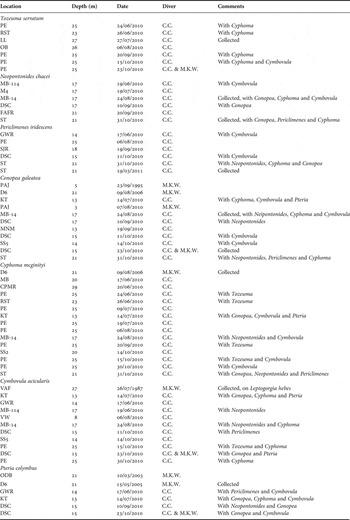
Photographs of gorgonian-associated fauna were scanned and compared with voucher specimens that were collected for each species mentioned herein. Specimens were deposited in the TCWC and at the California Academy of Sciences. All specimens were preserved in ethanol. The voucher specimens were identified by comparison with descriptions in the literature and with previously identified specimens in the collections of the TCWC. Notes made during the dive on 23 October 2010 were compared to notes and records made during other dives in the area by C.C., as well as records from M.K.W.'s diving log from the coast of Texas and the catalogue of specimens from the TCWC. A complete list of locations, depths and dates at which species were observed while diving (Table 1) is provided. Additional records from specimens at the TCWC are given in the text. Common names follow McLaughlin & Camp (Reference McLaughlin and Camp2005) and Tunnell et al. (Reference Tunnell, Andrews, Barrera and Moretzsohn2010).
Direct observations of gorgonian-associated species.

Note: ‘with’ indicates that the other species were seen during the same dive at the same site but not necessarily in close association with one another. M.K.W., Mary K. Wicksten; C.C., Carol Cox.
Key to locations with Mexico Beach reef numbers: CPMR, Charlie Parker Memorial Reef, MB 98, 28°43.0′N 86°32.5′W, 9 concrete pyramids; D6, ‘Deep Six’ wreck, 26°18′N 97°7′W, shrimp boat; DSC, Deep South Crane, MB 70, 29°53.44′N 85°31.74′W, 4 steel cylinders; FAFR, Fish America Foundation Reef, 29°53.6′N 85°32.6'W, 100 concrete reef balls; GWR, Garfield Wilson Reef, MB 114, 29°53.7′N 85°31.3′W, concrete rubble; KT, Kaiser Tug, MB 116, 29°53.9′N 85°31.0′W, wood and steel tug boat (broken); LL, Limestone ledges, 29°25.6′N 85°28.9′W, natural limestone reefs; MB, Marquardt Barge, MB 74, 29°53.5′N 85°32.4′W, steel barge; MB-14, un-named reef, 29°54.5′N 85°28.5′W, 35 reef balls; MB-91, un-named reef, 29°46.5′N 85°36.9′W, 4 concrete pyramids; MB-114, un-named reef, 29°54.5′N 85°28.5′W, 12 concrete pyramids; M4, Mixer no. 4, MB 22, 29°54.2′N 85°32.0′W, concrete truck drum; MNM, Mike Neal Memorial no. 1, MB 16, 29°53.9′N 85°30.7′W, steel cylinder; OB, OAR barge, MB 100, 29°46.1′N 85°36.7′W, inverted barge; ODB, Old Destin Bridge, 30°22′N 86°30′W, bridge wreckage; PAJ, Port Aransas jetty, 27°49.5′N 97°3′W, large rocks; PE, Progress Energy, MB 99, 29°47.1′N 85°42.0′W, shrimp boat; RST, Red Sea Tug, 30°1.0′N 85°42.0′W, sunken tug boat; SS2, Smurfit Stone no. 2, MB 65, 29°53.2′N 85°32.4′W, 4 steel cylinders; SS3, Smurfit Stone no. 3, MB 67, 29°53.8′N 85°32.6′W, 2 steel cylinders; SS5, Smurfit Stone no. 5, MB 69, 29°54.2′N, 85°31.7′W, 2 steel cylinders; SJR, Saint Joe Route, MB 39, 29°54.3′N 85°32.3′W, 100 reef balls; ST, Sherman Tug, 29°58.1′N 85°51.3′W, sunken tug boat; VAF, ‘V.A. Fogg’ wreck, 28°38′N 94°57′W, wrecked chemical tanker; VW, ‘Vamar’ wreck, MB 117, 29°54.0′N 85°27.8′W, scattered wreckage.
Positive identification of the gorgonians off Mexico Beach is pending. We believe that both Leptogorgia virgulata and L. hebes are present on the reefs, along with perhaps two other unidentified species. Unless otherwise noted, observations in life were of species associated with L. virgulata. Most records of specimens in the collections of the TCWC do not identify the host gorgonian. Jennifer Wheaton Lowry, Florida Department of Natural Resources, identified most of the gorgonian species reported in the catalogue of the TCWC. Frederick Bayer, United States National Museum of Natural History, identified a voucher specimen of L. hebes from Texas.
RESULTS
Species observed off Mexico Beach
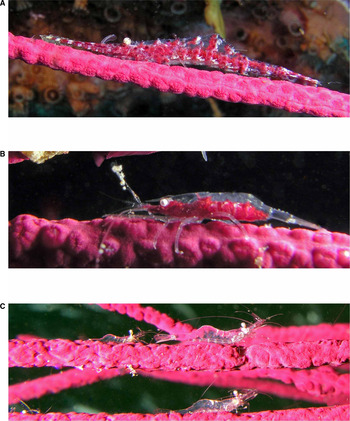
Three species of shrimp (Decapoda: Caridea) were found on or among gorgonians at Mexico Beach. The serrate arrow shrimp, Tozeuma serratum A. Milne Edwards, 1881 (family Hippolytidae) (Figure 1A) was the least common species found. This species has been reported to occur from Nonamesset Island, Massachusetts to Barbados, Colombia and Brazil (Christoffersen, Reference Christoffersen1982; Williams, Reference Williams1984). The specimens from Colombia were associated with an unidentified hydroid (Williams, Reference Williams1984).
Shrimp associates of gorgonians: (A) Tozeuma serratum, total length (TL) 20 mm; (B) Neopontonides chacei, TL 6 mm; (C) Periclimenes iridescens, TL 15 mm.

The only previous records of T. serratum in the Gulf of Mexico are a specimen taken in the north-eastern Gulf, 29°49.5′N 86°06.9′W, 44 m, 13 November 1965, (Chace, Reference Chace1972) and another taken from a fish stomach off Freeport, Texas, 28°57.2′N 95°21.6′W, 27 m, 4 March 1981, coll. Jeff Ross, TCWC catalogue no. 2-6412. The shrimp has a reported depth-range of 4.6 to 102 m, but all of the specimens found so far in the Gulf of Mexico lived at 23 m or deeper. Photographs taken at MB 99, Progress Energy Reef (hereafter called the ‘shrimp boat’) strongly suggest that at least one individual resided on the same colony of Leptogorgia cf. virgulata for nearly three months. At least two other individuals of this species were living on the shrimp boat and recognizable by their colour patterns. Two of these shrimp lived on a colony of an athecate hydroid. The shrimp were well camouflaged and rested parallel to the axis of each colony.
Chace's sea whip shrimp, Neopontonides chacei Heard, Reference Heard1986 (family Palaemonidae) (Figure 1B) rested parallel to the axis of the gorgonian colony. Smaller individuals were translucent but large ovigerous females had red pigment in the body as well as pigmented eggs. Sea whip shrimp did not live on the same colonies as T. serratum. Chace's sea whip shrimp has been reported from the Florida Keys to Carrie Bow Cay, Belize (Heard, Reference Heard1986).
Another species of the family Palaemonidae, Periclimenes iridescens Lebour, 1949 (Figure 1C) could co-occur with N. chacei on the same branch of a colony. This shrimp was also found at the bases of the sea whips. In the northern Gulf of Mexico, Williams (Reference Williams1984) mentioned a report of P. iridescens from off Panama City, Florida by Herbst et al. (Reference Herbst, Williams and Boothe1979). The material on which this report was based seems to have been specimens questionably referred to this species by F.A. Chace Jr of the United States Museum of Natural History. There are four additional specimens of P. iridescens in the collections of the TCWC, all taken off Freeport, Texas: 28°49.55′N 95°12.88′W, 15 m, 17 March 1981, coll. Jeff Ross, from the stomach of a rock sea bass, Centropristis philadelphica (Linnaeus, 1758), 1 specimen, TCWC 2-6409; and 28°44.51′N, 95°14.81′W, 21 m, 16 March 1981, coll. Jeff Ross, from the stomach of a rock sea bass, 3 specimens, TCWC 2-6410. All of the specimens from the fish stomachs are in a battered condition.
Periclimenes iridescens has been reported from north-east of Cape Hatteras, North Carolina; southern and north-western Florida, Bermuda, Tobago, Venezuela, the Atlantic coast of Colombia and Brazil (Christofferson, 1982; Criales, Reference Criales1984; Williams, Reference Williams1984). Heard & Spotte (Reference Heard and Spotte1991, Reference Heard and Spotte1997) noted that shrimp identified as Periclimenes iridescens actually comprise a species complex, so previous records and descriptions of species associations may be based on misidentifications.
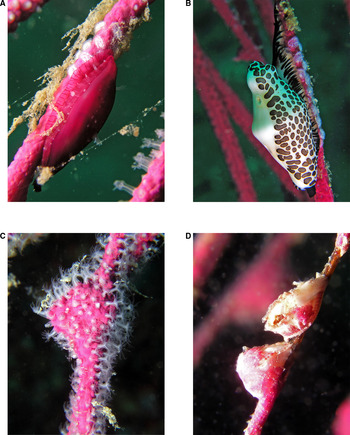
The barnacle Conopea galeata (Linnaeus, 1771) (Figure 2C) was observed on gorgonians at diverse locations off Mexico Beach and also on L. virgulata at two locations along the coast of Texas. This barnacle attaches to the axial rod of the gorgonian and can be covered over by the living tissue of the colony, leaving a knot-like protuberance. It commonly is cast ashore on L. setacea on sandy beaches from Port Aransas south to South Padre Island, Texas. The species has been considered to be cosmopolitan in distribution in association with gorgonians (R. Van Syoc, personal communication).
Mollusc and barnacle associates of gorgonians: (A) Cymbovula acicularis, total length (TL) 14 mm; (B) Cyphoma mcgintyi, TL 30 mm; (C) Conopea galeata embedded in gorgonians; (D) C. galeata exposed. Maximum dimension 8 mm.

The spider crabs Stenorhynchus seticornis (Herbst, 1788) and Podochela sidneyi Rathbun, 1924 (family Inachidae) commonly were found near the bases of the gorgonians but also on the surfaces of the reefs nearby. Both of these crabs have wide distributions: the former from North Carolina to Brazil and the latter from off Cape Hatteras, North Carolina to Veracruz, north-western Cuba and the Yucatan Channel (Williams, Reference Williams1984). There are numerous records of both of these species from the northern Gulf of Mexico. The former has been collected on natural rock reefs, breakwaters, and oil platforms and among corals, the latter on breakwaters and both natural and artificial reef. One female P. sidneyi, recognizable by its thick covering of white ascidians, was found in the same place on Reef MB-114 on 10 September 2010, 11 October 2010 and 23 October 2010.
Three molluscs lived in association with Leptogorgia virgulata off Mexico Beach. McGinty's cyphoma, Cyphoma mcgintyi Pilsbry, 1939 (Mollusca: Gastropoda: Ovulidae) (Figure 2B) was observed during 15 dives by C.C. and two by M.K.W. Tunnell et al. (Reference Tunnell, Andrews, Barrera and Moretzsohn2010) gave the range of this species as North Carolina to Florida, Texas, Bahamas and Bermuda. They stated that the species lives on ‘sea rods, sea pansies, and branched whip coral (Leptogorgia virgulata)’. One photograph from the shrimp boat shows T. serratum resting on the same branch as the cyphoma. Dive notes indicate that the cyphoma moved at least three times during a 3-month period but the shrimp remained in more or less the same place. This species has also been collected in the north-eastern Gulf of Mexico, 29°48.0′N 87°22.8′W, 40 m, trawl, 12 March 1988, Station D3-T1, coll. Donald Harper, TCWC 4-3611; at Seven and One-half Fathom Bank, 26°49.0′N 97°19.3′W, depth and collector not recorded, 25 August 1968, TCWC 4-4327; and six miles (9.7 km) off Mansfield Pass, Texas, 26°33′N 97°15′W, depth not recorded, 20 August 1993, coll. Jan Culbertson, TCWC 4-3637. Abbott (Reference Abbott1974) reported that the species was found at 12 fathoms (7 m) off Cameron, Louisiana.
The West Indian simnia, Cymbovula acicularis (Lamarck, 1811) (Mollusca: Gastropoda: Ovulidae) (Figure 2A) has been reported from North Carolina to south-east Florida, Texas, the West Indies and Bermuda, living on and eating sea whips, at 1–60 m (Tunnell et al., Reference Tunnell, Andrews, Barrera and Moretzsohn2010). The simnia was observed resting on the same branch of a gorgonian as N. chacei. Most simnias matched the colour of their host but one could, on occasion, find a ‘mismatched’ yellow one on a purple host or vice versa. It was also found in Texas on L. hebes on the north jetty at Mansfield Pass, 27°35′N 97°17′W, 3–5 m, 13 August 1984, coll. George Dennis, TCWC 4-2703; off South Padre Island, 27°15′N 97°20.3′W, on L. virgulata, 9.5 m, dredge, 12 October 1988, Ferrell Station 41, coll. Pamela Plotkin, TCWC 4-52400; outer beach at Padre Island National Seashore, 27°31.7′N 97°16.1′W, cast ashore ‘attached to sea whip’, winter 1960, coll. Anne Spears, TCWC 4-4530, 4-4531; and Seven and One-half Fathom Bank, 26°49.0′N 97°19.3′W, depth and collector not reported, 1 July 1964, TCWC 4-4328.
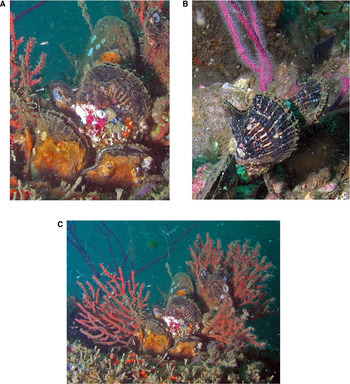
Colonies of Leptogorgia spp. off Mexico Beach and also in Texas had the Atlantic wing oyster, Pteria colymbus (Röding, 1798) (Figure 3A–C) attached to their branches. Tunnell et al. (Reference Tunnell, Andrews, Barrera and Moretzsohn2010) reported that the oyster has a range from North Carolina to Florida and Texas, the West Indies, Brazil and Bermuda. They stated that the oyster is ‘attached by byssus to gorgonian-type corals’. It also may attach directly to oil platforms (M.K.Wicksten, field notes). The wing oyster was also collected on a platform in the Buccaneer Field, 28°53′N 95°0′W (position approximate), 21 m, SCUBA dive, coll. Greg Boland, Station 76L-11, 26 August 1976, on L. virgulata, TCWC 5-1753. M.K.W. observed it along the south side of Roatan Island, Honduras, 16°21.5′N 86°26.5′W, 21 m, 9 January 2008, on an unidentified gorgonian; and at Klein Bonaire, Netherlands Antilles, 12°12′N 68°15.7′W, 20 m, 11 August 1994, on Pseudopterogorgia sp.
Atlantic wing oyster, Pteria colymbus, on gorgonians: (A) close-up view of oysters among Leptogorgia hebes; (B) oysters at base of Leptogorgia sp.; (C) habitat view of P. colymbus among L. hebes. Maximum dimensions 86 mm wide by 56 mm high.

Species not observed off Mexico Beach
At least three additional species of the family Ovulidae live in the northern Gulf of Mexico. Tunnell et al. (Reference Tunnell, Andrews, Barrera and Moretzsohn2010) reported that a single specimen of the flamingo tongue, Cyphoma gibbosum (Linnaeus, 1758) was cast ashore south of Bob Hall Pier, Padre Island, Texas. Another was photographed at approximately 90 m at the Flower Gardens Banks National Marine Sanctuary. They gave the range of this species as North Carolina to south-east Florida, Texas, the West Indies and Bermuda, but Abbott (Reference Abbott1968) reported this species to range to Brazil. There seem to be few reports of this species in the western and southern Caribbean. M.K.W. photographed this species at Paradise Reef, Isla Cozumel, Mexico, 20°28.8′N 86°57.4′W, 14 m, 20 August 1981, on Pseudopterogorgia sp. and Tormentos Reef, 20°27.4′N 86°59.9′W, 14 m, 20 August 1981, on Eunicea sp. and crawling freely along a small cliff near San Miguel, 20°30.3′N 86°54.9′W, 9 m, 18 August 1981. It was observed at La Ceiba Reef, 20°28.8′N 86°57.4′W, 9 m, 16 January 2001, on Gorgonia sp. M.K.W. also observed this species along the southern shore of Isla Roatan, Honduras, 16°21.5′N 86°57.4′W, 19 m, 8 January 2008, on Gorgonia sp.; and photographed it at Klein Bonaire, Netherlands Antilles, 12°12′N 68°15.7′W, 20 m, 11 August 1994, on Pseudopterogorgia sp. and also observed it there at 20 m, 6 August 1976, and at 18 m, 7 August 1996. There are four additional shells of this species at the TCWC collected on 1 January 1976, probably in the vicinity of North Padre Island, Texas but without data.
Tunnell et al. (Reference Tunnell, Andrews, Barrera and Moretzsohn2010) reported the intermediate cyphoma, Pseudocyphoma intermedium (Sowerby, 1828) (family Ovulidae) from Port Aransas, Texas southward at 0–128 m. They gave the wider range as Florida, Texas, the West Indies and Bermuda. There are five specimens in the TCWC: one each from the northern Gulf of Mexico off Alabama, 29°42.8′N 87°20.16′W, 100 m, trawl, 23 August 1988, Station D3-T1, coll. Donald Harper, TCWC 4-3610; and 29°48.0′N 87°22.8′W, 40 m, trawl, 12 March 1988, Station D2-T1, coll. Donald Harper, TCWC 4-3611; West Flower Gardens Banks, 27°49′N 93°50′W, 100 m, on unidentified white gorgonian, ROV, 28 September 2003, ‘Ronald Brown’ dive 41, TCWC 4-3118; Diaphus Bank, 28°5′N 98°42′W, 70–130 m, ROV, 29 September 2003, ‘Ronald Brown’ dive 42, TCWC 4-5232; ‘Mustang Island, Texas’, 27°40′N 97°10′W, depth and collector not reported, 4 October 1963, TCWC 4-4448; and Seven and One-half Fathom Bank, 26°49′N 97°19′W, the depth and collector not reported, 1 July 1964, TCWC 4-4328.
According to Tunnell et al. (Reference Tunnell, Andrews, Barrera and Moretzsohn2010), authors differ as to whether the sea whip simnia, Simnialena marferula Cate, 1973 is a distinct species from Simnialena uniplicata (Sowerby, 1849). The former is cast ashore on the sea whip Leptogorgia setacea from Port Aransas to South Padre Island, Texas, and has been reported only from Texas. The latter also can be cast ashore, and has a range from Virginia to Florida, Texas and Brazil (Tunnell et al., Reference Tunnell, Andrews, Barrera and Moretzsohn2010).
DISCUSSION
Identification of our tiny shrimp was difficult because there are no recent, well-illustrated guides to carideans of the north-eastern Gulf of Mexico. Our specimens of Tozeuma serratum and also the photographs of it clearly show the elongate, serrate margin of the rostrum, the frontal spines of the carapace and the form of the pereopods. These definitely distinguish our shrimp from any other species of Tozeuma or other species of the family Hippolytidae known from the Gulf of Mexico and adjacent regions. Two other hippolytids, Tozeuma carolinense Kingsley, 1878 and Hippolyte nicholsoni Chace, Reference Chace1972 have been reported to associate with gorgonians in the Florida Keys and the southern Gulf of Mexico (Voss, Reference Voss1956; Heard, Reference Heard1986; Hernández-Aguilera et al., Reference Hernández-Aguilera, Toral Almazán and Ruiz Nuño1996). Tozeuma carolinense lives among seagrasses in the northern Gulf of Mexico. Heard (Reference Heard1986) suggested that specimens of T. carolinense taken off Bahia Honda Key, Florida might be a different species but did not discuss the identification further. Hippolyte nicholsoni, which associates with Pseudopterogorgia americana (Gmelin, 1791), has been reported off Yucatan (Heard, Reference Heard1986; Hernández-Aguilera et al., Reference Hernández-Aguilera, Toral Almazán and Ruiz Nuño1996).
We originally identified one of our shrimp species as Neopontonides beaufortensis (Borradaile, 1920), previously reported from North Carolina to Panama and off Grand Isle, Louisiana (Dawson, Reference Dawson1963; Heard, Reference Heard1986). The description of two additional species, N. chacei Heard, Reference Heard1986 and N. brucei Fransen & Almeida, Reference Fransen and de Almeida2009 called into question whether previous identifications of shrimp as N. beaufortensis were correct. We compared our specimens to descriptions of all three species. Neopontonides brucei possesses dorsal teeth on the rostrum, absent in our specimens. Neopontonides beaufortensis has distinct protuberances on the distal flexor margin of the merus of pereopods 3–5, also absent in our specimens. Heard (Reference Heard1986) mentioned that he examined ‘a few specimens’ collected on gorgonians from the Florida Keys that ‘may represent new taxa or may be ecophenotypic variants of N. beaufortensis’, but ‘a larger series of specimens is needed to determine their taxonomic status’. We have been unable to examine specimens from Grand Isle. Based on our voucher specimens, the species off Mexico Beach most closely resemble N. chacei.
Species of Neopontonides are usually associated with gorgonians. The related N. beaufortensis specializes in feeding on gorgonians. It feeds on material on the surface of Leptogorgia virgulata or from inside the extended polyps (Patton, Reference Patton1972). Heard (Reference Heard1986) found N. beaufortensis on Leptogorgia setacea. Previous records of N. chacei are from Pseudopterogorgia americana. The two Pacific species of Neopontonides both associate with gorgonians, including Leptogorgia alba (Duchassaing & Michelotti, 1864). The host of N. brucei is not known (Heard, Reference Heard1986; Fransen & Almeida, Reference Fransen and de Almeida2009).
Periclimenes iridescens and related species can be distinguished either by use of existing keys based on morphology or by host specificity. Three recently described species from the Caribbean–West Atlantic closely resemble P. iridescens. Periclimenes patae Heard & Spotte, Reference Heard and Spotte1991 and P. mclellandi Heard & Spotte, Reference Heard and Spotte1997 differ from our specimens of P. iridescens in having simple dactyls on pereopods 3–5. Both species have been found on Pseudopterogorgia americana. Periclimenes colesi de Grave & Anker, Reference de Grave and Anker2009 has biunguiculate dactyls, similar to those of our specimens, but the rostrum is deeper than that of our specimens. Periclimenes colesi was found among sponges, not gorgonians. Our specimens most closely resemble ‘typical’ P. iridescens in morphology but are translucent, not iridescent.
We doubt that there is more than one species of either Neopontonides or Periclimenes present among the gorgonians off Mexico Beach. The north-eastern Gulf of Mexico is not as species-rich as the Florida Keys, approximately 710 km to the south-east. The artificial reefs off Mexico Beach have been in place for no more than 14 years. We were careful not to collect on sandy areas at the bases of the reefs, where other species of Periclimenes would be likely to occur. As suggested by Heard (Reference Heard1986), further morphological and genetic examination of an extensive series of specimens of Neopontonides spp. and the P. iridescens complex would be desirable to distinguish between distinct species and ecophenotypic variants of the same species.
Criales (Reference Criales1984) found Pseudocoutierea antillensis Chace, Reference Chace1972; P. edentata Criales, 1981; and P. conchae Criales, 1981 (family Palaemonidae) on L. virgulata off Colombia but these shrimps have not been reported in the Gulf of Mexico.
Based on our records, observations and the literature, Neopontonides spp., Conopea galeata, Cymbovula acicularis, Cyphoma mcgintyi and Simnialena marferula commonly associate with Leptogorgia spp. Neopontonides chacei has also been found on Pseudopterogorgia americana (Heard, Reference Heard1986). We found Tozeuma serratum on both Leptogorgia sp. and hydroids. We found Periclimenes iridescens both on and beneath gorgonians off Mexico Beach, and cannot state with confidence that it prefers to associate with them. Most observations on Cyphoma gibbosum in the Caribbean and West Atlantic were on gorgonians of the genera Pseudopterogorgia and Gorgonia, neither of which have been reported in the northern Gulf of Mexico. The gastropod must live on an alternate host in the northern Gulf. Pteria colymbus seems to be the least species-specific gorgonian associate of those we found, inhabiting a variety of species. The host of Pseudocymphoma intermedium is unknown.
Tozeuma serratum, N. chacei and C. acicularis are protectively coloured, matching their host. The latter two species, which feed on their host, probably acquire pigment from it. Periclimenes iridescens is translucent and difficult to see. Species of Cyphoma are brightly coloured, having an orange to pale-yellow mantle marked with conspicuous dots of black or black encircling orange. Their host species in the Caribbean include gorgonians known to contain compounds that are distasteful to fish. The bright coloration may serve to warn predators that they are distasteful.
It seems likely that the original settlers among the gorgonian associates arrived as planktonic larval stages carried on the Loop Current. The three shrimp species associated with the gorgonians have planktonic larval stages. Some species of cnidarian-associated carideans locate their hosts at a distance primarily by chemical cues (Guo et al., Reference Guo, Hwang and Fautin1996).
Species of Cyphoma and Cymbovula, like other ovulids, lay egg capsules on the branches of their host gorgonian (Abbott, Reference Abbott1968). The veliger larval stages hatch from these capsules and enter the plankton. These species are unable to crawl across great expanses of sand. Cyphoma gibbosum is the only species among the gorgonian associates that we have seen crawling on the sea-floor away from a gorgonian. Observations suggest that C. mcgintyi may move from host to host. During three different dives during summer 2010, C.C. observed a single Cyphoma mcgintyi on three different colonies of L. virgulata within 3 m of each other. This cyphoma was the only individual of its species on the entire wreck, which has a sparse population of sea whips.
Cyphomas and simnias may move from one colony to another in search of a mate. C.C. photographed mating pairs of Cyphoma mcgintyi and Cymbovula uniplicata on 14 July and 19 June, respectively, and a Cymbovula uniplicata laying egg capsules on a sea whip on 14 July 2010.
Gorgonians and their associated fauna may have a patchy or disjunctive distribution in the northern Gulf of Mexico due to physical factors. The near-shore waters of the northern Gulf are silt-laden, influenced by run-off from the Mississippi River and other rivers. Between Galveston and southern Texas a dense, saline layer of turbid water (the nepheloid layer) follows the sea-floor. The immediate coast of the northern Gulf of Mexico is subject to seasonal cold weather and infrequent ice storms, lethal to many warm-water organisms. Although there has been ample collecting by biologists from Texas A&M University in the vicinity of Galveston (29°20′N 94°43′W) and the Bolivar Peninsula north-east of there for over 40 years, the northernmost report of Leptogorgia setacea in Texas is a specimen cast ashore at Surfside, 29°2′N 95°11.3′W (TCWC 5-1827). Its distribution in western Louisiana and areas east of the Mississippi River is poorly known. M.K.W. collected it near Deep South Crane Reef off Mexico Beach. It is possible that this and other near-shore gorgonian species are absent from areas influenced by heavy flows of silt and fresh water.
Many gorgonians are hermatypic: they contain symbiotic algae (zooxanthellae) that are necessary for the growth of the gorgonian. Off Texas, one must travel 193 km from the shore, where the water is clear, to encounter hermatypic corals. The crests of the East and West Flower Gardens Banks are covered with hermatypic corals. Gorgonians at these banks live deeper than 50 m. Scouring by storms, competition for space with other species, and lack of larval recruitment may be responsible for the absence of gorgonians on top of these banks (see Rezak et al. (Reference Rezak, Bright and McGrail1985) for an extensive treatment of the location and environmental conditions of reefs and banks in the northern Gulf of Mexico).
The largest of the carideans associated with the gorgonians is less than 20 mm in length. Species of the Ovulidae are also small and often must be identified from features of the lower surface of the shell or living colour of the mantle. Without detailed close-up photographs and specimens, the species cannot be identified. Much of the historic collecting in the northern Gulf of Mexico has been with trawls, which can collect the larger gorgonians but not the tiny molluscs and crustaceans that fall through the mesh. If a diver is not looking carefully for the well-camouflaged and small animals living on a gorgonian, they will go unnoticed. Inability to collect or even see the gorgonians and their associated fauna likely has prevented biologists from studying their associations in life.
ACKNOWLEDGEMENTS
We thank Robert Van Syoc, California Academy of Sciences, for help in identifying the barnacles; Joseph Goy, Harding University, for information on larval settlement of symbiotic carideans; Emma Hickerson, Flower Gardens Banks National Marine Sanctuary, for information on gorgonians and their associated fauna; Kevin Strychar, Texas A&M University at Corpus Christi, for information on near-shore gorgonians, and Robert Cox of Port Saint Joe for underwater photography and serving as captain of the ‘Bob Cat’. We also thank two referees for helpful suggestions on additional references.