Background
Providing smokers with smoking cessation assistance is one of the core measures of quality of care delivered by healthcare systems (American Medical Association, 2012). Current recommendation by the United States Public Health Services (Fiore & Baker, Reference Fiore and Baker2011) is that healthcare providers assess tobacco use status of all their patients, provide at least a brief advice to all tobacco users, and assist those who are willing to quit with additional cessation services using the 5 A's model which consists of (1) Ask; (2) Advise; (3) Assess; (4) Assist; and (5) Arrange follow-up. However, adoption of the 5 A's in routine clinical practice has been slow (Fiore & Baker, Reference Fiore and Baker2011). Many providers accept responsibility for the first 2 A’s, (Ask, Advise) but resist the other 3 A's because they are time consuming and many providers do not feel they have the requisite counselling skills (Gordon, Lichtenstein, Severson, & Andrews, Reference Gordon, Lichtenstein, Severson and Andrews2006). To further facilitate the delivery of evidence-based smoking cessation services in clinical settings, an abbreviated version of the 5 A's known as 3 A's or Ask, Advise, Refer (AAR) has been recommended. The AAR model recommends the routine assessment of tobacco use status among all patients, provision of cessation brief advice to tobacco users, and referral to evidence-based tobacco cessation treatments such as tobacco quitlines that are available in all U.S. states. A slight modification of the AAR is the Ask, Advise, Connect (AAC) that replaces the ‘Refer’ with ‘Connect’ in which patients are linked to quitlines followed by a proactive call from the quitline (Shelley, Cantrell, Wong, & Warn, Reference Shelley, Cantrell, Wong and Warn2010; Vidrine et al., Reference Vidrine, Shete, Cao, Greisinger, Harmonson and Sharp2013). While the AAC model has been shown to increase smokers’ utilization of quitlines, the process is initiated following an encounter with the healthcare provider.
Quitlines can assist providers by assuming responsibility for the follow up calls to the smoker (Borland & Segan, Reference Borland and Segan2006). However, referrals to quitlines in primary care settings are low (Bentz et al., Reference Bentz, Bayley, Bonin, Fleming, Hollis and McAfee2006; Katz, Muehlenbruch, Brown, Fiore, & Baker, Reference Katz, Muehlenbruch, Brown, Fiore and Baker2002; Solberg, Maciosek, Edwards, Khanchandani, & Goodman, Reference Solberg, Maciosek, Edwards, Khanchandani and Goodman2006). Furthermore, although quitlines have demonstrated efficacy and real-world effectiveness (Fiore & Baker, Reference Fiore and Baker2011; Ossip-Klein & McIntosh, Reference Ossip-Klein and McIntosh2003; Rabius, McAlister, Geiger, Huang, & Todd, Reference Rabius, McAlister, Geiger, Huang and Todd2004) they reach less than 5% of smokers annually and they are generally geared toward smokers who are ready to quit (Borland & Segan, Reference Borland and Segan2006). Although up to 70% of smokers report they are interested in quitting at some point in future, only a much smaller proportion about 10% are ready to make plans to quit in the next 30 days (Hymowitz et al., Reference Hymowitz, Cummings, Hyland, Lynn, Pechacek and Hartwell1997). It is therefore not surprising that most smokers referred to quitlines do not utilize the program (Bentz et al., Reference Bentz, Bayley, Bonin, Fleming, Hollis and McAfee2006; Borland & Segan, Reference Borland and Segan2006). A program designed to increase the motivation of tobacco users to engage in cessation treatments could increase the utilization of quitlines by tobacco users otherwise not motivated to do so.
Motivational Interviewing is a method of therapy found to resolve ambivalence, enhance intrinsic motivation and promote confidence in a person's ability to make behaviour changes. Several studies have shown that MI has effected positive lifestyle changes, such as smoking cessation (Curry, Wagner, & Grothaus, Reference Curry, Wagner and Grothaus1991; Davis et al., Reference Davis, Shapiro, Windsor, Whalen, Rhode and Miller2011; Hettema & Hendricks, Reference Hettema and Hendricks2010). Current research demonstrates proactive telephone counselling is an effective method for smoking cessation (Barton, Reference Barton2011; Zhu et al., Reference Zhu, Anderson, Tedeschi, Rosbrook, Johnson and Byrd2002). A Cochrane review that included 77 trials that evaluated the effect of proactive and reactive telephone support via helplines to help smokers quit showed mixed evidence about whether increasing the number of calls altered the quit rates. A conclusion was drawn that three or more calls increase the chance of quitting compared to a minimal intervention such as providing self-help materials (Stead, Hartmann-Boyce, Perera, & Lancaster, Reference Stead, Hartmann-Boyce, Perera and Lancaster2013). However, little is known about the effectiveness of telephone counselling in unmotivated smokers. As an initial step to address this gap in knowledge, our study set out to determine if a three-session phone based MI intervention versus one time written materials (control) is successful at encouraging unmotivated adult smokers in primary care practices to utilize the Minnesota Quitplan helpline. Our primary hypothesis was that a significantly higher proportion of smokers receiving MI would enrol in the helpline than smokers in the control group.
As important as the primary care setting is to identify and engage smokers into a quitline, perhaps even greater challenge is to do so outside of a primary care encounter. Proactive identification and engagement of smokers across a healthcare system provides a unique opportunity to reach many more smokers, across the motivational spectrum, even in the absence of physician contact. The current study reports the findings from a randomized trial designed to compare two approaches for enhancing smokers’ engagement with the quitlines outside the healthcare system. Two novel components of the current study are engaging smokers who were (1) identified from a health system's database outside of a clinical encounter and (2) who may not be ready to quit smoking. Engaging smokers regardless of their readiness to quit outside of a clinical encounter addresses both clinic-level and patient-level barriers to dissemination of an evidence-based intervention by reaching patients in their natural environments and increasing their readiness to engage in treatment prior to the accessing the quitline services.
Methods
Study Design
This study was a two-group randomized trial of 235 adult smokers designed to compare the effectiveness of motivational interviewing counselling versus a one-time mailed printed quitline materials for Minnesota Quitplan Helpline. Prior to enrollment into the study, all participants provided written consent. All study procedures were approved and monitored by the principal investigator's institutional review board.
At baseline, participants were randomized to either the MI intervention or control arms. Participants in the control arm received one-time printed materials about the quitline by mail during the first three weeks after randomization. Participants in the MI intervention arm received the same printed materials and up to three weekly 15-minute MI sessions by phone during the first three weeks after randomization. The MI was focused on motivating participants to enrol in the Helpline.
All participants were asked to complete follow-up surveys by phone at week 4 and week 26 post randomization.
Participants, Screening and Randomization
Eligible participants were identified as smokers by a query of the electronic database of the fairview health systems (FHS) in the twin cities metropolitan area of Minnesota. The query was limited to patients who had a clinic encounter between January 1, 2008 and December 31, 2009 at any of the eight primary care clinics within the twin cities. Recruitment invitation packets were sent out to smokers in batches of 500 at a time by the health plan staff. Each packet included an informational mailing comprising of a fairview health systems letter notifying the patient about a voluntary research opportunity they may be eligible for, a letter from the research team briefly describing the study intentions emphasizing that they don't need to be ready to quit to participate, and a flyer with the study number to call if patient is interested in participating in the study.
Participants who called study staff back were screened over the phone for eligibility by trained staff. If the participant was found to be eligible, two copies of the consent forms and a baseline survey were mailed out to the participants with a business postage-paid return envelope. Participants were aged 18 years or older, smoked at least 100 cigarettes in their entire lifetime and have smoked cigarettes during the prior seven days, were residents of Minnesota, not planning to move out of state for the next six months, and had a working phone number. Smokers were eligible regardless of their readiness to quit smoking. Individuals were excluded if they or someone they lived with had ever enroled in the Minnesota Quitplan programs or any state-run smoking cessation services. Upon receipt of a signed consent and completed baseline assessment survey forms by the study team, the participants were contacted within 48 hours for randomization into the study. If forms were not received by mail within 10 business days, up to three reminder calls were made to the participants at varying times of weekdays and weekends. If there was still no response, no further contact was made with the potential participant.
Randomization occurred at baseline (week 0) on receipt of a signed consent form, a completed baseline assessment form, and successful randomization phone call. A randomization call is deemed successful, if participant answered the randomization phone call and confirmed continued interest for participation in the study. After a successful randomization, all study participants were mailed printed materials within 48 hours of the randomization call. The materials consisted of three Minnesota Helpline information pieces–a business card, a magnet and a colourful-glossy postcard, all containing the dedicated toll-free number for participants to access the Minnesota Helpline services, along with a unique study reference code. Those participants who were randomized to the intervention arm received a phone call from a study counsellor for a 15-minute MI session within a week post-randomization. Subsequent counselling sessions were then scheduled. The Helpline vendor provided the study coordinator with daily updates about participant enrollment in the Helpline through a secured website. Once enrollment was confirmed by the Helpline, participant did not receive additional MI sessions. Participants in the control group received one-time printed promotional materials only, similar to those received by the MI arm. All participants were contacted for phone-based surveys at weeks 4 and 26 to assess the use of the Helpline or other cessation aids, readiness to quit, quit attempts and smoking status.
Screening and recruitment started in February 2010 and ended in October 2010 when the study goal of enrolling 235 participants was met. The last 26-week follow up survey session was completed in April 2011. Participants were randomly assigned in a 1:1 ratio to either the MI group or control group using randomization schemes generated by our study's statistician. The random assignment used permuted block randomization with varying block sizes. The study's statistician provided the study coordinator with randomization assignments in sealed envelopes.
Each envelope was opened only after the participant was reached on the phone for the randomization call. To ensure balance in the intervention assignments between MI and the control groups, randomization was performed in permuted blocks, the size and sequence only known to the statistician. Participants were compensated $75 for returning a signed consent and completed baseline assessment; $25 for completing the week 4 assessments; and $50 for completing the week 26 assessment.
Intervention Components
Enroled participants were randomly assigned to either of the two study conditions, MI or control. All participants received one-time mailing of printed materials (a Quitplan magnet, business card and postcard) containing the toll-free number dedicated for the study to access the MN Helpline, along with a unique study reference code. In addition, those randomized to MI received up to three weekly 15-minute individual MI sessions during the first three weeks of the study.
MI was delivered by trained bachelors or masters level counsellors and each participant received MI from the same counsellor during the study. Prior to the start of recruitment, study counsellors were trained by a clinical psychologist (a co-author JT) using the principles adapted from the international MI network of trainers (MINT) manual (www.motivationalinterview.org) and with guidance from Miller's book ‘Introduction to Motivational Interviewing’ (Miller, Reference Miller1996). In addition study counsellors attended MI training sessions for at least 1.5 hours per month. Sessions included reviewing and rating recorded calls with participants under the supervision of a clinical psychologist (JT). The pro-active client-counsellor sessions lasted for about 10–15 minutes each. In order to address the specific needs of the participant, the counsellor assessed the participant's motivation and confidence for enrolling in the Helpline to help them quit smoking. For example, he or she asked the participant; ‘It would help me if I understood a little more about your current feelings about calling the Helpline. Is it OK if I ask you a few questions? On a scale of 0–10, where 0 is no interest and 10 is the highest level of interest, how interested are you in calling the Helpline this week?’ This was followed by queries to explore the participant's ambivalence with questions such as; ‘You said your interest was at 7, but you could have said 1 or 2. What influenced you to say 7?’ The focus on the MI sessions was primarily encouraging enrollment in the Helpline. Although MI has typically been used to build motivation to quit smoking (Hettema & Hendricks, Reference Hettema and Hendricks2010), we applied the principles and strategies to encourage enrollment in the Helpline.
If at any stage participants indicated that they were ready to call the Helpline, they were transferred (with their permission) to the Helpline number. No further MI sessions occurred after participants have called the Helpline. All MI sessions were audio-recorded and a randomly selected 10% sample of the tapes were reviewed and rated by a clinical psychologist for fidelity and consistency during the weekly supervision meetings with the counsellors.
Quitplan Helpline Services
The Minnesota Helpline vendor established a dedicated toll-free number exclusively for study participants to access the Helpline services. Participants were required to provide their unique study ID number they received at randomization when they called the Helpline. The Helpline staff documented the names and study ID numbers of smokers who enroled in the services and the type of services used. This information was provided to the project coordinator within 24 hours of participant's enrollment. This quick transfer of information was implemented to avoid providing additional MI (2nd or 3rd) sessions (after the initial MI call) to participants who had already enroled in the Helpline.
Measures
Measures Collected by Helpline Staff
Helpline staff documented calls and services they provided to study participants. They also documented the unique study identification code by each participant as well as demographics, e.g. age and gender. The unique study ID as well as age and gender data is used to match the data collected by Helpline with the rest of the data collected by the research study at the university study office.
Measures Collected by University Research Staff
Demographics: Age, gender, race/ethnicity, education, marital status, income, insurance, and employment.
Smoking history: At baseline, we collected data on the number of cigarettes smoked per day (CPD), age of regular smoking, number of quit attempts. At weeks 4 and 26 follow up surveys, we collected CPD, quit attempts lasting at least 24 hours since baseline, and seven-day abstinence defined as smoking no cigarettes in the seven days prior to time of assessment. These questions were derived from validated instruments that have been used in previous studies (Ahluwalia, Dang, Choi, & Harris, Reference Ahluwalia, Dang, Choi and Harris2002; Ahluwalia et al., Reference Ahluwalia, Okuyemi, Nollen, Choi, Kaur and Pulvers2006; Okuyemi et al., Reference Okuyemi, Thomas, Hall, Nollen, Richter and Jeffries2006; Okuyemi et al., Reference Okuyemi2007).
Nicotine dependence: Was assessed with the time to first cigarette of the day question from the Fagerstrom test of nicotine dependence. The single item saves time and has been shown to predict cessation outcomes in previous studies (Nollen et al., Reference Nollen, Mayo, Sanderson Cox, Okuyemi, Choi and Kaur2006; Okuyemi et al., Reference Okuyemi, Ahluwalia, Ebersole-Robinson, Catley, Mayo and Resnicow2003).
Readiness to quit: Was assessed using the one-item 11-point contemplation ladder (Amodei & Lamb, Reference Amodei and Lamb2004; Biener & Abrams, Reference Biener and Abrams1991). The ladder is anchored at the bottom with ‘0’ = ‘no thoughts on quitting’ and at the top with ‘10’ = ‘taking action to quit’. The scale is associated with cognitive and behavioural indices of readiness to consider smoking cessation. A modified version of the ladder was also used to assess participants’ readiness to call the Helpline, (on a scale of 0 to 10, with zero representing ‘no thought to call the Quitline’ and 10 being ‘ready to call’).
Use of other smoking cessation aids: In the weeks 4 and 26 follow up surveys participants were asked whether or not they have used other smoking cessation services apart from the Minnesota Helpline, including other quitlines (web and phone), behavioural programs, medications, or assistance from their healthcare provider.
Social influence: Was assessed by asking about smoking status of spouses, number of children under the age of 18 living with participant, household smoking restriction rules, and how much support they received from family or friends, if they were to decide to change their smoking behaviour.
Data Management
Surveys were completed in real time as the telephone based assessment was being conducted. Data was entered directly into REDCapTM database software (Harris et al., Reference Harris, Taylor, Thielke, Payne, Gonzalez and Conde2009) which was customized to do logic checks; in addition a second staff reviewed this information within 24–48 hours before submission as a completed participant survey.
Statistical Considerations
The sample size was determined a priori assuming a six month enrollment rate of 24.3% and 9.7% for participants in the MI group and control group (an enrollment ratio of 2.5), respectively, with a two-sided type I error of 0.05, and power of 80%. Power calculations indicated that 117 participants in each of the two study groups (total n = 234) would result in 80% power to detect statistically significant main effects using a two-sided continuity-corrected chi-square test. Categorical baseline variables were summarized by frequencies and percentages, and quantitative variables were summarized by mean and standard deviation (SD) for each group. Baseline categorical variables were compared using the chi-square test, and quantitative baseline variables were compared using the two-sample t-test. All statistical analyses were performed on an intention-to-treat basis. Seven-day point prevalence and continuous abstinence at weeks 4 and 26 were summarized using frequencies and percentages. The main outcomes analysis of the study used intent-to treat method, including each participant in the study conditions to which they were randomized. The main outcomes were enrollment in the Minnesota Helpline as reported by the Helpline staff at week 4 and week 26.
Results
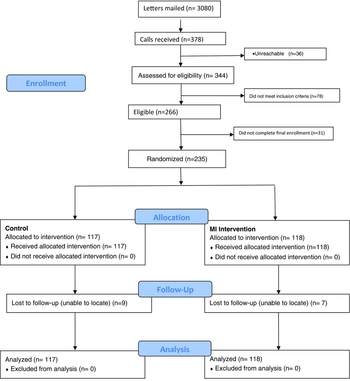
A total of 3,080 individuals identified as smokers were invited by mail from the health plan to participate in the study (Figure 1). Of this number, 378 (12.3%) called the study office to express interest in the study of which 91.0% (344/378) were screened for study eligibility, and 77.3% of those screened (266/344) were eligible. Two hundred thirty-five who returned signed consent forms were randomly assigned to either the MI or control conditions.
Study flow diagram.

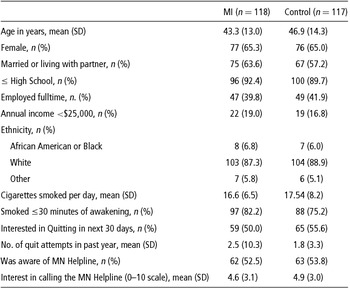
There were no differences in baseline characteristics of participants between the two study groups (Table 1). Participants had a mean age in the mid-forties, majority were female (65.1%), white (88.1%), employed (71%), married (42.6%) or living with significant other (17.9). Ninety-two percent had health care coverage of which 52.5% had this through their employer, 33.9% had Medicaid or other state administered public insurance, 16.1% had Medicare, and 6.9% had both Medicaid and Medicare. Participants smoked 17.1 (SD = 7.4) cigarettes per day and 47.2% reported they were not ready to quit smoking in the next 30 days. Fifty-three percent reported ever hearing about the MN Quitplan Helpline of which 7.6% knew that the MN Helpline offered free nicotine replacement therapy. Out of the 118 in the intervention arm 107 (90.68%) completed the first MI session; 75 (63.56%) completed the second session and 49 (41.53%) completed the third session. For the entire study population, 214 (91.1%) completed week 4 assessment and 219 (93.2%) completed week 26 assessment. Completion rates were similar for both study groups and there were no significant differences by demographic or smoking-related characteristics between completers and non-completers.
Baseline characteristics of 235 participants enroled in the study

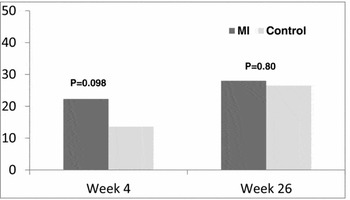
Figure 2 shows that using an intent-to-treat analysis using enrollment data provided by the Helpline, at week 4 follow-up, 22.3% of participants in the MI arm had enroled in the Minnesota Quitplan Helpline, compared to 13.6% in the control arm (p = 0.098). At week 26 follow-up, enrollment rates were 28.0% (33/118) for MI and 26.5% (31/117) for control arms. Enrollment data were based on documentation provided by the Helpline.
Enrollment in MN Quitplan helpline at weeks 4 and 26.

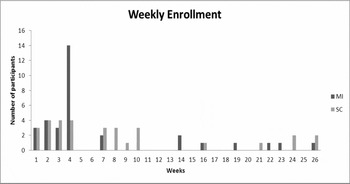
Figure 3 shows the weekly enrollment results by study conditions. Although not statistically significant, there was an increase in enrollment at week 4 in the MI group compared to the control group at the same time point. This may have been a non-specific effect of the intervention – i.e. it may have been the reminder phone call to schedule their MI appointment and not the MI per se that increased referrals at this time point. Of those who enroled in the Helpline, MI arm participants reported completing marginally greater number of Helpline sessions than those in usual care (4.9 vs. 3.2; p = 0.087). There was no significant interaction between readiness to quit and intervention for the outcome of enrollment in the Helpline. The self-reported seven day point prevalence quit rates at six months follow-up were 25.4% for the MI group 22.2% for the control group (p-value 0.617).
Weekly helpline enrollment by study conditions.

Discussion
The primary aim of this study was to determine whether providing motivational interview counselling by phone to patients outside of a healthcare setting would increase their enrollment in the MN QUITPLAN Helpline. Findings show that although MI had a marginal short-term benefit for enrollment in the Helpline, enrollment rates at six months were similar for both MI and control. While the primary hypothesis was not confirmed, it is notable that the enrollment rates for entire study population at six months (25%) were several folds higher than the prevailing ‘natural’ enrollment rate in the state at the time of the study (<5%). Perhaps more importantly is the finding that the minimal intervention consisting of one-time mailing of printed materials promoting the Helpline resulted in a five-fold increase in patients using the Helpline compared to the prevailing enrollment rate for smokers in Minnesota. If this finding is confirmed in other studies, it has a number of practical implications for both health plans and healthcare providers. First, an intervention consisting of one-time mailing of printed materials promoting the Helpline is not resource-intensive both in terms of staff time and monetary. Second, because the intervention reached out to smokers outside of the clinic setting, there were no disruptions of clinic schedule or patient flow. Third, because smokers were identified from a health plan database, the recruitment method was able to engage smokers who may not have regular contact with their healthcare providers and therefore less likely to benefit from clinic-based interventions. An alternative explanation for increased enrollment of participants in the control condition after week 4 is that the week 4 phone survey may have served as an intervention, although unintended, that prompted control participants to enrol.
Even if this were the case, it is remarkable that an assessment-only phone call resulted in increased Helpline enrollment. Another point to note is that since all our participants were recruited from within the health systems, these individuals could have been fairly high functioning individuals with access to healthcare, and as a result the written materials and the MI may not have made a significant difference. We acknowledge that our results may not entirely represent a sample of smokers that may not have health insurance.
Other studies have found that direct mailing may prompt smokers to call the quitline although response rates have been reported to be lower than other forms of media campaign (Bronar et al., Reference Bronar and Saul2009). In one study, two post-cards advertising the quitline and the availability of free nicotine patches were sent to 77,527 smoker households between August and October 2005. One postcard emphasized the effectiveness of the nicotine patch, whereas the other contrasted the risks of smoking and patch use. Results showed that the postcard campaign increased call volume by 36%, with no difference between the two postcard versions (O’Connor et al., Reference O’Connor, Carlin-Menter, Celestino, Bax, Brown and Cummings2008). However, another study that compared postcard mailing to no intervention and nurse phone counselling reported that nurse phone counselling resulted in higher quitline enrollment rate than postcards and that quitline enrollment rates were similar for postcards mailing and no intervention (Holtrop, Wadland, Vansen, Weismantel, & Fadel, Reference Holtrop, Wadland, Vansen, Weismantel and Fadel2005). The latter study only assessed quitline enrollment rates one month after the intervention. Because the study did not track enrollment rates beyond one month post-intervention, we do not know if enrollment rate for postcards increased later as we found in our current study which showed a doubling of enrollment rate for postcard between week 4 and week 26 post intervention. The study by Holtrop et al. also used a quitline nurse for the counselling which may have increased enrollment compared to a phone intervention from someone not affiliated with the quitline. Also, it is possible that the higher enrollment rate from counselling in the Holtrop study may have been due to their using an advice-oriented counselling technique in contrast to MI used in our current study. Results of studies on MI and smoking cessation have been mixed (Ahluwalia et al., Reference Ahluwalia, Okuyemi, Nollen, Choi, Kaur and Pulvers2006; Okuyemi et al., Reference Okuyemi2007; Okuyemi et al., Reference Okuyemi, Goldade, Whembolua, Thomas, Eischen and Sewali2013).
The current study has some limitations. One limitation is that participants self-selected into the study and this may have resulted in a sample that was more interested in quitting smoking or enrolling in the Helpline that the general population of smokers in the state. This limitation was somewhat mitigated by the study protocol that allowed participants into the study regardless of their interest in quitting smoking. Our baseline data showed that about half of study sample were not interested in quitting in the next 30 days. Another limitation was that smoking abstinence was only assessed by self-report with no biochemical validation. The primary outcome for the current study was enrollment in the MN Helpline which was measured by actual enrollment data collected by the Helpline. Smoking abstinence was a secondary outcome and using self-report is consistent with standard practice of tobacco quitlines.
In summary, a relatively low-resource intervention such as mailing printed materials promoting the Helpline yielded similar (greater than five-fold) increase in smokers’ utilization of a smoking cessation Helpline as a more resource intensive intervention like motivational interviewing counselling. Since, use of quitlines are a widely available and effective infrastructure for smoking cessation, we recommend that health plans and healthcare providers should consider using a low resource intervention such as mailing printed materials that contain clear smoking cessation promotional messages that encourage smokers to enrol in quitlines. This will ensure that more smokers receive evidence-based cessation intervention for reducing tobacco-related morbidity.
Acknowledgements
This work was supported by a grant from ClearWay Minnesota RC2007–026: and Cancer-related Health Disparities Education and Career Development Program (1R25CA163184). Special thanks to all volunteers who participated in this study.
Financial Disclosure
The authors have no financial disclosures to report.
Conflict of Interest
Authors have no conflict of interest.
Ethical standards
The study was approved and monitored by the University of Minnesota IRB.