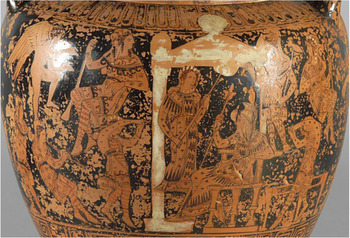
From the time they first encountered the military victories of Cyrus II in Asia Minor and first began to conceive of a powerful threat from the east, successive generations of Greeks fantasized, rhapsodized, feared, and scare-mongered about the delights and dangers of the Persians. We cannot underestimate the remarkable hold which the Persian Great King, his splendid and sophisticated court, and his vast and seemingly unending empire exerted over the Greek imagination. Greek art of the late Archaic period and throughout the classical age erupts with an plenitude of images that are intended to show the oriental otherness of the Persians, representing them as pampered playboys, absolute despots, or as effeminized, humiliated, and defeated combatants. Greek literature overflows too with references to all kinds of diverse Persian exotica: Persian-sounding (but fake) names, references to tribute, to proskynesis, law, impalement, the King’s Eye, good roads, eunuchs, gardens, concubines, drinking, and gold. Christopher Tuplin presents a useful catalogue of the Persians as seen through Greek eyes:
They … possess a large empire … whose … physical, floral or faunal characteristics are extremes of heat and cold, mountains, citrus fruit, camels, horses, peacocks, cocks, (perhaps) lions for hunting, paradeisoi, road systems measured in parasangs and travelled by escorted ambassadors and official messengers … There is great wealth … Persians are liable to pride, hauteur, and inaccessibility … They enjoy a luxurious life-style (exemplified by clothing, textiles, food and drink, tableware, means of transport, fans and fly-whisks, furniture) in a positively organized, regimented fashion: but the queens are sexually virtuous and sometimes energetically warlike … Their policy is defined by a tyrannical ideology and systems of deferential behaviour and hierarchical control which deny equality … [They] value mere power and are inimical to the principal of Law——except that there have been “good” Persian kings to whom some of this does not apply. Eunuchs will be encountered; and impalement or crucifixion is employed as a punishment.Footnote 1
Such representations helped to mold ancient Greek self-identity.Footnote 2 It is interesting to note that from the late Archaic age to the era of Alexander of Macedon’s conquest of the Achaemenid empire each successive generation of Greeks had its own particular way of reconfirming, as needed, national identity against the ever-changing yet ever-present external Persian threat. The infamous cultural construction of the Persian as barbarian has been best explored in its fifth-century context, but here I will concentrate on less familiar images of the Great Kings and their courts in fourth-century Greek sources, chiefly through the material evidence contained in vase paintings created (roughly) over a short period of fifty years between 380 and 330 BCE. These images drew on stereotypes of the Persians created in an earlier time, although they were softened and refined to make an adroit comment about a very different understanding of Persia in the decades following the Peace of Callias. The terror that the Greeks had so clearly felt during Xerxes’ invasion, which in itself resulted in two-decades’ worth of artistic images intended to belittle, humiliate, demean, and distance the Persian foe (the most notorious example of which is the so-called “Eurymedon vase” of c. 465 BCE), had been neutralized at the end of the century through increasing diplomacy, negotiation, and trade with the Achaemenid empire.Footnote 3 As a consequence, in the period 430–330 BCE, the artistic vision of Persia underwent a paradigmatic shift in style and purpose as the “barbarian” figure, devised through fear, confusion, and hostility, slipped into redundancy.
Encountering Post-War Persia: The Literary Landscape
Throughout the era of the Peloponnesian War and into much of the fourth century BCE the Persians remained central to the Greek world view. The Persians were still a military, political, and economic power and although they remained an uneasy presence in the Aegean, any immediate danger they presented to the Greek mainland had been suspended through peace negotiations and diplomatic exchange. But Persia was very much part of the fourth-century Greek cultural zeitgeist.
In literature the memory of the longstanding Persian involvement in Greek affairs continued to flourish and we know of several fourth-century tragedies with subjects set in the era of the Persian Wars: Theodectas’ Mausolus (72 TgrF T 6–7) and Moschion’s Themistocles (97 TgrF F 1) are cases in point. Moschion’s play certainly included a vivid description of a battle, echoing Aeschylus’ surviving Persai, and the Persian War narrative itself seems to have undergone what might be seen as a canonization process in tragic theater (as well as in oratory and historiography) during the fourth century. Lyric poetry also kept the image of Persia vital: apart from Simonides’ lyric poem on Salamis (fr. 536), by the close of the fifth century BCE Choerilus of Samos’ epic Persica was dealing in hexameter with Xerxes’ invasion, while in 410/409 BCE the remarkable Persai of Timotheus of Miletus received its premiere. This flamboyantly baroque concert aria for solo voice involved the performer imitating a host of Persians, from the pidgin-Greek speaking soldiery to the lofty lamentations of Xerxes himself. All in all, as James Horden perceptively notes, “the fourth century was … clearly a fruitful time … for Athenian interest in the [Persian] Wars,” and he suggests that the upsurge in poetic activity which centered around the wars can be explained by “the political difficulties experienced by Athens in their resistance to Macedon.”Footnote 4
In addition to tragedy and lyric, a particular vogue for Persica flourished in this period too, through the works of Ctesias, Deinon, and Heracleides (indeed, even parts of Herodotus’ Histories can be read as Persica too).Footnote 5 Persica is the name given to a particular field of Greek history writing which developed throughout the fifth and fourth centuries BCE; they are works written about the Persians and their empire at the time when the Achaemenid dynasty was ruling the biggest land empire the world had ever seen.Footnote 6 But the Persica focused their attentions not on the empire itself, but on the somewhat enclosed world of the Persian court. In fact, Ctesias’ Persica, the most influential of the genre, can be classified as a “Court History,” a style of history-writing that was perhaps current in Babylonia and the Levant in the later Achaemenid age and which centered on the affairs at the heart of government and, specifically, at the royal court.
As a consequence of the popularity of the court-centered Persica, the fourth-century view of Persia is, at best, one-sided and the realities of fourth-century Persian history are imperfectly understood. We do know however that the Persia of the late fifth to mid-fourth centuries was far from the moribund state depicted by Plato, Aristotle, Xenophon, Isocrates, and others, but nevertheless the image of the inevitable Persian slide from greatness into degeneracy was the standard trajectory of the most dominant Greek narrative.Footnote 7 Certainly the Epilogue of the Cyropaedia (8, 1–27) gives that impression, with its overarching desire to depict Persia at the nadir of its moral depravity, a technique achieved through the ruse of looking back to Persia’s brief Golden Age—the reign of Cyrus—and comparing that halcyon age with the moral and political bankruptcy of a contemporary Persia. “I maintain,” says the author (possibly Xenophon, but probably not), “that the Persians of the present day … are less reverent towards the gods, less dutiful to their kin, less upright in their treatment of men, and less brave in warfare than they were of old” (8, 27).Footnote 8 This topos is aired again in Isocrates’ masterful anti-Persian rant of 380 BCE, the Panathenaikos, where the easterners are cast as hostage to “lack of discipline, softness, servility, combined with arrogance, luxury and corruption.”Footnote 9 In a similar vein, but taking an even broader historical narrative sweep, in Book 3 of the Laws (c. 360 BCE) Plato reserves a relatively long exposition for Persian society (II, 639 c–698 a), dedicated by and large to a description of, and explanation for, its decadence and degeneracy. In a passage informed more by Greek prejudice than historical fact, Plato insists that “the Persians have failed to halt on the downward slope of decadence (truphē)” (697 c).Footnote 10
Greek Orientalist Art: Persia of the Imagination
Set against these literary constructions of the decadence of the Persian court and empire, the artistic vision of Persia created by the Greeks in the fourth century takes the fantasy of Achaemenid palace life to a new level of imaginary conjecture and offers some surprising evaluations of Persian culture. Of course, it is important to remember, as Margaret Miller emphasizes, that the 100 or so surviving images of Persians created by Greek artists “are not historical facts to be slotted into discussions of chronology or military history.” Rather they express how the Persians were conceived of in the ever-shifting Greek mind-set. She rightly notes that painters, “drew on a variety of sources to inform their rendering of the Persians: autopsy, artistic traditions for depicting other Easterners (notably Scythians …), and fantasy.”Footnote 11 Each of these facets are encountered with varying degrees of prominence in the vase paintings of 380–330 BCE, although I have little doubt that in addition to the three signifiers Miller identifies, the painted representations of the Persian court were also informed by the popular literary imaginings taken from tragedy, comedy, historiography, and political rhetoric. If we read the images as adjuncts to or, better yet, deviations from, the literary topoi, then we truly enter into the world of le roi imaginaire. In these artworks we are permitted access into the inner court of the Persian ruler and we encounter a rich mélange of subject matter and a heady mixture of themes: revelry, sport, slavery, power, riches, and sheer opulence—in brief, the Greek artists fixate on the most eye-catching of all the orientalist clichés.
The form of orientalism encountered in these vase scenes is not, however, of the Saidian sort; the ideology which created the Greek images does not operate around the nexus of power, dominance, and hegemony which Edward Said identified and promoted as his central thesis.Footnote 12 In fact, Miller has rightly observed that “the Orientalist discourse of classical Athens developed precisely to mask the real power structures.”Footnote 13 No, the particular sort of opulent visual orientalism encountered in the fourth-century vase paintings can best be understood by viewing them through Alain Grosrichard’s fascinating 1979 work Structure de sérail (published in 1998 in English as The Sultan’s Court), since he regards the supposedly enigmatic and opaque royal court as the locus classicus of the western fantasy of “Oriental Despotism.”Footnote 14 The figure of the eastern ruler and of his viziers, bodyguards, slaves, eunuchs, and countless wives and concubines is central to this visualization of the court as the ultimate phantasmal “Other” and, for his part, the eastern monarch is to be seen primarily as a “despot of enjoyment”; he consumes and even wastes an endless supply of desirables—women, food, wine, clothes, slaves, and even territories. For Grosrichard, “Oriental Despotism” is not a system of brute force, but in terms of fantasy it is all about the excesses of pleasure and obedience. This, I believe, is what motivates Greek orientalism for, as we now know, while the Greeks professed to despise the soft-living Persians and their luxurious empire, they nonetheless readily and enthusiastically adopted the trappings of that imperial system.Footnote 15 The fourth-century vase images of Persian court life are crafted through the eyes of inquisitive and aspirational outsiders; they are not critical of the Persians, nor do they lampoon the king or disparage the life of his court.Footnote 16 On the contrary, the images’ creation are motivated as much by the desire to own, enjoy, and indulge in the lifestyle they depict as they are by the inherent Greek need to express difference and diversity.
Undeniably some of the representations encountered in the vase paintings are informed by literary descriptions but others come from autopsy and the real-life experiences of the Greeks who encountered artifacts and images from the Persian empire as part of a lived reality.Footnote 17 How much these genuine Achaemenid products or motifs were understood and contextualized by the Greeks is open to debate, although I tend to be of the opinion that the nuances and intricacies of Persian culture were largely misunderstood or, more possibly, ignored. This offhand approach to the subtleties of Persian life resulted in some strange distortions of the Persian-created imagery as Greek artists reconfigured Achaemenid motifs and details and gave them a Hellenic spin (Miller neatly labels these follies “minor perversions”) which may reflect shifting ideologies or may simply be a product of a deep-centered artistic construct and language.Footnote 18
Picturing King and Court
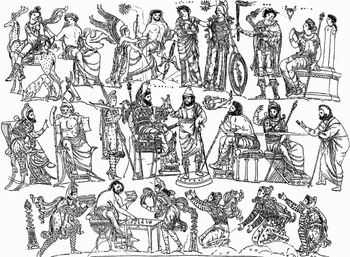
Let us start the investigation with one of the best-known fourth-century Greek renderings of the Persian court: an Apulian volute-krater known as the Darius Vase (Figure 1). Dated to c. 430 BCE, this huge and imposing vase, ornate in its intricate visualization of three registers of action, is typical of the orientalizing trend in the depiction of the luxury-loving Persians.Footnote 19 Edith Hall has suggested that it is in fact evidence for a splendid (but unknown) fourth-century play about the Persian invasion of 490 BCE. Certainly, a theater setting for the vase scene is plausible, but it would be short-sighted to limit it to only that context, and, of course, we must in no way think of it as a photographic record of a particular staging of some lost fourth-century tragic Persai.
Line-drawing of an Apulian volute-krater by the Darius Painter (‘the Darius Vase’).
Source: Museo Archaeologico Nazionale, Naples (H3253).
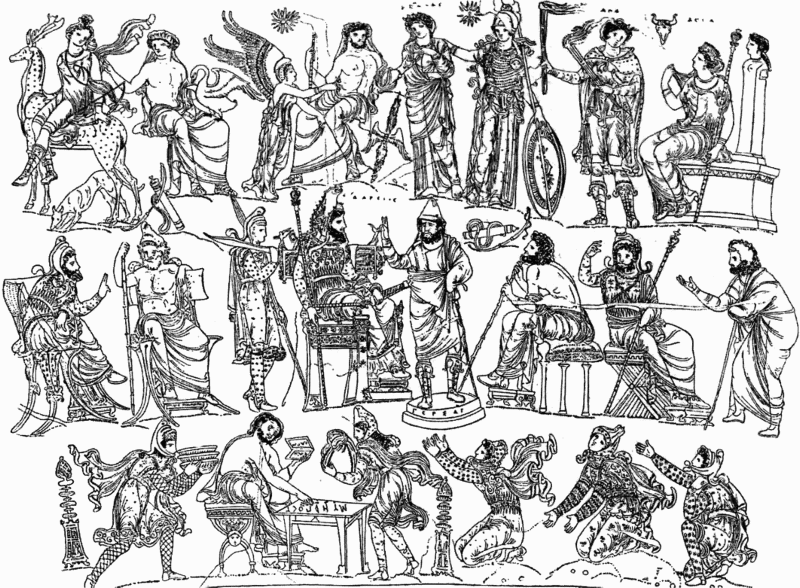
The center of the volute-krater shows the enthroned, named, and imperious figure of the scepter-bearing Great King Darius, who dominates the scene in his gorgeous patterned robes and with an elaborate kidaris (or tiara) crowing his head.Footnote 20 A messenger stands to his side (i.e. in front of the king; the artist is rendering three dimensions in a two-dimensional medium) and he holds up the fingers of his right hand as he makes a pronouncement. The round podium on which he stands bears the inscription PERSAI, which might refer to the title of the play or, more probably, to the location of the scene—the royal court in the city of the Persians. The messenger could well be a Greek, judging from his pilos and traveling cloak—the traditional get-up of the tragic messenger—although there is a possibility, of course, that he is a Persian messenger newly returned from Greece. His Greek clothing is not a cause for concern even if he is a Persian because in the topsy-turvy world of the Greek invention of the Persian court several of Darius’ councilors wear Greek himatia too. This is a familiar artistic conceit, and is even encountered in an earlier representation of a Persian king on a red-figure skyphos by (a follower of?) Douris (c. 450 BCE). No doubt based on genuine royal images of the so-called “archer-king” found on gold Darics, this ruler too is depicted holding a bow and a spear, but he wears a himation slung over his zig-zag-patterned trousers and his long-sleeved tunic; it is, of course, a fantastical ensemble and has no relation to actual Achaemenid dress-codes.Footnote 21
On the Darius Vase the Great King is flanked by an armed bodyguard holding spears and a scimitar, and he is attended too by a group of aged councilors, three of whom wear oriental costume; two of the courtiers appear to be especially perturbed or agitated and are in the thick of a debate, judging from their animated gesticulation and the body language they adopt. Several councilors lean forward into the scene, intent on listening. For his part, though, the Great King looks majestically aloof and calm.
Set in between two incense burners, the lowest register shows a royal treasurer seated at a low table (this cannot be another representation of Darius; the figure, in a Greek himation and short beard, is far too plebeian for that of a Great King). He is a royal treasurer or clerk (a representative of the monarch), counting pebbles and arranging them into correct columns as he tallies up on his wax tablet the value of the goods pouring in from the empire in the form of tribute, brought to the court by well-dressed satraps who appear before him: there is a sack of money (?) about to be placed on the table and some gold or silver dishes being proffered too. This will all help provide funding for the war effort against Greece. The three empty-handed satraps perform an elaborate obeisance; their gift-giving has already taken place.
Taken together, the two court scenes on the Darius Vase suggest, on the most obvious reading, a (highly imaginative) moment around 490 BCE when the Persians set themselves on the course for war with Greece. But the outcome of the war is preordained: the top register leads the viewer into the divine plane, and in an almost Homeric assemblage of Greek gods, paralleling the Persian war council below. Shapiro sensibly suggests that the Darius Vase presents a depiction of the clash of civilizations, played out in the opening decades of the fifth century BCE. The scene, with its “delusional air of unreality,” is a radical departure from the traditions of vase painting: “no other artist has attempted … to envisage a specific moment in the history of the confrontation between Persia and Greece,” Shapiro goes on to emphasize. I have suggested (elsewhere) that the conflict can actually be read on several layers and that the war-mongering Great King Darius can be read as any of the three Achaemenid monarchs who bore that throne-name.Footnote 22 Yet behind the complex narrative and multi-layered chronological possibilities, the vase scene is conceived of in an entirely Greek manner and depicts the Persians in a way that conforms entirely to their views of Achaemenid hierarchy. The Great King is socially superior and sits above his subjects’ heads, although a meaningful interaction between sovereign and councilors is suggested—an image drawn from Herodotus’ constitutional debate in Book 3 of the Histories, and other such Greek conceptions of the Great King in council. The middle register is, of course, a formal audience scene, while the lower register allows us to look at the workings of the imperial bureaucracy inside the palaces’ treasuries. The vase painter steers us towards believing that we are observing the complex working life of the Persian court.
In both registers many of the Persians wear what, at first glance, looks like Greek theatrical costume—sleeved and elaborately patterned robes and tall headdresses—but it is hard to verify if these are theater costumes per se: throughout the fifth century the Greek representation of Persians and other orientals blurred the reality of dress with the costume of the stage, so that it is impossible to accurately tweak out the pure imaginary from the deliberately theatrical. Generally speaking the Greeks expressed distaste for what might be perceived as “modification of body shape” through clothing: this can be seen in their attitudes to “barbarian” dress, and in particular the shaped garments (sleeved tunics and coats, as well as trousers and other forms of leg-coverings) of the Persians. Achaemenid cavalry dress (erroneously termed “Median” dress by the Greeks—an inaccuracy which still blights scholarship), for instance, consisted of a pair of trousers, a pair of anaxyrides (leather or suede “chaps”), and a sleeved tunic (ependytēs) long enough to be secured around the waist with a belt. The ensemble could be augmented with a coat with long hanging sleeves (kandys) often draped over the shoulders like a cape, sometimes fastened over the chest with ties. The Greeks were as much fascinated with this outfit as they were puzzled and repelled by it. According to Herodotus, in the period before Marathon the Greeks were terrified by the sight of Persian garb and it was the Athenians who “were the first Greeks … to endure seeing Persian dress and the men who wore it.”Footnote 23 Yet by the opening decades of the fourth century, the Persian sleeved coats and fitted trousers were regarded as “the most beautiful of all garments” and Xenophon was much struck by their splendor, noting (Cyr. 8.1.0):
Cyrus held the opinion that a monarch ought to excel his subjects, not only by being better than them, but by holding them under his spell. At any rate, he chose to wear the “Median” style of dress himself (i.e., the riding habit), and persuaded his followers to adopt it too because he thought that if anyone had a personal physical defect that this clothing would help conceal it and that it made the wearer look very tall and handsome.
The depiction of eastern costume (a word I use deliberately to contrast with “dress”) had been vacillating, shifting, and changing in the half century or so since the oriental first entered into the Attic artistic repertoire c. 520 BCE.Footnote 24 By the early fifth century a standard fantastical oriental costume had been created by Attic artists and the fully covered Persian body was used as a stark contrast to the heroic nakedness of the Greek.Footnote 25 In the later vase paintings, however, the shaped and highly decorated garments, so splendidly codified in the Darius Vase’s Great King, are admired for their exotic beauty and demarcate Persian luxury from Greek austerity.
However, I suggest that alongside the gorgeous robes and elaborate thrones depicted on the vase, there is a trace of the historically verifiable in the composition of the scene. Undoubtedly there are bone fide Achaemenid motifs located on the vase: the salaaming postures of the satraps in the lower register of the vase correspond neatly with figures found in a similar position on the base of a monumental Egyptian-style statue of Darius I from Susa; likewise the representation the spear-bearer behind Darius’ throne (looking very much at ease with his ankles crossed and a scimitar casually slung over his shoulder) is, to all intents and purposes, fashioned on bodyguards regularly depicted (but depicted upright and standing to attention) on Achaemenid brick-reliefs from Susa, or relief sculpture from Persepolis, and the Bisitun relief of Darius I shows the king accompanied by weapon-bearers. The throne and footstool of the king are also lifted from the genuine Achaemenid artistic repertoire.Footnote 26
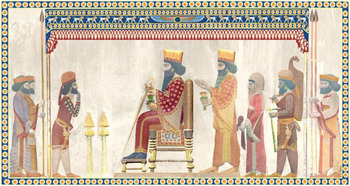
The Darius Vase’s Achaemenid-style motifs appear to have been taken from authentic Persian iconographic sources in an informed way, suggesting that Greek artists could be surprisingly au fait with centralized Persian royal imagery.Footnote 27 Indeed, the overall feel of the audience scene is fashioned after the royal audience scene motif, an intricate iconographical composition that was deliberately disseminated by the central authority throughout the empire in the form of painted stone reliefs (Figure 2), seals, gemstones, and other types of inlaid jewelry, and even in painted leather panels and woven textiles, such as those reported to have decorated Alexander III’s funeral catafalque.Footnote 28 It must have remained a well-known image throughout the lifespan of the Achaemenid dynasty because an unexpected detail taken from the “Alexander Sarcophagus” from Sidon (c. 325–311 BCE) depicts—inside a Persian soldier’s shield—an exact reproduction of the standard imperial audience scene.Footnote 29
Reconstruction of the audience scene relief from Persepolis.
Source: courtesy of Persepolis 3D.com

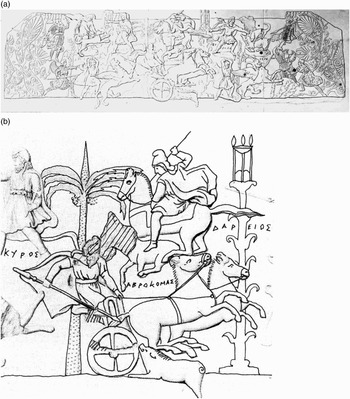
An interplay of genuine Achaemenid motifs and decidedly Greek visualizations of the Persian world are encountered in this important vase painting as it skillfully plays on important Greek constructions of “self” and “other.” The same strain is encountered on a relief scene on a squat lekythos of c. 380 BCE, signed by the Athenian artist Xenophantos (Figure 3). It is a fascinating fantasy, a riff on one of the most important features of Persian court life: the royal hunt in a paradisos.Footnote 30 The body of the lekythos is loosely divided into two registers: at the base of the vase a charioteer named Abrokomas delivers a death blow to a wild boar while above him, mounted on a white horse, a youthful looking Darius spears a wounded deer. To the left of Darius are a group of Persians: the bearded Cyrus holding an axe, moves towards his hunting dog which jumps up eagerly to greet him but is prevented from doing so by an unnamed page. To the left of Darius three Persians finish off another boar: the bearded Eurylaos aims his spear at it, Klytios (almost erased from the vase) thrusts his spear into its neck, and an unnamed youth awkwardly delivers a back thrust with his javelin. In the lower register, two hunters of two mythical beasts, a griffin and a horned lion-griffin, are named as Artamis and Seisames.Footnote 31
Line-drawing of a detail from the Xenophanes lekythos showing hunting scenes.
Source: St. Petersburg, The State Hermitage Museum P 1837.2.
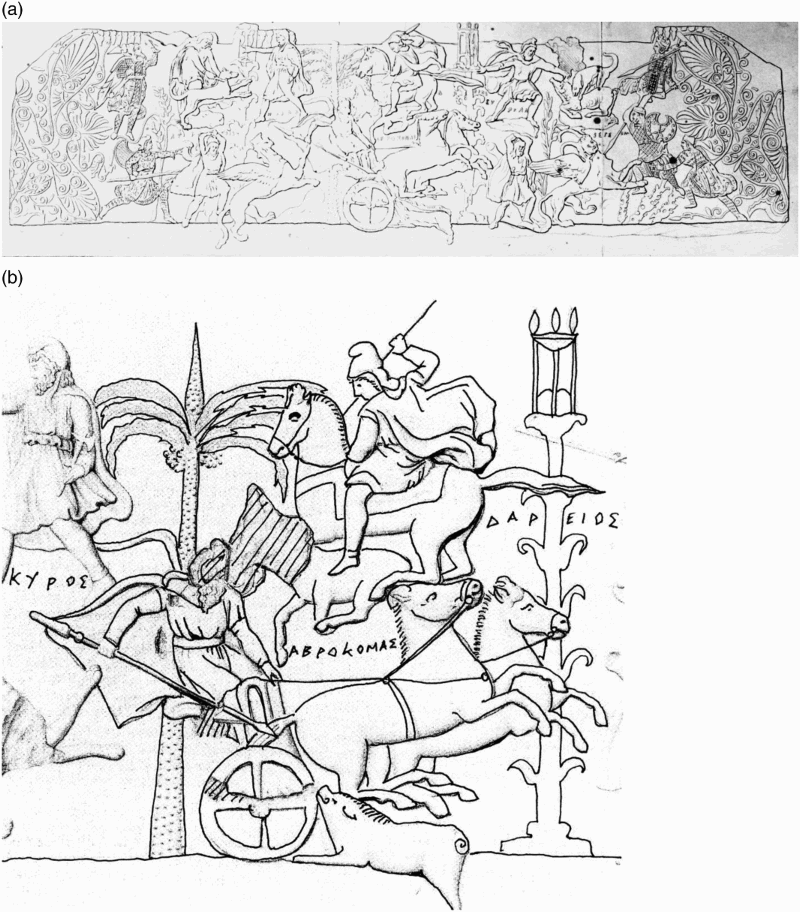
In this lively (if somewhat chaotic) scene the worlds of fantasy and reality converge. To achieve this Xenophantos employs some bone fide Achaemenid imagery within the picture, but toys with its use.Footnote 32 Many of the details of the hunting scene are derived from real Persian practices, which were well known to the Greeks of the fourth century, who seem to have developed something of a passion for stories of the royal chase in the great paradesoi of the empire.Footnote 33 The topos of the hunt had a lasting effect and is encountered time and again in the Greek novels of the late Hellenistic and early imperial eras. Chariton, for instance, loses himself in a voyeuristic fantasy-hunt in his novel Callirhoe when King Artaxerxes, dressed in Chinese silk and seated on a white horse, sets out to hunt lions:
Horsemen rode out splendidly got up, Persian courtiers and the pick of the army. Every one of them was a sight worth seeing, but the most spectacular was the King himself … He was an impressive sight in the saddle.Footnote 34
Some of the names of the hunting Persians on the Xenophantos lekythos are, of course, credible Achaemenid names: Darius and Cyrus are the names par excellence of the kings and princes of the Achaemenid royal house,Footnote 35 although the ostensibly Greek names of others hunters are out of place here. Michalis Tiverios suggests that they are Greeks in Persian service and therefore depicted wearing Persian court livery.Footnote 36 Certainly the hunters are easily recognizable as Persians and wear long-sleeved tunics over trousers; some also wear the kandys, a coat with hanging sleeves. They wear the kidaris on their heads. The appearance of the hunters on the Xenophantos lekythos are carefully constructed, which, together with their Persian names, leaves little doubt that they are supposed to represent Persian courtiers. It is likely that the names “Cyrus” and “Darius” would have either reminded the viewer of the earliest kings of the Persian past, those who first pulled Greece into the powerful Persian orbit, or else would simply have called to mind a generic image of rather fantastical hunting expedition of the “court of royal Persia.”
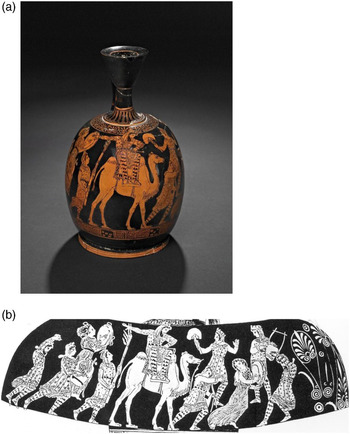
The court of Persia is encountered too on a red-figured lekythos (c. 370 BCE; Figure 4) which shows a procession.Footnote 37 Shapiro entertains the idea that the lekythos depicts Bendis or Sabazios or some other foreign deity whose popular cults erupted in Athens during the aftermath of the Peloponnesian War and that therefore the vase attempts to show the oriental origins of “the source of beliefs and practices that were now au courant in Athens.”Footnote 38 Certainly the embracing of exotic gods in this period is consistent with the vogue for enthusiastically welcoming many aspects of Persian culture into Athens—“everything from dress and drinking vessels to music, dance, and religious ritual.”Footnote 39 But I am less convinced that this is a religious pompē than one of a distinct kind of Persian spectacle; it shows the peripatetic court of the Achaemenid monarch on the move, a spectacle that had enthralled the Greeks for more than a century before this image was created. Many stories of the Great King on the move are to be found in the works of classical authors who seem to have a fascination for the notion of the peripatetic court and what it means for Persian identity. Some anecdotes tell of the enormous efforts undertaken to ensure that the ruler’s passage is both safe and smooth while others take an unexpected turn and depict the Great King as a kind and gentle recipient of humble gifts presented by the poorest people of the empire who turn out to see the royal progress pass by.Footnote 40 Greek authors display more awe than approbation for the nature of the royal progress, although one perverse expression of the Greek obsession with both Persian decadence and court nomadism is given voice by Aristophanes who conjured up an absurd fantasy wherein the Persian state en masse moved with the monarch merely to satisfy the king’s desire to empty his bowels, and the comic playwright subsequently pictures the ruler surrounded by his entire entourage defecating in the privacy of the mountains before returning to the royal place.Footnote 41
Attic red-figure lekythos depicting the Persian Great King on camel-back.
Source: Photograph courtesy of the British Museum.

The vase image is full of movement, life, and detail and easily captures the Greek fixation with Persian court-nomadism. It is full of detail, some observed from Achaemenid practices, although, as is always the case, many specifics are misread. In the center of the scene a well-crafted Bactrian camel is guided forward with a halter by a Persian who points forward, as if to the path ahead. He looks upward towards the rider, the Great King himself, who is sitting in a kind of howdah decorated with richly woven cloths and with a projecting foot-rest.Footnote 42 He cuts a dashing figure; his body is depicted front-on and his legs, resplendent in zig-zag-patterned trousers, are splayed apart as he balances nonchalantly between the camel’s humps, a short whip in one hand—used to spur the beast forward no doubt—while his right arm is outstretched to afford some balance perhaps as the camel lurches along. Miller suggests that the camel was “not an elegant or even prestigious mount: it was in fact the donkey of the east.”Footnote 43 But for the Persians the camel was a status-enhancing animal: camels are not native to Iran and were therefore considered exotica by the Achaemenids. At Persepolis, Bactrian camels are included in the representations of several delegations from the northeastern provinces of the empire as high-status gifts and single-humped dromedaries are depicted with the Arab delegation too. One seal-image shows the Great King in a chariot pulled by a team of dromedaries and another illustrates the Great King spearing a lion whilst seated on a dromedary, suggesting that camels could be used in the royal hunt.Footnote 44 Darius I certainly employed camel troops (ušabari) in his campaign against the rebellious Babylonians and large herds of camels belonging to Darius’ personal estate are attested in the Persepolis cuneiform texts being driven back and forth between Persepolis and Susa, following the route taken by the monarch.Footnote 45 Occasionally a king’s much-beloved camel is attested in the sources—like the fortunate one housed in the royal stables by Darius I.Footnote 46 This suggests that the camel was very much regarded as a prestigious animal fit for the monarch’s usage, in war, in sport, and in royal procession.Footnote 47
For his part, sitting on the camel’s back, the king cuts a dashing figure. His face is rendered in sharp profile; he is a handsome man. While the origin and significance of the tradition of the good-looking king is unclear, from early on Greek texts and images fixate on the body and looks of the Persian monarch and they take an obvious delight in his splendid appearance, making him into an attractive, albeit inherently despotic, ruler. In literature successive kings are noted for their handsome demeanor and their impressive stature (and coincidentally, a hallmark of Achaemenid art is that kings are made taller and more masculine than their subjects);Footnote 48 they are all “the most valiant of men” or “the best-looking of men” and their wives and daughters are equally beautiful—a “torment” for Greek eyes no less—and together Persian kings and queens are habitually tagged as being “the best looking in all of Asia.”Footnote 49 Of course, every prince and monarch aspired to match the standard of masculine good looks set by Cyrus the Great—his aquiline nose was allegedly the benchmark of beauty for generations of Persians: “Because Cyrus was hooked-nosed, the Persians—even to this day—love hooked nosed men and consider them the most handsome.”Footnote 50 In the vase painting, though, the king’s nose is straight and flawless—and very much the Greek conception of a handsome masculine profile.
As ever, dress, appearance, and accoutrements are important signifiers in this lively scene. Near to the king a clean-shaven attendant waves a fan. Another beardless Persian strums the kithara with a plectrum, another plays a chelys and a further smooth-cheeked individual holds (what appears to be) a flaming torch, although in all likelihood this, in its original Achaemenid context, is a fly-whisk. There is little doubt that these beardless individuals are eunuchs, the most fascinating of all the Great King’s courtiers as far as the Greeks were concerned. These castrated males served at court as high-ranking officials, bureaucrats, and attendants and as a kind of “third sex” they were able to negotiate the permeable barriers of the court in their crucial capacities as messengers and trusted body-servants.Footnote 51 Eunuchs are frequently attested in the Achaemenid sources carrying fly-whisks, towels, and perfume bottles and it is probable that they were fan-bearers and musicians too; the Greek artists are certainly able to imagine them as such and on the tragic stage Helen’s Phrygian fan-bearer is most probably based on a Persian court eunuch.Footnote 52
Alongside the eunuchs, the lekythos also represents female musicians—concubines, no doubt—and bearded courtiers dancing the so-called oklasma.Footnote 53 The world of the performing arts was an important part of Achaemenid court culture and we know of a courtly tradition for stories told though music from passing references to singers at the court. In the sources, royal concubines are expressly noted for their musical skills: “During dinner [the king’s] concubines sing and play the harp, one of them taking the lead as the others sing in chorus,” and we learn that “at night they sing and play on harps continually while the lamps burn,” which feasibly suggests that the court enjoyed a “complex and developed form of musical entertainment.”Footnote 54 Where there was music, there must have been dance, and we learn that the court was not only entertained by professional dancers like Zenon of Crete, “who was, by far, Artaxerxes [II’s] preferred performer,” but by the Great King himself, who during the feast of Mithra was encouraged to drink and then dance the so-called persica, a war-dance, by “clashing shields together, crouching down on one knee and springing up again from earth … in measured time to the sound of the flute.”Footnote 55 Dance, it seems, was both a courtly art and an expression of manliness, “for the Persians learn to dance as they learn to ride and they consider dance movements related to riding and very suitable for getting exercise and increasing fitness.”Footnote 56
While Benjamin Isaac agrees that the camel lekythos depicts an eastern court, rather than seeing the sophistications of the Achaemenid life which it articulates, he sees in it instead “a hotbed of orgiastic dissipation” which, in turn, reminds him of the salacious tales of Ctesias’ Persica.Footnote 57 In fact, actual decadence (in the sense of sexual license and debauchery) is hard to find in Ctesias’ work and neither his later epitomists nor critics ever cite him as an author with a particular penchant for the spicy or salacious; this is a modern misconception of his work. And no more is there anything scandalous or depraved to be found in the fourth-century vase paintings studied here: the royal court of Persia may be opulent, but it is free from any kind of lascivious carrying-on (a feature, in fact, even of depictions of the Great King among his women—which is in sharp contrast to the erotic imaginings of Greek literature which tends to fixate on the sex-life of the Persian king).Footnote 58 Even with the ubiquitous presence of eunuchs and concubines, the camel lekythos lacks erotic sensuality. It is rich in its evocations of joy and celebration, though, and I suggest that court festivity is the central theme here.
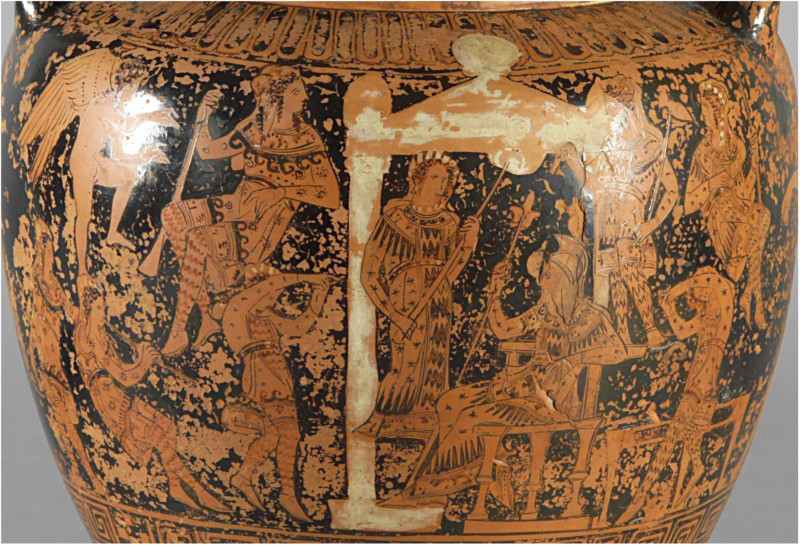
Eunuchs, concubines, and dancers are encountered again in a badly pitted if rococo-like Attic red-figure bell-krater of c. 370 BCE in which the scepter-bearing Great King, seated on his throne, enjoys the cavorting of his court dancers (Figure 5).Footnote 59 He sits within a naos, or some other shrine-like structure, which is surely a misinterpretation of the baldachin which covers the royal dais in the Achaemenid audience-scene and demarcates the royal space (Figure 2). The Persepolitan relief is closely echoed in a description by Deinon—“the throne … was gold, and round it stood four short golden posts studded with jewels; these supported a woven canopy of purple”—but the vase painter turns the throne and the canopy into a piece of theatrical paraphernalia, very much in keeping with the generic theatricalization of the Persians in this period which we have already encountered in the Darius Vase.Footnote 60 The scene, with its female fan-bearer (perhaps the beardless eunuch of the Achaemenid reliefs was thought to be a woman), its languid courtiers lounging around in opulently patterned costumes, and the heady atmosphere of pleasure conjured up through the twisting bodies of the dancers, is the finest representation of the vogue for peeping into the inner quarters of a Persian palace—Susa, Ecbatana, or Persepolis. Not surprisingly, the scene has been interpreted as the court of the luxury-loving Sadanapallos, the legendary Assyrian ruler, but given the close (if perverse) parallels with Achaemenid royal imagery, we can be confident that we are supposed to be ogling at the luxury of the court of the Great King of Persia.Footnote 61 The Persian court was a place of sophistication, culture, pleasure, and delight, although for the royalty and nobility who inhabited this rarefied world, the pleasures of court life was serious business too—as the Greeks understood all too well:
Tyrants and kings, being in control of the good things of life, and having had experience of them all, put pleasure in the first place, since pleasure makes men’s natures more kingly. All persons, at any rate, who pay court to pleasure and choose a life of luxury are lordly and magnificent, like the Persians … For more than any other men in the world they seek pleasure and luxury, yet they are the bravest and most noble barbarians. Indeed, to have pleasure and luxury is a mark of the freeborn; it eases their minds and exalts them.Footnote 62
Attic red-figure bell-krater depicting the Persian court, Vienna, Kunsthistorisches Museum 158.
Source: Photograph courtesy of the Kunsthistorisches Museum.
Closing Observations
The few works I have highlighted for discussion here may well be set within the Persian court, and may even draw on genuine Achaemenid visual motifs, but they have a distinctly laissez-faire Hellenic flavor to them, typical of other themes found in Greek art of this period. Without doubt the scenes of Persian monarchs and their courtiers, of women and eunuchs, of entertainers, camel-leaders, and even of the Persian elite relaxing, hunting, and dancing are very much in the spirit of classical Greek art. The Persian protagonists adopt decidedly Hellenized modes of behavior and, in a way, they are merely masqueraders in oriental fancy dress.
In bone fide Achaemenid art the kinds of pedestrian subjects encountered in the vase paintings are exceptionally rare and if they are encountered at all then they are seen only in small-scale glyptics but never in monumental imperial sculpture or relief.Footnote 63 The official art of central Iran tended to concentrate on representations of audiences and tribute-bearers, or on heroic images of monarchs fighting ferocious beasts and thereby reconfirming Achaemenid world order. There was no room in the official art of Persia for depictions of the minutiae of daily life at court because, as odd as this may seem given the centrality of the court to Achaemenid dynastic policy, such images would not have served the purpose of reflecting Persian imperial dogma.Footnote 64 The Greek vase images are as far removed from the artistic ideology promoted by the official centralized art of the Achaemenids as can be imagined.
There can therefore be little doubt to my mind that the Persian court we encounter in the Greek art is by and large a locale of oriental fabulousness; the images have a fairy-tale quality to them, a feeling of being set “Once Upon a Time in a Kingdom Far, Far Away.” As Alan Shapiro notes, “In one sense, they are descendants of the Persians of Aeschylus, with its imagined scenes of life at the Persian court, based on no first-hand knowledge … there is nothing ‘realistic’ about the scenes that appear to have a Persian setting.”Footnote 65 The scenes may nod towards oriental realia such as dress and equipment but even these are, at best, rudimentary. The Greek artworks must be regarded as important contributors to a long line of beautiful, if deeply misunderstood and precarious, orientalist clichés that permeate other Greek conceptions of the Achaemenid world.
Alain Grosrichard’s particular version of orientalism, with its focus on the supposedly enigmatic and opaque structure of a despot’s power echoed through his collection of fawning courtiers, eunuchs, countless wives, and concubines, finds a particular resonance, I suggest, in the Greek iconography of the late classical period which creates so vividly an “imaginative geography” of the East which is symbolized by the image of the autocratic but curiously compelling king and which is set amid the splendor of his court. Orientalist art of any kind, including that created by the Greeks, prioritizes visual pleasure and Persian scenes of the Greek imagination solicit the gaze. According to Grosrichard, the gaze is “the driving element of despotic power in the Orient” and in the vase scenes the viewer is invited to indulge in the pageantry and splendor of far-off Persia.Footnote 66 The picture created is of course an exotically fictionalized Persia of the imagination, a world in which all eyes are seduced into feasting upon the sights of the fabled hedonism of the royal court—the mandatory locale of all accounts of the Orient—but in no way should the scenes (even with their gender inversions and other types of distortions) be thought of as a caricature of the king and his court. The vase paintings do not lampoon the Persians, nor do they make any form of disdainful criticism of them in the style of, for instance, fourth-century Attic oratory. No, in spite of their errors, misreadings, and delusions, the Greek artists offer an “open sesame” to what they found to be a fantastical, puzzling, alien, but decidedly alluring world.