Humans often express their relationship to the natural world through the forms and symbolism of religious architecture. Scholars agree that temples in ancient Mesoamerica often were designed as metaphors for sacred mountains and served as stages for rulers to place themselves within the natural order of things. The relationship between landscape and architecture, one of the more prominent topics in Mesoamerican studies in the last half-century, has allowed scholars insight into ancient Mesoamerican worldviews and state religions.Footnote 1
Although there is evidence that Mesoamerican peoples conceived of their temples as sacred mountains at specific moments and sites in history—Mound C at La Venta, circa 600 b.c. (Reilly Reference Reilly and Kowalski1999), the Pyramid of the Sun at Teotihuacan circa a.d. 100 (Heyden Reference Heyden and Benson1981), or the Templo Mayor of Tenochtitlan circa a.d. 1400 (Broda et al. Reference Broda, Carrasco and Moctezuma1987; Schele and Kappelman Reference Schele, Kappelman, Koontz, Reese-Taylor and Headrick2001)—this is probably not true for all temples in Mesoamerica. Their forms and meanings varied through time and space, due to a range of factors such as available materials, the existing natural and built landscape, aesthetics, and local socio-political concerns. These latter two factors are extremely hard to recover archaeologically.
Ancient Maya architecture is ideal for a socio-historical study of temple variation, because it is the best-preserved architectural tradition in Mesoamerica and because archaeologists have uncovered artifacts and deciphered texts that span almost two millennia. In the 1970s, before Maya hieroglyphic texts could be read in any great detail, scholars approached variation in Maya architecture by charting regional styles, but these so-called regional styles now need to be reconsidered. For example, they defined the “Southern Lowland” regional style in part by its high-relief architectural sculpture and cited the ancient city of Copan in Western Honduras as the classic example (e.g., Gendrop Reference Gendrop1974; Kubler Reference Kubler1962a; Pollock Reference Pollock and Willey1965) (Figures 1 and 2). However, recent excavations indicate that façades in northern Yucatan also had high-relief architectural sculpture (Figure 3). A revised comparative study of Maya architectural design is in order and since the 1990s scholars have been calling for “an art historical analysis of stylistic interaction between sites” (Culbert Reference Culbert1991:345). They also have suggested that although scholars have identified temples, sweat baths, and ball courts, “additional work needs to be done to determine when and where such buildings appear and what their local attributes might be… the ways in which [they use] a vocabulary that was both universally Maya and simultaneously local” (Houston Reference Houston and Houston1998:520). The challenge is not only to better date and describe regional schools of architecture to understand how their appearance varied over time and space, but also to understand the reasons for these changes (Miller Reference Miller1999:6–7). Fortunately, it now is becoming feasible to examine the “whys” behind variation in temple design. Now that Maya hieroglyphs can be deciphered, and archaeological data is expanding, scholars are beginning to synthesize histories of the art and architecture of individual Maya kingdoms (W. Fash Reference Fash2001, Reference Fash, Andrews V and Fash2004; Fash and Stuart Reference Fash, Stuart and Culbert1991; Harrison Reference Harrison1998; Looper Reference Looper2003; Martin and Grube Reference Martin and Grube2000; Schele and Freidel Reference Schele and Freidel1990; Stuart and Stuart Reference Stuart and Stuart2008; Tate Reference Tate1992). It is slowly becoming possible to engage in closer analyses of the design, function, and meanings of certain buildings within their micro-historical contexts—that is, plus or minus just a few decades.
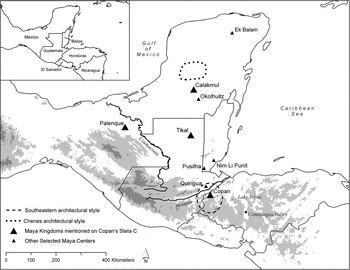
Copan and other Maya kingdoms mentioned in the text. Map by Heather Richards-Rissetto.

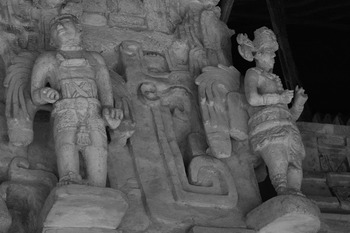
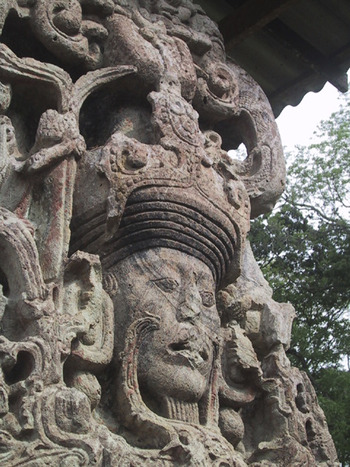
One of twenty Maize God sculptures from Temple 22, Copan (© The Trustees of the British Museum).

Detail from stucco façade at Ek Balam, Yucatan. Photo by author.

The micro-historical study of Maya architectural design has already been underway at the ancient city of Copan (Figure 4). Over 160 years of investigations have resulted in texts and archaeological data spanning five centuries and the dynasties of sixteen kings, and archaeologists now are able to date change in ceramics and architecture to within a few decades (for the most recent overview of research at Copan see Andrews and Fash [2004]). Relevant to the study of architecture, the Copan Mosaics Project (CMP), the Copan Acropolis Archaeological Project (PAAC), its sub-operations, and other projects have shown that architectural sculpture programs at Copan can be reconstructed and interpreted within a micro-historical context.Footnote 2 For example, the Popol Na or Council House at Copan has been interpreted to have been built by the sixteenth ruler of Copan in response to a challenging political situation (Fash et al. Reference Fash, Fash, Lane, Larios, Schele, Stomper and Stuart1992), while the House of the Bacabs has been interpreted to be the home of a scribe of one of the rising lineages that threatened the power of this very ruler (Webster Reference Webster1989). But what about the temple-like structures—buildings that scholars refer to as “sacred mountains?” What evidence is there for such “sacred mountains” in the Maya region, and can they be placed within a socio-historical context?
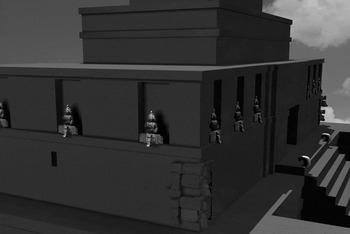
Reconstruction of the Principal Group of Copan with surrounding structures, as the architecture appeared in a.d. 820, viewed from the northeast. Sketch Up Model by Heather Richards-Rissetto.

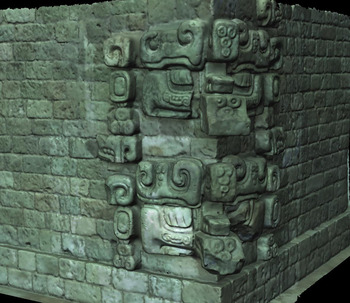
The building at Copan that scholars recognize as representing the Yax Hal Witz (“First True Mountain” or Creation Mountain) of Maya mythology (Freidel et al. Reference Freidel, Schele and Parker1993:149) is located high on the East Court of the acropolis of Copan. Called Structure 10L-22, or simply, Temple 22 (Figures 4–6), it was dedicated in a.d. 715 by the thirteenth king of Copan, Waxaklajuun Ub'aah K'awiil (known in earlier literature as 18 Rabbit) (Figure 7). Temple 22 has been lauded as the “single most beautifully executed” of all extant Copan structures (Miller Reference Miller, Boone and Willey1988:153). Relatively small as temples in the Maya area go (with a floor plan 25.5 × 11.5 m), it is perhaps best known for the detailed sculpture that frames the structure's interior doorway (Figure 8). This represents the Cosmic Monster (Milbrath 1999:275–283, Figure 7.5d; Schele 1992b:135–136; Stone 1985) or starry-deer-crocodile (Stuart Reference Stuart2005) with deer, serpent, and crocodile attributes. This symbolizes the sky—or perhaps more specifically, the Milky Way (Milbrath 1999:277–280; Schele 1992b:135–136)—that is held up by Pahuatuns or sky-bearers who hold up the four corners of the earth. Like this sculptural tour-de-force, the exterior façade bore an equally ornate sculptural program with almost 4,000 pieces and fragments of mosaic, stone sculpture that have led scholars to consider Temple 22 a masterpiece of Maya architecture (Freidel et al. Reference Freidel, Clancy and Harrison1990:147). Although Temple 22's façades are now collapsed and the sculpture is in collections around the world, the pieces are in good condition and the building has excellent archaeological and historical context. Since the 1980s, scholars have used Temple 22 to argue that Maya temples were symbolic mountains because its first story bears masks with the witz (hill) and tuun (stone) glyphs (Fash Reference Fash1992; Schele Reference Schele1987; Stuart Reference Stuart1987:17–23, Reference Stuart1997:15) (Figure 9), anthropomorphized maize figures (see Figure 2) (Spinden Reference Spinden1913:90), and an exterior doorway in the form of a fanged mouth, symbolizing a cave within the mountain (Figure 10) (Freidel et al. Reference Freidel, Schele and Parker1993:146–155; Schele Reference Schele1987; Schele and Freidel Reference Schele and Freidel1990:146–155; Schele and Miller Reference Schele and Miller1986; Stuart Reference Stuart1987, Reference Stuart1997). There has been ongoing debate, however, as to whether the building actually was a temple. Hypotheses vary from temple (Fash Reference Fash1991a; Reference Fash1992, Reference Fash, Andrews and Fash2005; Morales Reference Morales1997; Plank Reference Plank2003:261; Schele and Kappelman Reference Schele, Kappelman, Koontz, Reese-Taylor and Headrick2001; Schele and Miller Reference Schele and Miller1986; Spinden Reference Spinden1913; Taube Reference Taube and Houston1994, Reference Taube, Ruiz, Sosa and de León2002) to observatory for Venus and the Sun (Aveni Reference Aveni and Aveni1977; Closs et. al 1984; Morley Reference Morley1920:277–282; Šprajc Reference Sprajc1987), to royal residence (Baudez Reference Baudez and Webster1989; Miller Reference Miller1999:52; Sanders Reference Sanders and Webster1989) (for a more detailed survey of previous interpretations see Ahlfeldt [2004b:29–71]). This disagreement is partly because these studies had to rely on archaeological data and reconstruction drawings that employed less than one percent of the sculpture sample.
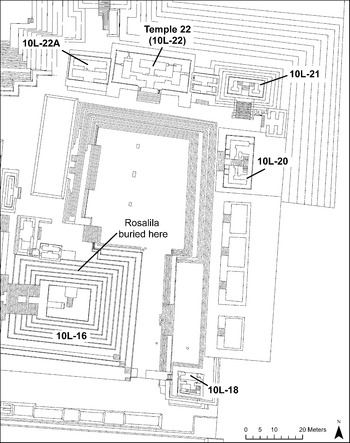
Plan of Temple 22 and the East Court. Graphic by Heather Richards-Rissetto (after Hohmann and Vogrin Reference Hohmann and Vogrin1982).

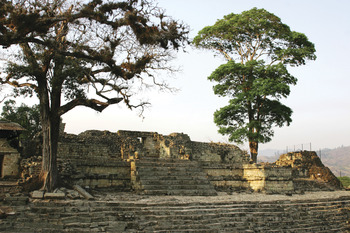
Temple 22 in its consolidated state today. Only the structure's platform and bearing walls of the first story remain. Photo by author (2008).

Stela B, Great Plaza, Copan. This stela is believed to be a portrait of Ruler Waxaklajuun Ub'aah K'awiil. Photo by author.

Reconstruction drawing of sculpture surrounding the doorway to the north room of Temple 22, based on the original sculpture now in the Copan Sculpture Museum. Drawing by Edgar Zelaya under the direction of the author.

View of 3D model of witz masks in the Copan Sculpture Museum that once decorated the corners of the bearing walls of the first story of Temple 22. Range data and 3D model realized by the 3D Optical Metrology research unit of FBK Trento, Italy.

Hypothetical reconstruction of Temple 22 by Tatiana Proskouriakoff (Reference Proskouriakoff2002:43), highlighting the serpent mouth doorway, corner masks, and maize god niches. Her reconstruction shows only one story.

Four archaeological projects over the last century have recovered close to 4,000 pieces of sculpture now attributed to Temple 22 and this unanalyzed material (as well as recent advances in archaeology and epigraphy at Copan and throughout the Maya area) demands a reinterpretation of the building's form and meanings. The most recent project, the PAAC, directed by William L. Fash of Harvard University (Fash Reference Fash1989, Reference Fash and Houston1998), contributed vastly to this corpus and the CMP, directed by Barbara Fash, catalogued the sculpture to conserve and analyze it (Fash et al. Reference Fash, Fash, Lane, Larios, Schele, Stomper and Stuart1992; Fash Reference Fash2011). In 1998 they invited me to continue the sculpture analysis and I have since directed the Temple 22 Façade Sculpture Analysis Project as a subproject of the CMP. I followed CMP methods to hypothetically reconstruct the building's façade sculpture, and to synthesize interdisciplinary data to determine the structure's significance (Ahlfeldt Reference Ahlfeldt2004a, Reference Ahlfeldt2004b) and began to explore the advantages of a digital reconstruction (Remondino et al. Reference Remondino, Gruen, von Schwerin, Eisenbeiss, Rizzi, Girardi, Sauerbier, Richards-Rissetto and Takase2009; von Schwerin et al. Reference von Schwerin, Richards-Rissetto, Remondino, Sauerbier, Eisenbeiss, Forte and Gruen2010, 2011).Footnote 3 In preliminary publications I also employed formal, stylistic, and construction analyses, and phenomenological and performance theory to locate this structure within the social and architectural history of Copan (Ahlfeldt Reference Ahlfeldt2004a, Reference Ahlfeldt2004b). A forthcoming excavation report by the PAAC project on the excavations of Temple 22 will include a more detailed report of the Temple 22 Façade Sculpture Analysis Project than can be presented here.
This paper summarizes what we have learned to date about the sculptural program of Temple 22 and analyzes it within the socio-historical context of eighth-century Copan—offering a case-study for how and why royal elites employed sacred mountain imagery in ancient Maya architecture. I show that during his reign (a.d. 695–738), king Waxaklajuun Ub'aah K'awiil was struggling to hold the kingdom together and that he commissioned Temple 22 as a response to his situation. This paper concludes that Temple 22 represented not only the sacred mountain of creation, but more broadly the fertile, ordered Maya universe—or kaan kab' (sky-earth)—peopled with the ruler, ancestors, and patron deities. I show how the building employed both ancient and innovative forms with a clarity intended both for Maya and non-Maya audiences, visually explaining the historical, mythical, and cosmic basis for Waxaklajuun Ub'aah K'awiil's reign to his eighth-century subjects as he sought to maintain Copan's power base on the southeastern Maya frontier. More broadly, this paper offers insights not only into Maya kingship and state religion at Copan in the early eighth century, but also moves the study of Mesoamerican temple design beyond structural interpretations as sacred mountains to show how and why this metaphor was used in one specific historical context. The reconstruction and interpretation of the Maya temple presented here offers a specific instance of how Mesoamerican elites used architecture as media to express their political agendas, and also how humanity's relationship to nature was conceived of and expressed at one moment in Mesoamerican history.
A SOCIAL HISTORY OF MAYA TEMPLE DESIGN
By “social history” I refer to that branch of art history influenced by the Marxist approach that examines circumscribed moments in the history of art, focusing on historical relations between artists, artworks, and institutions (for example, T.J. Clark's [Reference Clark1973] The Absolute Bourgeois: Artists and Politics in France between 1848–1851) (Hatt and Klonk Reference Hatt and Klonk2006). This is different from Appadurai's anthropological concept of the social history of objects (1986) in which an object goes through various states, at one time or another ending up as a commodity. While Appadurai's is a diachronic approach—looking at the change in meaning of a single object over time—in the discipline of art history, a social history of an object is a synchronic study that locates the object's significance within a particular socio-historical moment and context. This approach emphasizes that art (or architecture) does not simply reflect society, but can change society. A socio-historical inquiry of an object asks: “How is the object's design a product—and even agent—of the social, political, and economic conditions in which it was made?”
The relationship between historical context and architectural design has long engaged historians of Gothic cathedrals and Greek temples (e.g., Marconi Reference Marconi2007; Murray Reference Murray1989), and in the last decade, studies of elite architecture of the New World also have begun to take the social historical approach—although they have not named it as such. Edited volumes of studies of palace architecture, for example, have sought to identify palace forms and then to combine ethnohistoric, epigraphic, and archaeological data to infer ways that the forms and spaces of elite architecture express royal rhetoric (Christie Reference Christie2003; Christie and Sarro Reference Christie and Sarro2006; Evans and Pillsbury Reference Evans and Pillsbury2004; Inomata and Houston Reference Inomata and Houston2001). It has been shown, for example, that palace forms at different kingdoms and cities ranged widely in both Inka and Maya civilizations and that this variation in form reflected differing regional political strategies (Demarest Reference Demarest, Christie and Sarro2006; Morris Reference Morris, Evans and Pillsbury2004). As to the details of these political strategies, the recent developments in Maya archaeology, epigraphy, and archaeometric technologies now make a social history of Maya architectural design at individual cities a viable endeavor. See for example, the studies of royal architectural programs at Quirigua (Ashmore Reference Ashmore2007; Looper Reference Looper2003) or Copan (W. Fash Reference Fash1991a, Reference Fash, Andrews V and Fash2004; Freidel et al. Reference Freidel, Schele and Parker1993).
While most other socio-historical studies of Mesoamerican or Maya architecture focus on how building programs are built to send messages to people within the city or kingdom in question, I take a slightly different approach here in that I conceive of “context” more broadly—to explore the role Temple 22 played in Waxaklajuun Ub'aah K'awiil's, and Copan's, relationship to the broader southeastern Mesoamerican region—in particular the city's trading partners. I also build upon the results from a diachronic approach I took in a previous publication (von Schwerin Reference von Schwerin, Boschung and Blamberger2011), in which I examine the building as one “event” (Kubler Reference Kubler1962b), within a longer tradition of similar architectural events at Copan. This assists me in highlighting the temple's traditional and innovative aspects that in turn shed more light on the temple's significance to its eighth-century viewers. Finally, I seek to break down the static concept of Maya “pyramid-temples” by rethinking them in a socio-historical context, to consider how their design was part of a grander tradition with variation that might be explained by local factors. I am interested in the variation between royal temples specifically, but even the word “temple” needs to be defined and reconsidered (Ahlfeldt 2004b). Along these lines, Lisa Lucero (Reference Lucero2007) has suggested that more research needs to be made into the relationship between royal and community temples. To avoid entering this discussion here, I limit my focus here to a structure type that scholars believe often represented sacred mountains and caves—those with “zoomorphic portals” or “dragon-mouth entrances” (Gendrop Reference Gendrop1985; Schávelzon Reference Schávelzon, Robertson and Jeffers1980) (see Figure 2).
Among the buildings of this “serpent-mouth doorway” type in the Maya region, Temple 22 is one of the few that can be confidently designated as a royal structure, because its inscription, symbolism, location, and quality of construction indicate that it was linked to the royal dynasty. The building's inscription indicates that king Waxaklajuun Ub'aah K'awiil dedicated it on the katun (20-year) anniversary of his accession (Stuart Reference Stuart1986, Reference Stuart1989). Scholars have thus interpreted the structure as a symbolic gateway to the underworld that bore symbols related to ruler accession, where the ruler performed bloodletting rites (M. Miller Reference Miller and Benson1986, Reference Miller, Boone and Willey1988:170–171; Schele Reference Schele and Robertson1976; Schele and Miller Reference Schele and Miller1986; Stuart Reference Stuart, Benson and Griffin1988:204), perhaps related to cycles of maize agriculture and appearances of Venus (Aveni Reference Aveni and Aveni1977; Closs et al.Reference Closs, Aveni and Crowley1984; Fash Reference Fash2011; Morales Reference Morales1997; Šprajc Reference Sprajc1987). Abrams (Reference Abrams1994) showed that Temple 22 required more energy to build than any other structure he examined at Copan, further supporting the royal status of the building.
Here I examine specifically how this particular sacred mountain functioned as part of the kingdom's “ideological apparatus” (Patterson and Gailey Reference Patterson and Gailey1987). I am able to do this because research at Copan over the last few decades has provided a wealth of information to reframe Temple 22 and its patron's building campaign and political agenda within a micro-historical context. I use ideology here as other Maya researchers have used it, to indicate the set of doctrines the ruling elite project regarding the economic, political, religious, and social order of the world (Demarest Reference Demarest, Demarest and Conrad1992). It is clear that king Waxaklajuun Ub'aah K'awiil had an ideological program to convey, for when he ascended to the throne on July 6, a.d. 695 (9.13.3.6.8), he began to renovate Copan's urban center and was a prolific patron during the remainder of his forty-three year reign (Fash Reference Fash1991a). His most famous monuments are the stelae in Copan's Great Plaza (Newsome Reference Newsome2001). Excepting one (Stela C), none of these stelae were erected until the third decade of his reign. Rather, Temple 22 was dedicated at the end of the second decade of his reign on 9.14.3.6.8. (as were the East Court, and the other structures he dedicated—probably Structures 20 and 21 (Fash Reference Fash1991a:124)—and clearly laid out his agenda for a range of audiences.
COPAN (a.d. 715) AND THE KING'S AGENDA
The synthesis of published interdisciplinary data on early eighth-century Copan, and the broader Maya realm, that follows below indicates that when Waxaklajuun Ub'aah K'awiil dedicated Temple 22 in a.d. 715, Copan had reached the apex of its political and cultural expansion. I argue that as Copan's hegemony and the ideology of rulership was becoming more pronounced and yet increasingly problematic, the king was struggling to hold the city together and to stay abreast of current developments in Maya religion and aesthetics. The combination of both traditional and innovative forms found on Temple 22 is a clear response to these challenges.
When Waxaklajuun Ub'aah K'awiil acceded to power in a.d. 695, twelve successive Maya rulers had reigned at Copan for almost three centuries. Copan was an ancient city—a “city with a pedigree” (Miller Reference Miller1999:9)—established as the center of a Maya kingdom in the fifth century (Sharer Reference Sharer and Sabloff2003). As the thirteenth ruler, he inherited the legacy and prosperity of his father, Ruler 12, K'ahk' Uti' Witz' K'awiil—the longest ruling king in Copan's history—who had expanded Copan's territory in the southeastern Maya area (Canuto and Bell Reference Canuto and Bell2008; Fash 1991a; Looper Reference Looper2003; Schele and Mathews Reference Schele and Mathews1998; Stuart Reference Stuart1992). His father's influence as far north as southern Belize is seen at Pusilha, where kings adopted the names of K'ahk' Uti' Ha' K'awiil and his predecessor (Prager Reference Prager2002), or at Nim Li Punit where the kings wear the Copan turban headdress, and a ruler is named after a place name at Copan (Martin and Grube Reference Martin and Grube2000; Schele and Mathews Reference Schele and Mathews1998). In a.d. 695, Copan's population levels (estimates range between 8,000 and 15,000 people at this time [Webster et al. Reference Webster, Freter and Gonlin2000; Webster and Freter Reference Webster, Freter, Culbert and Rice1990]) and socio-political complexity indicate it was a state-level society that had deep and powerful ties with the Maya region to the northwest, and that it controlled the southeastern Maya region (Andrews and Fash Reference Andrews V and Fash2005; Fash Reference Fash1991a:112).
Despite this long period of control, Waxaklajuun Ub'aah K'awiil had the misfortune of taking the throne during a period of rapid growth, political reorganization, and consolidation throughout the Maya area (Fash 1991a; Sabloff and Henderson 1992), and his building program indicates his concern with the situation. In a.d. 695, in what has been called the “turning point in the history of the entire lowlands,” the twenty-sixth ruler of Tikal defeated his rival city of Calakmul, thus shifting the balance of power throughout the Maya region (Martin and Grube Reference Martin and Grube2000; Grube Reference Grube2001:168). This volatile period continued throughout Waxaklajuun Ub'aah K'awiil's reign, to the final capture of the king of Calakmul in a.d. 736 and the defeat of his dynasty. His building program must have responded to these changes—one example of this self-consciousness is Stela A, which Waxaklajuun Ub'aah K'awiil dedicated in a.d. 731. Its text cites four cities: Tikal, Calakmul, Palenque and Copan, thus asserting Copan's foundational place in lowland Maya civilization (Marcus Reference Marcus1973:912–913, Reference Marcus, Sabloff and Henderson1993:150).
Waxaklajuun Ub'aah K'awiil continued Copan's hegemony over the site of Quirigua and the lower Montagua valley by installing the Quirigua king K'ak Tiliw Chan Yoaat in a.d. 724 (Martin and Grube Reference Martin and Grube2000:203). One reason for Copan's interest in this region seems to have been economic—Copan likely benefited from the increased demand, production, and trade in precious goods that served the expanding elite class (McAnany Reference McAnany, Sabloff and Henderson1993; M. Miller Reference Miller, Sabloff and Henderson1993). Copan's reign at Quirigua may have been established in the fifth century to control trade in jade from sources along the Motagua river (Fash Reference Fash1991a), the feather trade from the highlands (Coggins 1987:98–109), as well as in Ixtepeque obsidian from the Guatemala highlands. The trading patterns of Ixtepeque obsidian have been traced along the Motagua River to the Caribbean, up the Belize coast, and then around the Yucatan peninsula, reaching as far away as the Chenes region (Aoyama Reference Aoyama1999; Gonzalez de la Mata and Andrews Reference González de la Mata, Andrews, Schmidt, de la Garza and Nalda1998). These trading routes were also conduits for architectural ideas and religious ideologies and may explain similarities between Copan and Chenes-style architecture to the north (Proskouriakoff Reference Proskouriakoff1963), and to sculptural styles in the Guatemalan highlands (B. Fash Reference Fash, Bell, Canuto and Sharer2004). Copan was interacting with Maya polities to the northwest and so we can conclude that Waxaklajuun Ub'aah K'awiil commissioned Temple 22 in part to assert Copan's central identity within the Maya region.
Copan was a frontier kingdom, however, and during Waxaklajuun Ub'aah K'awiil's reign, Copan was janus-faced, looking to objects and ideas from the Maya lowlands and exporting these to non-Maya areas towards the southeast. Copan was a distribution center, a gateway city (Fash Reference Fash1983, Reference Fash1991a; Fash and Stuart Reference Fash, Stuart and Culbert1991). By the time Waxaklajuun Ub'aah K'awiil took power, Copan was peaking in its control of the southeastern Maya region, and had shifted economic and political relations to the non-Maya areas of interior Honduras, western El Salvador, and the middle Montagua basin. Cultural interaction with these areas peaks around a.d. 700 and is visible in ceramic trade (Demarest Reference Demarest, Boone and Wiley1988; Fash Reference Fash1991a; Longyear Reference Longyear1952; Viel 1993), architecture and site planning (Ashmore Reference Ashmore and Pahl1987, Reference Ashmore2007; Canuto and Bell Reference Canuto and Bell2008; Schortman et al. Reference Schortman, Urban and Ausec2001:315; von Schwerin Reference von Schwerin2010), in the adoption of stone stelae at several sites in Honduras (Nakamura et al. Reference Nakamura, Aoyama and Uratsuji1991), and in the appearance of Maya motifs on local polychrome ceramics (Beaudry 1983; Beaudry et al. Reference Beaudry, Henderson, Joyce, Henderson and Beaudry-Corbett1993; Hirth Reference Hirth1998:297; Joyce Reference Joyce and Graham1993). A non-Maya audience made up much of Copan, for household artifacts show little connection to Maya culture, and are like those found in Comayagua and the Lake Yojoa regions of Honduras (Fash Reference Fash1983:236–240; Leventhal et al. Reference Leventhal, Demarest, Willey and Trinkaus1987). These collections also include trade items from El Salvador (Demarest Reference Demarest, Boone and Wiley1988:355), and objects common to the Lenca people who had lived in the Copan valley for centuries (Gerstle Reference Gerstle1988). In fact, when a sixteenth-century visitor inquired of Copan's inhabitants as to who had built the ancient structures, they replied, “a great lord from the Yucatan came, built these monuments, and then left” (Maudslay Reference Maudslay1889–1902:5–8). Archaeology and oral history both indicate that the eighth-century Maya ruling elite were ethnically different from their subjects and Newsome (Reference Newsome2001) argues that both Copan subjects and the non-Maya peoples to the east and south were the primary audience for Waxaklajuun Ub'aah K'awiil's building campaign. Copan's multi-ethnic nature was rather unusual among Maya kingdoms in the eighth century, and scholars have proposed models where ruling vassals from sites in Honduras and El Salvador came to Copan to witness the Mayan king perform period-ending rites or dedicate monuments such as Temple 22 (Demarest 1998; Newsome Reference Newsome2001; Schele and Freidel Reference Schele and Freidel1990).
Having vassals affirm his power was more important than ever, for during Waxaklajuun Ub'aah K'awiil's reign, Copan was on the verge of decline, never to return to its former glory (Fash et al. Reference Fash, Andrews V, Manahan, Demarest, Rice and Rice2004). The increasing population density at Copan suggests that its carrying capacity on a regional level might have been surpassed in the eighth century (Fash Reference Fash1983). Decreased economic production may also explain why fine-ware ceramic diversity at Copan peaked at this time and declines thereafter, whereas the diversity of utilitarian wares had been declining since a.d. 650 (Bill Reference Bill1997:521–523). His power must have been weakening, as he struggled to hold Copan's power together by leading military campaigns against Quirigua's subsidiary centers (Canuto and Bell Reference Canuto and Bell2008; Martin and Grube Reference Martin and Grube2000:203; Nakamura 2003), and he ultimately perished in a battle with Quirigua in a.d. 738 (Marcus Reference Marcus1976; Fash et al. Reference Fash, Andrews V, Manahan, Demarest, Rice and Rice2004). Wendy Ashmore (personal communication 2010) has noted the rapidity with which “new” non-Maya polities emerged in the wake of the king's assassination (Ashmore Reference Ashmore2007; Canuto and Bell Reference Canuto and Bell2008; Schortman and Nakamura Reference Schortman and Nakamura1991), and has pointed out that the restiveness that can be inferred from such rapid political transformation surely would have been a factor in the king's awareness that public action was needed.
Waxaklajuun Ub'aah K'awiil was not alone in his struggles, for martial themes increased in frequency and explicitness at Copan and in the Maya region through the eighth century (Fash Reference Fash1992; Fash and Fash Reference Fash and Fash1996). As competition amplified throughout the Maya region, rulers asserted their power through intensified building campaigns (M. Miller Reference Miller, Sabloff and Henderson1993, Reference Miller1999)—campaigns of which Waxaklajuun Ub'aah K'awiil was well aware. These public constructions served as locales for the performance of state ritual and expanded the vocabulary of religious iconography to enhance state power and identity. This paralleled an increase in the complexity of written texts (Houston and Stuart Reference Houston and Stuart1998:95). Finally, at this time there was an increasing emphasis on the body of the ruler as the embodiment of state, for imagery of rulers appears on buildings that previously only displayed deity masks (A. Miller Reference Miller1986). Proskouriakoff (Reference Proskouriakoff1950) made many of these observations 60 years ago, calling this period the “Ornate phase” of Maya art, which she dated to a.d. 692–751. In this style there is great intricacy and detail in what is represented, but compositions are ordered and restrained (in contrast to the later Dynamic phase, no action or narrative is shown) and thus very legible. These changes may well reflect a shift in the nature of Maya kingship and state religion.
Temple 22 must be considered, therefore, within the context of the increasing reliance of Copan on the non-Maya regions to maintain a prominent position in the Maya world, the demographic and resource challenges it faced, challenges to the office of divine kingship, and perhaps a shift in the cosmology and aesthetics of early eighth-century Maya religion. Until now, scholars have said that Waxaklajuun Ub'aah K'awiil's agenda was to assert his central role (Schele and Freidel Reference Schele and Freidel1990:316), and to expand state ritual in order to maintain influence over diverse ethnic communities (Newsome Reference Newsome1991:49, Reference Newsome2001). I would add a third intention—a desire to be competitive with the architectural campaigns of other Maya rulers. As this paper will demonstrate, the evidence for this tri-partite agenda can be found in patterns recoverable from Temple 22's socio-historical context, but are more directly apparent in the design and symbolism of the building itself.
TEMPLE 22 FAÇADE SCULPTURE CONSERVATION AND ANALYSIS PROJECT
Previous Research (1885–1998)
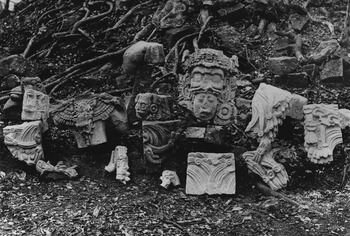
The effort to determine the original appearance and significance of Temple 22 may be traced back to the beginnings of Maya archaeology. Discovery and initial excavation of Temple 22 occurred in the nineteenth century when, like the Parthenon, explorers treated it as a quarry for museum collections. The building's façade sculpture is in collections of the Honduran Institute of Anthropology and History, as well as the British Museum, Harvard's Peabody Museum, the American Museum of Natural History, the National Gallery in Washington, DC, and Tulane University. The British Museum pieces are in London due to Alfred Maudslay, the first person to excavate and document Temple 22 (Maudslay Reference Maudslay1889–1902:10–13, 17–29). Although Stephens and Catherwood had been to Copan decades earlier to record its monuments, they did not discover Temple 22. Rather, it was Maudslay who in 1885 encountered the collapsed building with only load-bearing walls remaining, with a central southern entrance and four vaulted rooms, one in each cardinal direction (Figure 5). He found that the entrance to the north chamber is marked by a sculpted doorframe and hieroglyphic inscription (Figure 8). Maudslay also encountered four sculpture motifs in the rubble around the collapsed building: the Maize God sculptures (Figure 2), corner masks (Figure 9), other masks, and human figures (Figure 11), but did not document their original locations.
Sculpture from Temple 22, Copan, Honduras. Photograph by Alfred Maudslay, taken in 1890–1891 after his excavations around the temple (© The Trustees of the British Museum).

A decade later, G.B. Gordon from Harvard's Peabody Museum excavated around the structure and concluded that Temple 22 had a second level: “without a doubt the fragments in the [Peabody] collection are pieces of an elaborate fallen façade from the northern wall of temple no. 22 and I believe that by diligent search, the remaining pieces can be recovered, or a sufficient number of them to indicate the design” (Gordon 1894–1898:17–18). Unfortunately, he only vaguely recorded the sculpture's provenience, and neither he nor his predecessor published all of the pieces, nor attempted a reconstruction.
After a 1934 earthquake sent three East Court buildings toppling into the Copan River, the Carnegie Institution of Washington (CIW) excavated and consolidated three-fourths of Temple 22 between 1935–1937 (Trik Reference Trik1939). The archaeologists did not publish the thousands of pieces of sculptures they encountered, but rather left them in piles around the structure roughly according to the side of the building that they were found (Fash Reference Fash1992). The excavation report includes a reconstruction drawing by Proskouriakoff that identifies the monster-mouth framing the central doorway, and revised it a decade later to include the Maize God motif (Proskouriakoff 2002) (Figure 10). In both drawings she represents the structure with only one story and includes only a few pieces from the sculpture corpus.
Attention finally turned to the unanalyzed sculpture sample when between 1986 and 1994, the PAAC carried out final excavations and conservation of the building and catalogued the sculpture piles left by the CIW (Fash Reference Fash1989). One goal was to locate the remaining fallen sculpture with the hope of finding a fall pattern that would serve as a template for a reconstruction. The PAAC discovered and catalogued thousands of stone mosaic fragments, many of which helped to recontextualize sculpture from earlier excavations and re-identify sculptures now mixed in piles with those from other buildings. The project expanded the sculpture motif count from four to twenty (Barbara Fash, personal communication 1998; see also Ahlfeldt [2004:Figure 31] for an unpublished reconstruction by Fash), restored several corner masks onto the building (Fash Reference Fash1989, Reference Fash1992, Reference Fash2011:124–129; Freidel et al. Reference Freidel, Schele and Parker1993; Schele Reference Schele1987), and determined the stratigraphy of surrounding structures, supporting Stuart's dating of Temple 22 based upon the inscription (Larios et al. Reference Larios Villalta, Fash, Stuart and Fields1994). Meanwhile, as part of the PAAC, the Early Copan Acropolis Project (ECAP) tunneled underneath Temple 22, uncovering earlier façade sculpture and seven antecedents to the building (Morales Reference Morales1997; Sharer et al. Reference Sharer, Traxler and Miller1992, Reference Sharer, Fash, Sedat, Traxler, Williamson and Kowalski1999). Overall these projects to date have resulted in a half-restored building and a corpus of façade sculpture from the building in collections around the world.
Current Research (1998–2011)
Since 1998 I have directed the Temple 22 Façade Sculpture Conservation and Analysis Project under the aegis of the PAAC project and the Honduran Institute of Anthropology and History. We developed a database of Temple 22 sculpture, conserved and restored individual sculptures, and attributed or confirmed attribution of 3,713 pieces to the building (based on location excavated, sculptural style and motif, and on the refitting of excavated pieces to unprovenienced sculpture). Many of these sculptures were then refitted together to form motifs containing up to 25 or more pieces of mosaic sculpture.
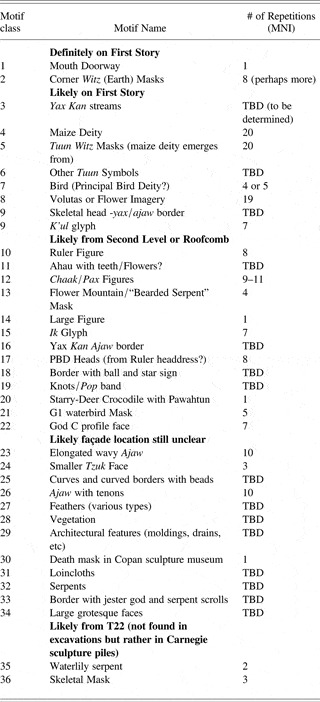
A motif is a symbol that can be identified; for instance, a mask, a human figure, a bird, or a volute (Kubler Reference Kubler1969). When I began this study, just six motifs from Temple 22 had been published: the Maize God and the tuun witz masks (Maudslay Reference Maudslay1889–1902; Miller Reference Miller, Boone and Willey1988:172–175; Spinden Reference Spinden1913), the mouth doorway (Freidel et al. Reference Freidel, Schele and Parker1993:149–151; Trik Reference Trik1939), the corner witz masks (Trik Reference Trik1939), the ruler figures (Fash Reference Fash1992) and the interior doorway (Freidel et al. Reference Freidel, Schele and Parker1993; Maudslay Reference Maudslay1889–1902). I analyzed and revised these sculpture motifs, as well as unpublished ones identified by the PAAC, and discovered 18 additional motifs. The information on the sculpture recovered by previous excavations varies in utility for reconstructing Temple 22's façades. Notes from the earliest excavations state simply: “west side Temple 22,” or “north side,” or “Mound 22.” The CIW left no records on the sculpture, but if a piece is located in Pile 22, for example, we can deduce that the piece was probably—but not positively—gathered or excavated near the area where Pile 22 once stood—southeast of Temple 22. Fortunately, coordinates and maps exist for the pieces excavated by the PAAC. These pieces act as a control sample to indicate which motifs were definitely from Temple 22 and on which side of the building a piece fell when the building collapsed. Fortunately, there are many factors other than provenance that make a reconstruction possible: stone size, tenon angle, relief depth, as well as iconographic patterns in the art of Waxaklajuun Ub'aah K'awiil's reign and throughout the Maya area. Once individual motifs have been reconstructed, they are tested in the sandbox, and then reconstructed digitally. In total, 36 mosaic sculpture motifs repeated around the building's façades between four and twenty times (Table 1).
Sculpture Motifs found in previous excavations around Temple 22 that were likely originally on its façade

These repetitions are determined by a minimum number of individual (MNI) count that I collected for each motif (Ahlfeldt Reference Ahlfeldt2004b:449–596). For example, I have identified 20 Maize God busts and 19 Maize God heads, suggesting that the motif repeated 20 times (Figure 12). The number of motif repetitions probably often carried symbolic meaning. How this motif was arranged on the façade is determined by examining various factors such as location found; the length, size, shape and angle of the tenon; the height of stone coursing; the depth of relief; the weight and size of individual stones, the number of repetitions of the motif; the size of the motif, and patterns of design and iconography on Waxaklajuun Ub'aah K'awiil's other monuments.
(a) Maize God busts in the warehouse at the Copan Regional Center for Archaeological Investigations, Honduras (11 out of the 20 total Maize Gods on the building); (b) The Maize God as it appeared 20 times on Temple 22, each time seated on top of a tuun witz mask (Drawing by Edgar Zelaya). The tuun witz mask was originally found and illustrated by Maudslay, although he did not recognize it as such.

For example, some scholars have suggested that the Maize God figures might have been set on earth masks within niches (Miller Reference Miller, Boone and Willey1988:172–173; Proskouriakoff Reference Proskouriakoff1963). An MNI count reveals 20 tuun witz mask groups with maize vegetation and 20 Maize Gods, indicating that the motifs could have been paired (Figure 13). Moreover, the tenons of the tuun witz masks are 80 cm long with a level surface that could have served as a platform for the busts (the Maize Gods must have been intended to be busts, as I have not located matching legs). Long, heavy tenons are used in Maya architecture at the medial molding to support the sculpture frieze above. Moreover, human-like figures in niches at Copan tend to be placed on the entablature (upper portion of building between medial and cornice molding corresponding to the vault that rests on the load-bearing walls). This motif was therefore probably on the entablature. CIW excavations recovered ten masks from the south side, concluding that they came from the south façade (Trik Reference Trik1939:101). These masks would not have fit on the south side unless they were stacked vertically, as is seen in Campeche and the northern Yucatan. But this probably was not the arrangement on Temple 22, since the Maize Gods were emerging from them. More probably, the building's vaults collapsed towards the south, sending sculptures on the South, East and West façades towards the south. Because Maudslay encountered three maize gods on the west side, I reconstruct the motif distribution as follows: six on the south side of the building (three flanking each side of the doorway), three on the east and west sides, and eight along the north side (Figure 13).
Test of Maize God and tuun witz mask on entablature of Temple 22. Uncompleted scale 3D reconstruction of Temple 22 in 3D Studio Max. Rendering by architect Laura Ackley and the author.

This multi-faceted analysis—requiring knowledge of individual stones, Maya iconography, stone masonry technology, and the building's collapse and excavation history—must be carried out for each of the 36 motifs. Although the project is ongoing, I summarize the most important motifs here as well as their likely arrangement.
DESIGN AND SYMBOLISM OF TEMPLE 22
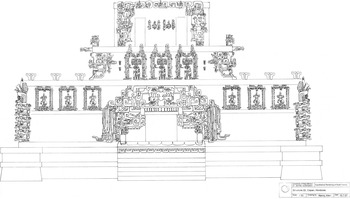
The results of the façade reconstruction project indicate that Temple 22's façades bore over 36 sculptural motifs that repeated in a hierarchical display of anthropomorphic and zoomorphic figures and swirling vegetation (Figure 14 and Table 1). The structure's façades represented a fertile mountain with flowers, maize and flowing water. Upon this mountain sat statues of the ruler and these were surrounded by pan-Maya deities, local patron deities and probably an arching sky-serpent. An iconographic analysis of these motifs indicates that together this sculptural symbolism and the building's design represented a three-dimensional diagram of the Maya universe, articulating its horizontal quadripartite and vertical tripartite spatial divisions as well as the temporal divisions of cosmic and human time. In many ways it mirrors the imagery found on the interior doorway of the building (Figure 8) but is far more elaborate and detailed.
Hypothetical reconstruction of selected motifs from Temple 22. Drawing by Nancy Allen under the direction of the author (2007).

Creation Mountain, Sacred Time/Space, and the Birth of Humanity
The first story—that is, the first level—of the structure represented the sacred cave of Creation Mountain as previously hypothesized (Freidel et al. Reference Freidel, Schele and Parker1993), as well as Flower Mountain as Taube (Reference Taube2004) suspected. Moreover it bears directional symbolism of quadripartitioning, as well as sacrifice and creation mountain imagery, thus continuing pan-Maya creation imagery that is associated with ruler accession in the murals at San Bartolo, Guatemala (150 b.c.) almost one thousand years earlier (Saturno et al. Reference Saturno, Taube, Stuart and Hurst2005; Taube et al. Reference Taube, Stuart, Saturno and Hurst2010).
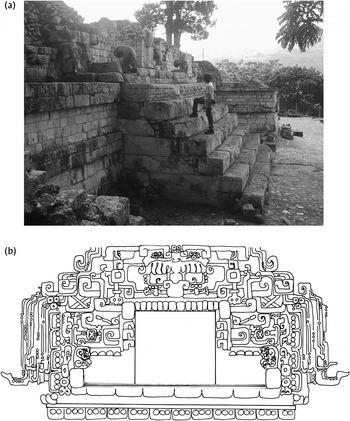
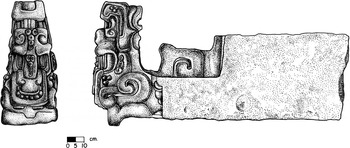
Each of the four corners of the building's first story bore two (and perhaps three) masks that marked the building as a stone mountain. The main doorway as a gaping mouth with teeth and fangs recalls a cave entrance rimmed with stalactites and stalagmites (Figure 15). This metaphor is prevalent in Mesoamerican art as far back as 700 b.c. at Chalcatzingo. Caves are considered to be underworld, womb-like emergent spaces, and sources of water where maize was first found. They are the abode of ancestors and powerful forces and contemporary Maya still make sacrificial offerings in caves (e.g., Bassie-Sweet Reference Bassie-Sweet1991, Reference Bassie-Sweet1996; Brady Reference Brady1988, Reference Brady1996; Brady and Prufer Reference Brady and Prufer2005; Brady and Veni Reference Brady and Veni1992; Heyden Reference Heyden and Benson1981; Le Fort et al. Reference Le Fort, Gardiol, Matteo and Helmke2009; Saturno et. al. 2005; Schávelzon Reference Schávelzon, Robertson and Jeffers1980; Schele Reference Schele and Houston1998; Stone Reference Stone1995; Townsend Reference Townsend1992).
(a) Side view of doorway as it appears today; (b) Hypothetical reconstruction of the mouth doorway. Drawing by Nancy Allen in collaboration with the author (2007).

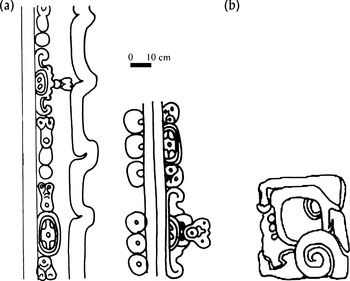
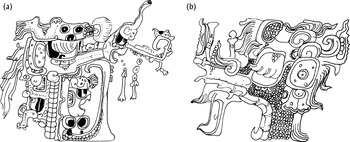
Emerging from either sides of this doorway are streams that represent water (Freidel et al.Reference Freidel, Schele and Parker1993; Thompson Reference Thompson1960:275) or blood (Stuart Reference Stuart, Benson and Griffin1988). My research indicates that streams of liquid with glyphs for yax (first, green) and k'an (yellow, ripe, preciousness) also probably framed the doorway (Figure 16a). Such signs occur on Maya stelae on period endings or accession anniversaries in the fluid scattered by rulers, or emerging from cosmic serpents (Stuart Reference Stuart and Nalda2004:138–139) or the starry-deer crocodile (Stuart Reference Stuart2005:70–71). This fluid represents the ruler's blood—offered as a source of life, fertility, and abundance (Stuart Reference Stuart, Benson and Griffin1988:212–213), as well as ch'ulel, the inner spirit that resides in the blood (Freidel et al. Reference Freidel, Schele and Parker1993:201–202). Together they indicate k'ul/ch'uh (“sacredness”) which is also a symbol for blood sacrifice offerings (Stuart Reference Stuart, Benson and Griffin1988:202–203). The glyph for ch'uh repeated seven times somewhere on the building (Figure 16b), seven being a sacred number for the modern Chorti Maya (Girard Reference Girard1969). Additional sculpture pieces that made up the doorway require further analysis, but it is clear that this doorway was similar to other zoomorphic doorways in the Maya region and alluded to themes of sacrifice, transformation, and birth.
(a) Two types of Yax and K'an borders from Temple 22. These probably once framed the building's mouth doorway; (b) Sculpture of K'ul or ch'uh glyph. Drawings by author.

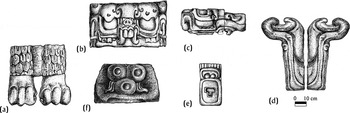
Project results also confirm Miller's hypothesis (M. Miller Reference Miller, Boone and Willey1988) that the Maize God statues represented corn growing on this fertile mountain, however my research indicates that there were 20 “Foliated Maize Gods” (Taube Reference Taube and Fields1985) on the first-story entablature that sprouted from 20 earth masks with flowers growing out of their foreheads (Figure 12). That this motif appears in 20 iterations may refer to the 20 agricultural cycles over which Waxaklajuun Ub'aah K'awiil presided during his first katun (20 years) of office—since the temple was erected on the twentieth anniversary of his coronation. This number may allude to the Maize God in the Popol Vuh, who planted five seeds in each corner of his maize field—20 in all. That the Maize Gods are related to cycles of time can be further supported by the fact that modern Maya day-keepers traditionally used maize seeds to count the 20 days of the Tzolkin ritual calendar (Bassie-Sweet Reference Bassie-Sweet, Gustafson and Trevelyan2002). Finally, Erik Boot (personal communication 2008) reminded me that the word for human also means “twenty” in Maya languages. In sum, the imagery on the first story supports Taube's theory that Temple 22 refers to the creation of maize and the emergence of humanity from Flower Mountain (Taube Reference Taube2004). Additional motifs confirming that Temple 22 was Copan's “Flower Mountain” include serpents and four ik' symbols—symbols for breath and wind (Taube Reference Taube, Ruiz, Sosa and de León2002), as well as tuun (stone) symbols, and vegetation (Figure 17). Four pairs of bird talons—most likely belonging to the Principal Bird Deity—probably graced the top corners of the first story (Barbara Fash, personal communication 2008; Fash Reference Fash and Fields1991b) (Figure 17).
Additional motifs that were likely on the first story: (a) feet from Principal Bird Deity motif, (b) skeletal head, (c) serpents, (d) flowers, (e) ik (breath, wind) glyphs, and (f) tuun (stone) glyphs. Drawings by Edgar Zelaya.

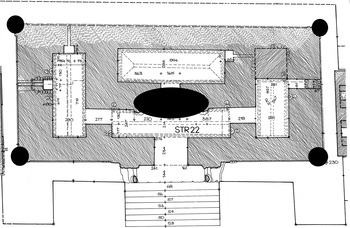
Moving beyond iconography, the design of this mountain anchored it in sacred space and time. Its plan expresses a cosmological order in that its four rooms are oriented to the cardinal directions, and the only sculpture on the load-bearing walls of the first story are located at five points: on the four corners (witz masks) and the center (interior doorway and mouth doorway) (Figure 18). These points form a quincunx pattern that symbolizes the sun's yearly path between the solstice points and zenith—this pattern is used in Maya ritual practice in both the past and present to bind and consecrate a sacred space (Hanks Reference Hanks1990; Maca Reference Maca2002; Mathews and Garber Reference Mathews and Garber2004). Oriented to the cardinal directions and to solar time, Temple 22 was a fertile landscape in stone—a model of cosmic order that provided a sacred space for ritual. These rituals probably had to do with the themes of human origins, creation, ingestion, transformation, and rebirth that are alluded to in the building's sculptural symbolism.
Locations of sculpture on load-bearing walls of first story of Temple 22, forming a quincunx, representing cosmological order and the stations of the sun in the year. Adapted by the author from Hohmann and Vogrin (Reference Hohmann and Vogrin1982).

King of the Mountain
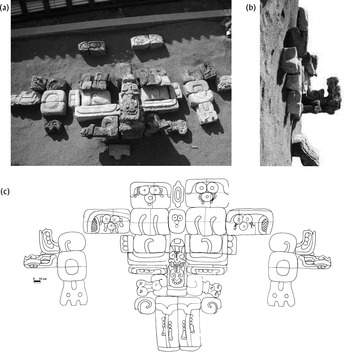
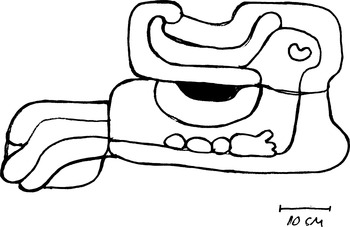
Arranged probably on the middle level of the building were images of Maya rulers seated between four zoomorphic mountains. I have reconstructed these zoomorphic mountains—over three meters wide—that probably anchored each corner (Figure 19). The same figures are found on contemporaneous vessels from the Maya lowlands (Figure 20), with zoomorphic snouts, drooping eyelashes, tuun glyphs, ear flares, and sacred water dripping out of the mouth. The serpents emerging from the ear flares are ‘breath serpents exhaled from witz masks [that] pass through ear spools, denoting mountains as places of conjuring and celestial ascent’ (Taube Reference Taube, Ruiz, Sosa and de León2002:435). In the Temple 22 sculpture corpus, these serpents and other features appear in sets of four, thus the MNI of four for the earth masks. Like the vessel masks that are rendered in profile, these stone masks likely appeared in profile on the corners (see also Tikal Lintel 3 in Stuart [1988:Figure 5.40]). Often their prominent nose has the tzuk (“partition”) on it (Nikolai Grube, personal communication, 2008) (see also K1370 in Kerr's Maya Vase database) (Figure 21). Other kinds of tzuk faces appeared on the building and so it seems that there is an interest in expressing partitions, or spaces of the universe. Perhaps these four corner masks alluded to the mountains at the corners of the Maya world, or the partitions made by the sun as it stops in its yearly path along the sky.
Hypothetical reconstruction of one of four large Flower Mountain masks that probably graced the corners of the building on the upper level(s). Each mask was at least 4.5 m wide. (a) Frontal view; (b) side view; and, (c) line drawing. Photos and drawing by author.

Zoomorphic flower mountains from Maya vessels. Detail drawings by author (after (a) Red Background polychrome vessel, Northern Peten Robicsek and Hales Reference Robicsek and Hales1983:Figure 30); and (b) detail from vessel featured in Robicsek and Hales Reference Robicsek and Hales1983:Figure 18).

Nose of large earth (“flower mountain”) mask. Note Tzuk face. Drawing by Edgar Zelaya.

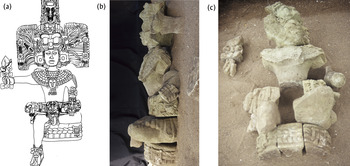
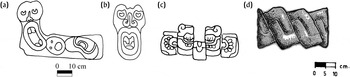
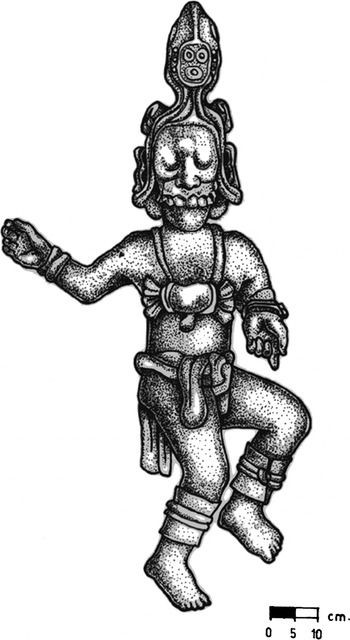
Arranged among these mountains were eight, greater-than-life-size statues of rulers that—in style and iconography—confirm the date of the building and support existing hypotheses about the rituals that occurred here (Figure 22). Previously called “guardian figures” (Fash Reference Fash1992, Reference Fash2011), I call them “ruler figures” for they wear the ajaw (“lord”) belt, ajaw breastplate, and sit on a cushion throne in a posture of royal ease (Fash Reference Fash1992). This cushion has flower motifs similar to that which Waxaklajuun Ub'aah K'awiil's contemporary, king Hasaw Chan K'awiil sits upon in Lintel 3 at Tikal (a.d. 700). Another detail from these ruler statues that dates to the proposed dedication date of the building is the feathered “flapstaff headdress.” This appears in the costume of Maya rulers after 9.13.0.0.0 (Tate Reference Tate1992:84) and is related to warfare (Looper Reference Looper2003:46). At the top of the headdress is the Hu'unal “jester god diadem” that represents a sprouting plant, perhaps maize (Fields Reference Fields1989, Reference Fields and Fields1991). (I thank Elizabeth Wagner [personal communication 2008] for pointing out that this sculpture piece belongs to the ruler's headdress). The relationship between warfare and fertility in the headdress is also alluded to in the items that the statues hold in their hands: blood letters in their left hands at their groin, and centipede lances in their right hands (also seen at the Temple of the Sun at Palenque, ca. a.d. 692, on which is incised the etz'nab glyph for obsidian, or sharp stone). These two instruments allude to auto-sacrifice and captive sacrifice respectively (Baudez Reference Baudez and Nalda2004:71–74)—two activities that likely took place in this building. One of these ruler statues was different in that it also bore a crocodile pectoral (alluding to creation) and held in its right hand a k'awiil figure (an infant-like creature with a snake for one leg—like a baby with umbilical cord). The k'awiil figure symbolized rulership and power and is associated with transformations (such as birth, accession, or death) that occur through blood sacrifice (Freidel et al. Reference Freidel, Schele and Parker1993:193–207; Miller and Taube Reference Miller and Taube1993:110). It is held by rulers in accession scenes and indicates that accession ritual or commemorations thereof may have occurred at Temple 22. Additional sculptures that emphasize the royal nature of the building and need to be analyzed further include: ajaw faces, pop (mat) bands, and eight small masks (Figure 23). Overall, the statues likely represented Waxaklajuun Ub'aah K'awiil and his contemporaries or ancestors, and were placed on all four sides of the building, asserting the ruler's control over the partitions of the world, the earth and its fertility, and his city.
One of eight ruler figures (over 2 m high) from the upper façade of Temple 22: (a) Drawing by author; (b-c) Sandbox reconstruction of actual sculpture elements. Photos by author.

From Temple 22: (a-b) Ajaw signs; (c) small masks; and, (d) pop bands.

The Celestial House/Sky-Cave and its Residents
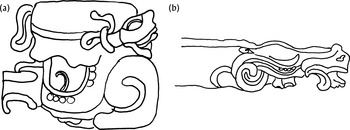
The highest level of the building represented the sky with ancestors or patron deities. I have identified at least seven small sculptures of twisting and spreading limbs (Figure 24), and these are similar to the nine small figures that cavort in the body of the cosmic serpent in Temple 22's interior doorway. Stuart (Reference Stuart, Benson and Griffin1988:203) identified these as ancestral deities and I have identified them as Chaaks and K'awiils (Ahlfeldt Reference Ahlfeldt2004b:148). The seven figures, with bulging eyes, flattened nose, and missing lower jaw, are a notable contrast to the idealized beauty of the Maize Gods and Ruler figures. Naked except for a loincloth and pectoral, they wear the same leaf-shaped diadem that Waxaklajuun Ub'aah K'awiil wears on Stela B. This has been identified as relating to Chaak—the rain god (Newsome Reference Newsome2001; Schele and Mathews Reference Schele and Mathews1998), or a representation of a tobacco leaf (Nikolai Grube, personal communication 2008), or a cacao pod (McNeil et al. Reference McNeil, Hurst, Sharer and McNeil2006); and the missing lower jaw suggests the god of the month Pax (Karl Taube, personal communication 2002). The pectorals on these figures vary, suggesting they are different beings. This motif requires further research and so I simply call it “patron deities.” As for the serpent in which they probably cavorted on the top of the building, there are a range of large serpent heads and potential body parts that have been catalogued but have yet to be analyzed. One particular serpent head is large enough that it may be a candidate for one of the heads of the celestial serpent (Figure 25).
Reconstruction of Chaak figure motif or “patron deity” motif on Temple 22. Drawing by Edgar Zelaya. Compare this diadem with that worn by Ruler 13 on Stela B at Copan (see Figure 7).

Reconstruction of portion of a serpent head possibly from upper level of Temple 22.

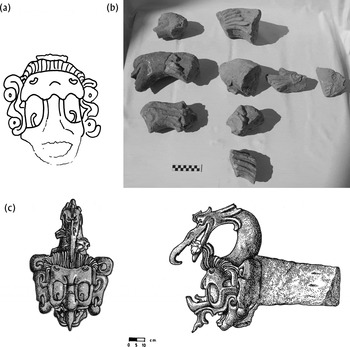
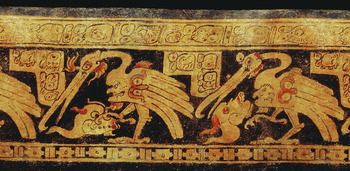
Another celestial motif that likely came from the upper level of the building is a mask from which an egret or heron emerges, holding a fish in its beak. Five such heads were cataloged from Pile 5 (Figure 26a), and fragments of the fishing birds that emanated from these heads were found in excavations confirming that these came from Temple 22 (Figure 26b). These fragmented sculptures resemble those birds excavated beneath Structure 26 at Copan (Fash Reference Fash2011; Fash and Fash Reference Fash and Fash1996) (Figure 26c). Justin Kerr was the first to point out their similarities with images on Maya vessels (Figure 27) (Barbara Fash, personal communication 2001). Stuart identifies this figure as God GI (Stuart Reference Stuart2005)—a proto-sun, perhaps from the watery underworld. And indeed, the GI sculpture from Temple 22 has star symbols on it suggesting that it relates to a celestial object (see also Krempel and Davletshin Reference Krempel and Davletshin2011:27). Both the heads from Temple 22 and those found under Structure 26 were accompanied by forms of falling water—perhaps representing a celestial body such as Venus that accompanies the onset of the rainy season.
(a) One of six GI heads with star symbol from Structure 22—note the protrusion at the top for the egret's neck. Drawing by author; (b) Egret and fish fragments. Photo by author; (c) Similar sculpture found by PAAC cached in the Hijole structure (under Temple 26), now in Copan Sculpture Museum. Drawing by Edgar Zelaya.

Vessel with G1 (K 6181 © Justin Kerr). See also Kerr vessels K3536, 6438, K6167, K6438, K8538, and K8651. Compare with Figure 26a and 26c above.

Additional water imagery on the upper façades probably included a single drain in the form of a serpent (Figure 28b) that I attribute to Temple 22 based on stylistic features and that it was found in excavations around Temple 22.Footnote 4 This was probably placed on the roof so that water fell in streams over the façades, likened by William Fash (personal communication 1997) to waterfalls falling over the sacred mountain. Two large “water serpent” heads with a water lily blossom headdress were found on piles right next to the building and probably appeared on Temple 22 as well (Figure 28a). This symbol of streaming water—deity of rain and aquatic spirit—appears at Copan in the context of period-ending rituals and also is part of K'ahk' Uti' Witz' K'awiil's name (Stuart Reference Stuart2007). Its appearance on the façade probably alluded to all of these meanings, but the abundance of imagery and icons of sacred water also supports Williams-Beck's (Reference Williams-Beck and Garza1987) association of zoomorphic portals in the Maya area with water. Overall, the motifs that represent the sky, celestial bodies, and patron deities were probably on the upper levels of the building, so that the water imagery symbolized rain coursing down from the sky onto Flower Mountain.
(a) One of two Water Serpent heads (author drawing); (b) Serpent drain in Peabody Museum, excavated in 1895 from slope of Temple 21. 117 cm long. Drawing by Nancy Allen (after Spinden Reference Spinden1913:Figure 152).

A Multi-Story Cosmogram
Together these motifs were arrayed on what was probably a three-level façade that may have been at least 17 m tall. One story would not have held all the sculpture attributed to the building and the vaulted chambers of the first story and its unusually thick load-bearing walls suggest that a great deal of weight was planned for the upper levels. The upper levels probably did not contain interior rooms, however, because there is no evidence for an interior or exterior stairway as occurs on other buildings at Copan with second story rooms (see Structure 10L-11 and Structure 10L-20 [Hohmann and Vogrin Reference Hohmann and Vogrin1982:Figures 176 and 178]). Rather, the building was probably comprised of a first story and a two-level roof crest.
Multi-level structures with no interior stairways but rather roof-crests have precedent at Copan. The sixth-century “Rosalila” structure is a good model for the likely form and dimensions of Temple 22, as it was discovered buried intact with an initial story and two-level roof crest, making three levels in all (Agurcia and Fash Reference Agurcia Fasquelle, Fash, Andrews and Fash2005) (Figure 29). The building's roof comb had a room with doorways to the outside, but with no stairway and so it is probable that this space was not a room but rather served to lighten the load of the roof comb upon the structure (Agurcia Reference Agurcia Fasquelle1996). I reconstruct Temple 22 according to these proportions, so that including its platform, Temple 22 was over 17 m tall.
(a) Elevation drawing of Rosalila structure, Copan, circa sixth century. Drawing by Barbara Fash (from Agurcia and Fash Reference Agurcia Fasquelle, Fash, Andrews and Fash2005); (b) Cross section of the Copan Acropolis on the central axis of Structure 10L-16. Reconstruction drawing by Barbara Fash, after the original Proyecto Arqueologíco Acropolis Copán (PAAC) drawing by Rudy Larios and Fernando López (Agurcia and Fash Reference Agurcia Fasquelle, Fash, Andrews and Fash2005:Figure 6.1).

Additional evidence that Temple 22 might have had a two-level roof crest is the similar imagery on both structures. Agurcia and Fash (Reference Agurcia Fasquelle, Fash, Andrews and Fash2005:232) describe the iconography of Rosalila as a “gigantic cosmogram with a solar god, scenes of creation, the heavens, the sacred mountain and death, intertwined with the instruments that royal mortals used to try to control these forces—sacrificial bundles, incense burners, vision serpents, and bicephalic serpent bars.” They note that like Temple 22, Rosalila has mountain imagery with maize marking the building as a sacred mountain, as well as an arching sky-serpent (Agurcia and Fash Reference Agurcia Fasquelle, Fash, Andrews and Fash2005:117–232, 228), suggesting a design of the Maya cosmos with its three domains of sky, earthly world and otherworld. Indeed they note that it is a forerunner to Structures such as 22, 11, and 16 that contain world “cosmograms.” There are also allusions to the first king of Copan on the façade imagery, through icons that relate to his name.
Like Rosalila, Temple 22 represented not only a sacred mountain as previous interpretations have suggested, but more the ordered, fertile, universe—what the Maya call the kaan kab' (sky-earth). It could also be the “sky-cave” (chan ch'e'n), a phrase “often related to the center of Classic sites, that may refer to royal tombs as both underworld chambers and paths of celestial ascent into the heavens” (Taube Reference Taube, Ruiz, Sosa and de León2002:433; see also Stuart 2000). David Stuart (personal communication in Taube Reference Taube, Ruiz, Sosa and de León2002:435) noted that two of the carved bones from Burial 116 at Tikal describe the conjuring of a war serpent or Waxaklajuun Ub'aah Chan at Flower Mountain. Taube also notes that in Mesoamerican mythology, the dead may enter the path of the dawning sun at Flower Mountain (Taube Reference Taube, Ruiz, Sosa and de León2002:425–427). Finally, Linda Schele observed that the central doorway of Temple 22 was illuminated on the winter solstice, thus suggesting that Temple 22 was intended to mark the moment/place where the sun literally dawns, emerging from the watery underworld (Freidel et al. Reference Freidel, Schele and Parker1993). Given that serpents are seen as creatures of conduit, passing, and transformation (Taube Reference Taube, Ruiz, Sosa and de León2002) and the abundance of serpent imagery on the building, it is likely that Temple 22 was such a place to access the path of the sun through transformation rituals of various kinds (sacrifice, death, rebirth/accession).
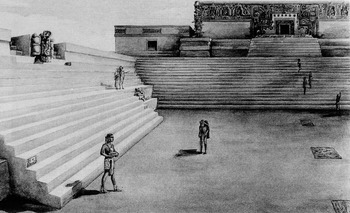
This solar cosmological symbolism also extended to the East Court whose design is a diagram of Maya directional cosmology (Ahlfeldt Reference Ahlfeldt2004b; Fash Reference Fash and Houston1998:250; Miller Reference Miller, Boone and Willey1988). It was renovated under Waxaklajuun Ub'aah K'awiil's reign along with Temple 22 (Sharer et al. Reference Sharer, Traxler and Miller1992). The East Court is oriented to the cardinal directions (Figure 5) and the stairway sculpture refers to the movements of the sun: the setting sun is represented by the symbolic “Jaguar God of the Underworld” sculpture on the west stairway, while the rising sun may be represented by the naturalistic sculpture of a crouched jaguar, known as the “jaguar altar” (see Robicsek Reference Robicsek1972:Plate 182), that sat on the east stairway so that the sun rises and falls through this symbolic landscape. Emphasizing this point are the ballcourt markers on the north-south axis of the court rendering it a symbolic ballcourt (Fitle Reference Fitle2006; Miller Reference Miller, Boone and Willey1988). These may have been placed there by a later ruler, however, and so the concept of the East Court as a ballcourt may not have yet been the case during Waxaklajuun Ub'aah K'awiil's reign. Overall, though, it is clear that the East Court itself is a bounded, sacred location that ordered Temple 22 within cosmic space-time.
In sum, Temple 22's design is elegant in its symmetry and lavish in its sculptural style, with organic, zoomorphic, and anthropomorphic forms that animate the building, all organized within a three-dimensional diagram of the quadripartite and tripartite universe. Why was such an overt diagram necessary? Why at this time and place?
DISCUSSION: TEMPLE 22 AS AN AGENT OF RULER 13'S AGENDA
We have seen that Temple 22 was built at the peak of Copan's power as the kingdom was beginning to feel economic, environmental, and political stress, and that the temple's audience included both Maya and non-Maya inhabitants of Copan, vassal polities, and other kingdoms. Temple 22 served Waxaklajuun Ub'aah K'awiil's agenda of maintaining power and competitiveness by addressing this range of audiences. To do so it bore different levels of signs through its location, design, iconography, and carving style—some overt, some more subtle, some traditional, and some more innovative.
Tradition
One of Waxaklajuun Ub'aah K'awiil's concerns was to assert Copan's role as a foundational Maya kingdom—and himself as its center. In location, access, and spatial design, Temple 22 uses a pan-Maya spatial vocabulary to create an urban experience that would have been familiar to those who had visited other Maya cities. For example, as the seat for the highest civic-religious authority at Copan, Temple 22 was one of the most elevated buildings at the city. High on the acropolis, it could be seen from most directions in the Copan pocket of the Copan River valley (see Figure 4). The ruler's statues on all sides expressed his all-seeing gaze. This use of elevation is a traditional feature of Maya state architecture. To access the temple, one had to move through the city, climb at least 30 m to the top of the Acropolis and be channeled through corridors before arriving in the East Court. Based on what remains of the architecture today, it appears that this path followed a counterclockwise direction (Figure 30), the typical direction of ritual performance in Maya culture (Hanks Reference Hanks1990). The quadripartitioning and vertical layering of Temple 22 and its courtyard are also ancient signs for sacred space, the ordered universe, and the place of creation (Christie Reference Christie2003; Houston Reference Houston and Houston1998; Mathews and Garber Reference Mathews and Garber2004; Schele Reference Schele and Houston1998; Schele and Miller Reference Schele and Miller1986). The courtyard's forms and acoustics were designed for people to gather and to view performances around Temple 22 (Fash and Fash Reference Fash and Fash1996), and probably only members of the ruler's court, captives about to be sacrificed, and visiting elites were invited to climb up to the temple or to circumambulate its platform to survey the valley below and mountains beyond. The phenomenological experiences of height, gaze, and ordered space that Temple 22 and its court offered were typical of Maya cities and Maya state ritual for millennia.
Counter-clockwise route for a possible ritual circuit from West court to East Court to arrive at Temple 22. Graphic by Heather Richards-Rissetto.

Not only would visiting elites have found the physical experience of visiting the temple familiar, but they would also have recognized its themes: the mythology of sacrifice and cyclical regeneration, the cave of creation and the birth of maize, cosmic order, and ruler accession. These are associated with the narrative of divine kingship—the role of the ruler in providing abundant food and water and carrying out the kingly duties of sacrifice and self-sacrifice—that appeared in Maya art and architecture a thousand years earlier, in the San Bartolo murals mentioned earlier. These themes also were present on structures at Copan at least a century before the construction of Temple 22, which was the last in a sequence of structures built on the north end of the East Court that had similar form and imagery (Agurcia and Fash Reference Agurcia Fasquelle, Fash, Andrews and Fash2005; von Schwerin Reference von Schwerin, Boschung and Blamberger2011). Directly below Temple 22, “Chachalaca” had corner masks like those of Temple 22 (Morales Reference Morales1997: Figure 14). This dates to K'ahk' Uti' Witz' K'awiil's reign (Freidel et al. Reference Freidel, Schele and Parker1993; Sharer et al. Reference Sharer, Fash, Sedat, Traxler, Williamson and Kowalski1999) and thus Temple 22 asserts its place (and by extension the ruler's) in the dynastic lineage of Copan. Interestingly, as we have seen, this sacred mountain, ruler accession, and sky imagery first appeared at Copan in the axis of buildings underneath Rosalila. With the reign of the twelfth ruler, this axis moved north to the East Court, culminating with Temple 22. The reasons for this shift in location have yet to be understood, but as Ellen Bell notes (personal communication 2011), it is interesting to think that the iconographic reorganization followed somewhat on the heels of shifting the early residential groups from the north to the south (the Cementerio Group) (see Sharer et al. Reference Sharer, Traxler and Miller1992). In any case, Temple 22 manifests organizing frameworks, or “cultural or ideational structures” (Johnson and Gonlin Reference Johnson, Gonlin and Houston1998:144–145) common to Maya sacred architecture and participates in a tradition of Maya architectural design that alludes to the entire universe (Agurcia and Fash Reference Agurcia Fasquelle, Fash, Andrews and Fash2005; von Schwerin Reference von Schwerin, Boschung and Blamberger2011). This may have occurred on a larger urban scale in Maya cities (e.g., Ashmore Reference Ashmore1991; Maca Reference Maca2002, Reference Maca, Robertson, Seibert, Fernandez and Zender2006), or on the domestic level as well, for Vogt (Reference Vogt1976:52–58) describes modern Maya practices in which the house is conceived as a microcosm. Moreover, as Bell has shown (2007), Early Classic ritual deposits within the Copan acropolis also show precise three-dimensional cosmograms. These include caches that themselves have three levels and quadripartite layering, but also buildings marked in this way. The fifth-century structure Margarita, for example, had mercury deposits marking the four corners and center of the building (Bell Reference Bell2007:341–345).
These deep structures of Maya-style monumental architecture were important to Waxaklajuun Ub'aah K'awiil's expression of his and Copan's pivotal role in the Maya world and so they were overtly expressed in the temple's forms. The theme of the sacred landscape in ancient Mesoamerican architecture appears in Maya architecture at Copan's Temple 22 not only in the form of the sacred mountain, but as an entire Maya universe—the sky-cave (chan ch'e'n) (Stuart and Vogt Reference Vogt, Stuart, Brady and Prufer2005) or kaan kab' (world). Self-conscious and in many ways highly traditional, Temple 22 thus placed the ruler's symbolic and physical body in historical, mythological, and cosmological space/time.
The fact that Temple 22 employs highly traditional creation imagery suggests that its themes were still relevant, and perhaps to some extent, still necessary. As has been shown, the iconographic detail and carving style supports the dating of the building given by archaeological and epigraphic data to around a.d. 715. Although the evidence that Copan was facing deforestation and depleted agricultural resources at this time (Rice Reference Rice, Sabloff and Henderson1993) is now disputed (McNeil et al. Reference McNeil, Burney and Burney2010), Copan in the early eighth century was facing other significant challenges due to an increased population, reliance on both Maya and non-Maya subjects, and expanding architectural and military campaigns of other Maya kingdoms. Lisa Lucero has suggested that Maya kings may have maintained their power in part by providing water during annual droughts, by maintaining water systems, by providing food when crops were lost and by “sponsoring public events…that highlighted their special abilities in reaching gods and ancestors” (Lucero Reference Lucero2004:37). Perhaps Waxaklajuun Ub'aah K'awiil responded to looming threats by sponsoring the public event of the construction of Temple 22 to draw upon the ancient creation myth on the anniversary of his accession, to remind his subjects of the ideological relationship between Maya kingship and fertility, and of the agricultural abundance the ruler provided in the first katun of his reign. Temple 22 highlights the traditional roles of the divine ruler, projecting his central role in eighth-century Maya history, myth, and cosmology, and serving as a physical and conceptual extension of his royal body.
Innovation
Although seemingly timeless in design, the temple's use of this ancient imagery also manifests the worldly concerns of its patron. Contemporary viewers versed in Maya sacred architectural design would have noticed, however, some truly innovative features of the structure's design, symbolism, and style. These suggest that Waxaklajuun Ub'aah K'awiil was concerned with being “up to date” with contemporary developments in Maya politics, religion, and even aesthetics and philosophy.
As a physical and conceptual extension of the royal body, Temple 22 emphasized the ruler's physical, historical person, the more human side of the god-like king, as well as his territorial control and martial power. Although divine kingship among the Maya had existed for almost a millennium, by a.d. 715 a clear shift had taken place in the Maya area as artistic programs on public architecture began to focus on the humanity and historicity of individual rulers—rather than their office. Throughout the Classic period, the ruler had always been shown on stelae. However, while earlier iconographic programs on temples such as Rosalila only displayed monumental masks of deities or name glyphs of rulers, slowly the full body of kings began to appear on buildings (Miller Reference Miller1986). The figure of the ruler seated on top of the mountain that we see at Temple 22 is a development in Maya art that appeared as early as a.d. 550 on Structure 1 at Okolhuitz (Gendrop Reference Gendrop1983:Figure 15c), and really expands in the Maya area in the eighth century; it is a pan-Mesoamerican visual metaphor for rulership (Bernal-Garcia Reference Bernal-Garcia and Fields1994; Stuart Reference Stuart1997; Taylor Reference Taylor, Robertson and Jeffers1978), indicating a settled, civilized place. Indeed, altepetl (water mountain) in highland Mexico is the name for a town or city—and in the codices, a town is represented by a mountain (Fernández Christlieb and Garcia Zambrano 2006; Noguez Reference Noguez and Carrasco2001). By placing the figure of a ruler on this mountain that is Temple 22, it is feasible that Temple 22 was intended to symbolize the kingdom of Copan in a spatial sense, such that Waxaklajuun Ub'aah K'awiil is asserting Copan as a space ruled by the king.
What also is innovative about this building is that the king was represented not as an abstract concept of a god-like king, as with the heraldic symbolism of Rosalila, but rather a particular historical person, with a very human body. Temple 22 is one of the earliest buildings at Copan that had full-bodied images of a ruler on its façades. By commissioning life-size images of himself on architectural sculpture at Copan, Waxaklajuun Ub'aah K'awiil asserted a different kind of kingship—one that focused less on the “ruler-like deity,” and more on the “ruler-like human.” Perhaps this was necessary given demographic and political changes in this period. It might have been more difficult at this time to convince the non-Maya that a Maya ruler was a god, rather than a human. Moreover, the structure's inscription mentions Waxaklajuun Ub'aah K'awiil's own accession, refers to his father, and is written in the first person—something extremely rare for Maya public inscriptions (Stuart Reference Stuart1986, Reference Stuart1989). All of these emphasize the historical figure of the king in an unprecedented manner.
Along with the emphasis on owned territory and human body, a particular feature of these figures that I have already mentioned above is the more overt military imagery that emphasizes the role of the ruler as warrior, captive taker, blood letter, and guardian of the order of the city and of the natural cycles. The king as warrior is certainly a prominent theme in the architectural monuments of the Principal Group from the time of Waxaklajuun Ub'aah K'awiil onward. Barbara Fash has demonstrated that this is a near obsession in Late Classic Acropolis architectural sculpture. Knives, Tlaloc imagery, and portraits of rulers as warriors are found on Structures 10L-16, 10L-18, 10L-20, 10L-21, 10L-21A, 10L-22, and 10L-26 (Fash Reference Fash1992, Reference Fash and Orefici1997a, Reference Fash1997b).
Finally, the abundant and ornate feather-work in the costume of Waxaklajuun Ub'aah K'awiil is also new to ruler imagery at Copan. He is the first ruler to be represented wearing feathers in his headdress and there is an abundant amount of feather imagery in his stelae and in Temple 22. The reason for this sudden change at Copan is unclear. It may have some economic implications—perhaps alluding to his role in expanding the feather-trade at Copan, or it may simply be a connection to the feather work that appears in rulers' costumes throughout the Maya area at this time, indicating that he is within the fashion or rules of costume of his peers. Or finally, because his name alludes to the Teotihuacan war serpent which is the feathered serpent, Guido Krempel (personal communication 2011) suggested that the feathers in his headdress may allude to the identity of this ruler as the feathered serpent. In any case, Temple 22's sculpture conformed to contemporary iconography and presented a more elaborate and human-centered vision of the divine king.
The building indicates a desire not only to place the ruler as a historical figure in a historical moment, but also within what might be new developments in Maya religion. Temple 22 shows a dramatic increase in the number and complexity of figures on the façades compared to what came before on architectural sculpture at Copan—this suggests an increase in the complexity of Maya religious ideology. There is an emphasis on patron deities of Copan, both in the structure's inscription and exterior façade. The clarity with which this is all rendered is innovative as well. Although the sacred mountain and ordered universe are ancient themes, the explicit rendering of a zoomorphic portal or cave does not appear on exterior façades of structures at Copan (or anywhere else in the Maya region to my knowledge) before Temple 22 (the Chenes temples have not yet been more securely dated other than “coeval” with Temple 22 [Gendrop 1983, 1985]). The full-blown representation of Creation Mountain with cave appears at Copan for the first time with Temple 22.
Temple 22 participates in a period at Copan that initiates a new artistic style that also is evident in the Great Plaza Stelae dedicated by Waxaklajuun Ub'aah K'awiil. I would argue that this style may be characterized by three features: (1) great intricacy, (2) naturalism, and, (3) anthropomorphization. This intricacy in art at Copan first appears with the stelae of Ruler 12 and is part of a general “Ornate Phase” of art and architecture throughout the Maya world that Proskouriakoff (Reference Proskouriakoff1950) identified. This style was brought to its highest level of expression on architecture at Copan with Temple 22. Its façades were not only ornate, but they were in a naturalistic style with serpentine lines that animated the building. The mosaic sculpture often was carved in three dimensions and extended out in varying depths, so that the surface moved in and out of the viewer's space. Heads and limbs of figures occasionally are turned so that the bodies seemed to be in motion, although specific actions other than “sitting,” “emerging,” “seeing,” or “flying” are not alluded to. What is important is that the sense of “–ing,” (that is, “being,” or animation) is expressed very clearly. The temple imagery also participates in a Maya-wide shift in religious imagery towards more animism that culminated in Proskouriakoff's (Reference Proskouriakoff1950) “Dynamic Phase” of Maya art. Finally, there is a new interest in anthropomorphization. Where maize on Rosalila is rendered as kernels emerging out of the mountain, maize appears as half-human (the “Maize God”) on Temple 22. Many other objects and figures are anthropomorphized (e.g., the blood letters held by the ruler figures) or zoomorphized, and suggest an interest in indicating the ch'ul, or life essence, and animism, in all things. This heightened animism in Maya art and architecture in this period may have related to changes in the aesthetics or tenets of Maya state religion. What exactly these ideas were is difficult to say, except that Temple 22's sculptors were participating in a pan-Maya phenomenon in the public art of the early eighth century that asserted the animated nature of the Maya universe. By showing that Copan was up to date with the latest trends and styles in Maya politics, philosophy and aesthetics, Waxaklajuun Ub'aah K'awiil used Temple 22 to declare Copan's leading position in the competitive political landscape of the early eighth-century Maya world.
Finally, the focus on a cosmic diagram, on the partitioning of space and directions, is emphasized to a greater degree during Waxaklajuun Ub'aah K'awiil's reign than in previous reigns. Temple 22 is a cosmic diagram, as were many sacred Maya buildings, but with Temple 22 there is a particular concern to indicate order. For example, although the interior sculpted doorway has a precedent at Copan in that the starry-eyed deer crocodile is found on the earlier Margarita structure (von Schwerin Reference von Schwerin, Boschung and Blamberger2011), this is the first appearance of Pawahtuuns (sky corner bearers). There is also a concern for partitioning seen by the presence of many tzuk faces in the temples façades, as well as the marking of the four corners and center of the building through prominently placed sculpture. All this seems to allude to the king's power to order the world and control its partitions.
In sum, by using innovative forms relating to history, myth, and cosmology, Temple 22 expressed an ideological message of universal order and abundance to which Waxaklajuun Ub'aah K'awiil was personally connected. Temple 22 articulates the tenets of early eighth-century Maya kingship and religion with detail and clarity for the both the Maya and non-Maya populations upon whose allegiance the kingdom's power relied. An increasing emphasis on maize and water in a time of a shortage of resources is certainly understandable, as is the focus on the historical figure of the king, his territory, and his prerogatives in a period of increased warfare and competition.
The Temple's Legacy
This overemphasis on the singular power of the human king ultimately may have led to his defeat. Waxaklajuun Ub'aah K'awiil was killed a few decades later in battle on 29 April 738 (9.15.6.14.6) by the ruler of Quirigua (David Stuart [1998], cited in Fash et al. [Reference Fash, Andrews V, Manahan, Demarest, Rice and Rice2004:263]). No matter how impressive the temple was, it did not succeed in its goals of solidifying power for the thirteenth ruler. Copan then began a slow decline ending in the collapse of the Copan dynasty in a.d. 820 (Fash et al. Reference Fash, Andrews V, Manahan, Demarest, Rice and Rice2004). After Waxaklajuun Ub'aah K'awiil's reign, many subsidiary sites in western Honduras began to represent figures of rulers on mountains, suggesting that these sites were newly independent and thus allowed to indicate their sovereignty (von Schwerin Reference von Schwerin2010).
However, Copan's eighth- and ninth-century occupants recognized Temple 22 as a significant architectural event in the history of their city. Not only did the three subsequent rulers of Copan continue to care for Temple 22—opting not to raze and build over the structure as was common practice—but they also allowed it to play an enduring role in the life of the city for over a century. Eventually Temple 22 fell into disuse after the end of the dynasty in the ninth century—for pilfered sculpture from the temple appears at other sites in Copan that date between a.d. 950 and 1050 (Manahan Reference Manahan2004). But before this, three subsequent structures all erected under Copan's last king, Yax Pasaj (Structure 11, Structure 18, and Structure 10L-32), show enough influence in design and iconography that they may be considered direct progeny of Temple 22 (Ahlfeldt Reference Ahlfeldt2004b; Morales Reference Morales1997; Plank Reference Plank2003; Schele and Freidel Reference Schele and Freidel1990:322–327; Schele and Miller Reference Schele and Miller1986). If buildings are considered works of art, it is because they continue to have relevance for subsequent generations. Temple 22, a masterpiece of Maya temple design, persisted in asserting a particular perspective of history, myth, and cosmology for Copan's population for at least a century after its construction.
CONCLUSIONS
Not since the Temple of the Warriors at Chichen Itza, Mexico and the House of the Governor at Uxmal, Mexico were reconstructed in the 1920s and 1930s (Morris Reference Morris, Charlot and Morris1931; Kowalski Reference Kowalski1987) has Maya archaeology had such a large sample of preserved sculpture from which to reconstruct a collapsed, highly-complex, temple façade. Temple 22 at Copan, Honduras offers not only an abundance of façade sculpture and therefore greater insight into eighth-century Maya temple design, kingship, and religion, but—thanks to the archaeologists, epigraphers, and conservators who have worked at Copan and other ancient Maya archaeological sites over the last century—its façade now can be analyzed within a rich historical context. Certainly, Maya temple architecture was a tradition with thousands of years of history. Temple builders did not depart easily from its forms and themes—including the concepts of the sacred landscape, sacred mountain, and ordered universe. Yet finer features of these buildings did vary due to local factors and historical events, and it is this richness of meaning that I have explored with regard to Temple 22. Specifically, this paper's goals were to understand the intended meaning of the building's form and its sculptural program, and then to infer the commissioning king's intentions in the socio-political context of his reign. Briefly put, to grasp not only the “what” and “when,” but also the “why” of Maya temple design in the early eighth century.
The Temple 22 Façade Sculpture Analysis Project has shown that the temple's exterior had at least 36 repeating sculptural motifs (rather than the six that have been previously published), that it was probably three stories tall, and in design, construction, and carving style was the most sophisticated stone mosaic façade at Copan yet discovered. This study of the temple's full corpus of sculpture shows that Temple 22's builders designed it not simply to represent a symbolic mountain, but to diagram the Maya universe. The building represented an animate and fertile “sky-earth,” populated by human and heavenly bodies. The lower level represented the origin mountain of Mesoamerican creation mythology and the source of maize, water, wind, and birth place of the sun. The upper levels, meanwhile, portrayed the ruler who presides over this land and its partitions and above, the sky with ancestors, patron gods and abundant water. The building's design and imagery expressed myths of emergence, sacrifice, regeneration, and ruler accession, and placed the ruler within historical, religious/mythic, and cosmic frameworks.
There are many sculptural motifs from this temple that still require analysis and publication and so the project continues. Surely insight into the identities of many zoomorphic figures will emerge in future years, as will a clearer understanding of the design of the mouth doorway, the uppermost levels of the building, and the abundant serpent imagery that covered the structure. Further research into the early eighth century no doubt also will alter the historical narrative related here. The three-dimensional ordered universe (with flower mountain and celestial imagery) and the central role of the sun, the ruler, and sacrifice in Maya religion are represented not only on Temple 22, but on temple architecture at Copan as early as the sixth century (Agurcia and Fash Reference Agurcia Fasquelle, Fash, Andrews and Fash2005; von Schwerin Reference von Schwerin, Boschung and Blamberger2011), and throughout the high cultures of Mesoamerica over millennia. Three-dimensional cosmograms also are prominent in a range of media throughout Copan's history—additional instances of these, and the reasons for this emphasis at Copan would be worth further investigation.
This research also has shown that Temple 22 contains innovations on these ancient themes that manifest king Waxaklajuun Ub'aah K'awiil's concerns that are particular to his kingdom's role in the early eighth-century Maya (and non-Maya) world. A survey of the specific historical moment of Temple 22 indicates that the building should be considered within the context of increasing population and declining resources at Copan, within Copan's need to reinvent itself in a shifting political climate, and in light of new developments in Maya religion and aesthetics. Of the innovations seen on Temple 22, what most stands out is the detail and clarity with which the temple presents the cosmic diagram and the central tenets of Maya state religion. Certainly this clarity has much to do with the non-Maya audiences at Copan. Further investigations of how Copan's non-Maya population affected artistic production at Copan are certain to be revealing. In any case, it is fortunate for posterity in that the temple tells us so clearly about the themes and aesthetics of Maya state religion at Copan in the early eighth century. It also is striking that the structure's imagery is so closely linked to contemporary developments in Maya dynastic art at other cities such as Tikal, Palenque, and Yaxchilan—surely the artists at these cities were traveling between cities and sharing the same pattern books. Research into the similarities and differences in the architectural programs of Waxaklajuun Ub'aah K'awiil's contemporaries will provide even greater insight into Temple 22's significance for Copan in a.d. 715.
Although this paper has sought to summarize the range of imagery and meanings that Temple 22's façades expressed, there has not been space to address the variety of use-functions that the building likely had. I will conclude with one observation in this regard—although the façade imagery is three-dimensional and animated, it is not narrative. The human and deity figures on the building do not appear in action scenes—rather, they are iconic figures placed in a hierarchy. Important stories must have been narrated through performances, therein supporting previous scholars’ hypotheses that Temple 22 was a stage for ritual. Throughout world architecture, performance spaces that are designed as cosmological diagrams—such as in Temple 22 and its East Court—tend to appear in sacred structures such as temples (Carlson Reference Carlson and Benson1981). Metaphors of the sky-earth appear in other temples at Copan and the Maya area and acted as microcosms of the universe that were ideationally associated with the ruler's body. Elsewhere I have suggested that this is a fundamental aspect of Maya temple design that always had its local variations. Temple 22 was a temple, performance space, and dwelling place—although probably not the personal residence—of king Waxaklajuun Ub'aah K'awiil (Ahlfeldt Reference Ahlfeldt2004b). It was probably the temple-as-throne-room where the ruler-as-deity sat within his larger palace (indeed we might want to think of the entire Principal Group as the palace complex) and received visitors and tribute, and where certain ritual ceremonies occurred. The building functioned as a frame and extension of the ruler's body, and asserted social order during state ritual, such as commemorations of royal accession. Temple 22's design, imagery and history as presented in this paper support a temple-like function for this structure.
I have sought to go beyond a description of a building and its sculpture program, to an analysis of the building's role in the reign of Waxaklajuun Ub'aah K'awiil. Overall, this is a study not only of Temple 22 of Copan, but also of the importance of architecture in establishing and supporting the power of Maya kings. This paper thus contributes to understanding levels of meaning in elite architecture throughout Mesoamerica. It provides new comparative data for examining temporal and regional change in temple design by offering an example of how rulers in ancient Mesoamerica used elite architecture and the concept of the sacred landscape (and in the case of the Maya, flower mountain and the “sky-earth”) to convey ideological messages in specific historical contexts. More fundamentally, this paper provides an example of how an art historical approach may be used to examine the ways in which humans both express and effect change through architecture.
RESUMEN
Tradicionalmente los templos de la Mesoamérica precolombina han sido interpretados como montañas sagradas, definición estructuralmente estática que no tiene en cuenta el contexto histórico y social en que estos edificios se sitúan y en el que adquieren su pleno significado. El propósito del presente artículo es reexaminar críticamente esta interpretación a través de una revisión de la forma, las funciones y los significados del Templo 22 en la ciudad maya de Copan (Honduras), y mostrar cómo las imágenes que acompañan a estas montañas sagradas fueron empleadas en un contexto histórico específico.
El Templo 22, ó estructura 10L-22, se encuentra en la Plaza Oriental de Copan. Este templo fue dedicado en el año 715 n.e. por el treceavo gobernante de Copan, Waxaklajuun Ub'aah K'awiil, para conmemorar su primer katún (20 años) de gobierno. Varios investigadores lo identificaron como una Montaña Sagrada. Actualmente, sólo se conserva parte una parte de la fachada del templo.
En el presente trabajo, la autora sugiere una reconstrucción de la fachada y demuestra que el Templo 22 no sólo representa la Montaña Sagrada, sino el Universo con sus tres niveles verticales, cuatro sectores horizontales y la parte central. Estas conclusiones se basan en el análisis de miles de fragmentos de esculturas, provenientes de las partes colapsadas del templo.
De los tres niveles del Universo en la fachada del Templo 22, la parte más baja representa la fértil Montaña Florida, de donde procede el maíz y el agua. En el nivel intermedio se encuentra el gobernante con sus símbolos de poder y, finalmente, la parte superior está ocupada por los ancestros, las deidades patronas y abundantes símbolos de agua. La Montaña Florida podría ser un símbolo para el reino de Copan, por lo que, al colocar al gobernante sobre ésta, probablemente se trate de una metáfora del rey sobre sus dominios.
El diseño del templo contiene varios elementos innovadores. En particular, es una de las primeras ocasiones en Copan cuando el gobernante aparece en su cualidad humana, representado de cuerpo completo en la fachada de un edificio. Su atavío de guerrero y sus ornamentos de plumas también son novedosos. Además, el gran detalle y el naturalismo de los relieves se distinguen de los trabajos anteriores.
El estudio del contexto social e histórico del periodo de la construcción permite concluir a la autora que el diseño arquitectónico del Templo 22, sofisticado e innovador, pretende afirmar el poder de Copan en la frontera de la región maya, el papel de la ciudad como centro importante en el desarrollo religioso y estético de los Mayas y la conexión personal de Waxaklajuun Ub'aah K'awiil con el orden y la abundancia universales. La claridad con la cual el cosmograma Maya está plasmado en la fachada del templo probablemente se debe al deseo del gobernante de comunicarlo a los habitantes no Mayas de Copan y sus territorios subyugados.
ACKNOWLEDGMENTS
Many thanks are extended to the Honduran Institute of Anthropology and History (IHAH) and to the directors and staff for their support and permission to work at Copan, particularly Ricardo Agurcia Fasquelle, Oscar Cruz, Darío Euraque, Carmen Julia Fajardo, Olga Joya, and Eva Martínez. Sincere thanks and gratitude go to William and Barbara Fash of Harvard University for their invitation to join the Copan Mosaics Project, and their generousness with the unpublished data from the PAAC excavations and their ideas from their twelve years of working on sculpture reconstructions on Temple 22. Their model and commitment to sculpture conservation is exemplary. Project funding was provided by the Foundation for the Advancement of Mesoamerican Studies (FAMSI), the Department of Art History and Archaeology at Columbia University, the Whiting Foundation, the Metropolitan Museum of Art, and the Office of the Vice President for Research at the University of New Mexico (UNM). A post-doctoral fellowship from the Alexander von Humboldt Foundation provided me with time to write up this research while a resident scholar at both the Commission for the Archaeology of Non-European Cultures of the German Archaeological Institute, Bonn, and the Department of Cultural Anthropology in the Americas at the University of Bonn. This project was also inspired and influenced by Esther Pasztory and Stephen Murray at Columbia University. In Honduras, masons Santos Vasquez Rosa and Francisco Canan helped with the movement of the sculpture, and UNM and Harvard field school students assisted with the sculpture study. Laura Flores, Reyna Flores, Rufino Membreño, helped with archives, photographs, and sculpture restoration, respectively. Edgar Zelaya created the outstanding sculpture drawings and Nancy Allen prepared the reconstruction drawing of the temple. Heather Richards-Rissetto generously provided maps and reconstruction views of the acropolis. E. Wyllys Andrews, Ellen Bell, Cassandra Bill, Erik Boot, Marcello Canuto, Christine Carrelli, Julia A. Hendon, Adam Herring, Cameron McNeil, Alfonso Morales, Christian Prager, Robert J. Sharer, David Stuart, Carolyn Tate, Karl Taube, Loa Traxler, Elisabeth Wagner, and many others also shared information on this topic or otherwise contributed to this research. Karla Ramirez-Rosas and Pablo García prepared the Spanish summary. Particular thanks go to Wendy Ashmore, Peter Biro, Robert Bradley, Barbara Fash, Nikolai Grube, Guido Krempel, Dana Leibsohn, Susan Milbrath, Allan Maca, Sarah Newman, Elisabeth Olton, Markus Reindel, and an anonymous reviewer whose suggestions significantly improved earlier drafts of this article and gave shape to its present state. This project has benefited greatly from the ideas and knowledge of all of these people and yet I take responsibility for any errors in this paper.