Introduction
Head and neck cancer is the eighth most common cancer in the UK.1 Referrals to the head and neck service with an urgent suspicion of cancer are expedited to minimise delays to diagnosis and time-to-treatment. It is widely accepted that increased time-to-diagnosis and time-to-treatment are associated with poorer clinical outcomes, including increased mortality associated with the rapidly progressive nature of head and neck malignancy.Reference Hanna, King, Thibodeau, Jalink, Paulin and Harvey-Jones2
The National Institute for Health and Care Excellence mandates that urgent suspicion of cancer referrals should be seen within two weeks of the referral being made.3 A diagnosis should be achieved within 31 days of referral, and treatment should be commenced within a maximum of 62 days. Despite efforts to meet these targets, it is not always possible because of difficulties that arise from: the increasingly high volume of urgent suspicion of cancer referrals, the limited availability of radiological services for cross-sectional imaging and ultrasound-guided tissue biopsies, and the limited opportunities to perform staging examinations under local or general anaesthesia.4
Urgent suspicion of cancer referrals are indicated by the presence of ‘red flag’ features of head and neck cancer, particularly in combination with known aetiological risk factors such as smoking or excessive alcohol intake.Reference Zeitler, Fingland, Tikka, Douglas and Montgomery5 The urgent suspicion of cancer pathway facilitates early access to specialist services, with the aim of optimising outcomes by diagnosing malignancy at an earlier stage. Prior to the coronavirus disease 2019 (Covid-19) outbreak, once a patient was referred, they would attend clinic, have a full history taken, and undergo complete examination including flexible laryngoscopy of the upper aerodigestive tract. Further investigation and management would be organised where indicated.
The delivery of routine National Health Service (NHS) care was hugely disrupted because of the rapid spread of Covid-19 and the burden of disease caused by the pandemic. The first UK national lockdown began on 23 March 2020, which led to the cancellation of most ENT clinic appointments. Many secondary care sites, including our own in NHS Greater Glasgow and Clyde, began to offer telephone appointments to determine the necessity of a face-to-face review. A telephone template was developed locally for red flag symptoms. Shortly afterwards, ENT UK promoted the use of a risk calculator to facilitate remote triaging.6
The assessment of patients referred via the urgent suspicion of cancer pathway was made more difficult by the classification of flexible laryngoscopy as an aerosol-generating procedure (AGP). This necessitated use of the highest level of personal protective equipment (PPE).7 Some health boards stipulated the need for ‘down-time’ of the clinic room before another patient could be brought in, to allow a prerequisite number of air changes to occur in order to prevent aerosol exposure. In NHS Greater Glasgow and Clyde, the required down-time was 2 hours, which impacted the number of new face-to-face appointments that could be achieved per clinic.Reference Jackson, Deibert, Wyatt, Durand-Moreau, Adisesh and Khunti8–10
This audit aimed to compare head and neck cancer referral pathway times in the West of Scotland during the first wave of the Covid-19 pandemic with those during the same time period in 2019.11
Materials and methods
We conducted a retrospective review of head and neck multidisciplinary team (MDT) data from the start of March to the end of May in both 2019 and 2020. A total of 207 patients were discussed at MDT meetings during the study period in 2019, while 185 patients were discussed over the same time period in 2020. Information on these patients was anonymously compiled from electronic health records. Demographic data on gender, age, disease stage and referral route were collected.
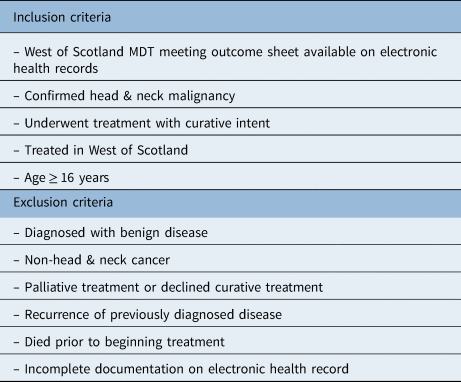
Only patients diagnosed with a true, de novo head and neck cancer, who received treatment with curative intent, were considered for inclusion. Inclusion and exclusion criteria are fully detailed in Table 1. After application of these criteria, 118 patients in 2019 and 118 patients in 2020 were considered suitable for analysis.
Inclusion and exclusion criteria applied to head and neck cancer referrals

MDT = multidisciplinary team
Pathway times with respect to the 31-day and 62-day targets were calculated for each referral pathway: urgent suspicion of cancer, urgent out-patient, routine out-patient, secondary care and emergency presentations. The numbers of patients who met the 31-day time-to-diagnosis and 62-day time-to-treatment targets were compared.
This audit was agreed by our clinical governance department. All data were stored with consideration to Caldicott Guardian principals. Ethical approval was not required in our institution as this is an audit of clinical practice.
Results
Demographics
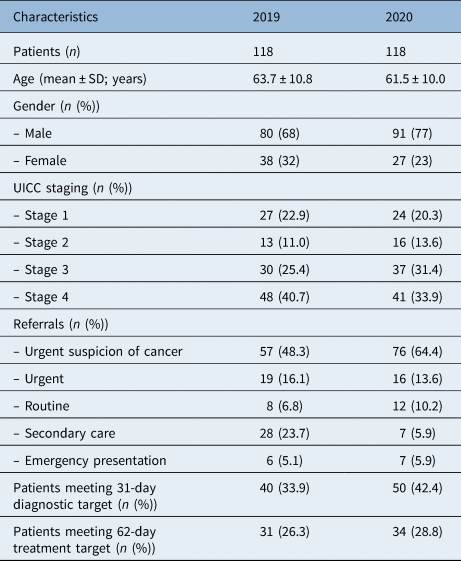
In 2019, 80 (67 per cent) of the 118 patients were male and the mean age was 63.7 years. The most common stage of disease presentation was stage 4.
In 2020, 91 (77 per cent) of the 118 patients were male and the mean age was 61.5 years. The most common stage of disease presentation was stage 4, as highlighted in Table 2.
Head and neck cancer patient demographics in 2019 and 2020
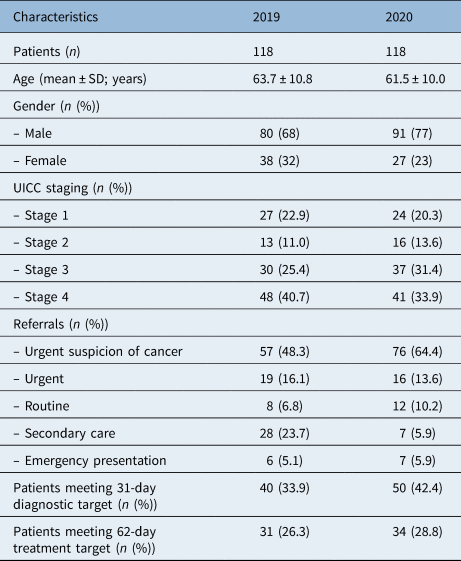
SD = standard deviation; UICC = Union for International Cancer Control
Urgent suspicion of cancer pathway
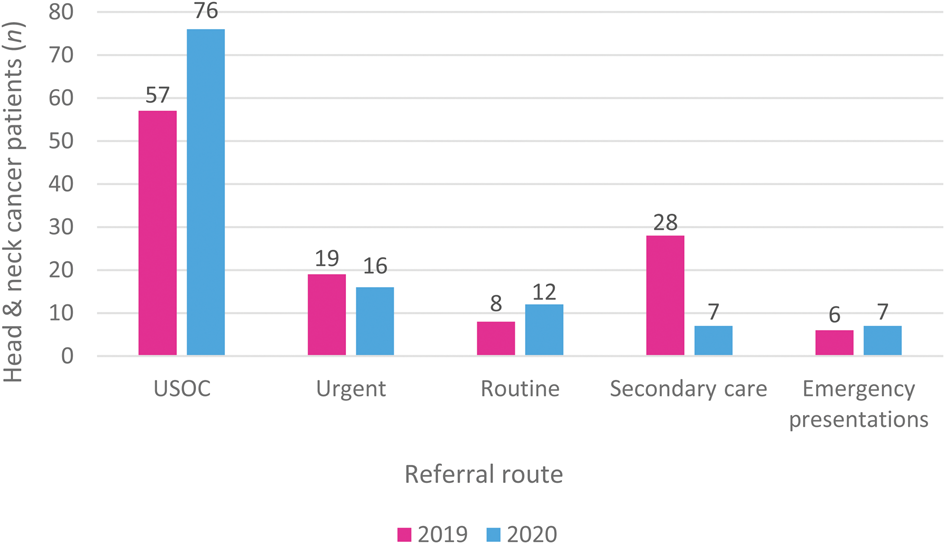
Most patients referred with head and neck cancer were referred through the urgent suspicion of cancer pathway. This remained consistent between the study periods, with 57 patients (48.3 per cent) in 2019 and 76 patients (64.4 per cent) in 2020. There was a 33.3 per cent statistically significant (p = 0.013) increase in cancers in urgent suspicion of cancer referrals during the first wave of the Covid-19 pandemic in 2020, as illustrated in Figure 1.
West of Scotland head and neck cancer patients split by referral route during March–May 2019 and March–May 2020. USOC = urgent suspicion of cancer

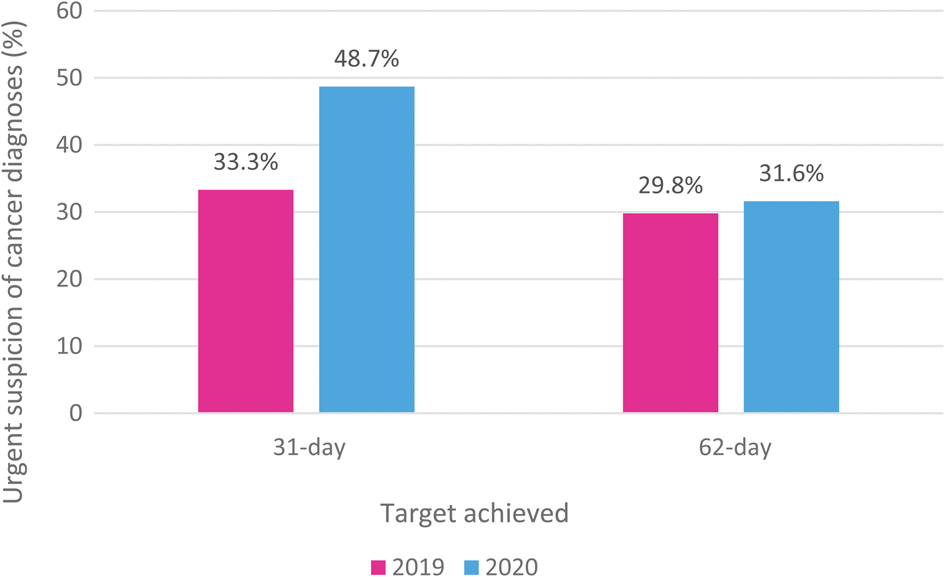
In 2019, 19 patients (33.3 per cent) met the 31-day time-to-diagnosis target, and 17 patients (29.8 per cent) achieved the 62-day time-to-treatment target. In 2020, 37 patients (48.7 per cent) were diagnosed within 31 days, and 24 (31.6 per cent) began treatment within 62 days, as shown in Figure 2. No significant difference was found using chi-square tests for time-to-diagnosis (p = 0.076) or time-to-treatment (p = 0.828) between the study periods.
Comparison of urgent suspicion of cancer 31-day diagnosis and 62-day treatment times between March–May 2019 and March–May 2020.

Urgent out-patient referral pathway
Nineteen patients (16.1 per cent) were referred as an urgent out-patient in 2019, compared with 16 patients (13.6 per cent) in 2020. In 2019, four patients (21.1 per cent) met the 31-day time-to-diagnosis target and one patient (5.3 per cent) met the 62-day time-to-treatment target. In 2020, four patients (25.0 per cent) met the 31-day time-to-diagnosis target and four patients (25.0 per cent) met the 62-day time-to-treatment target. Using Fisher's exact test, no significant difference was found in time-to-diagnosis (p = 1) or time-to-treatment (p = 0.156) between the study periods.
Routine out-patient referral pathway
In the routine out-patient referral cohort, only 1 of the 8 patients (12.5 per cent) in 2019 met the 31-day time-to-diagnosis target, compared to only 1 of the 12 patients (8.3 per cent) in 2020. There was no significant difference (p = 1) using Fisher's exact test. In 2019, one patient (12.5 per cent) met the 62-day time-to-treatment target, while in 2020, zero patients (0 per cent) met the target. Again, no significant difference was identified (p = 0.4) using Fisher's exact test.
Referrals from secondary care specialties
In 2019, 28 patients with head and neck cancer were referred from secondary care, and 11 patients (39.3 per cent) met the 31-day time-to-diagnosis target. In 2020, seven patients with head and neck cancer were referred from secondary care, and two patients (28.6 per cent) met the time-to-diagnosis target, with no significant difference found (p = 0.689, Fisher's exact test). The 62-day time-to-treatment target was met by nine patients (32.1 per cent) in 2019, compared to one patient (14.3 per cent) in 2020, with no significant difference found (p = 0.645, Fisher's exact test). Table 2 shows a statistically significant (p < 0.01), 75 per cent reduction in patients with head and neck cancers referred from secondary care in 2020 compared with 2019.
Presentations via emergency department
In 2019, there were six patients with diagnosed head and neck cancers referred from the emergency department, compared with seven patients in 2020. In 2019, five patients (83.3 per cent) met the 31-day time-to-diagnosis target, compared to six patients (85.7 per cent) in 2020 (p = 1, Fisher's exact test). In 2019, the 62-day time-to-treatment target was met by three patients (50 per cent), compared to five patients (71.4 per cent) in 2020 (p = 0.592, Fisher's exact test).
Discussion
Main clinical findings
Urgent suspicion of cancer, and urgent and emergency referral pathways demonstrated increased compliance with the 31-day time-to-diagnosis and 62-day time-to-treatment targets during the UK national lockdown. The cancellation of all elective and non-emergency work during the first wave of the Covid-19 pandemic resulted in a shift of NHS service provision towards Covid-19, emergency care and urgent cancer work. While the outcomes of these improvements to the pathways were not statistically significant, our study shows that head and neck cancer pathways did not suffer during the Covid-19 pandemic, and in fact may have benefitted from the streamlining of services.
As demonstrated in Figure 1, there was a significant reduction in the volume of patients referred with head and neck cancer from secondary care during the first wave of the Covid-19 pandemic. The reasons for this are unclear, but face-to-face appointments in other secondary care services were suspended, which potentially led to fewer referrals. Innovations introduced to enhance the running of out-patient clinics, radiology services, MDT meetings and operating theatre schedules resulted in reduced waiting times, and facilitated earlier diagnosis and access to treatment in 2020. In comparison, the same patient pathway in 2019 required multiple appointments to achieve the same results, delaying the process.
Urgent suspicion of cancer pathway
There are several issues with the urgent suspicion of cancer pathway that affect its ability to meet the 31- and 62-day targets. For instance, the number of referrals continues to increase year on year. In 2015, NHS Greater Glasgow and Clyde received 2200 urgent suspicion of cancer referrals within one year; by 2019, this number had risen to 4300.
The reasons for this increase are unclear. In our study, before any inclusion or exclusion criteria were applied, we received 141 (68.1 per cent) and 134 (72.4 per cent) urgent suspicion of cancer referrals in March–May 2019 and in March–May 2020 respectively. However, the 2020 figures represent the first wave of the pandemic when NHS care was focused on emergency and urgent cancer work, which undoubtedly led to fewer head and neck cancer referrals. There is some evidence to suggest that this rise may be accounted for by increased health-seeking behaviours in women (most urgent suspicion of cancer attenders are female) and by primary care physicians’ fear of medicolegal action associated with non-referral.Reference Zeitler, Fingland, Tikka, Douglas and Montgomery5,Reference McKie, Ahmad, Fellows, Meikle, Stafford and Thomson12 In addition, publication of the revised Scottish Referral Guidelines for Suspected Cancer in 2019 may have increased awareness of cancer red flag features in primary care.4
Poor compliance with red flag criteria by referrers leads to increasing numbers of inappropriate referrals via the urgent suspicion of cancer referral pathway. This results in a system that is over-burdened by low-risk patients, with poorer access for those most in need. In contrast, referrals that ought to be urgent suspicion of cancer referrals are often made via alternative pathways.4,Reference Tikka, Kavanagh, Lowit, Jiafeng, Burns and Nixon13 For example, only 56.4 per cent of the referrals in our study were urgent suspicion of cancer referrals.
Impact of coronavirus on cancer service delivery
Flexible laryngoscopy is an essential examination in a head and neck cancer diagnostic clinic. This is an AGP, as the laryngoscope needs to pass through the upper aerodigestive tract, where the viral load of the severe acute respiratory syndrome coronavirus 2 (SARS-CoV-2) virus, if present, is high.7,Reference Jackson, Deibert, Wyatt, Durand-Moreau, Adisesh and Khunti8 Flexible laryngoscopy therefore requires level 3 PPE to be worn, and the procedure needs to be carried out in a space where frequent room air changes are possible. No such facility was available in NHS Greater Glasgow and Clyde. This limited the number of patients that could be seen during each clinic.Reference Bann, Patel, Saadi, Gniady, Goyal and McGinn14–Reference Lammers, Lea and Westerberg16 Nevertheless, our study shows that head and neck cancer pathway times did not suffer as a result of these changes.
The Covid-19 pandemic brought many changes to the running of head and neck cancer services in the West of Scotland. Enhanced vetting was implemented, with all patients undergoing telephone triage by a head and neck consultant prior to their face-to-face clinic appointment. This facilitated the assessment of high-risk patients with true red flag symptoms sooner than if conducted prior to the pandemic, as the telephone triage system filtered out the high volume of low-risk referrals with no true red flag features of head and neck malignancy.6
Another service-enhancing adaptation that developed following the onset of the pandemic was the prospective cover for all diagnostic clinics provided by our radiology colleagues. Being able to offer same-day ultrasound-guided biopsies from the out-patient clinic contributed to the reduced time-to-diagnosis in 2020 compared to the same period in 2019.
Given the reduced access to the operating theatre, the schedules for the most urgent cases were pooled; this was an additional innovation that sped up the time to tissue diagnosis. Patients requiring a general anaesthetic for a staging panendoscopy were able to undergo this sooner than in 2019, reducing the time-to-diagnosis and the initiation of treatment.
The changes implemented to the head and neck cancer service during the Covid-19 pandemic were dependent on seamless interdepartmental collaboration between surgery, radiology and pathology departments, with a strong intradepartmental focus on teamwork, effective communication and flexibility among the consultants in one of the largest UK ENT departments.
• Head and neck cancer is rapidly progressive, requiring prompt diagnosis and treatment
• There was a significant increase in urgent suspicion of head and neck cancer referrals during the coronavirus disease 2019 pandemic
• The classification of flexible laryngoscopy as an aerosol-generating procedure has had a considerable logistical impact on ENT out-patient departments
• Restructuring service provision for head and neck cancer pathways improved time-to-diagnosis and time-to-treatment during the pandemic
• Most patients do not meet the 31-day and 62-day targets of Scottish Government guidance
Ability to meet targets
Despite the general improvements to head and neck cancer pathways in 2020, the majority of all patients (87 patients (73.7 per cent) in 2019 and 84 patients (71.2 per cent) in 2020) did not meet their 31- and 62-day targets. This is a real-world audit that included all patients with new cancers, many of whom are not traditionally ‘tracked’ as part of targets, for example, unknown primary head and neck cancer cases. Many of the innovations brought in as a response to the Covid-19 pandemic have been dismantled as services return towards normal. We hope that some of the experience gained during the pandemic in terms of cancer pathway times can be used in the longer term to benefit our patients.
Conclusion
In 2020, we observed non-statistically significant improvements in the 31- and 62-day diagnosis and treatment targets for head and neck cancer in all pathways except for routine and secondary care referrals. However, the secondary care referral pathway saw a significant decline in referrals during the UK's first national lockdown. During the first wave of the Covid-19 pandemic, all non-emergency clinical care was initially suspended, which subsequently led to delays in the routine and secondary care referral pathways, but which resulted in better streamlined pathways for urgent suspicion of cancer and urgent referrals.
Irrespective of the impact of the Covid-19 pandemic, our ability to meet 31- and 62-day targets remains poor, with a minority of patients meeting targets across all referral pathways; treatment initiation times of 3 months are not uncommon. Urgent efforts to overhaul the head and neck cancer diagnostic and treatment pathways are required.
Competing interests
None declared