Introduction
A growing number of elderly individuals spend the end-of-life in nursing homes (NHs), which means that healthcare professionals (HCPs) increasingly encounter residents who are close to death and may benefit from palliative-oriented care (Currow et al., Reference Currow, Phillips and Agar2017). However, prognostication of death remains challenging due to multimorbidity, and this can lead HCPs to avoid conversations about death and dying until the dying process has already started (Krawczyk and Gallagher, Reference Krawczyk and Gallagher2016). This tendency is also reflected in the low prevalence of advance directives (Gonella et al., Reference Gonella, Basso and Dimonte2019b) and the extremely sparse documentation in medical charts of discussions between families and HCPs about the possibility of death (Bern-Klug, Reference Bern-Klug2006).
Indeed, it is not uncommon for NH residents to die without ever being considered at the end-of-life (Bern-Klug, Reference Bern-Klug2004). This leads to the adoption of life-prolonging, curative-oriented treatments (Di Giulio et al., Reference Di Giulio, Toscani and Villani2008) that may conflict with residents’ wishes for a natural death (Bollig et al., Reference Bollig, Gjengedal and Rosland2016) and the preference of family carers (FCs) for palliative-oriented care, as well as contribute to increased suffering due to unmet physical, emotional, spiritual, and existential needs (Morin et al., Reference Morin, Johnell and Van den Block2016; Frey et al., Reference Frey, Foster and Boyd2017).
Residents whose death is expected in the near future are compromised to the point that unforeseen acute events, such as pneumonia, urinary infections, or falls may lead to death (Mitchell et al., Reference Mitchell, Teno and Kiely2009). These sudden changes have been described as trigger events and represent an opportunity to discuss the resident's prognosis, needs, and care goals (Bern-Klug, Reference Bern-Klug2006). FCs are best placed to identify changes in their relative's health (Powell et al., Reference Powell, Blighe and Froggatt2018). When they notice deteriorations, it prompts an awareness that their relative may be close to death and can help HCPs open a conversation on the topic (Gjerberg et al., Reference Gjerberg, Lillemoen and Førde2015). The involvement of FCs is even more important for residents with cognitive impairments who cannot express their distress (Lo et al., Reference Lo, Wang and Liu2010). However, despite their pivotal role in noticing deteriorations in their relative's health, FCs are not always able to take stock of the situation and need HCPs to help them understand the evolution of the clinical situation (Fosse et al., Reference Fosse, Schaufel and Ruths2014).
The NH environment and the relationships between HCPs may have an impact on the identification of trigger events and the attitudes surrounding end-of-life care decisions (Wallace et al., Reference Wallace, Adorno and Stewart2018). An environment that promotes communication and mutually supportive partnerships between FCs and HCPs (Gonella et al., Reference Gonella, Basso and De Marinis2019a), and among HCPs themselves (Corazzini et al., Reference Corazzini, Twersky and White2014), can help FCs more easily identify trigger events and sustain the transition towards palliative-oriented care (Gonella et al., Reference Gonella, Basso and Dimonte2019b).
Trigger events, NH environment, and HCP relationships can be captured by the experiences of FCs who are actively engaged in their relative's care (Wallace et al., Reference Wallace, Adorno and Stewart2018; Gonella et al., Reference Gonella, Basso and De Marinis2019a), but the perspective of FCs on these issues has been poorly investigated (Forbes-Thompson and Gessert, Reference Forbes-Thompson and Gessert2005; Bern-Klug, Reference Bern-Klug2006). Learning more about these perspectives will ensure that HCPs in NHs have a more comprehensive understanding of how FCs experience the change in their relative's care goals. Therefore, we explored contributors to bereaved FCs’ decision to transition towards palliative-oriented care for their relatives in NH, including (a) trigger events, (b) NH environment, and (c) HCP relationships.
Methods
Study design
This phenomenological study followed the Consolidated criteria for Reporting Qualitative research to report methodological aspects (Tong et al., Reference Tong, Sainsbury and Craig2007).
Setting and recruitment
Fifty-two NHs located in Northwest Italy were purposively sampled by geographical area and size and invited to participate in the study; 20 agreed. FCs from participating NHs were eligible for inclusion if (a) they belonged to the family unit (e.g., spouse/partner, sibling, son/daughter, niece/nephew, or grandchild), (b) were willing to participate, (c) their relative had spent the last 30 days of their life in NH, and (d) their relative had died 45 days–9 months before study start. Eligible FCs were identified by the NH director with the support of HCPs and contacted according to NHs’ preferences: (1) by phone after preliminary contact by the NH director who provided an explanation of the study aims and requested permission for contact; (2) by phone and interview directly scheduled by the NH director; or (3) by a personalized letter of condolence with a brief presentation of the study aims and the phone number of researchers that FCs could call if interested. In all, 32 FCs from 13 participating NHs agreed to take part in the study.
Data collection
Between December 2018 and May 2019, each participating FC attended a semi-structured, in-depth, open-ended interview with follow-up questions, conducted by one of two trained female nurses who were not affiliated with participating NHs. The interview guide was refined after the first 10 interviews. To provide an in-depth view of the events prior to death and capture changes in residents’ care, FCs were asked to “tell the story” of their relative's death (Supplementary Table S1). Probing questions regarding trigger events, symptom control, satisfaction with symptom management and end-of-life care, perceived support from HCPs, and NH environment were structured to elicit narratives in the interviewees’ own words (Supplementary Table S1). Interviews also collected data on FCs’ demographics; their relationship to the resident; and frequency of visits; they were audio-recorded, lasted 21–58 min (median 32 min), and took place at a location chosen by the interviewee.
Data on NH residents’ characteristics were collected from clinical records: demographics; comorbidities; curative-oriented treatments in the last week of life (access or call to the emergency services, hospitalization, cardiopulmonary resuscitation, intravenous hydration, parenteral or enteral nutrition, blood test, and invasive procedures, such as peripheral cannulation, bladder catheter, and glycemic monitoring); palliative-oriented treatments in the last week of life (assessment of pain/discomfort, hypodermic hydration, oral therapy withdrawal, oxygen therapy, opioid analgesics, oral aspiration, and palliative sedation); antibiotics (considered separately, as it was not possible to determine the reason for their prescription); cause of worsening conditions; and cause of death.
Finally, information on NH characteristics was collected from a semi-structured questionnaire completed by the NH director: structure variables (e.g., public or private NH, number of beds available, staffing); process variables (e.g., formal end-of-life communication with FCs, written procedures, HCPs involved in updating the resident's care plan); and outcome variables (supplemental initiatives/complementary therapies, referral of residents to palliative care services — PCS, i.e., hospice or to an outside, local team of experienced and trained HCPs who provided home-based palliative care — in the 6 months before study start).
Transcription and qualitative data analysis
Two researchers transcribed interview recordings verbatim. To guarantee the accuracy, another researcher checked a random sample of transcripts, and participants could also review transcripts. Nine participants requested copies of transcripts and two were returned with minor revisions (e.g., grammatical or syntax errors). The full research team (a doctoral candidate in nursing with post-graduate specialization in bioethics with experience in qualitative research; a nurse experienced in NH end-of-life care; a postdoctoral researcher in nursing with expertise in qualitative methods; and a professor in nursing experienced in end-of-life care research) analyzed interview transcripts shortly after each interview using ATLAS.ti 6.2 software. Content analysis (Graneheim and Lundman, Reference Graneheim and Lundman2004) with a combined inductive (Boyatzis, Reference Boyatzis1998) and deductive (Crabtree and Miller, Reference Crabtree, Miller, Crabtree and Miller1992) approach was applied. Firstly, an inductive coding approach (Boyatzis, Reference Boyatzis1998) was independently performed by two researchers as follows: (1) familiarization with data — interview transcripts were read carefully and repeatedly; (2) identification of meaning units — interesting features of the data were identified in a systematic fashion; and (3) condensation — meaning units were collated into codes. To ensure that all relevant text had been identified, all transcripts were reread as new codes were developed. Secondly, a deductive approach (Crabtree and Miller, Reference Crabtree, Miller, Crabtree and Miller1992) was applied by fitting the identified codes into the “Family carers’ perspective of good end-of-life care in NH” framework (Gonella et al., Reference Gonella, Basso and De Marinis2019a). All members of the research team were involved in frequent meetings to discuss the codes, how they fit in the selected framework, and illustrative quotations until a consensus was reached. When the codes did not fit the given framework, they were grouped into new categories according to their similarities; homogeneous categories were finally gathered into themes, which supplemented the original framework. Themes are illustrated by participant quotations, which are identified by an alphanumeric code indicating the NH and the FC (e.g., NH1/FC1, NH1/FC2, NH2/FC4 … ), and the type of care provided (palliative-oriented or curative-oriented).
Quantitative data analysis
Quantitative data analysis was performed on demographic variables, clinical information, structure variables, process variables, and outcome variables. Descriptive statistics were performed by computing frequencies, percentages, mean with standard deviation or range, and median with interquartile range (IQR). To capture differences in context characteristics, participating NHs were categorized as having (n = 6) or not having (n = 7) referred residents to PCS in the 6 months before study start.
Results
FC and resident characteristics
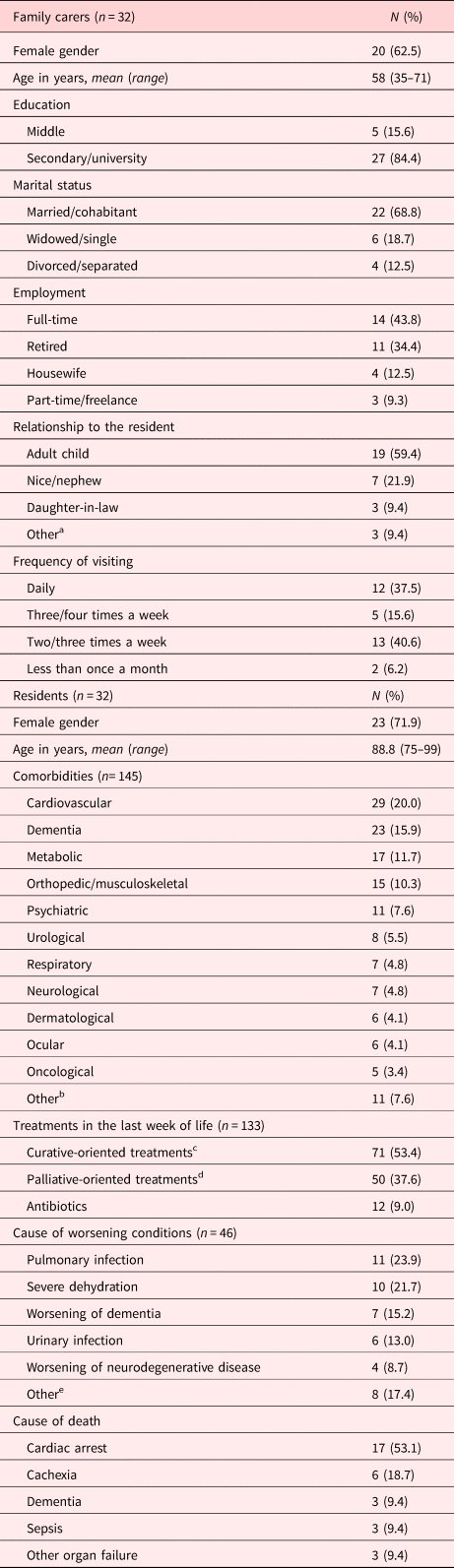
Interviews were recorded a median of 106 (IQR 68–175) days after the resident's death, and two FCs had their interview by telephone. Most interviewees were female adult children (mean age: 58 years, range 35–71). Most residents were female (71.9%) and aged 85 years or older (29/32). The median NH stay was 18 (IQR 5–36) months (Table 1).
Family carer and nursing home resident characteristics

a Sister-in-law (1), cousin (1), wife (1).
b Septic (4), renal (4), hepatic (1), gastric (1), rheumatic (1).
c Intravenous hydration (24), blood test (12), peripheral cannulation (11), call to the emergency services (6), bladder catheter (6), access to the emergency services (5), glycemic monitoring (2), parenteral nutrition (2), enteral nutrition (1), cardiopulmonary resuscitation (1), hospitalization (1).
d Oxygen therapy (15), assessment of pain/discomfort (13), hypodermic hydration (11), oral therapy withdrawal (4), opioid analgesics (4), oral aspiration (2), palliative sedation (1).
e Fall (3), ab ingestis (2), worsening of respiratory disease (2), pressure ulcer infection (1).
NH characteristics
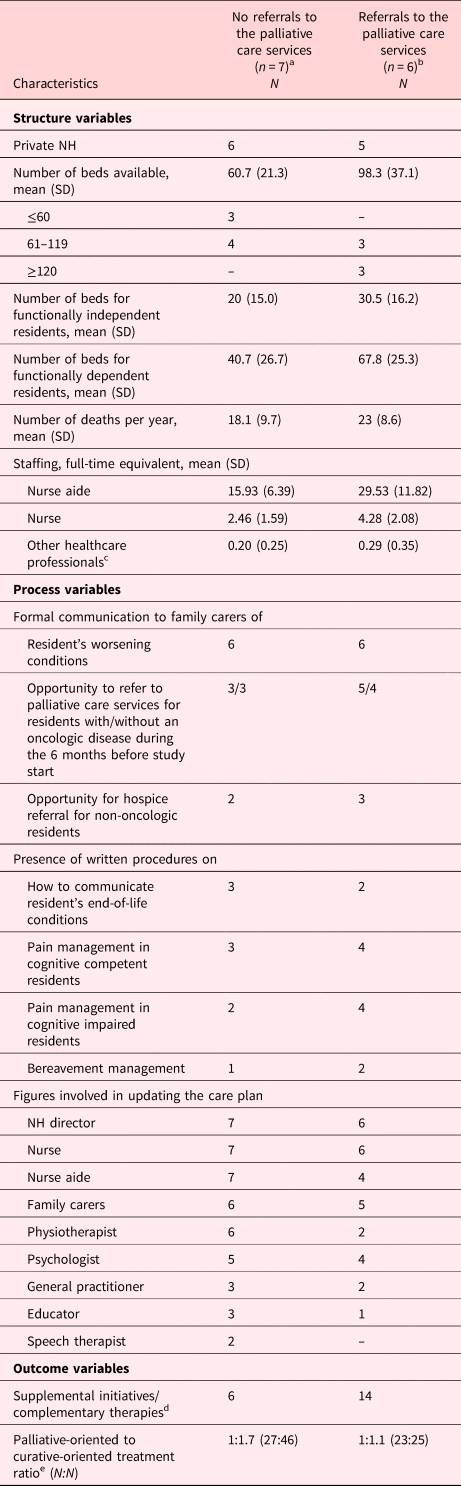
All NHs had the opportunity to refer residents to PCS using general practitioners as intermediaries. When looking at structure variables, the 6 NHs that had referred residents to PCS in the 6 months before study start were generally larger and had a lower nurse-to-resident (1:23 vs. 1:24.7) and nurse aide-to-resident (1:3.3 vs. 1:3.8) ratios than the 7 NHs that did not. No NHs had internal physicians, instead, they relied on outside general practitioners. In all, 2/6 (10% of the overall staff for both) and 3/7 (4%, 30% and 80% of the overall staff, respectively) NHs employed contract workers. No participating NHs had beds for hospice care, while two had an Alzheimer unit (one in each group) (Table 2).
NH characteristics according to referral of residents to palliative care services in the 6 months before study start

NH, Nursing home; SD, Standard deviation.
a NH1, NH2, NH4, NH5, NH7, NH9, NH11.
b NH3, NH6, NH8, NH10, NH12, NH13.
c Among the NHs that did not refer residents to palliative care services: physiotherapist (n = 7), psychologist (n = 6), educator (n = 5), speech therapist (n = 3), occupational therapist (n = 1). Among the NHs that referred resident to palliative care services: physiotherapist (n = 6), psychologist (n = 5), educator (n = 5), speech therapist (none), occupational therapist (n = 1).
d The sum is greater than the total since some NHs offered more than one additional initiative/complementary therapy. Among the NHs that did not refer residents to palliative care services: garden therapy (n = 2), pet therapy, reading projects, smile therapy, and music therapy (n = 1 each). Among the NHs that referred residents to palliative care services: pet therapy (n = 2), garden therapy (n = 2), gentle exercises classes (n = 2), validation method, neuro-cognitive tele-rehabilitation, reading projects, collaborations with the alpine choir, projects with elementary schools, yoga, self-help groups for family carers, and smile therapy (n = 1, each).
e The palliative-oriented to curative-oriented treatments ratio indicates the relationship between the provision of palliative-oriented treatments (i.e., assessment of pain/discomfort, hypodermic hydration, oral therapy withdrawal, oxygen therapy, opioid analgesics, oral aspiration, and palliative sedation) and curative-oriented treatments (i.e., call to the emergency services, access to emergency department, hospitalization, cardiopulmonary resuscitation, intravenous hydration, parenteral or enteral nutrition, blood test, peripheral cannulation, bladder catheter, and glycemic monitoring) on an overall level. The absolute number of palliative-oriented and curative-oriented treatments is shown in brackets.
Investigation of process variables showed that only one NH that had referred residents to PCS in the 6 months before study start provided formal training in palliative care in the last 12 months. Formal communication about resident's worsening condition was generally provided to FCs, while the opportunity to refer residents to PCS was more frequently discussed in the NHs that did it. Written procedures on how to communicate resident's end-of-life conditions, pain management, and bereavement management were poor. FCs were largely involved in updating their relative's care plan (Table 2).
Finally, outcome variables showed that palliative-oriented treatments, supplemental initiatives (e.g., self-help groups for FCs), and complementary therapies (e.g., pet therapy) were more frequently offered in NHs that had referred residents to PCS in the 6 months before study start (Table 2).
Qualitative findings
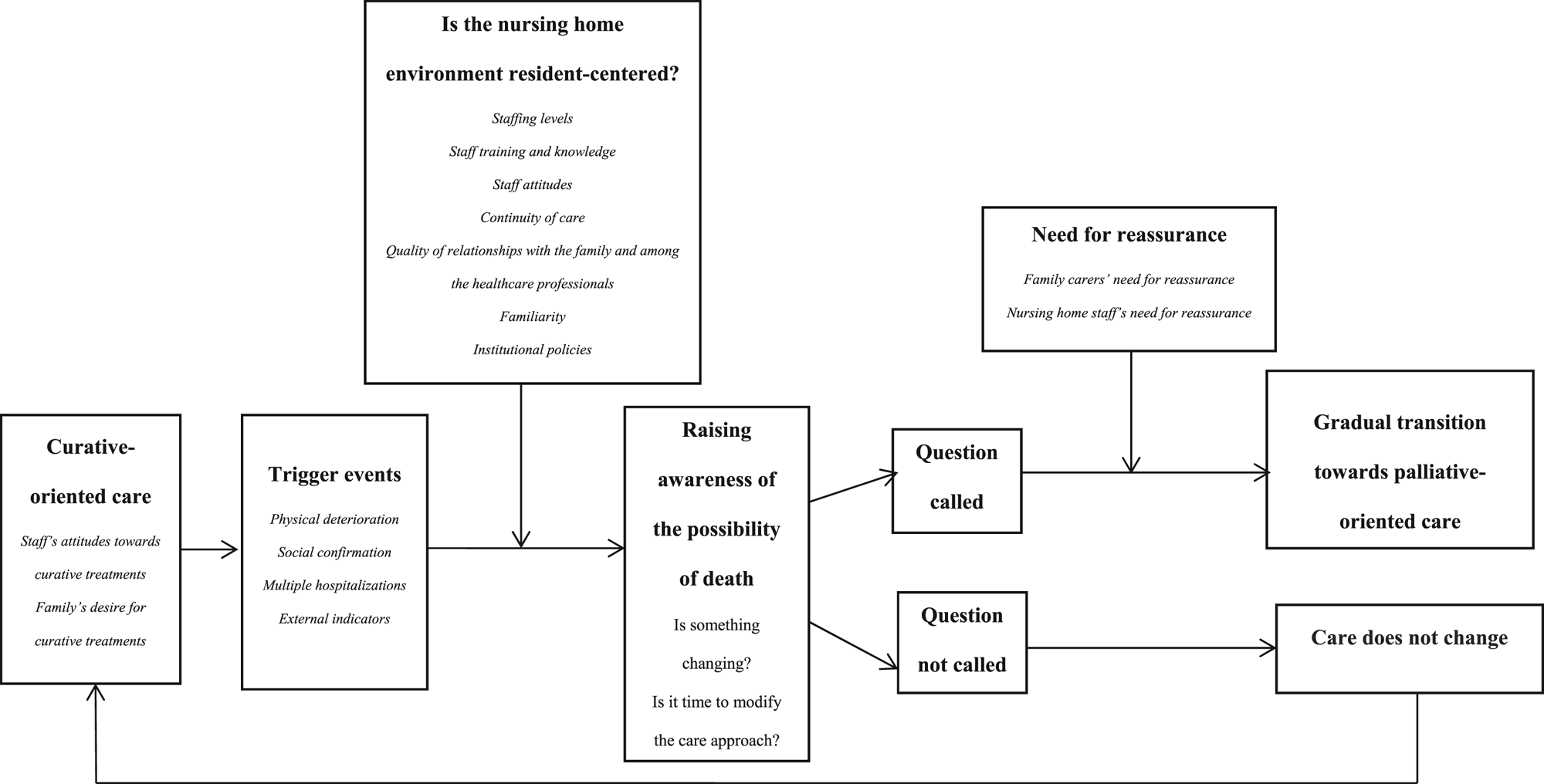
The original conceptual model (Gonella et al., Reference Gonella, Basso and De Marinis2019a) had to be adapted and finally consisted of 6 themes and 17 categories that described contributors to FCs’ decision to transition towards palliative-oriented care (Figure 1, Supplementary Table 2).
Transition towards palliative-oriented care in nursing home according to family carers’ perspective. Note: A trigger event may cause family carers to doubt that their relative will recover. Whether the trigger event is recognized, provokes doubt, and contributes to a transition towards a palliative-oriented approach, may partly depend on a resident-centered nursing home environment. Moreover, even if the trigger event is recognized, family carers and nursing home staff need to be reassured that the transition towards a palliative-oriented approach is the right decision before adjusting the care plan. Whether the trigger event is not recognized and does not provoke doubt that the family member will recover, care does not change and the resident continues to receive a curative-oriented care.

Trigger events
FCs reported four types of trigger events that made them doubt that their relative would recover: (1) physical deterioration; (2) social confirmation; (3) multiple hospitalizations; and (4) external indicators. Physical deterioration trigger events, such as stopping eating/walking, or swallowing problems, but also losing weight, breathing distress, stopping drinking, loss of responsiveness, fluid retention, and glycemic alterations, were frequently reported. The relative's relocation to another dining table or to a floor with residents in need of more support also promoted awareness of a worsening condition. Social confirmation trigger events were described as a discussion with friends who had lost a family member that confirmed FCs’ thoughts about their relative's condition, or the need to call their relative daily to check on their situation. Multiple hospitalizations (admissions to the emergency department or hospital) in a short period, as well as ward transfers during hospital stays, were reported and also served as trigger events. Finally, although less frequently, external indicators, i.e., medical examination by external consultants (e.g., geriatrician) or at hospital discharge after emergency hospital admission acted as a trigger event. However, these external indicators often occurred too late to lead to the provision of palliative-oriented care.
Participants commonly reported more than one trigger event, particularly physical deterioration trigger events:
“I said, ‘Mom, do you want to eat?’. She answered, ‘no’. Then, when I brought the spoon to her mouth to feed her, she clenched her teeth and ate nothing [ … ] I knew she couldn't go on for a long.” (NH11/FC27/ palliative-oriented care)
“I called my dad almost every day to ascertain how he was, I knew he wouldn't live long.” (NH1/FC3/palliative-oriented care)
“We were careful to perceive any signal that suggested a worsening of my father's conditions, since in his last months of life he had had at least a dozen sudden hospitalizations to the emergency department.” (NH8/FC19/curative-oriented care)
“I started to talk about my father's worsening condition with the NH director after my father received a check-up from an external consultant.” (NH8/FC19/curative-oriented care)
Resident-centered NH environment
FCs reported that a resident-centered NH environment played an important role in helping them recognize trigger events and promote the transition towards palliative-oriented care. Factors that could act as barriers or facilitators to providing resident-centered care were connected to (1) staffing levels; (2) staff training and knowledge; (3) staff attitudes; (4) continuity of care; (5) quality of relationships with the family and among HCPs; (6) familiarity; and (7) institutional policies.
FCs perceived nurses as knowledgeable and experienced and were generally satisfied with HCPs’ caring attitudes (e.g, availability, carefulness, discretion, kindness, patience):
“The nurses were trained and immediately saw if something got worse. I would not have had their competence.” (NH2/FC5/curative-oriented care)
Poor staffing negatively impacted perceived care quality. In contrast, low nurse turnover and continuity of care across shifts and health services (e.g., hospital-NH, external consultants-NH) contributed to prompt care and promoted communication:
“The [NH staff] was very small; at night their numbers were ridiculous. It seems to me that there were only two staff members for all the residents […] my uncle got worse during the night, and no one noticed him.” (NH7/FC16/curative-oriented care)
“The physicians changed at lightning speed, while there was more continuity among the nurses. They [nurses] changed too, but someone I knew was always there, so I could communicate with them.” (NH7/FC16/curative-oriented care)
Similarly, good collaboration among HCPs and FCs’ involvement improved the quality of relationships and the extent of FCs’ awareness of their relative's condition. These informal, friendly relationships between HCPs and FCs that felt constantly updated (e.g., during daily care activities) without the need for scheduled meetings favored a familiar atmosphere. They promoted FCs’ awareness of impending death and unnecessary treatments and their involvement in decisions:
“Sometimes I went to the nurse to tell her what the doctor had said. We communicated in this way. She knew that I knew.” (NH1/FC3/palliative-oriented care)
“We were in very close contact with them [NH staff]. We often went there [to the NH] to see how things were going, there was always someone that updated us about what was happening.” (NH1/FC2/palliative-oriented care)
Institutional policies characterized by limited bureaucracy and allowing FCs to stay at their relative's bedside without any time restrictions promoted the perception of warm and supportive care:
“I appreciated the opportunity to move around freely. The NH staff let me go to my mother-in-law's room at any time; I could visit her whenever I wanted. It was a bit like going to her house.” (NH11/FC28/palliative-oriented care)
Raising awareness of the possibility of death
Preferences for end-of-life care were mostly discussed once the resident's condition had clearly worsened, and this discussion was usually initiated by HCPs. These preferences were rarely discussed at admission, since at that time, FCs perceived their relative's condition as stable:
“After the second visit to the emergency department, we realized that her conditions had worsened. Then both the nurse and the physician asked us our preferences if she worsened further, whether they should call emergency services and have her taken to the hospital or keep her in the NH.” (NH3/FC7/palliative-oriented care)
“We addressed the issue of treatment preferences when conditions worsened, because before that, there were no problems, and we had not thought about it.” (NH5/FC11/palliative-oriented care)
However, it should not be taken for granted that these discussions always take place. The daughter of a 91-year-old man with dementia reported that:
“No one ever asked us [our preferences for end-of-life care], but I also didn't think that a decision had to be made at a specific moment. I did not feel that I had to make a decision, because no machine had to be turned off nor a cure be started.” (NH1/FC1/curative-oriented care)
In this case, the resident stopped eating, but neither the HCPs nor the FCs initiated any discussion about changing health conditions.
Need for reassurance
After the trigger event was recognized, both FCs and HCPs needed reassurance that transitioning towards palliative-oriented care was the right decision before the care plan was adjusted. In some situations, FCs sought the opinion of HCPs external to the NH; in others, the NH director asked for additional consultations:
“I phoned one of my mum's dear friends who was a physician, explained the situation to him and asked him what he thought. He said, ‘When my mum was at that point, I let her go’. Then I called a physician friend of mine who told me the same thing. The following morning, I went to the NH and told the NH director, ‘Probably it's time to let her go’.” (NH6/FC15/palliative-oriented care)
“The NH director told me, ‘In addition to your general practitioner, I asked another person that works here if your sister-in-law may benefit from hospitalization, and she answered, ‘Listen to me, definitely not’.” (NH1/FC2/palliative-oriented care)
Gradual transition towards palliative-oriented care
When the trigger event was recognized, and FCs were reassured about the transition towards palliative-oriented care, their relative's care plan was more likely to be adjusted. Most FCs reported that oral therapy was stopped and their relative was sustained by hypodermic hydration; the residents received psychosocial and spiritual support and died peacefully without distressing symptoms:
“She died without edema, without dyspnea, without pain, she didn't complain at all.” (NH11/FC27/palliative-oriented care)
“I went to her room and was pleasantly surprised that the priest had been already called for last rites, I knew she desired it.” (NH1/FC2/palliative-oriented care)
Several interviewees said they received both practical (e.g., tasks related to the funeral planning) and emotional support from NH staff, including the director and the secretary:
“The NH director realized that each kind word was like a balm for me. The NH secretary maybe even more so. Her door was always open for me to share some chocolate, some small talk, or for help with any paperwork.” (NH10/FC23/palliative-oriented care)
Curative-oriented care
When the trigger event was not recognized, the resident often continued to receive curative-oriented care.
Some FCs reported the desire to make every possible effort for their relative:
“I'm in favor of anything that prolongs life. I never said, ‘Let her go to her destiny’. I always said, ‘Let's try to do everything possible’.” (NH11/FC26/curative-oriented care)
Curative-oriented care was usually sustained by FCs’ poor awareness of their relative's impending death, as suggested by the case of this daughter of a 99-year-old woman with heart failure:
“On Monday, my mother was taken to the emergency department because of her worsening heart failure. She received care and her vital signs went back to normal. The following day, she had another attack, and the nurse told me ‘Her vital signs are modified, it's better to call emergency services’, and I agreed with her [ … ] I did not imagine that she would be dead on Saturday.” (NH2/FC4/curative-oriented care)
Discussion
This study depicts the transition towards palliative-oriented care in NHs from the perspective of FCs. Four types of trigger events (i.e., physical deterioration, social confirmation, multiple hospitalizations, and external indicators) that may represent an opportunity to discuss changes in a resident's health status and the need to adjust the care plan were identified. Moreover, our findings highlighted the role of the NH environment and HPC relationships in facilitating or hindering the identification of these triggers and provoking a discussion about whether care goals should be changed.
Consistent with previous literature, trigger events as physical deterioration (Bern-Klug, Reference Bern-Klug2006; Waldrop and Kusmaul, Reference Waldrop and Kusmaul2011; Frey et al., Reference Frey, Foster and Boyd2017) and multiple hospitalizations (Glass, Reference Glass2016) prompted FCs to doubt that their relative would recover. Our findings highlighted some new trigger events, such as discussions between FCs and friends who had lost a family member that confirmed FCs’ thoughts about their relative's condition, the need to make daily phone calls to their relative to check on changes in their health condition, and the role of external consultants in raising awareness of the possibility of death and the need to adjust the care plan.
Our findings suggest that when the trigger event was recognized and a discussion took place, care goals usually shifted to maximize the quality of the resident's remaining life. In contrast, FCs’ unawareness of their relative's health conditions promoted the desire to make every effort possible to prolong life and sustained curative-oriented care. When facing sudden changes in a resident's conditions, clear and open communication between HCPs and FCs is pivotal to promote the transition towards palliative-oriented care (Gonella et al., Reference Gonella, Basso and Dimonte2019b). Thorough and regular updates about the general health of their relative, any disease progression, and treatments available, promoted FCs’ understanding of impending death and contributed to the transition towards palliative-oriented care (Mitchell et al., Reference Mitchell, Teno and Kiely2009; Van der Steen et al., Reference Van der Steen, Onwuteaka-Philipsen and Knol2013; Gonella, Reference Gonella, Campagna and Basso2019c). The literature largely shows that awareness of poor prognosis is associated with FCs’ preference for palliative-oriented care (Mitchell et al., Reference Mitchell, Palmer and Volandes2017), while lack of awareness was associated with a low perceived quality of life for relatives when active treatment was not provided (Maust et al., Reference Maust, Blass and Black2008). Poor or ambiguous communication was often responsible for a lack of understanding (Hebert et al., Reference Hebert, Schulz and Copeland2009) and may explain the desire for curative-oriented care expressed by some of our interviewees.
Similar to previous studies (Wetle et al., Reference Wetle, Shield and Teno2005; Gjerberg et al., Reference Gjerberg, Lillemoen and Førde2015; Morin et al., Reference Morin, Johnell and Van den Block2016), we found that communication tended to be delayed until the resident's health status severely deteriorated, and sometimes it never occurred, thus inhibiting the provision of palliative-oriented care. Indeed, several of residents continued to receive curative-oriented care until death. The literature suggests that a delay in communication increases the risk of a short awareness time (Valdimarsdottir et al., Reference Valdimarsdottir, Helgason and Furst2004) and the regret of not having been able to spend time with their relative (Frey et al., Reference Frey, Foster and Boyd2017). Talking about end-of-life events early prepares FCs for the critical decisions that may need to be made in the near future (Levy, Reference Levy2015). Finally, our FCs waited for HCPs to mention that their relative's health was changing, thus confirming previous findings (Gjerberg et al., Reference Gjerberg, Lillemoen and Førde2015), likely because FCs considered their own medical competence to be poor, and they needed guidance and support regarding end-of-life decisions (Fosse et al., Reference Fosse, Schaufel and Ruths2014).
Some interviewees and NH directors looked for reassurance from external HCPs before deciding to move from curative- to palliative-oriented care (Ciemins et al., Reference Ciemins, Brant and Kersten2015). This may be due to a desire to reduce uncertainty about the resident's future care, since the transition towards palliative-oriented care may be emotionally challenging (Fringer et al., Reference Fringer, Hechinger and Schnepp2018).
Our findings provide insight into the pivotal role of the NH environment in influencing the recognition and discussion of trigger events, and the subsequent transition towards palliative-oriented care. Adequate staffing levels, staff characteristics (training, knowledge and attitudes), continuity of care, high quality of relationships, and institutional policies that promote resident/family centered care appeared to contribute to this transition (Wallace et al., Reference Wallace, Adorno and Stewart2018; Gonella et al., Reference Gonella, Basso and De Marinis2019a). The NHs that had referred residents to PCS in the 6 months before study start had a lower nurse-to-resident and nurse aide-to-resident ratio compared to NHs that had not made such referrals, and they less frequently employed temporary staff. However, this association should be further explored with larger samples. This may explain why the literature states that staffing is a major concern for FCs (Wetle et al., Reference Wetle, Shield and Teno2005). Moreover, although most of our FCs perceived HCPs to be knowledgeable, the observed lack of training, with only one NH that had provided formal training in palliative care in the last 12 months, may suggest that education is among the key barriers to palliative care (Aldridge et al., Reference Aldridge, Hasselaar and Garralda2016; Centeno et al., Reference Centeno, Garralda and Carrasco2017). However, beyond staffing and staff training, participants stated that an overall caring presence — judged essential for personalized care (Gonella et al., Reference Gonella, Basso and De Marinis2019a) — was commonly offered.
Our FCs reported that high physician turnover hampered communication about their relative's conditions. In contrast, lower nurse turnover allowed FCs to have satisfying communication, as nurses could rely on their prior knowledge of the resident and established relationships. Indeed, communication in NHs is often based on the complex relationships that develop between the resident, FCs, and HCPs (Majerovitz et al., Reference Majerovitz, Mollott and Rudder2009); to be effective, these relationships require time and continuity. High-quality relationships between FCs and HCPs may contribute to a familiar atmosphere (Van der Steen et al., Reference Van der Steen, Dekker and Gijsberts2017), promote FC involvement in decision making (Caron et al., Reference Caron, Griffith and Arcand2005), and a transition towards palliative-oriented care (Gonella et al., Reference Gonella, Campagna and Basso2019c). Similarly, and in accordance with previous studies, we found that collaboration among HCPs (Corazzini et al., Reference Corazzini, Twersky and White2014) and continuity of care on different levels (i.e., shift-to-shift, services within the healthcare system) (Aldridge et al., Reference Aldridge, Hasselaar and Garralda2016; Centeno et al., Reference Centeno, Garralda and Carrasco2017; Midtbust et al., Reference Midtbust, Alnes and Gjengedal2018) affected a timely transition towards palliative-oriented care.
In spite of the limited numbers, differences at the structure (i.e., lower nurse-to-resident and nurse aide-to-resident ratio), process (i.e., opportunity to activate the PCS more frequently discussed), and outcome (i.e., higher palliative-oriented to curative-oriented treatments ratio) levels could be observed between the NHs that had referred residents to PCS in the 6 months before study start and those NHs that did not make such referrals. Different institutional cultures have been suggested to influence HCPs’ attitudes surrounding end-of-life decisions (Dzeng et al., Reference Dzeng, Colaianni and Roland2015) and residents’ outcomes (Forbes-Thompson and Gessert, Reference Forbes-Thompson and Gessert2005). However, our findings also highlighted an emerging palliative-oriented culture: in NHs that did not refer residents to PCS, some elements that promoted resident-centered care, such as low nurse turnover (NH7), flexible institutional policies (NH11), exploration of FCs’ treatment preferences (NH5), and staff training and competence (NH2), were observed. There is much room for improvement since the presence of written procedures about symptom control, how to communicate poor prognosis, and how to emotionally care for bereaved FCs, which are among the criteria to determine the level of palliative care (Wallace et al., Reference Wallace, Adorno and Stewart2018), was still limited in all participating NHs. Therefore, investments in HCP training aimed at developing communication and empathetic skills in order to better share prognostic information and support FCs in dealing with emotionally demanding situations are needed.
Strengths and limitations
Our findings may offer an excessively positive picture of palliative-oriented care in NHs, since it is likely that the NHs that participated in the study were already more sensitive to the topic. Second, most of our interviewees had a medium-to-high education level, which may have promoted palliative-oriented attitudes (Gonella et al., Reference Gonella, Basso and Dimonte2019b). Third, trigger events related to the FCs (e.g., reluctance to move for travel or work for fear of bad news) (Bern-Klug, Reference Bern-Klug2006; Church et al., Reference Church, Schumacher and Thompson2016) were not captured, since the interview mainly aimed to explore changes in the resident's illness trajectory. Fourth, referral of residents to PCS was reported by the NH director. Nevertheless, this rigorously conducted study offers reflections about the role of NH environment and HCP relationships in promoting palliative-oriented care, and offers a greater understanding of the trigger events that may represent an opportunity for HCPs to discuss changes in a resident's health condition with FCs.
Conclusion
This study provides a comprehensive understanding of FCs’ perspective of the transition towards palliative-oriented care in NHs in Italy. Trigger events emerged as an opportunity for HCPs to discuss the resident's prognosis with their FCs and adjust the care plan. Moreover, a resident-centered environment — characterized by adequate staffing and thorough communication between FCs and HCPs, as well as teamwork collaboration — appeared to promote the recognition of changes in the resident's health status and a timely transition towards palliative-oriented care.
Although our findings may seem similar to those in well-known literature, the discussion of trigger events, i.e., the starting point for a gradual transition towards palliative-oriented care, often does not take place and should not be taken for granted. Moreover, HCPs in this field should be mindful that a resident-centered environment and good collaboration across HCPs contribute to a sensitive and timely shift in care goals.
Supplementary material
The supplementary material for this article can be found at https://doi.org/10.1017/S1478951520000747.
Ethics statement
Ethical approval was gained from the Ethics Committee of the University of Torino (Italy, reference 457626/10.12.2018). All procedures were done in accordance with the required ethical guidelines for the protection of human subjects in research. Informed written consent was obtained from each participant in the present study.
Authors’ contributions
S.G. designed and conceptualized the aims of this paper, conducted the study procedures, conducted the analyses and their interpretation, and led the drafting of the manuscript. I.B. aided in conceptualizing the aims of this paper, conducting study procedures and interpretation of analyses. M.C. aided in analyses and their interpretation. P.D.G. aided in conceptualizing the aims of this paper, in analyses and their interpretation, and assisted in the write-up of this paper.
Acknowledgments
The authors would thank the nursing homes for their interest in this research and for their help in recruiting participants. The authors express their deepest gratitude to the family carers that participated to the study.
Funding
This research received no specific grant from any funding agency in the public, commercial, or not-for-profit sectors.
Conflict of interest
The authors have no conflicts of interest to report and nothing to disclose.