‘[The press] is an invaluable arm of the presidency, as a check, really, on what’s going on in the administration, as more things come to my attention that cause me either concern or give me information … Even though we never like it, even though we wish they didn’t write it, even though we disapprove, there still isn’t any doubt that we couldn’t do the job at all without a very, very active press.’
John F. KennedyFootnote 1
‘He was obsessed with the media, in the sense that we had begun … the monitoring of what the news media were saying. There was a daily sheet on what the criticisms were, and that was the first thing he wanted to see.’
Robert H. FinchFootnote 2
What can American presidents learn from the news media? The question might be thought a strange one, for it seems natural to assume that presidents have access to all the information they might need from official sources. Indeed, the main body of scholarship on the chief executive and the media treats the president as a producer, not a consumer, of the news. As a consequence, students of politics are beginning to learn more about the changing role of the news media within the political processFootnote 3 and about how presidents use the press to appeal beyond Washington, D.C, to the broader public.Footnote 4 But scholarly analysis of what presidents receive from the news media – and how they receive it – is lacking.Footnote 5
This is an important omission because, as Richard Neustadt instructs, information is the modern president’s ‘first essential need’.Footnote 6 Because each piece of information is not equally valuable, Neustadt advises presidents to choose cannily what to reach for and how to reach for it. Such choices are especially important with respect to news media consumption because the modern president works in an atmosphere of potential information overload, with a near tidal wave of messages from the nation’s print and electronic media facing the West Wing every day. Effectively dealing with these non-stop flows of information in a way that prevents overload but also guards against bias is a central task of any White House.
Anecdotes about patterns of presidential media consumption abound, of course. John F. Kennedy was known to respond personally to news stories – phoning reporters to compliment them on their work and once ostentatiously cancelling his subscription to the New York Herald Tribune.Footnote 7 Lyndon Johnson was a voracious consumer of newspapers, wire reports, magazines and television; pictures of LBJ sitting in front of his three-screen television are an indelible part of the Johnson presidential image. More recently, press reports from the early days of the previous administration included tales about George W. Bush reading the morning newspapers in bed. Partway through his first term, Bush reported preferring the more ‘objective’ information that came from his staff, describing his routine as including a ‘glance at the headlines, just to get kind of the flavor’, but reading the full stories only ‘rarely’ because ‘a lot of times there’s opinions mixed in with the news’.Footnote 8 These are fascinating glimpses, but they fall far short of systematic accounts of presidential media consumption. We lack a careful study of where presidents get their news and how they respond to what they read or see.
This article examines the unique approach to the ‘information problem’ taken by one of the nation’s most fascinating and controversial chief executives – Richard Milhous Nixon. Nixon’s solution to the problem of news consumption was noteworthy: he avoided direct exposure to newspaper, television or radio reports almost entirely. Instead, he instituted an elaborate system of media monitoring that substituted for almost all first-hand consumption of the news. Nixon was not the first president to use his staff to monitor the news, but his monitoring system was more extensive than any of his predecessors.Footnote 9 More importantly, Nixon was the first president to rely on such monitoring as his primary source of exposure to the mass media.
Beginning with his first day in office and continuing through his entire presidency, Nixon required a written summary of the previous day’s news coverage, including network television evening news, prominent talk shows, important newspapers, and leading magazines. Prepared each night under the direction of Lyndon K. (‘Mort’) Allin and Patrick J. Buchanan (who later went on to become a conservative political commentator and in 1992 to mount a primary challenge to George H. W. Bush from the right), the news summaries were the first item on Nixon’s daily schedule, and he filled the margins with a variety of comments, interjections, directives and responses. These marginalia, in turn, helped dictate a significant portion of the daily business for the White House staff.
As a target of opportunity for studying the larger problem of presidential use of the mass media, the news summaries are especially helpful. Because Nixon tended not to read the press or watch the network news, the summaries represent a nearly complete universe of media exposure for one particular (and particularly interesting) American president. They were the Nixon White House’s way of isolating, reducing and simplifying media information flows by converting them to one stream sanctioned by the West Wing. When combined with Nixon’s handwritten reactions, they are doubly valuable. Nixon’s marginalia provide insight into his political personality, allowing researchers to examine first-hand his reactions to the daily news stories of his presidency.Footnote 10 As Stephen Ambrose has written, the summaries are the ‘most revealing of sources’ for understanding that style because they uncover his emotions and instinctive responses to an extent not found in other White House documents.Footnote 11
My aim in this article is to analyse Nixon’s news summary as a means of presidential media consumption, shedding light on how the summaries affected both Nixon and his presidential advisory system. The Nixon presidency, with its astonishing juxtaposition of momentous first-term accomplishments and seriously flawed reality testing, is a uniquely instructive case study in presidential leadership style, one in which the president’s understanding of the media plays a central role. I find that Nixon’s summaries resulted from a sophisticated news gathering operation that covered an admirably wide variety of sources and stories. Nixon’s marginal comments show that he used the summary to comment on the success of administration initiatives, to direct public relations efforts, to praise or discipline administrators, or simply to blow off steam.
Still, Nixon’s ability to draw on the summaries to accurately judge public opinion, the conduct of his administration, or even the perspectives of reporters was hampered by the fact that the summaries fell far short of an objective review of the news. The value of the summary operation was thus undermined by the bias of those writing the summaries. Too often, the summary blurred the line between what journalists actually produced, on the one hand, and White House reactions to the content of the news or assumptions about the motives of individual reporters, on the other. This blurring primed the more negative aspects of Nixon’s attitudes toward the press, making it difficult for the summary to serve its intended functions for either the president or the members of his administration.
My analysis proceeds in several steps. I begin by reviewing the basics of the news summary operation and its importance for the Nixon administration, drawing on previous work on the presidency and the media to show how the summary was intended to function as a tool for reality testing, governing with the news and understanding public opinion. I then turn to a sample of the summaries themselves, analysing both their breadth of coverage and the ways in which summary writers framed the news. With the help of evidence from the diaries of H. R. Haldeman, I explore the private worries White House staffers expressed regarding the kinds of reactions the news summaries provoked in the president, with careful attention to the ways in which the summaries interacted with Nixon’s personality to affect decision making. I then turn to a content analysis of Nixon’s marginal responses to assess directly both the function and the patterns of his written reactions to what he was reading. Finally, I close with a discussion of how the Nixon experience points to some larger lessons about presidential news consumption.
Richard Nixon’s Highly Controlled Media Diet And How It Fed His Advisory System
The news summary was the first item on Nixon’s daily agenda, and the schedule allotted twenty to thirty minutes for him to read it by himself and make notes in the margins. Though reports conflict about the extent to which Nixon read newspapers or watched television himself, his aides agree that the news summary was the president’s most regular and consistent source of news coverage.Footnote 12 If he did watch television or read newspapers and magazines, it was sporadically. He consumed the news summary nearly every day, a fact that prompted Stephen Ambrose to comment that the president was ‘totally addicted’ to it.Footnote 13
Between 1969 and 1974, Allin, Buchanan, and their news summary team produced more than 15,000 pages of summaries.Footnote 14 As Buchanan described the process, they routinely culled information from evening television reports, the wire services, more than fifty newspapers and at least thirty magazines.Footnote 15 With the help of stopwatches, the summary team carefully timed the amount of coverage given to different topics on each of the evening news broadcasts. Coverage of important stories and editorial comments from each of these sources was condensed, then compiled into the summary format, which was organized by topic. Allin and Buchanan regularly wrote an introductory cover memo that summarized major stories and highlighted issues for the president’s attention. Often, this cover memo included pointed political advice and commentary on the media; the memo thus functioned as the summary team’s most explicit effort to frame the day’s news. Allin also frequently dictated follow-up memos in which he commented on specific news stories contained in the summary and how the White House communications efforts might respond to them. At one point, the summary team also produced a separate weekly magazine report that tended to fill about 45 pages, though by 1972, magazine coverage was integrated in the daily summary materials.
The paper trail each day’s summary generated can show how Nixon’s memo-driven staff advisory system sometimes revolved around the president’s responses to media messages. In this sense, the summaries were critical to the inner workings of the advisory system and structured the administration’s action agenda. As Roy Ash recalled, ‘One doesn’t realize how important those things are to any administration. The previous night’s six o’clock news and the morning newspapers help drive the agenda for the day’.Footnote 16 Because of their importance, the number of staffers who received copies of the news summary quickly grew from between 12 and 15 to as many as 100. Allin had to request that the distribution be limited at 100 because the news summary staff was spending too much of its time copying. Clearly, the summaries were a valuable commodity for workers in the West Wing.
Though they tended to be brief, Nixon’s marginal responses to the summaries reportedly generated many instructions to his staff. In his testimony during the impeachment inquiry, Alexander Butterfield recounted the president’s routine:
It was his habit to write in the margins of the news summary when something struck him. But usually, those things were nothing elaborate. He might say ‘E note.’ Meaning Ehrlichman note this. ‘Or H note,’ meaning Haldeman note this; or ‘K, let’s get on this one right away’ to Henry Kissinger. Or ‘Let’s cut back our forces in the Philippines by 8 per cent within 6 months,’ or something like that. Those are some typical little comments … Then I would transcribe the President’s written messages and put them in memo form and send them out through the staff secretary … So many of his instructions, directives to the staff were by way of these handwritten, quickly scrawled notes.Footnote 17
He could not specify the exact percentage, but Butterfield testified that perhaps as many as half of Nixon’s instructions to his staff came through brief written notes like those on the news summaries, nearly all of them addressed to Haldeman, Ehrlichman, Kissinger or Colson.
The literature on presidential advisory systems calls attention to precisely the kind of memo-driven White House culture the Nixon staffers described when talking about the news summaries. Political scientist Richard Tanner Johnson has labelled Nixon’s advisory system ‘formalistic’ – emphasizing order, structure and paper.Footnote 18 Johnson asserts that such an advisory style has its advantages, including emphasizing decision making in an atmosphere of informed reflection rather than in the heat of debate; suppressing distractions that might grow from interpersonal conflict; and allowing the president time to make decisions on his own, in writing. But formalism also magnified Nixon’s already strong tendencies towards isolation and aloofness. In addition, it granted a small group of loyal and order-driven advisers a tremendous amount of gate-keeping power.
Within Nixon’s formalistic White House, the summaries functioned as a window through which the political events of the day could be viewed, and they occupied a central place in the White House communications effort. According to political scientist Timothy Cook, the modern news media have become critical to the process of governing because intra-governmental communication through the medium of the news can be a means of institutional leadership.Footnote 19 Such ‘governing with the news’ requires using the news media to send messages, as Cook has shown, but the news media can also be a means of reality testing – that is, gathering and processing information about the political world – as political actors listen for responses from the press and other political actors.Footnote 20 Effective governing is thus predicated upon accurately sending and receiving this mediated information.Footnote 21 In the Nixon White House, staffers understood that the president used the summary as a way of receiving information about their collective efforts. As one aide summarized, the daily summary was a ‘very important document’ because it was ‘one of the principal ways through which he [Nixon] spots problems and keeps tabs on the adequacy of our performance’.Footnote 22
Similarly, the summary effort was also meant to help the president better understand public opinion and the broader public mood. According to Buchanan,
The President is interested not only in comment and reaction to his programs but he also wants to keep abreast of the daily developments which are going on across the nation and affect every citizen – developments which may well be more important to the country than some piece of legislation. By keeping an eye on stories reported in all the media, the President maintains an excellent feel of the nation’s pulse.Footnote 23
Nixon was sensitive to the charge of being isolated, and Buchanan insisted that the news summary’s careful attention to multiple media sources allowed the president to forge a stronger connection with the mass public.
Lawrence Jacobs and Robert Shapiro have catalogued the Nixon administration’s efforts to establish a centralized ‘public opinion apparatus’ that would, in the words of Haldeman, track what ‘moves and concerns the average guy’, thereby resisting the tendency to get ‘out of touch’.Footnote 24 Nixon brought institutional changes to the White House that greatly expanded the commitment to understanding public opinion and dramatically increased the sophistication of previous presidents’ efforts. Under Nixon, White House polling efforts, for example, improved markedly in their funding, complexity and intensity. According to Jacobs and Shapiro, the Nixon White House used polls to improve the effectiveness of their public relations efforts, to challenge objectionable media coverage and to make decisions about strategy and government policy. The daily news summary served these same purposes, and as Jacobs and Shapiro indicate, the news summary and polling efforts complemented each other well. Both efforts were supervised carefully by H. R. Haldeman, and both represented a new-found institutional commitment to monitoring ‘the nation’s pulse’.
With a basic overview of the news summary operation and its intended function in place, I turn now to an analysis of the summary materials available at the National Archives.
Breadth Of Coverage In The Daily News Summary
In their public discussions of the news summaries, White House staffers made several important assertions about the summaries’ reliability and their ability to improve presidential gathering of information and making of decisions.Footnote 25 First, Nixon aides hailed the summaries as a creative and effective solution to the information problem – they allowed the president to sample from the widest possible selection of media outlets without being overwhelmed by the sheer volume of news reports and opinion pieces. The summaries could, therefore, expose the president to a broad range of ideological and regional perspectives on the events of the day. In a letter to Vanderbilt political scientist Harry Howe Ransom, Buchanan wrote:
Unless you feel that we should put fifty newspapers on his desk every morning, and fully thirty magazines a week, it seems to me there is no other way to let him know what they all are saying than to pick and choose and condense and digest their articles and editorials. The President set up this news summary for the specific reason that he does not want to rely on the networks and the Eastern papers alone. He wants opinion from the Far Left and far Right, the moderate Left and the Moderate Right.Footnote 26
In an interview with US News and World Report, H. R. Haldeman added that the summaries ‘very successfully’ allowed the president to receive a broad spectrum of news events and commentary.Footnote 27
The Annotated News Summary series (hereafter, ANS) at the Nixon collection of the National Archives allows researchers to study the news summary material first hand and to evaluate independently the strength of any claims made about their institutional value. Though the summary collection is, sadly, incomplete, enough summaries survive to conduct basic research. Here, I present results of a quantitative content analysis of a sample of the ANS series as well as qualitative archival research on an additional selection of summaries and other supplementary material for the period between 1969 and 1973.Footnote 28 Data for the quantitative analysis were drawn from the seventeen extant summaries from January 1972. During this period, the mean number of pages per summary was approximately 26, with the range extending from a low of 19 pages to a high of 34 pages. Nixon made, on average, approximately seven marginal comments per summary, though the range of comments made is very wide and runs from a low of one comment to a high of twenty-three.
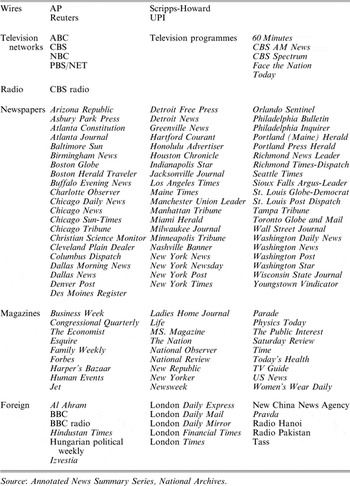
The first claim made by the White House involved the news summaries’ range of sources. As Table 1 shows, even a partial list of the media sources explicitly cited in the summaries from January 1972 reveals strong support for the assertion that they brought together a diverse selection of media in one central location.Footnote 29 Within the 26 pages that, on average, made up the news summary, the Allin/Buchanan team was able to condense a very large number of news stories from many different sources. Both print and broadcast media were represented, as were the major news wires. Though the bulk of the summary material was drawn from major news outlets, such as the AP and UPI wires, the three major television networks, the Washington newspapers, the New York Times, or magazines like Time, Newsweek, and U.S. News, the summary team clearly incorporated an additional, more diverse set of sources as well. From the Youngstown Vindicator to the Ladies Home Journal to Physics Today, non-traditional news outlets were regularly cited in the summary material.
Partial List of Cited Media Sources, January 1972

Source: Annotated News Summary Series, National Archives.
Local newspapers, such as the Arizona Republic, the Dallas Morning News, the Denver Post or the Seattle Times, also made occasional appearances in the summary. In the January sample, such sources were more likely to be included following important presidential events, such as the State of the Union address. Buchanan and the rest of the summary team used editorial comments from these local papers to highlight reactions from around the country. To the extent that a large selection of sources was also an important element in governing with the news and advancing a more organized public relations effort, the news summary clearly met its mandate. As Washington Post reporter Don Oberdorfer wrote, Nixon was ‘probably the most profusely informed executive in the country about what the press [was] saying.’Footnote 30
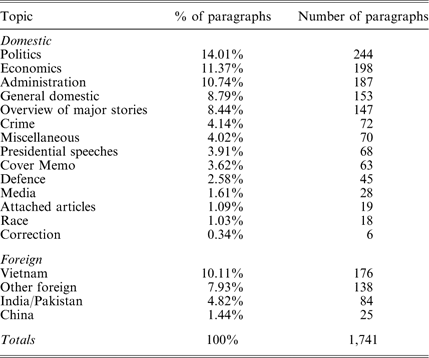
In addition to citing a large number of different news sources, the summaries dealt with a wide spectrum of news stories.Footnote 31 As Table 2 shows, the summary team did not focus exclusively on any one topic in their daily report, and they attempted to give the president a feel for the diversity of news stories being published or broadcast on any given day. Careful attention was given to both foreign and domestic stories, with foreign stories usually covered first in the summary report, followed by a slate of domestic items.
Topic Coverage, January 1972
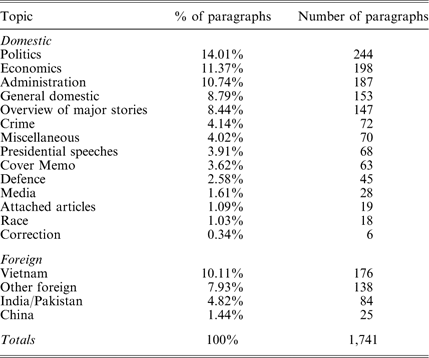
In terms of the number of paragraphs devoted to them, political stories, which most often dealt with rival candidates or other prominent political figures, made up the largest percentage of coverage, but a prominent role was also given to stories about economics, Vietnam and the administration.Footnote 32 The Administration topic listed in Table 2 includes stories about White House initiatives as well as any items dealing with Richard Nixon’s image or the image of other prominent administration figures. Stories about race received surprisingly little coverage in terms of the number of paragraphs devoted to them, especially given the fact that an important busing case was being decided in Richmond, Virginia, during January 1972. This is not to say that Buchanan and Allin ignored the busing issue, however. Frequently, the Richmond busing decision was included in the Overview of Major Stories, and they gave some attention to it in their cover memo. As we will see, Nixon did respond to race issues in his marginalia, though these usually came in reaction to the Buchanan and Allin cover memo, not to the details of the story in the main body of the summary.
Given the considerable attention devoted to stories about politics and about the effectiveness of the administration, Table 2 highlights the fact that the summaries aimed to help Nixon govern with the news by keeping tabs on what his administration was doing and how those actions were perceived by political elites, including media figures, and other political actors. In terms of the overall number of paragraphs written, Buchanan and Allin spent a significant amount of space recapping stories about the president’s image and his effectiveness as well as tracking rival political figures. In fact, the Politics and Administration categories comprise nearly a quarter of the total number of paragraphs written during January 1972. If stories about Vietnam, where the administration was deeply involved in both military actions and peace negotiations, are included, that number jumps to more than a third of the total coverage.
Objectivity, Framing And Journalistic Standards In The News Summary
Following from their assertions about the range of topics and sources contained in the summary, White House aides also claimed that the summaries could be an effective substitute for the direct consumption of the news. Implicit in this claim is the argument that the summaries were a reliable and objective account of media reporting. As one staffer insisted, ‘I have such faith in it, I’ve stored my television set in the basement to give us more room in the living room.’Footnote 33 In other words, there was a sense among White House staffers that Allin and Buchanan’s news summary team could be relied upon to represent the essence of news reports faithfully and thus eliminate the need for the president to read, view or listen to media reports directly.
Richard Nixon staked more than anyone on the reliability of the daily summary. Because he did not consume the news directly, his understanding of his efforts’ effectiveness was filtered through the medium of the news summary. His ability to perceive the success of his governing efforts accurately was thus directly tied to the reliability of the summary material. As Don Oberdorfer, one of the few reporters to see contemporary examples of the summaries during the Nixon administration, put it, these were ‘an optical lens and filter trained on that other filter that is the press’, and ‘the means by which the President obtains most of his impressions of the press’.Footnote 34 For that reason, Richard Tanner Johnson called the objectivity of the summaries the ‘linchpin’ in Nixon’s system of monitoring his own administration.Footnote 35
Even if the summary covered a great many sources, as I have shown above, we must go beyond understanding the sources and topics of the summary material to also get a feel for the tone and substantive content of the coverage. How are the summaries framed? From what perspective are they written? Do they give the president an accurate sense of media coverage and, thus, of the political landscape and the contours of public opinion? To answer these questions, I turn to a qualitative analysis of the summaries and a wider selection of summaries beyond those from January 1972.Footnote 36 I also make extensive use of H. R. Haldeman’s very thorough diary, which is available on CD-ROM and readily searchable, making it an extremely valuable resource. The Allin/Buchanan team worked under Haldeman’s direction, and he was deeply involved in helping shape the summary effort.
Despite the White House’s public pride in the daily summaries and their apparent importance to the president himself, a close review of their contents reveals that they were anything but dispassionate or objective, and they fell far short of a sophisticated, critical analysis of media messages. Allin and Buchanan frequently offered their own opinions and prejudices about various media outlets and political figures, fuelling the president’s already burning resentments and biases in the process. This tendency was especially pronounced in the cover memos that accompanied the summaries. A cover memo from 19 January 1972, for example, outlines the news summary team’s views on the media and Henry Kissinger: ‘Reasoner had an aBC [sic] commentary last night, hostile to Henry… There is a real possibility in this observers [sic] view that the Democrats and media may attempt to portray Henry as mysterious Svengali, appointee, who cannot be called to account, yet who pulls the foreign policy strings. While this case has not been made, there is a real chance that it could be done by media, with consequent problems with RN’s own natural constituency.’
The summaries themselves tended to personalize the news, repeatedly drawing attention to the perceived biases of prominent reporters. They also tended to be intensely ideological and partisan, depicting conservatives, Republicans, or other administration officials as beleaguered by Democrats (especially members of the Kennedy family) and other liberal forces. It is instructive that Nixon cabinet secretary Robert Finch, quoted in the epigraph to this article, described the summary as a ‘daily sheet where all the criticisms were’.Footnote 37 The ‘Weekend News Report’ of 24 January 1972, for example, highlights potential biases in a unique television format used by the Democrats to respond to the State of the Union address: ‘Stories note only 6 calls were taken – all partisan as were studio guests… Tribune with report of anger stirred in Chicago by the broadcast. Hundreds of complaints over bitter attacks on RN and fact that it was twice as long as his speech. Calls which were pro-RN were cut off. (Could it be that 99,994 of the 100,000 calls were pro-RN and the only 6 pro-Dem calls were the ones accepted?)’
The few Nixon-era accounts from non-West Wing sources who gained access to the summaries expressed worry that the president’s ‘window on the press’ was coloured in a variety of potentially worrisome ways. In his detailed, front-page analysis of one summary from April 1971, for example, the Washington Post’s Don Oberdorfer wrote that the ‘reporting on the reporting’ contained in the White House daily summary fell far short of accepted journalistic standards.Footnote 38 This tendency was especially pronounced, Oberdorfer found, in the cover memo written by Pat Buchanan. Describing the memo as ‘breezy’ and ‘abbreviated’, Oberdorfer wrote that a ‘we versus them’ psychology pervaded the writing. In the cover memo from 23 April, Buchanan highlights the comparative weight given by the television networks to stories that emphasized opposition to the war. The number of minutes devoted to coverage of John Kerry on the various networks is carefully monitored, and Buchanan draws a variety of conclusions about the tone of the media coverage. For example, he writes that ‘NBC did us no favors’ by emphasizing war protests and ignoring Herbert Rainwater’s criticisms of media coverage, while the Washington Post’s coverage of Nixon’s efforts towards China (written, ironically, by Oberdorfer himself) was handled in a ‘straight to favorable fashion’.Footnote 39
Compared to the cover memo, the rest of the summary was, on Oberdorfer’s assessment, ‘more objective and more detailed’.Footnote 40 Still, Oberdorfer catalogued a number of omissions, misrepresentations, biases, errors of fact and other problems with the summary document. First, he highlighted a troubling tendency to attribute strong political statements to reporters or news anchors, when in fact the statements were quotations from other political actors. The summary from 23 April, for example, represented CBS News Commentator Eric Sevareid as offering a harsh assessment of the FBI when the criticisms actually came from House Majority Leader Hale Boggs, whom Sevareid quoted as part of his story. In addition, key quotations from television reports were left out of the summary, including three direct challenges to the president from anti-war protesters – one from John Kerry, one from the Communist delegation to the Paris talks, and one from a delegate to the White House Conference on Youth. These omissions muted the force of the criticism towards the White House contained in the media reports – an example of White House gate-keeping that protected Nixon from unwelcome information and may also have caused Nixon to miss opportunities to respond. Finally, Oberdorfer writes that the summary writers made several simple errors of fact. In one case, William Sullivan, former ambassador to Laos, was quoted as testifying before a Senate subcommittee that only 20,000 Laotian refugees had been driven from their homes by the North Vietnamese, when in fact Sullivan had testified that all but 20,000 of 700,000 refugees had been forced out by North Vietnamese forces. In another case, the summary writers wrongly asserted that Britain and France had decided to go ahead with full production of the Concorde airplane, when in fact, they had decided to postpone the production decision.Footnote 41
As the Oberdorfer article highlights, one of the most persistent themes in Buchanan and Allin’s work was the perceived unfairness of media stories about the administration. In almost every summary I read in the ANS collection, charges of media bias permeated both the content and the tone of the writing. In September 1969, for example, Allin and Buchanan described an NBC News report with the following introduction: ‘Chancellor obviously was determined to do a hatchet job’, and this sort of attribution is typical of almost every summary I have studied.Footnote 42 Ambrose uncovered similar sentiments: ‘Reading the summaries with whatever objectivity twenty years can bring, one is struck by the antipathy felt by Allin and Buchanan toward virtually all the big names in television broadcasting, but most especially Dan Rather and Walter Cronkite of CBS News. They fed Nixon’s idée fixe that the television newsmen, like the newspaper reporters, were all his bitter enemies, men who hated him and would do anything to hurt him’.Footnote 43 As a result, the summaries offered a seriously skewed view of the world – one in which every news report is filtered through the bunker ‘us versus them’ mentality of the summary writers. It is instructive, then, that Buchanan’s files at the National Archives include memos containing long lists of ‘media opponents’ – reporters who, in the minds of the summary team, were ‘almost always hostile’ to the president.Footnote 44 Instead of helping the president see outside the White House bubble, the tone and framing of the summaries ensured that every piece of information available through the news media was filtered through the perspectives of summary writers.
Priming And Private White House Worries As Revealed In The Haldeman Diaries
Privately, Nixon staffers – and sometimes even Nixon himself – worried about the tone and framing of the material produced by Allin and Buchanan. Such worries contrasted sharply with the public confidence the administration professed. As a resource for uncovering these concerns, H. R. Haldeman’s daily diaries are unmatched. As Nixon’s designated gatekeeper, Haldeman had more access than anyone, and he was involved in nearly every White House decision. The diaries contain regular references to the news summaries as well as Nixon’s reactions to them. Thus, they open up new insights into the institutional role of the summaries in the Nixon White House as well as the publicly concealed worries of West Wing staffers about their impact on the presidency.
From the first year of his presidency on, Nixon made the news summary a frequent topic of conversation with Haldeman, with the president regularly reconsidering every aspect of the news summary effort. He mused about whether he should read the entire packet of material or have some sent directly to the staff without his comments. He discussed which newspapers and magazines should be included and which excluded, and he repeatedly approached Haldeman with ideas for changes in the summary’s format.Footnote 45 As late as February 1973, Nixon was still tinkering, wondering about whether they should ‘separate the opinion section from the news section’.
Haldeman’s diary entries reveal a Nixon who could step back to think critically about both the style and content of Allin and Buchanan’s work. At several points in his presidency, Nixon worried openly about the tone of the summaries.Footnote 46 He talked frequently of the need to ‘emphasize the positive, rather than drawing so much on negative things’.Footnote 47 During his groundbreaking trip to China, for example, Nixon became very concerned about how Buchanan’s unenthusiastic response to the visit was colouring his approach to the news summaries. Initial press reports had been quite positive, a fact that had pleased the president enormously, but by the end of the trip, the news summaries were taking on a decidedly negative tone. Haldeman records the president emphasizing that ‘we’ve got to work on the news summary people to make sure they cover positive stuff, so we don’t get the staff depressed.’Footnote 48 The day after the China trip, Nixon met with Haldeman again about avoiding the summaries in an effort to avoid falling into depression. In his diary, Haldeman records: ‘He wants to hold off on the news summary and criticism, keep the P in somewhat different position. He needs to stay in a positive, radiant mood, and also he want to get the staff away from feeling that they have to criticize, because they’ll then think negatively. Instead, they should look at the positives.’Footnote 49
What applied to the staff applied to Nixon as well. He was bothered by the criticisms he read in the summaries, and his displeasure was increased by Buchanan’s low level of enthusiasm for the China trip. Nixon worried that reading the summaries would send him into bouts of depression and negative thinking, and he openly wondered whether he should stay away from them. Reading the summary, he knew, would likely dampen the ‘positive radiant mood’ he sought at the conclusion of the China trip. These concerns continued for at least a week, with Haldeman recording on 5 March and again on 7 March that Nixon wanted Buchanan off the news summary team because of his ‘excess negativism’.Footnote 50
Political scientists interested in the effects of the media on the public have coined the term ‘priming’ to describe how media emphasis on certain stories can be a ‘powerful force determining what springs to the citizen’s mind and what does not’, thus setting ‘the terms by which political judgments are rendered and political choices are made.’Footnote 51 Haldeman’s reports make clear that Nixon recognized such priming effects in himself; he knew the summaries could provoke strong reactions. White House staffers also worried about how agitated Nixon became while reading the summaries, and they shared those worries with Haldeman. After a long September day in 1969 when both the president and Haldeman spent much of their time in heated meetings about the administration’s public relations’ efforts, the chief of staff made one of his most insightful comments about the president’s relationship to the news summaries: ‘Some concern of all I met with about the news summary, which is what gets him going to begin with. It clearly does present all the bad stuff and is the basis of his reactions.’Footnote 52 Though Haldeman felt that some portions of the summary were ‘pretty objective’,Footnote 53 he and the other members of the senior White House staff recognized that the summaries provoked Nixon’s anxieties and caused him to lash out at them. The summaries primed the president in worrisome ways. In their view, the daily news analysis ‘gets him going to begin with’ and is ‘the basis of his reactions’.
A close examination of every Haldeman diary entry that mentions the news summaries underscores this point even more emphatically. When Nixon’s reactions to the summaries are described, it is almost always in negative terms. Words and phrases like ‘upset’, ‘got him started’, ‘preoccupied’, ‘anxious’, ‘concerned’, ‘strange mood’, and ‘negative’ are employed to portray the president’s disposition after reading the summaries. Positive reactions are mentioned only three times, and the most descriptive of those involves Nixon chortling about a piece that seemed to confirm some of his negative attitudes about the press. Historians who have researched aspects of the summaries have come away with similar impressions. Ambrose notes, for example, the prevalence of violent verbs in Nixon’s responses: ‘Get someone to hit him,’ Nixon would write about one reporter, or ‘fire him’, or ‘cut him’, or ‘freeze him’, or ‘knock this down’, or ‘fight him’, or ‘dump him’, or ‘don’t back off’.Footnote 54 For Ambrose, the marginalia revealed Nixon at his most spontaneous, instinctive and impulsive.
Nixon’s responses frequently focused on how the administration could ‘raise hell’ with offending media outlets or freeze out others altogether. Similarly, Nixon frequently made notes about mistakes within the administration, often including extreme and hasty comments about how particular individuals should be fired or agencies eliminated or funding cut off or White House staffers should be disciplined for leaks. Most of the time, senior staffers who received such instructions prudently took no action, but the marginalia make clear that Nixon was often agitated by what he read. The president’s response to a Newsweek story from June 1969 is typical: ‘Newsweek is loaded against us. Cut them like we cut Times. Play Time and U.S. News’.Footnote 55 A month earlier, Nixon had issued instructions about which newspapers to exclude: ‘H – I have told Zigler [sic] not to have our people talk to Post Dispatch, N. Y. Times & Wash. Post. Knock it off!’Footnote 56 Nixon repeatedly expressed his anger and frustrations about the political motivations and biases he perceived in news and polling organizations.
The president also seemed to be upset by stories mentioning ‘White House sources’ or ‘White House staffers’. A June 1969 annotation in response to a story that included information from anonymous ‘White House staffers’ is typical: ‘K & H again – The Damned “White House Staffers.” Can’t we get all of them to shut up. I think a hard talk is urgent – spell it out.’Footnote 57 Again in October, Nixon scribbled, ‘We have to muzzle the dopes’, in response to another article citing an unnamed White House aide.Footnote 58
Minding The Marginalia: Nixon’s Responses To The Daily News Summary
Previous work on Nixon’s personality would lead us to expect that the summaries might be a source of unusual provocation for Nixon. The political science, psychological and biographical research devoted to understanding Nixon’s personality is, of course, vast and need not be exhaustively reviewed here,Footnote 59 but several observers have described Nixon’s unusual combination of intense interest in analysing public relations efforts and strong negative reactions to media criticism. Rowland Evans and Robert Novak commented, for example, that when it came to his attitudes to the media, Nixon possessed a curious combination of detached ‘journalistic voyeurism in observing’ and angry, personal ‘anguish’ that accompanied any critical stories of him or his administration.Footnote 60
Jeb Magruder, who was deeply involved in public relations efforts at the Nixon White House, opined that the president had a ‘split personality’ regarding the press:
On the one hand [Nixon] was the extremely astute student of media politics, one with a legitimate interest in presenting himself and his policies in ways that would strengthen his leadership. On the other hand [he] was a politician who was absolutely paranoid about criticism, who took it all personally, and whose instinct was to lash back at his critics in ways that usually did more harm than good.Footnote 61
Similarly, William Safire wrote that Nixon could be ‘his own backseat driver’ when it came to the news media, an ‘observer-participant’ capable of insightful analysis of media image-making and able to provide a running editorial commentary of applause or criticism of his actions.Footnote 62 At the same time, however, he believed the press to be his political enemy, and his reactions to media criticism also tended to be deeply adversarial and angry. As Alexander Butterfield commented, ‘I don’t think people understood how deep these resentments were. He hated with a passion, and I don’t think anyone has quite captured it yet’.Footnote 63
Such impressionistic accounts are helpful and insightful, but the existence of the ANS series at the National Archives also allows researchers to test more systematically. To that end, I return to my sample of summaries from January 1972. In addition to coding the topics covered in the summaries themselves, I also coded every Nixon marginal note written during this period, categorizing them according to the function they served. With this content analysis of both the news summaries and the responses, I am able to examine the patterns of Nixon’s marginalia more systematically in order to uncover a more complete picture of the institutional roles the summaries served.
The analysis shows, first, that Nixon’s marginal responses to the news summary generated a significant number of memoranda and other action items. It is not clear what portion of Nixon’s memos came from the summaries, as opposed to other sources, but my sample from January 1972 contains approximately 119 marginal comments, of which at least 105 are addressed to some staff member. In almost every case, these marginal comments were sent out in the form of memoranda. The count of 105 is probably an extremely conservative estimate of the total number of memoranda generated because additional staff members were frequently copied on these messages, depending on their subject matter. Just one marginal comment thus had the potential of generating memos to three or four staff members. John Ehrlichman remembered that he spent a portion of every day responding to the memos generated from the news summary.Footnote 64 During Nixon’s first year in office alone, the president’s news summary marginalia resulted in over 300 memos to Haldeman,Footnote 65 and his diary records that he felt stress about the number of memos that emerged from the marginalia.Footnote 66
In the January sample, Nixon’s responses were directly addressed to an exceptionally small number of aides. More than 42 per cent of the marginal comments were sent to Haldeman, so it is little wonder he felt burdened at times by responding to the summaries. Another 15 per cent of the marginalia were directed towards Henry Kissinger and Charles Colson, respectively. Kissinger received almost every response regarding foreign affairs, and Colson tended to receive instructions about dealing with reporters or other aspects of the public relations effort. All told, nearly 75 per cent of Nixon’s responses were directed towards only three senior White House staff members. Perhaps surprisingly, Nixon addressed only about 5 per cent of his marginal comments to John Ehrlichman. An additional 10 per cent were scattered among a few other recipients, and a final 10 per cent were not addressed to anyone. These numbers support Johnson’s description of Nixon’s formalistic White House, which stressed written communication and in which only a few top aides enjoyed regular, direct access to the president.Footnote 67
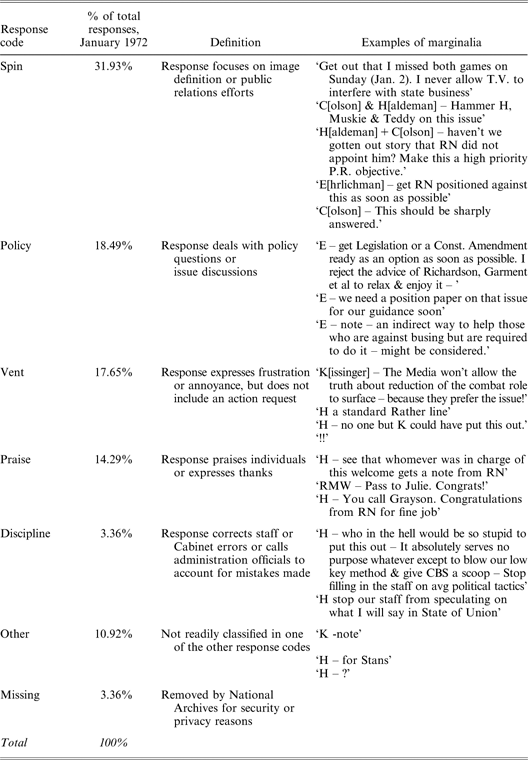
As instructive as the breakdown by recipient is an analysis of the marginalia by substantive content. To that end, I coded each of Nixon’s responses into one of six distinct categories – spin, policy, vent, praise, discipline, and other. Table 3 presents definitions and examples for each response category as well as a frequency distribution of the coded responses. The ‘spin’ category includes all marginalia in which Nixon writes about image definition or public relations efforts. Marginal notes were coded as ‘policy’ if they dealt with policy questions or issue discussions. Nixon sometimes responded to the news summary by writing about his issue preferences or asking his aides to pursue answers to policy questions. The ‘vent’ category describes responses in which the president expresses anger, frustration, annoyance or some other negative emotion without making any specific action requests. In these marginal notes, the president seems to be ‘blowing off steam’, and the Nixon personality literature leads us to believe that notes of this category would be a common Nixon reaction to the news.Footnote 68 ‘Praise’ includes the president’s congratulations for good work or thanks for support. ‘Discipline’ involves responses in which Nixon corrects staff errors or calls administration officials to account for mistakes made. Any responses that did not readily fit into these categories were classified as ‘other’.
Response Codes for Nixon Marginalia
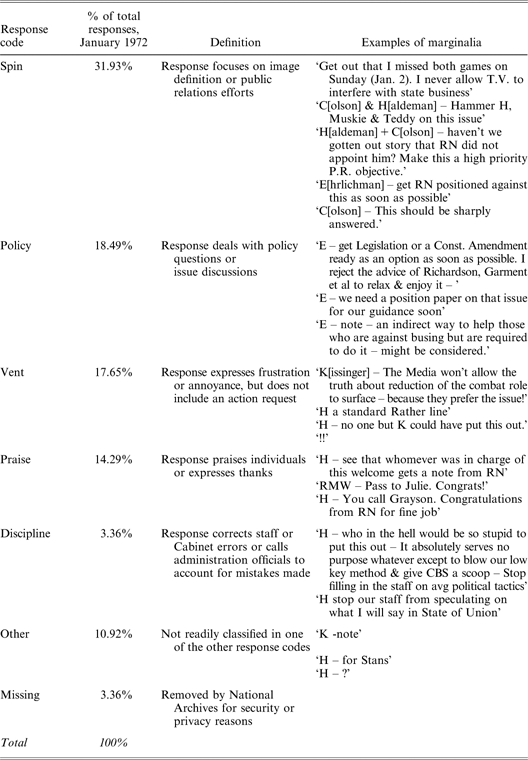
As Table 3 shows, nearly a third of Nixon’s marginal notes dealt with the administration’s public relations or ‘spin’ efforts. These responses indicate that Nixon was thinking hard about how to shape the White House message and improve his personal image as he read the summaries. In other words, Nixon used the news summary as a tool to help him mould messages that would be more appealing to both the public at large and other political elites, and he gave special attention to the need to answer the public relations efforts of his opponents (for example, in response to a story about Hubert Humphrey’s contention that the country would be out of Vietnam if he had been elected, Nixon instructs his staff to ‘Hammer H, Muskie & Teddy on this issue’).Footnote 69 In that sense, Nixon used the summaries as a way of governing with the news. Table 3 uncovers another sense in which the summaries allowed Nixon to govern with the news as well – by provoking policy discussions and questions between him and his top aides. Nearly 19 per cent of Nixon’s responses – the second-largest category by percentage – can be classified as policy-based notes. These responses do not focus directly on image-building or White House messages; rather, they are internal exchanges about substantive policy issues, such as the president’s instruction to Ehrlichman in mid-January of 1972 to prepare ‘a position paper’ on the issue of low-cost housing ‘for our own guidance soon’.Footnote 70
Just as the personality literature pointed towards a Nixon who could simultaneously analyse and allow himself to be provoked by the news, Table 3 shows that the range of Nixon responses to the news summaries included a significant amount of venting in addition to image analysis and policy talk. Close to 18 per cent of the January 1972 responses were classified as venting. Here, Nixon is not engaging in any substantive dialogue about issues or asking for any specific actions to be performed. Rather, he simply expresses frustration, annoyance or anger. Though it sometimes targets other political actors as well, most often, this venting focuses on the media. Next to a description of a Time magazine story about the continued presence of troops in Vietnam, for example, Nixon scrawled, ‘The Media won’t allow the truth about reduction of the combat role to surface – because they prefer the issue!’Footnote 71
The univariate statistics for two response categories were somewhat unexpected. First, Nixon does relatively little disciplining of staff members in his responses. When he does, the marginal notes are thundering and memorable (for example, ‘who in the hell would be so stupid as to put this out’), but overall, they make up a relatively small percentage of the total responses. Conversely, Nixon also shows that he can be quite generous in his responses to the news. When administration officials, friends, family members or other political supporters take actions he thinks are positive, he does not hesitate to send thank-you notes or respond with praise.Footnote 72 In fact, just over 14 per cent of the responses in my sample involved praise or thanks of one sort or another. All told, he praises his friends nearly as often as he vents about the news or his political opponents.
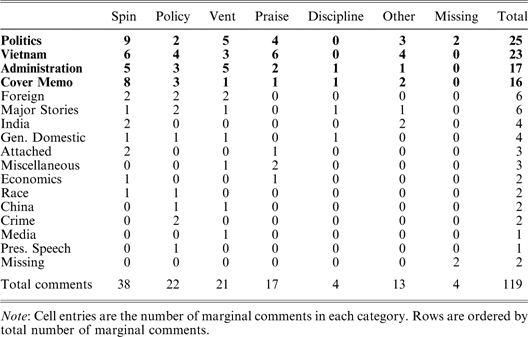
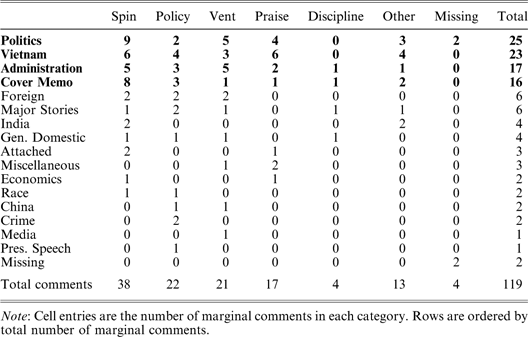
Moving beyond the simple frequency distribution of the content analysis, it is also possible to look for additional patterns in Nixon’s marginalia by exploring the relationship between the response codes and the news summary topics. Table 4 presents a basic interaction of these two variables, with rows showing the breakdown by topic and columns organizing the comments by response category. Each cell thus contains a count of marginal comments by topic and response category. Several patterns emerge. First, Nixon responds most frequently to stories included in the Buchanan/Allin cover memo and stories classified as dealing with politics, the administration or Vietnam. Together, these four categories – the first four rows of the table – account for nearly 70 per cent of Nixon’s comments. Notably, these are also the most overtly political categories in the news summary, and my impression from the qualitative analysis is that they were the portions of the summaries most likely to be framed by Allin and Buchanan in ways that emphasized strong ideological, partisan or press biases.Footnote 73
Response Codes vs. Topic Codes, January 1972
Note: Cell entries are the number of marginal comments in each category. Rows are ordered by total number of marginal comments.
And how can Nixon’s marginal comments about these issues best be characterized? Table 4 shows that when Nixon responds to the cover memo and to the politics or administration sections of the summary, he is most likely to engage in spinning or venting. Of the fifty-eight comments dedicated to these three topics, approximately 57 per cent (or thirty-three comments) are classified as spinning or venting. In these areas, Nixon’s ability to function as his own ‘back-seat driver’, as Safire put it, is most clear: he is deeply committed to steering his administration’s public relations efforts, he is fully engaged in crafting political responses to the news he receives, and he erupts in frustration when his political machinations are opposed or thrown off track. Policy-based notes are not absent from his responses to the cover memo or coverage of politics and the administration, but they seem to be somewhat less frequent, comprising only 14 per cent of his comments on these issues.
Nixon’s responses to the topic of Vietnam are far less easy to characterize. Of the twenty-three marginal responses to this topic, 23 per cent (six comments) are categorized as spin, another 23 per cent (six comments) are praise, 17 per cent (four comments) discuss policy, and 13 per cent (three comments) involve venting. While Nixon writes a large number of marginalia in reaction to news about Indochina, those responses are spread fairly evenly across the categories – some spinning, some policy discussion, some praising and a lesser amount of venting. In contrast to his discussions of politics or the administration, which are dominated by public relations considerations or expressions of emotion, Nixon responds to news about Vietnam with a mixture of praise for work well done and policy ideas in addition to the other sorts of responses.
Other topics receive very little comment from the president. As Table 4 shows, news items dealing with economics, the media, China, crime, presidential speeches and race all provoked relatively small numbers of marginal comments. Nixon focused nearly all of his attention – at least in terms of the raw number of comments made – on the cover memo, politics, the administration and Vietnam. Of course, these four topics were also summary categories with the largest number of paragraphs, representing more than 45 per cent of all paragraphs coded in the January 1972 sample. Indeed, the number of Nixon responses is strongly positively correlated with the number of paragraphs contained in the summary (r = 0.4627).
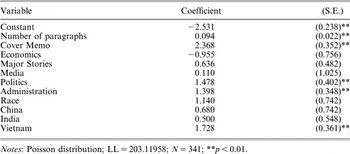
In an effort to control for the size (that is, number of paragraphs) of the topic categories, I also ran an event count model of the number of Nixon responses. The results are displayed in Table 5, and they show that Nixon is more likely to write marginal comments in response to the cover memo, politics, administration and Vietnam topics, even controlling for the number of paragraphs devoted to the topic.Footnote 74 No other category rises to the level of statistical significance, though the race topic comes closest (p = 0.12).Footnote 75 These results should be treated with considerable statistical care, but they do point to the same empirical patterns we have been seeing in the analyses to this point. That is, Nixon was far more likely to respond with marginal comments to political news stories, particularly those that highlighted the actions of his administration, including in Vietnam, or the actions of rival political figures.
Event Count Model

Notes: Poisson distribution; LL = 203.11958; N = 341; **p < 0.01.
The Use And Abuse Of Presidential News Summaries
What do we learn from Richard Nixon’s use of news summaries, and what are the larger implications of the Nixon experience for understanding presidents’ consumption of the mass media? The existence of such an elaborate White House media monitoring effort is evidence of Nixon’s awareness of the power of information and the need to attend carefully to what appeared in the news media. The summaries were exceptionally successful in sampling from a wide variety of news sources and, from that perspective, could plausibly claim to be a solution to what Neustadt called the president’s information problem.
When it comes to the assertion that the summaries were an effective substitute for first-hand news consumption, however, the evidence is far less convincing. Allin and Buchanan wrote the summaries from a definitely partisan perspective and framed their work in ways that emphasized the perceived biases of individual reporters. The news summary effort does not eliminate framing or priming; rather, it tends to shift framing and priming from the news media to the White House. Because he relied almost exclusively on the summary, Nixon’s ability to see clearly the political world around him depended upon the accuracy of the written materials submitted to him by those who controlled access. In other words, the priming effects of the summary writers become just as important as – perhaps even more important than – priming from reporters and editors in the news media. Thus, while the summary effort may have allowed the president to avoid an overwhelming flood of media messages, it did so in a way that raises troubling questions about objectivity and, thus, about the president’s ability to accurately test reality. Such concerns are especially worrisome in the case of Nixon, given the already simmering anger he harboured towards the press.
If the summaries could not accurately represent the press or open up reliable views of the political landscape, their ability to be effective instruments for governing with the news or serving any of the other functions the White House intended is severely undercut, especially if the summaries were the president’s primary source for media consumption. Though Nixon occasionally chafed at Buchanan’s ‘negativism’, he never abandoned the notion that the summaries were essentially a reliable tool for testing reality, managing his public relations efforts and governing. A systematic study of Nixon’s responses shows that he used the summaries to help shape his image, create policy, praise the positive efforts of aides and supporters and even occasionally discipline staff members. The daily news summary thus played an important role in Nixon’s management of his advisory system, generating a large number of memoranda and functioning as a significant catalyst for daily White House business. The shortcomings of the summaries raise questions, though, about whether alternative systems of media monitoring would have been more effective and reliable.
Privately, staffers worried about the many potentially negative reactions the summaries seemed to provoke. Content analysis of Nixon’s responses reveals that those worries were not without cause: a significant percentage of Nixon’s marginalia could be described as venting – expressing frustration or annoyance or other negative reactions – though praise was nearly as frequent a response, too. These findings have important implications for our understanding of the interaction between personality and advisory system. According to Alexander George, elements of a president’s personality, including cognitive style, sense of efficacy and orientation towards conflict ‘combine to determine how a new president will structure the policymaking system around him and how he will define his own role and that of others in it’.Footnote 76 In other words, we should be sensitive to the ‘fit’ (or lack thereof) between personality and advisory system.Footnote 77 The advisory system a president establishes around himself is a critical, if self-created, environmental stimulus. The needs of Nixon’s personality helped dictate his choice of a formalistic advisory system that included a prominent role for a daily news summary written by advisers who shared his sense of media bias.
In that sense, the summaries were an element of his leadership style that ‘fit’ his desire to respond to the press and direct many aspects of his presidency on his own terms – in writing, alone, in the privacy of his office. He used the summaries to issue terse, peremptory directives to a handful of senior staff. At the same time, though, the summaries were the kindling that could fire the more negative aspects of Nixon’s personality. From that perspective, they were an extremely poor fit with his personality. Instead of countering his destructive tendencies, the summaries consistently reinforced already existing resentments. When summary writers working out of the West Wing know of such pre-existing tendencies and resentments, the temptation to write in a way that reinforces or underscores the president’s pre-existing attitudes may be great.
Ultimately, the existence of the summaries as a political science resource leads us beyond the Nixon experience to the question of what the summaries teach us about presidents as consumers of the news media. And that question leads to a more difficult, normative query: what should presidents get from the mass media? While Nixon’s visceral antipathy towards the press may have been unique, he was not the only president to generate a news summary. As the number and platforms of news outlets grows and the news cycle shrinks, such summary efforts may be the only way to avoid a flood tide of news stories that would, as Neustadt predicted, swamp any chief executive. Thus, news monitoring efforts should not be seen as inherently problematic, but they should be undertaken only with considerable sensitivity to the chief executive’s predispositions towards the media and a strong commitment to avoid simply echoing his (or his staff’s) prior attitudes and biases. Tensions between the need to overcome the sheer volume of media messages present in the electronic age, on the one hand, and the tendency for White House summary writers to frame the news in ways that are tailored to the occupant of the Oval Office, on the other, will almost always be present. The weaknesses of the Nixon summaries can thus serve as cautionary tales for future White Houses seeking to design effective news monitoring systems.
Paradoxically, the flawed news summaries of the Nixon presidency point to the possibility of constructive use of news summaries by future presidents – balanced, professionally prepared news summaries, complemented by selective consumption of the media itself. Instead of reinforcing West Wing perspectives that make effective reality testing more difficult, summaries could be used to help the president see beyond what is sometimes called the White House ‘bubble’. Summary efforts should provoke concern if they are used as a method for filtering not only the volume of media messages, but also their tone and content. As the Nixon experience showed, editorial comments about specific stories or reporters can be particularly problematic when presidents do not see media stories first hand. Critical responses to the media, such as those found in Allin and Buchanan’s cover memos and commentaries, may be an important part of any White House communication strategy, but they should not be indistinguishable from the stories themselves. Blurring the line between the news media and White House reactions to it must be avoided, though, because it will be likely to prime the president’s responses to the news in ways that ultimately make both governing and communications efforts more difficult.
At the same time, engaging in some regular, direct consumption of the news media offers singular advantages for a president. Effectively governing with the news means getting an accurate feel for the news and information climate. Though the prospect of being swamped by the sheer volume of stories persists, the best avenue for understanding both the tone and the content of news coverage may be for a president to read or view first hand at least some of what reporters are writing or saying. This allows the president to avoid both the factual errors sometimes found in the Nixon summaries as well as to avoid the filtering and priming that was all too common in what Allin and Buchanan wrote. Similarly, watching the visual images contained in a news broadcast may also be more informative – and more memorable – than a description of those images produced in the White House. If the goal is to see clearly outside the White House bubble, reading what those outside the bubble have written – at least occasionally – may be far preferable to passing the news through the filter of White House summary writers.
For healthy presidential leadership, there may be no substitute for first-hand consumption of media stories, even if in managed doses. It can be said of presidential news summaries what is sometimes said of the relative merit of vitamin pills and nutritious foods: in a busy world, a chief executive may find it useful to resort to news summaries, but news capsules provided by a president’s aides are an imperfect replacement for at least some exposure to the real thing. The president whose media diet includes only summaries may be cognitively undernourished.